
Timecode Enhancements for Space Wire Barry M Cook

Time-code Enhancements for Space. Wire Barry M Cook Presented by Paul Walker Both of 4 Links 2006 MAPLD International Conference Washington, D. C. September 25, 2006 MAPLD International Conference 1 Space. Wire 101 Seminar
Introduction • Time codes can be inserted into a Space. Wire data stream 2006 MAPLD International Conference 2 Space. Wire 101 Seminar
Introduction • Time codes can be inserted into a Space. Wire data stream • but there is some uncertainty in their time of arrival – jitter – of some 10 bit times per link 2006 MAPLD International Conference 3 Space. Wire 101 Seminar
Introduction • Time codes can be inserted into a Space. Wire data stream • but there is some uncertainty in their time of arrival – jitter – of some 10 bit times per link – 1µs per link at 10 Mb/s – 100 ns per link at 100 Mb/s 2006 MAPLD International Conference 4 Space. Wire 101 Seminar
Introduction • Time codes can be inserted into a Space. Wire data stream • but there is some uncertainty in their time of arrival – jitter – of some 10 bit times per link – 1µs per link at 10 Mb/s – 100 ns per link at 100 Mb/s • We show this can be reduced to 10 ns (or better) per link. 2006 MAPLD International Conference 5 Space. Wire 101 Seminar
Content • • Space. Wire links, tokens and time-codes The causes of jitter Experimental verification of jitter Reducing jitter Experimental verification of improvement Removing delay differences Limitations Conclusions 2006 MAPLD International Conference 6 Space. Wire 101 Seminar
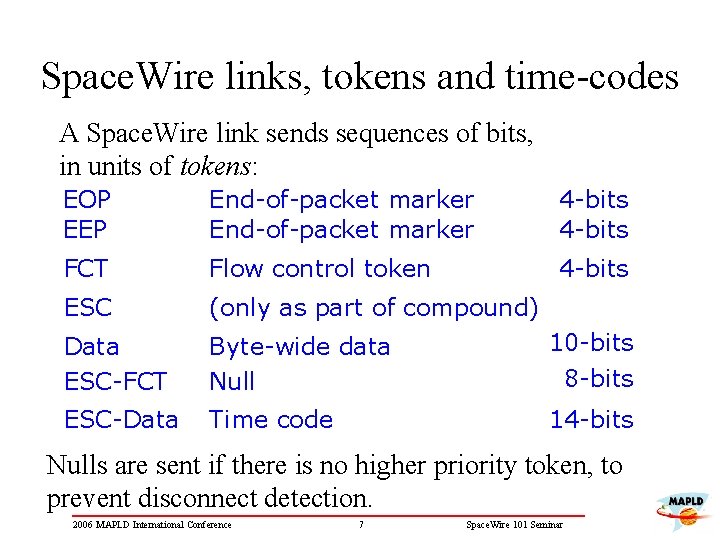
Space. Wire links, tokens and time-codes A Space. Wire link sends sequences of bits, in units of tokens: EOP EEP End-of-packet marker 4 -bits FCT Flow control token 4 -bits ESC (only as part of compound) Data ESC-FCT Byte-wide data Null 10 -bits 8 -bits ESC-Data Time code 14 -bits Nulls are sent if there is no higher priority token, to prevent disconnect detection. 2006 MAPLD International Conference 7 Space. Wire 101 Seminar
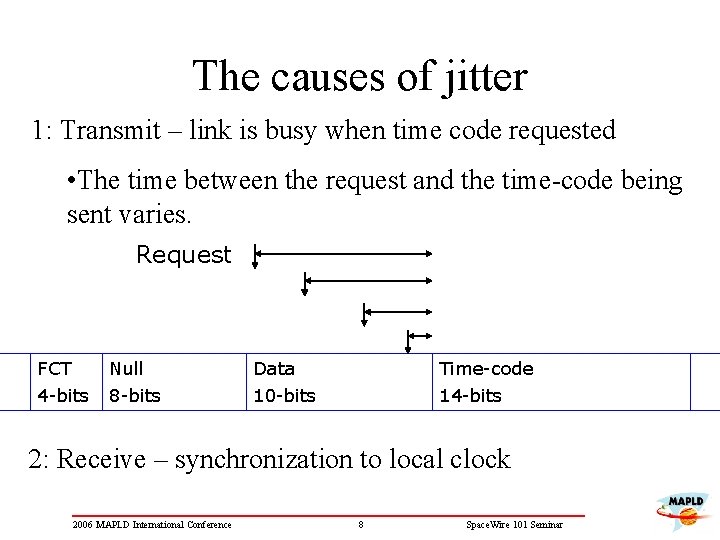
The causes of jitter 1: Transmit – link is busy when time code requested • The time between the request and the time-code being sent varies. Request FCT Null Data Time-code 4 -bits 8 -bits 10 -bits 14 -bits 2: Receive – synchronization to local clock 2006 MAPLD International Conference 8 Space. Wire 101 Seminar
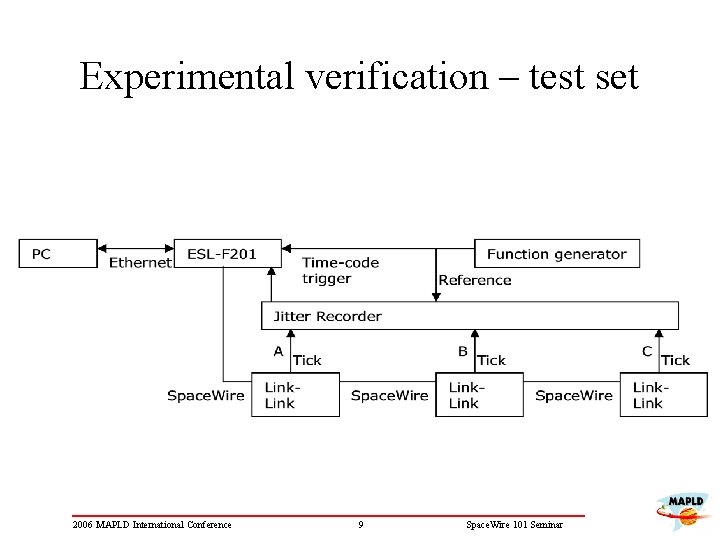
Experimental verification – test set 2006 MAPLD International Conference 9 Space. Wire 101 Seminar
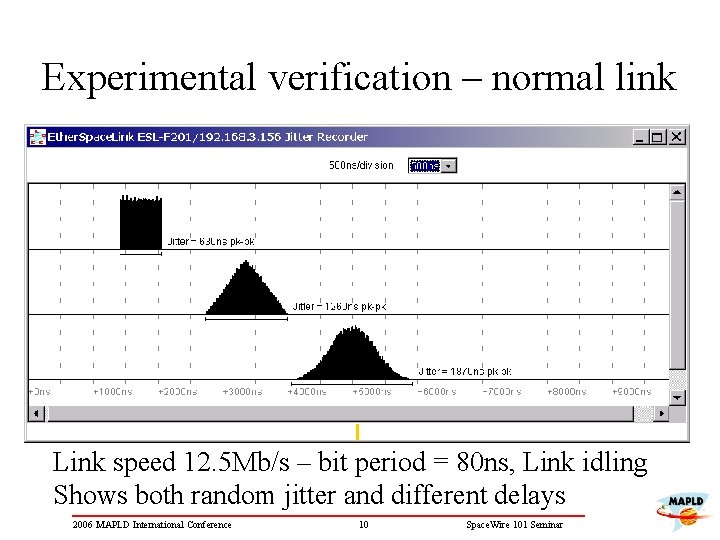
Experimental verification – normal link Link speed 12. 5 Mb/s – bit period = 80 ns, Link idling Shows both random jitter and different delays 2006 MAPLD International Conference 10 Space. Wire 101 Seminar
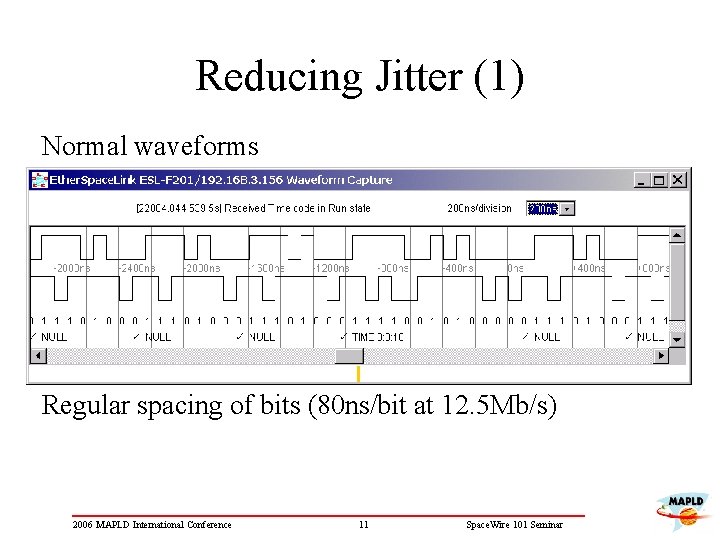
Reducing Jitter (1) Normal waveforms Regular spacing of bits (80 ns/bit at 12. 5 Mb/s) 2006 MAPLD International Conference 11 Space. Wire 101 Seminar
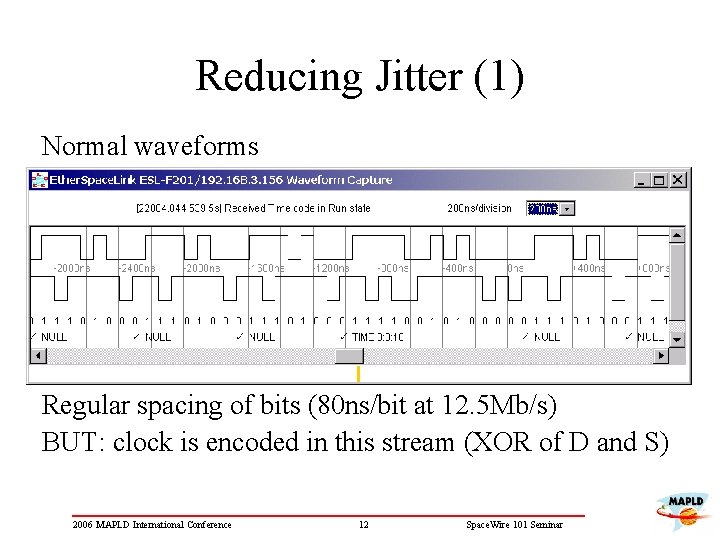
Reducing Jitter (1) Normal waveforms Regular spacing of bits (80 ns/bit at 12. 5 Mb/s) BUT: clock is encoded in this stream (XOR of D and S) 2006 MAPLD International Conference 12 Space. Wire 101 Seminar
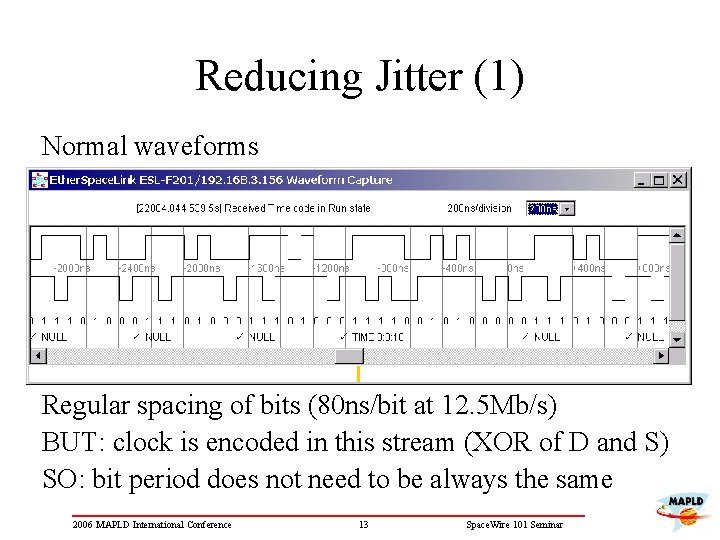
Reducing Jitter (1) Normal waveforms Regular spacing of bits (80 ns/bit at 12. 5 Mb/s) BUT: clock is encoded in this stream (XOR of D and S) SO: bit period does not need to be always the same 2006 MAPLD International Conference 13 Space. Wire 101 Seminar
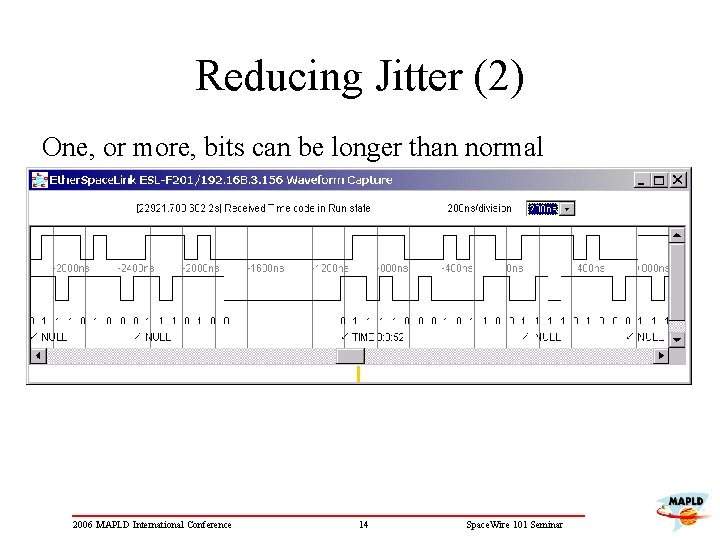
Reducing Jitter (2) One, or more, bits can be longer than normal 2006 MAPLD International Conference 14 Space. Wire 101 Seminar
Reducing Jitter (3) Fix the time between request and time code transmission (to >10 -bits) 2006 MAPLD International Conference 15 Space. Wire 101 Seminar
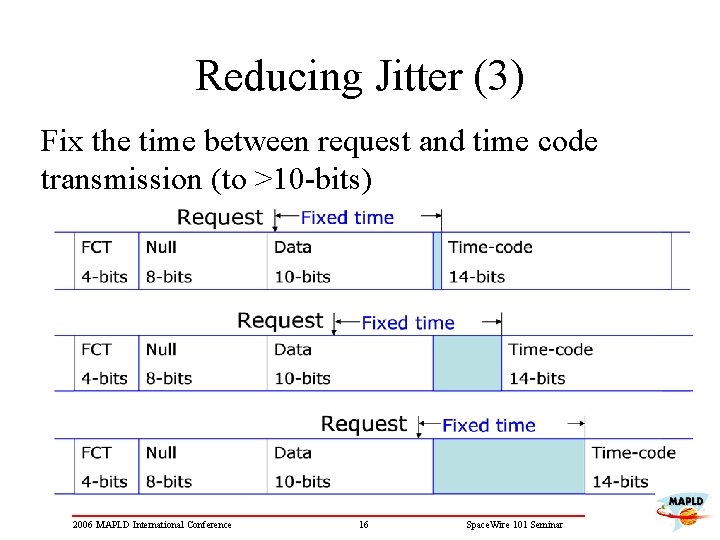
Reducing Jitter (3) Fix the time between request and time code transmission (to >10 -bits) 2006 MAPLD International Conference 16 Space. Wire 101 Seminar
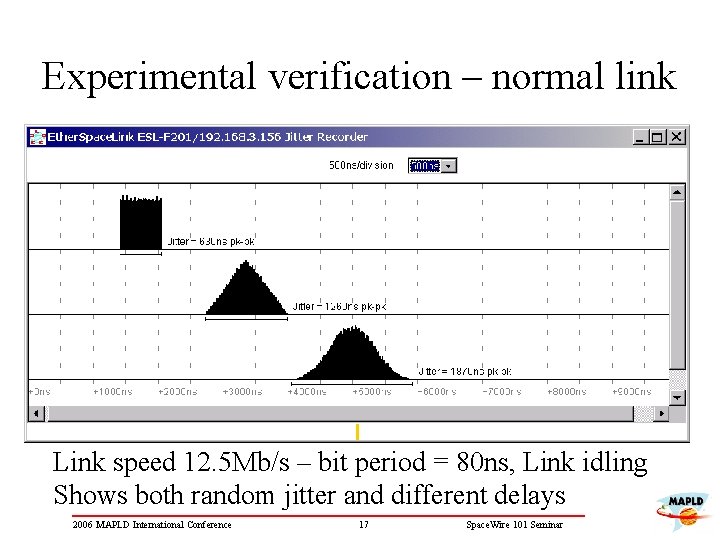
Experimental verification – normal link Link speed 12. 5 Mb/s – bit period = 80 ns, Link idling Shows both random jitter and different delays 2006 MAPLD International Conference 17 Space. Wire 101 Seminar
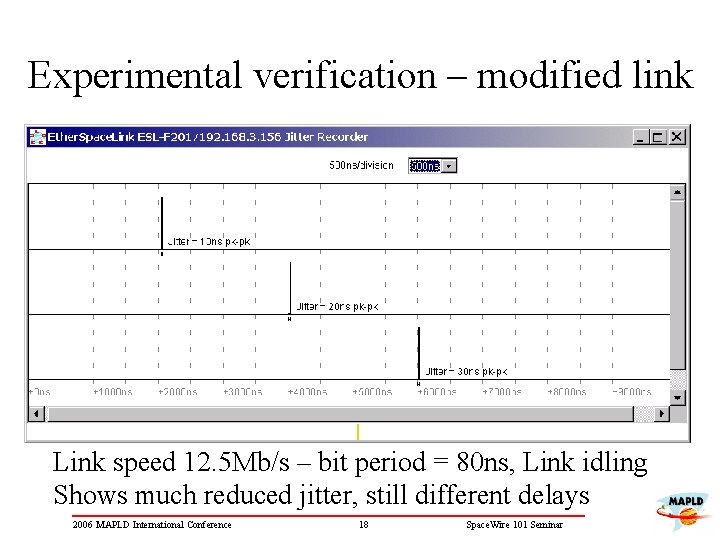
Experimental verification – modified link Link speed 12. 5 Mb/s – bit period = 80 ns, Link idling Shows much reduced jitter, still different delays 2006 MAPLD International Conference 18 Space. Wire 101 Seminar
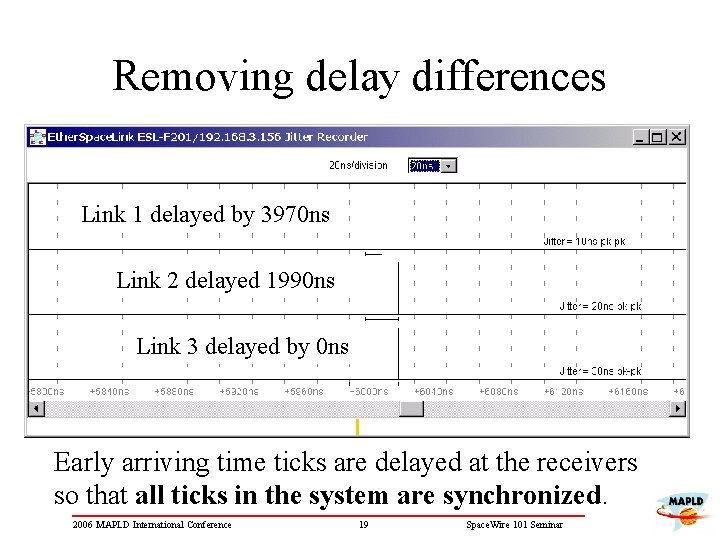
Removing delay differences Link 1 delayed by 3970 ns Link 2 delayed 1990 ns Link 3 delayed by 0 ns Early arriving time ticks are delayed at the receivers so that all ticks in the system are synchronized. 2006 MAPLD International Conference 19 Space. Wire 101 Seminar
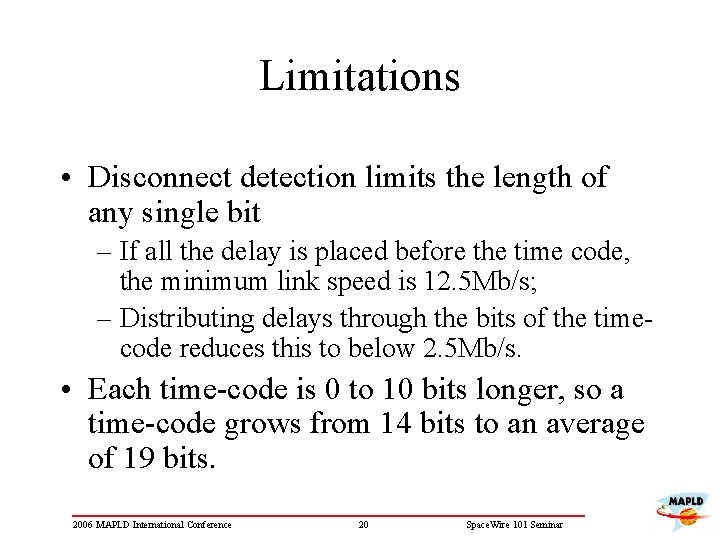
Limitations • Disconnect detection limits the length of any single bit – If all the delay is placed before the time code, the minimum link speed is 12. 5 Mb/s; – Distributing delays through the bits of the timecode reduces this to below 2. 5 Mb/s. • Each time-code is 0 to 10 bits longer, so a time-code grows from 14 bits to an average of 19 bits. 2006 MAPLD International Conference 20 Space. Wire 101 Seminar
Conclusions • A small change in the link transmitter can give a very significant reduction in time-code jitter. • The receiver need not be altered, so long as its behaviour is deterministic. • It is possible to produce accurately synchronized time codes at all nodes in a system. • This makes time codes easier to use and enables their use in more applications. • And it is all completely compliant with the ECSS standard and interoperable with devices that do not have reduced jitter. 2006 MAPLD International Conference 21 Space. Wire 101 Seminar
- Slides: 21