
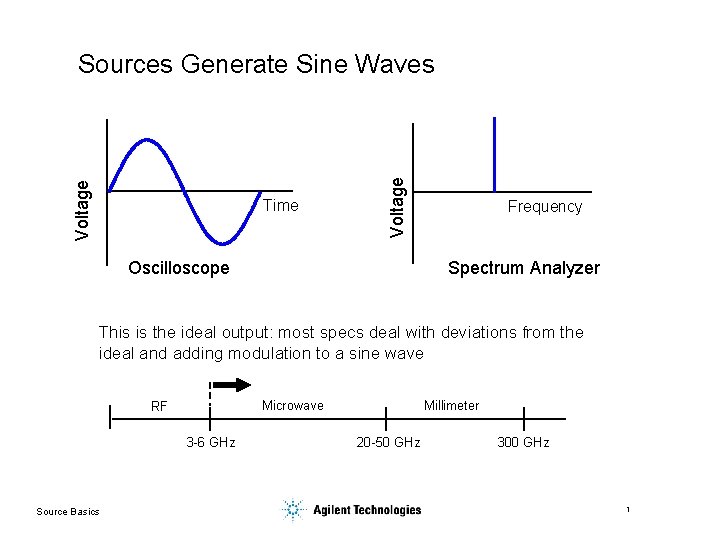
Time Voltage Sources Generate Sine Waves Oscilloscope Frequency
![Modulation. . . Where the information resides p f(t)f + (t)] V= A(t) sin[2](https://slidetodoc.com/presentation_image_h2/8aaaf52d2d8bb937c33c5925e8735435/image-20.jpg "Modulation. . . Where the information resides p f(t)f + (t)] V= A(t) sin[2")
![Modulation: Analog Frequency Modulation p c f bt + m(t)] A sin[2 V= b=D](https://slidetodoc.com/presentation_image_h2/8aaaf52d2d8bb937c33c5925e8735435/image-22.jpg "Modulation: Analog Frequency Modulation p c f bt + m(t)] A sin[2 V= b=D")
![Digital Modulation. . . Quadrature Phase Shift Keying (QPSK) p ftf+ (t)] V= A](https://slidetodoc.com/presentation_image_h2/8aaaf52d2d8bb937c33c5925e8735435/image-30.jpg "Digital Modulation. . . Quadrature Phase Shift Keying (QPSK) p ftf+ (t)] V= A")
- Slides: 40
Time Voltage Sources Generate Sine Waves Oscilloscope Frequency Spectrum Analyzer This is the ideal output: most specs deal with deviations from the ideal and adding modulation to a sine wave 3 -6 GHz Source Basics Millimeter Microwave RF 20 -50 GHz 300 GHz 1
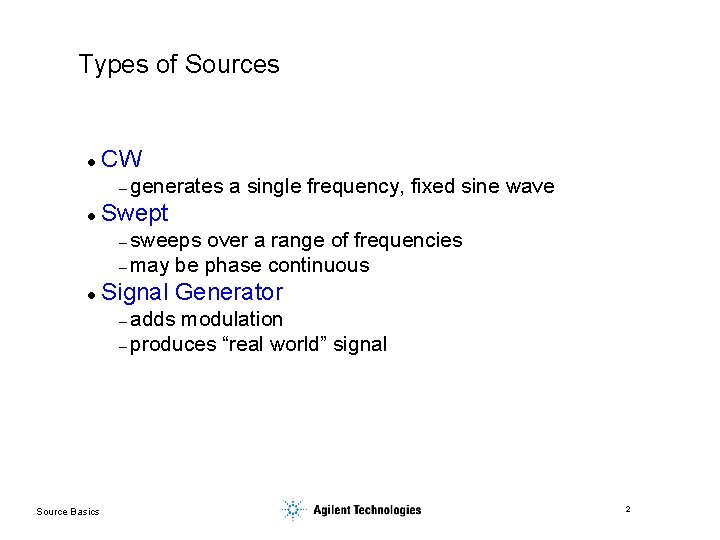
Types of Sources l CW – generates l a single frequency, fixed sine wave Swept – sweeps over a range of frequencies – may be phase continuous l Signal Generator – adds modulation – produces “real world” signal Source Basics 2
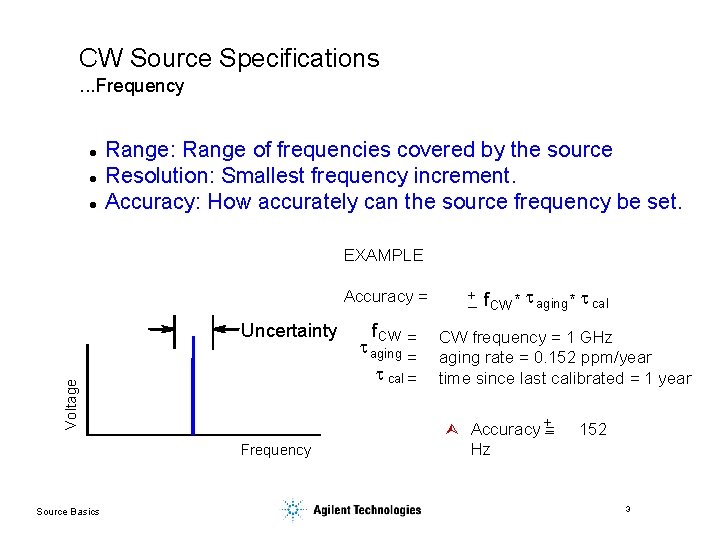
CW Source Specifications. . . Frequency l l l Range: Range of frequencies covered by the source Resolution: Smallest frequency increment. Accuracy: How accurately can the source frequency be set. EXAMPLE Accuracy = Voltage Uncertainty t aging = t cal = CW frequency = 1 GHz aging rate = 0. 152 ppm/year time since last calibrated = 1 year _ = Ù Accuracy + Frequency Source Basics f CW = +_ f CW * t aging * t cal 152 Hz 3
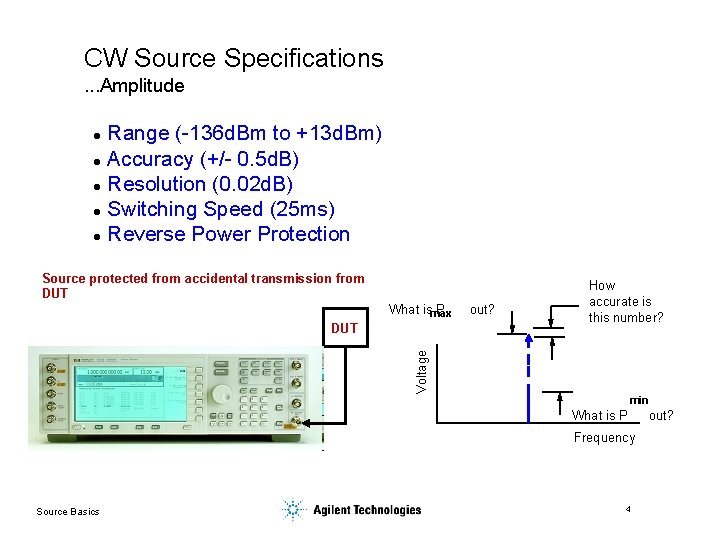
CW Source Specifications. . . Amplitude l l l Range (-136 d. Bm to +13 d. Bm) Accuracy (+/- 0. 5 d. B) Resolution (0. 02 d. B) Switching Speed (25 ms) Reverse Power Protection Source protected from accidental transmission from DUT What ismax P Voltage DUT out? How accurate is this number? min What is P Frequency Source Basics 4 out?
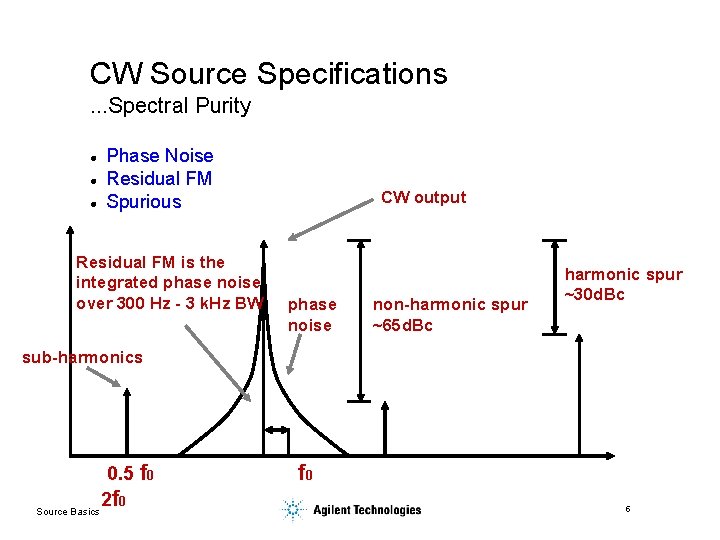
CW Source Specifications. . . Spectral Purity l l l Phase Noise Residual FM Spurious Residual FM is the integrated phase noise over 300 Hz - 3 k. Hz BW CW output phase noise non-harmonic spur ~65 d. Bc harmonic spur ~30 d. Bc sub-harmonics 0. 5 f 0 2 f 0 Source Basics f 0 5
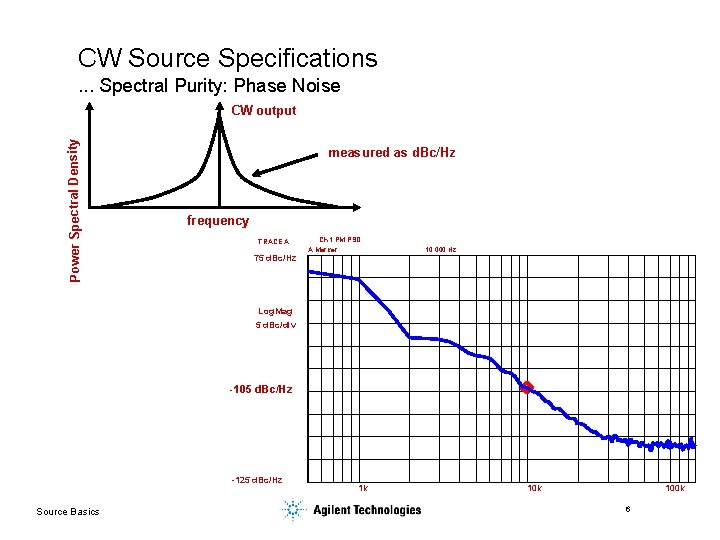
CW Source Specifications. . . Spectral Purity: Phase Noise Power Spectral Density CW output measured as d. Bc/Hz frequency TRACE A: 75 d. Bc/Hz Ch 1 PM PSD A Marker 10 000 Hz Log. Mag 5 d. Bc/div -105 d. Bc/Hz -125 d. Bc/Hz Source Basics 1 k 100 k 6
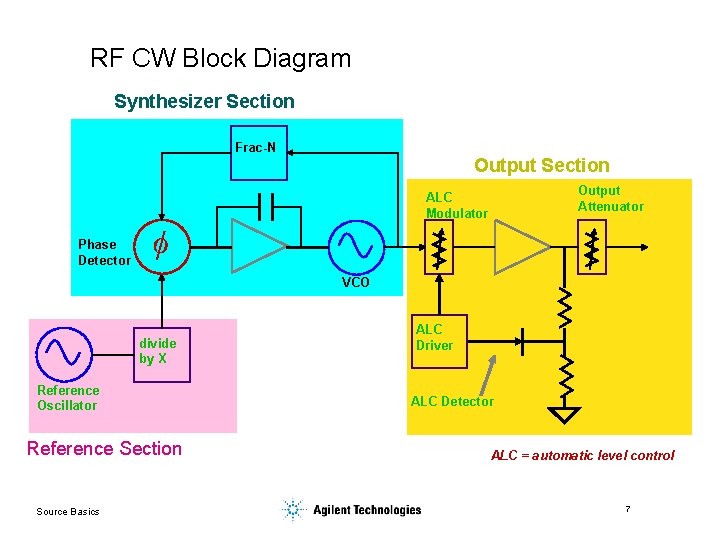
RF CW Block Diagram Synthesizer Section Frac-N Output Section Phase Detector Output Attenuator ALC Modulator f VCO divide by X Reference Oscillator Reference Section Source Basics ALC Driver ALC Detector ALC = automatic level control 7
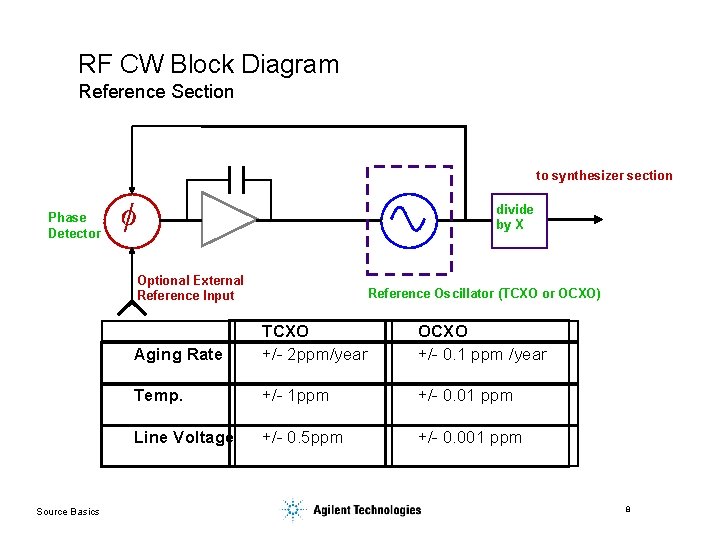
RF CW Block Diagram Reference Section to synthesizer section Phase Detector f divide by X Optional External Reference Input Source Basics Reference Oscillator (TCXO or OCXO) Aging Rate TCXO +/- 2 ppm/year OCXO +/- 0. 1 ppm /year Temp. +/- 1 ppm +/- 0. 01 ppm Line Voltage +/- 0. 5 ppm +/- 0. 001 ppm 8
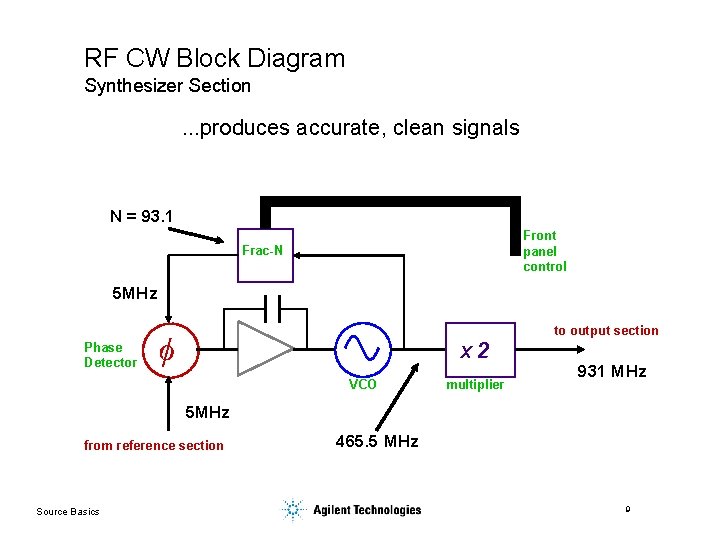
RF CW Block Diagram Synthesizer Section . . . produces accurate, clean signals N = 93. 1 Front panel control Frac-N 5 MHz Phase Detector f X VCO 2 multiplier to output section 931 MHz 5 MHz from reference section Source Basics 465. 5 MHz 9
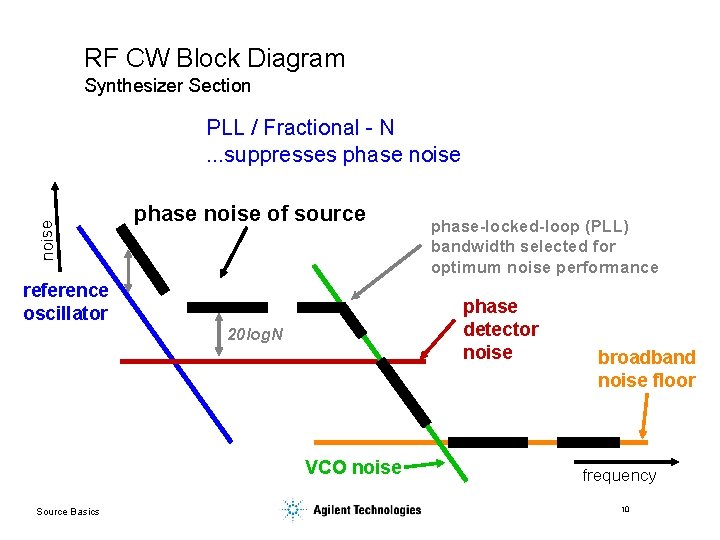
RF CW Block Diagram Synthesizer Section noise PLL / Fractional - N. . . suppresses phase noise of source reference oscillator phase detector noise 20 log. N VCO noise Source Basics phase-locked-loop (PLL) bandwidth selected for optimum noise performance broadband noise floor frequency 10
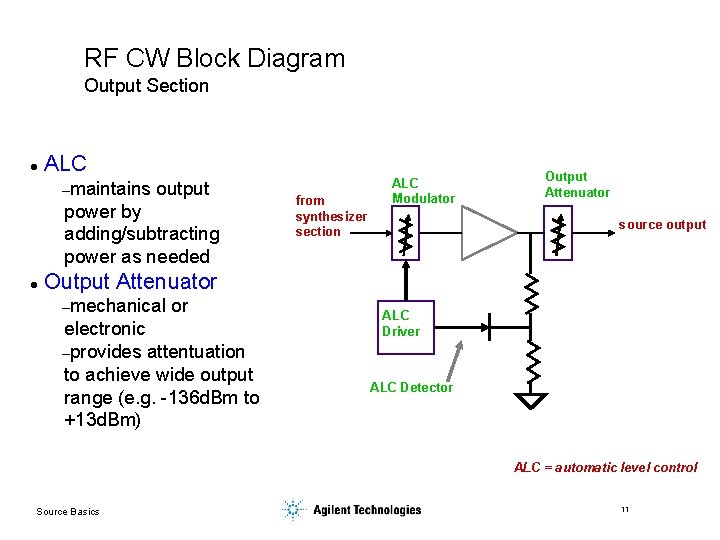
RF CW Block Diagram Output Section l ALC –maintains output power by adding/subtracting power as needed l from synthesizer section ALC Modulator Output Attenuator source output Output Attenuator –mechanical or electronic –provides attentuation to achieve wide output range (e. g. -136 d. Bm to +13 d. Bm) ALC Driver ALC Detector ALC = automatic level control Source Basics 11
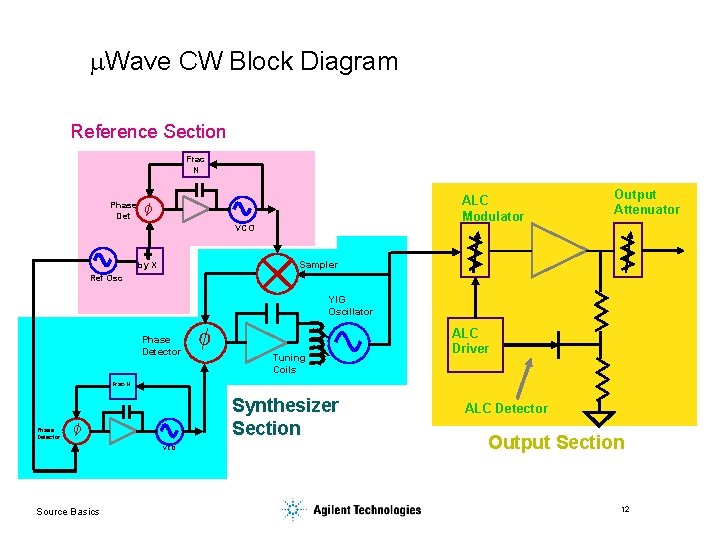
m. Wave CW Block Diagram Reference Section Frac N Phase Det ALC Modulator f VCO Output Attenuator Sampler by X Ref Osc YIG Oscillator Phase Detector f Tuning Coils ALC Driver Frac-N Phase Detector Synthesizer Section f VCO Source Basics ALC Detector Output Section 12
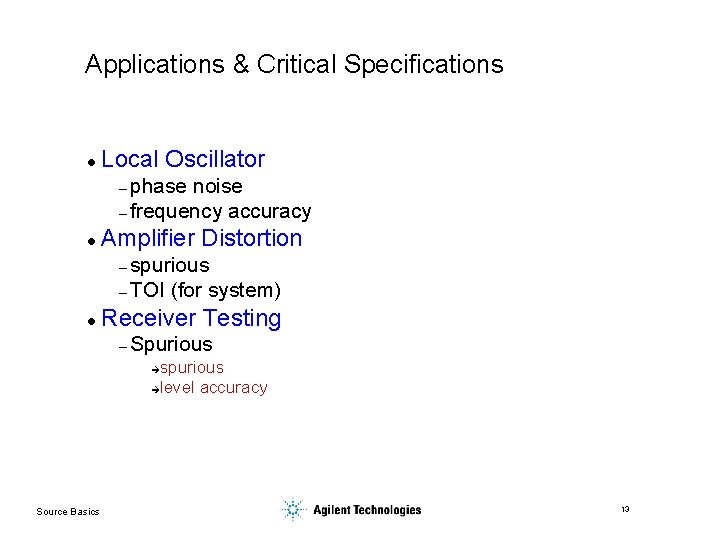
Applications & Critical Specifications l Local Oscillator – phase noise – frequency accuracy l Amplifier Distortion – spurious – TOI l (for system) Receiver Testing – Spurious spurious èlevel accuracy è Source Basics 13
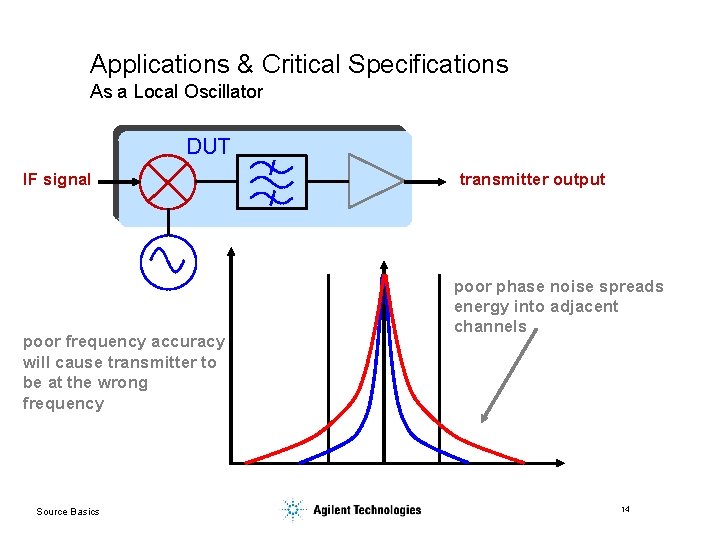
Applications & Critical Specifications As a Local Oscillator DUT IF signal poor frequency accuracy will cause transmitter to be at the wrong frequency Source Basics transmitter output poor phase noise spreads energy into adjacent channels 14
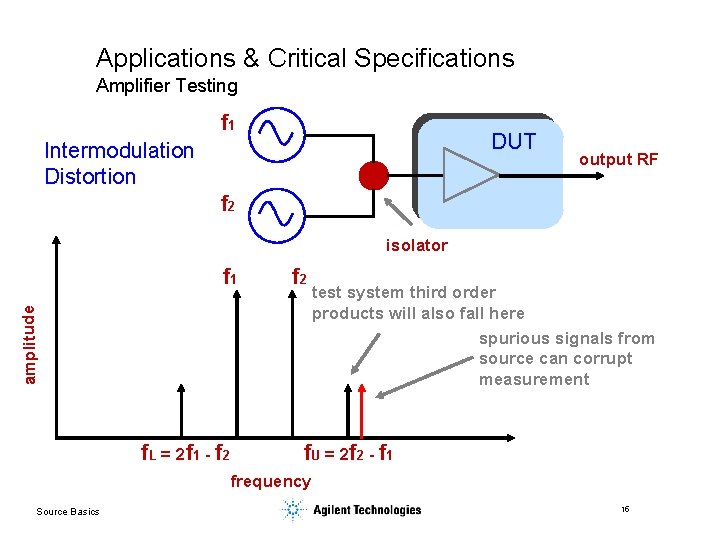
Applications & Critical Specifications Amplifier Testing f 1 DUT Intermodulation Distortion output RF f 2 isolator amplitude f 1 f. L = 2 f 1 - f 2 test system third order products will also fall here spurious signals from source can corrupt measurement f. U = 2 f 2 - f 1 frequency Source Basics 15
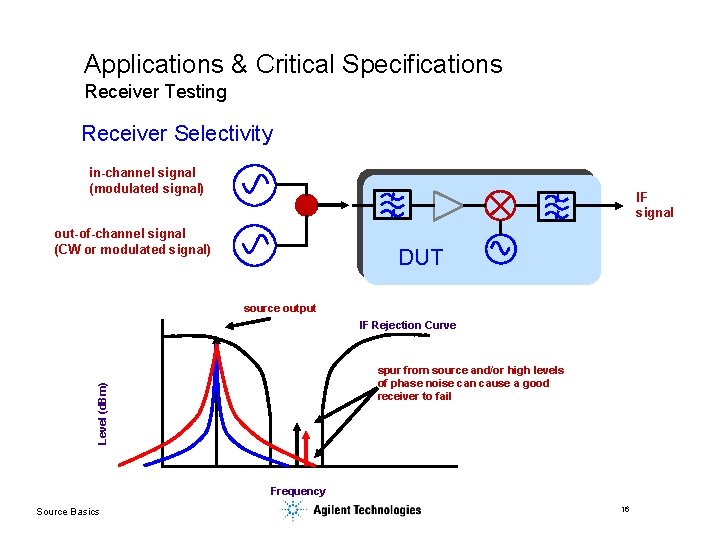
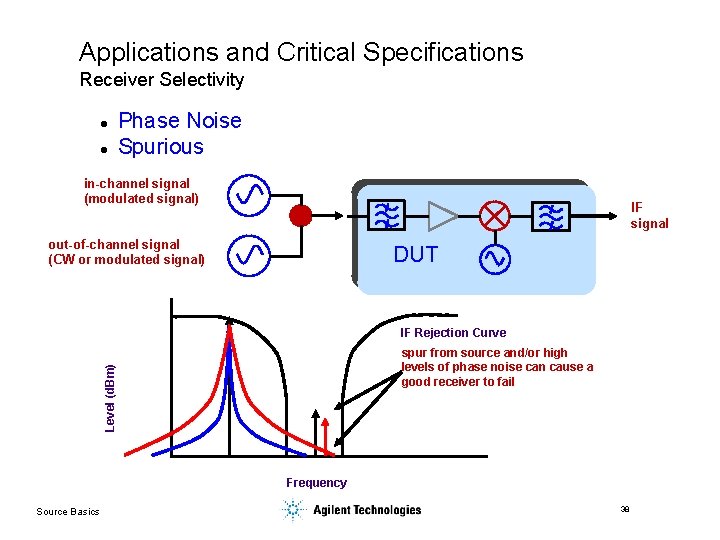
Applications & Critical Specifications Receiver Testing Receiver Selectivity in-channel signal (modulated signal) IF signal out-of-channel signal (CW or modulated signal) DUT source output IF Rejection Curve Level (d. Bm) spur from source and/or high levels of phase noise can cause a good receiver to fail Frequency Source Basics 16
Applications & Critical Specifications l Frequency Response – – – l Amplifier Compression – Source Basics Frequency Accuracy Output Power (Level) Accuracy Flatness Speed residual FM Power Range 17
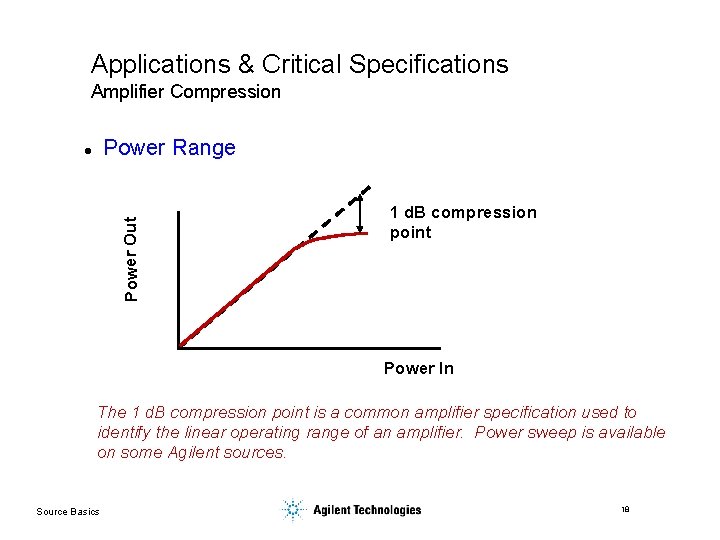
Applications & Critical Specifications Amplifier Compression Power Range Power Out l 1 d. B compression point Power In The 1 d. B compression point is a common amplifier specification used to identify the linear operating range of an amplifier. Power sweep is available on some Agilent sources. Source Basics 18
Signal Generators l Calibrated modulation – Analog (AM, FM, Pulse) – Digital (I-Q) – Format Specific(TDMA, CDMA, etc. ) Source Basics 19
Modulation. . . Where the information resides p f(t)f + (t)] V= A(t) sin[2 AM, Pulse FM PM V= A(t) sin[ q (t)] Source Basics 20
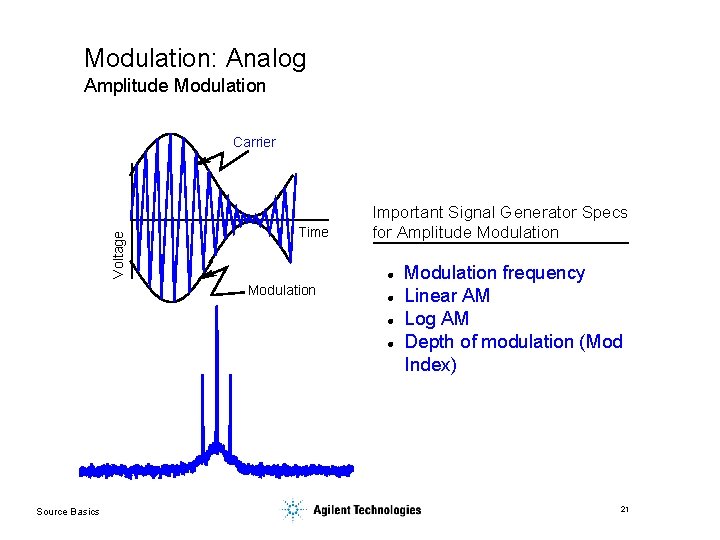
Modulation: Analog Amplitude Modulation Voltage Carrier Time Important Signal Generator Specs for Amplitude Modulation l l l Source Basics Modulation frequency Linear AM Log AM Depth of modulation (Mod Index) 21
Modulation: Analog Frequency Modulation p c f bt + m(t)] A sin[2 V= b=D F dev /F Important Signal Generator Specs for Frequency Modulation mod Voltage l l l Time l l Source Basics Frequency Deviation Modulation Frequency dc. FM Accuracy Resolution 22
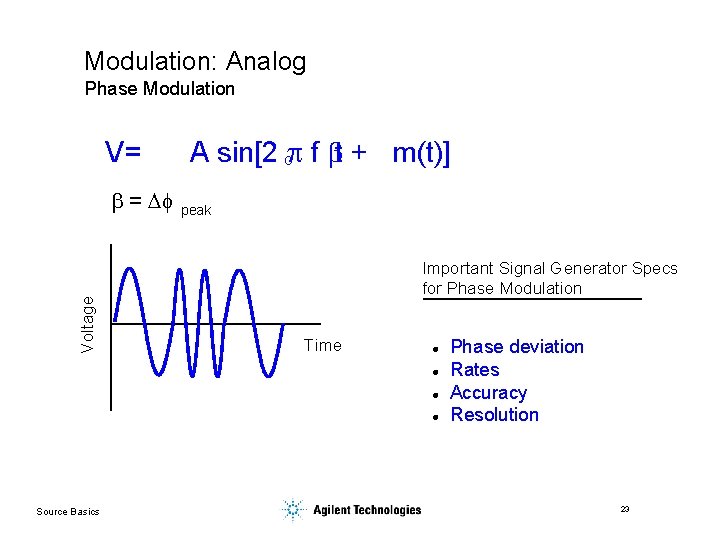
Modulation: Analog Phase Modulation V= Voltage b = Df A sin[2 cp f bt + m(t)] peak Important Signal Generator Specs for Phase Modulation Time l l Source Basics Phase deviation Rates Accuracy Resolution 23
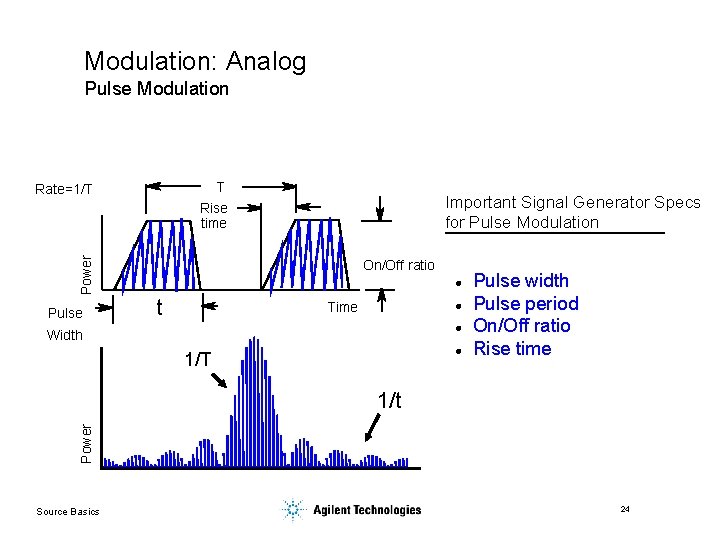
Modulation: Analog Pulse Modulation T Rate=1/T Important Signal Generator Specs for Pulse Modulation Power Rise time Pulse On/Off ratio l t Time l l Width l 1/T Pulse width Pulse period On/Off ratio Rise time Power 1/t Source Basics 24
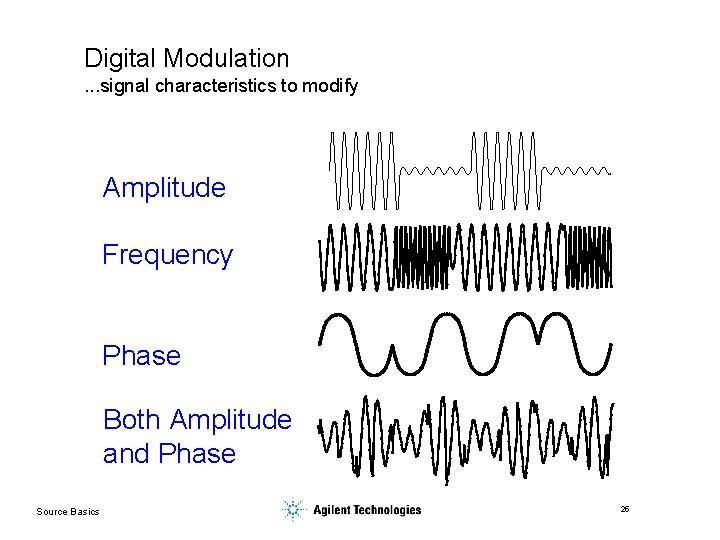
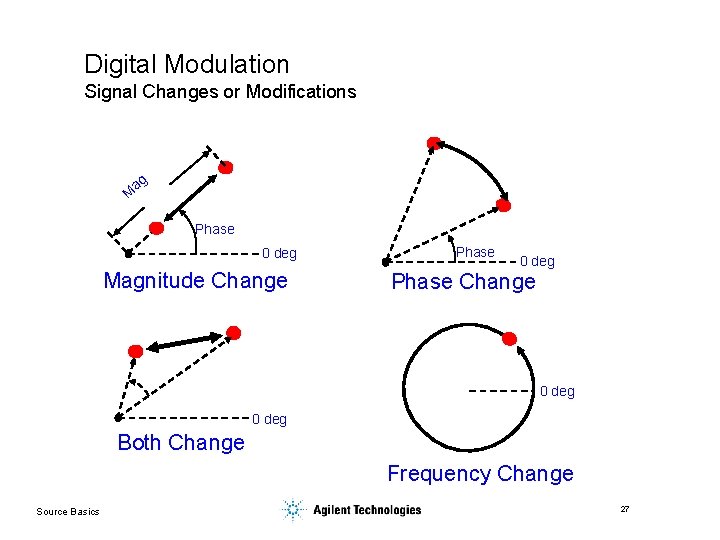
Digital Modulation. . . signal characteristics to modify Amplitude Frequency Phase Both Amplitude and Phase Source Basics 25
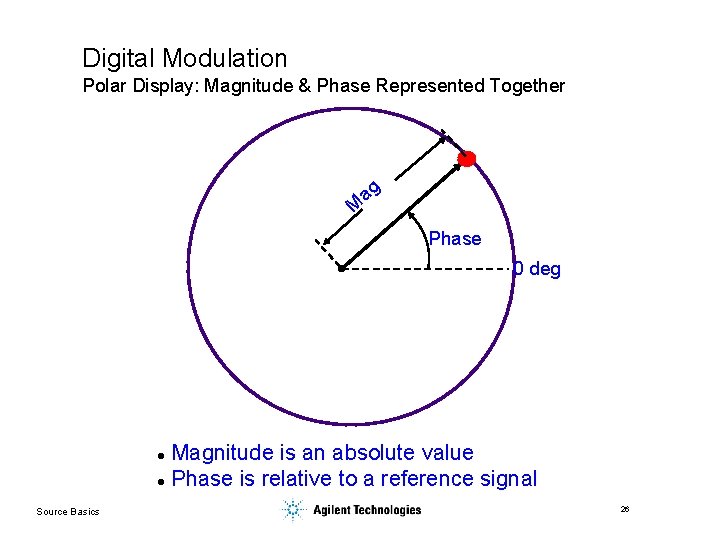
Digital Modulation Polar Display: Magnitude & Phase Represented Together ag M Phase 0 deg Magnitude is an absolute value l Phase is relative to a reference signal l Source Basics 26
Digital Modulation Signal Changes or Modifications ag M Phase 0 deg Magnitude Change Phase 0 deg Phase Change 0 deg Both Change Frequency Change Source Basics 27
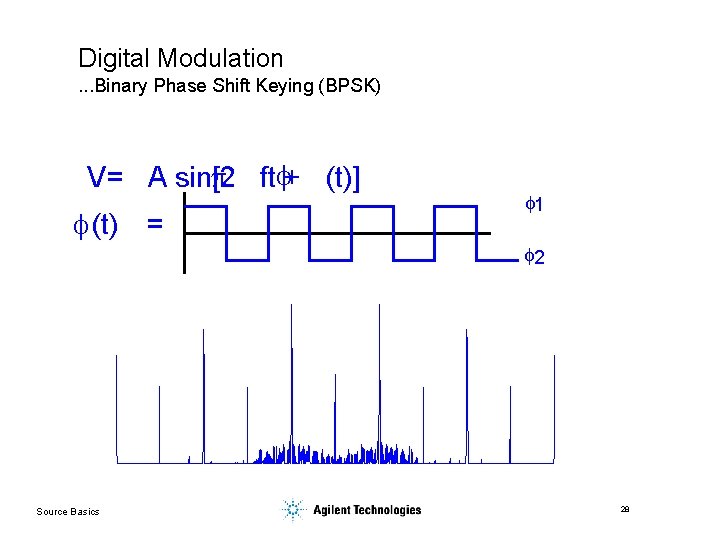
Digital Modulation. . . Binary Phase Shift Keying (BPSK) V= A sin[2 p ftf+ (t)] f (t) = f 1 f 2 Source Basics 28
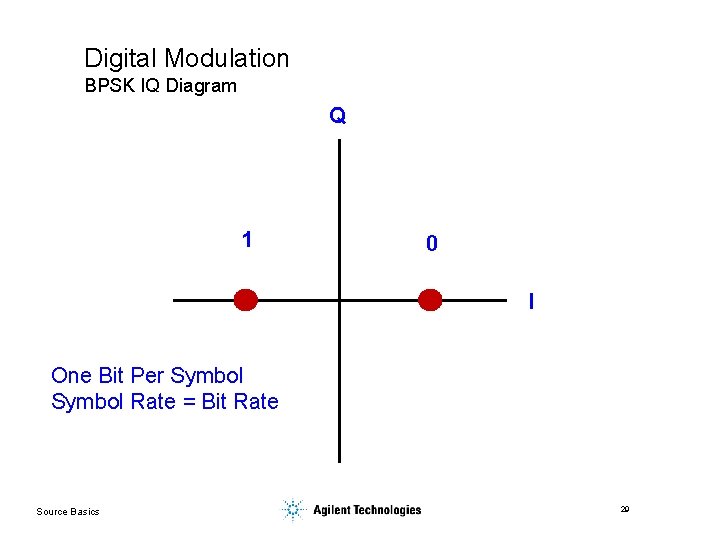
Digital Modulation BPSK IQ Diagram Q 1 0 I One Bit Per Symbol Rate = Bit Rate Source Basics 29
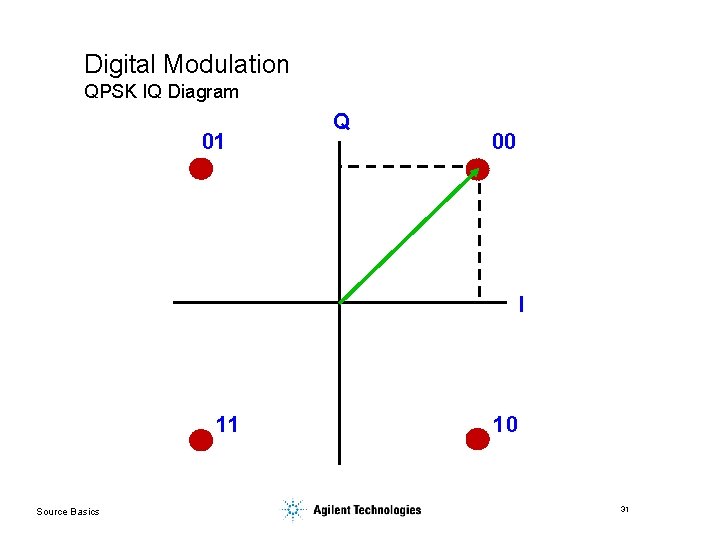
Digital Modulation. . . Quadrature Phase Shift Keying (QPSK) p ftf+ (t)] V= A sin[2 f (t) = Source Basics f 1 = 3 p /4 f 2 = p /4 f 3 = - p /4 f 4 = - 3 p /4 30
Digital Modulation QPSK IQ Diagram 01 Q 00 I 11 Source Basics 10 31
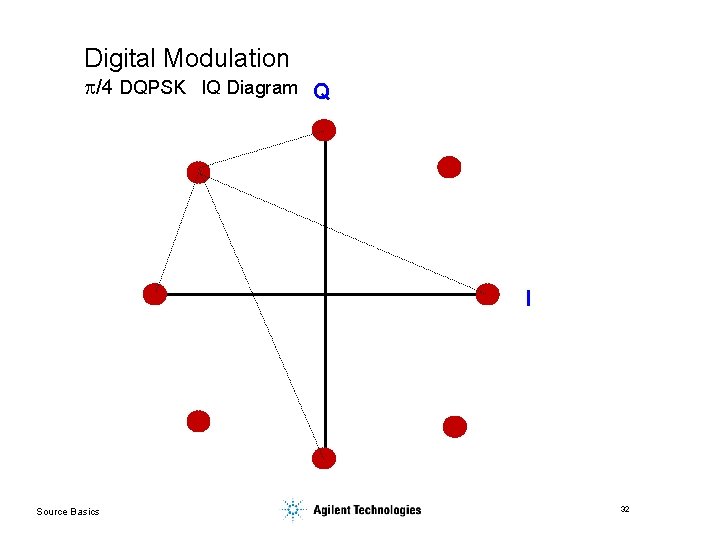
Digital Modulation p/4 DQPSK IQ Diagram Q I Source Basics 32
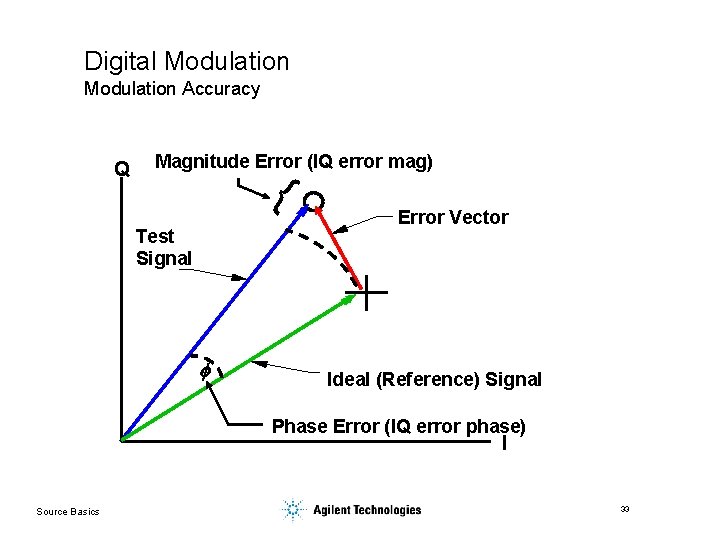
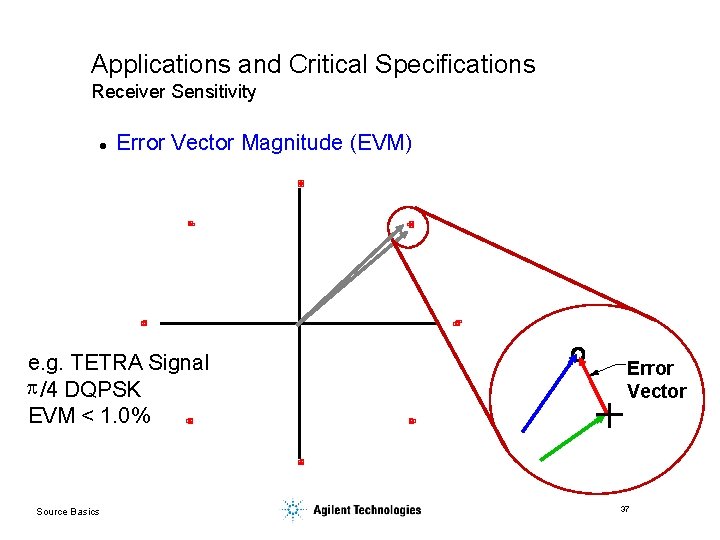
Digital Modulation Accuracy Q Magnitude Error (IQ error mag) { Test Signal f Error Vector Ideal (Reference) Signal Phase Error (IQ error phase) I Source Basics 33
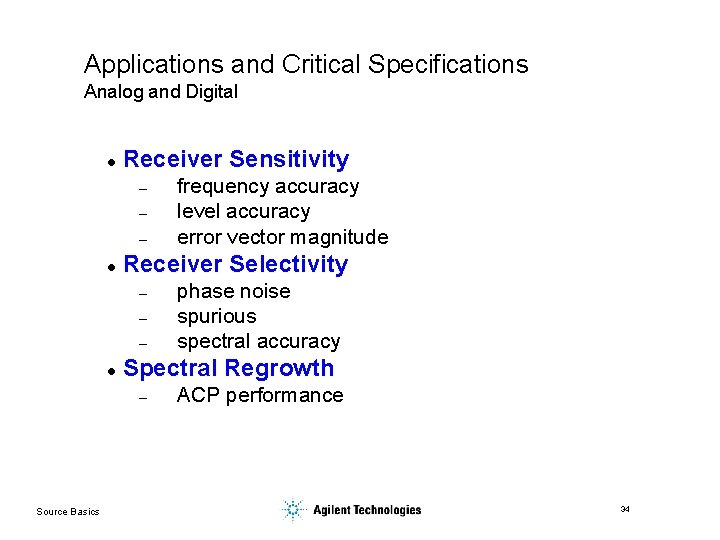
Applications and Critical Specifications Analog and Digital l Receiver Sensitivity – – – l Receiver Selectivity – – – l phase noise spurious spectral accuracy Spectral Regrowth – Source Basics frequency accuracy level accuracy error vector magnitude ACP performance 34
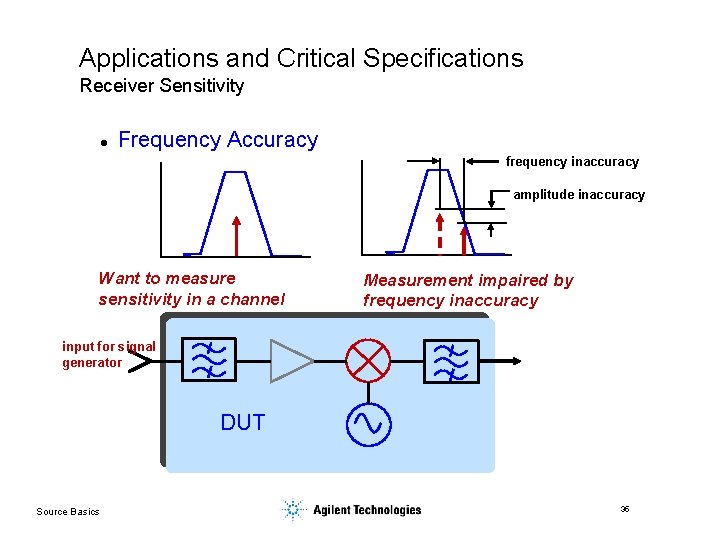
Applications and Critical Specifications Receiver Sensitivity l Frequency Accuracy frequency inaccuracy amplitude inaccuracy Want to measure sensitivity in a channel Measurement impaired by frequency inaccuracy input for signal generator DUT Source Basics 35
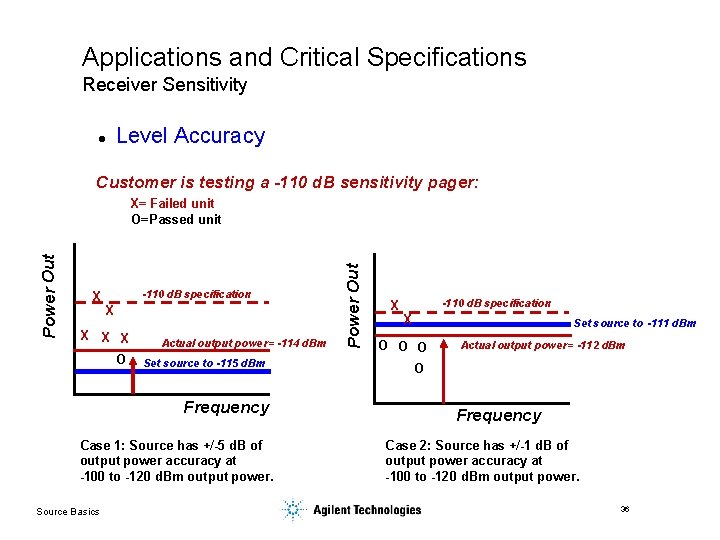
Applications and Critical Specifications Receiver Sensitivity l Level Accuracy Customer is testing a -110 d. B sensitivity pager: X -110 d. B specification X X O Actual output power= -114 d. Bm Set source to -115 d. Bm Frequency Case 1: Source has +/-5 d. B of output power accuracy at -100 to -120 d. Bm output power. Source Basics Power Out X= Failed unit O=Passed unit X -110 d. B specification X Set source to -111 d. Bm O O O Actual output power= -112 d. Bm O Frequency Case 2: Source has +/-1 d. B of output power accuracy at -100 to -120 d. Bm output power. 36
Applications and Critical Specifications Receiver Sensitivity l Error Vector Magnitude (EVM) e. g. TETRA Signal p /4 DQPSK EVM < 1. 0% Source Basics Error Vector 37
Applications and Critical Specifications Receiver Selectivity l l Phase Noise Spurious in-channel signal (modulated signal) IF signal out-of-channel signal (CW or modulated signal) DUT IF Rejection Curve Level (d. Bm) spur from source and/or high levels of phase noise can cause a good receiver to fail Frequency Source Basics 38
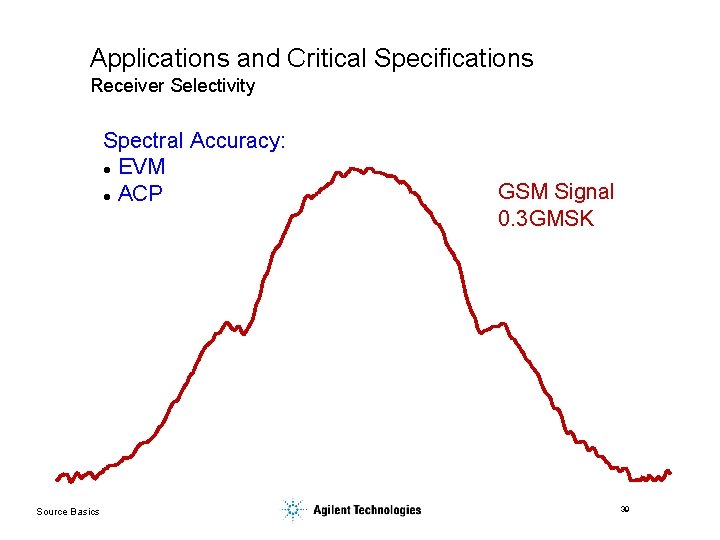
Applications and Critical Specifications Receiver Selectivity Spectral Accuracy: l EVM l ACP Source Basics GSM Signal 0. 3 GMSK 39
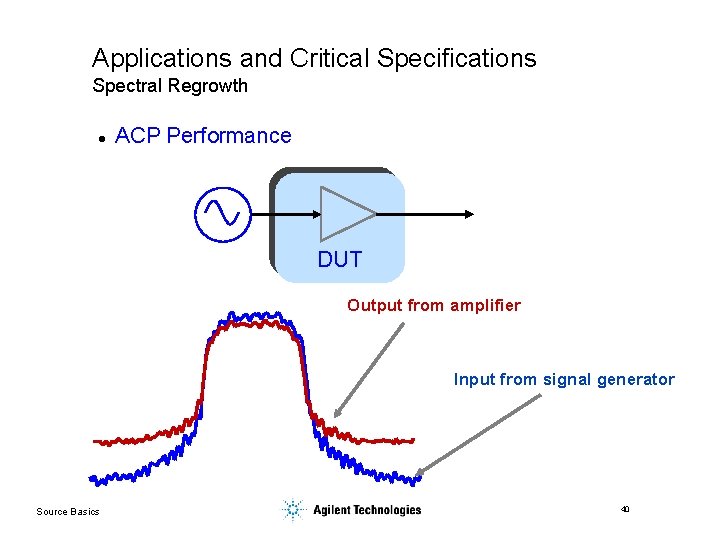
Applications and Critical Specifications Spectral Regrowth l ACP Performance DUT Output from amplifier Input from signal generator Source Basics 40