
Time Value of Money Appendix C BACK OF
Time Value of Money $$$$ Appendix C – BACK OF TEXTBOOK Part 1 Hint: Not in back of Chapter 10!
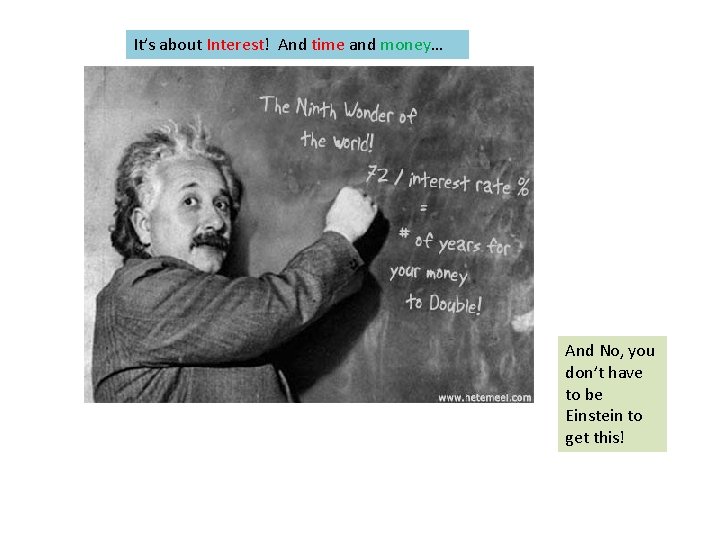
It’s about Interest! And time and money… And No, you don’t have to be Einstein to get this!
Time Value of Money…. • The SAME amount of Money is worth more TODAY, then in the FUTURE. • Why? • Because you could take that money and invest it and earn interest on it. • How is interest calculated?
Time Value of Money. . • What is Simple Interest? You borrow $5, 000 For 2 years At 12% How much interest is earned the first year? How much interest is earned the second year? acct. 220 4
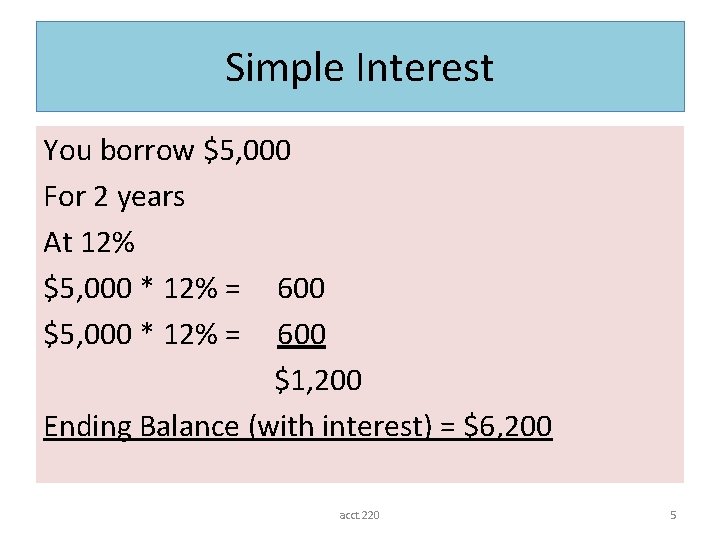
Simple Interest You borrow $5, 000 For 2 years At 12% $5, 000 * 12% = 600 $1, 200 Ending Balance (with interest) = $6, 200 acct. 220 5
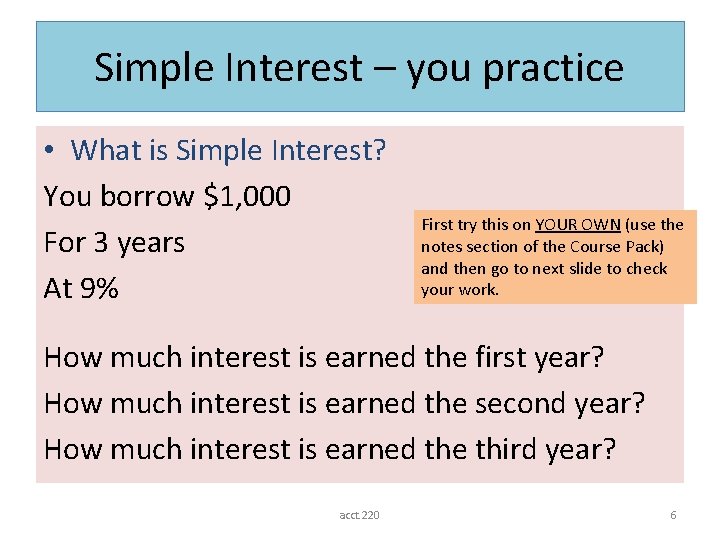
Simple Interest – you practice • What is Simple Interest? You borrow $1, 000 For 3 years At 9% First try this on YOUR OWN (use the notes section of the Course Pack) and then go to next slide to check your work. How much interest is earned the first year? How much interest is earned the second year? How much interest is earned the third year? acct. 220 6
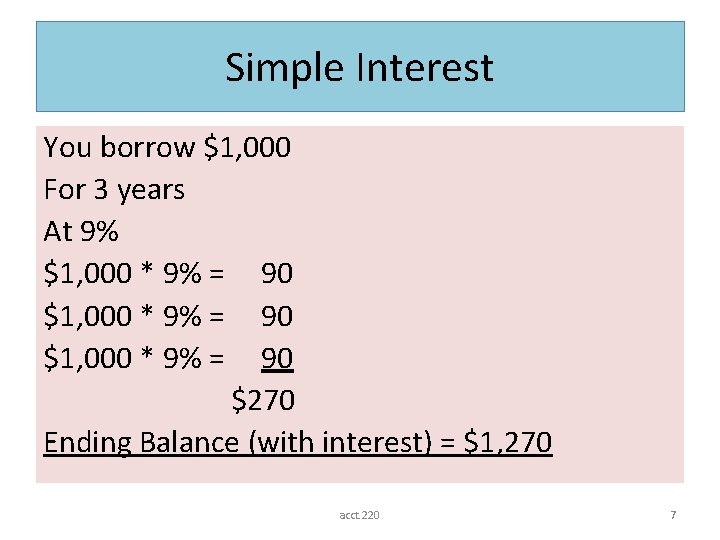
Simple Interest You borrow $1, 000 For 3 years At 9% $1, 000 * 9% = 90 $270 Ending Balance (with interest) = $1, 270 acct. 220 7
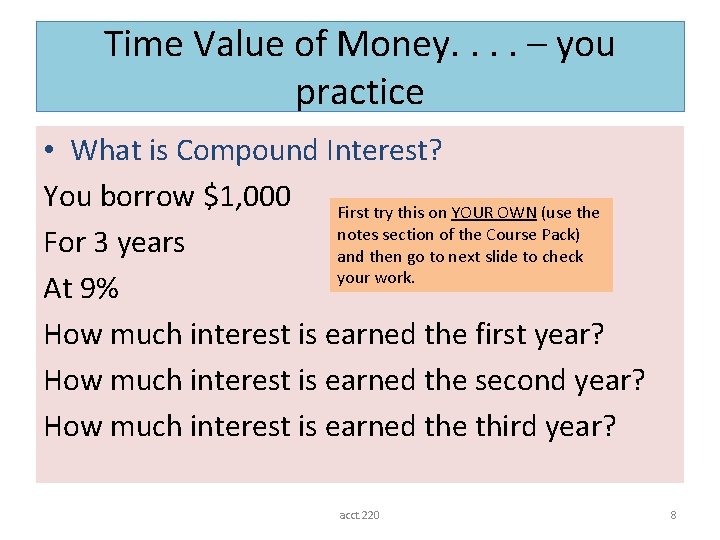
Time Value of Money. . – you practice • What is Compound Interest? You borrow $1, 000 First try this on YOUR OWN (use the notes section of the Course Pack) For 3 years and then go to next slide to check your work. At 9% How much interest is earned the first year? How much interest is earned the second year? How much interest is earned the third year? acct. 220 8
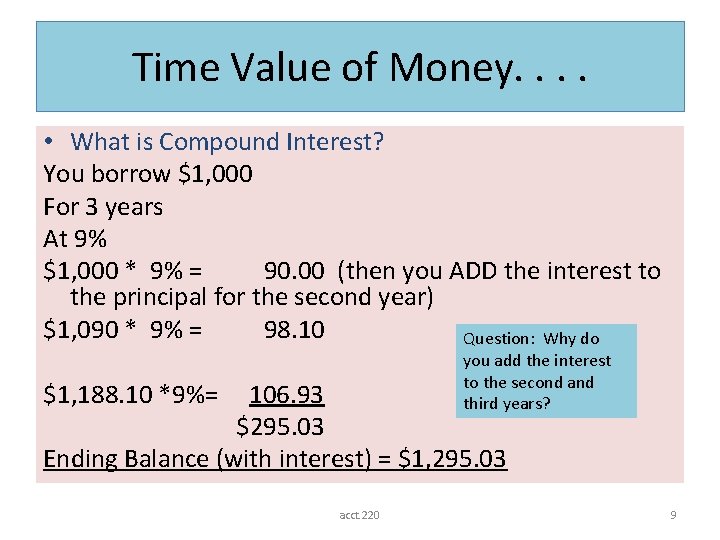
Time Value of Money. . • What is Compound Interest? You borrow $1, 000 For 3 years At 9% $1, 000 * 9% = 90. 00 (then you ADD the interest to the principal for the second year) $1, 090 * 9% = 98. 10 Question: Why do you add the interest to the second and third years? $1, 188. 10 *9%= 106. 93 $295. 03 Ending Balance (with interest) = $1, 295. 03 acct. 220 9
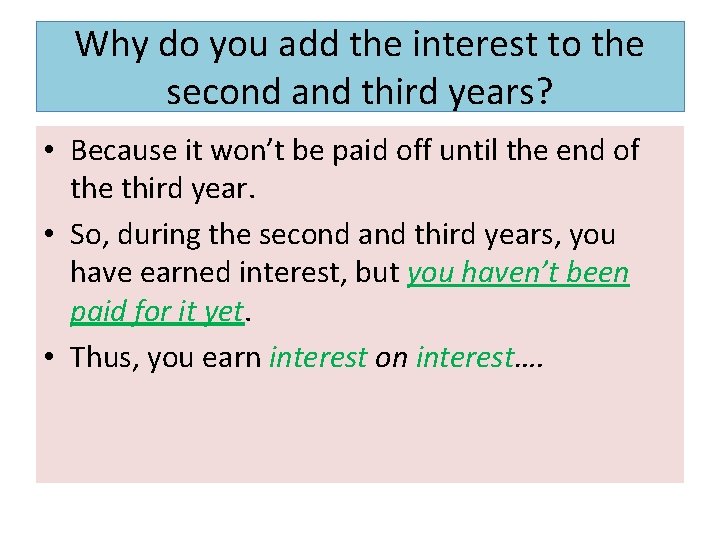
Why do you add the interest to the second and third years? • Because it won’t be paid off until the end of the third year. • So, during the second and third years, you have earned interest, but you haven’t been paid for it yet. • Thus, you earn interest on interest….
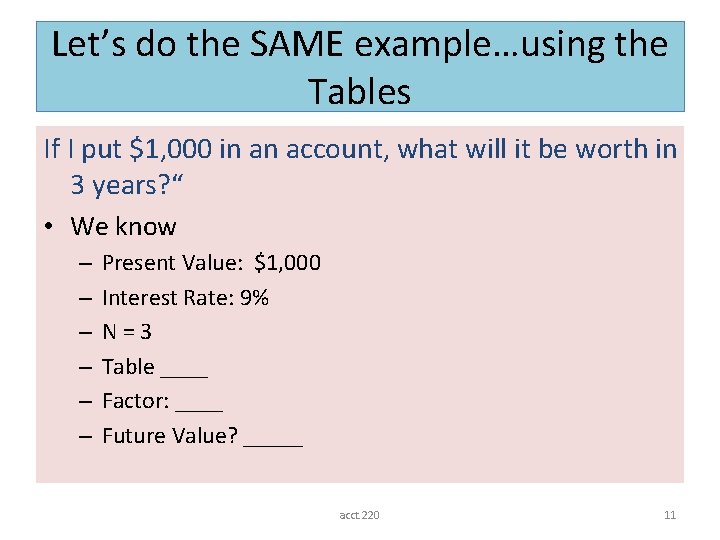
Let’s do the SAME example…using the Tables If I put $1, 000 in an account, what will it be worth in 3 years? “ • We know – – – Present Value: $1, 000 Interest Rate: 9% N=3 Table ____ Factor: ____ Future Value? _____ acct. 220 11
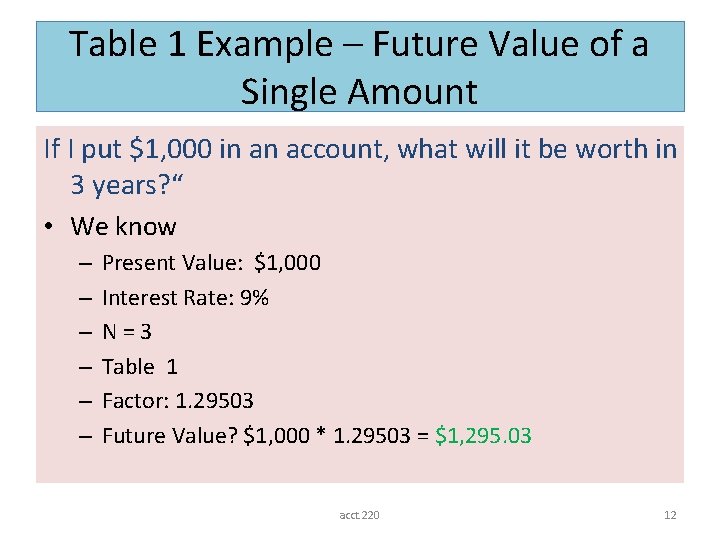
Table 1 Example – Future Value of a Single Amount If I put $1, 000 in an account, what will it be worth in 3 years? “ • We know – – – Present Value: $1, 000 Interest Rate: 9% N=3 Table 1 Factor: 1. 29503 Future Value? $1, 000 * 1. 29503 = $1, 295. 03 acct. 220 12
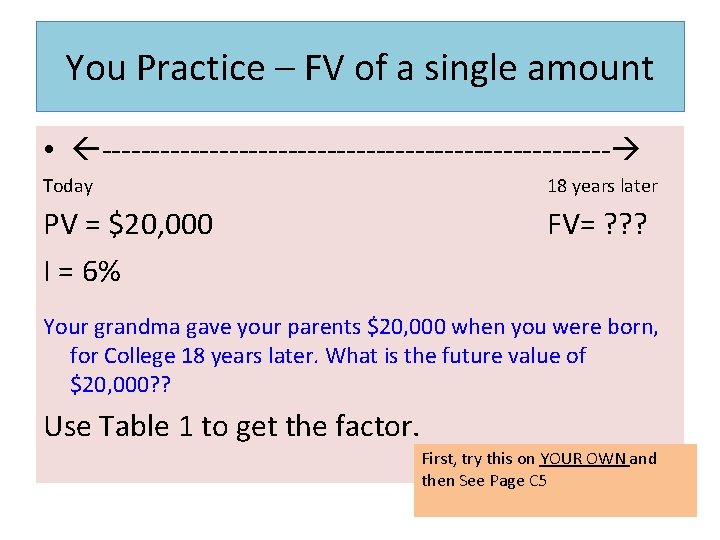
You Practice – FV of a single amount • -------------------------- Today 18 years later PV = $20, 000 I = 6% FV= ? ? ? Your grandma gave your parents $20, 000 when you were born, for College 18 years later. What is the future value of $20, 000? ? Use Table 1 to get the factor. First, try this on YOUR OWN and then See Page C 5
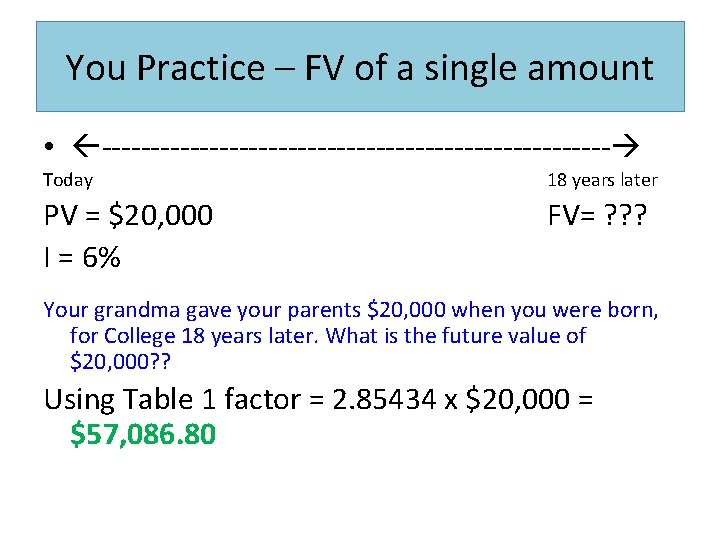
You Practice – FV of a single amount • -------------------------- Today 18 years later PV = $20, 000 I = 6% FV= ? ? ? Your grandma gave your parents $20, 000 when you were born, for College 18 years later. What is the future value of $20, 000? ? Using Table 1 factor = 2. 85434 x $20, 000 = $57, 086. 80
What about Annuities? • Question: What are annuities?
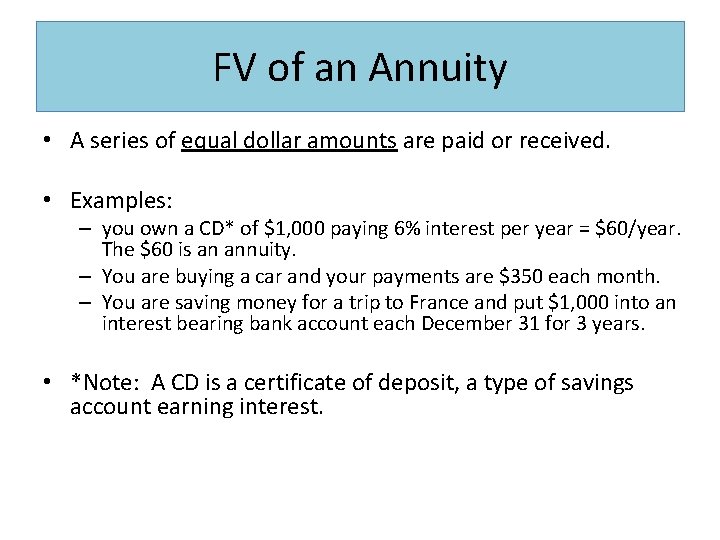
FV of an Annuity • A series of equal dollar amounts are paid or received. • Examples: – you own a CD* of $1, 000 paying 6% interest per year = $60/year. The $60 is an annuity. – You are buying a car and your payments are $350 each month. – You are saving money for a trip to France and put $1, 000 into an interest bearing bank account each December 31 for 3 years. • *Note: A CD is a certificate of deposit, a type of savings account earning interest.
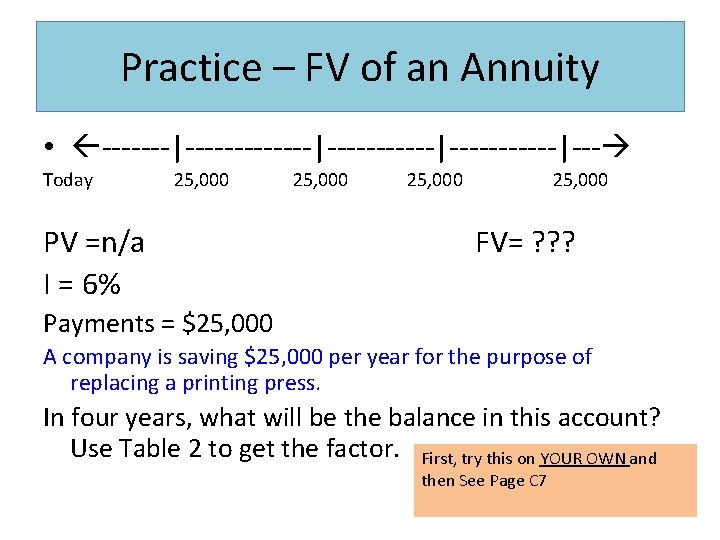
Practice – FV of an Annuity • -------|-----------|------|--- Today 25, 000 PV =n/a I = 6% 25, 000 FV= ? ? ? Payments = $25, 000 A company is saving $25, 000 per year for the purpose of replacing a printing press. In four years, what will be the balance in this account? Use Table 2 to get the factor. First, try this on YOUR OWN and then See Page C 7
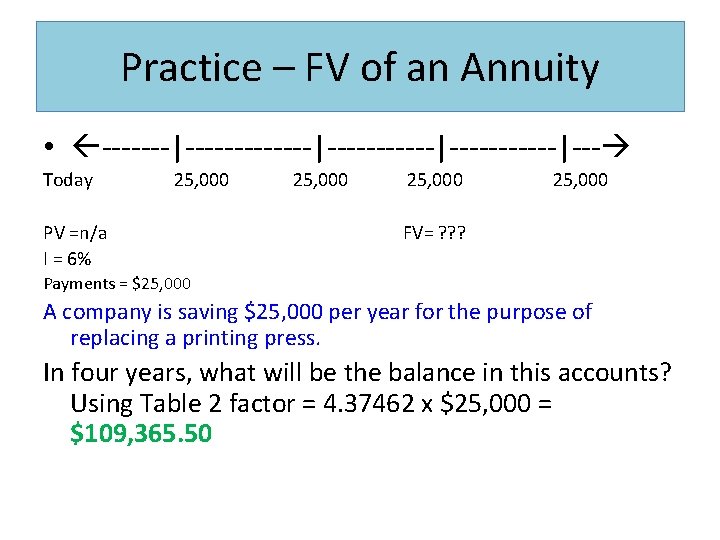
Practice – FV of an Annuity • -------|-----------|------|--- Today 25, 000 PV =n/a I = 6% 25, 000 FV= ? ? ? Payments = $25, 000 A company is saving $25, 000 per year for the purpose of replacing a printing press. In four years, what will be the balance in this accounts? Using Table 2 factor = 4. 37462 x $25, 000 = $109, 365. 50
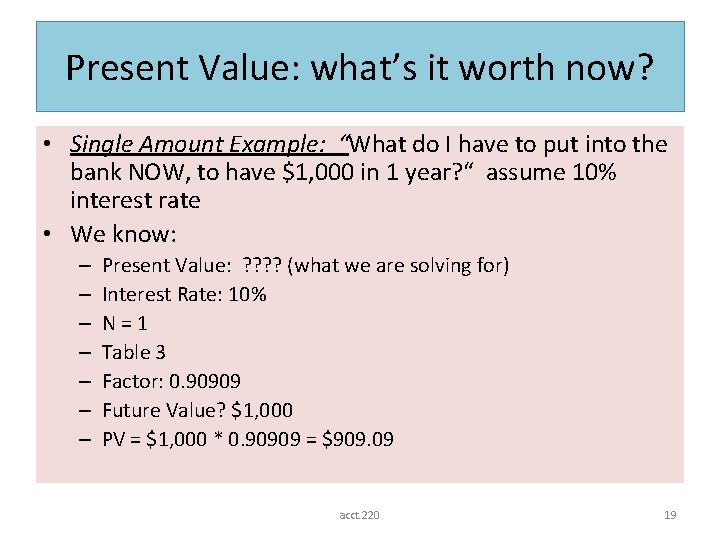
Present Value: what’s it worth now? • Single Amount Example: “What do I have to put into the bank NOW, to have $1, 000 in 1 year? “ assume 10% interest rate • We know: – – – – Present Value: ? ? (what we are solving for) Interest Rate: 10% N=1 Table 3 Factor: 0. 90909 Future Value? $1, 000 PV = $1, 000 * 0. 90909 = $909. 09 acct. 220 19
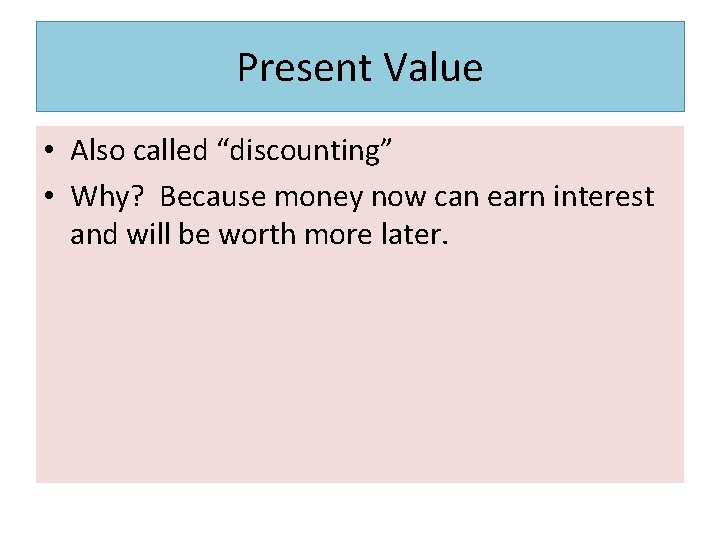
Present Value • Also called “discounting” • Why? Because money now can earn interest and will be worth more later.
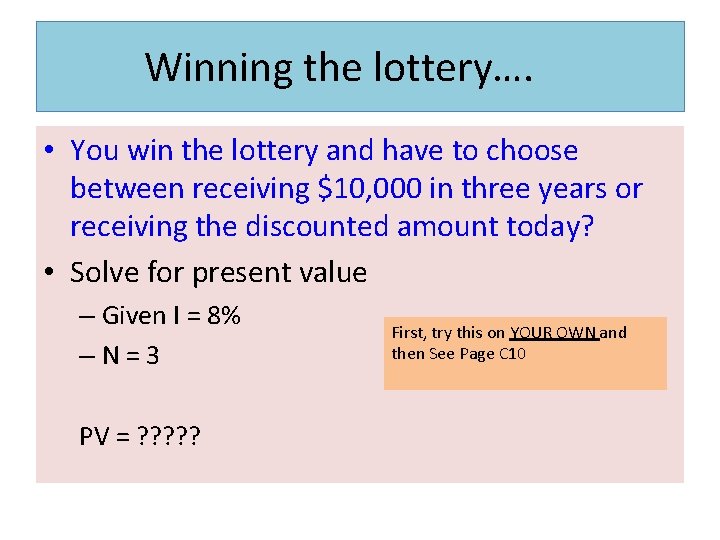
Winning the lottery…. • You win the lottery and have to choose between receiving $10, 000 in three years or receiving the discounted amount today? • Solve for present value – Given I = 8% –N=3 PV = ? ? ? First, try this on YOUR OWN and then See Page C 10
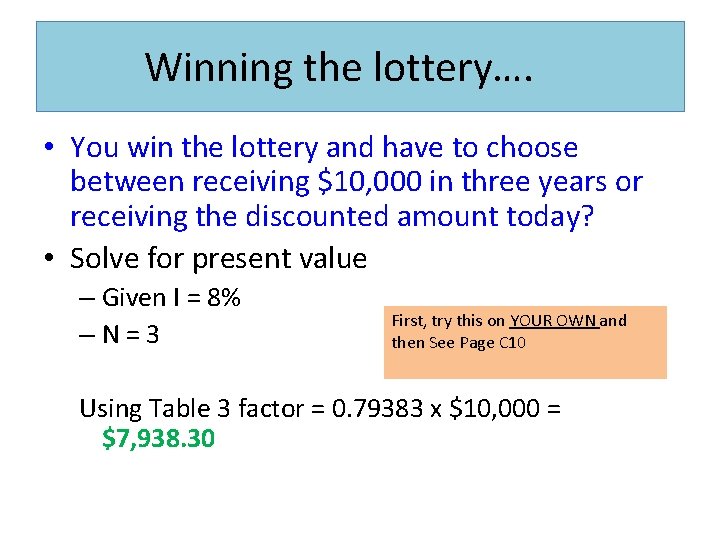
Winning the lottery…. • You win the lottery and have to choose between receiving $10, 000 in three years or receiving the discounted amount today? • Solve for present value – Given I = 8% –N=3 First, try this on YOUR OWN and then See Page C 10 Using Table 3 factor = 0. 79383 x $10, 000 = $7, 938. 30
What about Present Value of an annuity? • For example, instead of making payments, I’ll just pay Cash NOW….
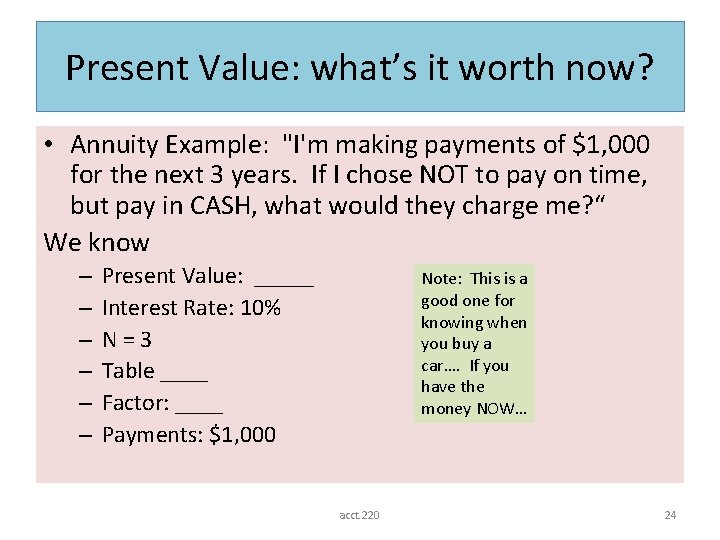
Present Value: what’s it worth now? • Annuity Example: "I'm making payments of $1, 000 for the next 3 years. If I chose NOT to pay on time, but pay in CASH, what would they charge me? “ We know – – – Present Value: _____ Interest Rate: 10% N=3 Table ____ Factor: ____ Payments: $1, 000 Note: This is a good one for knowing when you buy a car…. If you have the money NOW… acct. 220 24
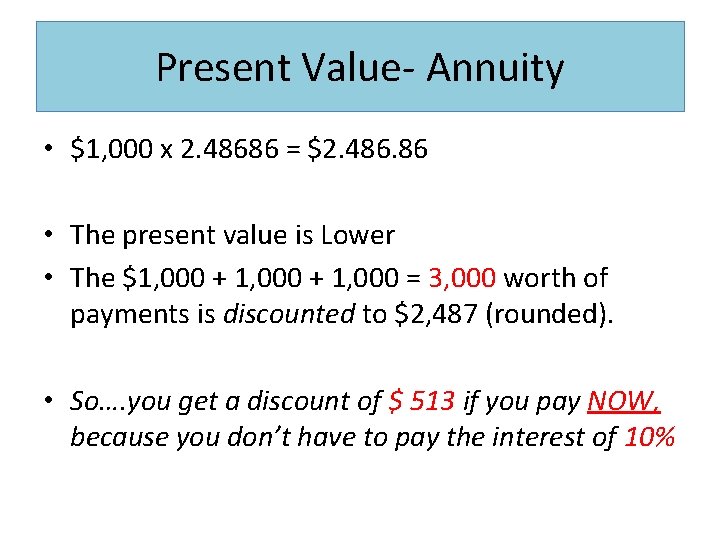
Present Value- Annuity • $1, 000 x 2. 48686 = $2. 486. 86 • The present value is Lower • The $1, 000 + 1, 000 = 3, 000 worth of payments is discounted to $2, 487 (rounded). • So…. you get a discount of $ 513 if you pay NOW, because you don’t have to pay the interest of 10%
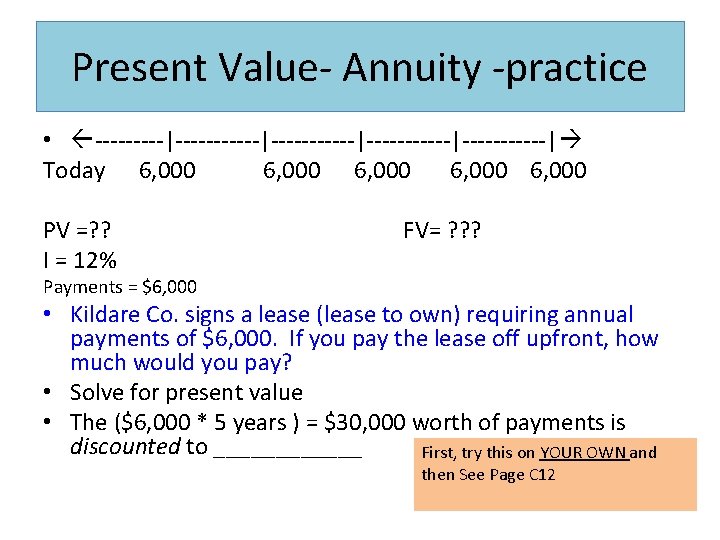
Present Value- Annuity -practice • ---------|-----------|-------| Today 6, 000 6, 000 PV =? ? I = 12% FV= ? ? ? Payments = $6, 000 • Kildare Co. signs a lease (lease to own) requiring annual payments of $6, 000. If you pay the lease off upfront, how much would you pay? • Solve for present value • The ($6, 000 * 5 years ) = $30, 000 worth of payments is discounted to ______ First, try this on YOUR OWN and then See Page C 12
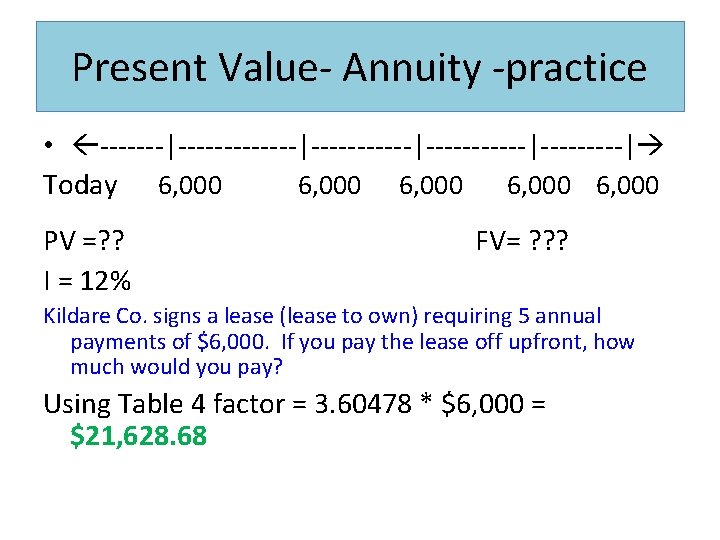
Present Value- Annuity -practice • -------|-----------|---------| Today 6, 000 6, 000 PV =? ? I = 12% FV= ? ? ? Kildare Co. signs a lease (lease to own) requiring 5 annual payments of $6, 000. If you pay the lease off upfront, how much would you pay? Using Table 4 factor = 3. 60478 * $6, 000 = $21, 628. 68
End of Appendix C – Part 1 • Go on to Part 2
Time Value of Money $$$$ Appendix C – BACK OF TEXTBOOK Part 2 Hint: Not in back of Chapter 10!
Appendix C – applications -Bonds • In Chapter 10, you studied Bonds are issued at Face Value, or Discount or Premium • We know – The Bond Selling Price varies depending on Market Interest Rate: • Face Value (Market interest rate = Bond contract rate) • Discounted from Face Value (Market interest rate > Bond contract rate) • Premium – higher than Face Value (Market interest rate < Bond contract rate) Question: How is the selling price of a bond calculated? acct. 220 30
Appendix C – applications -Bonds NEED TO KNOW: – Bond Interest Rate (the contract rate) % (only used to calculate the Bond interest payment amount) – Face Value of Bond Issuance ($1, 000 x number of bonds sold) – Bond Interest Payments in $$$ each interest payment date (Face Value of Bond Issuance x semi annual bond interest (contract) rate – Market Interest Rate % use with the Tables acct. 220 31
The Cash Flow of Bonds Let’s say you have 100 bonds. Review: What is the face value of a single bond? Stop and Answer before checking the next slide 32
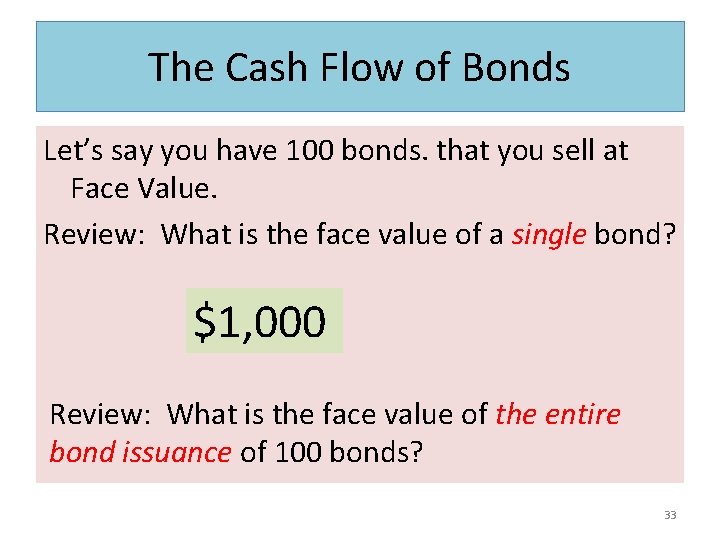
The Cash Flow of Bonds Let’s say you have 100 bonds. that you sell at Face Value. Review: What is the face value of a single bond? $1, 000 Review: What is the face value of the entire bond issuance of 100 bonds? 33
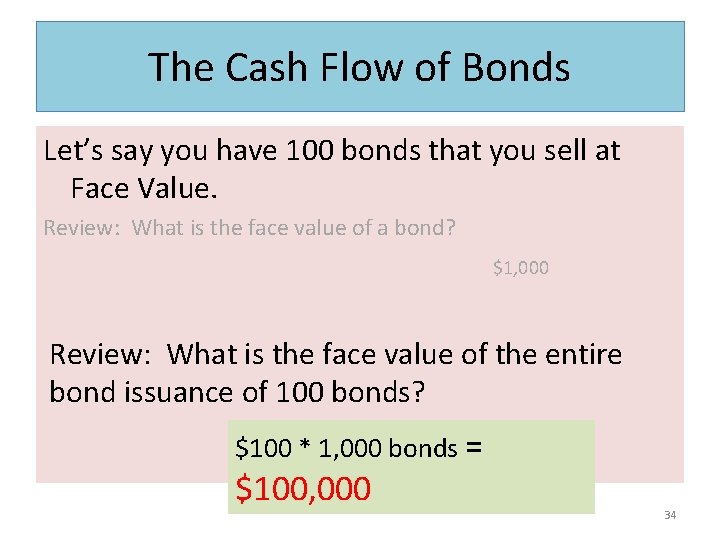
The Cash Flow of Bonds Let’s say you have 100 bonds that you sell at Face Value. Review: What is the face value of a bond? $1, 000 Review: What is the face value of the entire bond issuance of 100 bonds? $100 * 1, 000 bonds = $100, 000 34
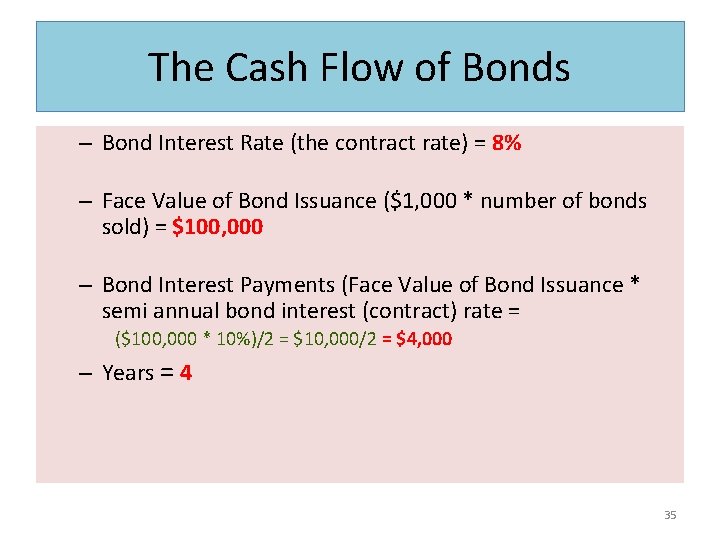
The Cash Flow of Bonds – Bond Interest Rate (the contract rate) = 8% – Face Value of Bond Issuance ($1, 000 * number of bonds sold) = $100, 000 – Bond Interest Payments (Face Value of Bond Issuance * semi annual bond interest (contract) rate = ($100, 000 * 10%)/2 = $10, 000/2 = $4, 000 – Years = 4 35
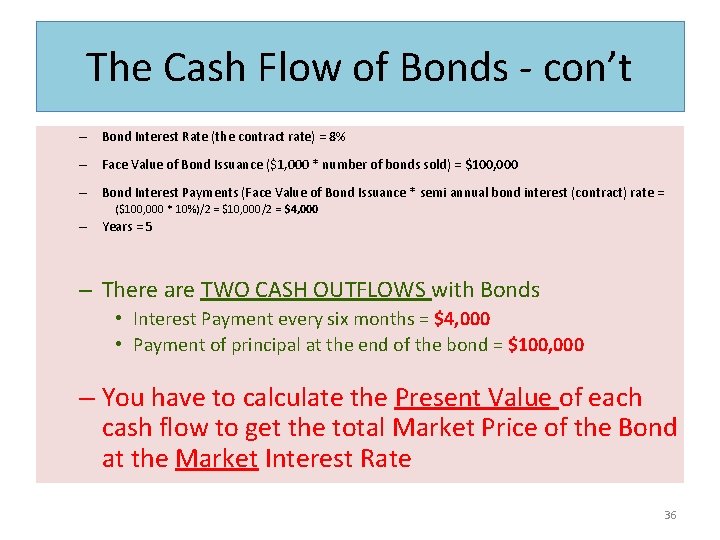
The Cash Flow of Bonds - con’t – Bond Interest Rate (the contract rate) = 8% – Face Value of Bond Issuance ($1, 000 * number of bonds sold) = $100, 000 – Bond Interest Payments (Face Value of Bond Issuance * semi annual bond interest (contract) rate = ($100, 000 * 10%)/2 = $10, 000/2 = $4, 000 – Years = 5 – There are TWO CASH OUTFLOWS with Bonds • Interest Payment every six months = $4, 000 • Payment of principal at the end of the bond = $100, 000 – You have to calculate the Present Value of each cash flow to get the total Market Price of the Bond at the Market Interest Rate 36
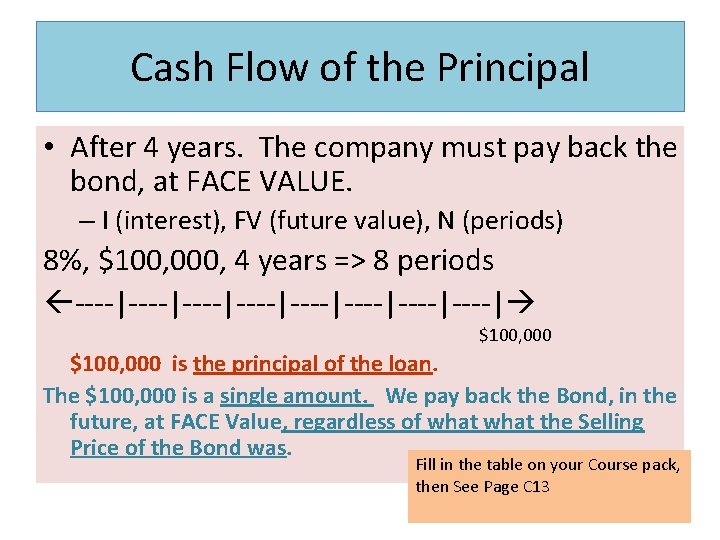
Cash Flow of the Principal • After 4 years. The company must pay back the bond, at FACE VALUE. – I (interest), FV (future value), N (periods) 8%, $100, 000, 4 years => 8 periods ----|----|----|----| $100, 000 is the principal of the loan. The $100, 000 is a single amount. We pay back the Bond, in the future, at FACE Value, regardless of what the Selling Price of the Bond was. Fill in the table on your Course pack, then See Page C 13 37
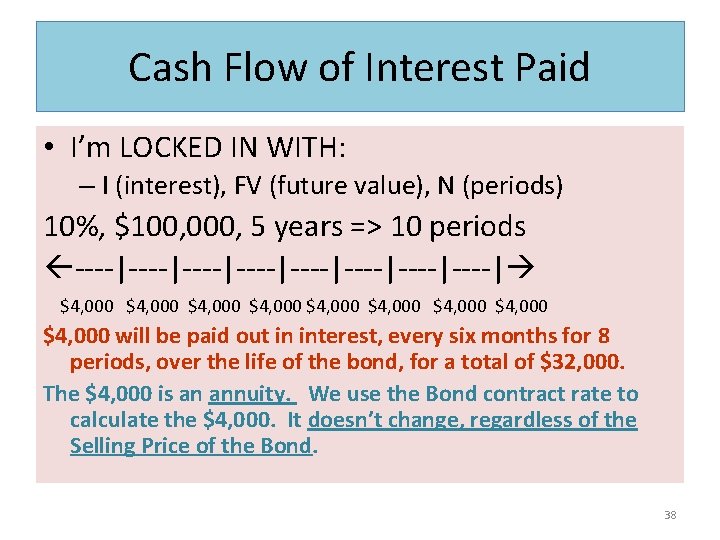
Cash Flow of Interest Paid • I’m LOCKED IN WITH: – I (interest), FV (future value), N (periods) 10%, $100, 000, 5 years => 10 periods ----|----|----|----| $4, 000 $4, 000 $4, 000 will be paid out in interest, every six months for 8 periods, over the life of the bond, for a total of $32, 000. The $4, 000 is an annuity. We use the Bond contract rate to calculate the $4, 000. It doesn’t change, regardless of the Selling Price of the Bond. 38
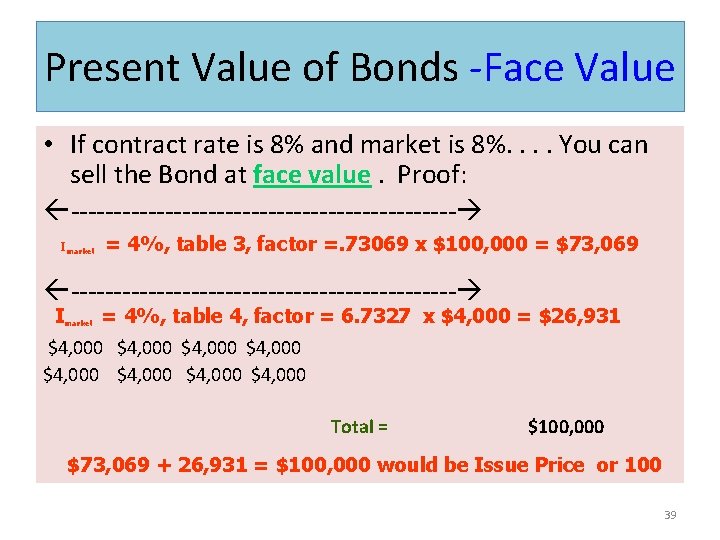
Present Value of Bonds -Face Value • If contract rate is 8% and market is 8%. . You can sell the Bond at face value. Proof: ----------------------- Imarket = 4%, table 3, factor =. 73069 x $100, 000 = $73, 069 ----------------------- I market = 4%, table 4, factor = 6. 7327 x $4, 000 = $26, 931 $4, 000 $4, 000 Total = $100, 000 $73, 069 + 26, 931 = $100, 000 would be Issue Price or 100 39
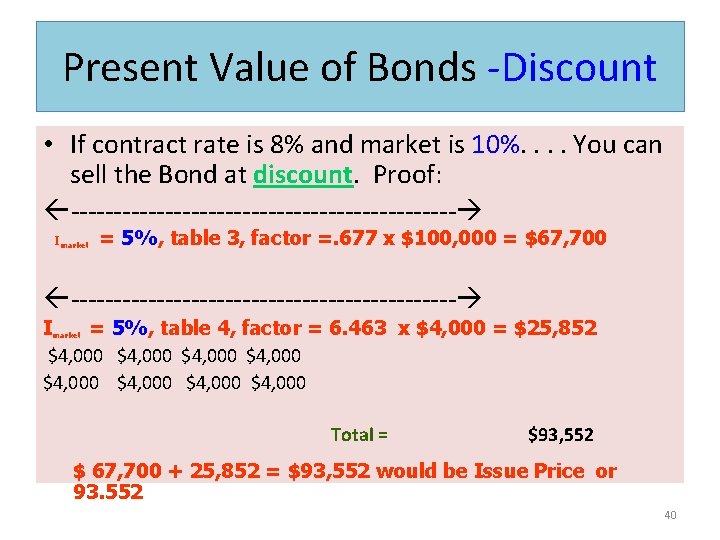
Present Value of Bonds -Discount • If contract rate is 8% and market is 10%. . You can sell the Bond at discount. Proof: ----------------------- Imarket = 5%, table 3, factor =. 677 x $100, 000 = $67, 700 ----------------------- I = 5%, table 4, factor = 6. 463 x $4, 000 = $25, 852 $4, 000 $4, 000 market Total = $93, 552 $ 67, 700 + 25, 852 = $93, 552 would be Issue Price or 93. 552 40
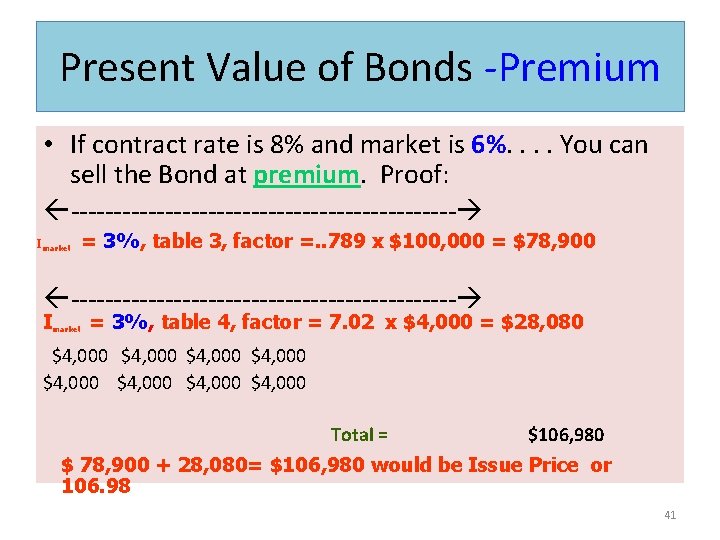
Present Value of Bonds -Premium • If contract rate is 8% and market is 6%. . You can sell the Bond at premium. Proof: ----------------------- Imarket = 3%, table 3, factor =. . 789 x $100, 000 = $78, 900 ----------------------- I market = 3%, table 4, factor = 7. 02 x $4, 000 = $28, 080 $4, 000 $4, 000 Total = $106, 980 $ 78, 900 + 28, 080= $106, 980 would be Issue Price or 106. 98 41
Appendix C • You are responsible for pages C 1 -C 14 acct. 220 42
End of Appendix C – part 2 • Good Bye and Good Luck!
- Slides: 43