
time Uncovering the Assumptions of Physics Christine A

- Slides: 43
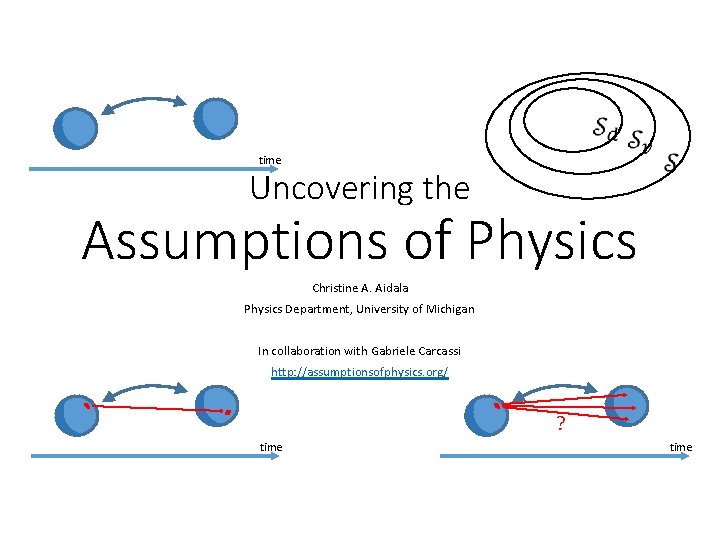
time Uncovering the Assumptions of Physics Christine A. Aidala Physics Department, University of Michigan In collaboration with Gabriele Carcassi http: //assumptionsofphysics. org/ ? time
Assumptions of Physics • The aim of the project is to find a handful of physical principles and assumptions from which the basic laws of physics can be derived • To do that we want to develop a general mathematical theory of experimental science: theory that studies scientific theories • A formal framework that forces us to clarify our assumptions • From those assumptions the mathematical objects are derived • Each mathematical object has a clear physical meaning and no object is unphysical • Gives us concepts and tools that span across different disciplines • Gives us a better understanding of what the laws of physics are and what they represent Christine Aidala, Applied Physics Seminar, Feb 13, 2018 2
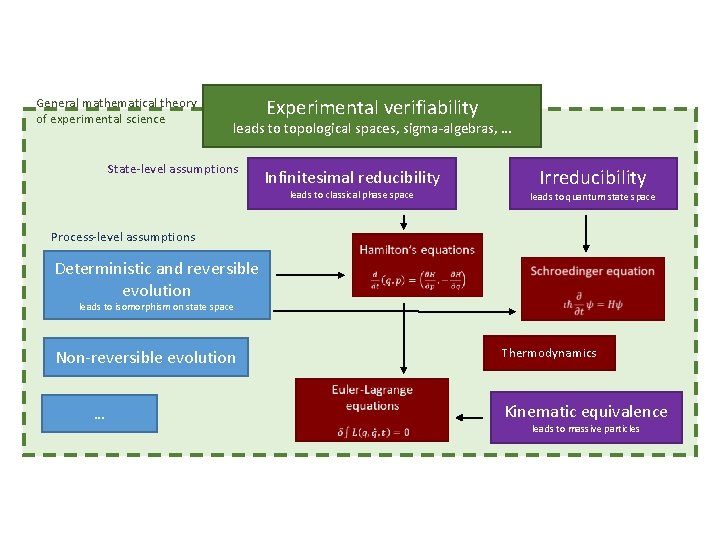
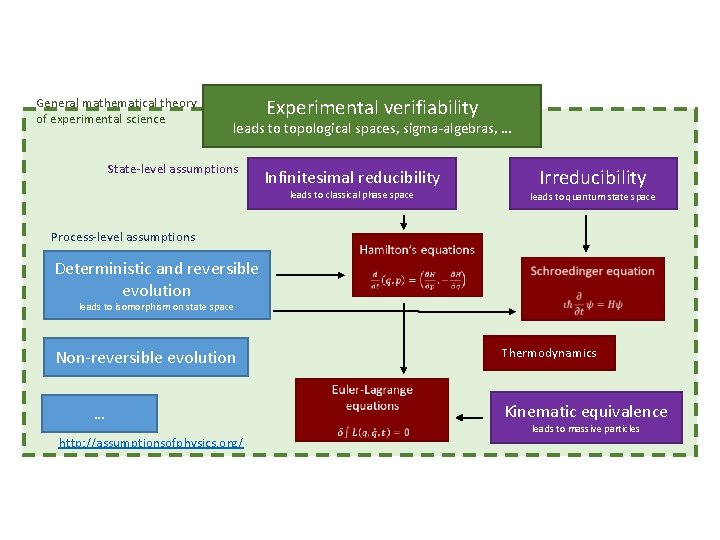
General mathematical theory of experimental science Experimental verifiability leads to topological spaces, sigma-algebras, … State-level assumptions Infinitesimal reducibility leads to classical phase space Irreducibility leads to quantum state space Process-level assumptions Deterministic and reversible evolution leads to isomorphism on state space Non-reversible evolution … Thermodynamics Kinematic equivalence leads to massive particles
Assumptions of Physics • The scope of the project is broad, touching elements of many different disciplines • Yet it is the ability to see how the different pieces fit that makes it very rewarding • In this talk we’ll go through at least the major starting points and hopefully give a sense of how they lead to certain branches of known physics, and the types of insight this approach can provide Christine Aidala, Applied Physics Seminar, Feb 13, 2018 4
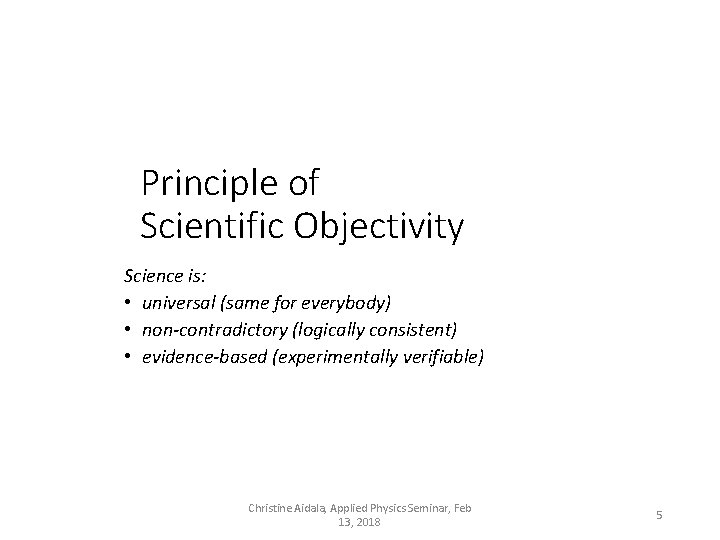
Principle of Scientific Objectivity Science is: • universal (same for everybody) • non-contradictory (logically consistent) • evidence-based (experimentally verifiable) Christine Aidala, Applied Physics Seminar, Feb 13, 2018 5
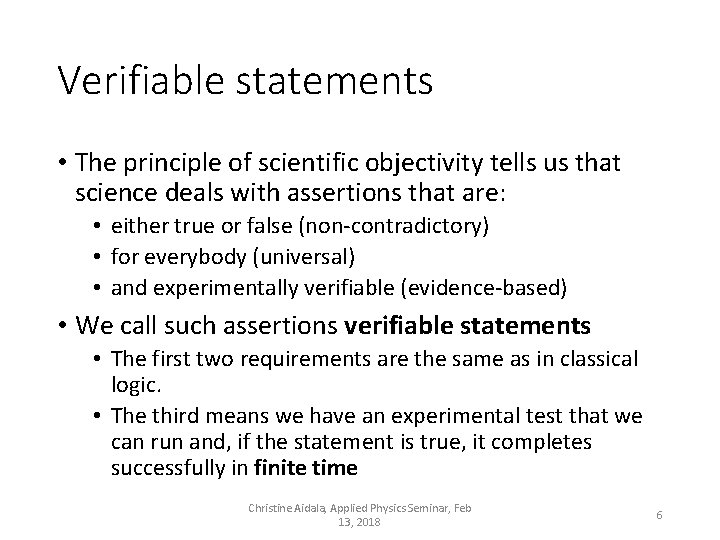
Verifiable statements • The principle of scientific objectivity tells us that science deals with assertions that are: • either true or false (non-contradictory) • for everybody (universal) • and experimentally verifiable (evidence-based) • We call such assertions verifiable statements • The first two requirements are the same as in classical logic. • The third means we have an experimental test that we can run and, if the statement is true, it completes successfully in finite time Christine Aidala, Applied Physics Seminar, Feb 13, 2018 6
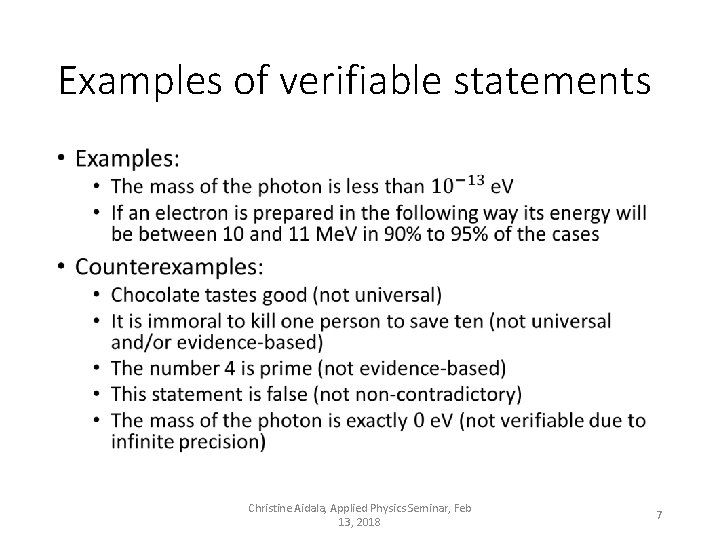
Examples of verifiable statements • Christine Aidala, Applied Physics Seminar, Feb 13, 2018 7
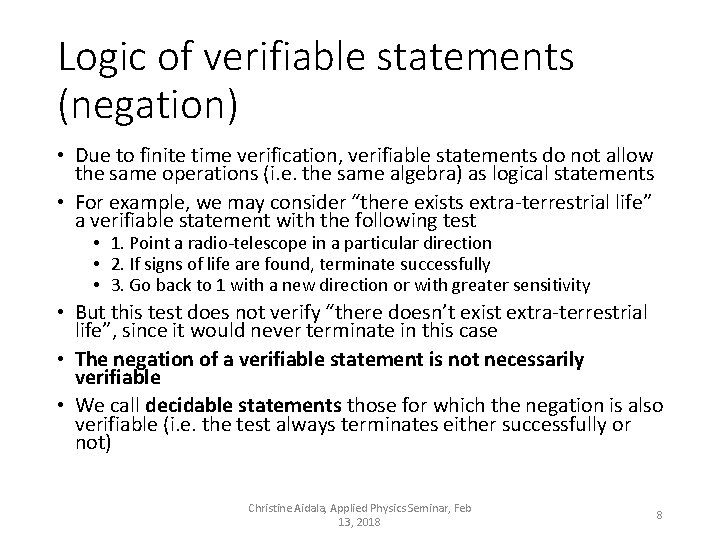
Logic of verifiable statements (negation) • Due to finite time verification, verifiable statements do not allow the same operations (i. e. the same algebra) as logical statements • For example, we may consider “there exists extra-terrestrial life” a verifiable statement with the following test • 1. Point a radio-telescope in a particular direction • 2. If signs of life are found, terminate successfully • 3. Go back to 1 with a new direction or with greater sensitivity • But this test does not verify “there doesn’t exist extra-terrestrial life”, since it would never terminate in this case • The negation of a verifiable statement is not necessarily verifiable • We call decidable statements those for which the negation is also verifiable (i. e. the test always terminates either successfully or not) Christine Aidala, Applied Physics Seminar, Feb 13, 2018 8
Logic of verifiable statements (conjunction) • We can take a set of verifiable statements and create the conjunction (i. e. the logical AND) • “The horizontal velocity of the ball is between 0 and 1 m/s” AND “the vertical velocity of the ball is between 3 and 4 m/s” • Since we can verify each statement, we simply verify all of them one at a time. But we can only combine finitely many statements, or we would never finish checking all of them. • The finite conjunction of verifiable statements is a verifiable statement Christine Aidala, Applied Physics Seminar, Feb 13, 2018 9
Logic of verifiable statements (disjunction) • We can take a set of verifiable statements and create the disjunction (i. e. the logical OR) • “The horizontal velocity of the ball is between 0 and 1 m/s” OR “the horizontal of the ball is between 3 and 4 m/s” • Since we can verify each statement, we can verify them one at a time and, as long as one is verified, the disjunction is verified. Since we don’t need to verify all of them, we can combine infinitely many. But they have to be countably many or we wouldn’t find the test that terminates in finite time. • The countable disjunction of verifiable statements is a verifiable statement Christine Aidala, Applied Physics Seminar, Feb 13, 2018 10
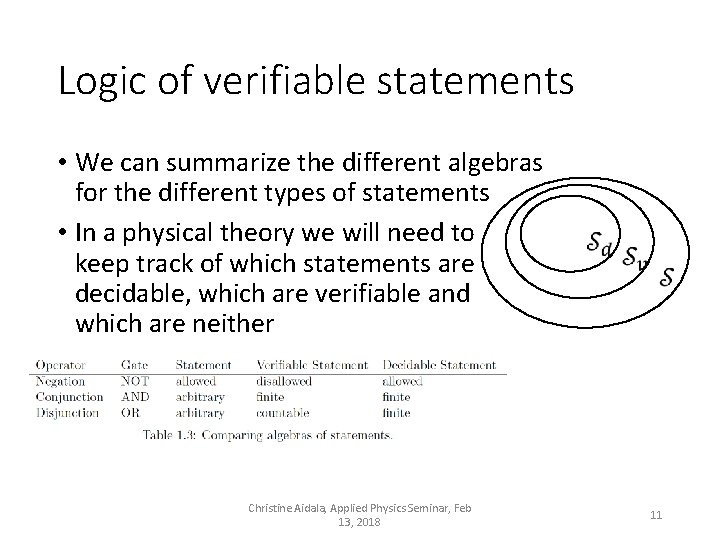
Logic of verifiable statements • We can summarize the different algebras for the different types of statements • In a physical theory we will need to keep track of which statements are decidable, which are verifiable and which are neither Christine Aidala, Applied Physics Seminar, Feb 13, 2018 11
Scientific models and domains • A scientific model or theory, then, is fully specified by a set of verifiable statements, which, together with their algebra, forms the most fundamental mathematical structure in our general theory: an experimental domain • The set has to be countable because, even with infinite time, we can’t verify more than those • The possible cases identified in theory are those experimentally distinguishable • The finiteness required by experimental verification is a major constraint on what mathematical structures are possible in experimental science • For example, a set of physically distinguishable cases will never have cardinality greater than that of the continuum Christine Aidala, Applied Physics Seminar, Feb 13, 2018 12
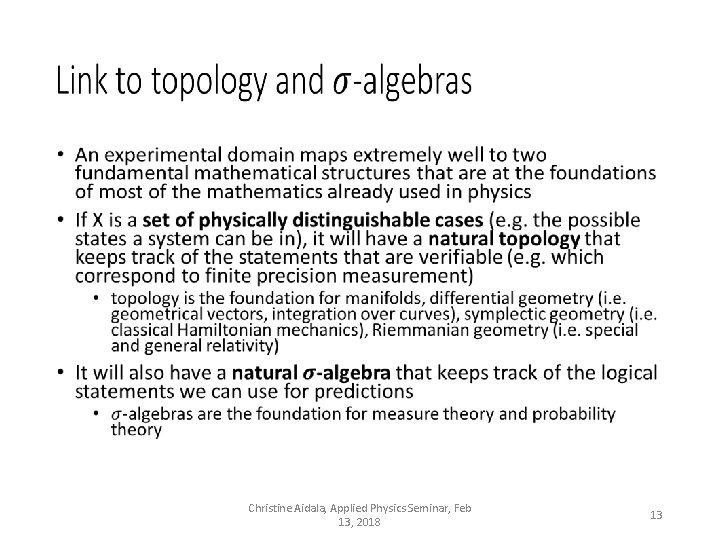
• Christine Aidala, Applied Physics Seminar, Feb 13, 2018 13
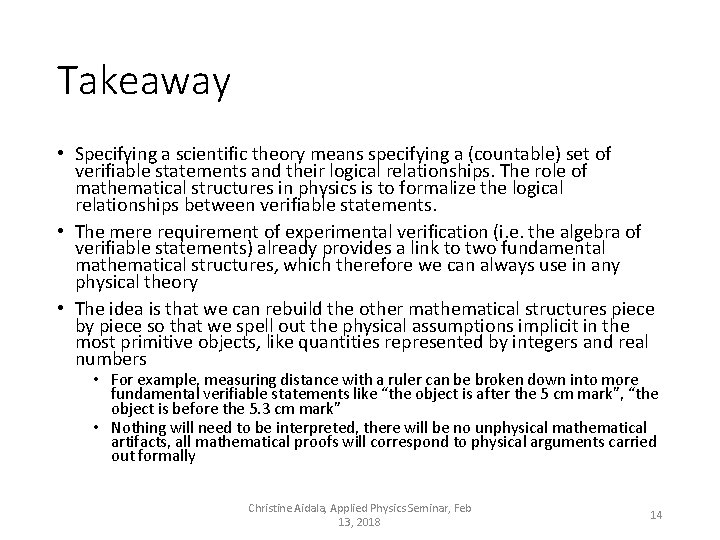
Takeaway • Specifying a scientific theory means specifying a (countable) set of verifiable statements and their logical relationships. The role of mathematical structures in physics is to formalize the logical relationships between verifiable statements. • The mere requirement of experimental verification (i. e. the algebra of verifiable statements) already provides a link to two fundamental mathematical structures, which therefore we can always use in any physical theory • The idea is that we can rebuild the other mathematical structures piece by piece so that we spell out the physical assumptions implicit in the most primitive objects, like quantities represented by integers and real numbers • For example, measuring distance with a ruler can be broken down into more fundamental verifiable statements like “the object is after the 5 cm mark”, “the object is before the 5. 3 cm mark” • Nothing will need to be interpreted, there will be no unphysical mathematical artifacts, all mathematical proofs will correspond to physical arguments carried out formally Christine Aidala, Applied Physics Seminar, Feb 13, 2018 14
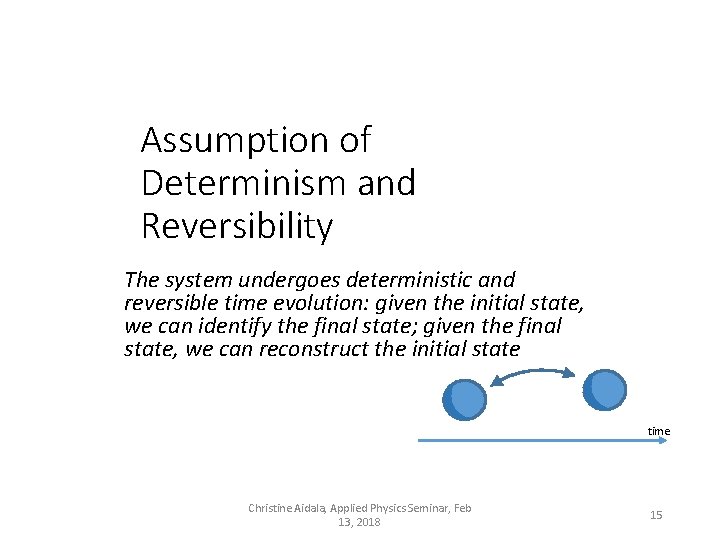
Assumption of Determinism and Reversibility The system undergoes deterministic and reversible time evolution: given the initial state, we can identify the final state; given the final state, we can reconstruct the initial state time Christine Aidala, Applied Physics Seminar, Feb 13, 2018 15
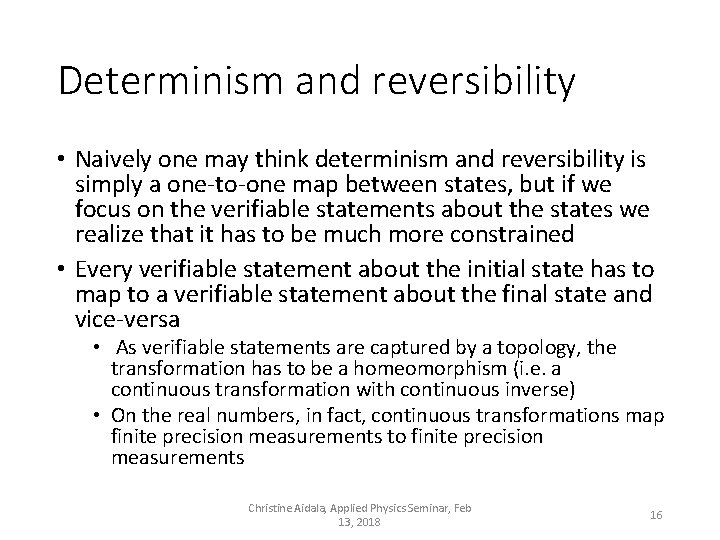
Determinism and reversibility • Naively one may think determinism and reversibility is simply a one-to-one map between states, but if we focus on the verifiable statements about the states we realize that it has to be much more constrained • Every verifiable statement about the initial state has to map to a verifiable statement about the final state and vice-versa • As verifiable statements are captured by a topology, the transformation has to be a homeomorphism (i. e. a continuous transformation with continuous inverse) • On the real numbers, in fact, continuous transformations map finite precision measurements to finite precision measurements Christine Aidala, Applied Physics Seminar, Feb 13, 2018 16
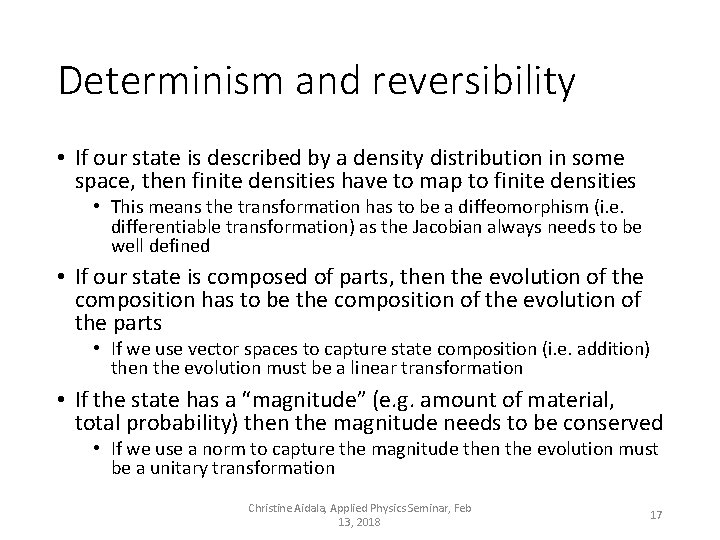
Determinism and reversibility • If our state is described by a density distribution in some space, then finite densities have to map to finite densities • This means the transformation has to be a diffeomorphism (i. e. differentiable transformation) as the Jacobian always needs to be well defined • If our state is composed of parts, then the evolution of the composition has to be the composition of the evolution of the parts • If we use vector spaces to capture state composition (i. e. addition) then the evolution must be a linear transformation • If the state has a “magnitude” (e. g. amount of material, total probability) then the magnitude needs to be conserved • If we use a norm to capture the magnitude then the evolution must be a unitary transformation Christine Aidala, Applied Physics Seminar, Feb 13, 2018 17
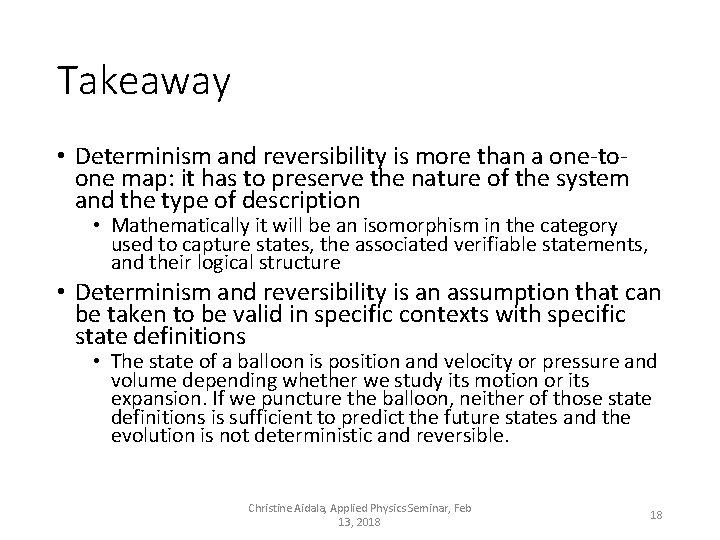
Takeaway • Determinism and reversibility is more than a one-toone map: it has to preserve the nature of the system and the type of description • Mathematically it will be an isomorphism in the category used to capture states, the associated verifiable statements, and their logical structure • Determinism and reversibility is an assumption that can be taken to be valid in specific contexts with specific state definitions • The state of a balloon is position and velocity or pressure and volume depending whether we study its motion or its expansion. If we puncture the balloon, neither of those state definitions is sufficient to predict the future states and the evolution is not deterministic and reversible. Christine Aidala, Applied Physics Seminar, Feb 13, 2018 18
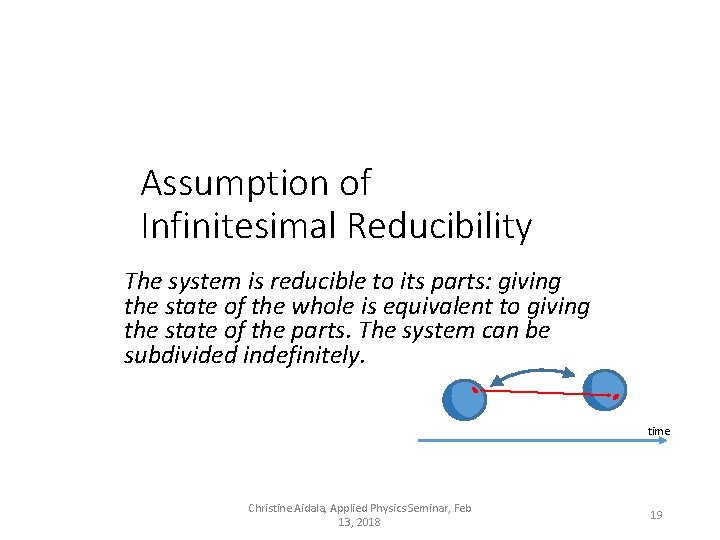
Assumption of Infinitesimal Reducibility The system is reducible to its parts: giving the state of the whole is equivalent to giving the state of the parts. The system can be subdivided indefinitely. time Christine Aidala, Applied Physics Seminar, Feb 13, 2018 19
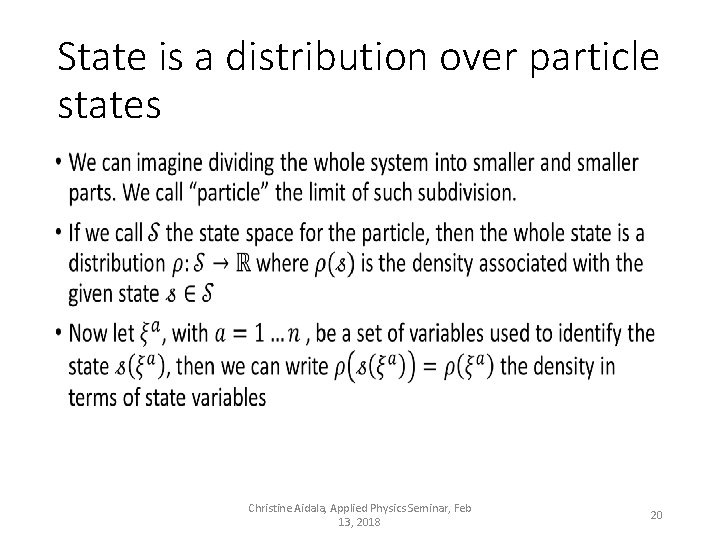
State is a distribution over particle states • Christine Aidala, Applied Physics Seminar, Feb 13, 2018 20
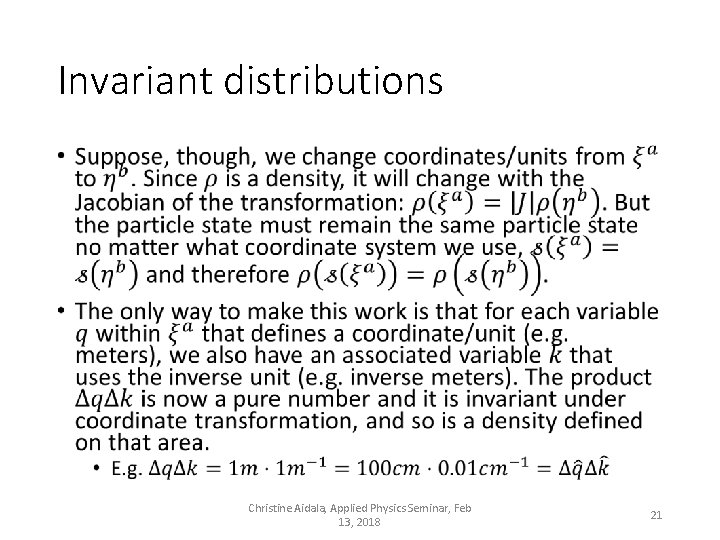
Invariant distributions • Christine Aidala, Applied Physics Seminar, Feb 13, 2018 21
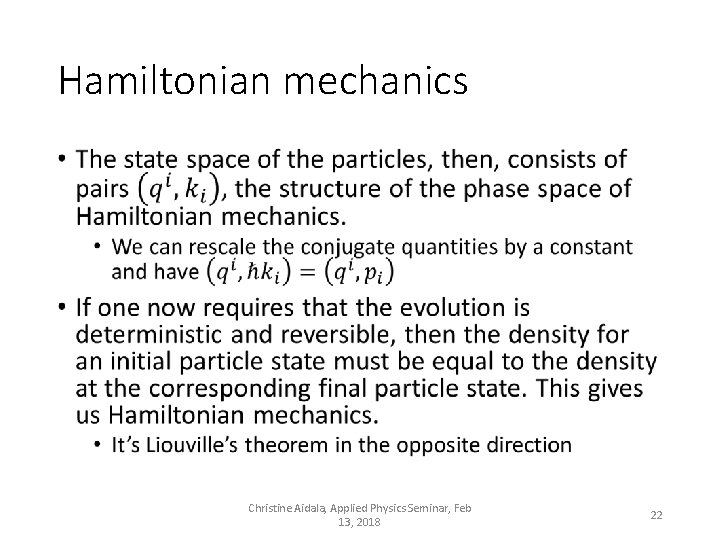
Hamiltonian mechanics • Christine Aidala, Applied Physics Seminar, Feb 13, 2018 22
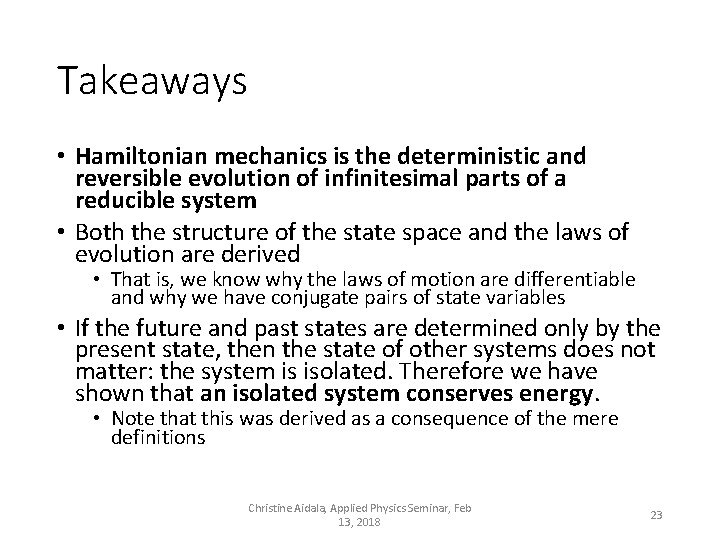
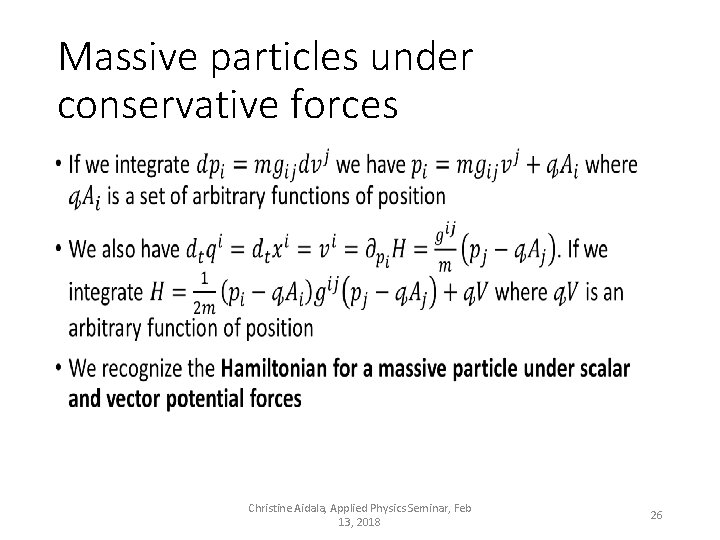
Takeaways • Hamiltonian mechanics is the deterministic and reversible evolution of infinitesimal parts of a reducible system • Both the structure of the state space and the laws of evolution are derived • That is, we know why the laws of motion are differentiable and why we have conjugate pairs of state variables • If the future and past states are determined only by the present state, then the state of other systems does not matter: the system is isolated. Therefore we have shown that an isolated system conserves energy. • Note that this was derived as a consequence of the mere definitions Christine Aidala, Applied Physics Seminar, Feb 13, 2018 23
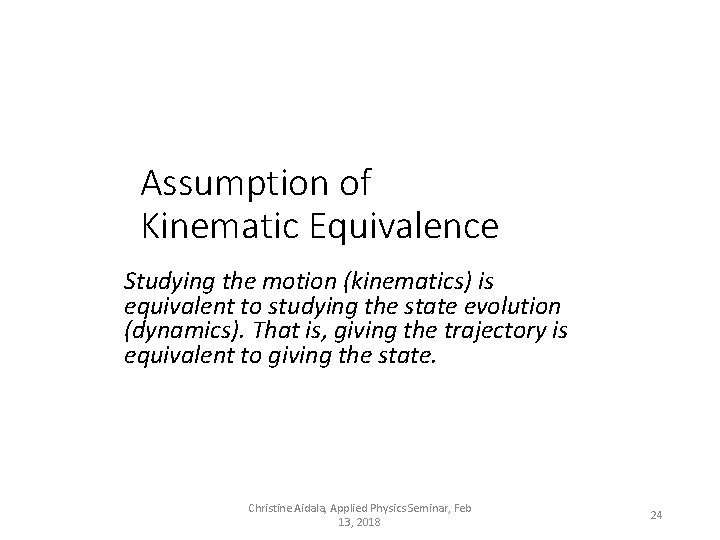
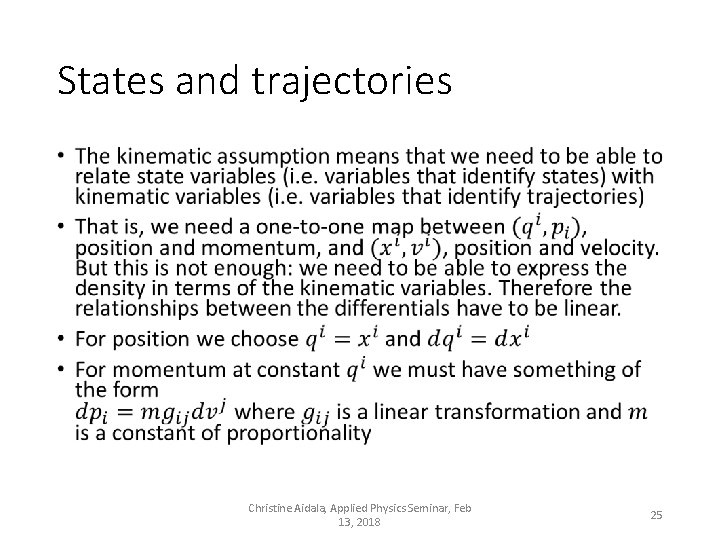
Assumption of Kinematic Equivalence Studying the motion (kinematics) is equivalent to studying the state evolution (dynamics). That is, giving the trajectory is equivalent to giving the state. Christine Aidala, Applied Physics Seminar, Feb 13, 2018 24
States and trajectories • Christine Aidala, Applied Physics Seminar, Feb 13, 2018 25
Massive particles under conservative forces • Christine Aidala, Applied Physics Seminar, Feb 13, 2018 26
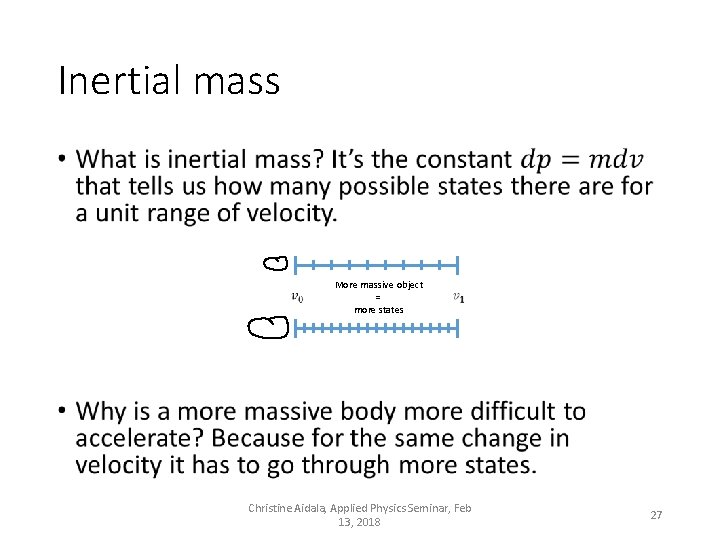
Inertial mass • More massive object = more states Christine Aidala, Applied Physics Seminar, Feb 13, 2018 27
Massless particles • Note that massless particles (e. g. photons) do not satisfy kinematic equivalence: the velocity is always the same so it is not enough to reconstruct the value of momentum. Multiple states will travel through the same trajectory • The fact that the mass is zero does not mean that they are very easy to accelerate. It means there is no relation between momentum and speed. Christine Aidala, Applied Physics Seminar, Feb 13, 2018 28
Takeaways • Massive particles under conservative forces are infinitesimal parts of a system for which the trajectory is enough to reconstruct its deterministic and reversible state evolution • Mass is the scaling factor between the number of trajectories identified by a range of velocity and the number of states identified by a range of momentum Christine Aidala, Applied Physics Seminar, Feb 13, 2018 29
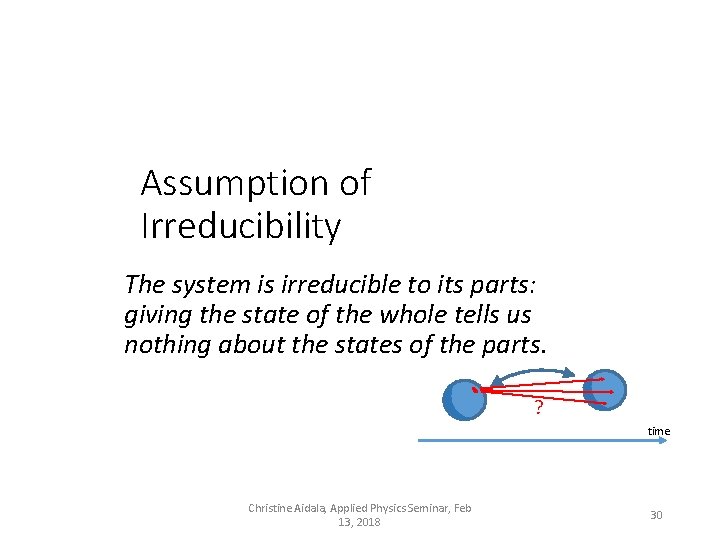
Assumption of Irreducibility The system is irreducible to its parts: giving the state of the whole tells us nothing about the states of the parts. ? time Christine Aidala, Applied Physics Seminar, Feb 13, 2018 30
Irreducibility and random processes • With infinitesimal reducibility we could track the motion of each part of the system. With irreducibility, instead, we cannot: any part could have been mapped to any other part of the same size. • We will have a stable overall distribution where the parts are constantly randomly shifting around • The parts are identified by random variables and their evolution is a pure random process • The strength of the random process within a fraction of the system will be proportional to the size of that fraction (more parts with which to switch) Christine Aidala, Applied Physics Seminar, Feb 13, 2018 31
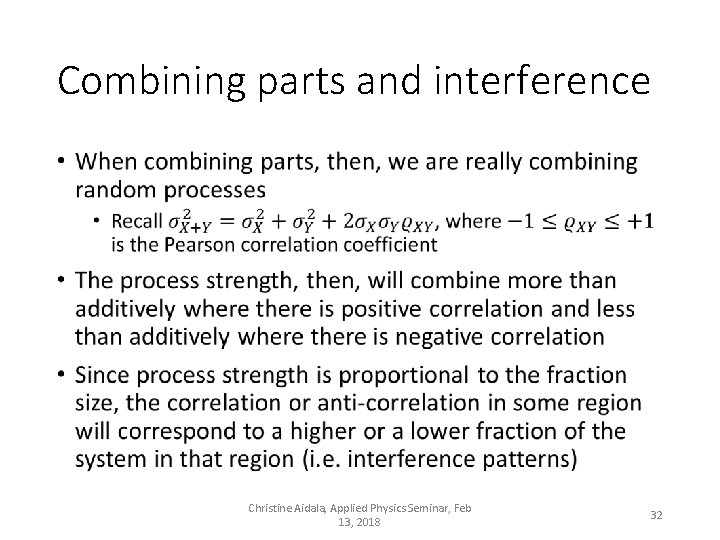
Combining parts and interference • Christine Aidala, Applied Physics Seminar, Feb 13, 2018 32
Distribution spread • Note that the knowledge of the whole tells us something about the parts: namely that they have to be within that whole • If we shrink the spread of the whole system in both position and momentum, then we are restricting the random processes: we are reducing the states available to the parts • In the limit, if the whole system were at one point in both position and momentum, we would know the position and momentum of all parts, these would not be able to randomly fluctuate within the distribution: the system is no longer irreducible • An irreducible system, then, must have a minimum spread for the system in position and momentum Christine Aidala, Applied Physics Seminar, Feb 13, 2018 33
Non-locality • Now suppose the system is spread over a long distance • Suppose we interact, within a region, with part of the system. • Given that the system is irreducible, we cannot tag one part and therefore we can’t interact only with part of the system: we will interact with the whole, even if parts are distant • Yet, since the motion of the parts is purely random, we cannot use this non-local interaction to transfer messages, introduce cause-effect relationships, and so on Christine Aidala, Applied Physics Seminar, Feb 13, 2018 34
Takeaway • The irreducibility of the system leads to the state space of quantum particle mechanics • A complex number is used to represent an element of the vector space formed by two random variables; the cosine of phase differences represents the Pearson correlation coefficient • The deterministic and reversible evolution of an irreducible system leads to the Schroedinger equation • The non-deterministic evolution, in certain cases, leads to the projection (i. e. collapse) Christine Aidala, Applied Physics Seminar, Feb 13, 2018 35
Overall takeaway • It takes few assumptions to recover the basics of classical and quantum Hamiltonian particle mechanics • These assumptions seem simple but they pack a lot more consequences than one would think at first and they help clarify the realm of applicability of theories • The assumptions tell us how states are related in time (i. e. past and future), at different scales (i. e. whole and parts) and to trajectories. These relatively few concepts are of a general nature and allow us to focus on the essentials of the different theories and understand what is common and what is different Christine Aidala, Applied Physics Seminar, Feb 13, 2018 36
Current activities and possible opportunities for contribution
Current activities and possible opportunities for contribution • Extend – Bring different areas within the framework • Literature search on math/physics/philosophy of science for other areas, investigate other approaches, understand what parts can fit and be used • Consolidate – Take the published ideas and make them more rigorous • Review current material and provide feedback, work on the more precise mathematical formulation where missing • Popularize – Prepare material to make the work more accessible Christine Aidala, Applied Physics Seminar, Feb 13, 2018 38
Extend • Currently working on thermodynamics and statistical mechanics • The idea is to substitute deterministic and reversible evolution with non-reversibility at the macro level, which leads to equilibria (i. e. the same final state is reached with different initial states). • At the micro level, instead, we would have non-determinism. This means knowledge of the initial micro-state is not enough to predict the final micro-state, i. e. more information is needed: an increase in information entropy. • What parts of other approaches can we use? How much can be derived from these simple premises? What recombination of established concepts provides the most insight with the fewest starting points? What mathematical tools are the most appropriate? • Other areas of future extensions: field theories (classical and quantum), gravitation, quantum hydrodynamics/stochastic mechanics, . . . Christine Aidala, Applied Physics Seminar, Feb 13, 2018 39
Consolidate • Review what (we think) is finished • Extend the formal framework to distributions and densities • The formal framework right now roughly stops at manifolds (i. e. physically distinguishable cases that can be identified by a set of numeric variables). The next step is to formalize the concept of a distribution from statements like “The mass within volume V is between 1 and 2 grams”. • This should provide a bridge between statistics, measure theory and differential geometry • Other extensions to the formal framework: probability theory, states and processes, … Christine Aidala, Applied Physics Seminar, Feb 13, 2018 40
Popularize • Find better ways to convey the information • Figures, examples, … • Prepare material for undergraduate audiences • Prepare didactic material • E. g. supplemental material aimed at different standard courses • Prepare videos or other multimedia material Christine Aidala, Applied Physics Seminar, Feb 13, 2018 41
For further information • See our project website: http: //assumptionsofphysics. org/ • Includes links to conference presentations, published papers, drafts of first three chapters of a book, series of videos, Gabriele Carcassi’s blog on the foundations of physics Christine Aidala, Applied Physics Seminar, Feb 13, 2018 42
General mathematical theory of experimental science Experimental verifiability leads to topological spaces, sigma-algebras, … State-level assumptions Infinitesimal reducibility leads to classical phase space Irreducibility leads to quantum state space Process-level assumptions Deterministic and reversible evolution leads to isomorphism on state space Non-reversible evolution … http: //assumptionsofphysics. org/ Thermodynamics Kinematic equivalence leads to massive particles