
Time Table and Train Order Dispatching Lessons Burnt
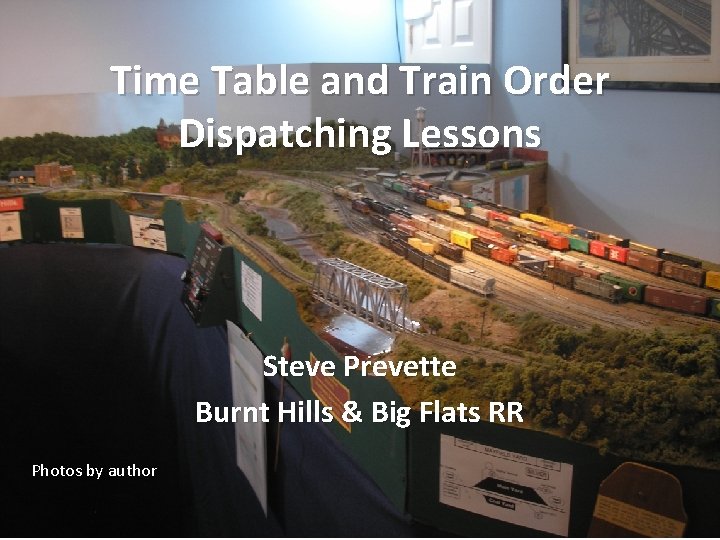
Time Table and Train Order Dispatching Lessons Burnt Hills and Big Flats Railroad Employee Training DISPATCHER Steve Prevette Burnt Hills & Big Flats RR Photos by author
Introduction • This presentation is a set of lessons learned from implementing TT&TO over the past two years on my home layout • I HAVE MADE COMPROMISES! – You may or may not agree with them • Oriented to Single Track TT&TO • Example of TT&TO Dispatcher training
Your Host Layout • The Burnt Hills and Big Flats is a 20 x 30 ft N scale layout, 1970 NYO&W • Have always “done operations” • Dispatched with simplified track warrants – closer to “mother may I? ” – Fixed location radios – 5 to 7 operators • Moved from Washington state to South Carolina in 2009 • See Kalmbach GMR to be published this year
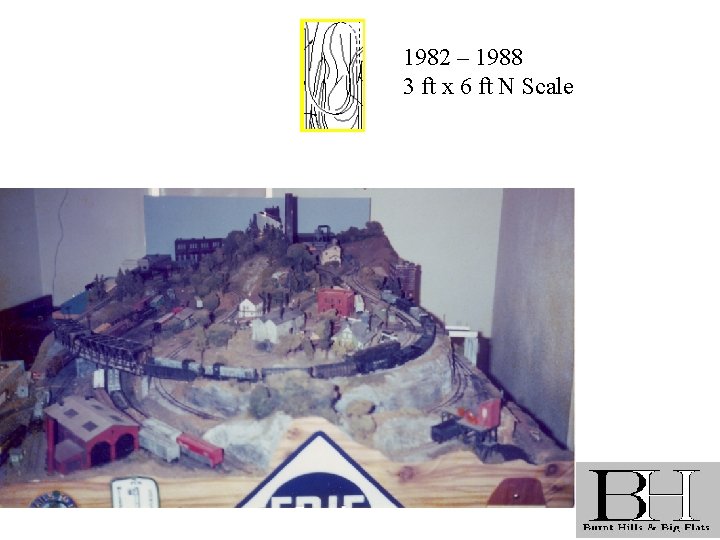
1982 – 1988 3 ft x 6 ft N Scale
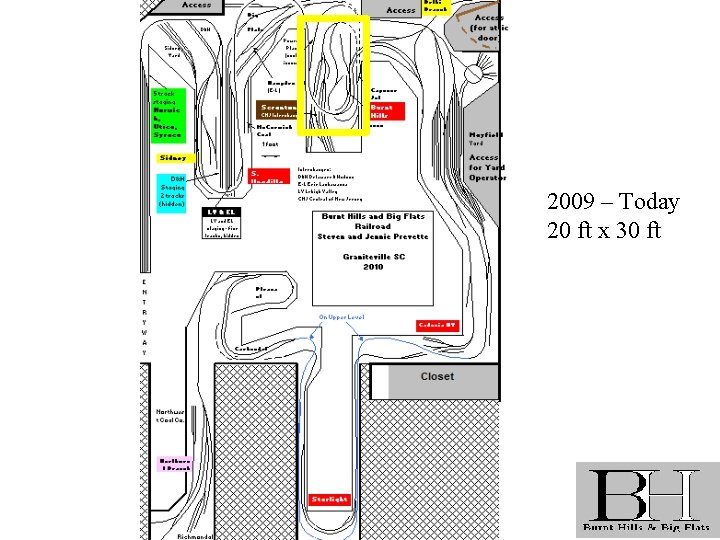
2009 – Today 20 ft x 30 ft
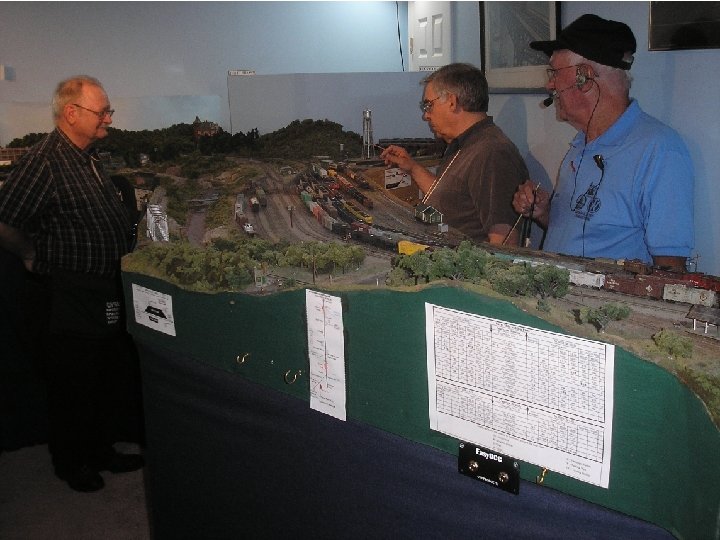
New Location, New Crew
New Location, New Crew • New crew size usually 8 to 12 – Larger crew size, need more jobs • Oral orders were getting forgotten, unfamiliarity with layout • Crew did not like using radios • One layout in the existing group was planning on going TT&TO
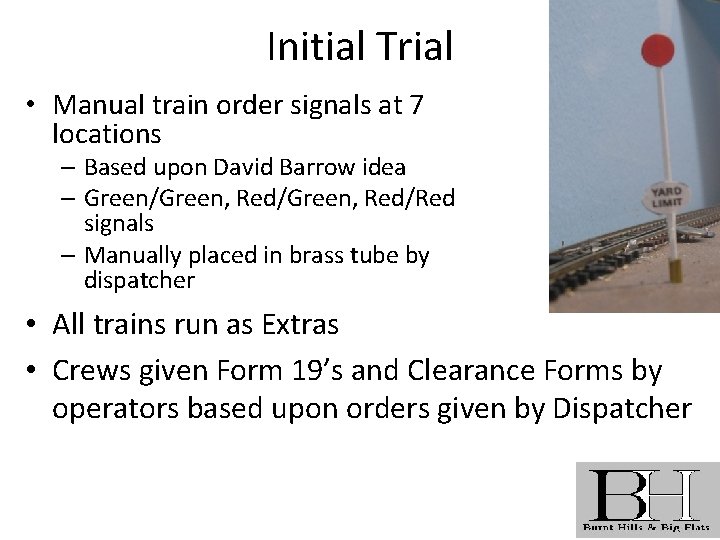
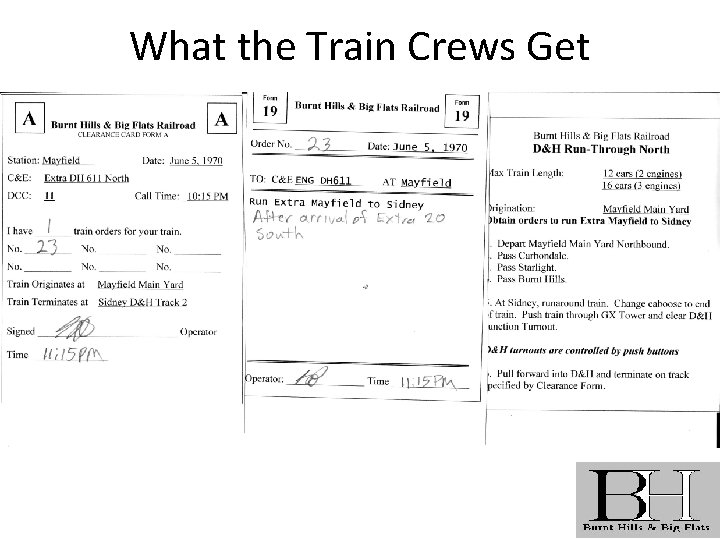
Initial Trial • Manual train order signals at 7 locations – Based upon David Barrow idea – Green/Green, Red/Red signals – Manually placed in brass tube by dispatcher • All trains run as Extras • Crews given Form 19’s and Clearance Forms by operators based upon orders given by Dispatcher
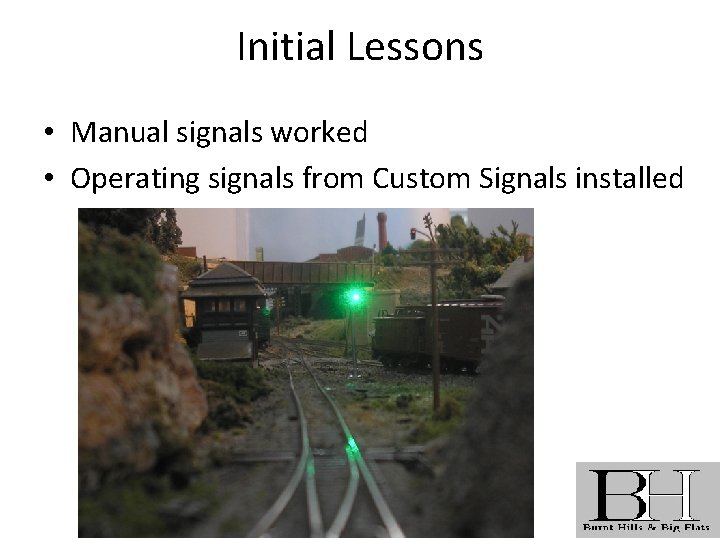
Initial Lessons • Manual signals worked • Operating signals from Custom Signals installed
Initial Lessons • All trains as Extras created a LOT of Train Orders – Created a Schedule with 12 Scheduled Trains – Went to pre-printed Form G’s (run extra) to cover the remaining extra trains – Added yard limits for two towns that had lots of interactions between local switching and through trains
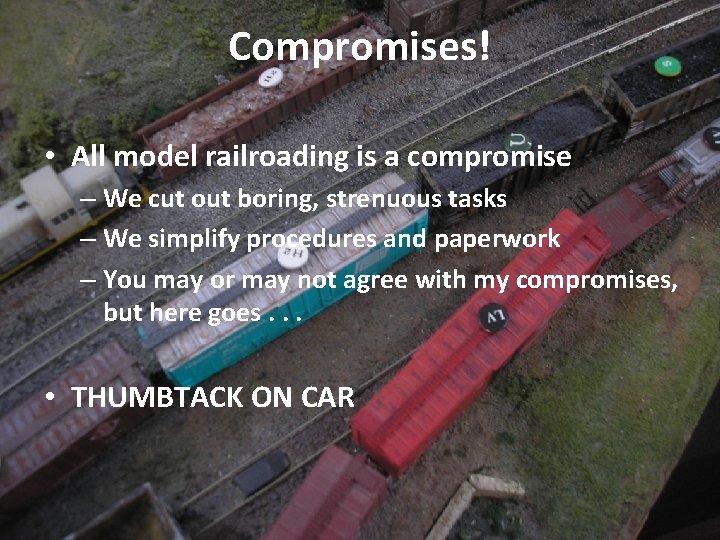
Compromises! • All model railroading is a compromise – We cut out boring, strenuous tasks – We simplify procedures and paperwork – You may or may not agree with my compromises, but here goes. . . • THUMBTACK ON CAR
Pre-Printed Orders • The dispatcher starts with pre-printed Form G (Run Extra from A to B) Train Orders for all trains expected to be run • Pre-printed Clearance Form A’s with some non -prototype info – DCC two digit channel – Point of Origination and Termination – Call Time
No Order Dictation • My operators do not find repeating back orders and writing them to be “fun” • Dispatcher hands written orders to the operators, who then post at train order signals • Gives flexibility when there are not enough crew to man all operators • Keeps communications lines open for OS reports (consider the compressed distances)
No Register Books • I should have at least three register stations – Sidney (north end of division and adjacent to staging) – Big Flats (adjacent to southern staging) – Mayfield (division point) • At the beginning of the session any pending trains are announced, and upon completion of any scheduled train • This will probably be the next compromise to be “undone”
What the Train Crews Get • Small Clipboard – Schematic on back, Schedule on Front – Train Order(s) – Clearance Form A – Train Instructions
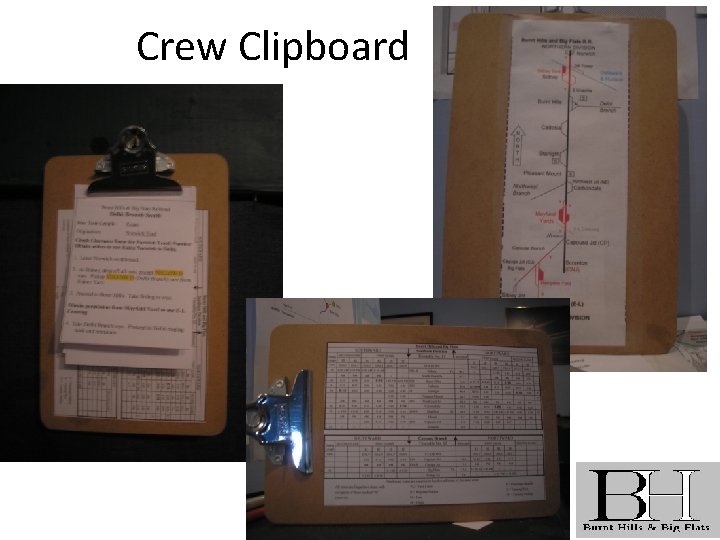
Crew Clipboard
What the Train Crews Get
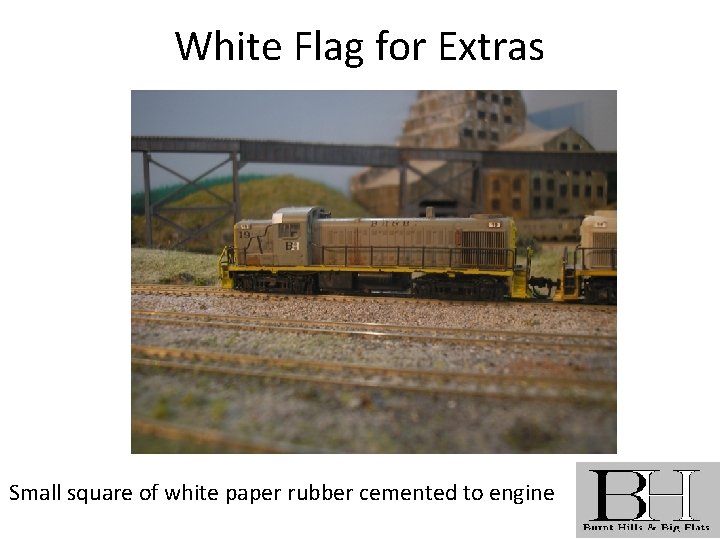
White Flag for Extras Small square of white paper rubber cemented to engine
“Employee Training” • The following is the Dispatcher Training Power Point • Also made Operator and Crew Training • Want to avoid “Death By Power Point” • You may find this example useful for your own purposes • Intent is to quickly overview this part of the presentation
Burnt Hills and Big Flats Railroad Employee Training DISPATCHER
Topics • • Scranton Division Overview Scheduled and Routine Extra Trains Limitations at Cadosia and Pleasant Mount Dispatcher Communications Standard Train Orders Yard Limits and Branches Trainsheet and Train Order Log
Dispatcher Duties 1. Ensure safe movement of trains over the Main Track 2. Promote efficient flow of traffic to allow the railroad to make revenue http: //santaferailroad. blogspot. com/201 0/11/archival-photos-dispatcher. html
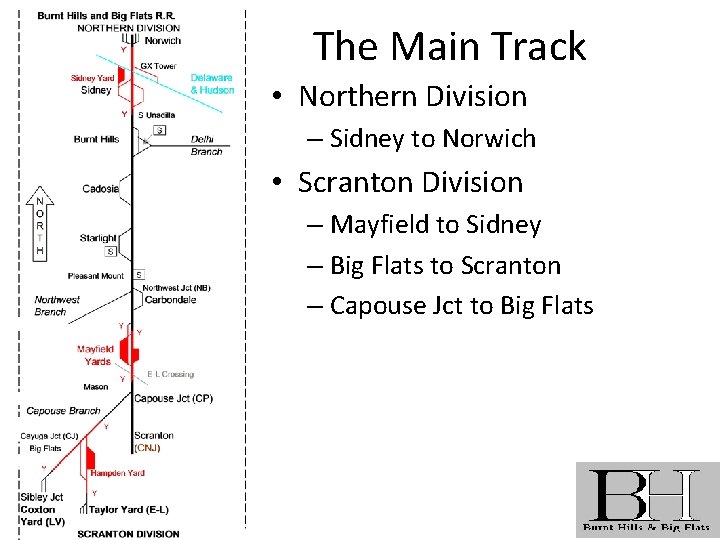
The Main Track • Northern Division – Sidney to Norwich • Scranton Division – Mayfield to Sidney – Big Flats to Scranton – Capouse Jct to Big Flats
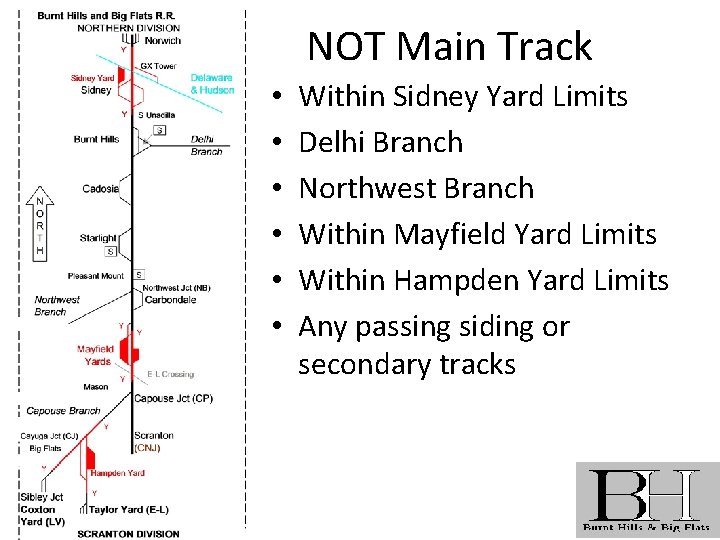
NOT Main Track • • • Within Sidney Yard Limits Delhi Branch Northwest Branch Within Mayfield Yard Limits Within Hampden Yard Limits Any passing siding or secondary tracks
Northern Division • On the prototype, Sidney NY was a division point, though the division’s primary yard was in Norwich, 25 miles to the north • On the model, Sidney yard limits butt against Norwich Staging • Scranton dispatcher (for model purposes) will authorize movements into and out of Norwich staging
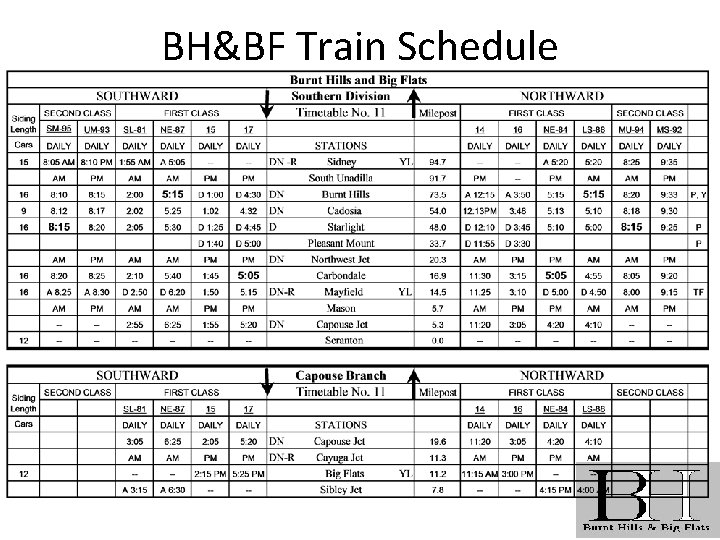
Train Schedule • The schedule authorizes movement of trains • No train orders are required to run schedule • Safe movement is handled by the train crews – Superiority is by Class and/or Direction • The dispatcher may alter the schedule by issuing train orders if needed for efficiency – Train has fallen behind schedule – Lower class train has a priority movement
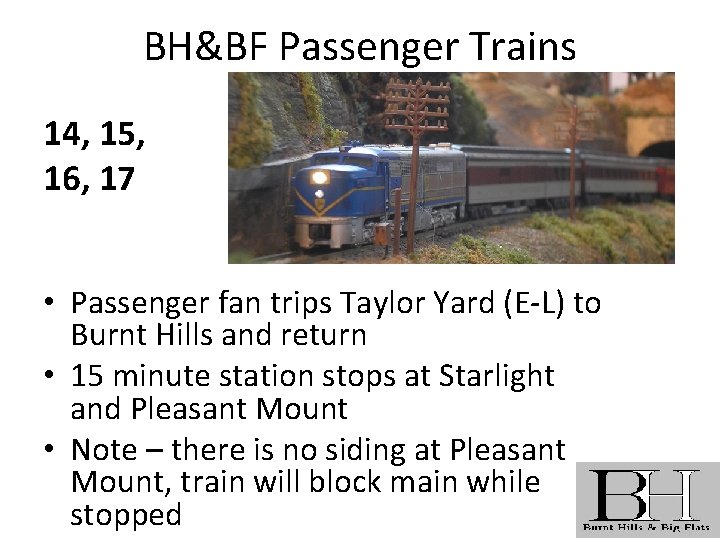
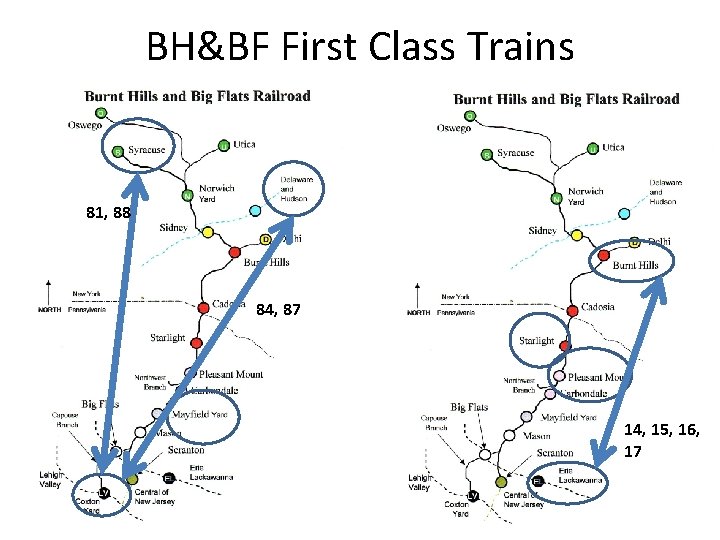
BH&BF Passenger Trains 14, 15, 16, 17 • Passenger fan trips Taylor Yard (E-L) to Burnt Hills and return • 15 minute station stops at Starlight and Pleasant Mount • Note – there is no siding at Pleasant Mount, train will block main while stopped
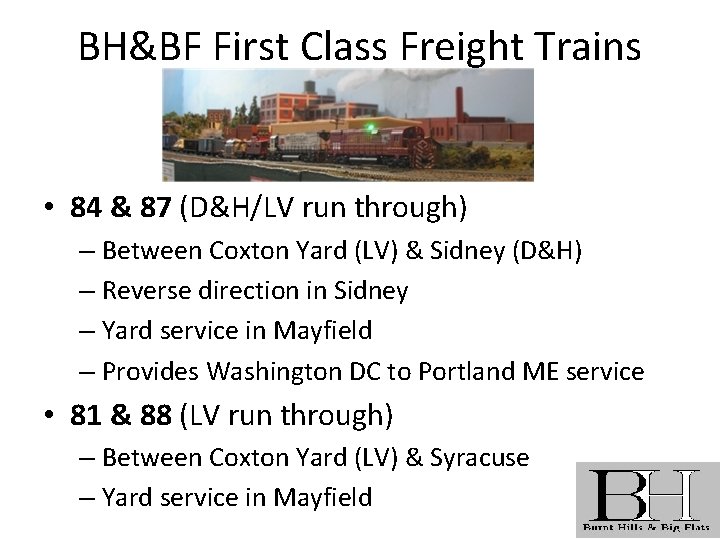
BH&BF First Class Freight Trains • 84 & 87 (D&H/LV run through) – Between Coxton Yard (LV) & Sidney (D&H) – Reverse direction in Sidney – Yard service in Mayfield – Provides Washington DC to Portland ME service • 81 & 88 (LV run through) – Between Coxton Yard (LV) & Syracuse – Yard service in Mayfield
BH&BF First Class Trains 81, 88 84, 87 14, 15, 16, 17
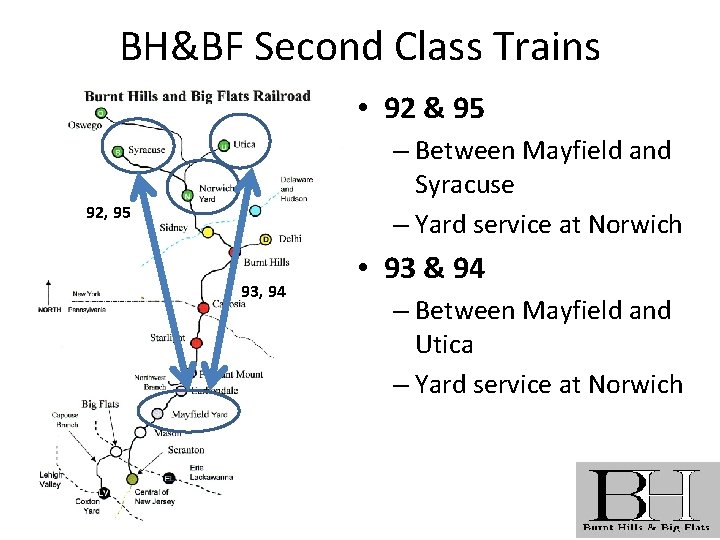
BH&BF Second Class Trains • 92 & 95 – Between Mayfield and Syracuse – Yard service at Norwich 92, 95 93, 94 • 93 & 94 – Between Mayfield and Utica – Yard service at Norwich
BH&BF Train Schedule
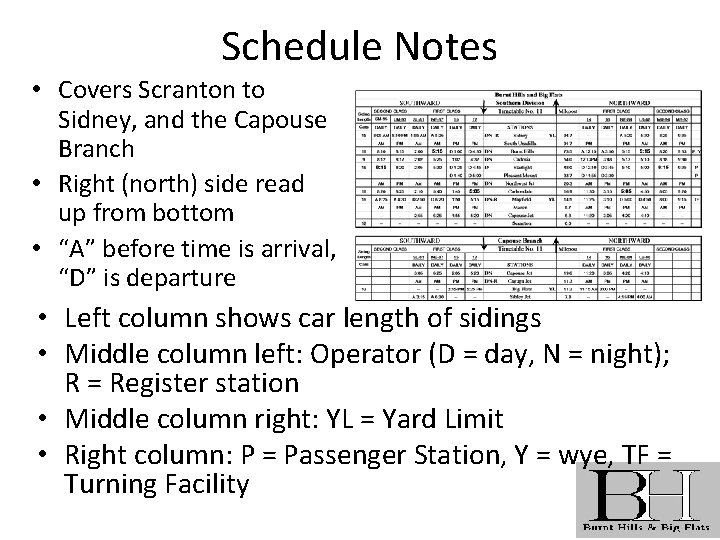
Schedule Notes • Covers Scranton to Sidney, and the Capouse Branch • Right (north) side read up from bottom • “A” before time is arrival, “D” is departure • Left column shows car length of sidings • Middle column left: Operator (D = day, N = night); R = Register station • Middle column right: YL = Yard Limit • Right column: P = Passenger Station, Y = wye, TF = Turning Facility
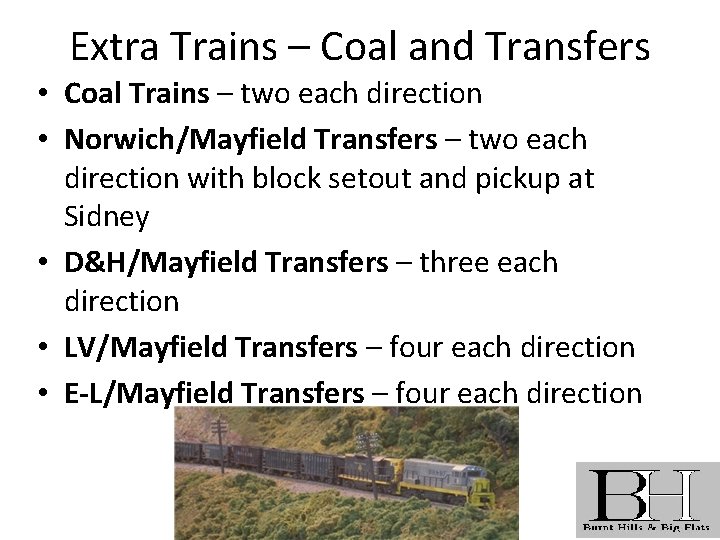
Extra Trains – Coal and Transfers • Coal Trains – two each direction • Norwich/Mayfield Transfers – two each direction with block setout and pickup at Sidney • D&H/Mayfield Transfers – three each direction • LV/Mayfield Transfers – four each direction • E-L/Mayfield Transfers – four each direction
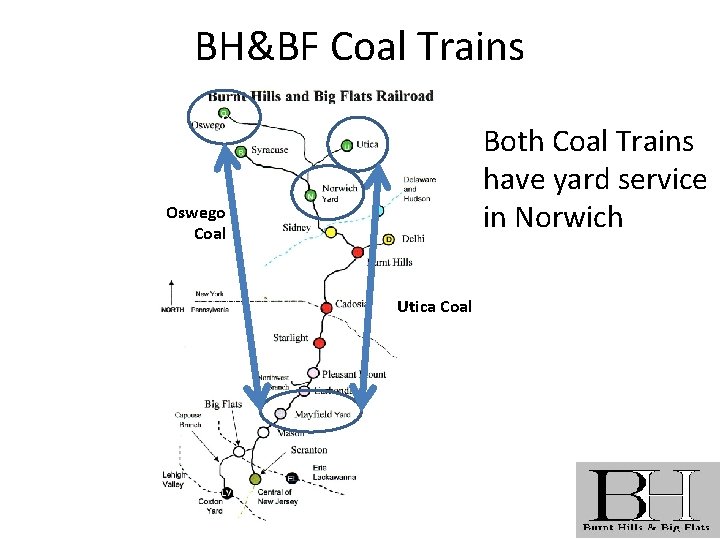
BH&BF Coal Trains c Oswego Coal Both Coal Trains have yard service in Norwich c Utica Coal
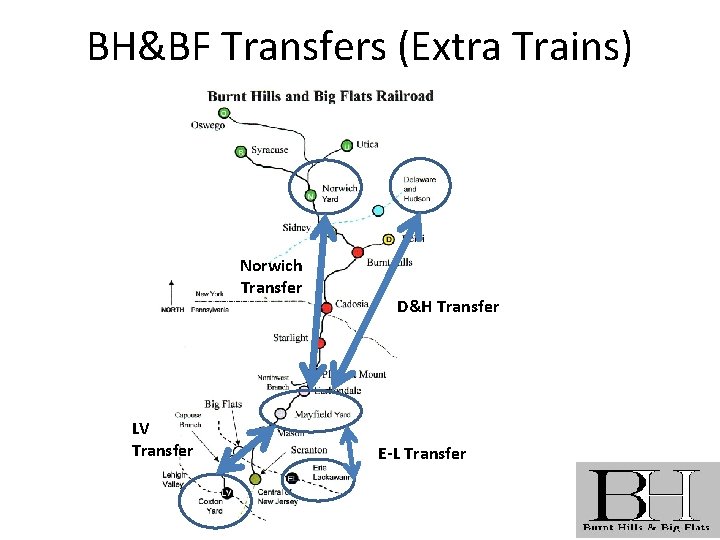
BH&BF Transfers (Extra Trains) Norwich Transfer LV Transfer D&H Transfer E-L Transfer
Extra Trains - Locals • Big Flats Mine Run – shuttles between Mayfield, Scranton, and Big Flats as needed • Northwest Mine Run – two round trips Mayfield to Northwest Branch and return • Burnt Hills Local – two round trips Mayfield to Sidney and return, service to Starlight, Cadosia, Burnt Hills and S. Unadilla • Sidney Local – Norwich to Mayfield and return. Switches Sidney industries. • Delhi Branch – Norwich to Delhi and return
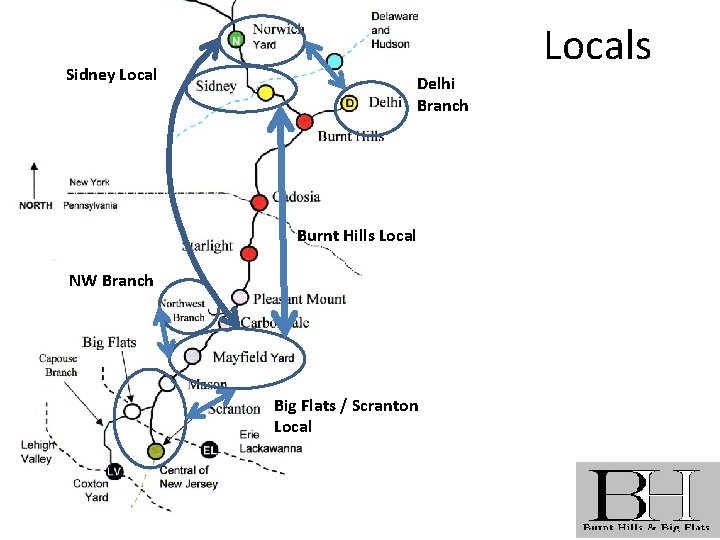
Sidney Locals Delhi Branch Burnt Hills Local NW Branch Big Flats / Scranton Local
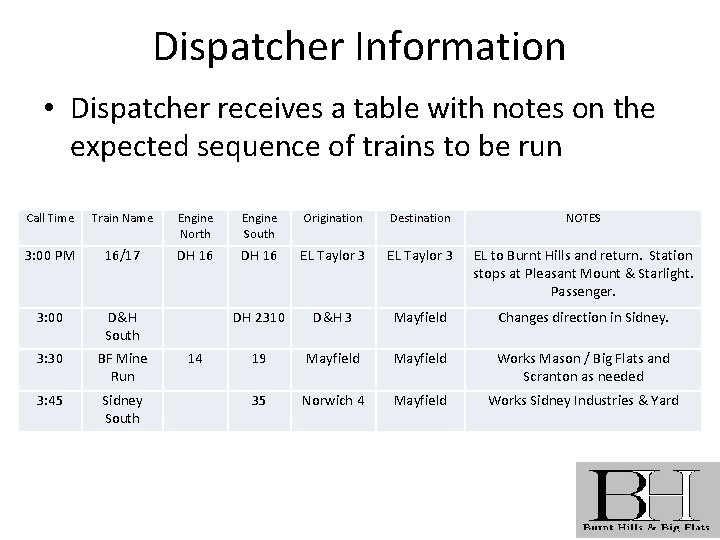
Dispatcher Information • Dispatcher receives a table with notes on the expected sequence of trains to be run Call Time Train Name Engine North Engine South Origination Destination NOTES 3: 00 PM 16/17 DH 16 EL Taylor 3 EL to Burnt Hills and return. Station stops at Pleasant Mount & Starlight. Passenger. 3: 00 D&H South DH 2310 D&H 3 Mayfield Changes direction in Sidney. 3: 30 BF Mine Run 19 Mayfield Works Mason / Big Flats and Scranton as needed 3: 45 Sidney South 35 Norwich 4 Mayfield Works Sidney Industries & Yard 14
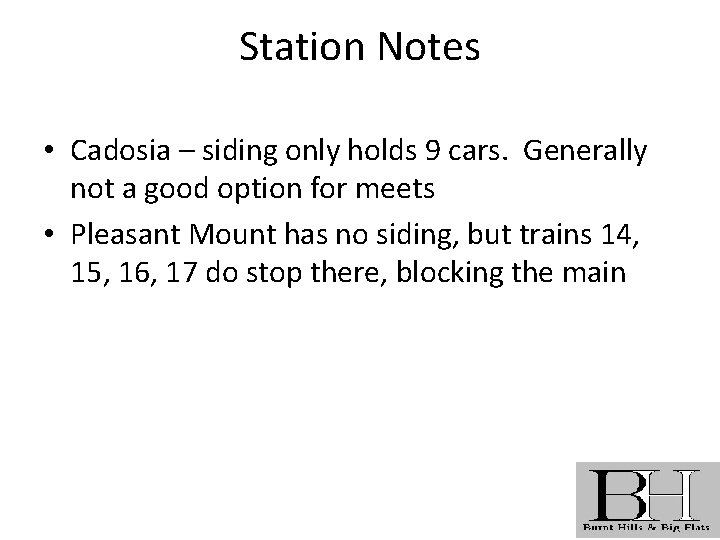
Station Notes • Cadosia – siding only holds 9 cars. Generally not a good option for meets • Pleasant Mount has no siding, but trains 14, 15, 16, 17 do stop there, blocking the main
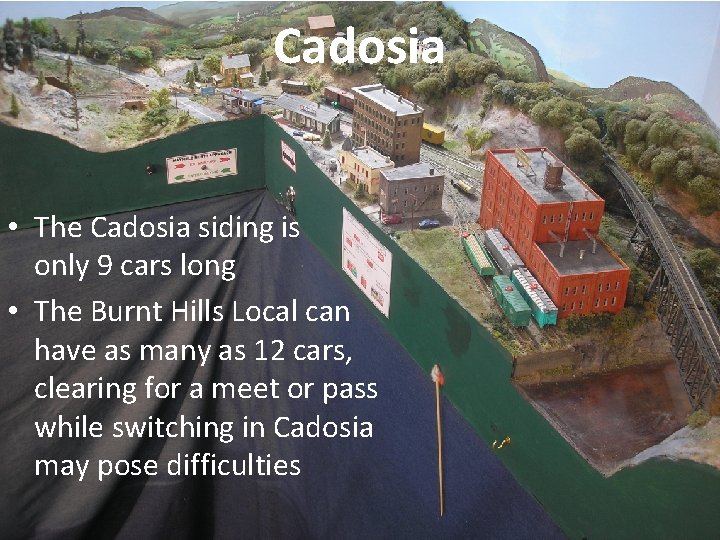
Cadosia • The Cadosia siding is only 9 cars long • The Burnt Hills Local can have as many as 12 cars, clearing for a meet or pass while switching in Cadosia may pose difficulties
Dispatcher Communications • FORMAL – Train orders to the train crews via operators, authorizing movement of trains • INFORMAL: – Clearance Form A’s – O. S. reports from operators – Information to and from yardmasters
Form G Train Order • This train order authorizes Extra trains • Example for northward coal train follows: • Order addressed to the conductor and engineer (C&E) of the engine at Mayfield since the extra does not yet exist • The expected Form G’s have been pre-printed Engine 27 Run Extra Mayfield to Norwich
Trains in Opposing Directions • The Dispatcher does not need to provide protection for scheduled trains against extras • The Dispatcher MUST provide protection for opposing extras: – Hold the Form G until opposing train terminates – A “Meet Order” – A “Right Over Order”
Extra 27 North Scenario 1 • The dispatcher is ready to give the Form G to the engine 27, but notes that No. 17 is running southward from Burnt Hills. Are any additional orders needed? No! • Extra 27 North must study the schedule and determine their meeting location with No. 17
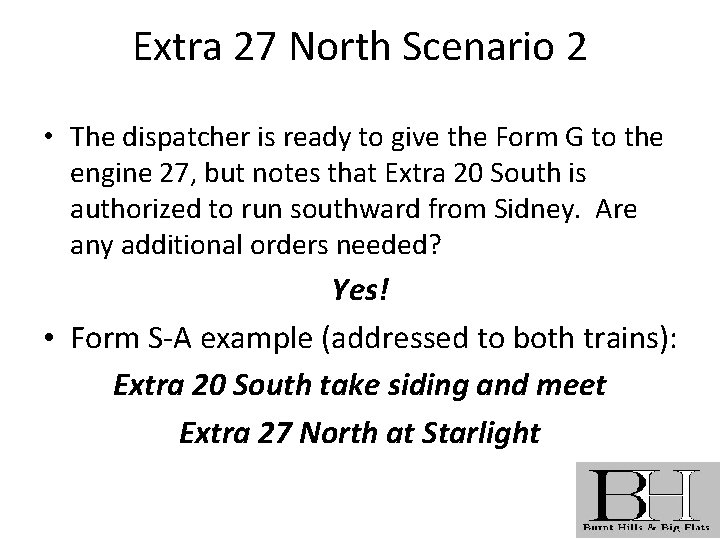
Extra 27 North Scenario 2 • The dispatcher is ready to give the Form G to the engine 27, but notes that Extra 20 South is authorized to run southward from Sidney. Are any additional orders needed? Yes! • Form S-A example (addressed to both trains): Extra 20 South take siding and meet Extra 27 North at Starlight
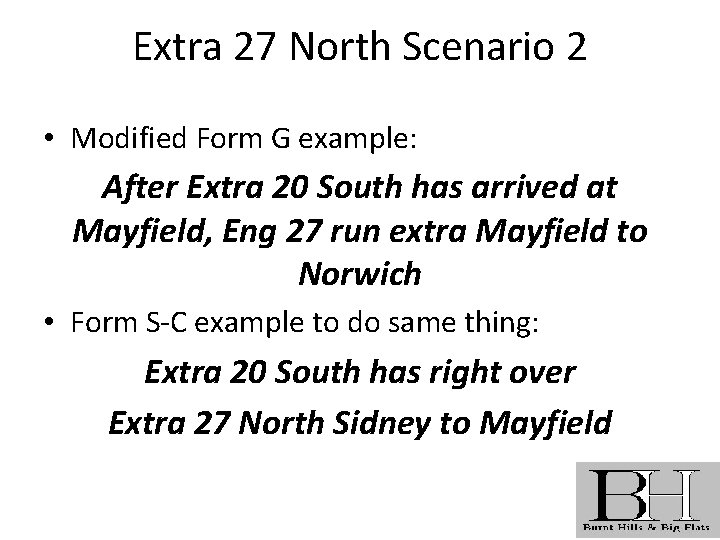
Extra 27 North Scenario 2 • Modified Form G example: After Extra 20 South has arrived at Mayfield, Eng 27 run extra Mayfield to Norwich • Form S-C example to do same thing: Extra 20 South has right over Extra 27 North Sidney to Mayfield
Meet Orders • To date, no more than two meet or right over orders have been needed per session • The locals are sequenced to stay out of each other’s way • The scheduled trains don’t need meet orders • Yard Limits at Sidney and Big Flats also reduce need for orders • Must plan ahead and provide orders at least one station prior to meeting location
Extras in the Same Direction • The Dispatcher has NO safety responsibilities for trains going the same direction • If a train is stopped, it sends out a flagman to protect the rear of the train • The stopped train does not have to allow a following extra train to pass it • The Dispatcher MAY order a train to allow another to pass it for efficiency purposes using a Form B
Extra 27 North Scenario 3 • The dispatcher is ready to give the Form G to the engine 27, but notes that Extra 32 North is switching in Burnt Hills. Are any additional orders needed? No, these two extras are running in the same direction. Extra 32 North should have a flagman at the south end of Burnt Hills
Extra 27 North Scenario 3 • If the dispatcher wants to ensure the coal extra is not delayed by the local switching in Burnt Hills, the Dispatcher may either: Unofficially advise the Burnt Hills operator to tell the local to clear up • Or issue a Form B order: Extra 27 North pass Extra 32 North at Burnt Hills
Yard Limits – Big Flats • There are Yard Limits at Big Flats • When the Big Flats Mine Run is switching in Big Flats, then Extras and Scheduled Trains meet or pass the local under Rule 93, no train orders needed. • Trains run at Restricted Speed within yard • See http: //www. pcrnmra. org/conv 2012/handouts/all. About. Yard. Limits. pdf
Yard Limits – Mayfield • The Mayfield Yards are controlled by the Yardmaster • There are call-on signals operated by the Yardmaster at yard entrances • Dispatcher does not control movements within the yards • All extra trains (northward and southward) terminate at Mayfield, there are no run through extras
Yard Limits – Sidney • Yard Limits at Sidney allow multiple trains to operate within the area without dispatcher attention • The Burnt Hills Local ends its run switching in Sidney. Once it arrives at Sidney, and prior to receiving the run extra order for Sidney to Mayfield, their switching does not have to be protected by the dispatcher
Branches • There are no train order stations at Scranton, Delhi, or on the Northwest Branch • Form G orders to Scranton must include “and return to Capouse Junction” • Form G orders to Northwest Branch must include “and return to Northwest Junction” • From G orders to Delhi should include “and return to Burnt Hills” • The pre-printed Form G’s cover these requirements
Branches • Often the Northwest Mine Run will be ready to depart Mayfield, and there is a southward extra on the main north of Carbondale • If the dispatcher wants the NW Mine Run to run Mayfield to Carbondale prior to arrival of the southward extra in Mayfield, send a “right over” Form S-C order: Extra 34 North has right over Extra 27 South Mayfield to Carbondale
Branches • If extra 34 North enters the Northwest Branch prior to arrival of the southward extra (the dispatcher will know this from the OS report), the southward extra should be notified using a Form V: Extra 34 North has passed Carbondale • The same situation could arise with Scranton and Delhi, but has not happened yet
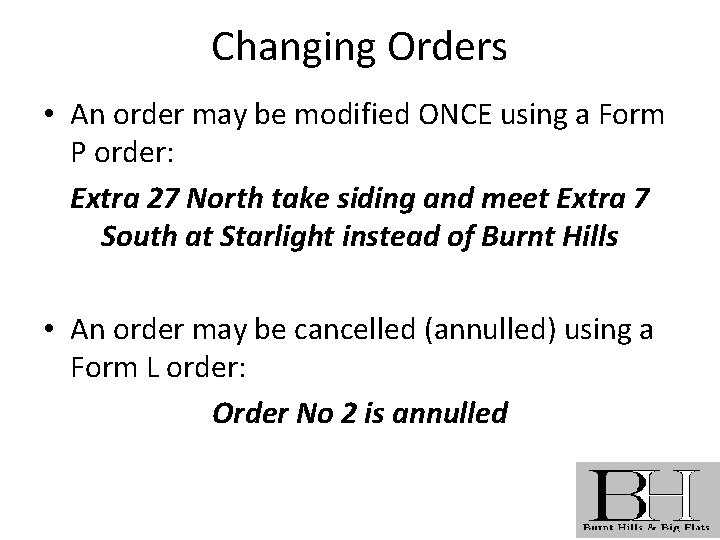
Changing Orders • An order may be modified ONCE using a Form P order: Extra 27 North take siding and meet Extra 7 South at Starlight instead of Burnt Hills • An order may be cancelled (annulled) using a Form L order: Order No 2 is annulled
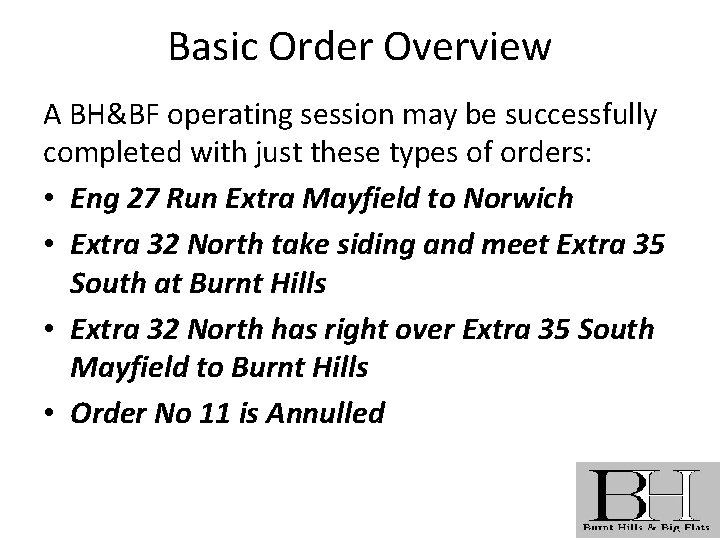
Basic Order Overview A BH&BF operating session may be successfully completed with just these types of orders: • Eng 27 Run Extra Mayfield to Norwich • Extra 32 North take siding and meet Extra 35 South at Burnt Hills • Extra 32 North has right over Extra 35 South Mayfield to Burnt Hills • Order No 11 is Annulled
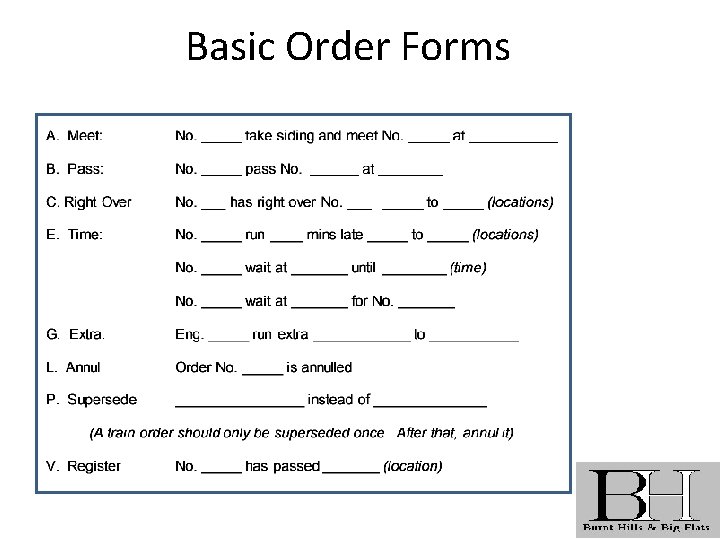
Basic Order Forms
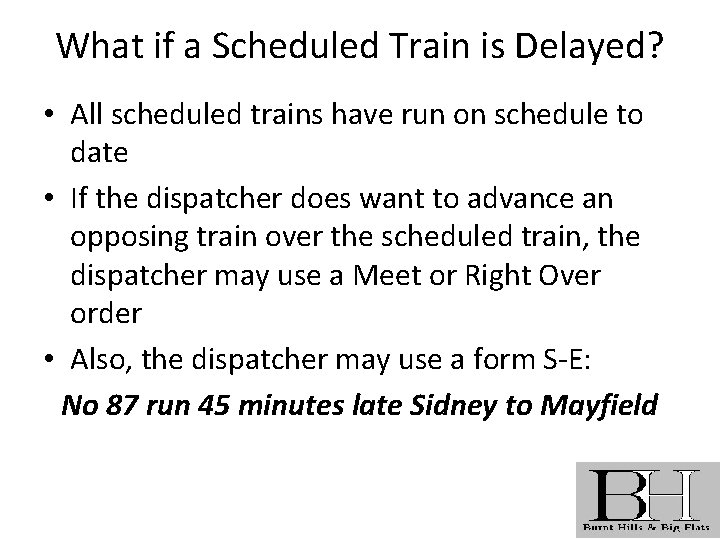
What if a Scheduled Train is Delayed? • All scheduled trains have run on schedule to date • If the dispatcher does want to advance an opposing train over the scheduled train, the dispatcher may use a Meet or Right Over order • Also, the dispatcher may use a form S-E: No 87 run 45 minutes late Sidney to Mayfield
Keeping Track of Trains and Orders • Currently, we use a spreadsheet to track train orders, versus a hard bound book • A spreadsheet map is used to track the clearances and progress of trains, based upon OS reports • Prototypical paper forms are available for those who prefer the paper forms • Purpose is to keep track of train locations, meet points, and potential conflicts
Train Order Log Copy of log from six fast hours (two sessions): “Completed” is time order issued to Operator
Spreadsheet Map • Extra 32 North is in Burnt Hills, with authorization to run to Sidney
Spreadsheet Map • Green arrows advance a train along the map • Red X clears the train from the track section • Advance each train from origination to the limit of its movement authorization • Clear the track sections behind the train as OS reports are received • Track sections within Yard Limits are pink
Train Sheet • Above is a section of the trainsheet used to record progress of trains at stations.
Goal • BH&BF Management hopes some employees will be interested in the Dispatcher job • This will increase flexibility and give some job rotation • Dispatching can be the most prototypically correct jobs available
- Slides: 66