
Time stepping Hendrik Tolman The WAVEWATCH III Team
- Slides: 20
Time stepping Hendrik Tolman The WAVEWATCH III Team + friends Marine Modeling and Analysis Branch NOAA / NWS / NCEP / EMC NCEP. list. WAVEWATCH@NOAA. gov NCEP. list. waves@NOAA. gov Version 1. 3, Feb. 2013 WW Winter School 2013 Time stepping 1/20
Outline Covered in this lecture: Basic time steps per grid. � Time steps versus limiter. l Mosaic model runs. � General grid interactions. � Overlapping grids. l Impact of output. l Version 1. 3, Feb. 2013 WW Winter School 2013 Time stepping 2/20
Basic time stepping There are four basic time steps per grid: Overall time step to propagate solution. l Time step for lowest model frequency in absence of currents to assure stable propagation (CFL). l Refraction time step. l Minimum source term time step. l This is the order in the input file, l But CFL is most important, and therefore discussed first. l l Qualitative here only, practical examples are all over the test cases provided with the model. Version 1. 3, Feb. 2013 WW Winter School 2013 Time stepping 3/20
Basic time stepping CFL time step: l Only explicit FD propagation schemes are available. � CFL criterion means that information can only be propagated by discrete number of grid boxes per time step. �Depends on propagation scheme. �All schemes available now allow one grid box. � Violate it and the model will blow up (eventually). l In the code: � CFL time step adjusted as a function of frequency (longer time steps for higher frequencies). � CFL time step dynamically adjusted for current velocity: �Should stay stable, but �Strong currents may slow down model. Version 1. 3, Feb. 2013 WW Winter School 2013 Time stepping 4/20
Basic time stepping Overall time step: The model allows for larger overall time steps, to acknowledge that the lowest frequency rarely contains information. l Accuracy requires relatively small factor between CFL time step and overall time step (say 2~3). � Do not want to propagation information over barely resolved bathymetry in overall time step. l l Ratio of overall / CFL time step directs needed overlap between equally ranked grids (more on day 2). Version 1. 3, Feb. 2013 WW Winter School 2013 Time stepping 5/20
Basic time stepping Refraction time step: “Refraction” includes great-circle direction change, depth and current refraction, and current induced wavenumber shifts. l Refraction due to depth and current is filtered to assure stable solutions with large local depth changes. � Filter per frequency. � Fraction of CFL can be set by user. l Reducing refraction time step will reduce use of filter. � May be useful for pre-implementation testing of models. l l Generally kept large, but best set at half the overall time step, to avoid numerical wiggles due to alternate orders of computation. Version 1. 3, Feb. 2013 WW Winter School 2013 Time stepping 6/20
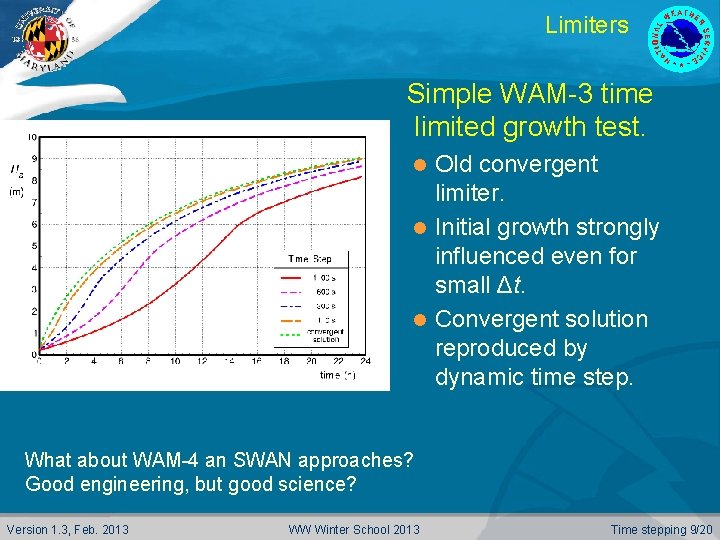
Basic time stepping Minimum source term time step. History: WAM model used “limiter” to curtail the source term change of the spectrum per time step to assure integration stability for large source term time step. l This has an impact on the solution, as will be shown below. l WAM went to non-convergent limiter: � Minimal impact of time step on solution, but � Limiter becomes part of solution. �OK for engineering application. �Not good for research, since impact of limiter cannot be split from explicit physics. l SWAN also uses limiters in iterations. l Version 1. 3, Feb. 2013 WW Winter School 2013 Time stepping 7/20
Basic time stepping More history (details in manual): WAVEWATCH II (not III !): � Use limiter to dynamically adjust time step to get accurate yet economical source term integration. �Compare to parametric change. �Compare to (filtered) relative change. �Do not apply in tail. �Apply limiter if computed time step is less to allowed minimum time step. � Need to know something about limiters as they still are used depending on setup of model. l Smaller minimum time step results in smoother model, often in faster model. � I generally use 5~60 s. Tolman 1992: JPO. , 22, 1095 -1111. Tolman 2002: GAOS, 8, 67 -83. l Version 1. 3, Feb. 2013 WW Winter School 2013 Time stepping 8/20
Limiters Simple WAM-3 time limited growth test. Old convergent limiter. l Initial growth strongly influenced even for small Δt. l Convergent solution reproduced by dynamic time step. l What about WAM-4 an SWAN approaches? Good engineering, but good science? Version 1. 3, Feb. 2013 WW Winter School 2013 Time stepping 9/20
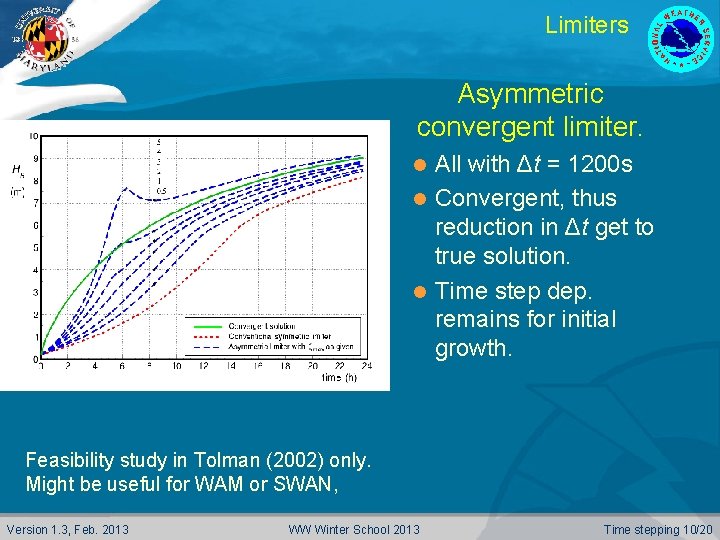
Limiters Asymmetric convergent limiter. All with Δt = 1200 s l Convergent, thus reduction in Δt get to true solution. l Time step dep. remains for initial growth. l Feasibility study in Tolman (2002) only. Might be useful for WAM or SWAN, Version 1. 3, Feb. 2013 WW Winter School 2013 Time stepping 10/20
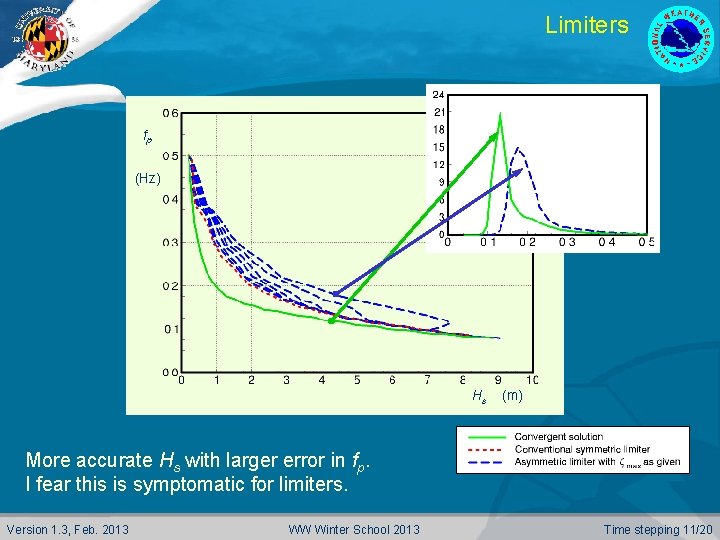
Limiters fp (Hz) Hs (m) More accurate Hs with larger error in fp. I fear this is symptomatic for limiters. Version 1. 3, Feb. 2013 WW Winter School 2013 Time stepping 11/20
Mosaic models Some multi-grid time step basics: In a multi-grid model the time stepping for grid is set up individually per grid. l Two examples are given in the following slides. � Triple nest for swell propagation. � Triple nest for hurricane. l l You do not have to coordinate time steps per grid, but if you do not, you may have a problem predicting how this works. Version 1. 3, Feb. 2013 WW Winter School 2013 Time stepping 12/20
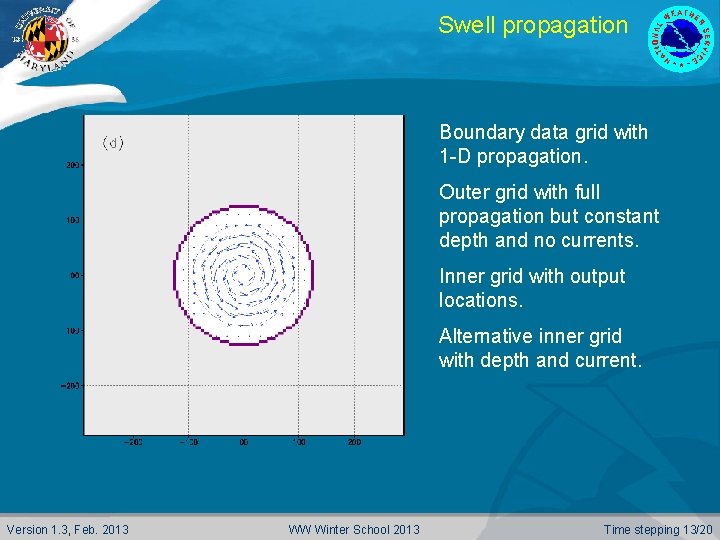
Swell propagation Boundary data grid with 1 -D propagation only Outer grid with full propagation but constant depth and no currents. Inner grid with output locations. Alternative inner grid with depth and current. Version 1. 3, Feb. 2013 WW Winter School 2013 Time stepping 13/20
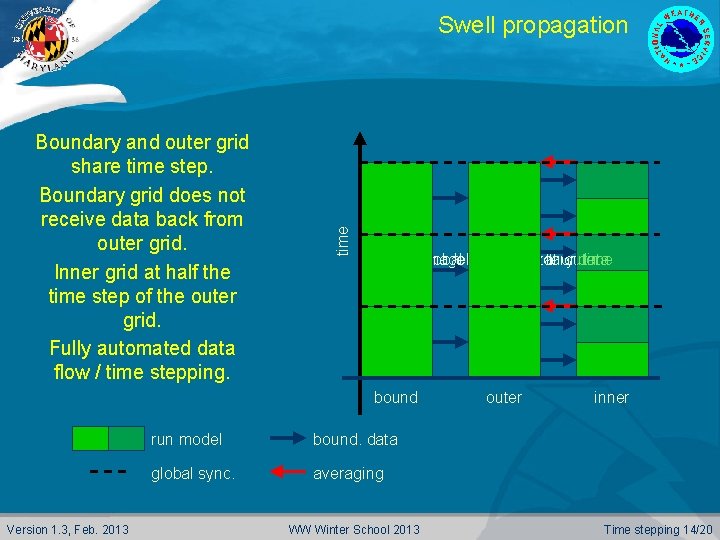
Boundary and outer grid share time step. Boundary grid does not receive data back from outer grid. Inner grid at half the time step of the outer grid. Fully automated data flow / time stepping. time Swell propagation set run average global modelsynchronization run from start withmodel inner over boundary to outer data time bound Version 1. 3, Feb. 2013 run model bound. data global sync. averaging WW Winter School 2013 outer inner Time stepping 14/20
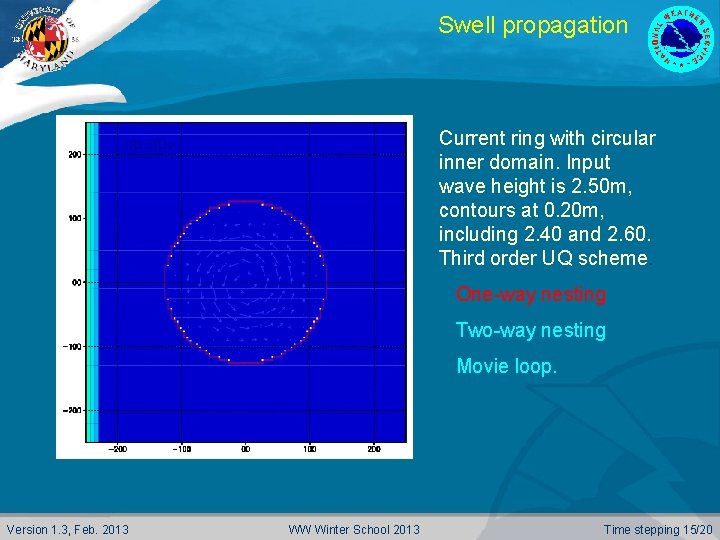
Swell propagation Current ring with circular inner domain. Input wave height is 2. 50 m, contours at 0. 20 m, including 2. 40 and 2. 60. Third order UQ scheme. One-way nesting Two-way nesting Movie loop. Version 1. 3, Feb. 2013 WW Winter School 2013 Time stepping 15/20
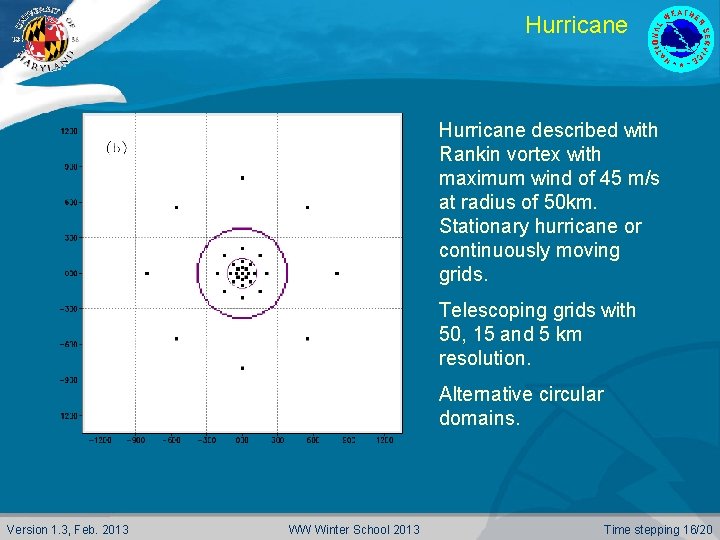
Hurricane described with Rankin vortex with maximum wind of 45 m/s at radius of 50 km. Stationary hurricane or continuously moving grids. Telescoping grids with 50, 15 and 5 km resolution. Alternative circular domains. Version 1. 3, Feb. 2013 WW Winter School 2013 Time stepping 16/20
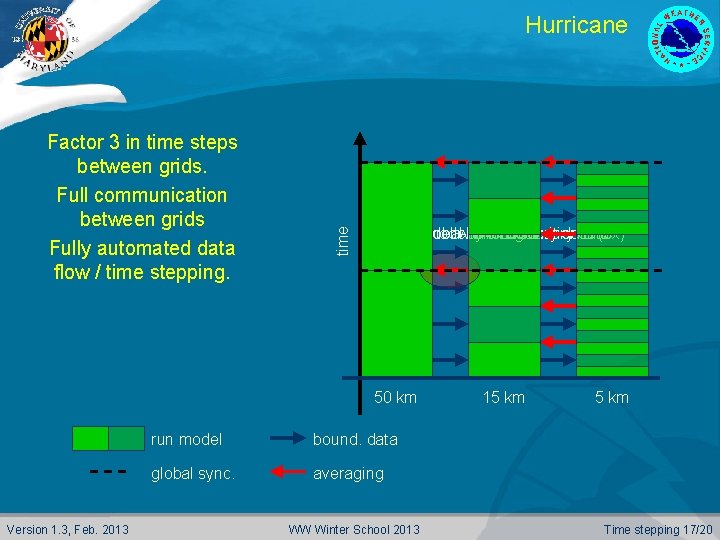
Factor 3 in time steps between grids. Full communication between grids Fully automated data flow / time stepping. time Hurricane run set run model global model with synchronization run with average boundary model boundary data time (3 x) 50 km Version 1. 3, Feb. 2013 run model bound. data global sync. averaging WW Winter School 2013 15 km Time stepping 17/20
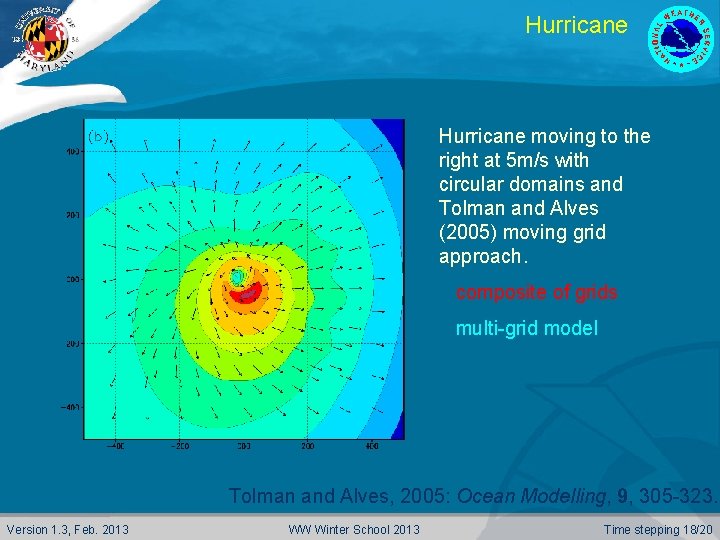
Hurricane moving to the right at 5 m/s with circular domains and Tolman and Alves (2005) moving grid approach. composite of grids multi-grid model Tolman and Alves, 2005: Ocean Modelling, 9, 305 -323. Version 1. 3, Feb. 2013 WW Winter School 2013 Time stepping 18/20
Output This was all about running the model, But if you want output too …. . l The model is always providing data at all times for which output is requested. � Overrides overall time step in ww 3_shel as needed. � Ditto impact in ww 3_multi. Pitfall: l In example input files a single restart file is asked for at a single time. � Interval is set at 1 second. � Some folks changed the interval without changing the increment …… Version 1. 3, Feb. 2013 WW Winter School 2013 Time stepping 19/20
The end End of lecture Version 1. 3, Feb. 2013 WW Winter School 2013 Time stepping 20/20