
Time Response Lecture 12 1 Introduction to time
- Slides: 12
Time Response Lecture 12: 1. Introduction to time response analysis 2. First-order systems 3. Stability Lecture 13: Second-order systems Lecture 14: Non-canonical systems ME 431, Lecture 12: First-Order Systems 1
• During the semester we have found the time response of dynamic systems for arbitrary initial conditions and inputs • From diff eq and transfer function models • Classifying the response of some standard systems to standard inputs can provide insight • Ex Systems: first order, second order • Ex Inputs: impulse, step, ramp, sinusoid ME 431, Lecture 12 Time Response 2
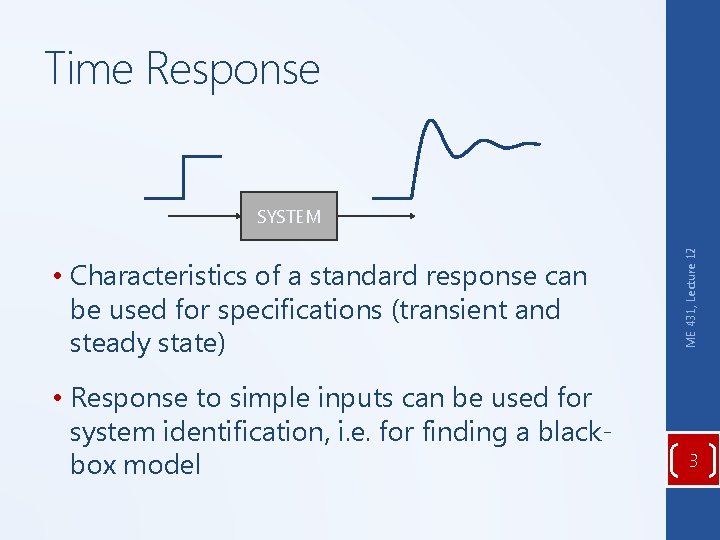
Time Response • Characteristics of a standard response can be used for specifications (transient and steady state) • Response to simple inputs can be used for system identification, i. e. for finding a blackbox model ME 431, Lecture 12 SYSTEM 3
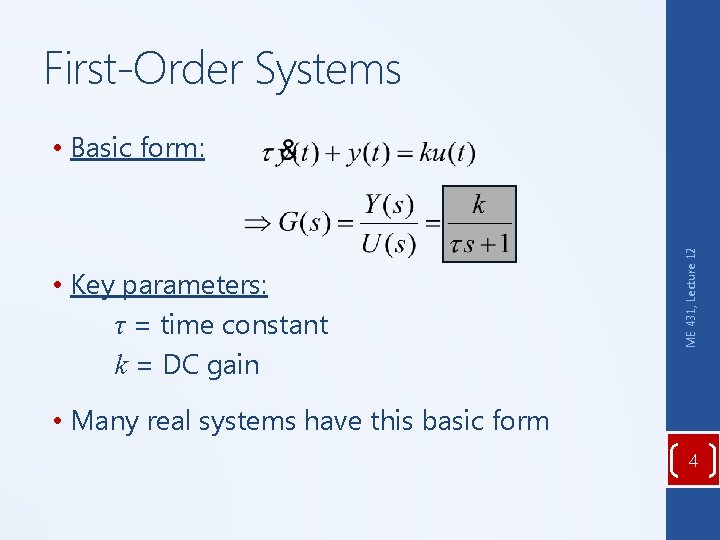
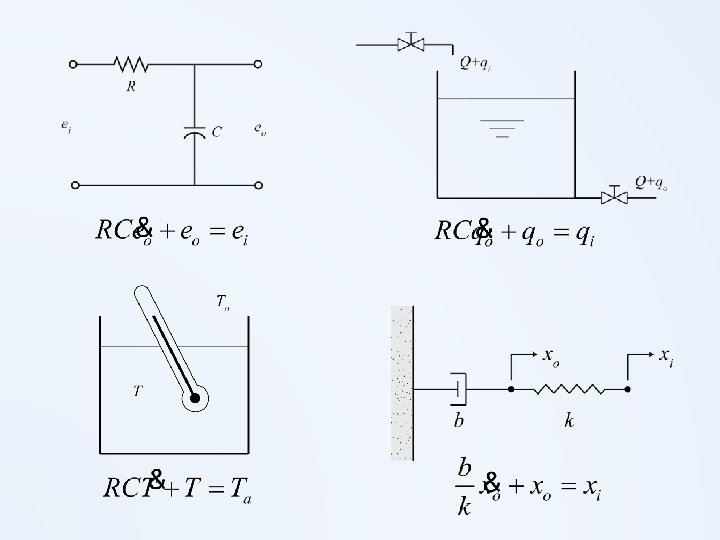
First-Order Systems • Key parameters: τ = time constant k = DC gain ME 431, Lecture 12 • Basic form: • Many real systems have this basic form 4
First-Order Systems • Step response (u(t) = 1(t))
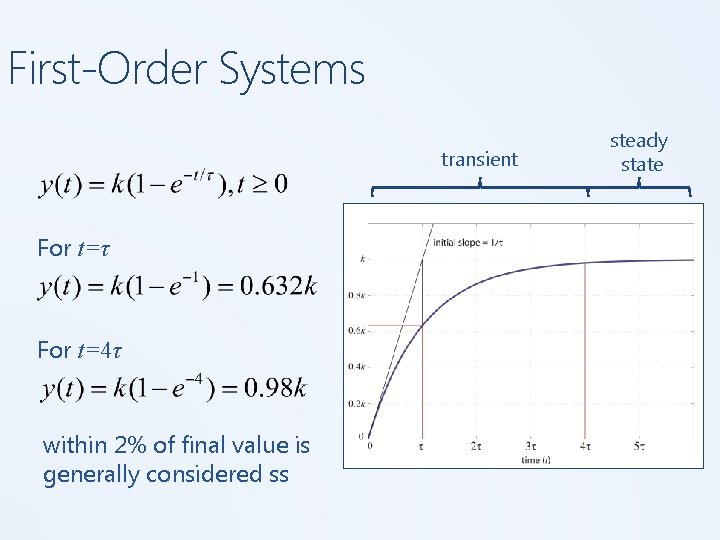
First-Order Systems transient For t=τ For t=4τ within 2% of final value is generally considered ss steady state
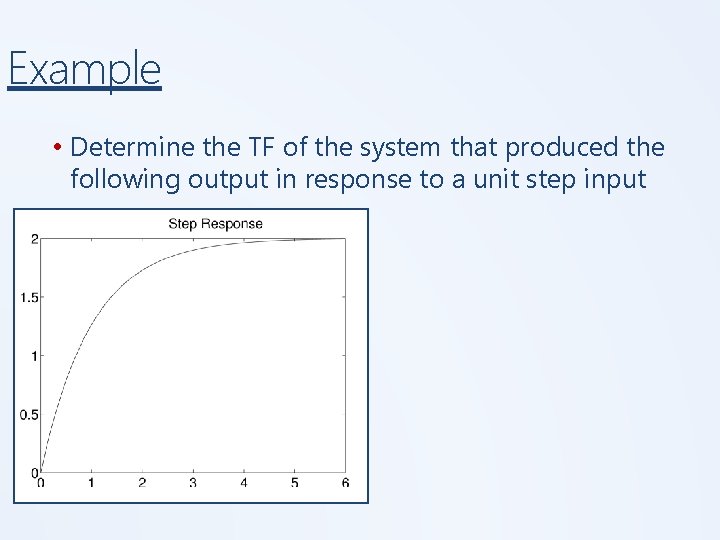
Example • Determine the TF of the system that produced the following output in response to a unit step input
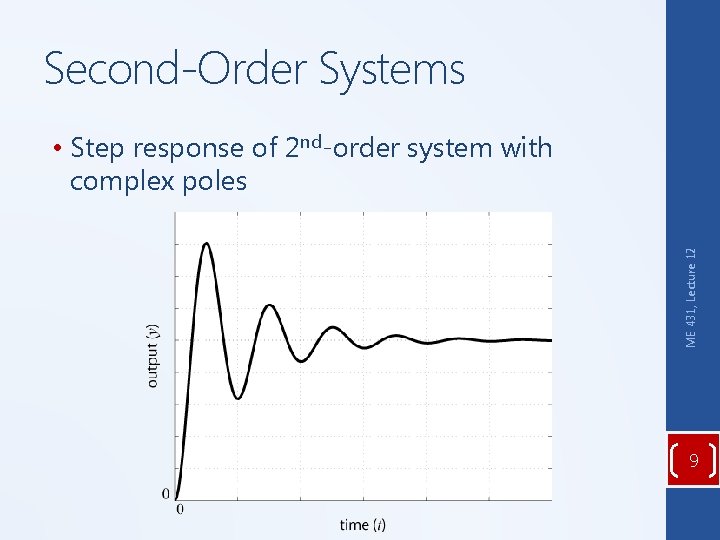
Second-Order Systems ME 431, Lecture 12 • Step response of 2 nd-order system with complex poles 9
• Note how the roots of the characteristic equation (poles of the transfer function) relate to natural response • Real part of pole = rate of decay (growth) • Imag part of pole = frequency of oscillation • If the response does not grow unbounded then it is stable (real part less than or equal to 0) ME 431, Lecture 12 Stability 10
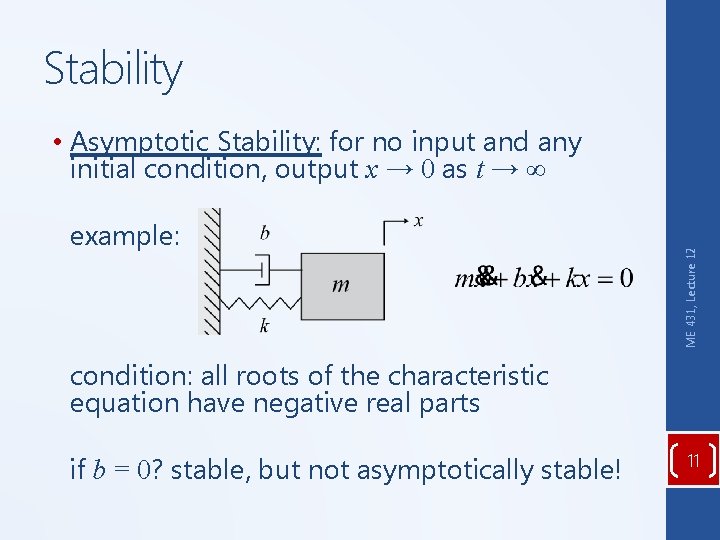
Stability example: ME 431, Lecture 12 • Asymptotic Stability: for no input and any initial condition, output x → 0 as t → ∞ condition: all roots of the characteristic equation have negative real parts if b = 0? stable, but not asymptotically stable! 11
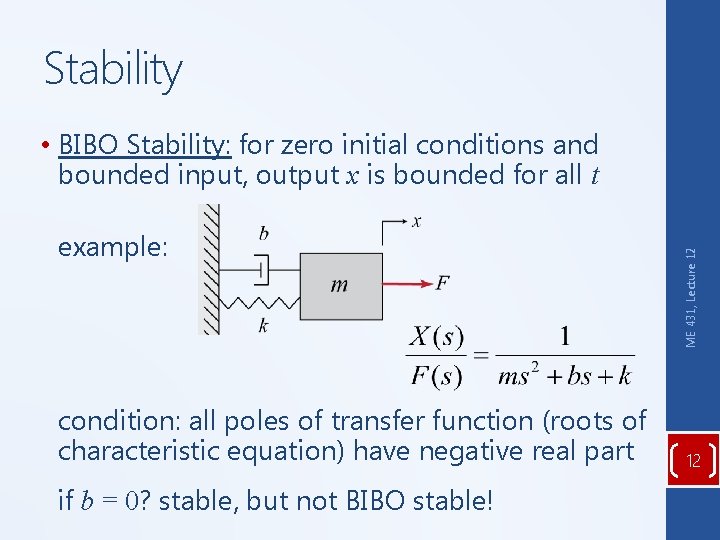
Stability example: condition: all poles of transfer function (roots of characteristic equation) have negative real part if b = 0? stable, but not BIBO stable! ME 431, Lecture 12 • BIBO Stability: for zero initial conditions and bounded input, output x is bounded for all t 12