
Time Perspective and its Role in Coping Behaviour
Time Perspective and its Role in Coping Behaviour with a Conflict Situation Performed by Milana R. Hachaturova, lecturer Department of Psychology, National Research University – Higher School of Economics, Moscow, Russia Research adviser: Professor Bolotova, Doctor of Psychology Alla Konstantinovna
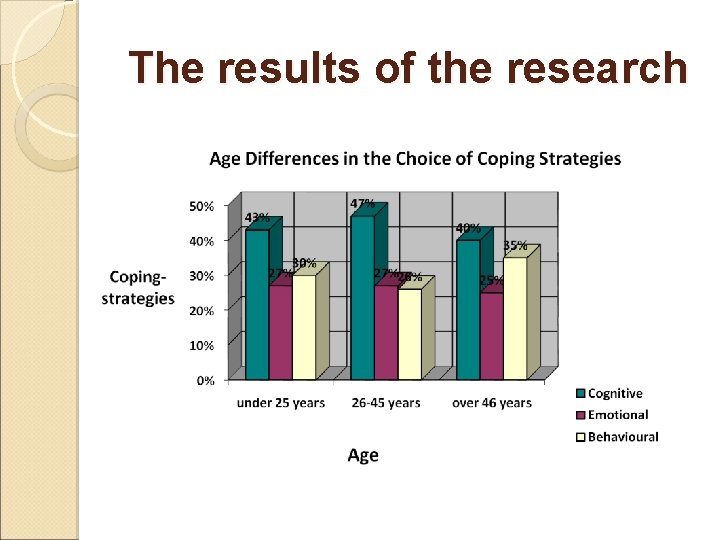
Сoping strategies A coping strategy - the actions of an individual in dealing with complex situations. There are three types of coping strategies: emotional, cognitive and behavioural. These types of coping strategies of behavior in a conflict can be adaptive, relatively adaptive and non-adaptive.

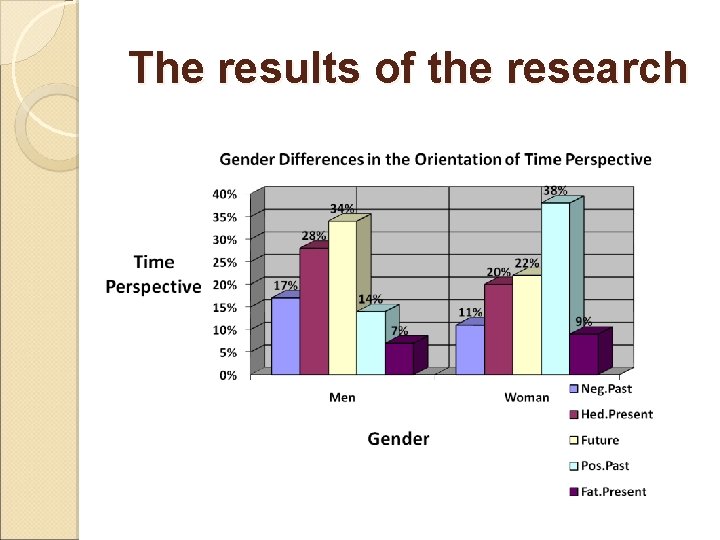
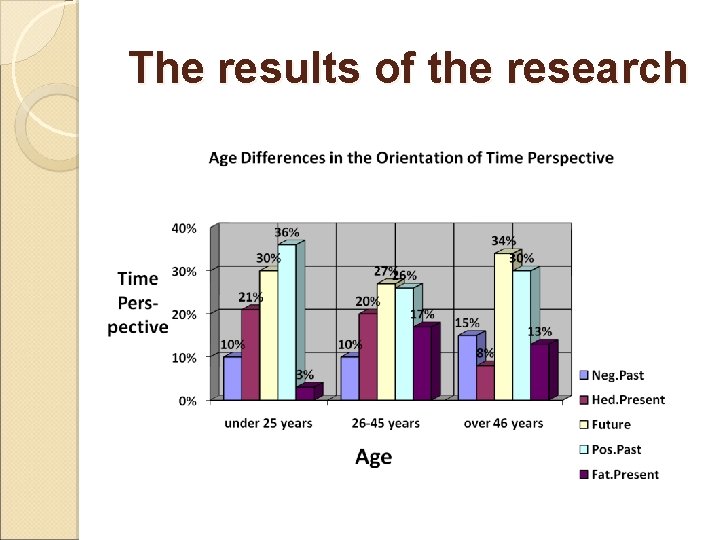
ZTPI (F. Zimbardo Time Perspective Inventory) 1. Allows working with all three time aspects at once - the past, the present and the future. ZTPI consists of five factors or scales: ◦ «the negative past» ; ◦ «the hedonistic present» ; ◦ «the future» ; ◦ «the positive past» ; ◦ «the fatalistic present» .

The goal of the research is studying the interrelation between time perspective orientation and the person’s choice of coping strategies in conflicts situations.
Hypotheses 1. A person with prevalence of time perspective focused on the future prefers cognitive strategies of behaviour in a situation of interpersonal conflicts. 2. A person with prevalence of time perspective focused on the fatalistic present and the negative past prefers non-adaptive emotional and behavioural strategies of behaviour in a conflict situation. 3. A person with prevalence of time perspective focused on the future, the positive past and the hedonistic present prefers adaptive and relatively adaptive strategies of behaviour in a conflict

Methodology To prove the stated hypotheses we used the following methods: Zimbardo Time Perspective Inventory and E. Heim’s technique (coping strategies). 156 (87 women and 69 men), whose average was 27 participated in our research.
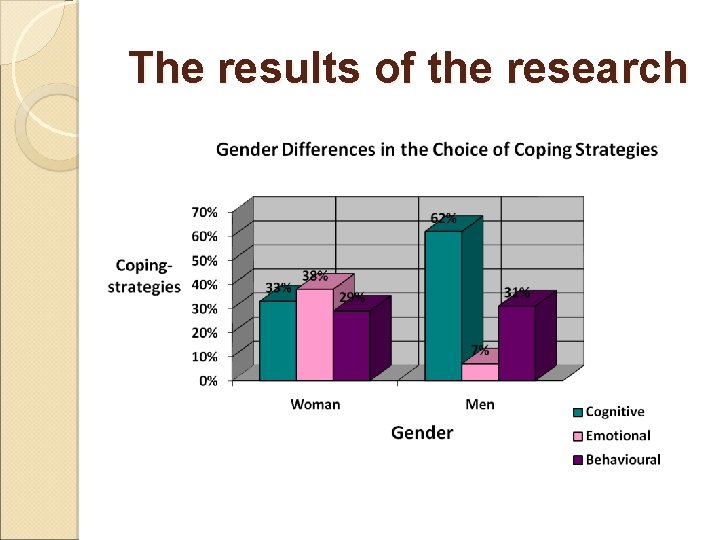
The results of the research
The results of the research
The results of the research
The results of the research

The results of the research Coping strategies Time Perspective Cognitive strategies A RA Emotional strategies N A RA Behavioural strategies N r=0, 487 A RA N r=0, 517 Future r=0, 410 r=0, 601 r=0, 496 r=0, 614 r=0, 434 Fatalistic Present Negative Past r=-0, 517 r=0, 498 Positive Past r=0, 451 Hedonistic Present Pearson Correlation Coefficient p<0, 01 and p<0, 05 A – adaptive, RA – relatively adaptive, N – non-adaptive r=0, 467

References 1. Folkman S. , Moskowitz J. T. (2000). Stress, Positive Emotion, and Coping // Current Directions in Psychological Science. - № 9, pp. 115118. 2. Grishina N. (2004). Psychology of conflict. St. Petersburgh, Piter. 3. Lazarus R. S. , Folkman S. (1984). Stress, Appraisal and Coping. N. Y: Springer. 4. Marin T. , Holtzman S. (2007). Coping and the Response of Others // Journal of Social and Personal Relationships. - № 24. Caplan L. , Schooler C. (2007). Socioeconomic Status and Financial Coping Strategies: The Mediating Role of Perceived Control // Social Psychology Quarterly. - Vol. 70, 2007, pp. 43 -58. Heim E. (1988). Coping and Psychosocial Adaptation // Journal of Mental Health Counseling. - № 10, pp. 136 -144. Zimbardo P. G. , Boyd J. N. (1999). Putting Time in Perspective: A Valid, Reliable Individual-Differences Metric // Journal of Personality and
- Slides: 12