
TIME MANAGEMENT NERCNAHRO MIDWINTER CONFERENCE FEBRUARY 4 7
TIME MANAGEMENT NERC/NAHRO MID-WINTER CONFERENCE FEBRUARY 4 -7, 2018 STEPHEN J. O’ROURKE WEST WARWICK HOUSING AUTHORITY
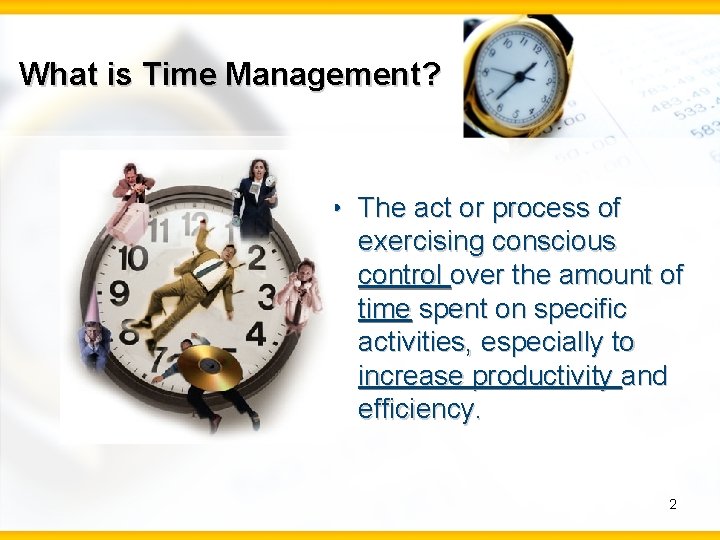
What is Time Management? • The act or process of exercising conscious control over the amount of time spent on specific activities, especially to increase productivity and efficiency. 2
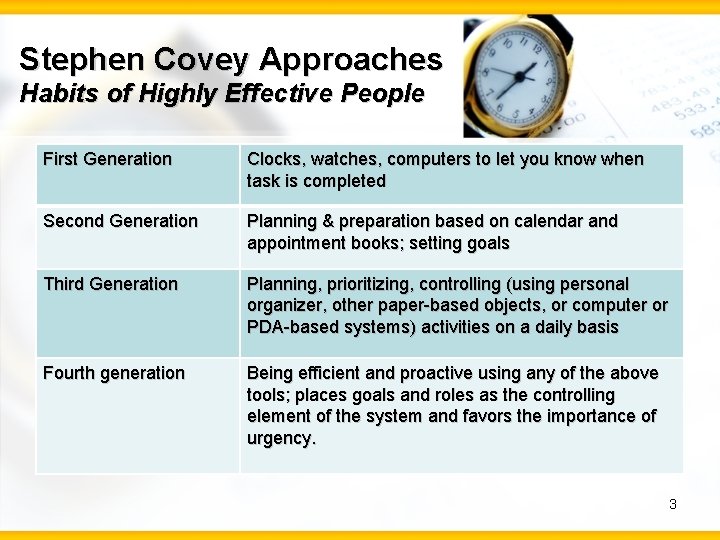
Stephen Covey Approaches Habits of Highly Effective People First Generation Clocks, watches, computers to let you know when task is completed Second Generation Planning & preparation based on calendar and appointment books; setting goals Third Generation Planning, prioritizing, controlling (using personal organizer, other paper-based objects, or computer or PDA-based systems) activities on a daily basis Fourth generation Being efficient and proactive using any of the above tools; places goals and roles as the controlling element of the system and favors the importance of urgency. 3
Time Management Skills • At the heart of time management is an important shift in focus: – Concentrate on results, not on being busy. • 80 : 20 Rule – Summed up in Pareto Principle • Typically 80% of unfocused time effort generates only 20% of results • Remaining 80% of results are achieved with only 20% of effort. 4
How Good is Your Time Management? • How often do you find yourself running out of time? – – – Weekly Daily? Hourly? • For many there just doesn’t seem to be enough time to accomplish everything that has to be done. • Time Management Survey 5
Time Management System • A time management system is a designed combination of processes, tools, techniques, and methods 6
Ten Common Time Management Mistakes 1. Failing to keep a To-Do list. 2. Not setting personal goals 3. Not prioritizing 4. Failing to manage distractions 5. Procrastination 6. Taking on too much 7. Thriving on “Busy” 8. Multitasking 9. Not taking breaks 10. Ineffectively scheduling tasks 7
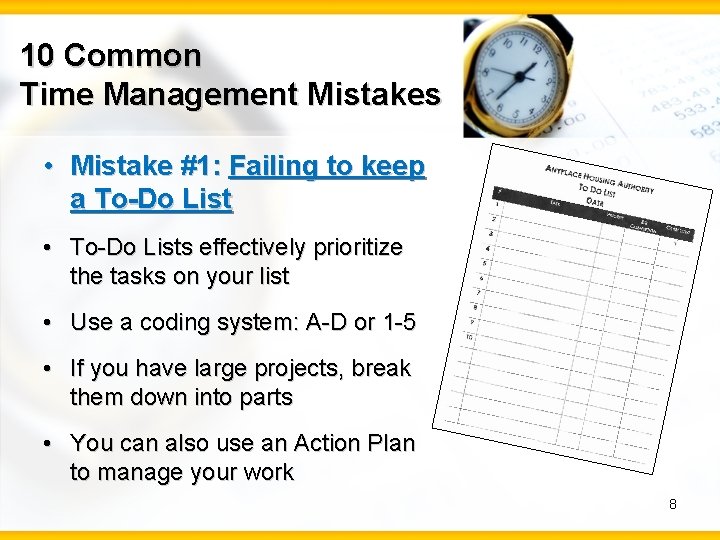
10 Common Time Management Mistakes • Mistake #1: Failing to keep a To-Do List • To-Do Lists effectively prioritize the tasks on your list • Use a coding system: A-D or 1 -5 • If you have large projects, break them down into parts • You can also use an Action Plan to manage your work 8
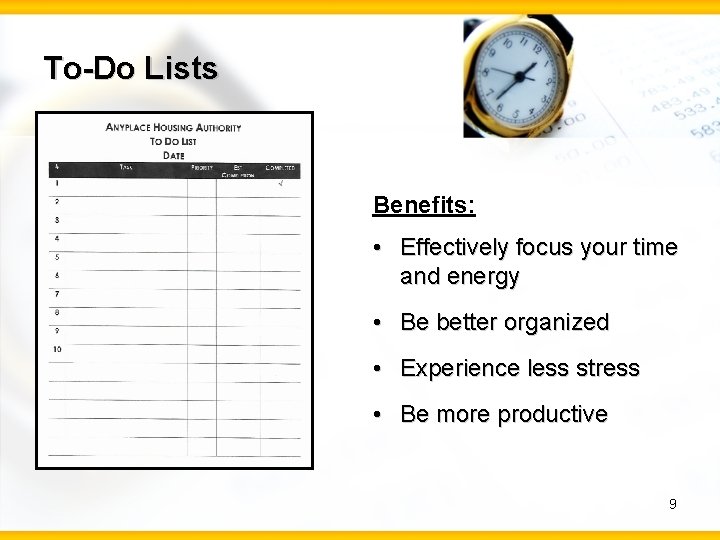
To-Do Lists Benefits: • Effectively focus your time and energy • Be better organized • Experience less stress • Be more productive 9
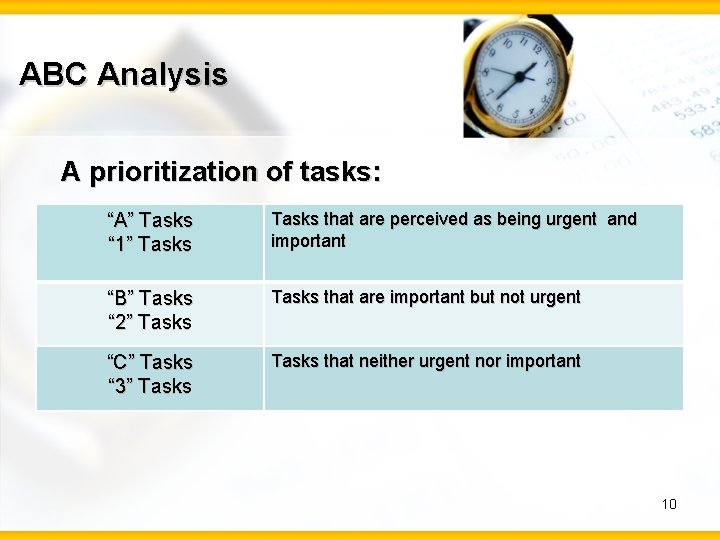
ABC Analysis A prioritization of tasks: “A” Tasks “ 1” Tasks that are perceived as being urgent and important “B” Tasks “ 2” Tasks that are important but not urgent “C” Tasks “ 3” Tasks that neither urgent nor important 10
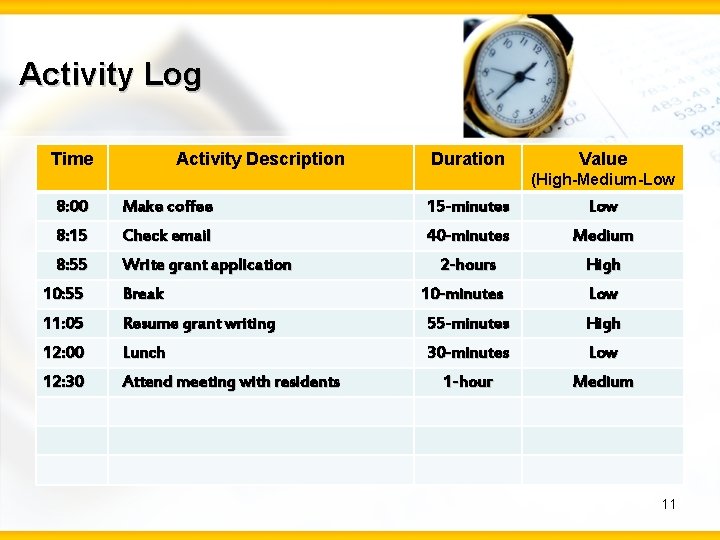
Activity Log Time Activity Description Duration Value (High-Medium-Low 8: 00 Make coffee 15 -minutes Low 8: 15 Check email 40 -minutes Medium 8: 55 Write grant application 2 -hours High 10: 55 Break 10 -minutes Low 11: 05 Resume grant writing 55 -minutes High 12: 00 Lunch 30 -minutes Low 12: 30 Attend meeting with residents 1 -hour Medium 11
10 Common Time Management Mistakes • Mistake #2: Not Setting Personal Goals – Personal goal setting is essential to managing your time, goals give you a destination and vision to work toward. – When you know where you want to go, you can manage your priorities, time, and resources to get there. – Goals help you decide what is worth spending your time on. 12
5 Principles of Goal Setting • To motivate, goals must have: § § § Clarity Challenge Commitment Feedback Task Complexity The whole point of goal setting is to facilitate success! 13
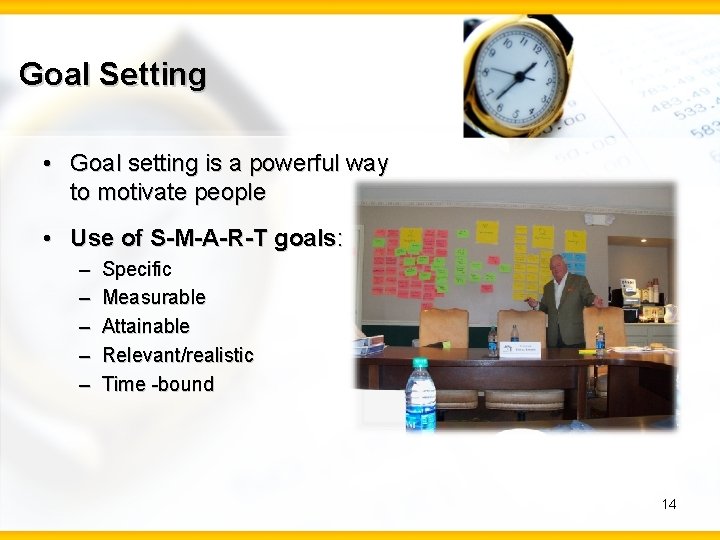
Goal Setting • Goal setting is a powerful way to motivate people • Use of S-M-A-R-T goals: – – – Specific Measurable Attainable Relevant/realistic Time -bound 14
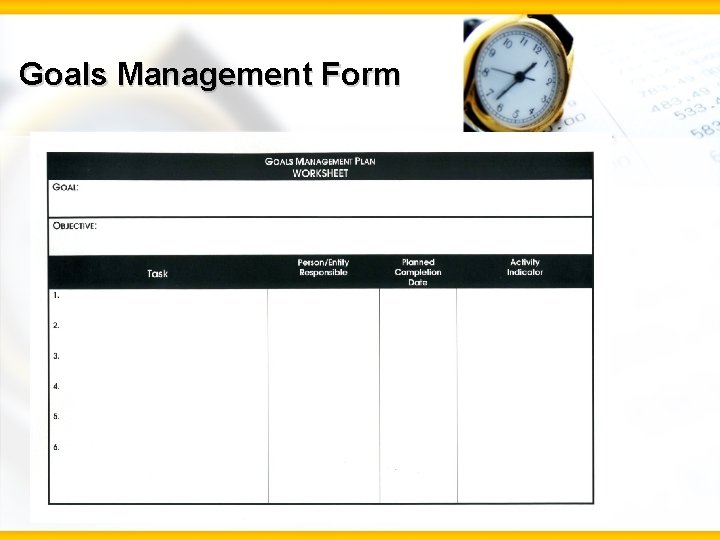
Goals Management Form
10 Common Time Management Mistakes • Mistake #3: Not Prioritizing • Sometimes it is difficult to know how to prioritize, especially when your facing a flood of seemingly-urgent tasks. • Tools: – Urgent/Important Matrix – Action Priority Matrix 16
Activity Logs Taking Inventory of Your Time • How long do you spend each day on unimportant tasks? – Junk mail, talking to colleagues, making coffee? • It may be a good idea to take inventory of your workday by keeping an Activity Log • By using this simple tool you will be able to determine how to better use your time for more important issues 17
Action Priority Matrix Worksheet Impact 0 -10) Effort (0 -10) Complete security grant 9 9 Design poster for community center 5 4 Conduct meeting with Resident Advisory Group 8 4 Draft resolution for board meeting 8 3 Activity 18
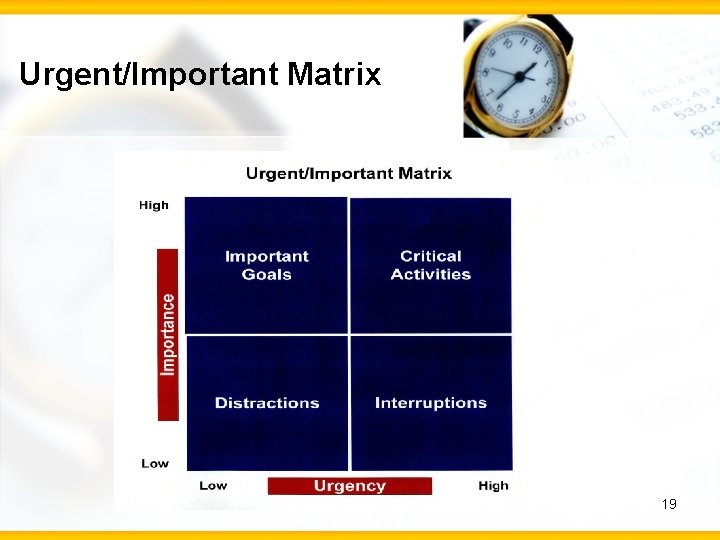
Urgent/Important Matrix 19
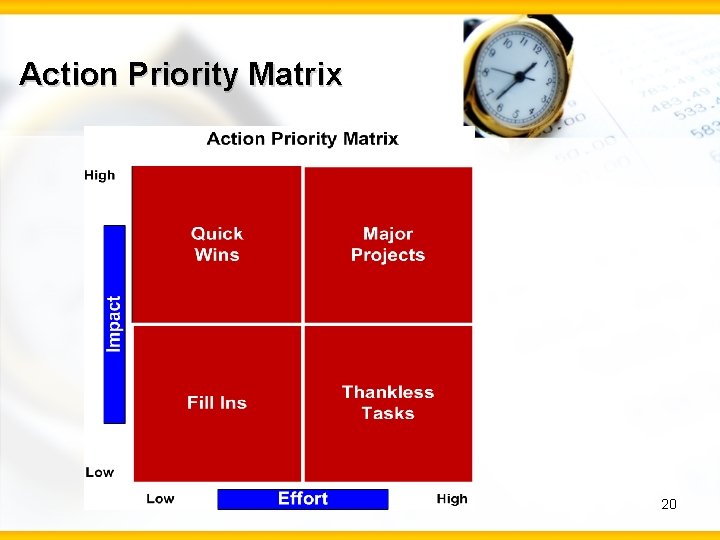
Action Priority Matrix 20
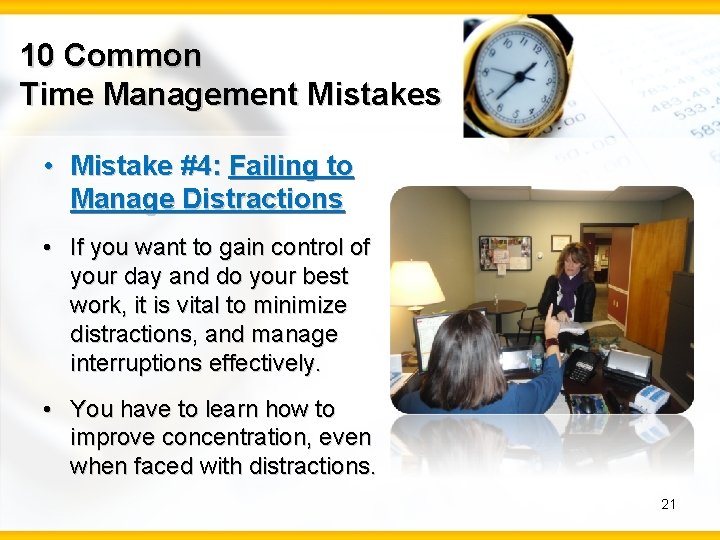
10 Common Time Management Mistakes • Mistake #4: Failing to Manage Distractions • If you want to gain control of your day and do your best work, it is vital to minimize distractions, and manage interruptions effectively. • You have to learn how to improve concentration, even when faced with distractions. 21
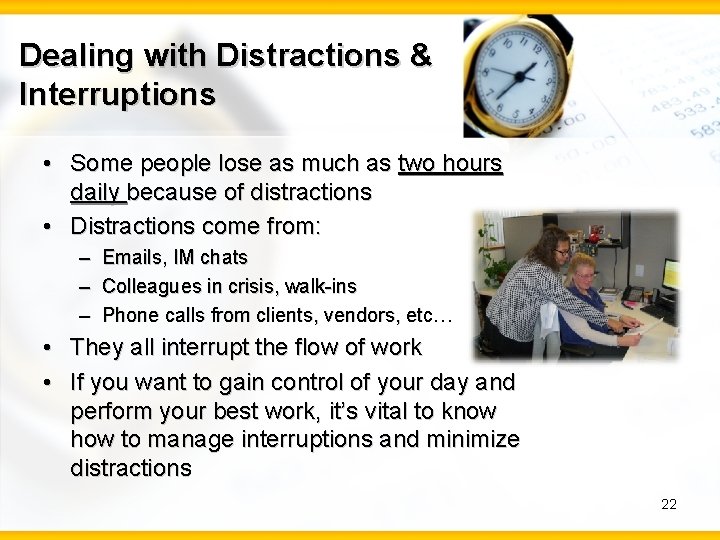
Dealing with Distractions & Interruptions • Some people lose as much as two hours daily because of distractions • Distractions come from: – Emails, IM chats – Colleagues in crisis, walk-ins – Phone calls from clients, vendors, etc… • They all interrupt the flow of work • If you want to gain control of your day and perform your best work, it’s vital to know how to manage interruptions and minimize distractions 22
Minimizing Distractions • Email § Schedule “email” times § Check and respond to email at “low productivity” times § Schedule your email check-in during your less-productive hours § Keep you email program closed § Turn emails into actions 23
Minimizing Distractions (2) • Disorganization – A disorganized desk or office can be very distracting and slow down your productivity – When you are disorganized, you cannot think and plan clearly • Instant messaging – Use in a disciplined way • Phone calls – Minimize phone call distractions by turning it off during peak work hours – Don’t take non-essential phone calls during certain hours (highproductive) of the day 24
Minimizing Distractions (3) • The Internet – Read the news before the start of the day – Close your Internet browser – Take short Internet breaks • Other People – Close your office door – Use headphones – Talk to the disrupter 25
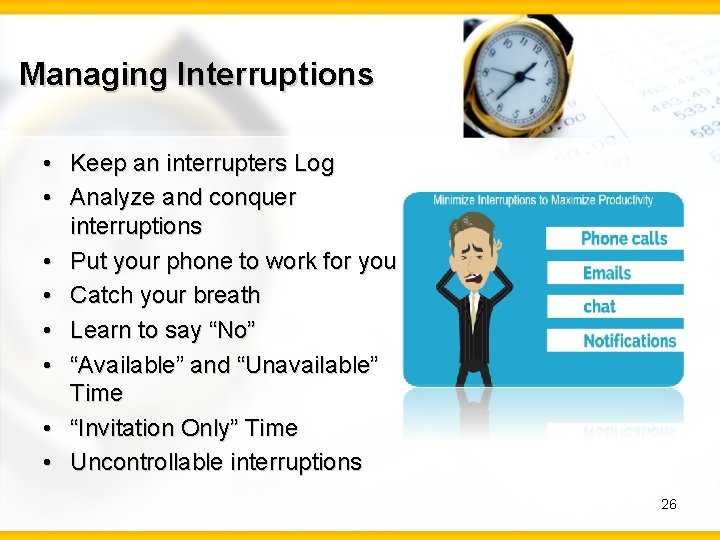
Managing Interruptions • Keep an interrupters Log • Analyze and conquer interruptions • Put your phone to work for you • Catch your breath • Learn to say “No” • “Available” and “Unavailable” Time • “Invitation Only” Time • Uncontrollable interruptions 26
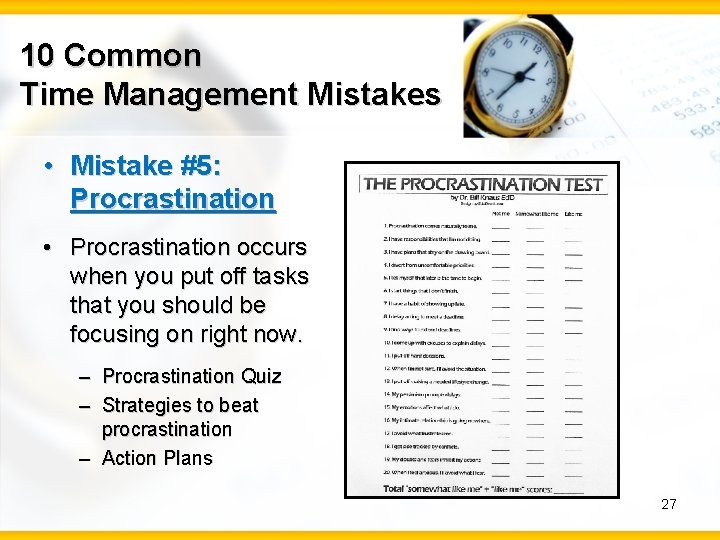
10 Common Time Management Mistakes • Mistake #5: Procrastination • Procrastination occurs when you put off tasks that you should be focusing on right now. – Procrastination Quiz – Strategies to beat procrastination – Action Plans 27
Overcoming Procrastination • What is procrastination? – When you put off things that you should be focusing on right now, usually in favor of doing something that is more enjoyable or that you are more comfortable with. • How to overcome procrastination: 1. Recognize that you are procrastinating. 2. Work out WHY you’re procrastinating 3. Adopt anti-procrastinating strategies 28
Recognizing Procrastination • Indicators: § Filling your day with low-priority tasks from your To-Do List § Reading emails several times without starting work on them or deciding what you are going to do with them § Sitting down to start a high-priority task and almost immediately going off to make a cup of coffee § Leaving an item on your To-Do List for a long time even though you know it’s important § Regularly saying yes to unimportant tasks that others ask you to do. § Waiting for the “right mood” or the “right time” to tackle the most important task at hand. 29
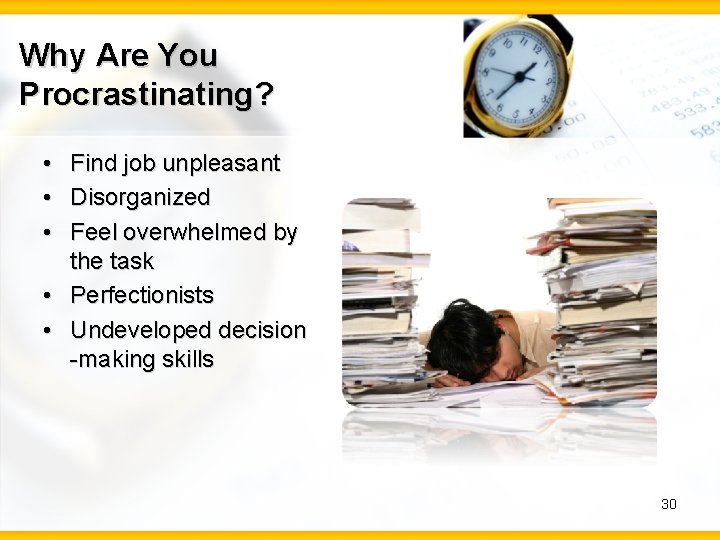
Why Are You Procrastinating? • Find job unpleasant • Disorganized • Feel overwhelmed by the task • Perfectionists • Undeveloped decision -making skills 30
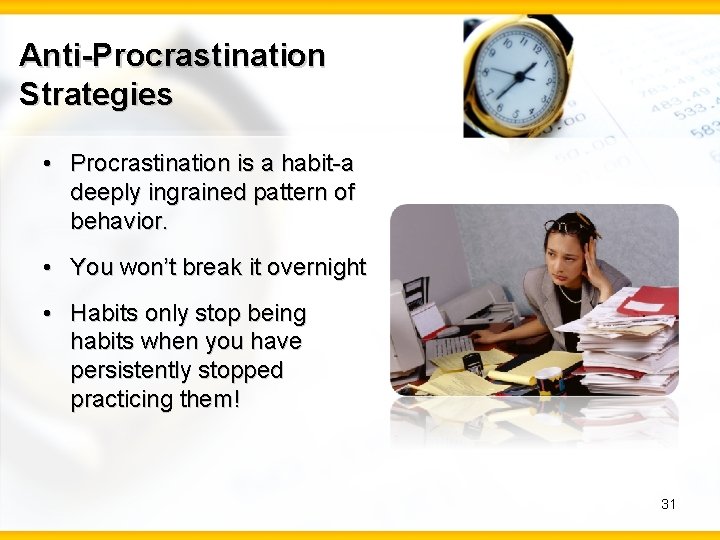
Anti-Procrastination Strategies • Procrastination is a habit-a deeply ingrained pattern of behavior. • You won’t break it overnight • Habits only stop being habits when you have persistently stopped practicing them! 31
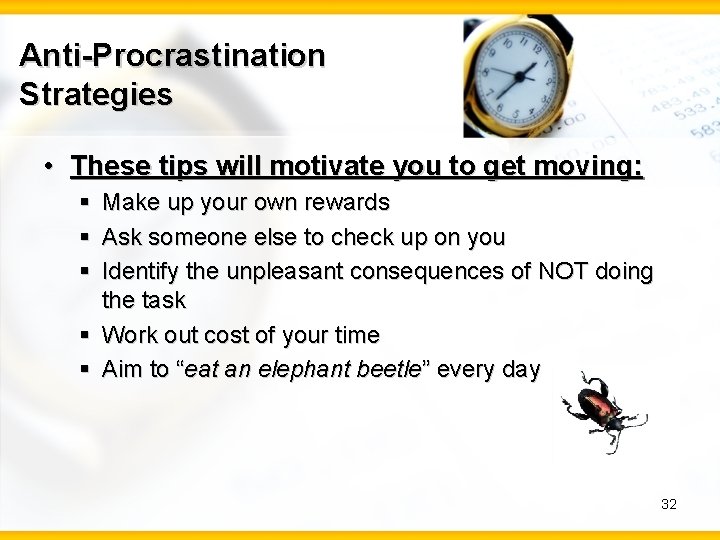
Anti-Procrastination Strategies • These tips will motivate you to get moving: § § § Make up your own rewards Ask someone else to check up on you Identify the unpleasant consequences of NOT doing the task § Work out cost of your time § Aim to “eat an elephant beetle” every day 32
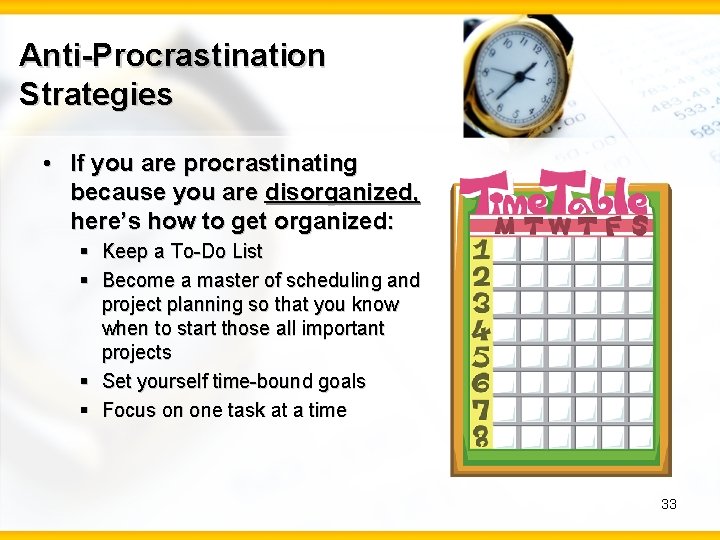
Anti-Procrastination Strategies • If you are procrastinating because you are disorganized, here’s how to get organized: § Keep a To-Do List § Become a master of scheduling and project planning so that you know when to start those all important projects § Set yourself time-bound goals § Focus on one task at a time 33
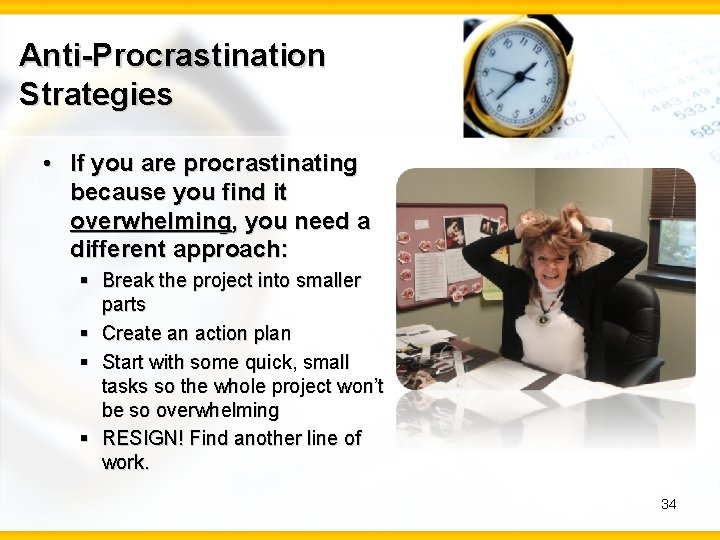
Anti-Procrastination Strategies • If you are procrastinating because you find it overwhelming, you need a different approach: § Break the project into smaller parts § Create an action plan § Start with some quick, small tasks so the whole project won’t be so overwhelming § RESIGN! Find another line of work. 34
10 Common Time Management Mistakes • Mistake #6: Taking on too Much § Are you a person who has a hard time saying “no” to people? • If so, you probably have far too many projects and commitments on your plate. § Are you a micromanager? : someone who insists on controlling or doing all of the work yourself, because they don’t trust anyone else to do it correctly. 35
Avoid Micromanaging • Signs of Micromanaging – Resisting delegation – Immersing yourself in overseeing projects of others – Start by correcting tiny details instead of big picture – Taking back delegated work before it’s finished – Discouraging others to make decisions without you • Micromanagement restricts the ability of micromanaged people to grow, and it also limits what the micromanager’s team can achieve, because EVERYTHING has to go through him or her. 36
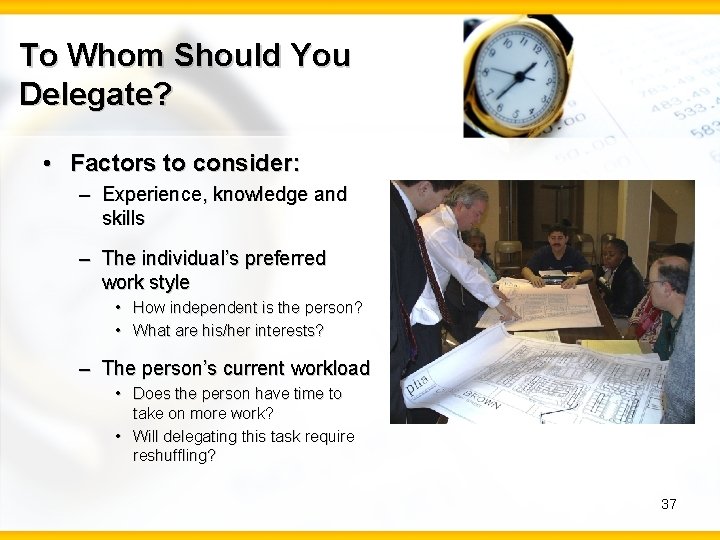
To Whom Should You Delegate? • Factors to consider: – Experience, knowledge and skills – The individual’s preferred work style • How independent is the person? • What are his/her interests? – The person’s current workload • Does the person have time to take on more work? • Will delegating this task require reshuffling? 37
How to Delegate (1) § Clearly articulate desired outcome § Clearly identify constraints and boundaries § Should the person: ü Wait to be told what to do? ü Ask what to do? ü Recommend what should be done, and then ask? ü Act, and then report results immediately ü Initiate action, and then report periodically? § Empower staff. Let them decide what tasks are to be delegated 38
How to Delegate (2) § Delegate to the lowest possible organizational level • Closest to the work – they have the most knowledge § Provide adequate support and ne available to answer questions § Focus on results § Avoid “upward” delegation” § Build motivation and commitment § Discuss the impact on the organization § Establish and maintain control 39

Ready to Serve 40
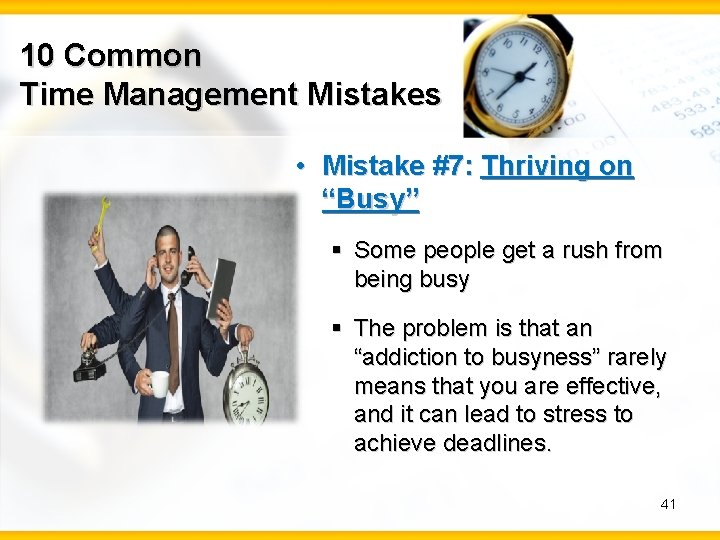
10 Common Time Management Mistakes • Mistake #7: Thriving on “Busy” § Some people get a rush from being busy § The problem is that an “addiction to busyness” rarely means that you are effective, and it can lead to stress to achieve deadlines. 41
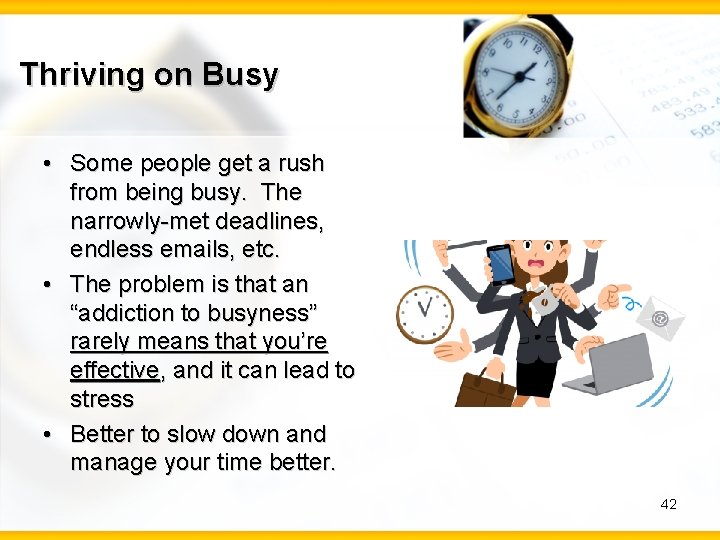
Thriving on Busy • Some people get a rush from being busy. The narrowly-met deadlines, endless emails, etc. • The problem is that an “addiction to busyness” rarely means that you’re effective, and it can lead to stress • Better to slow down and manage your time better. 42
10 Common Time Management Mistakes • Mistake #8: Multitasking 43
Multitasking Can It help You Get More Done? • Multitasking DOES NOT make you more productive! • American Psychological Association – Journal of Experimental Psychology • “multitasking actually results in us wasting around 20 -40% of our time, depending on what we’re trying to do. ” • Simple reason is that we can’t actually focus on more than one task at a time – Reduces quality of work 44
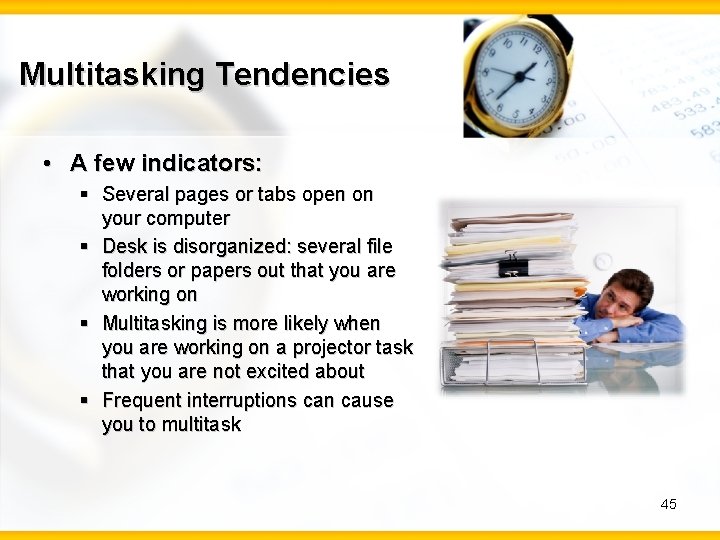
Multitasking Tendencies • A few indicators: § Several pages or tabs open on your computer § Desk is disorganized: several file folders or papers out that you are working on § Multitasking is more likely when you are working on a projector task that you are not excited about § Frequent interruptions can cause you to multitask 45
How To Stop Multitasking § Plan your day in blocks § Follow your To-Do List § Prioritize! § Manage your interruptions § § § Be assertive Close your office door Hold the phone calls § Improve your concentration § Focus on one task at a time 46
10 Common Time Management Mistakes • Mistake #9: Not Taking Breaks – Don’t dismiss taking breaks as a waste of time • Enables you to think creatively and work effectively • Helps to avoid stress 47
10 Common Time Management Mistakes • Mistake #10: Ineffectively Scheduling Tasks § § § Are you a morning person? Do you work better in the afternoon? All of us have different rhythms, that is, different times of the day when we feel more productive and energetic § Schedule high value work during your peak time 48
Effective Scheduling Planning to Make the Best Use of Your Time • Scheduling is the process by which you look at the time available to you, and plan on how you will use it to achieve your goals. § By using a schedule properly, you can: • Understand what you can realistically achieve with your time • Plan to make the best use of the time available • Leave enough time for things you absolutely must do • Preserve contingency time to handle the unexpected • Minimize stress by avoiding over-commitment to yourself and others 49
Preparing Your Schedule • Scheduling is done on a regular basis. Go through the following steps: § Identify time available § Block in actions you absolutely must take to do a good job § Review your To-Do List and schedule highpriority urgent activities § Block in appropriate contingency time § What’s left is “discretionary time” the time available to deliver your priorities and achieve your goals 50
Time Management Summary Key Issues: Key Points: • • • Time management is an essential skill that helps keep your work under control, at the same time that it helps you keep stress to a minimum Goal Setting Prioritization Managing Interruptions Procrastination Scheduling 51

Thank you for your time! Any questions? ? ? 52
- Slides: 52