
Time Management and Stress Management Tips on how
- Slides: 26
Time Management and Stress Management Tips on how to stay mentally and emotionally healthy whilst studying
Why Time Management? n n Good time management is essential to success at university Planning your time avoids a ‘traffic jam’ of work and helps you cope with study stress Helps you study for harder subjects Makes you feel in control!
Most Important: Plan ahead n Prioritize your tasks- decide which task is most important and should be completed first. For example- In a choice between writing an essay due in 2 weeks or preparing a presentation due to 4 weeks - start with the essay.
Tips n n Complete small tasks straight away rather than putting them off. Break difficult or boring work into sections Don’t try and write an assignment in one sitting-write it section by section If you feel yourself loosing focus, sit back and think “What are my goals? Why am I studying? ”
Long Term Planning n n n Using a yearly or 6 month planner allows you to plan your work over the entire semester and helps to remind you about deadlines and upcoming commitments Place your planner in a position where you have easy access to it (desk or wall) Write in dates assignments are due and exams are scheduled
Long Term Planning Cont n n Remember to allow for extra workload. If you have several assignments due at the same time, you will need to begin each task even earlier than usual Plan start dates for each task and write them on your planner. Draw lines back from the due dates to the start dates, using different colours for each subject
Planning on a Weekly Basis n n n It may seem that you have no time to study, but short and medium time slots can be used effectively Short time slots include train/bus journeys, lunch breaks and gaps between classes Anything from 15 minutes to 1 hour is a short break and is still useful!
Tasks for Short Time Slots n n n Reviewing lecture notes Completing short readings Revising for exams Proofreading an assignment Writing essay plans Completing tutorial tasks
Medium Time Slots 1 to 3 hours is a good time for more concentrated study. Medium time slots can be used for: n Revising for exams n Drafting/editing assignments n Reading for assignments n Taking notes from readings
Long Time Slots More than 3 hours can be set aside for: n Working on assignments n Completing extensive amounts of reading n Doing research for assignments n Revising for exams During medium and long time slots, take regular breaks after 1 hour, as your concentration begins to slip
Weekly Planner For weekly planning use your student diary or a timetable. Fill in all the main demands on your time : n Lectures and Tutorials n Hours of work (part time job) n Regular social commitments n Mealtimes and family events n Sleep times
Weekly Planner n n When you have written in the main demands on your time, look at the blank time slots left. This will help you work out how many hours a week you actually have for study. Then plan time slots for study, fill in times that can be used for study periods including short, medium and long time slots
Stress Management n n The first and most important part of stress management whilst you study is time management! If you are organised and plan ahead you won’t become as worried or stressed with your studies. However there are several other tips that can help you keep your stress under control…
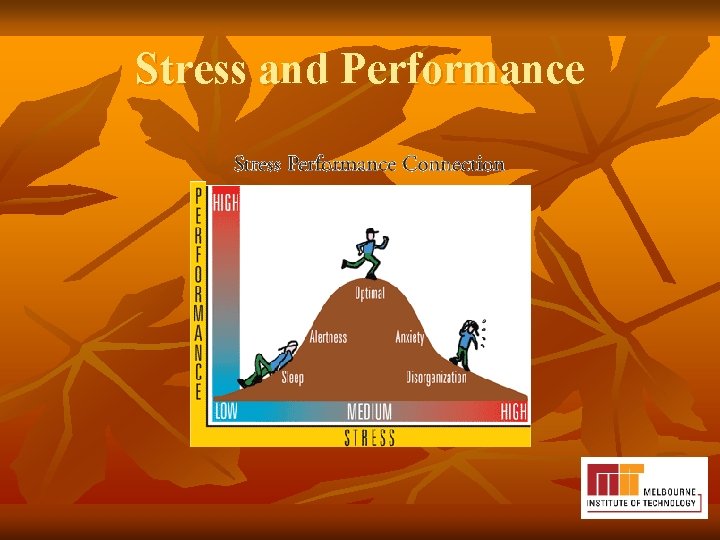
What is stress? n n Stress is our body’s way of responding to any kind of demand. It can be from positive or negative experiences. Stress is unavoidable, we all need a certain degree of stress in our lives to keep us motivated, to protect us and to keep us alert.
Stress and Performance
How do I know I’m stressed? n n n Stress can be felt in a variety of different ways, including physically, emotionally, cognitively and behaviourally. There are many different symptoms of stress and each individual can experience them differently. However there are common signs and symptoms of stress…
Intellectual Symptoms- How stress can affect your mind n n n n Memory Problems Difficulty making decisions Inability to concentrate Confusion Seeing only negative Desire to escape or run away Repetitive or racing thoughts Poor judgment
Emotional Symptoms-How stress can make you feel n n n n Moody and hypersensitive Depressed Anger and resentment Easily irritated Lack of confidence Anxiety Sense of being overwhelmed Urge to laugh or cry at inappropriate times
Physical Symptoms- How stress can affect your body n n n n n Headaches Digestive problems Muscle tension and pain Fatigue Chest pain, irregular heartbeat High blood pressure Weight loss or gain Sleep disturbances Skin problems
Behavioural Symptoms-How stress can affect your behaviour n n n n Eating more or less Sleeping too much or too little Isolating yourself from others Neglecting your responsibilities Teeth grinding or jaw clenching Loosing your temper Overreacting to unexpected problems Overdoing activities such as shopping or exercise
So what can we do? There are many different techniques we can use to assist in managing our stress. Some general things we can do include: n Exercising regularly n Eating right n Eliminating or reducing caffeine n Sleeping regularly n Develop emotional supports and using them
What else? Relaxation Breathing: n Take long deep breaths and visualize the air going from your mouth down to your stomach. n Attempt to do this 10 -15 times a day. n Breathing will slow down or stop the stress response in your body, it helps the body to relax.
What else? Mindfulness: n Find yourself a quite comfortable place where you can sit down. Close your eyes and breath, noticing your body, how it feels etc. n With your eyes still closed, purposefully shift your awareness away from your body to everything you can hear and smell n If you feel yourself getting caught up with your thoughts, shift your focus back to your breathing n Practice for 5 -10 minutes
What else? Laughing: n Have some fun! Enjoy leisure activities as your normally would. n Having a balance between work, study and friends is beneficial to your well being. n Have regular hobbies or activities that you can enjoy. This gives you a “time out” from study and from stress!
4 things in 5 minutes n n 1. Breath deeply- take several deep breaths to slow your heart rate and reduce your stress 2. Relax your muscles- stretch your neck, stand or sit up straight 3. Make a change- Step back from what you’re doing. A few seconds can bring a lot of perspective 4. Laugh- Nothing relieves the tension in your body or mind like a little laughter
Remember: n n We cannot avoid stress. Positive and negative events can cause stress so we have to be realistic. Stress can be accumulative, so its important to recognise our body’s response and warning signs of stress. Take a break between semesters to have some “down time”. Get help if you need it, through either friends or talking to the student counsellor.