
Time for HighConfidence CyberPhysical Systems Key Collaborators on
Time for High-Confidence Cyber-Physical Systems Key Collaborators on work shown here: Edward A. Lee Robert S. Pepper Distinguished Professor UC Berkeley Invited Plenary Talk Performance Metrics for Intelligent Systems (Per. MIS'12) Workshop University of Maryland March 20 -22, 2012. • Steven Edwards • Jeff Jensen • Sungjun Kim • Isaac Liu • Slobodan Matic • Hiren Patel • Jan Reinke • Sanjit Seshia • Mike Zimmer • Jia Zou
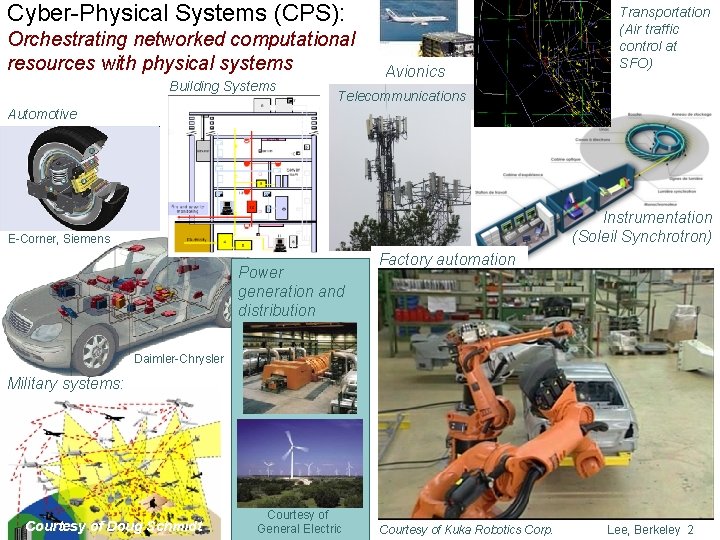
Cyber-Physical Systems (CPS): Orchestrating networked computational resources with physical systems Building Systems Avionics Transportation (Air traffic control at SFO) Telecommunications Automotive Instrumentation (Soleil Synchrotron) E-Corner, Siemens Power generation and distribution Factory automation Daimler-Chrysler Military systems: Courtesy of Doug Schmidt Courtesy of General Electric Courtesy of Kuka Robotics Corp. Lee, Berkeley 2
Claim For CPS, programs do not adequately specify behavior. Corollary: Performance of program execution may not be a good metric. Lee, Berkeley 3
A Story The Boeing 777 was Boeing’s first fly-by-wire aircraft, controlled by software. It is deployed, appears to be reliable, and is succeeding in the marketplace. Therefore, it must be a success. However… Boeing was forced to purchase and store an advance supply of the microprocessors that will run the software, sufficient to last for the estimated 50 year production run of the aircraft and another many years of maintenance. Why? Lee, Berkeley 4
Lesson from this example: Apparently, the software does not specify the behavior that has been validated and certified! Unfortunately, this problem is very common, even with less safety-critical, certification-intensive applications. Validation is done on complete system implementations, not on software. Lee, Berkeley 5
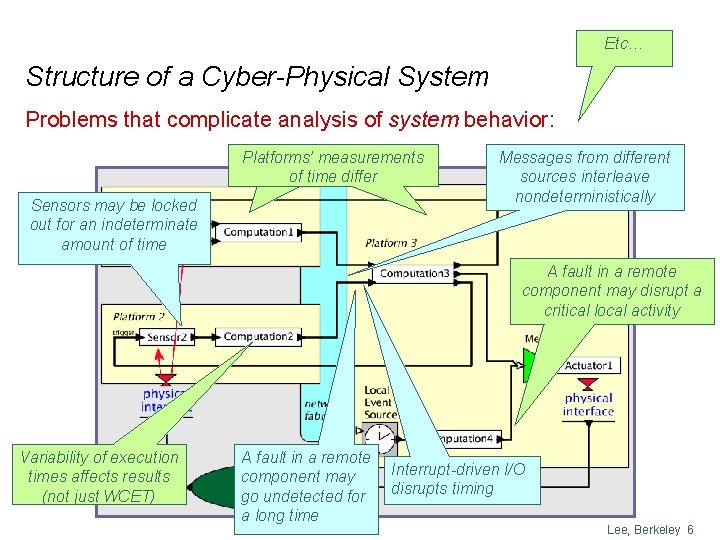
Etc… Structure of a Cyber-Physical System Problems that complicate analysis of system behavior: Platforms’ Plat measurements of time differ Sensors may be locked out for an indeterminate amount of time Messages from different sources interleave nondeterministically A fault in a remote component may disrupt a critical local activity Variability of execution times affects results (not just WCET) A fault in a remote component may go undetected for a long time Interrupt-driven I/O disrupts timing Lee, Berkeley 6
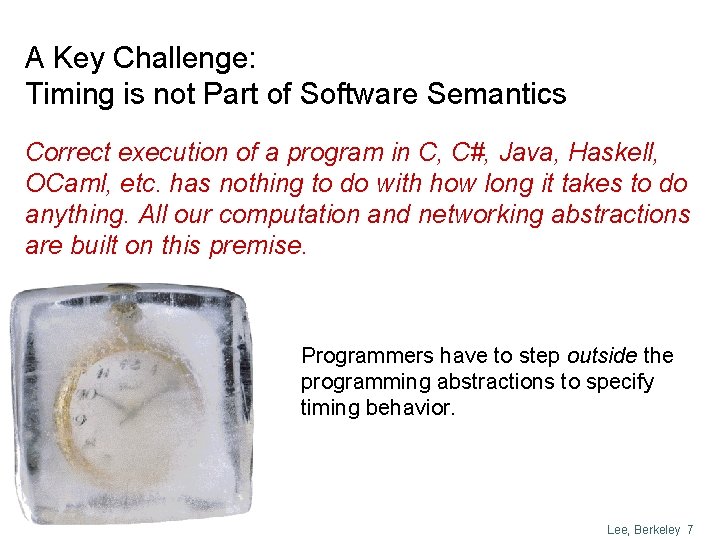
A Key Challenge: Timing is not Part of Software Semantics Correct execution of a program in C, C#, Java, Haskell, OCaml, etc. has nothing to do with how long it takes to do anything. All our computation and networking abstractions are built on this premise. Programmers have to step outside the programming abstractions to specify timing behavior. Lee, Berkeley 7

The first edition of Hennessy and Patterson (1990) revolutionized the field of computer architecture by making performance metrics the dominant criterion for design. Today, for computers, timing is merely a performance metric. It needs to be a correctness criterion. Lee, Berkeley 8
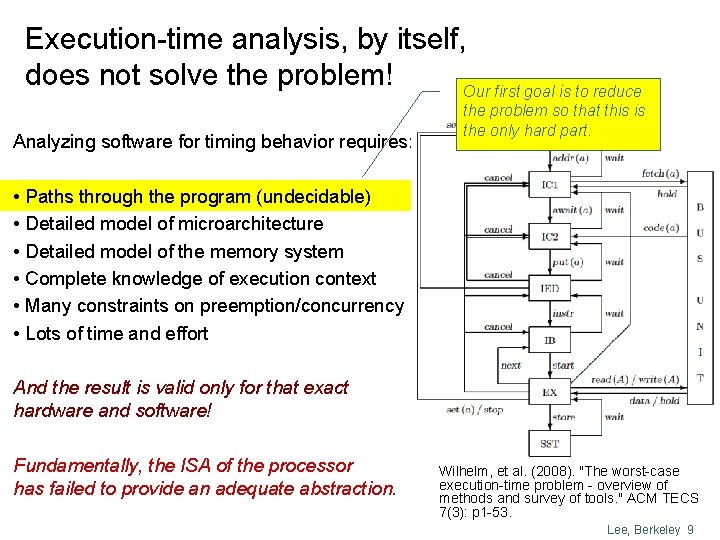
Execution-time analysis, by itself, does not solve the problem! Our first goal is to reduce Analyzing software for timing behavior requires: the problem so that this is the only hard part. • Paths through the program (undecidable) • Detailed model of microarchitecture • Detailed model of the memory system • Complete knowledge of execution context • Many constraints on preemption/concurrency • Lots of time and effort And the result is valid only for that exact hardware and software! Fundamentally, the ISA of the processor has failed to provide an adequate abstraction. Wilhelm, et al. (2008). "The worst-case execution-time problem - overview of methods and survey of tools. " ACM TECS 7(3): p 1 -53. Lee, Berkeley 9
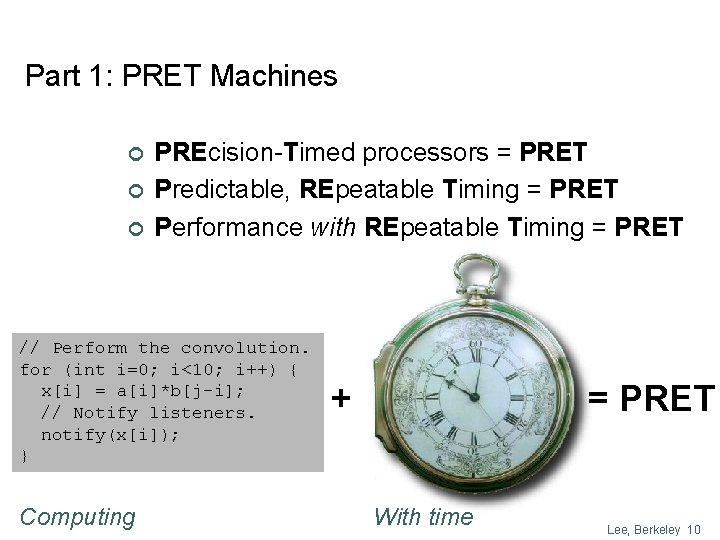
Part 1: PRET Machines ¢ ¢ ¢ PREcision-Timed processors = PRET Predictable, REpeatable Timing = PRET Performance with REpeatable Timing = PRET // Perform the convolution. for (int i=0; i<10; i++) { x[i] = a[i]*b[j-i]; // Notify listeners. notify(x[i]); } Computing + = PRET With time Lee, Berkeley 10
Dual Approach ¢ Rethink the ISA l ¢ Timing has to be a correctness property not a performance property. Implementation has to allow for multiple realizations and efficient realizations of the ISA l l Repeatable execution times Repeatable memory access times Lee, Berkeley 11
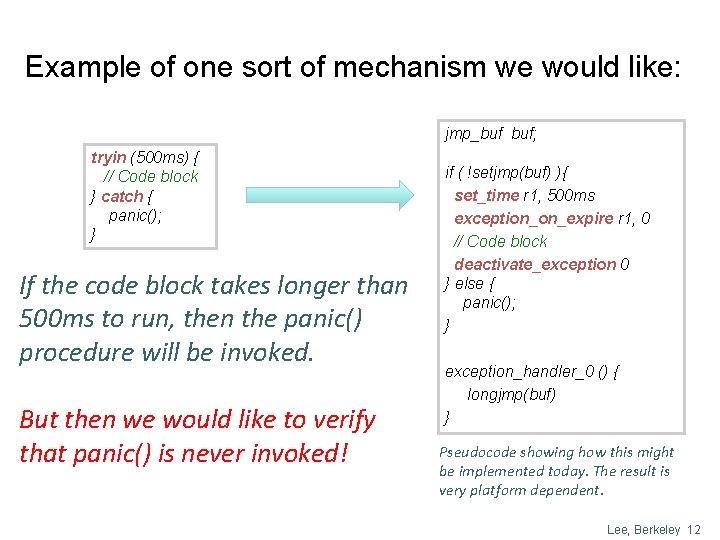
Example of one sort of mechanism we would like: jmp_buf buf; tryin (500 ms) { // Code block } catch { panic(); } If the code block takes longer than 500 ms to run, then the panic() procedure will be invoked. But then we would like to verify that panic() is never invoked! if ( !setjmp(buf) ){ set_time r 1, 500 ms exception_on_expire r 1, 0 // Code block deactivate_exception 0 } else { panic(); } exception_handler_0 () { longjmp(buf) } Pseudocode showing how this might be implemented today. The result is very platform dependent. Lee, Berkeley 12
![Extending an ISA with Timing Semantics [V 1] Best effort: set_time r 1, 1](http://slidetodoc.com/presentation_image_h/168228600efeaf7dbb9805b7d3e5c625/image-13.jpg "Extending an ISA with Timing Semantics [V 1] Best effort: set_time r 1, 1")
Extending an ISA with Timing Semantics [V 1] Best effort: set_time r 1, 1 s // Code block delay_until r 1 [V 2] Late miss detection set_time r 1, 1 s // Code block branch_expired r 1, <target> delay_until r 1 [V 3] Immediate miss detection set_time r 1, 1 s exception_on_expire r 1, 1 // Code block deactivate_exception 1 delay_until r 1 [V 4] Exact execution: set_time r 1, 1 s // Code block MTFD r 1 Lee, Berkeley 13
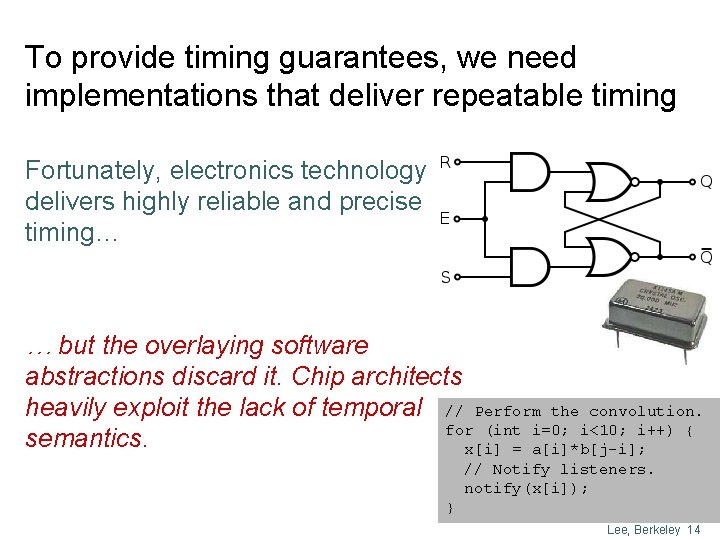
To provide timing guarantees, we need implementations that deliver repeatable timing Fortunately, electronics technology delivers highly reliable and precise timing… … but the overlaying software abstractions discard it. Chip architects heavily exploit the lack of temporal // Perform the convolution. for (int i=0; i<10; i++) { semantics. x[i] = a[i]*b[j-i]; // Notify listeners. notify(x[i]); } Lee, Berkeley 14
To deliver repeatable timing, we have to rethink the microarchitecture Challenges: l l l Pipelining Memory hierarchy I/O (DMA, interrupts) Power management (clock and voltage scaling) On-chip communication Resource sharing (e. g. in multicore) Lee, Berkeley 15
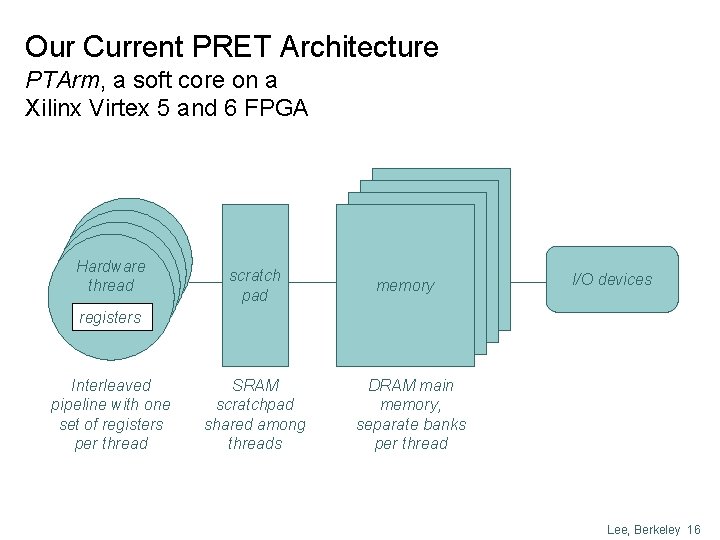
Our Current PRET Architecture PTArm, a soft core on a Xilinx Virtex 5 and 6 FPGA Hardware thread scratch pad memory I/O devices registers Interleaved pipeline with one set of registers per thread SRAM scratchpad shared among threads DRAM main memory, separate banks per thread Lee, Berkeley 16
Status of the PRET project ¢ Results: l l ¢ PTArm implemented on Xilinx Virtex 5 FPGA. UNISIM simulator of the PTArm facilitates experimentation. DRAM controller with repeatable timing and DMA support. PRET-like utilities implemented on COTS Arm. Much still to be done: l Realize MTFD, interrupt I/O, compiler toolchain, scratchpad management, etc. Lee, Berkeley 17
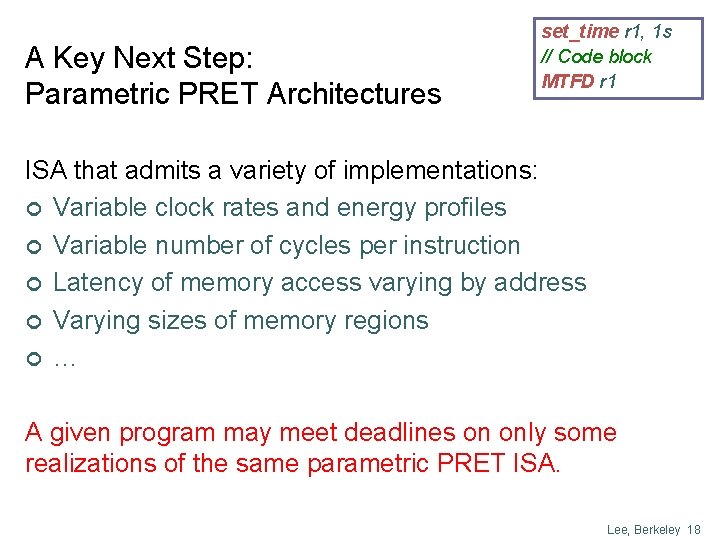
A Key Next Step: Parametric PRET Architectures set_time r 1, 1 s // Code block MTFD r 1 ISA that admits a variety of implementations: ¢ Variable clock rates and energy profiles ¢ Variable number of cycles per instruction ¢ Latency of memory access varying by address ¢ Varying sizes of memory regions ¢ … A given program may meet deadlines on only some realizations of the same parametric PRET ISA. Lee, Berkeley 18
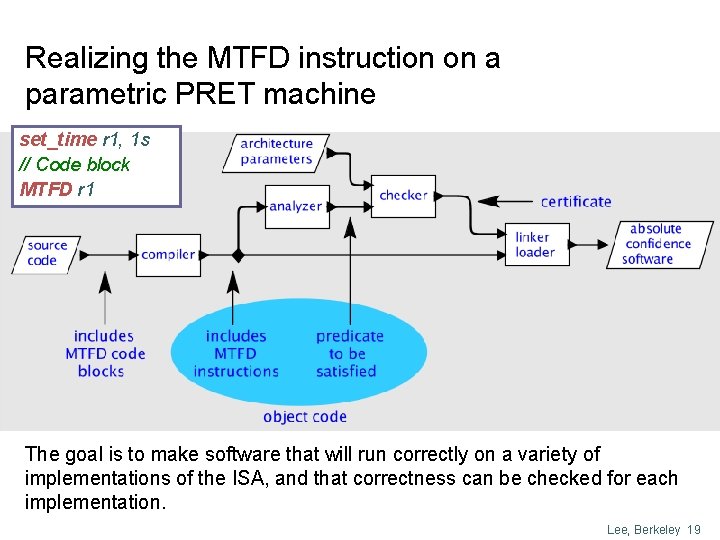
Realizing the MTFD instruction on a parametric PRET machine set_time r 1, 1 s // Code block MTFD r 1 The goal is to make software that will run correctly on a variety of implementations of the ISA, and that correctness can be checked for each implementation. Lee, Berkeley 19
PRET Publications http: //chess. eecs. berkeley. edu/pret/ ¢ S. Edwards and E. A. Lee, "The Case for the Precision Timed (PRET) Machine, " in the Wild and Crazy Ideas Track of DAC, June 2007. ¢ B. Lickly, I. Liu, S. Kim, H. D. Patel, S. A. Edwards and E. A. Lee, “Predictable programming on a precision timed architecture, ” CASES 2008. ¢ S. Edwards, S. Kim, E. A. Lee, I. Liu, H. Patel and M. Schoeberl, “A Disruptive Computer Design Idea: Architectures with Repeatable Timing, ” ICCD 2009. ¢ D. Bui, H. Patel, and E. Lee, “Deploying hard real-time control software on chip-multiprocessors, ” RTCSA 2010. ¢ Bui, E. A. Lee, I. Liu, H. D. Patel and J. Reineke, “Temporal Isolation on Multiprocessing Architectures, ” DAC 2011. ¢ J. Reineke, I. Liu, H. D. Patel, S. Kim, E. A. Lee, PRET DRAM Controller: Bank Privatization for Predictability and Temporal Isolation (to appear), CODES+ISSS, Taiwan, October, 2011. ¢ S. Bensalem, K. Goossens, C. M. Kirsch, R. Obermaisser, E. A. Lee, J. Sifakis, Time-Predictable and Composable Architectures for Dependable Embedded Systems, Tutorial Abstract (to appear), EMSOFT, Taiwan, October, 2011 Lee, Berkeley 20
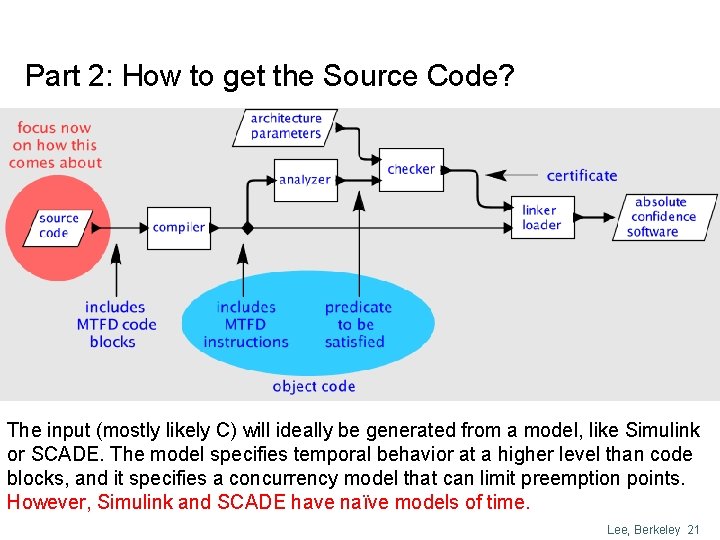
Part 2: How to get the Source Code? The input (mostly likely C) will ideally be generated from a model, like Simulink or SCADE. The model specifies temporal behavior at a higher level than code blocks, and it specifies a concurrency model that can limit preemption points. However, Simulink and SCADE have naïve models of time. Lee, Berkeley 21
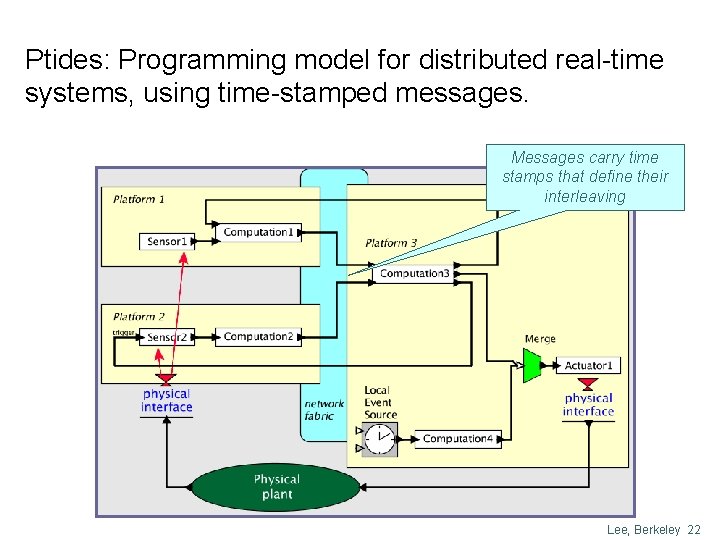
Ptides: Programming model for distributed real-time systems, using time-stamped messages. Messages carry time stamps that define their interleaving Lee, Berkeley 22
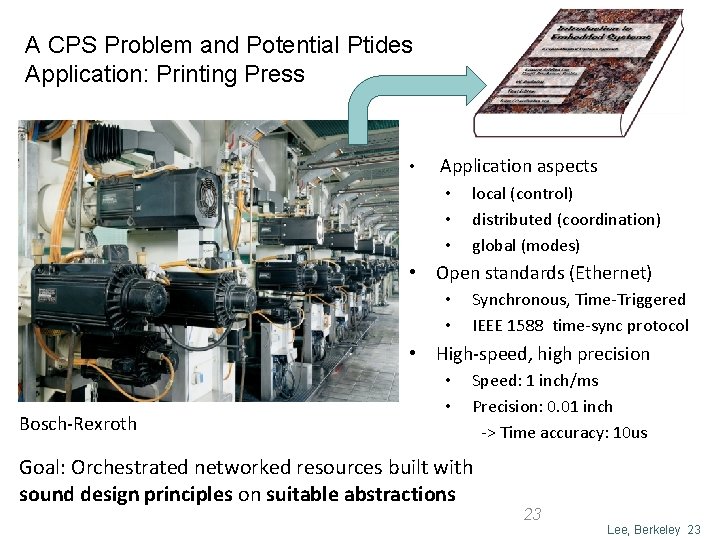
A CPS Problem and Potential Ptides Application: Printing Press • Application aspects • • • local (control) distributed (coordination) global (modes) • Open standards (Ethernet) • • Synchronous, Time-Triggered IEEE 1588 time-sync protocol • High-speed, high precision Bosch-Rexroth • • Speed: 1 inch/ms Precision: 0. 01 inch -> Time accuracy: 10 us Goal: Orchestrated networked resources built with sound design principles on suitable abstractions 23 Lee, Berkeley 23
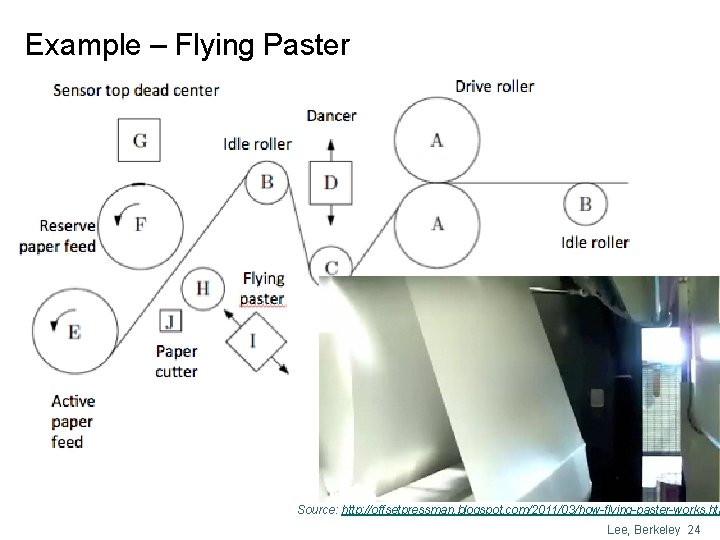
Example – Flying Paster Source: http: //offsetpressman. blogspot. com/2011/03/how-flying-paster-works. htm Lee, Berkeley 24
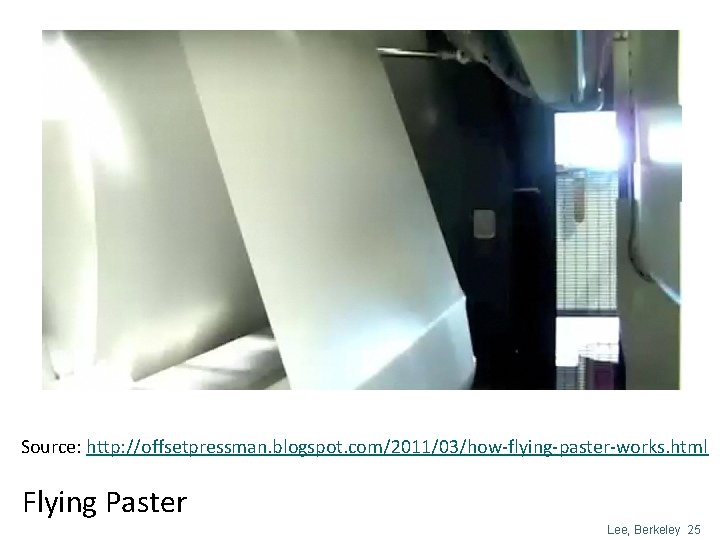
Source: http: //offsetpressman. blogspot. com/2011/03/how-flying-paster-works. html Flying Paster Lee, Berkeley 25
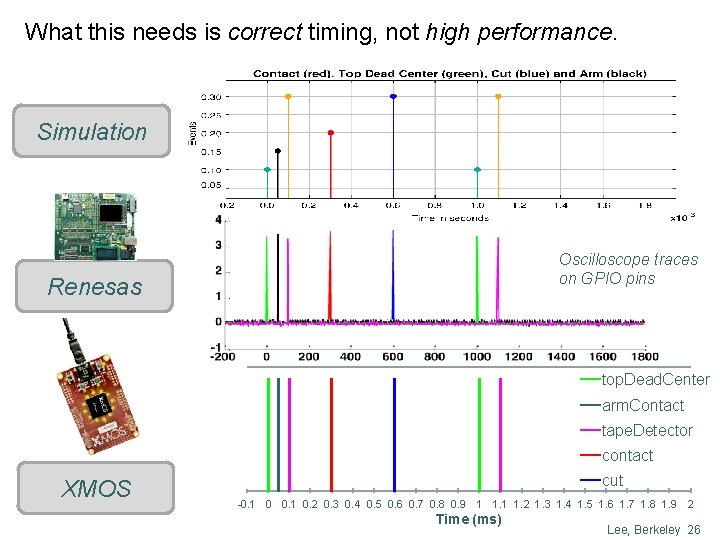
What this needs is correct timing, not high performance. Simulation Oscilloscope traces on GPIO pins Renesas top. Dead. Center arm. Contact tape. Detector contact XMOS cut -0. 1 0. 2 0. 3 0. 4 0. 5 0. 6 0. 7 0. 8 0. 9 1 1. 2 1. 3 1. 4 1. 5 1. 6 1. 7 1. 8 1. 9 2 Time (ms) Lee, Berkeley 26
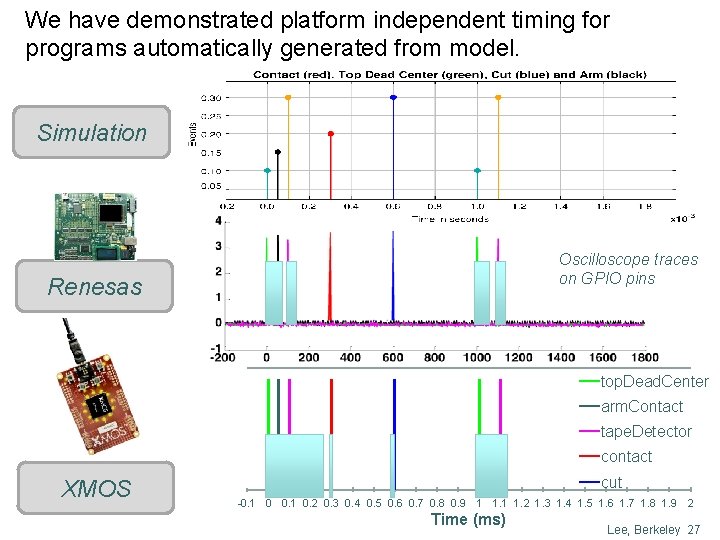
We have demonstrated platform independent timing for programs automatically generated from model. Simulation Oscilloscope traces on GPIO pins Renesas top. Dead. Center arm. Contact tape. Detector contact XMOS cut -0. 1 0. 2 0. 3 0. 4 0. 5 0. 6 0. 7 0. 8 0. 9 1 1. 2 1. 3 1. 4 1. 5 1. 6 1. 7 1. 8 1. 9 2 Time (ms) Lee, Berkeley 27
Ptides Publications http: //chess. eecs. berkeley. edu/ptides/ ¢ Y. Zhao, J. Liu, E. A. Lee, “A Programming Model for Time-Synchronized Distributed Real-Time Systems, ” RTAS 2007. ¢ T. H. Feng and E. A. Lee, “Real-Time Distributed Discrete-Event Execution with Fault Tolerance, ” RTAS 2008. ¢ P. Derler, E. A. Lee, and S. Matic, “Simulation and implementation of the ptides programming model, ” DS-RT 2008. ¢ J. Zou, S. Matic, E. A. Lee, T. H. Feng, and P. Derler, “Execution strategies for Ptides, a programming model for distributed embedded systems, ” RTAS 2009. ¢ J. Zou, J. Auerbach, D. F. Bacon, E. A. Lee, “PTIDES on Flexible Task Graph: Real-Time Embedded System Building from Theory to Practice, ” LCTES 2009. ¢ J. C. Eidson, E. A. Lee, S. Matic, S. A. Seshia and J. Zou, “Time-centric Models For Designing Embedded Cyber-physical Systems, ” ACES-MB 2010. ¢ J. C. Eidson, E. A. Lee, S. Matic, S. A. Seshia, and J. Zou, Distributed Real. Time Software for Cyber-Physical Systems, To appear in Proceedings of the IEEE special issue on CPS, December, 2011. Lee, Berkeley 28
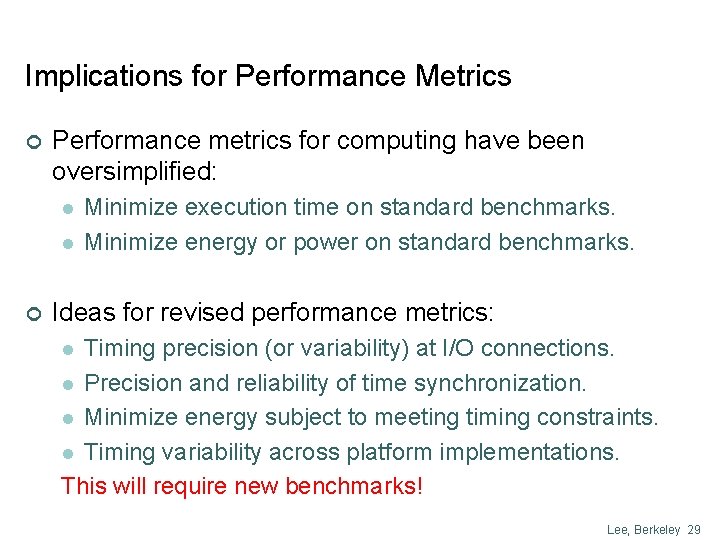
Implications for Performance Metrics ¢ Performance metrics for computing have been oversimplified: l l ¢ Minimize execution time on standard benchmarks. Minimize energy or power on standard benchmarks. Ideas for revised performance metrics: Timing precision (or variability) at I/O connections. l Precision and reliability of time synchronization. l Minimize energy subject to meeting timing constraints. l Timing variability across platform implementations. This will require new benchmarks! l Lee, Berkeley 29
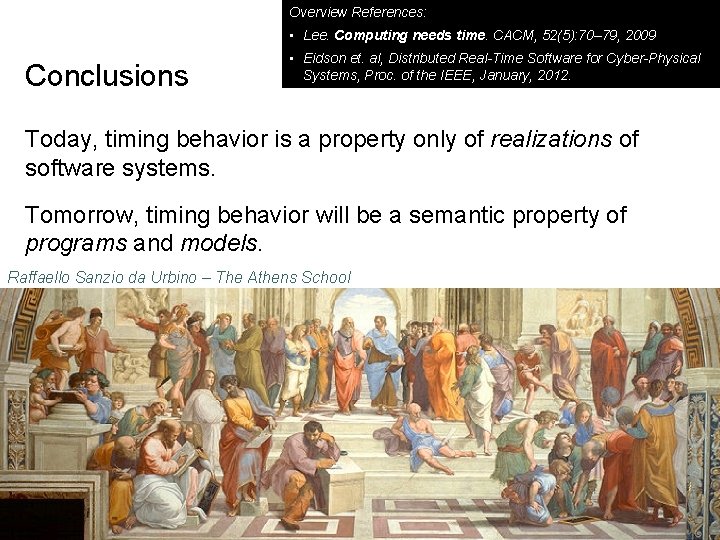
Overview References: • Lee. Computing needs time. CACM, 52(5): 70– 79, 2009 Conclusions • Eidson et. al, Distributed Real-Time Software for Cyber-Physical Systems, Proc. of the IEEE, January, 2012. Today, timing behavior is a property only of realizations of software systems. Tomorrow, timing behavior will be a semantic property of programs and models. Raffaello Sanzio da Urbino – The Athens School Lee, Berkeley 30
- Slides: 30