
Time evolution of reactor antineutrino energy spectrum and
![Obtained spectra Données : [A. Hahn et al. , Phys. Lett. B, 218, (1989)]](https://slidetodoc.com/presentation_image_h2/d88dfb7c72e77080304784fa9fc28643/image-12.jpg "Obtained spectra Données : [A. Hahn et al. , Phys. Lett. B, 218, (1989)]")
- Slides: 33
Time evolution of reactor antineutrino energy spectrum and flux Collaborations Double Chooz, Nucifer and MURE March 19. 2009 AAP 09 - Brazil - M. Fallot et al.
Outline 2 reasons why antineutrino spectrum and flux vary with time : - Non equilibrium : U and Pu istope and energy spectrum simulations - Variation of the fuel isotopic content of a reactor core : reactor antineutrino spectrum and flux simulation proliferation scenario (taking into account out of equilibrium effects when rapid power changes) March 19. 2009 AAP 09 - Brazil - M. Fallot et al.
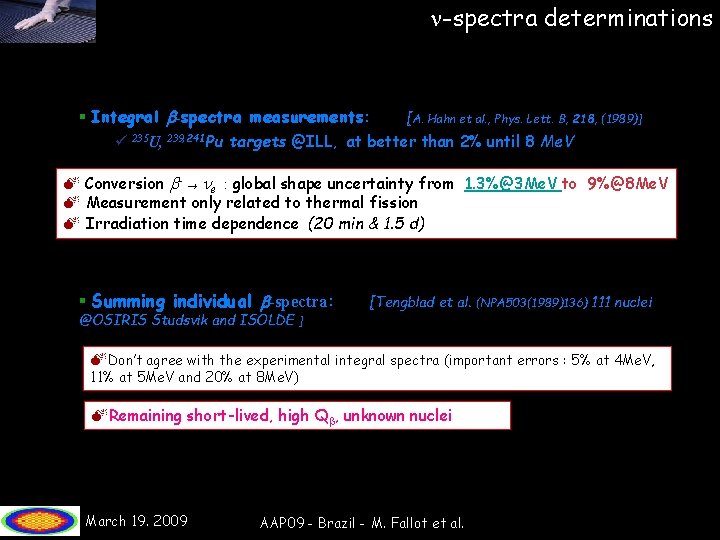
-spectra determinations § Integral -spectra measurements: [A. Hahn et al. , Phys. Lett. B, 218, (1989)] 235 U, 239, 241 Pu targets @ILL, at better than 2% until 8 Me. V Conversion - e : global shape uncertainty from 1. 3%@3 Me. V to 9%@8 Me. V Measurement only related to thermal fission Irradiation time dependence (20 min & 1. 5 d) § Summing individual -spectra: @OSIRIS Studsvik and ISOLDE ] [Tengblad et al. (NPA 503(1989)136) 111 nuclei Don’t agree with the experimental integral spectra (important errors : 5% at 4 Me. V, 11% at 5 Me. V and 20% at 8 Me. V) Remaining short-lived, high Q , unknown nuclei March 19. 2009 AAP 09 - Brazil - M. Fallot et al.
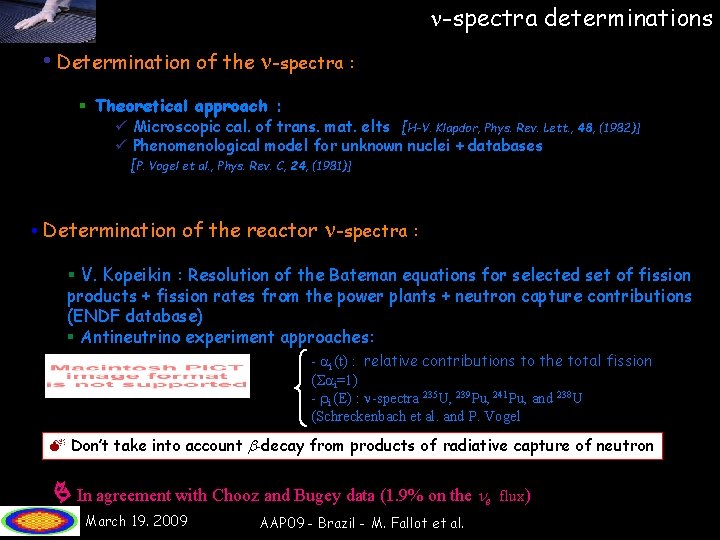
-spectra determinations • Determination of the -spectra : § Theoretical approach : Microscopic cal. of trans. mat. elts [H-V. Klapdor, Phys. Rev. Lett. , 48, (1982)] Phenomenological model for unknown nuclei + databases [P. Vogel et al. , Phys. Rev. C, 24, (1981)] • Determination of the reactor -spectra : § V. Kopeikin : Resolution of the Bateman equations for selected set of fission products + fission rates from the power plants + neutron capture contributions (ENDF database) § Antineutrino experiment approaches: - i (t) : relative contributions to the total fission ( i=1) - i (E) : -spectra 235 U, 239 Pu, 241 Pu, and 238 U (Schreckenbach et al. and P. Vogel Don’t take into account -decay from products of radiative capture of neutron In agreement with Chooz and Bugey data (1. 9% on the e March 19. 2009 AAP 09 - Brazil - M. Fallot et al. flux)
Neutron capture, non equilibrium effects V. Kopeikin et al. , ar. Xiv: hep-ph/0110290 « In the antineutrino energy range 1. 8 -3. 5 Me. V, the relative contribution of the additional radiation during the reactor operating period (Figs. 1, 5) is about 4%, which is somewhat greater than the error of the ILL spectra [5]. » Ratio of the reactor -spectrum obtained by conversion + calculation methods �to the - spectrum obtained by conversion method only �convers. : 1 – the additional contribution from fission product residual - activity of the previous two reactor cycles; 2 – from neutron capture by fission products; 3 – from increase of fission product activity of the current reactor cycle from 1 day to 0. 5 year; 4 – the sum (4=1+2+3) March 19. 2009 AAP 09 - Brazil - M. Fallot et al.
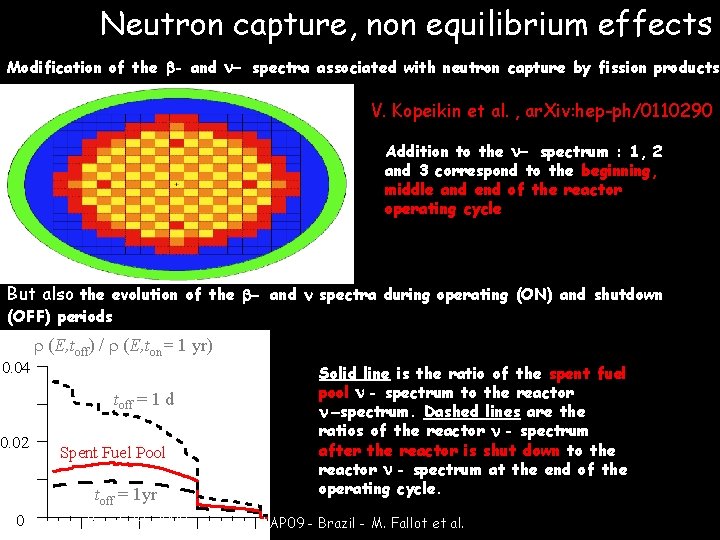
Neutron capture, non equilibrium effects Modification of the - and spectra associated with neutron capture by fission products V. Kopeikin et al. , ar. Xiv: hep-ph/0110290 Addition to the spectrum : 1, 2 and 3 correspond to the beginning, middle and end of the reactor operating cycle But also the evolution of the and spectra during operating (ON) and shutdown (OFF) periods 0. 04 (E, toff) / (E, ton= 1 yr) toff = 1 d 0. 02 Spent Fuel Pool toff = 1 yr 0 March 19. 2009 Solid line is the ratio of the spent fuel pool - spectrum to the reactor spectrum. Dashed lines are the ratios of the reactor - spectrum after the reactor is shut down to the reactor - spectrum at the end of the operating cycle. AAP 09 - Brazil - M. Fallot et al.
Developed simulation tools And results on U and Pu isotopes spectra March 19. 2009 AAP 09 - Brazil - M. Fallot et al.
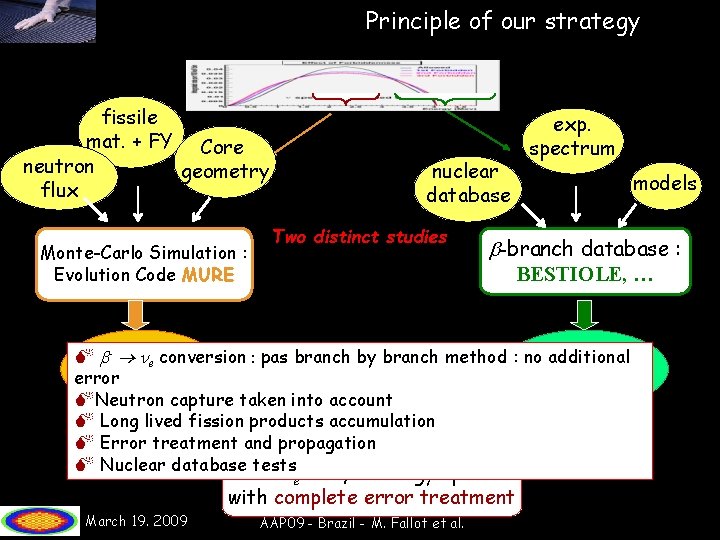
Principle of our strategy fissile mat. + FY Core neutron geometry flux Monte-Carlo Simulation : Evolution Code MURE nuclear database Two distinct studies exp. spectrum models -branch database : BESTIOLE, … - conversion : pas branch by branch method : no - /additional e spectra - decay e rates error Neutron capture taken into account weighted Long lived fission products accumulation Error treatment and propagation Nuclear database tests - Total e and energy spectra with complete error treatment March 19. 2009 AAP 09 - Brazil - M. Fallot et al.
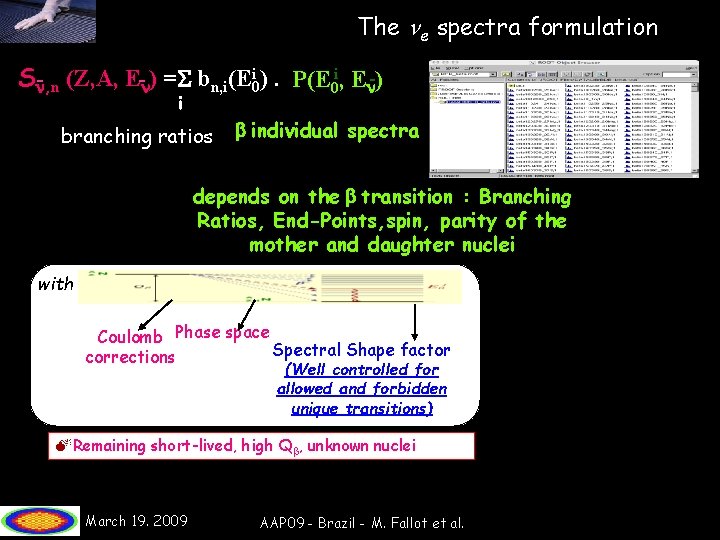
The e spectra formulation S , n - (Z, A, E- ) = bn, i(Ei 0). P(E 0 i, E -) i branching ratios individual spectra depends on the transition : Branching Ratios, End-Points, spin, parity of the mother and daughter nuclei with Coulomb Phase space Spectral Shape factor corrections (Well controlled for allowed and forbidden unique transitions) Remaining short-lived, high Q , unknown nuclei March 19. 2009 AAP 09 - Brazil - M. Fallot et al.
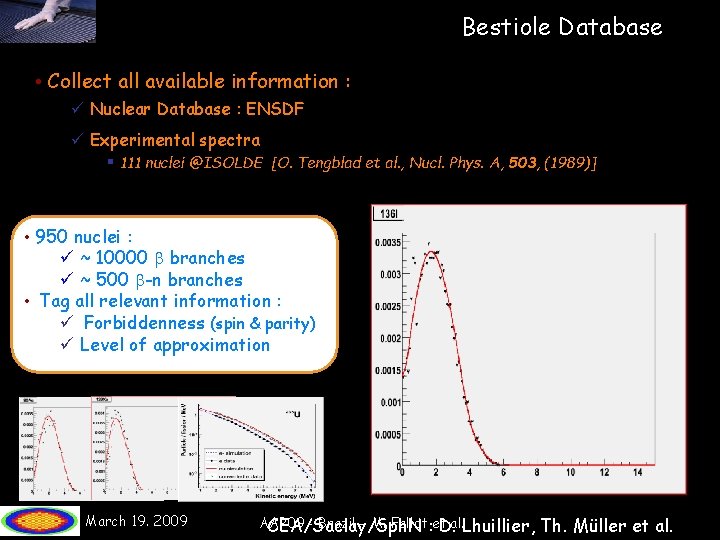
Bestiole Database • Collect all available information : Nuclear Database : ENSDF Experimental spectra § 111 nuclei @ISOLDE [O. Tengblad et al. , Nucl. Phys. A, 503, (1989)] • 950 nuclei : ~ 10000 branches ~ 500 -n branches • Tag all relevant information : Forbiddenness (spin & parity) Level of approximation (ROOT and ASCII formats) March 19. 2009 AAP 09 - Brazil - M. Fallot: et CEA/Saclay/Sph. N D. al. Lhuillier, Th. Müller et al.
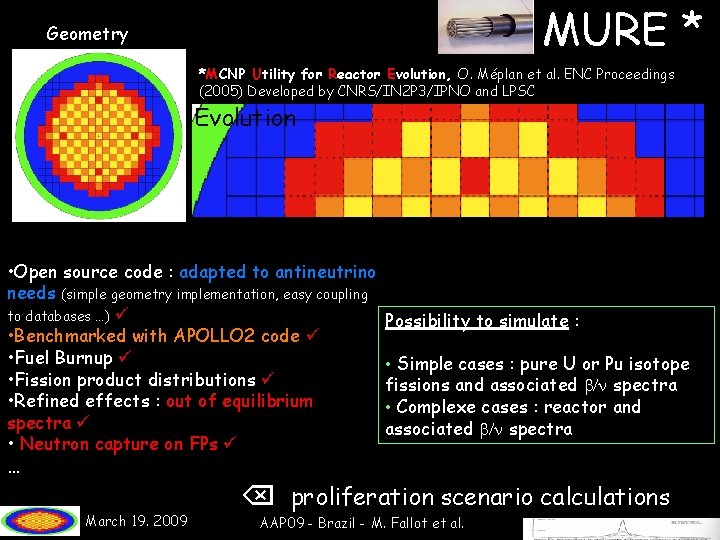
MURE * Geometry *MCNP Utility for Reactor Evolution, O. Méplan et al. ENC Proceedings (2005) Developed by CNRS/IN 2 P 3/IPNO and LPSC Evolution • Open source code : adapted to antineutrino needs (simple geometry implementation, easy coupling to databases …) • Benchmarked with APOLLO 2 code • Fuel Burnup • Fission product distributions • Refined effects : out of equilibrium spectra • Neutron capture on FPs … March 19. 2009 Possibility to simulate : • Simple cases : pure U or Pu isotope fissions and associated spectra • Complexe cases : reactor and associated spectra proliferation scenario calculations AAP 09 - Brazil - M. Fallot et al.
Obtained spectra Données : [A. Hahn et al. , Phys. Lett. B, 218, (1989)] X 4% agreement in the range 2 -6 Me. V with Schreckenbach’s data , higher discrepancy at high energy X simulation errors (cf. Th. Müller’s talk) within the experimental error bars Ratio : (MURE - DATA)/DATA March 19. 2009 AAP 09 - Brazil - M. Fallot et al. Rudstam data + Bestiole + JENDL + Qb Rudstam data + Bestiole
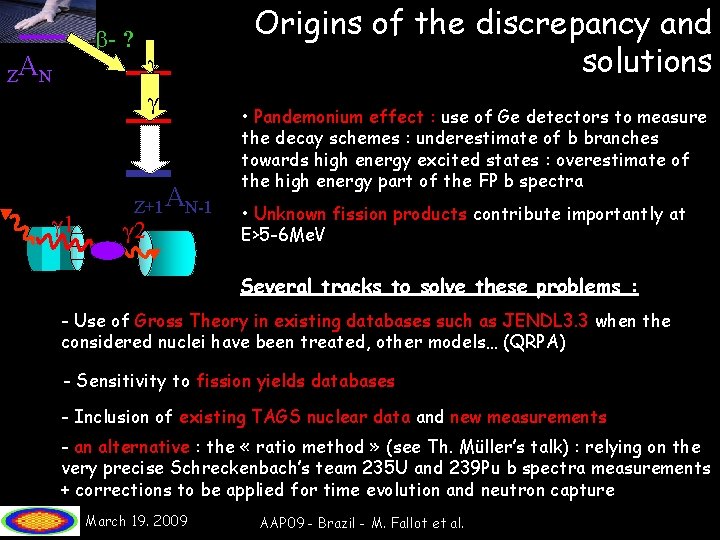
- ? Z AN γ γ γ 1 Z+1 AN-1 γ 2 Origins of the discrepancy and solutions • Pandemonium effect : use of Ge detectors to measure the decay schemes : underestimate of b branches towards high energy excited states : overestimate of the high energy part of the FP b spectra • Unknown fission products contribute importantly at E>5 -6 Me. V Several tracks to solve these problems : - Use of Gross Theory in existing databases such as JENDL 3. 3 when the considered nuclei have been treated, other models… (QRPA) - Sensitivity to fission yields databases - Inclusion of existing TAGS nuclear data and new measurements - an alternative : the « ratio method » (see Th. Müller’s talk) : relying on the very precise Schreckenbach’s team 235 U and 239 Pu b spectra measurements + corrections to be applied for time evolution and neutron capture March 19. 2009 AAP 09 - Brazil - M. Fallot et al.
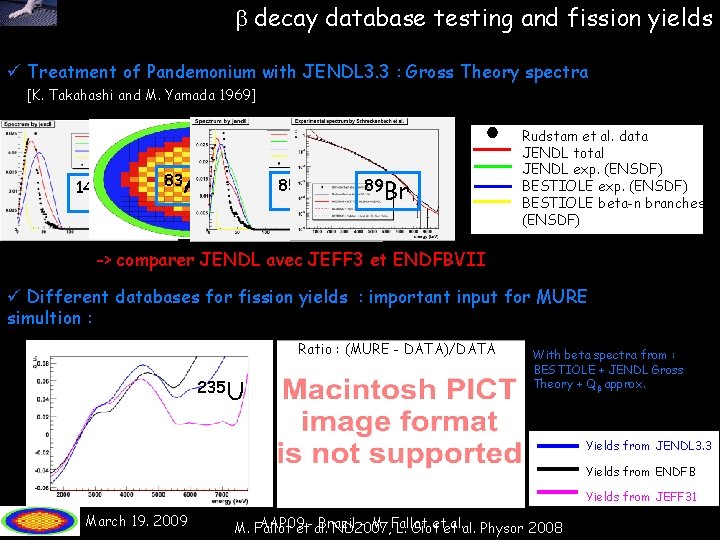
decay database testing and fission yields Treatment of Pandemonium with JENDL 3. 3 : Gross Theory spectra [K. Takahashi and M. Yamada 1969] 142 Cs 83 As 85 As 89 Br Rudstam et al. data JENDL total JENDL exp. (ENSDF) BESTIOLE beta-n branches (ENSDF) -> comparer JENDL avec JEFF 3 et ENDFBVII Different databases for fission yields : important input for MURE simultion : Ratio : (MURE - DATA)/DATA 235 U With beta spectra from : BESTIOLE + JENDL Gross Theory + Q approx. Yields from JENDL 3. 3 Yields from ENDFB Yields from JEFF 31 March 19. 2009 AAP 09 Brazil - M. Fallot etet al. Physor 2008 M. Fallot et-al. ND 2007, L. Giot
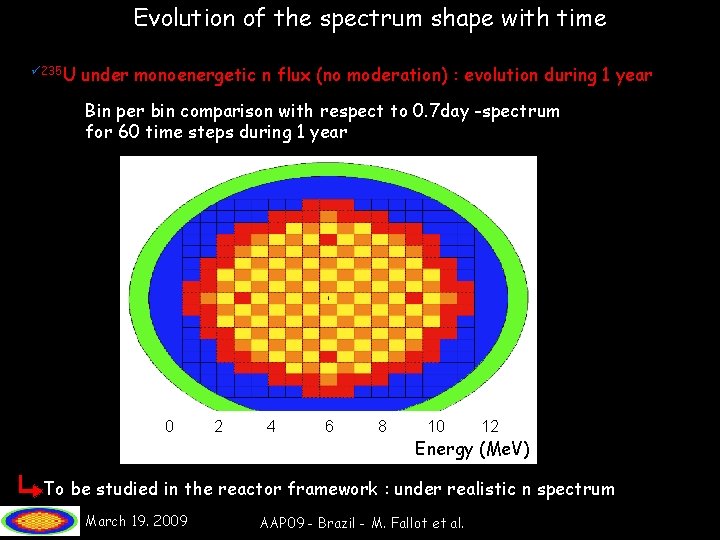
Evolution of the spectrum shape with time 235 U under monoenergetic n flux (no moderation) : evolution during 1 year Bin per bin comparison with respect to 0. 7 day -spectrum for 60 time steps during 1 year 0 2 4 6 8 10 12 Energy (Me. V) To be studied in the reactor framework : under realistic n spectrum March 19. 2009 AAP 09 - Brazil - M. Fallot et al.
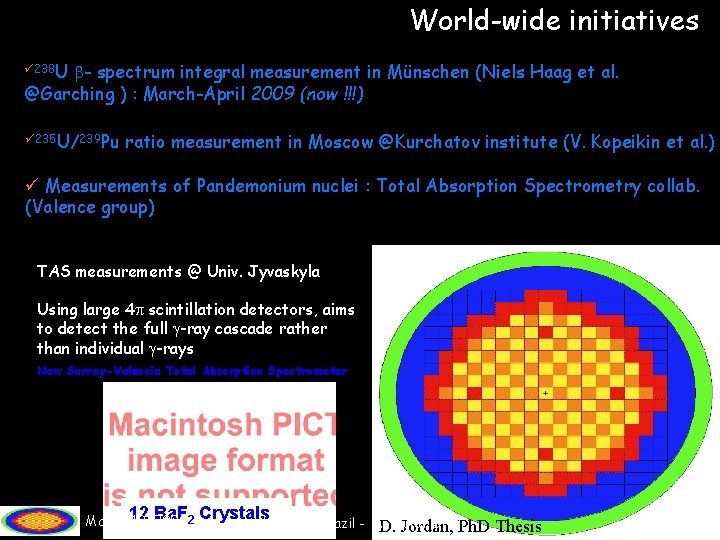
World-wide initiatives 238 U - spectrum integral measurement in Münschen (Niels Haag et al. @Garching ) : March-April 2009 (now !!!) 235 U/239 Pu ratio measurement in Moscow @Kurchatov institute (V. Kopeikin et al. ) Measurements of Pandemonium nuclei : Total Absorption Spectrometry collab. (Valence group) TAS measurements @ Univ. Jyvaskyla Using large 4 scintillation detectors, aims to detect the full -ray cascade rather than individual -rays New Surrey-Valencia Total Absorption Spectrometer Ba. F 2 March 12 19. 2009 Crystals AAP 09 - Brazil - M. et al. Ph. D D. Fallot Jordan, Thesis
Antineutrino energy spectrum and flux reactor simulations, « gross » proliferation scenarios March 19. 2009 AAP 09 - Brazil - M. Fallot et al.
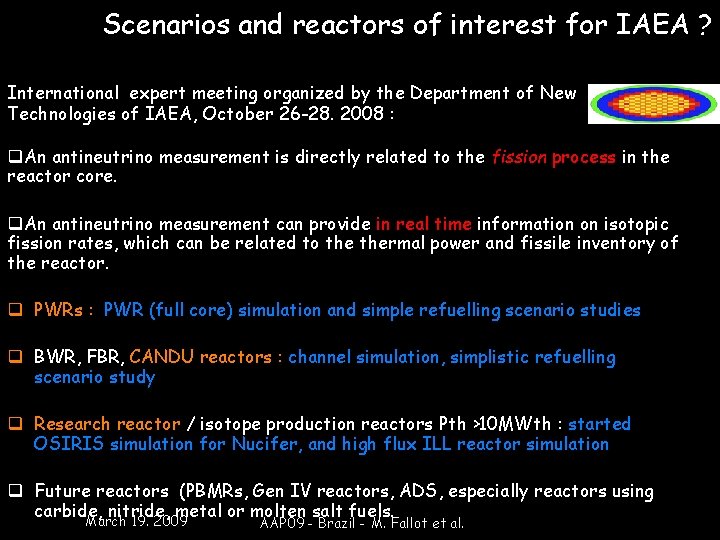
Scenarios and reactors of interest for IAEA ? International expert meeting organized by the Department of New Technologies of IAEA, October 26 -28. 2008 : q. An antineutrino measurement is directly related to the fission process in the reactor core. q. An antineutrino measurement can provide in real time information on isotopic fission rates, which can be related to thermal power and fissile inventory of the reactor. q PWRs : PWR (full core) simulation and simple refuelling scenario studies q PWRs q BWR, FBR, CANDU reactors : channel simulation, simplistic refuelling q BWR, FBR, CANDU reactors scenario study q q Research reactor/isotope reactor / isotopeproductionreactors. Pth>10 MWth : started OSIRIS simulation for Nucifer, and high flux ILL reactor simulation q Future reactors (PBMRs, Gen IV reactors, ADS, especially reactors using nitride, metal or molten fuels. ADS, especially reactors using q carbide, Future reactors (PBMRs, Gen IVsalt reactors, carbide, nitride, metal or molten salt fuels. March 19. 2009 AAP 09 - Brazil - M. Fallot et al.
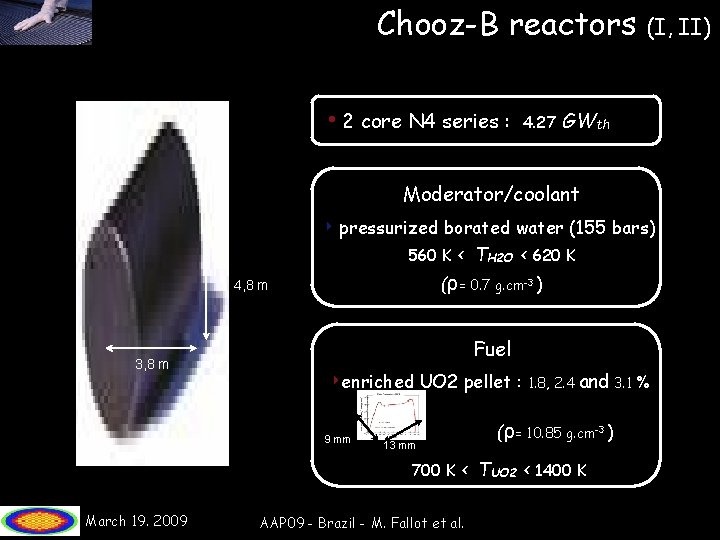
Chooz-B reactors • 2 core N 4 series : 4. 27 (I, II) GWth Moderator/coolant ‣ pressurized borated water (155 bars) 560 K < TH 2 O < 620 K 13 m (ρ= 0. 7 g. cm-3 ) 4, 8 m 3, 8 m Fuel ‣enriched UO 2 pellet : 1. 8, 2. 4 and 3. 1 % 9 mm 13 mm (ρ= 10. 85 g. cm-3 ) 700 K < TUO 2 < 1400 K 4, 5 m March 19. 2009 AAP 09 - Brazil - M. Fallot et al.
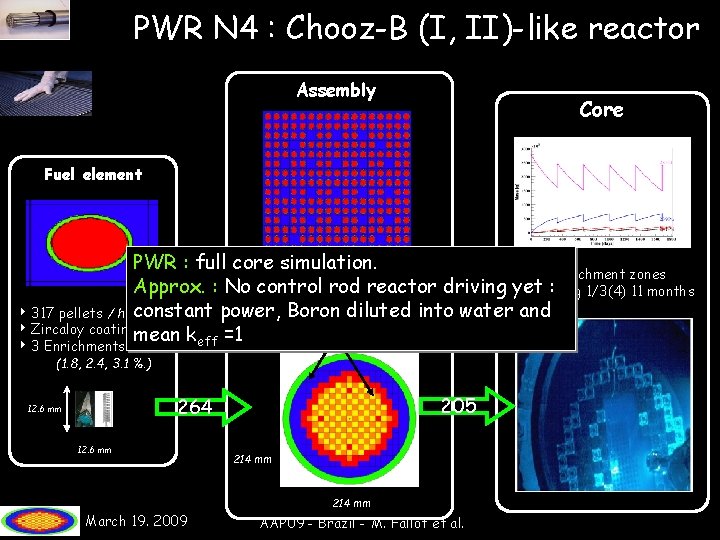
PWR N 4 : Chooz-B (I, II)-like reactor Assembly Core Fuel element PWR : full core simulation. ‣ 3(4) enrichment zones ‣ Zircaloy structure Approx. : No control rod reactor driving ‣yet : Refueling 1/3(4) 11 months ‣ 24 ‘guide’ tubes power, Boron diluted into water and ‣ 317 pellets / h =constant 4. 2 m (poison, ‣ Zircaloy coatingmean / 0. 6 mmk instrumentation, . . ) eff =1 ‣ 3 Enrichments : (1. 8, 2. 4, 3. 1 %. ) 205 264 12. 6 mm 214 mm March 19. 2009 AAP 09 - Brazil - M. Fallot et al.
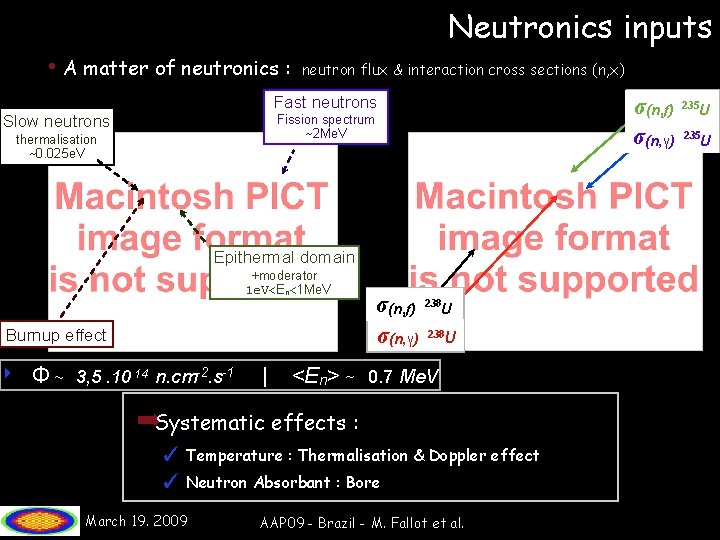
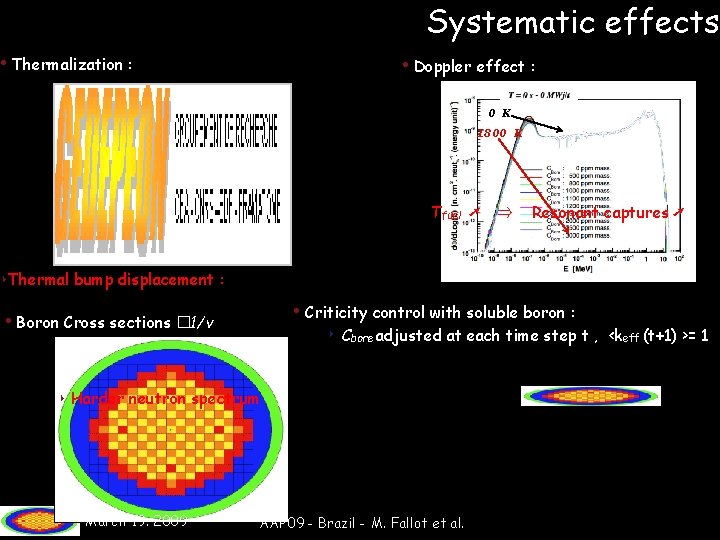
Neutronics inputs • A matter of neutronics : neutron flux & interaction cross sections (n, x) Fast neutrons Slow neutrons Fission spectrum ~2 Me. V thermalisation ~0. 025 e. V Epithermal domain +moderator 1 e. V<En<1 Me. V Burnup effect ‣ Φ ~ 3, 5. 10 14 n. cm-2. s-1 | σ(n, f) 238 U σ(n, γ) 238 U <En> ~ 0. 7 Me. V ➡Systematic effects : ✓ Temperature : Thermalisation & Doppler effect ✓ Neutron Absorbant : Bore March 19. 2009 AAP 09 - Brazil - M. Fallot et al. σ(n, f) σ(n, γ) 235 U
Systematic effects • Thermalization : • Doppler effect : 0 K 1800 K Tfuel ➚ ⇒ Resonant captures➚ ‣Thermal bump displacement : • Criticity control with soluble boron : ‣ Cbore adjusted at each time step t , • Boron Cross sections � 1/v ‣ Harder neutron spectrum March 19. 2009 AAP 09 - Brazil - M. Fallot et al. <keff (t+1) >= 1
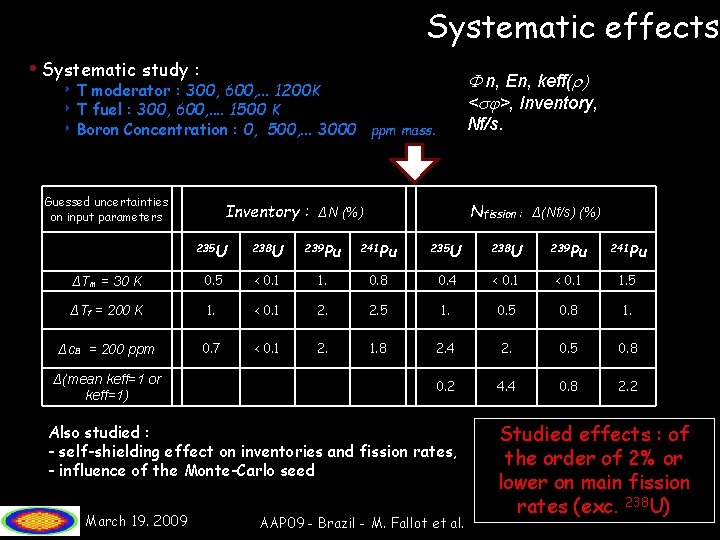
Systematic effects • Systematic study : n, En, keff( < >, Inventory, ‣ T moderator : 300, 600, . . . 1200 K ‣ T fuel : 300, 600, . . 1500 K ‣ Boron Concentration : 0, 500, . . . 3000 Guessed uncertainties on input parameters Nf/s. ppm mass. Inventory : ΔN (%) Nfission : Δ(Nf/s) (%) 235 U 238 U 239 Pu 241 Pu ΔTm = 30 K 0. 5 < 0. 1 1. 0. 8 0. 4 < 0. 1 1. 5 ΔTf = 200 K 1. < 0. 1 2. 5 1. 0. 5 0. 8 1. Δc. B = 200 ppm 0. 7 < 0. 1 2. 1. 8 2. 4 2. 0. 5 0. 8 0. 2 4. 4 0. 8 2. 2 Δ(mean keff=1 or keff=1) Also studied : - self-shielding effect on inventories and fission rates, - influence of the Monte-Carlo seed March 19. 2009 AAP 09 - Brazil - M. Fallot et al. Studied effects : of the order of 2% or lower on main fission rates (exc. 238 U)
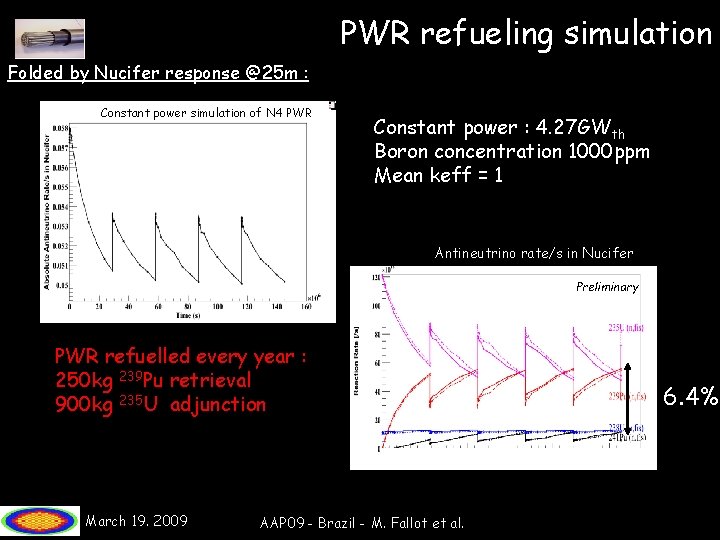
PWR refueling simulation Folded by Nucifer response @25 m : Constant power simulation of N 4 PWR Constant power : 4. 27 GWth Boron concentration 1000 ppm Mean keff = 1 Antineutrino rate/s in Nucifer Preliminary PWR refuelled every year : 250 kg 239 Pu retrieval 900 kg 235 U adjunction March 19. 2009 AAP 09 - Brazil - M. Fallot et al. 6. 4%
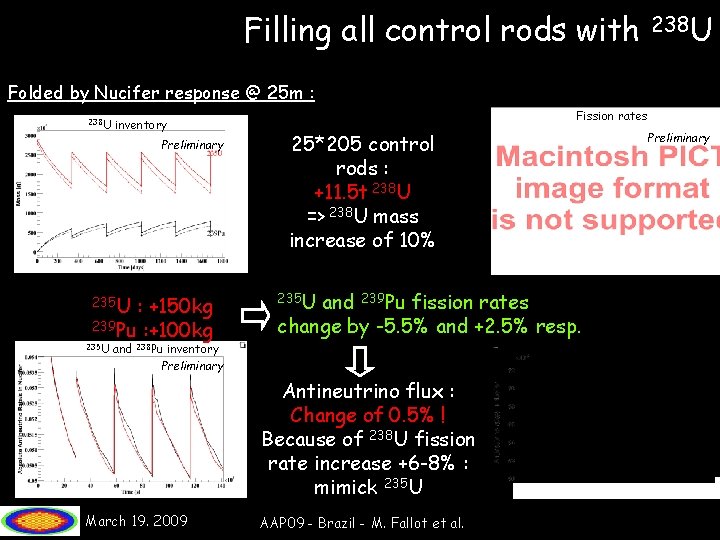
Filling all control rods with 238 U Folded by Nucifer response @ 25 m : 238 U inventory Preliminary 235 U : +150 kg 239 Pu : +100 kg 235 U Fission rates 25*205 control rods : +11. 5 t 238 U => 238 U mass increase of 10% 235 U and 239 Pu fission rates change by -5. 5% and +2. 5% resp. and 238 Pu inventory Preliminary Antineutrino flux : Change of 0. 5% ! Because of 238 U fission rate increase +6 -8% : mimick 235 U March 19. 2009 Preliminary AAP 09 - Brazil - M. Fallot et al. Antineutrino rate/s in Nucifer Preliminary
Removal of the control rods Corresponds to 65 kg 239 Pu removal, without changing 238 U and masses as rods are replaced by fresh Unat Preliminary Normal refuelling Replacement of the control rods 1. 3% Amount of 238 U stays ~ the same, so no compensation by 238 U of 235 U and 239 Pu fission rates variations March 19. 2009 AAP 09 - Brazil - M. Fallot et al. 235 U
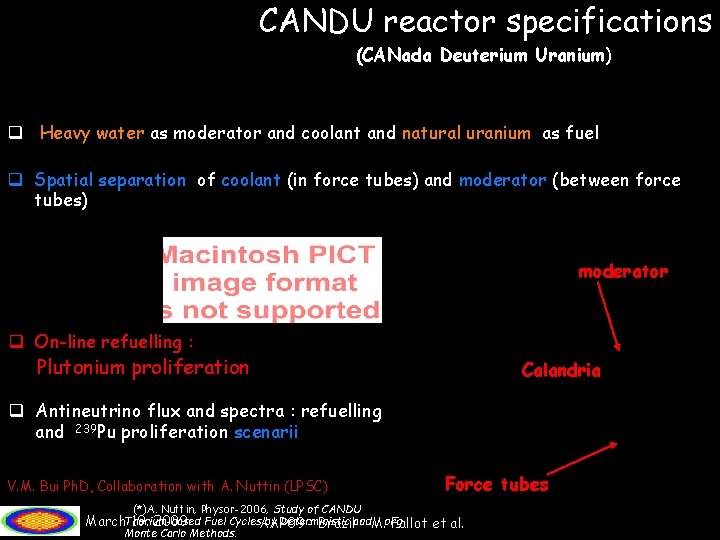
CANDU reactor specifications (CANada Deuterium Uranium) q Heavy water as moderator and coolant and natural uranium as fuel q Spatial separation of coolant (in force tubes) and moderator (between force tubes) moderator q On-line refuelling : Plutonium proliferation Calandria q Antineutrino flux and spectra : refuelling and 239 Pu proliferation scenarii V. M. Bui Ph. D, Collaboration with A. Nuttin (LPSC) (*)A. Nuttin, Physor-2006, Study of CANDU Force tubes by Deterministic March. Thorium-based 19. 2009 Fuel Cycleshttp: //canteach. candu. org AAP 09 - Braziland - M. Fallot et al. Monte Carlo Methods.
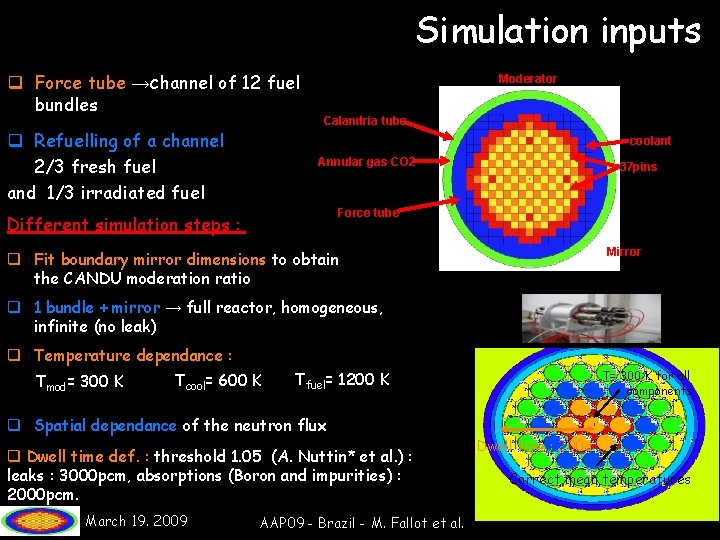
Simulation inputs A q Force tube →channel of 12 fuel bundles q Refuelling of a channel 2/3 fresh fuel and 1/3 irradiated fuel Calandria tube Annular gas CO 2 b u n d l e Moderator. A q Fit boundary mirror dimensions to obtain the CANDU moderation ratio 37 pins Mirror 1 2 q 1 bundle + mirror → full reactor, homogeneous, infinite (no leak) q Temperature dependance : Tcool= 600 K Tfuel= 1200 K 3 Pool Irradiated fuel 4 q Spatial dependance of the neutron flux fuel q Dwell time def. : threshold 1. 05 (A. Nuttin* et al. )Fresh : leaks : 3000 pcm, absorptions (Boron and impurities) : 2000 pcm. March 19. 2009 coolant Force tube Different simulation steps : Tmod= 300 K c h a n n e l AAP 09 - Brazil - M. Fallot et al. 5 1’ T= 300 K for all components Dwell time : 200 d Correct mean temperatures
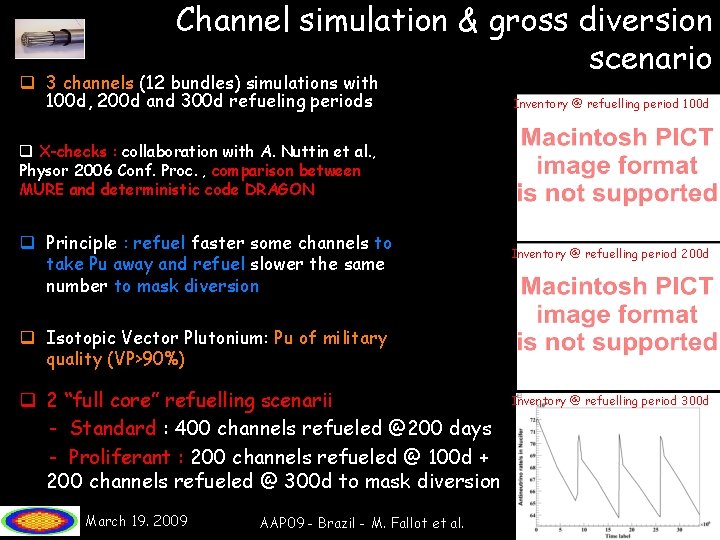
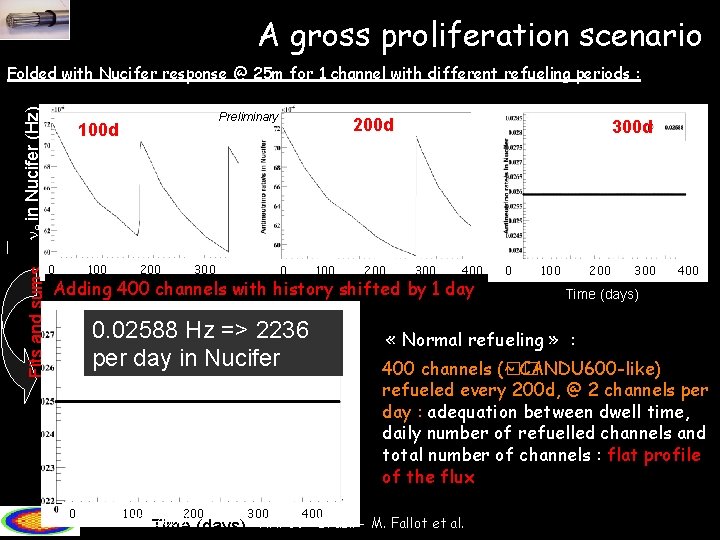
Channel simulation & gross diversion scenario q 3 channels (12 bundles) simulations with 100 d, 200 d and 300 d refueling periods Inventory @ refuelling period 100 d q X-checks : collaboration with A. Nuttin et al. , Physor 2006 Conf. Proc. , comparison between MURE and deterministic code DRAGON q Principle : refuel faster some channels to take Pu away and refuel slower the same number to mask diversion Inventory @ refuelling period 200 d q Isotopic Vector Plutonium: Pu of military quality (VP>90%) q 2 “full core” refuelling scenarii - Standard : 400 channels refueled @200 days - Proliferant : 200 channels refueled @ 100 d + 200 channels refueled @ 300 d to mask diversion March 19. 2009 AAP 09 - Brazil - M. Fallot et al. Inventory @ refuelling period 300 d
A gross proliferation scenario Fits and sums e in Nucifer (Hz) Folded with Nucifer response @ 25 m for 1 channel with different refueling periods : Preliminary 100 d 0 100 200 300 200 d 0 100 200 300 d 300 400 Adding 400 channels with history Time shifted Time (days)by 1 day 0. 02588 Hz => 2236 per day in Nucifer +…+ 0 100 200 March 19. Time 2009 (days) 300 400 0 100 200 300 400 Time (days) « Normal refueling » : 400 channels (�� ~ CANDU 600 -like) refueled every 200 d, @ 2 channels per day : adequation between dwell time, daily number of refuelled channels and total number of channels : flat profile of the flux AAP 09 - Brazil - M. Fallot et al.
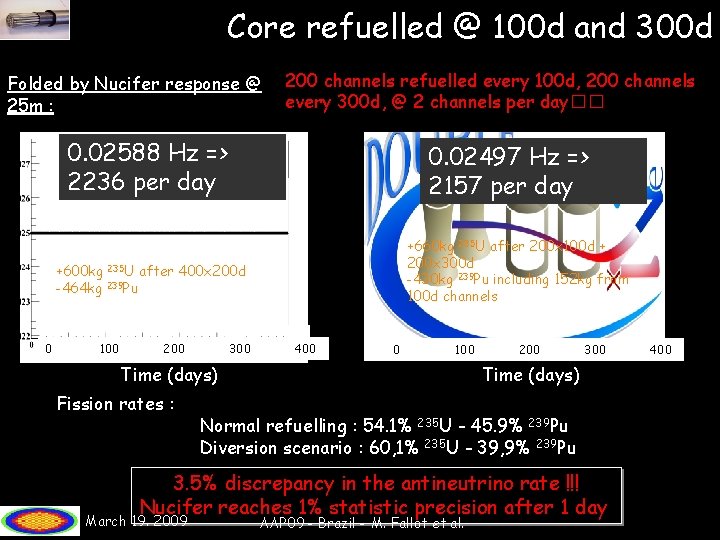
Core refuelled @ 100 d and 300 d Folded by Nucifer response @ 25 m : 200 channels refuelled every 100 d, 200 channels every 300 d, @ 2 channels per day�� 0. 02588 Hz => 2236 per day 0. 02497 Hz => 2157 per day +660 kg 235 U after 200 x 100 d + 200 x 300 d -430 kg 239 Pu including 152 kg from 100 d channels +600 kg 235 U after 400 x 200 d -464 kg 239 Pu 0 100 200 300 400 0 100 300 Time (days) Fission rates : 200 Normal refuelling : 54. 1% 235 U - 45. 9% 239 Pu Diversion scenario : 60, 1% 235 U - 39, 9% 239 Pu 3. 5% discrepancy in the antineutrino rate !!! Nucifer reaches 1% statistic precision after 1 day March 19. 2009 AAP 09 - Brazil - M. Fallot et al. 400
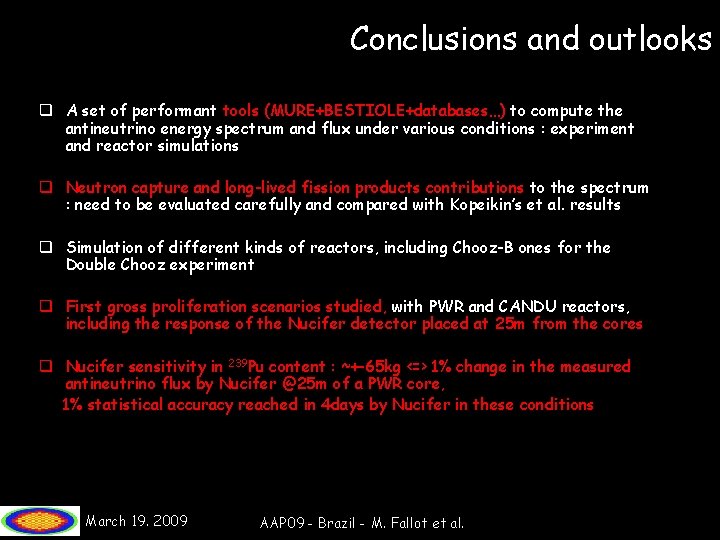
Conclusions and outlooks q A set of performant tools (MURE+BESTIOLE+databases…) to compute the antineutrino energy spectrum and flux under various conditions : experiment and reactor simulations q Neutron capture and long-lived fission products contributions to the spectrum : need to be evaluated carefully and compared with Kopeikin’s et al. results q Simulation of different kinds of reactors, including Chooz-B ones for the Double Chooz experiment q First gross proliferation scenarios studied, with PWR and CANDU reactors, including the response of the Nucifer detector placed at 25 m from the cores q Nucifer sensitivity in 239 Pu content : ~+-65 kg <=> 1% change in the measured antineutrino flux by Nucifer @25 m of a PWR core, 1% statistical accuracy reached in 4 days by Nucifer in these conditions March 19. 2009 AAP 09 - Brazil - M. Fallot et al.
Backup Slides March 19. 2009 AAP 09 - Brazil - M. Fallot et al.