
Time and frequency Workshop SIGNAL GENERATION AND MEASUREMENTS







- Slides: 25
Time and frequency Workshop SIGNAL GENERATION AND MEASUREMENTS IN TIME AND FREQUENCY Raul F. Solis B. CENAMEP AIP
Signal in Time and Frequency Metrology � Signals: typically, electromagnetic oscillations that have an amplitude, frequency and waveform that we can measure. ◦ Amplitude: from m. V to V. ◦ Frequency: from DC to optical region. ◦ Waveform: sine, square, triangular, pulse, etc. � Exist all kinds of signals, but in metrology of time and frequency we seek for these that represent their source and we can calibrate.
Synchronization and Syntonization � Synchronization is the process of setting two or more clocks to the same time ◦ Clocks, time interval reference, telecommunication systems, digital systems, etc. � Syntonization is the process of setting two or more oscillators to the same frequency ◦ Disciplined oscillators (like GPSDO), radio and microwave links, etc.
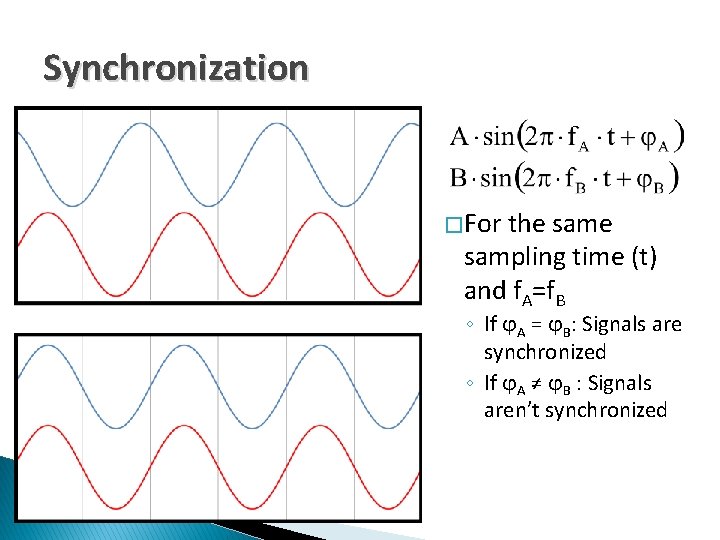
Synchronization � For the sampling time (t) and f. A=f. B ◦ If ϕA = ϕB: Signals are synchronized ◦ If ϕA ≠ ϕB : Signals aren’t synchronized
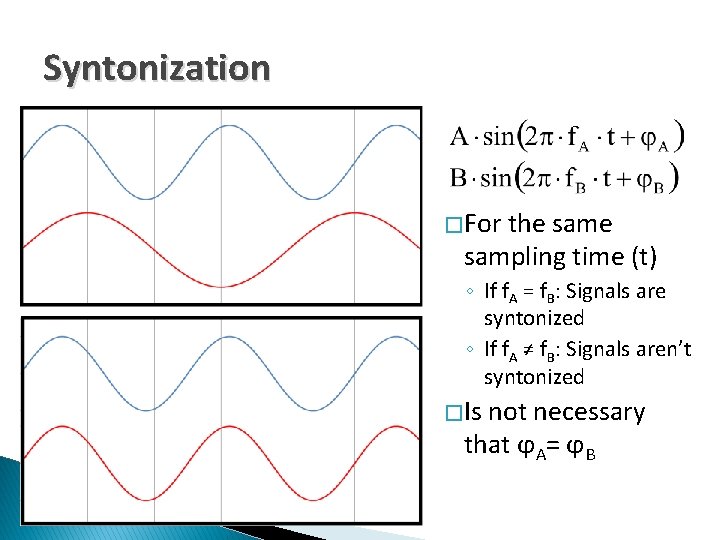
Syntonization � For the sampling time (t) ◦ If f. A = f. B: Signals are syntonized ◦ If f. A ≠ f. B: Signals aren’t syntonized � Is not necessary that ϕA= ϕB
Signal Generation � The signal generation can be based on: ◦ Fixed frequency (Oscillators, clocks, timebase). ◦ Variable frequency (Frequency synthesizer, waveform generators). � The generation of fixed frequency signals or variable frequency signals depend directly of the reference oscilator.
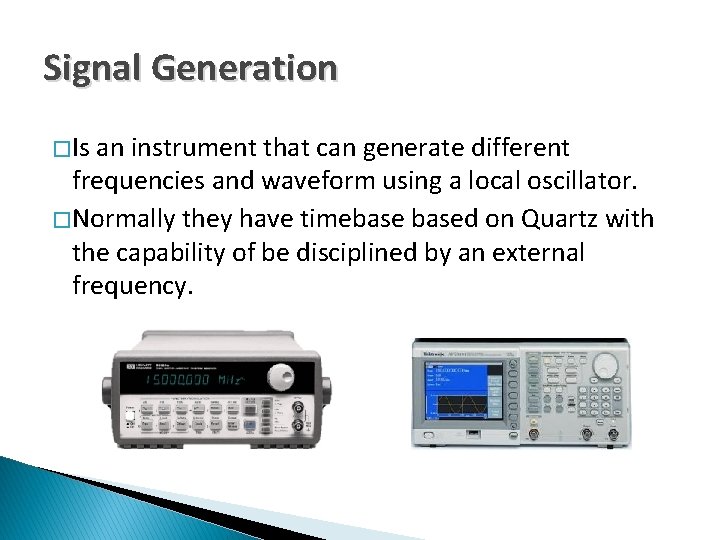
Signal Generation � Is an instrument that can generate different frequencies and waveform using a local oscillator. � Normally they have timebased on Quartz with the capability of be disciplined by an external frequency.
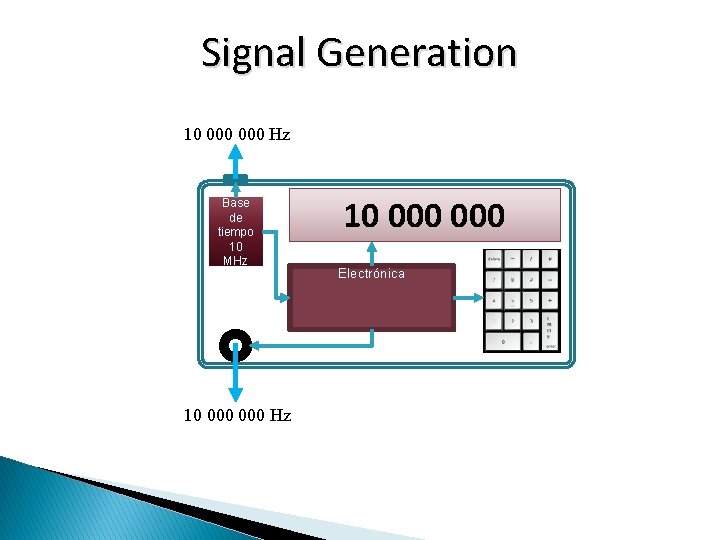
Signal Generation 10 000 Hz Base de tiempo 10 MHz 10 000 000 Electrónica
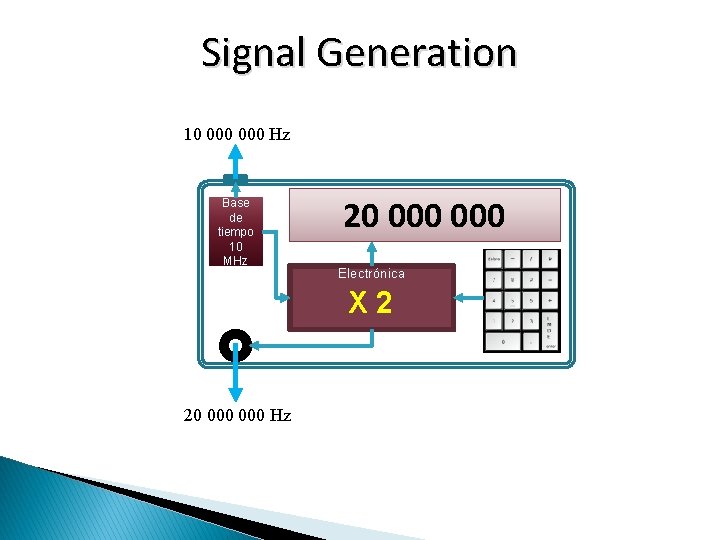
Signal Generation 10 000 Hz Base de tiempo 10 MHz 20 000 Electrónica X 2 20 000 Hz
Signal Generation 10 000 Hz Base de tiempo 10 MHz 50 000 Electrónica X 5 50 000 Hz
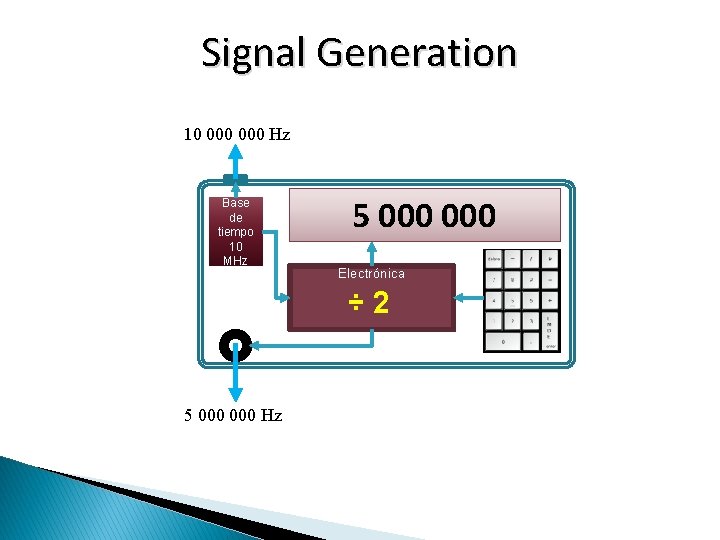
Signal Generation 10 000 Hz Base de tiempo 10 MHz 5 000 Electrónica ÷ 2 5 000 Hz
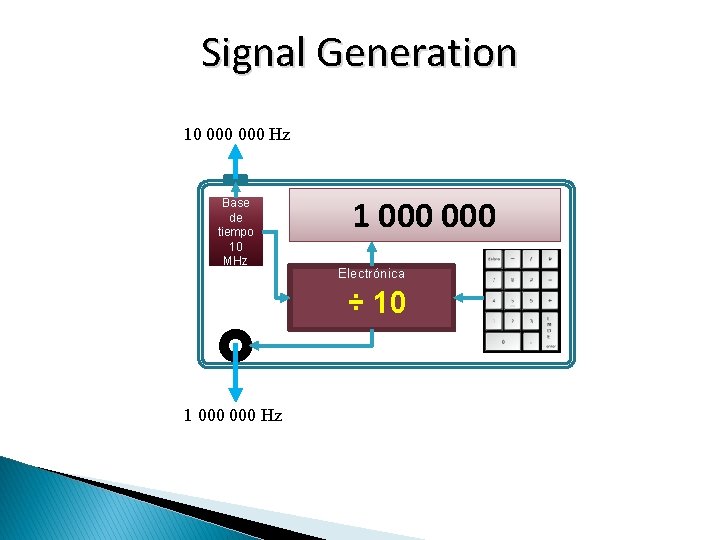
Signal Generation 10 000 Hz Base de tiempo 10 MHz 1 000 Electrónica ÷ 10 1 000 Hz
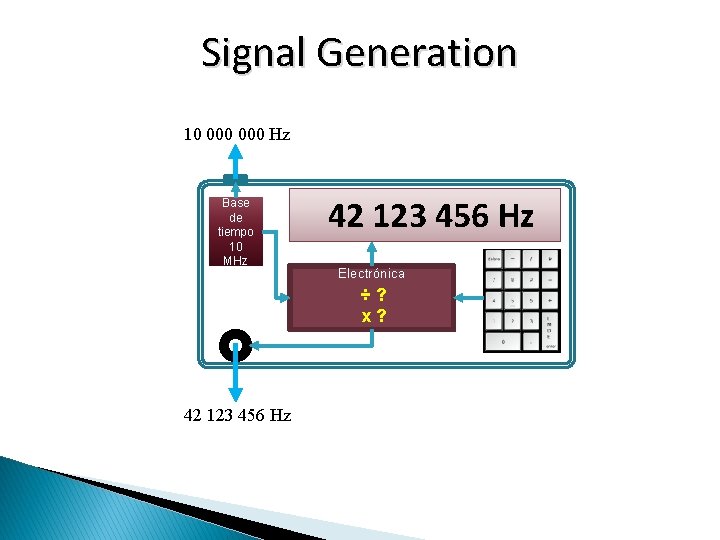
Signal Generation 10 000 Hz Base de tiempo 10 MHz 42 123 456 Hz Electrónica ÷? x? 42 123 456 Hz
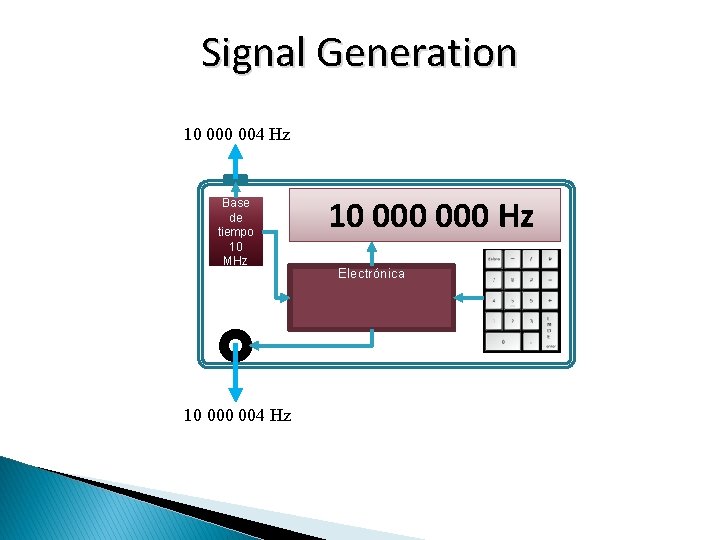
Signal Generation 10 004 Hz Base de tiempo 10 MHz 10 004 Hz 10 000 Hz Electrónica
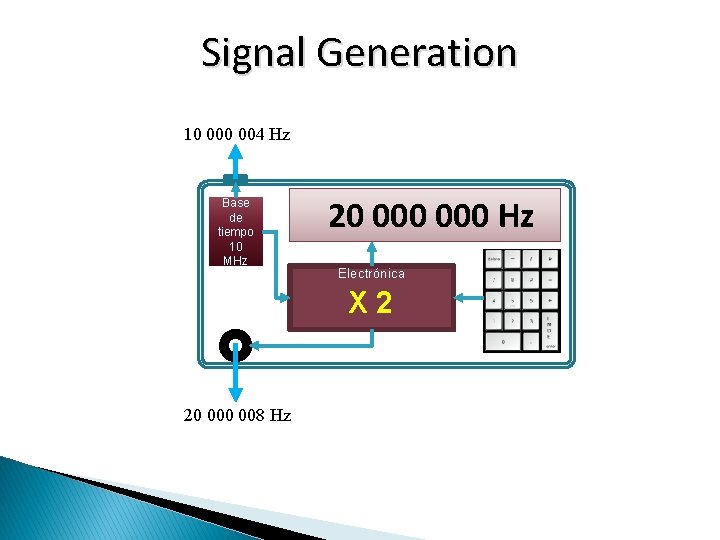
Signal Generation 10 004 Hz Base de tiempo 10 MHz 20 000 Hz Electrónica X 2 20 008 Hz
Signal Generation 10 004 Hz Base de tiempo 10 MHz 80 000 Hz Electrónica X 8 80 000 032 Hz
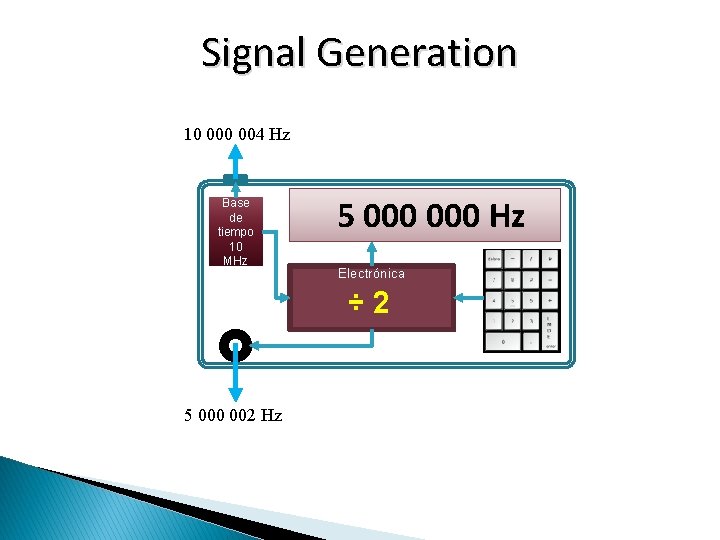
Signal Generation 10 004 Hz Base de tiempo 10 MHz 5 000 Hz Electrónica ÷ 2 5 000 002 Hz
Signal Generation � The signal generator depends of his reference oscillator, but an better external oscillator can improve the signal synthesis. � But for low frequencies, the equipment electronics and local oscillator is the major source of noise. � You can avoid some noises if you change the waveform: ◦ From sine to square or pulse. � But if you want low frequency signal with low noise, you need to acquire a signal generator with these characteristics.
Signal Measurement in Time and Frequency Metrology � When we measure signal in time and frequency terms, we are looking for: ◦ Signal frequency. ◦ Time Interval difference of the signal and a reference. � And the objective from measure these variables is to obtain the stability and the frequency offset of the reference oscillator.
Signal Measurement � Frequency measurement ◦ Frequency meters ◦ Frequency counters � Time Interval Measurement ◦ Time interval counter � All these measurements are basically the comparison of the oscillation of the local oscillator and the oscillator of the device under test.
Signal Measurement � The amplitude and the waveform of the signal can affect the measure (frequency counters and time interval counters). � Frequency counters depend of a zero crossing point detector to count the frequency of the signals.
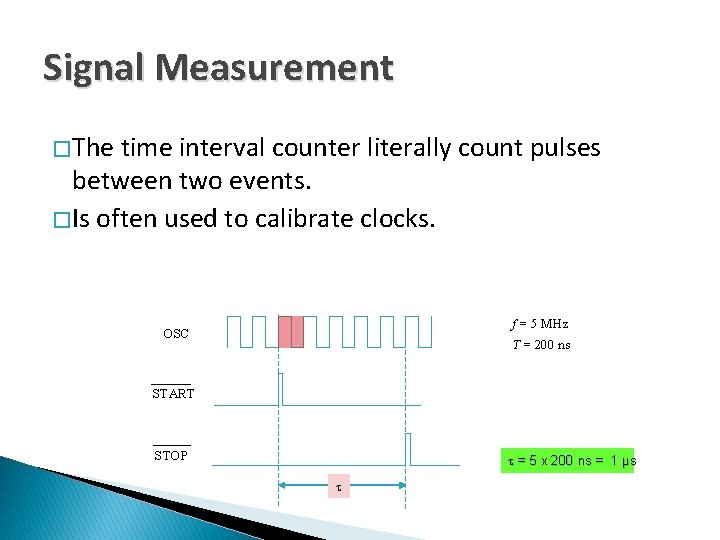
Signal Measurement � Frequency meters measure frequency by comparing some relative deviation of their internal mechanism (capacitors, inductors, etc. ) � Time interval counter depend of their internal oscillator to count the time between the start and stop.
Signal Measurement � In frequency terms, you can do a measurement using: ◦ Direct frequency measures. ◦ Single mixer frequency measures. ◦ Double mixer frequency measures. � In terms of time interval, you can do a measurement using: ◦ Time interval measures. ◦ Phase difference measures.
Signal Measurement � The time interval counter literally count pulses between two events. � Is often used to calibrate clocks. f = 5 MHz OSC T = 200 ns START STOP t = 5 x 200 ns = 1 µs t
Thanks rsolis@cenamep. org. pa