
Time and Data Telling the Time Objectives Day
Time and Data Telling the Time Objectives Day 1 Revise telling the time past the hour (to 5 mins) on both analogue and digital clocks. Revise telling time, am and pm to the nearest minute on both analogue and digital clocks, convert between the two. Day 2 Revise telling the time past the hour (to 5 mins) on both analogue and digital clocks. Read and tell the time to nearest minute on 24 -hour digital and analogue clocks. Day 3 Know equivalent analogue and digital times; use am and pm. Convert 24 -hour clock to am and pm times. Day 4 Read and write analogue and digital times to nearest minute. Read, write and match analogue and digital times. Read 24 -hour times, converting to am or pm times and vice versa. © hamilton-trust. org. uk 1 Year 3/4
Time and Data Telling the Time Short Mental Workouts Day 1 5 times table with complements to 60 Day 2 Roman numerals on the clock Day 3 Months of the year Day 4 Units of time © hamilton-trust. org. uk 2 Year 3/4
Time and Data Telling the Time Short Mental Workout 5 times table with complements to 60 © hamilton-trust. org. uk 3 Year 3/4
Time and Data Telling the Time Short Mental Workout Roman numerals on the clock © hamilton-trust. org. uk 4 Year 3/4
Time and Data Telling the Time Short Mental Workout Months of the year © hamilton-trust. org. uk 5 Year 3/4
Time and Data Telling the Time Short Mental Workout Units of time © hamilton-trust. org. uk 6 Year 3/4
Time and Data Telling the Time Day 1 Revise telling the time past the hour (to 5 mins) on both analogue and digital clocks. Revise telling time, am and pm to the nearest minute on both analogue and digital clocks, convert between the two. © hamilton-trust. org. uk 7 Year 3/4
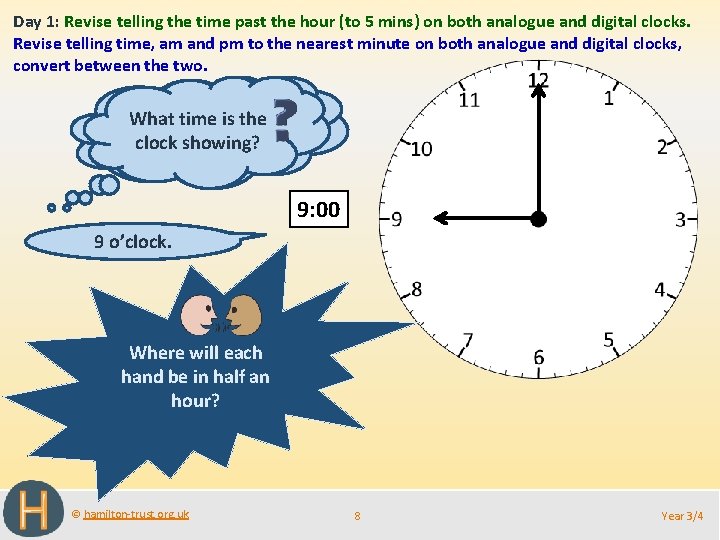
Day 1: Revise telling the time past the hour (to 5 mins) on both analogue and digital clocks. Revise telling time, am and pm to the nearest minute on both analogue and digital clocks, convert between the two. How many minutes What time is the are in an hour? clock showing? Half an hour? 9: 00 9 o’clock. Where will each hand be in half an hour? © hamilton-trust. org. uk 8 Year 3/4
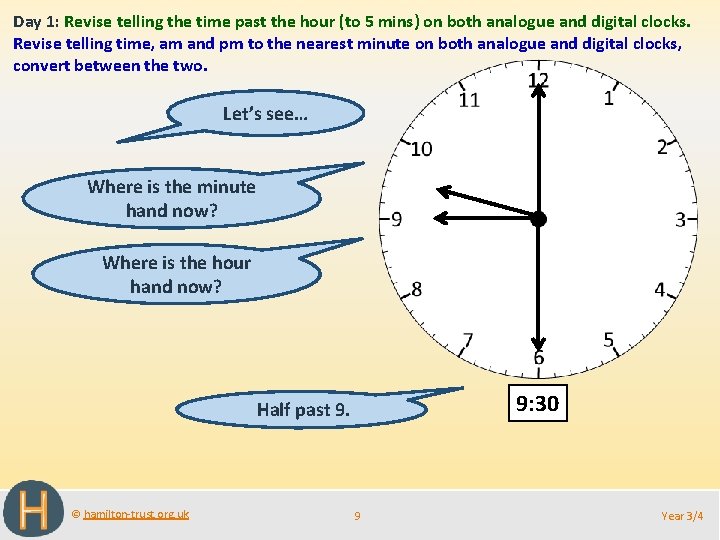
Day 1: Revise telling the time past the hour (to 5 mins) on both analogue and digital clocks. Revise telling time, am and pm to the nearest minute on both analogue and digital clocks, convert between the two. Let’s see… Where is the minute hand now? Where is the hour hand now? 9: 30 Half past 9. © hamilton-trust. org. uk 9 Year 3/4
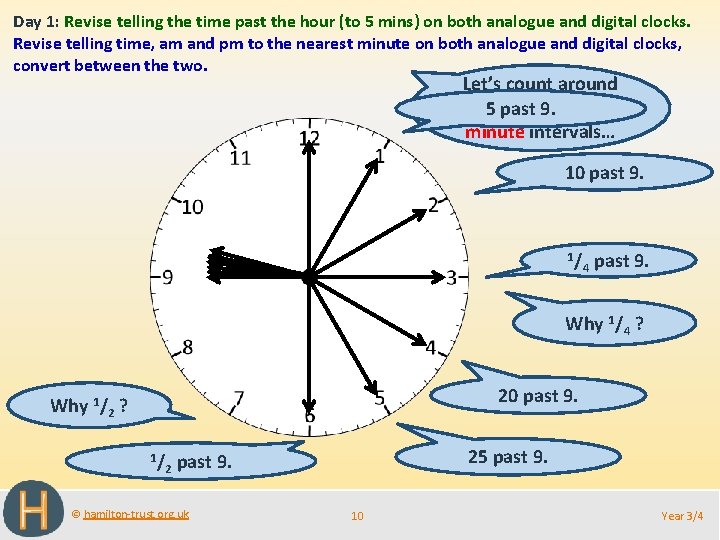
Day 1: Revise telling the time past the hour (to 5 mins) on both analogue and digital clocks. Revise telling time, am and pm to the nearest minute on both analogue and digital clocks, convert between the two. Let’s count around from 9 o’clock in 5 5 past 9. minute intervals… 10 past 9. 1/ 4 past 9. Why 1/4 ? 20 past 9. Why 1/2 ? 1/ 2 25 past 9. © hamilton-trust. org. uk 10 Year 3/4
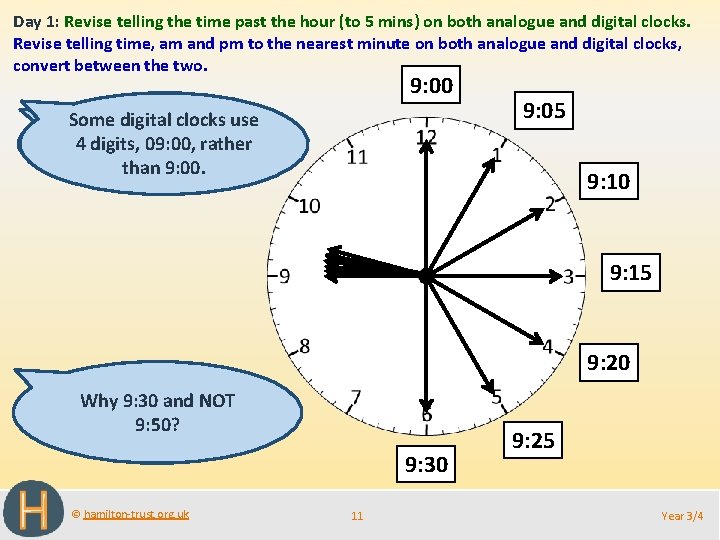
Day 1: Revise telling the time past the hour (to 5 mins) on both analogue and digital clocks. Revise telling time, am and pm to the nearest minute on both analogue and digital clocks, convert between the two. 9: 00 Some digital clocks use Let’s try those times 4 digits, 09: 00, rather with digital notation… than 9: 00. 9: 05 9: 10 9: 15 9: 20 Why 9: 30 and NOT 9: 50? 9: 30 © hamilton-trust. org. uk 11 9: 25 Year 3/4
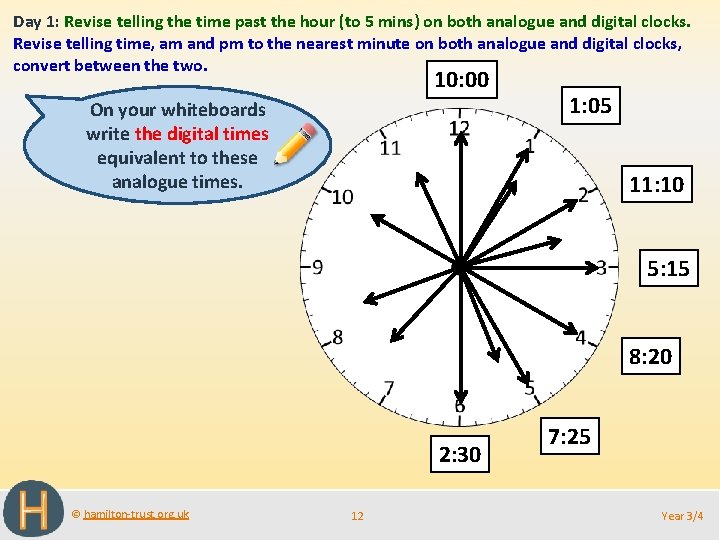
Day 1: Revise telling the time past the hour (to 5 mins) on both analogue and digital clocks. Revise telling time, am and pm to the nearest minute on both analogue and digital clocks, convert between the two. 10: 00 On your whiteboards write the digital times equivalent to these analogue times. 1: 05 11: 10 5: 15 8: 20 2: 30 © hamilton-trust. org. uk 12 7: 25 Year 3/4
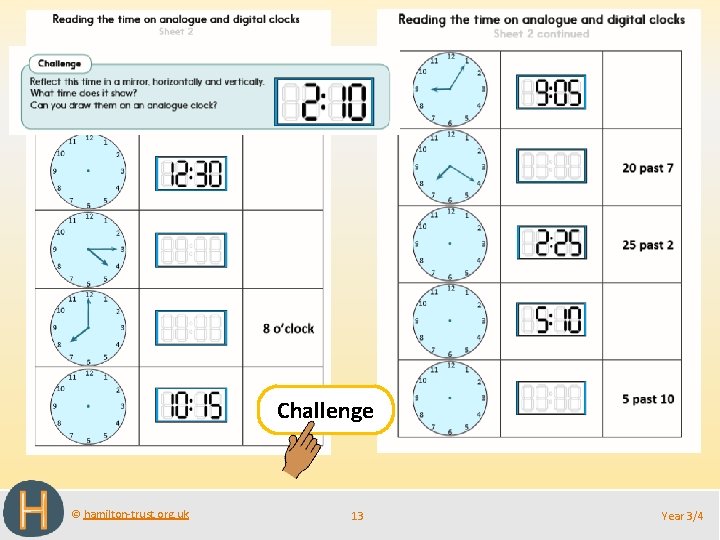
Challenge © hamilton-trust. org. uk 13 Year 3/4
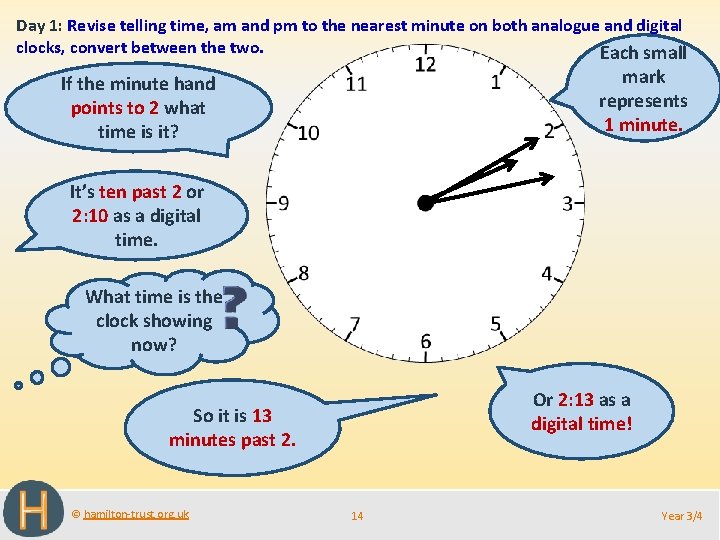
Day 1: Revise telling time, am and pm to the nearest minute on both analogue and digital clocks, convert between the two. Each small mark represents 1 minute. If the minute hand points to 2 what time is it? It’s ten past 2 or 2: 10 as a digital time. What time is the clock showing now? Or 2: 13 as a digital time! So it is 13 minutes past 2. © hamilton-trust. org. uk 14 Year 3/4
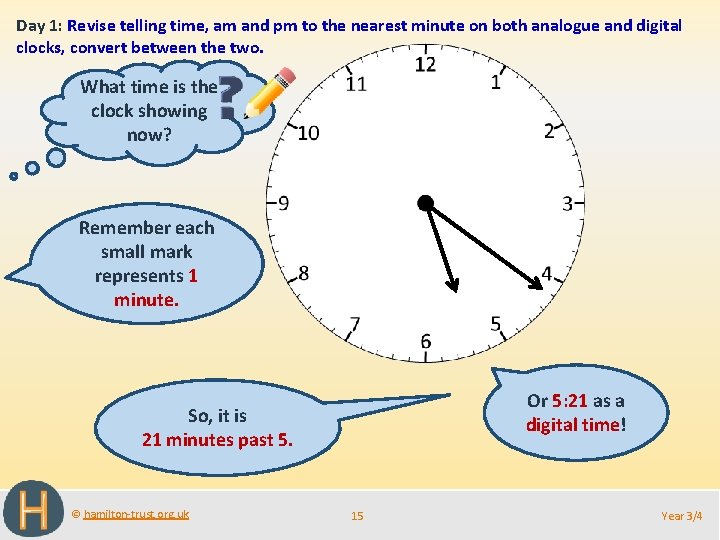
Day 1: Revise telling time, am and pm to the nearest minute on both analogue and digital clocks, convert between the two. What time is the clock showing now? Remember each small mark represents 1 minute. Or 5: 21 as a digital time! So, it is 21 minutes past 5. © hamilton-trust. org. uk 15 Year 3/4
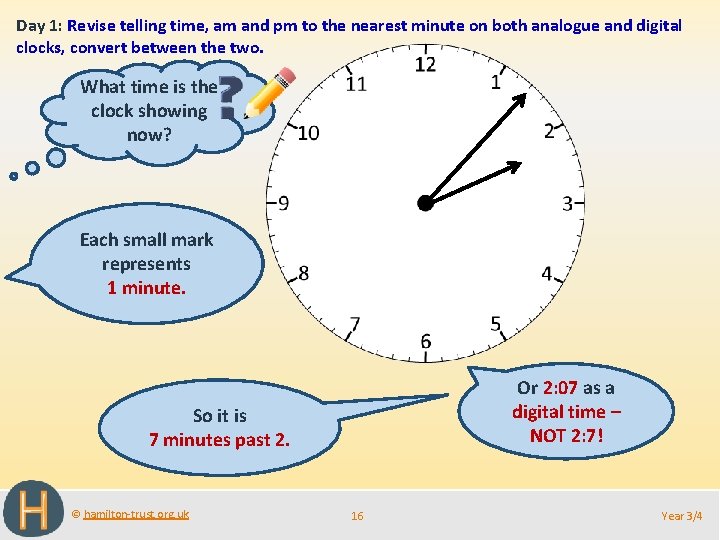
Day 1: Revise telling time, am and pm to the nearest minute on both analogue and digital clocks, convert between the two. What time is the clock showing now? Each small mark represents 1 minute. Or 2: 07 as a digital time – NOT 2: 7! So it is 7 minutes past 2. © hamilton-trust. org. uk 16 Year 3/4
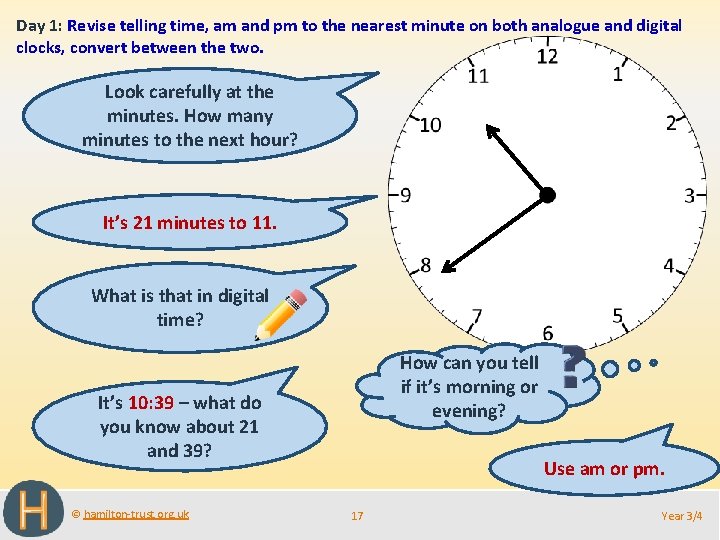
Day 1: Revise telling time, am and pm to the nearest minute on both analogue and digital clocks, convert between the two. Look carefully at the minutes. How many minutes to the next hour? It’s 21 minutes to 11. What is that in digital time? How can you tell if it’s morning or evening? It’s 10: 39 – what do you know about 21 and 39? © hamilton-trust. org. uk Use am or pm. 17 Year 3/4
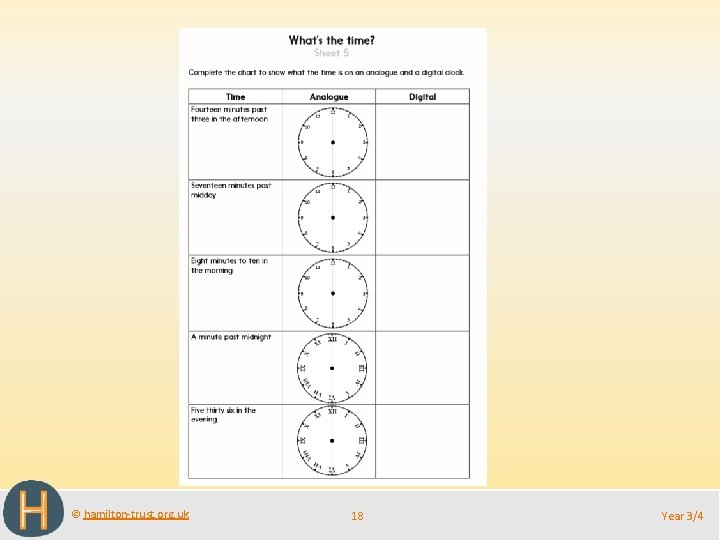
© hamilton-trust. org. uk 18 Year 3/4
Time and Data Telling the Time Day 2 Revise telling the time past the hour (to 5 mins) on both analogue and digital clocks. Read and tell the time to nearest minute on 24 -hour digital and analogue clocks. © hamilton-trust. org. uk 19 Year 3/4
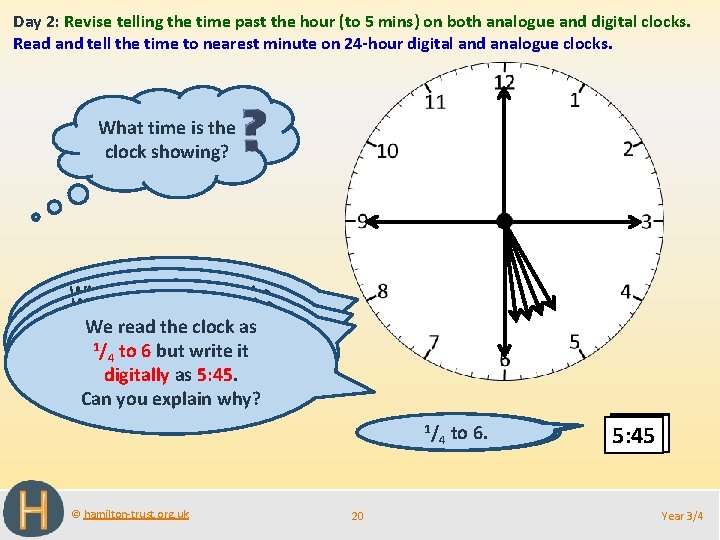
Day 2: Revise telling the time past the hour (to 5 mins) on both analogue and digital clocks. Read and tell the time to nearest minute on 24 -hour digital and analogue clocks. What time is the clock showing? Whatwouldthe thetimebe be What would the. Move time the be in 15 minutes? in. We another 15 minutes? read the clock as in another 15 minutes? hands around your Move the hands around 1/ to 6 but write it Move hands around 4 thethe to show new time. your clock to show digitally asshow 5: 45. the your clock to the new time. Can you explain new time. why? 115 to 6. 5. past 5. /1//24 o’clock. 4 past © hamilton-trust. org. uk 20 5: 15 5: 00 5: 30 5: 45 Year 3/4
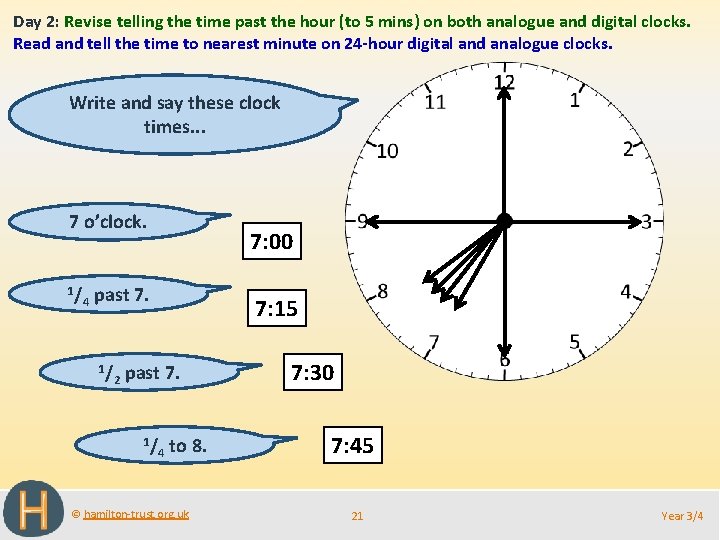
Day 2: Revise telling the time past the hour (to 5 mins) on both analogue and digital clocks. Read and tell the time to nearest minute on 24 -hour digital and analogue clocks. Write and say these clock times. . . 7 o’clock. 1/ 4 7: 00 past 7. 1/ 2 7: 15 past 7. 1/ 4 to 8. © hamilton-trust. org. uk 7: 30 7: 45 21 Year 3/4
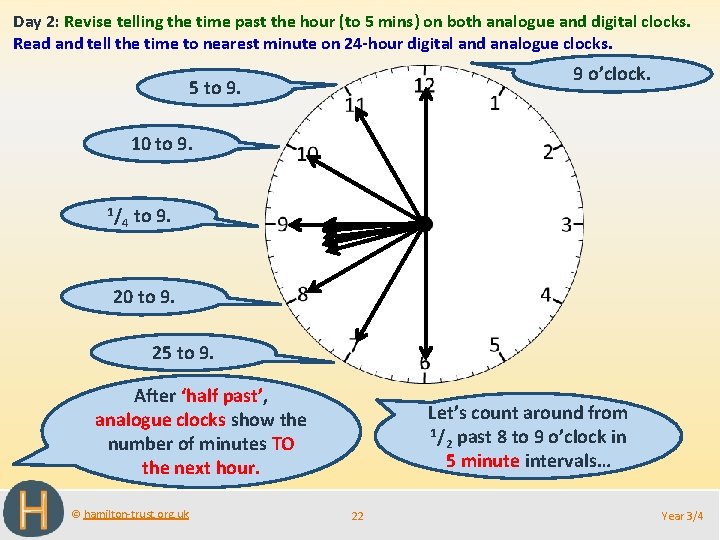
Day 2: Revise telling the time past the hour (to 5 mins) on both analogue and digital clocks. Read and tell the time to nearest minute on 24 -hour digital and analogue clocks. 9 o’clock. 5 to 9. 10 to 9. 1/ 4 to 9. 20 to 9. 25 to 9. After ‘half past’, analogue clocks show the number of minutes TO the next hour. © hamilton-trust. org. uk Let’s count around from 1/ past 8 to 9 o’clock in 2 5 minute intervals… 22 Year 3/4
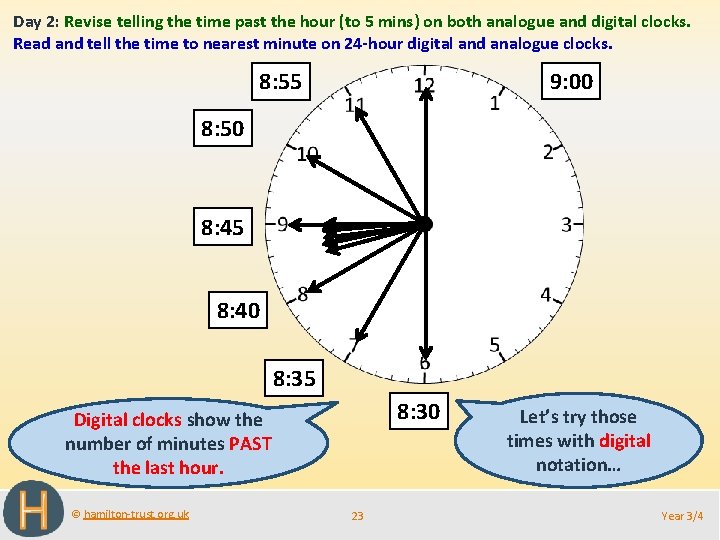
Day 2: Revise telling the time past the hour (to 5 mins) on both analogue and digital clocks. Read and tell the time to nearest minute on 24 -hour digital and analogue clocks. 9: 00 8: 55 8: 50 8: 45 8: 40 8: 35 8: 30 Digital clocks show the number of minutes PAST the last hour. © hamilton-trust. org. uk 23 Let’s try those times with digital notation… Year 3/4
© hamilton-trust. org. uk 24 Year 3/4
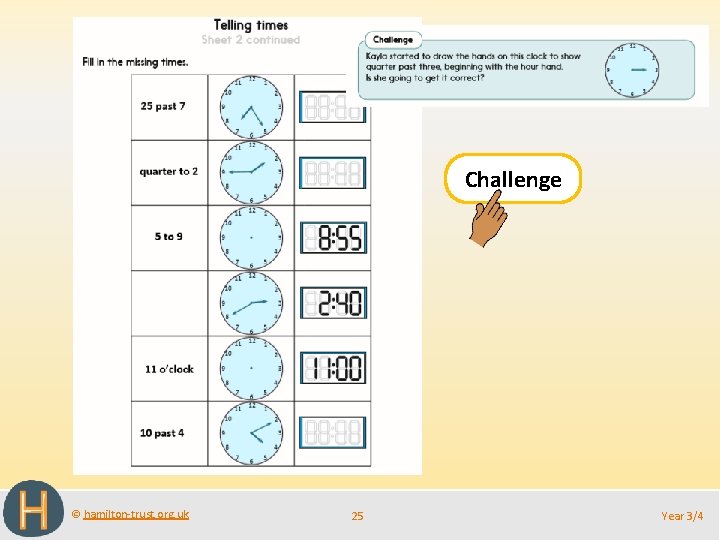
Challenge © hamilton-trust. org. uk 25 Year 3/4
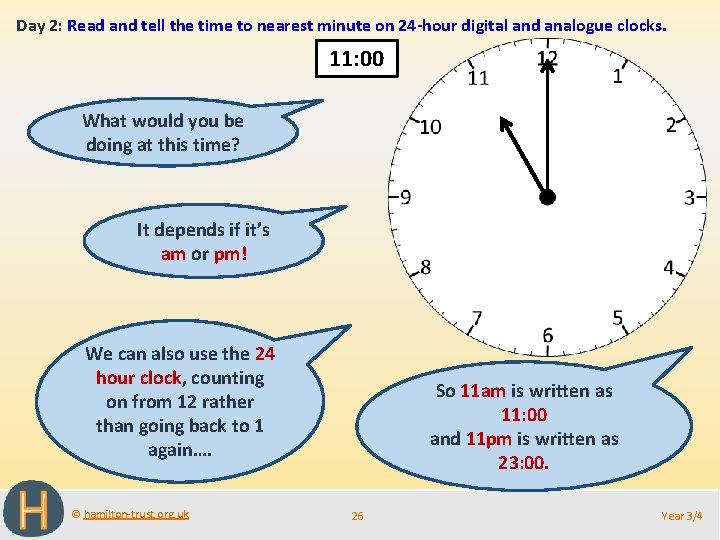
Day 2: Read and tell the time to nearest minute on 24 -hour digital and analogue clocks. 11: 00 What would you be doing at this time? It depends if it’s am or pm! We can also use the 24 hour clock, counting on from 12 rather than going back to 1 again…. © hamilton-trust. org. uk So 11 am is written as 11: 00 and 11 pm is written as 23: 00. 26 Year 3/4
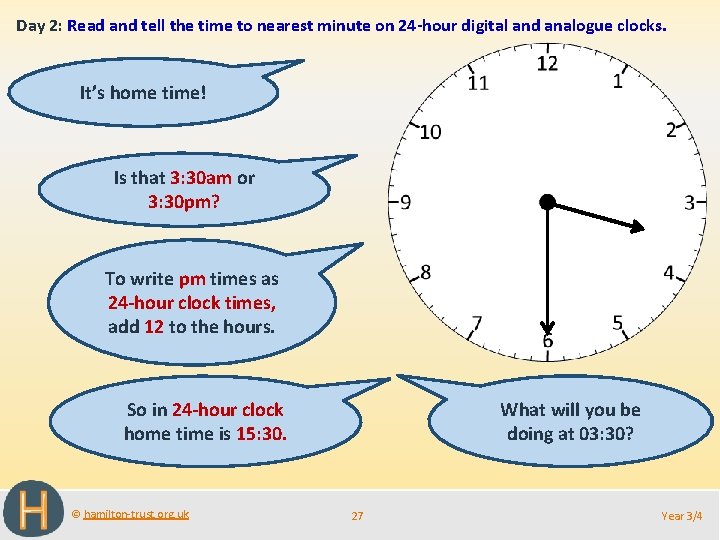
Day 2: Read and tell the time to nearest minute on 24 -hour digital and analogue clocks. It’s home time! Is that 3: 30 am or 3: 30 pm? To write pm times as 24 -hour clock times, add 12 to the hours. What will you be doing at 03: 30? So in 24 -hour clock home time is 15: 30. © hamilton-trust. org. uk 27 Year 3/4
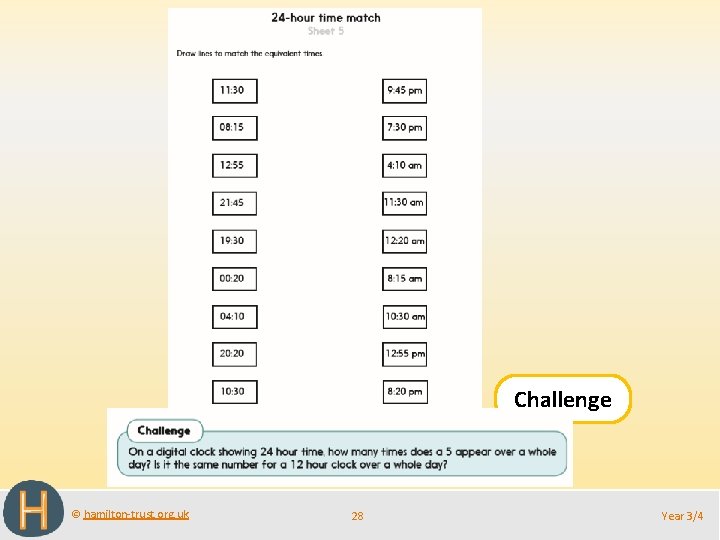
Challenge © hamilton-trust. org. uk 28 Year 3/4
Time and Data Telling the Time Day 3 Know equivalent analogue and digital times; use am and pm. Convert 24 -hour clock to am and pm times. © hamilton-trust. org. uk 29 Year 3/4
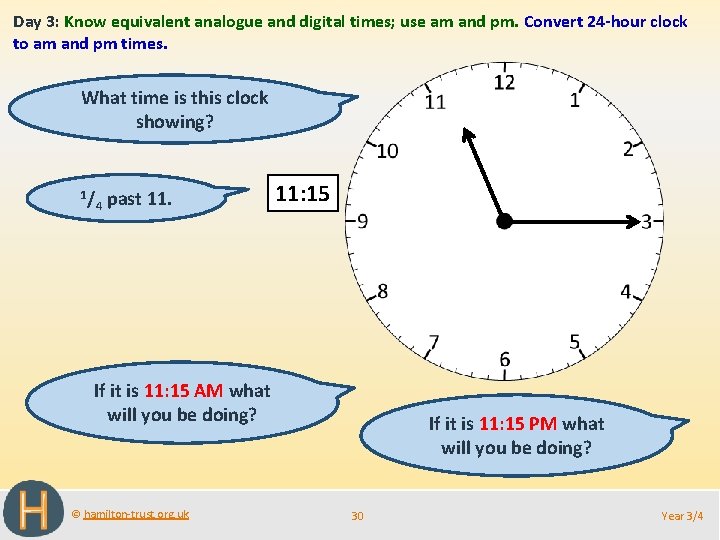
Day 3: Know equivalent analogue and digital times; use am and pm. Convert 24 -hour clock to am and pm times. What time is this clock showing? 1/ 4 past 11. 11: 15 If it is 11: 15 AM what will you be doing? © hamilton-trust. org. uk If it is 11: 15 PM what will you be doing? 30 Year 3/4
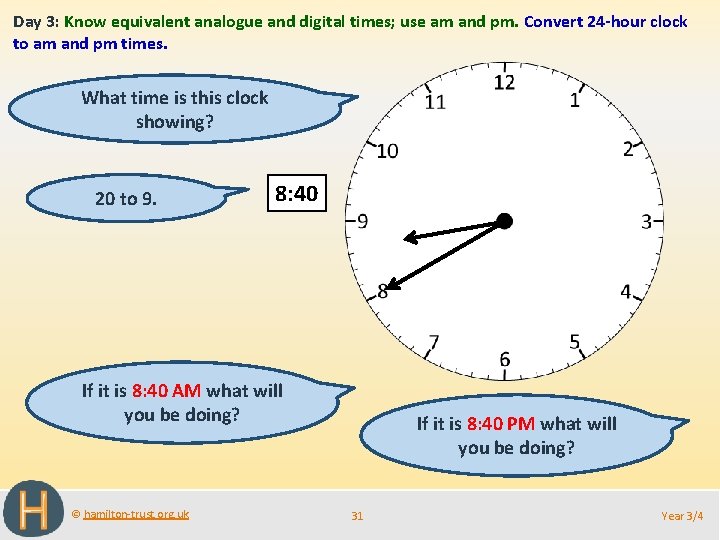
Day 3: Know equivalent analogue and digital times; use am and pm. Convert 24 -hour clock to am and pm times. What time is this clock showing? 20 to 9. 8: 40 If it is 8: 40 AM what will you be doing? © hamilton-trust. org. uk If it is 8: 40 PM what will you be doing? 31 Year 3/4
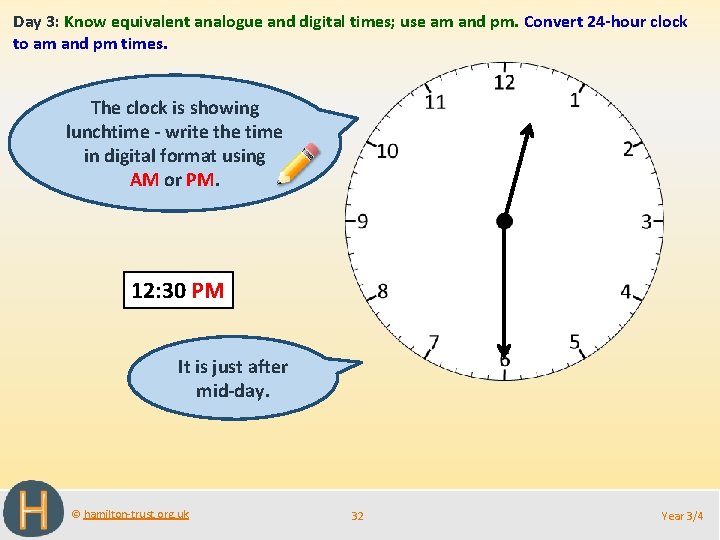
Day 3: Know equivalent analogue and digital times; use am and pm. Convert 24 -hour clock to am and pm times. The clock is showing lunchtime - write the time in digital format using AM or PM. 12: 30 PM It is just after mid-day. © hamilton-trust. org. uk 32 Year 3/4
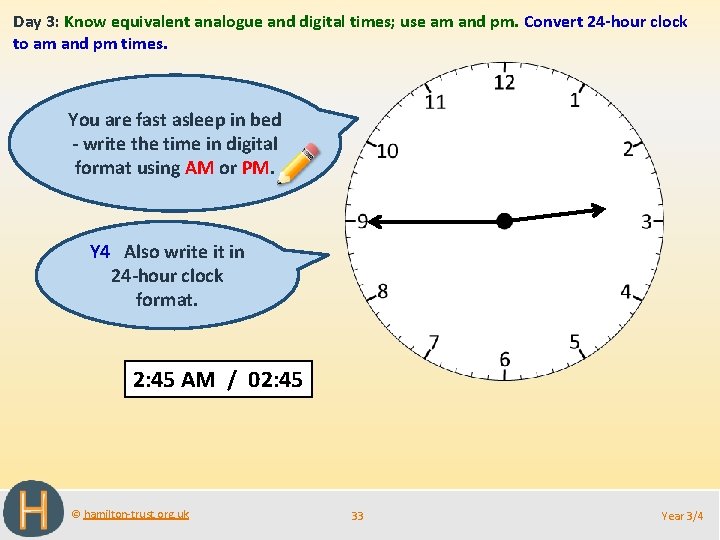
Day 3: Know equivalent analogue and digital times; use am and pm. Convert 24 -hour clock to am and pm times. You are fast asleep in bed - write the time in digital format using AM or PM. Y 4 Also write it in 24 -hour clock format. 2: 45 AM / 02: 45 © hamilton-trust. org. uk 33 Year 3/4
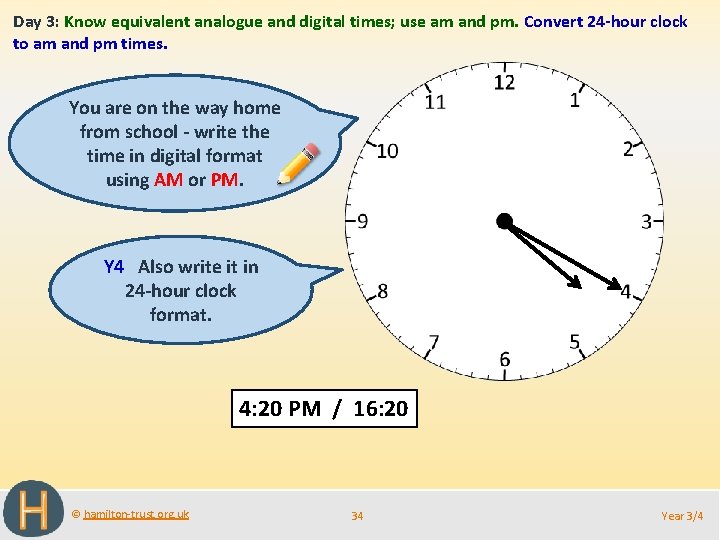
Day 3: Know equivalent analogue and digital times; use am and pm. Convert 24 -hour clock to am and pm times. You are on the way home from school - write the time in digital format using AM or PM. Y 4 Also write it in 24 -hour clock format. 4: 20 PM / 16: 20 © hamilton-trust. org. uk 34 Year 3/4
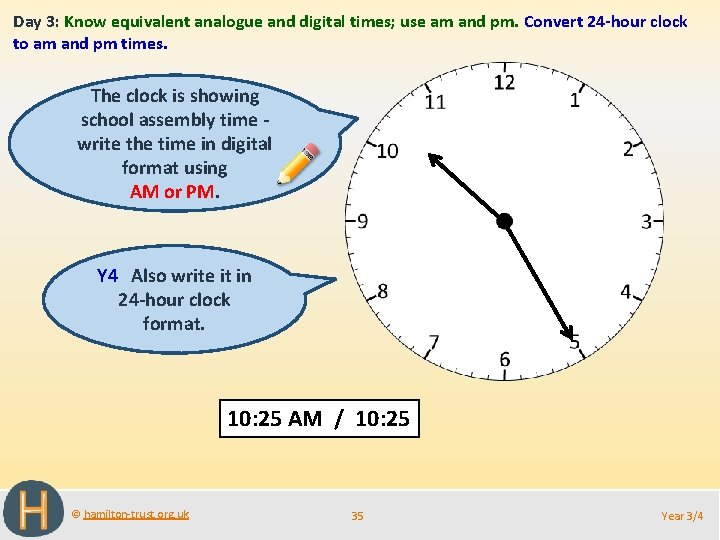
Day 3: Know equivalent analogue and digital times; use am and pm. Convert 24 -hour clock to am and pm times. The clock is showing school assembly time write the time in digital format using AM or PM. Y 4 Also write it in 24 -hour clock format. 10: 25 AM / 10: 25 © hamilton-trust. org. uk 35 Year 3/4
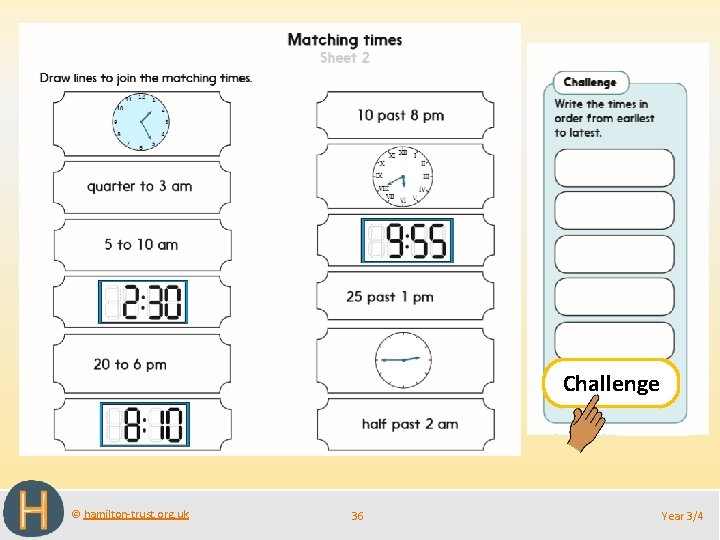
Challenge © hamilton-trust. org. uk 36 Year 3/4
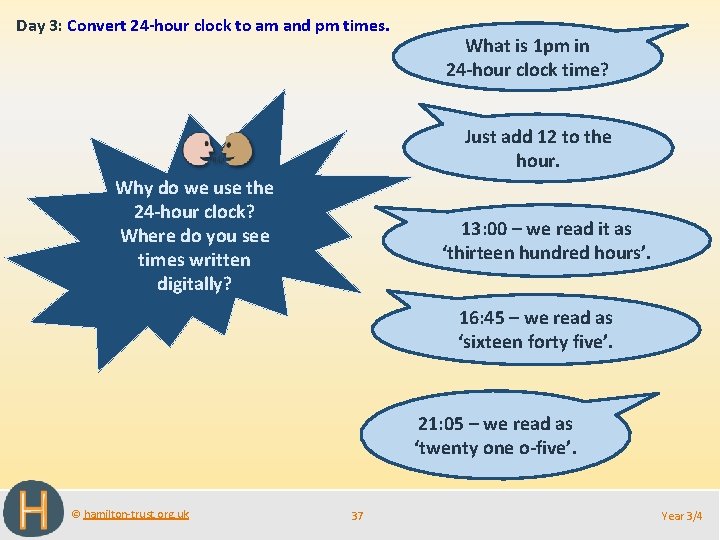
Day 3: Convert 24 -hour clock to am and pm times. What is 1 pm in 24 -hour clock time? Just add 12 to the hour. Why do we use the 24 -hour clock? Where do you see times written digitally? 13: 00 – we read it as ‘thirteen hundred hours’. 16: 45 – we read as ‘sixteen forty five’. 21: 05 – we read as ‘twenty one o-five’. © hamilton-trust. org. uk 37 Year 3/4
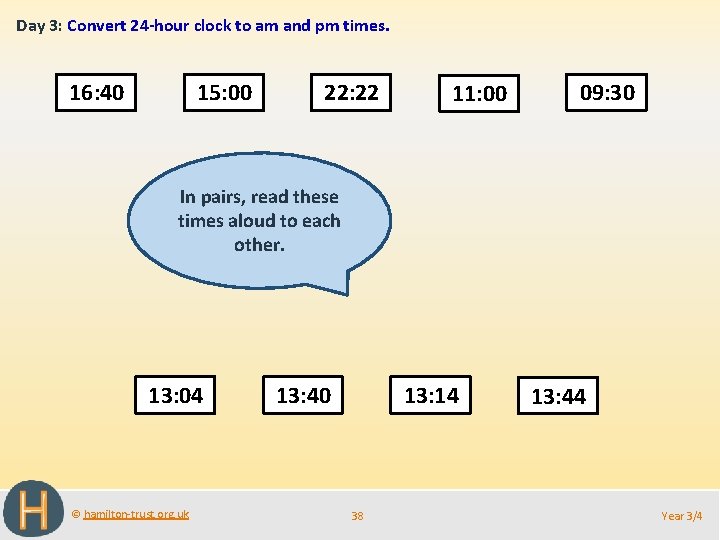
Day 3: Convert 24 -hour clock to am and pm times. 16: 40 15: 00 22: 22 11: 00 09: 30 In pairs, read these times aloud to each other. 13: 04 © hamilton-trust. org. uk 13: 40 13: 14 38 13: 44 Year 3/4
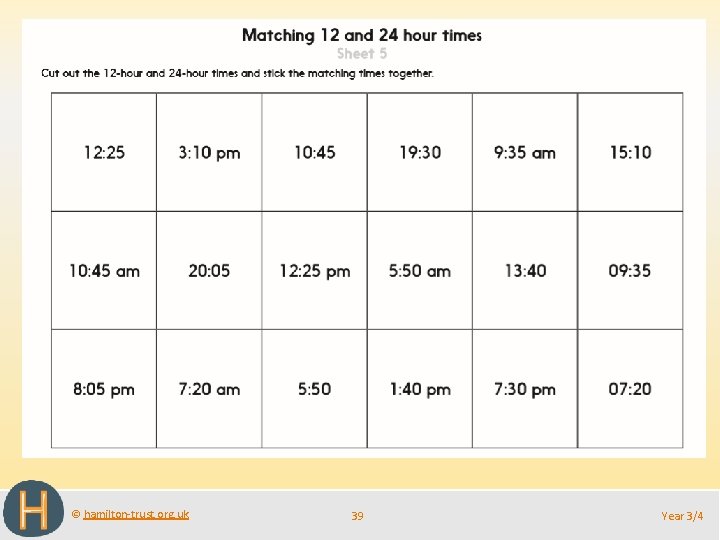
© hamilton-trust. org. uk 39 Year 3/4
Time and Data Telling the Time Day 4 Read and write analogue and digital times to nearest minute. Read, write and match analogue and digital times. Read 24 -hour times, converting to am or pm times and vice versa. © hamilton-trust. org. uk 40 Year 3/4
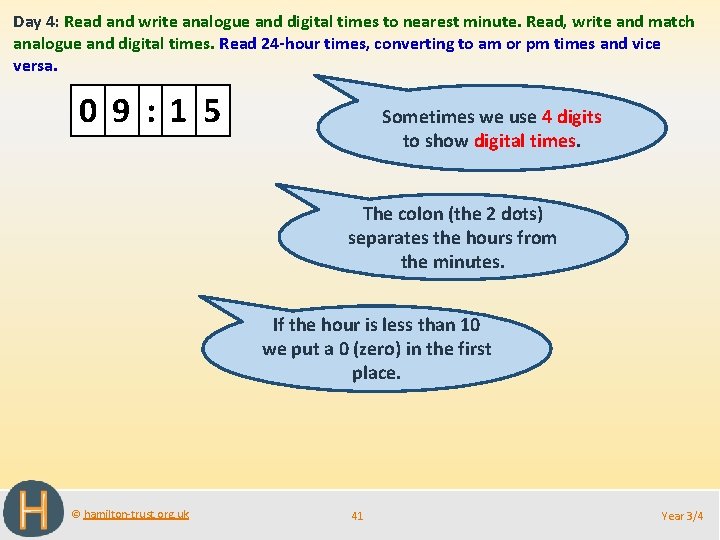
Day 4: Read and write analogue and digital times to nearest minute. Read, write and match analogue and digital times. Read 24 -hour times, converting to am or pm times and vice versa. 0 9 : 1 5 Sometimes we use 4 digits to show digital times. The colon (the 2 dots) separates the hours from the minutes. If the hour is less than 10 we put a 0 (zero) in the first place. © hamilton-trust. org. uk 41 Year 3/4
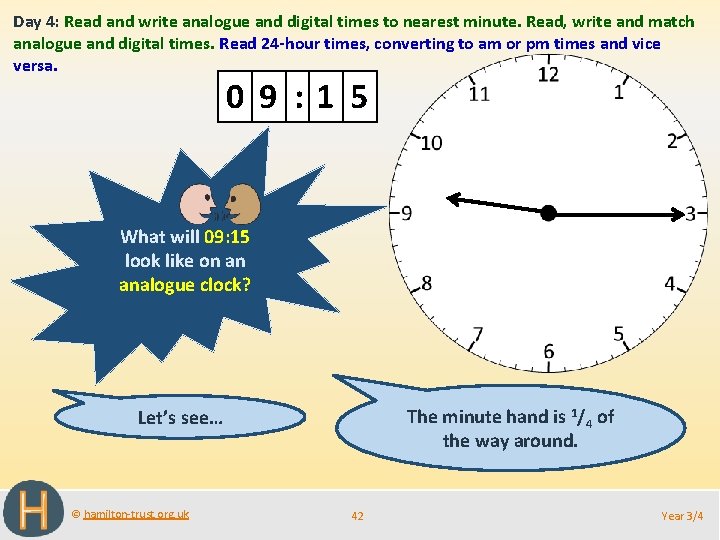
Day 4: Read and write analogue and digital times to nearest minute. Read, write and match analogue and digital times. Read 24 -hour times, converting to am or pm times and vice versa. 0 9 : 1 5 What will 09: 15 look like on an analogue clock? The minute hand is 1/4 of the way around. Let’s see… © hamilton-trust. org. uk 42 Year 3/4
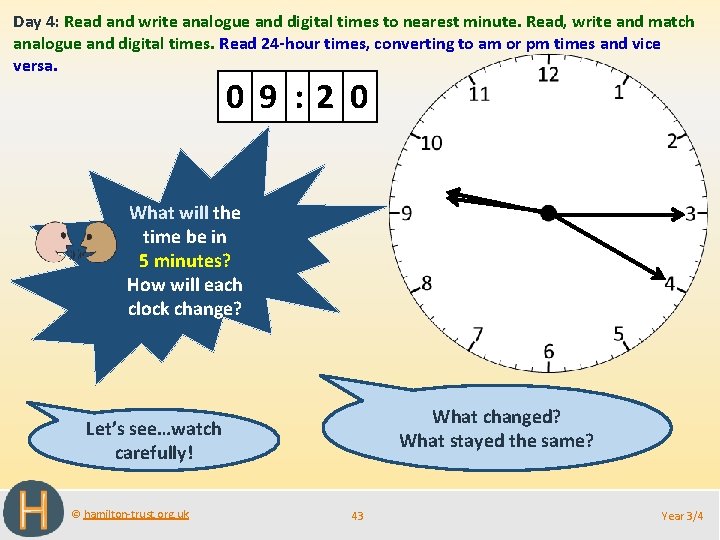
Day 4: Read and write analogue and digital times to nearest minute. Read, write and match analogue and digital times. Read 24 -hour times, converting to am or pm times and vice versa. 0 9 : 2 1 0 5 What will the time be in 5 minutes? How will each clock change? What changed? What stayed the same? Let’s see…watch carefully! © hamilton-trust. org. uk 43 Year 3/4
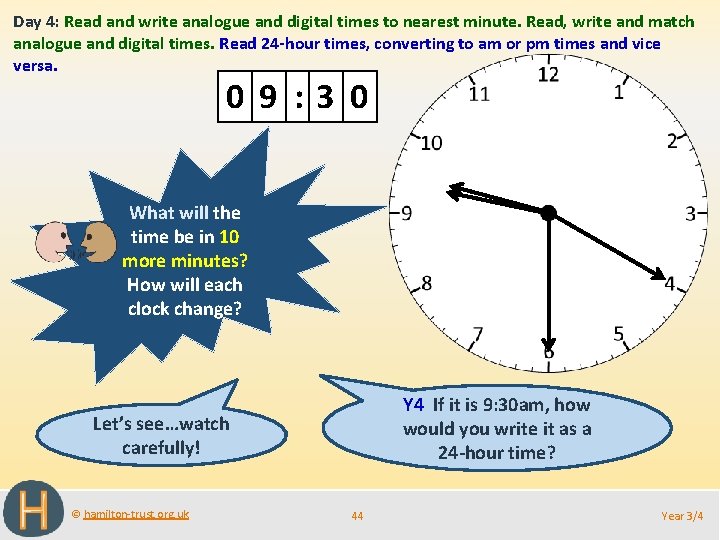
Day 4: Read and write analogue and digital times to nearest minute. Read, write and match analogue and digital times. Read 24 -hour times, converting to am or pm times and vice versa. 0 9 : 3 2 0 What will the time be in 10 more minutes? How will each clock change? Y 4 If it is 9: 30 am, how would you write it as a 24 -hour time? Let’s see…watch carefully! © hamilton-trust. org. uk 44 Year 3/4
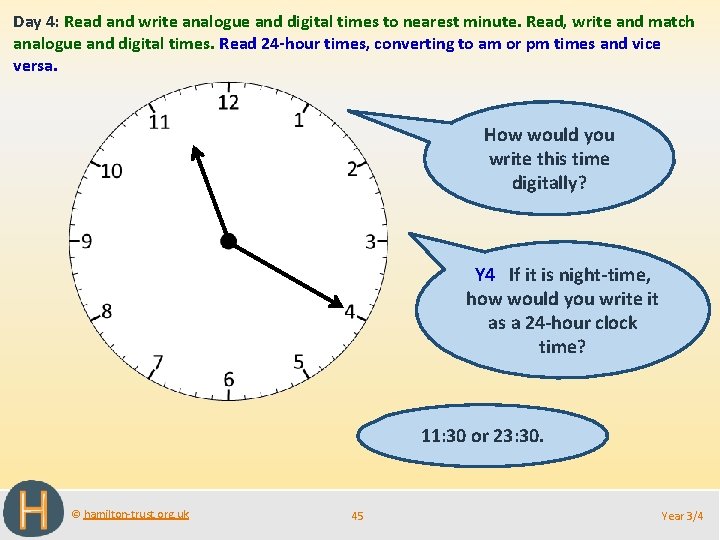
Day 4: Read and write analogue and digital times to nearest minute. Read, write and match analogue and digital times. Read 24 -hour times, converting to am or pm times and vice versa. How would you write this time digitally? Y 4 If it is night-time, how would you write it as a 24 -hour clock time? 11: 30 or 23: 30. © hamilton-trust. org. uk 45 Year 3/4
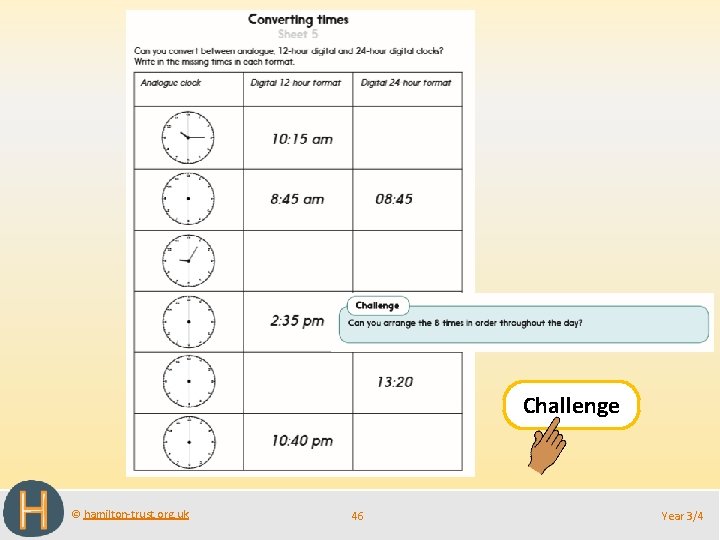
Challenge © hamilton-trust. org. uk 46 Year 3/4
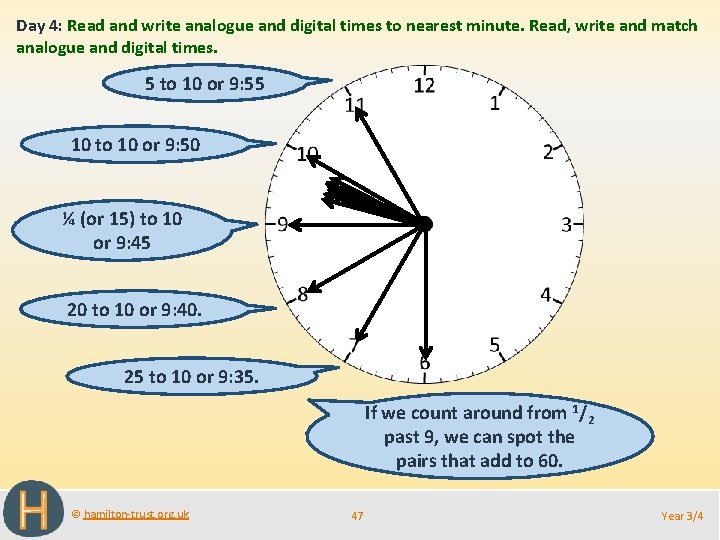
Day 4: Read and write analogue and digital times to nearest minute. Read, write and match analogue and digital times. 5 to 10 or 9: 55 10 to 10 or 9: 50 ¼ (or 15) to 10 or 9: 45 20 to 10 or 9: 40. 25 to 10 or 9: 35. If we count around from 1/2 past 9, we can spot the pairs that add to 60. © hamilton-trust. org. uk 47 Year 3/4
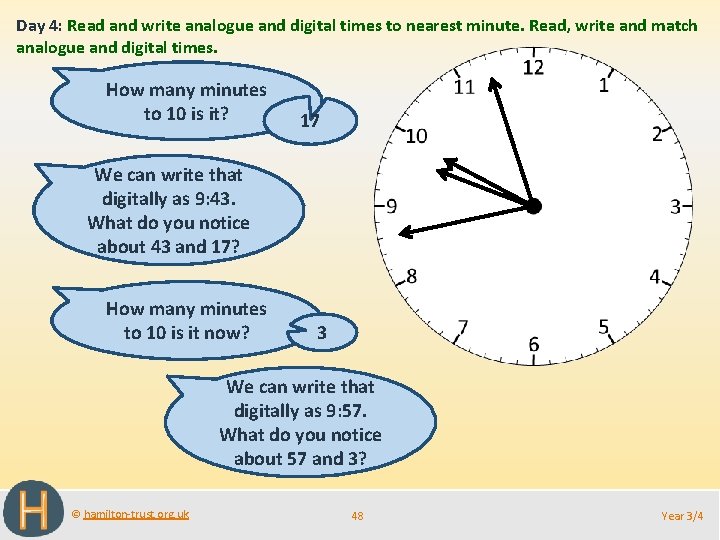
Day 4: Read and write analogue and digital times to nearest minute. Read, write and match analogue and digital times. How many minutes to 10 is it? 17 We can write that digitally as 9: 43. What do you notice about 43 and 17? How many minutes to 10 is it now? 3 We can write that digitally as 9: 57. What do you notice about 57 and 3? © hamilton-trust. org. uk 48 Year 3/4
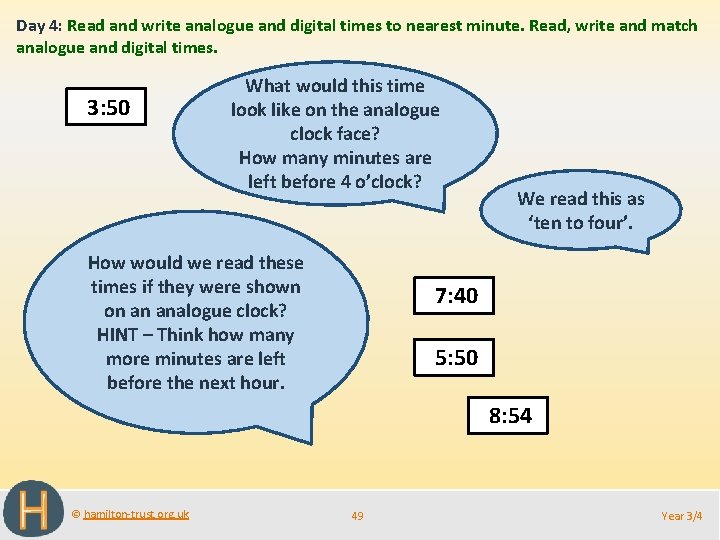
Day 4: Read and write analogue and digital times to nearest minute. Read, write and match analogue and digital times. 3: 50 What would this time look like on the analogue clock face? How many minutes are left before 4 o’clock? How would we read these times if they were shown on an analogue clock? HINT – Think how many more minutes are left before the next hour. We read this as ‘ten to four’. 7: 40 5: 50 8: 54 © hamilton-trust. org. uk 49 Year 3/4
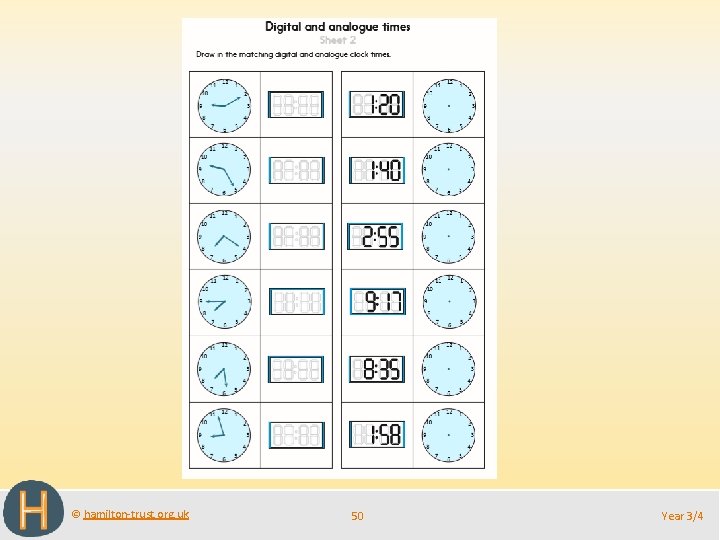
© hamilton-trust. org. uk 50 Year 3/4
Time and Data Telling the Time Well Done! You’ve completed this unit. Objectives Day 1 Revise telling the time past the hour (to 5 mins) on both analogue and digital clocks. Revise telling time, am and pm to the nearest minute on both analogue and digital clocks, convert between the two. Day 2 Revise telling the time past the hour (to 5 mins) on both analogue and digital clocks. Read and tell the time to nearest minute on 24 -hour digital and analogue clocks. Day 3 Know equivalent analogue and digital times; use am and pm. Convert 24 -hour clock to am and pm times. Day 4 Read and write analogue and digital times to nearest minute. Read, write and match analogue and digital times. Read 24 -hour times, converting to am or pm times and vice versa. © hamilton-trust. org. uk 51 Year 3/4
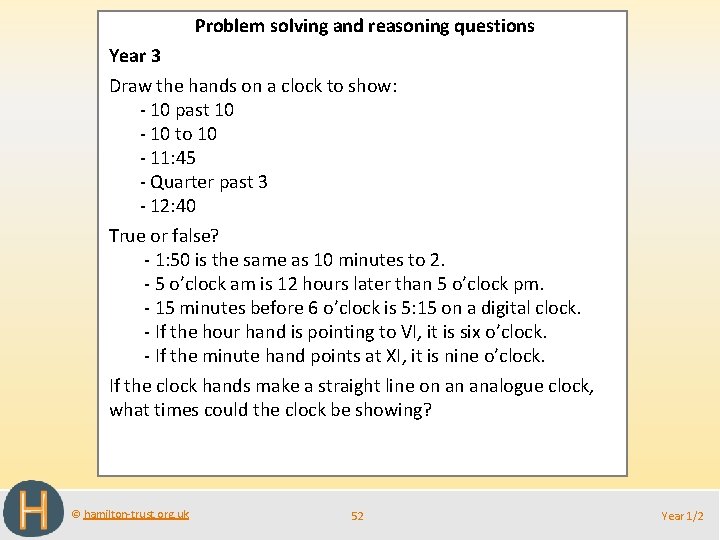
Problem solving and reasoning questions Year 3 Draw the hands on a clock to show: - 10 past 10 - 10 to 10 - 11: 45 - Quarter past 3 - 12: 40 True or false? - 1: 50 is the same as 10 minutes to 2. - 5 o’clock am is 12 hours later than 5 o’clock pm. - 15 minutes before 6 o’clock is 5: 15 on a digital clock. - If the hour hand is pointing to VI, it is six o’clock. - If the minute hand points at XI, it is nine o’clock. If the clock hands make a straight line on an analogue clock, what times could the clock be showing? © hamilton-trust. org. uk 52 Year 1/2
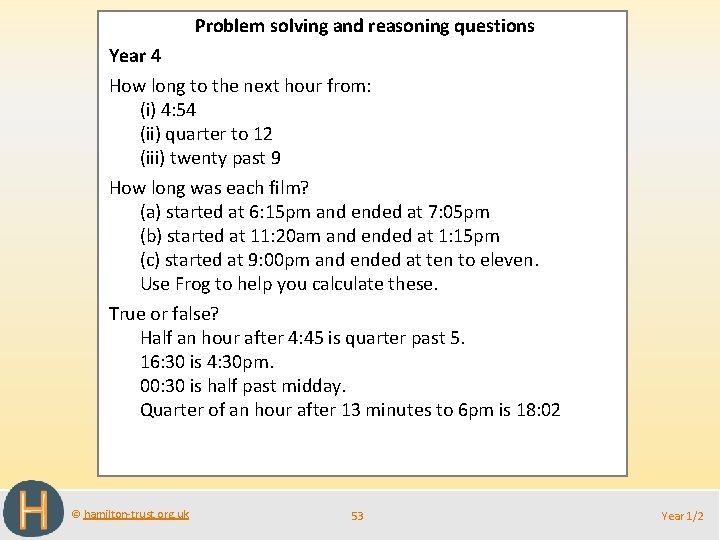
Problem solving and reasoning questions Year 4 How long to the next hour from: (i) 4: 54 (ii) quarter to 12 (iii) twenty past 9 How long was each film? (a) started at 6: 15 pm and ended at 7: 05 pm (b) started at 11: 20 am and ended at 1: 15 pm (c) started at 9: 00 pm and ended at ten to eleven. Use Frog to help you calculate these. True or false? Half an hour after 4: 45 is quarter past 5. 16: 30 is 4: 30 pm. 00: 30 is half past midday. Quarter of an hour after 13 minutes to 6 pm is 18: 02 © hamilton-trust. org. uk 53 Year 1/2
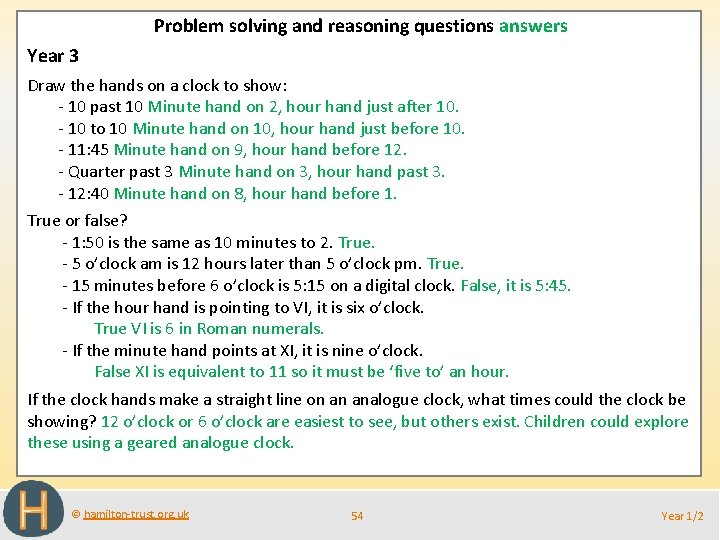
Problem solving and reasoning questions answers Year 3 Draw the hands on a clock to show: - 10 past 10 Minute hand on 2, hour hand just after 10. - 10 to 10 Minute hand on 10, hour hand just before 10. - 11: 45 Minute hand on 9, hour hand before 12. - Quarter past 3 Minute hand on 3, hour hand past 3. - 12: 40 Minute hand on 8, hour hand before 1. True or false? - 1: 50 is the same as 10 minutes to 2. True. - 5 o’clock am is 12 hours later than 5 o’clock pm. True. - 15 minutes before 6 o’clock is 5: 15 on a digital clock. False, it is 5: 45. - If the hour hand is pointing to VI, it is six o’clock. True VI is 6 in Roman numerals. - If the minute hand points at XI, it is nine o’clock. False XI is equivalent to 11 so it must be ‘five to’ an hour. If the clock hands make a straight line on an analogue clock, what times could the clock be showing? 12 o’clock or 6 o’clock are easiest to see, but others exist. Children could explore these using a geared analogue clock. © hamilton-trust. org. uk 54 Year 1/2
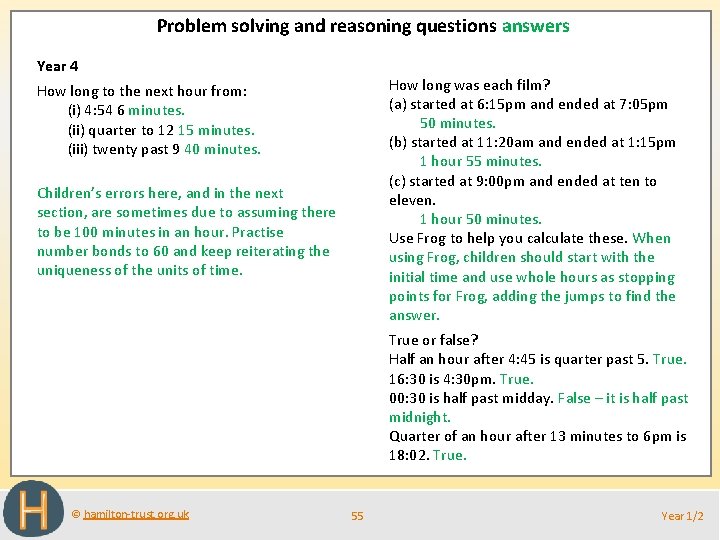
Problem solving and reasoning questions answers Year 4 How long was each film? (a) started at 6: 15 pm and ended at 7: 05 pm 50 minutes. (b) started at 11: 20 am and ended at 1: 15 pm 1 hour 55 minutes. (c) started at 9: 00 pm and ended at ten to eleven. 1 hour 50 minutes. Use Frog to help you calculate these. When using Frog, children should start with the initial time and use whole hours as stopping points for Frog, adding the jumps to find the answer. How long to the next hour from: (i) 4: 54 6 minutes. (ii) quarter to 12 15 minutes. (iii) twenty past 9 40 minutes. Children’s errors here, and in the next section, are sometimes due to assuming there to be 100 minutes in an hour. Practise number bonds to 60 and keep reiterating the uniqueness of the units of time. True or false? Half an hour after 4: 45 is quarter past 5. True. 16: 30 is 4: 30 pm. True. 00: 30 is half past midday. False – it is half past midnight. Quarter of an hour after 13 minutes to 6 pm is 18: 02. True. © hamilton-trust. org. uk 55 Year 1/2
- Slides: 55