
TIMBER Definition The word timber is derived from
TIMBER Definition: - The word timber is derived from an old English word Timbrian, meaning to Build. Thus the wood suitable for building, carpentry or various other engineering purposes is called Timber. Classification of Trees: - Depending upon the mode of growth the trees are classified into two categories. 1. Endogenous Trees 2. Exogenous Trees § Endogenous trees grows inwards in a longitudinal fibrous mass such as v banana, v bamboo, v palm and v cane. § Though the stem is light and tough, yet it is too flexible and slender to furnish material for engineering works. § Exogenous trees are those that grows outwards by addition of one concentric ring every year and are known as Annual Rings. Timber obtained from these kind of trees is extensively used in engineering works. The timber obtained from exogenous trees is further classified into two categories: 1
Conifers or Evergreen trees: - yielding soft wood. They have pointed leaves. Deodar, Pine, Chir, Kail belong to this category. Deciduous : - These are the trees with broad leaves yielding hard wood. Teak, Sal, Shisham, etc. belong to this category. Growth of Timber Tree And its Structure Growth : Ø In Spring season the roots of the tree suck a salt solution from the soil and transmit the same through the trunk of the tree to the branches and leaves. Ø This salt solution looses some of the moisture because of evaporation and absorbs CO 2 from the air. Ø This action in the presence of sun makes the solution a bit viscous and is known as sap. Ø In Autumn viscous sap descends below the bark and leaves a thick layer, which subsequently is transformed into wood and is known as cambium layer. Ø It goes on gaining strength with the passage of time. Ø Thus a fresh layer is added on the outside of tree every year forming a new annual ring. Ø Therefore a new annual ring represents a year’s growth of tree and the number of rings denotes its age. 2
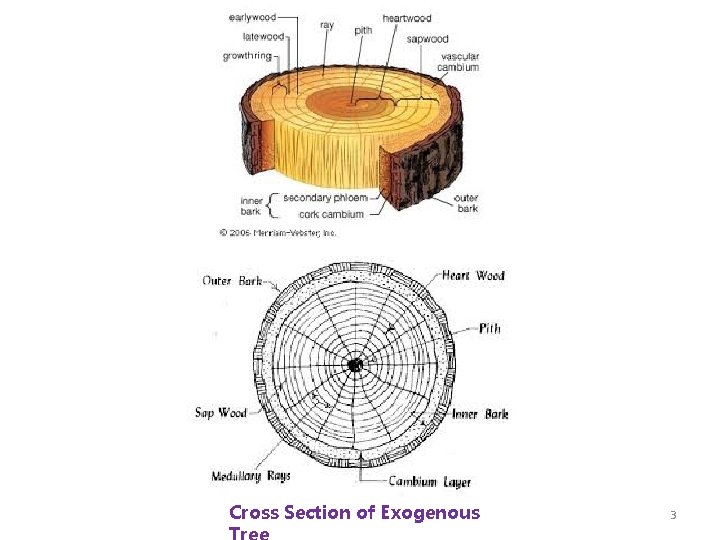
Cross Section of Exogenous 3
Structure : Pith: v The innermost portion or core of the tree is termed as pith or medulla. It is the first formed portion of the stem of the tree. v It consist entirely of cellular tissues and nourishes the plant in its younger age. v When the plant becomes old, the pith dries up and decays and sap is than transmitted by the woody fibres deposited round the pith. Heart Wood: v Innermost annual rings surrounding the pith constitute the heart wood. v It indicates dead portion of the tree and therefore does not take active part in the growth of tree. v But it is stronger, darker in colour, more compact and durable and gives rigidity to the tree. v It is this portion of the tree which provides strong and durable timber for engineering work. Sap Wood: v The outer annual rings between heart wood and cambium layer is Sap Wood or Alburnum. v It indicates recent growth and takes active part in the growth of tree by transmitting the sap from the roots to the branches. v As compared with heart wood it is lighter in colour, weaker and more liable to decay. 4
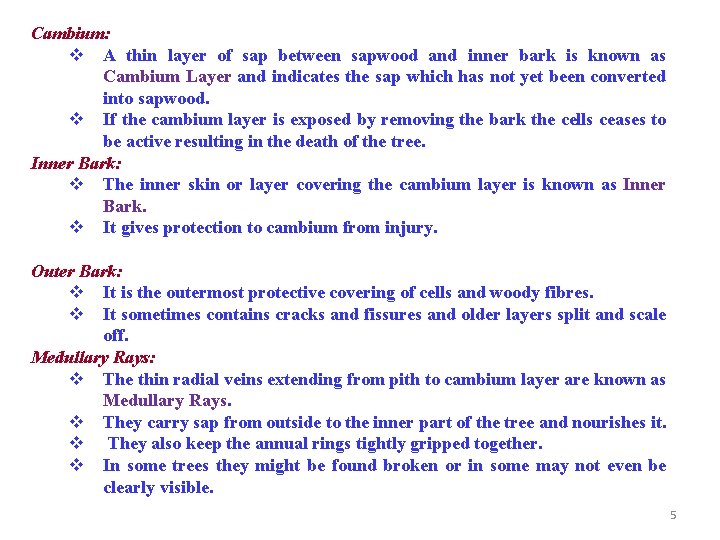
Cambium: v A thin layer of sap between sapwood and inner bark is known as Cambium Layer and indicates the sap which has not yet been converted into sapwood. v If the cambium layer is exposed by removing the bark the cells ceases to be active resulting in the death of the tree. Inner Bark: v The inner skin or layer covering the cambium layer is known as Inner Bark. v It gives protection to cambium from injury. Outer Bark: v It is the outermost protective covering of cells and woody fibres. v It sometimes contains cracks and fissures and older layers split and scale off. Medullary Rays: v The thin radial veins extending from pith to cambium layer are known as Medullary Rays. v They carry sap from outside to the inner part of the tree and nourishes it. v They also keep the annual rings tightly gripped together. v In some trees they might be found broken or in some may not even be clearly visible. 5
Characteristics of Hard and Soft Wood Hard Wood 1. The wood is comparatively heavier and is darker in colour. 2. The annual rings are not distinct. 3. It is hard and difficult to work upon. 4. It contains large percentage of acid. 5. It resists shearing stresses. 6. It is close grained and strong. 7. It is non-resinous. Shisham, Sal, Teak, Oak, Mahogany and Babul are the examples of hard wood. Soft Wood 1. It is light in weight and colour. 2. Annual rings are very distinct. 3. It is comparatively weaker and splits easily. 4. It has straight fibres. 5. It is resinous i. e. , contains resins and turpentine. It has peculiar fragrance. 6. It is strong for resisting tensile forces. 7. It is weak in directions across the grains. 8. Its texture is soft and regular. Spruce, Deodar, Chir, Kail and Walnut etc. are the examples of soft wood. 6
Characteristics of Good Timber 1. 2. 3. 4. It should be from the heart of a sound tree and be free from Sap. It should have straight and close fibres. It should be of uniform colour. It should give a clear ringing sound when struck. Dull heavy sound is the sign of internal decay. 5. It should have regular annual rings. 6. Timbers with narrow annual rings are generally the strongest. 7. Freshly cut surfaces should give sweet smell. 8. Teeth of saw should not be clogged while sawing. 9. It should have bright and smooth surface when planed. Dull appearance is the sign of defective timber. 10. Out of same variety of timber, darker and heavier pieces are stronger. 11. It should be free from dead Knots, from too many Knots, Shakes or other defects. 12. It should firm adhesion of fibres and compact medullary rays. 7
Characteristics and Uses of Common Indian Timber Trees Deodar It is a tall tree with pointed leaves found in western Himalayas at a height of 1000 m to 3000 m. It is one of the most important timbers of India. Characteristics 1. Its colour is yellowish brown. 2. It is a soft wood. 3. It can be easily worked. 4. It is a strong and durable timber. 5. It possesses distinct annual rings. 6. It is strongly scented and oily. 7. Its weight after seasoning at 12% moisture is 560 Kg/m 3. Uses It is used for the construction of buildings and for railway sleepers, bridges and piles. 8
Sal It is found in sub Himalayan ranges, Madhya Pradesh, Orrisa and Uttar Pradesh. Characteristics 1. The timber is pale brown in colour, darkening on exposure. 2. It is hard, fibrous and close grained. 3. It requires slow and careful seasoning. 4. It is durable under ground and water. 5. It does not take up a good polish. 6. Its weight after seasoning at 12% moisture is 800 Kg/m 3. Uses It is used for railway sleepers, wagons, ship buildings, bridges, Structural work etc. The sal poles are also used as foundation piles 9
Teak It is a large deciduous tree growing in the central and southern India. Characteristics 1. Its colour is deep yellow to dark brown. 2. It is moderately hard. 3. It is strong and durable under all climatic conditions. 4. It shrinks very little and can be easily seasoned and worked upon. 5. It takes a good polish. 6. It has resinous oils which gives it preservative, rust preventing properties and a characteristic scent 7. It is practically immune to white ants, fire proof, and resist action of acids. 8. Its weight after seasoning at 12% moisture is 625 Kg/m 3. Uses It is used for railway sleepers, ship buildings, furniture making, bridges, railway carriages, and all sorts of building works. Its use is limited to superior work only as it is comparatively costly. 10
Shisham It is widely available in northern India. It is one of the most valuable timbers of the country. Characteristics 1. The wood is dark brown in colour with golden and dark brown streaks. 2. It is close grained. 3. It is strong, tough and durable. 4. It is very hard. 5. It seasons well and takes a fine polish. 6. Its weight after seasoning at 12% moisture is 770 Kg/m 3 Uses It is used for high class furniture, beams and other important building works. It is very good for decorative work and carvings. 11
Walnut It grows in the Himalayas and in upper Burma. Characteristics 1. Colour varies from light greyish brown to dark brown streaked black or golden red. 2. It is strong, hard, tough and elastic. 3. It is uniform in texture and takes good polish when seasoned. 4. It is easily worked and does not split. 5. It is slow to season and shrinks on seasoning. 6. When seasoned it is quit durable but is vulnerable to the attack of worms. 7. It weighs 650 Kg/cum Uses It is an excellent timber for high class furniture, cabinet work, panelling, carving work and for making veneers and plywood. 12
Kail It is a large evergreen tree, found in the Himalayas from Bhutan to Afghanistan at heights ranging from 2000 m to 4000 m. Characteristics 1. Wood is of pale brown in colour. 2. Wood is close grained. 3. It is quite durable. 4. It seasons well. 5. It is less brittle and more free from oil than Deodar. Uses Used for house building(doors and windows etc. ), water channels, poles, Matches and match boxes, and railway sleepers. 13
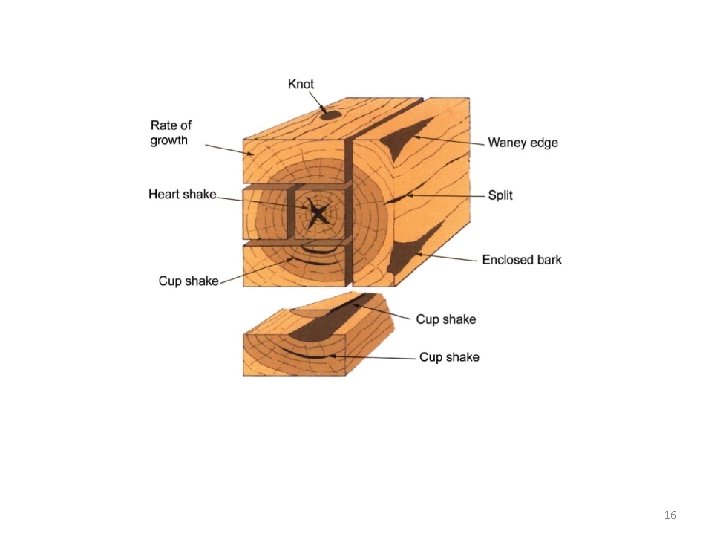
Defects in Timber The defects of timber are of two types: 1. Those developed during the growth of the tree 2. Those developed after the tree has been felled. Defects Developed During the Growth of the Tree Shakes : - These are the cracks which partly or completely separate the fibres of the wood. Following are the different types of Shakes. Star Shakes : § These are the cracks which extend from bark towards the sap wood. § They are confined only up to sapwood. § They are wider on the surface of the tree and become narrower towards the inner side. § These are formed due to the severe heat or frost during the growth of the tree. Heart Shakes : § These are the cracks which occur in the centre of the cross section of tree and extend from pith to the sapwood in the direction of the medullary rays. § These are caused by the shrinkage of the interior parts of tree which is approaching maturity. Cup Shakes or Ring Shakes: § These are the curved splits separating one annual ring from the adjacent one either wholly or partly. § If it separates the annual ring partly then it is called Cup shakes and if they separate the entire ring then it is called Ring Shakes. § These are caused by strong winds swaying the tree or by excessive frost action on the moisture present in the tree, especially while it is still young. 14
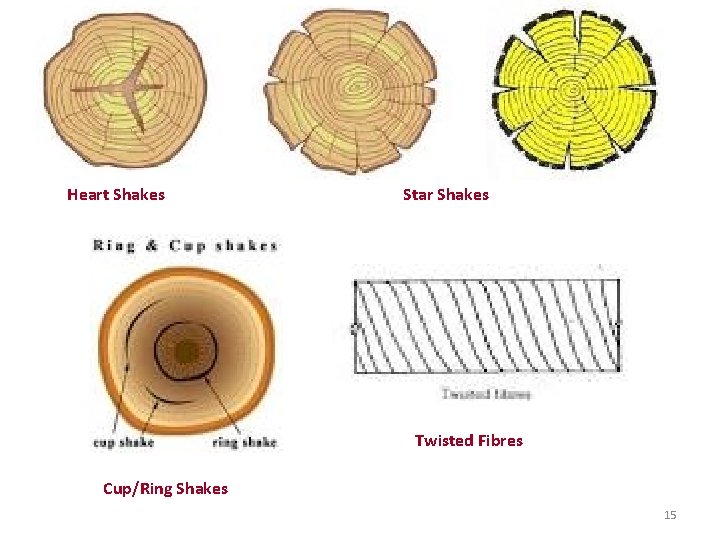
Heart Shakes Star Shakes Twisted Fibres Cup/Ring Shakes 15
16
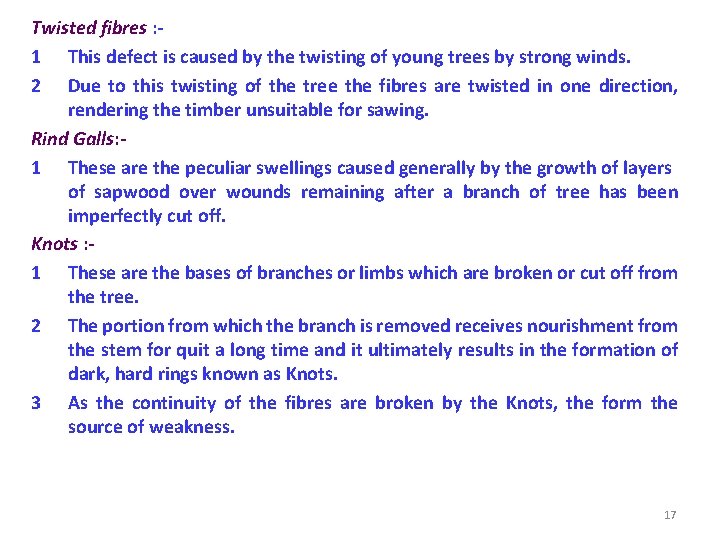
Twisted fibres : 1 This defect is caused by the twisting of young trees by strong winds. 2 Due to this twisting of the tree the fibres are twisted in one direction, rendering the timber unsuitable for sawing. Rind Galls: 1 These are the peculiar swellings caused generally by the growth of layers of sapwood over wounds remaining after a branch of tree has been imperfectly cut off. Knots : 1 These are the bases of branches or limbs which are broken or cut off from the tree. 2 The portion from which the branch is removed receives nourishment from the stem for quit a long time and it ultimately results in the formation of dark, hard rings known as Knots. 3 As the continuity of the fibres are broken by the Knots, the form the source of weakness. 17
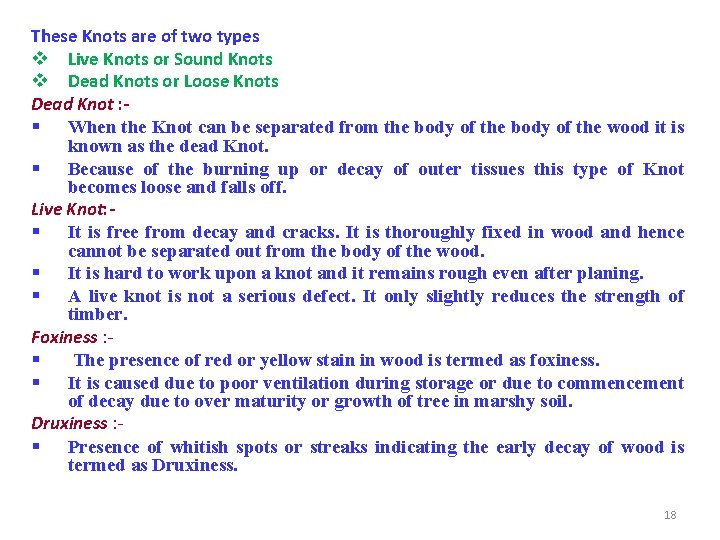
These Knots are of two types v Live Knots or Sound Knots v Dead Knots or Loose Knots Dead Knot : § When the Knot can be separated from the body of the wood it is known as the dead Knot. § Because of the burning up or decay of outer tissues this type of Knot becomes loose and falls off. Live Knot: § It is free from decay and cracks. It is thoroughly fixed in wood and hence cannot be separated out from the body of the wood. § It is hard to work upon a knot and it remains rough even after planing. § A live knot is not a serious defect. It only slightly reduces the strength of timber. Foxiness : § The presence of red or yellow stain in wood is termed as foxiness. § It is caused due to poor ventilation during storage or due to commencement of decay due to over maturity or growth of tree in marshy soil. Druxiness : § Presence of whitish spots or streaks indicating the early decay of wood is termed as Druxiness. 18
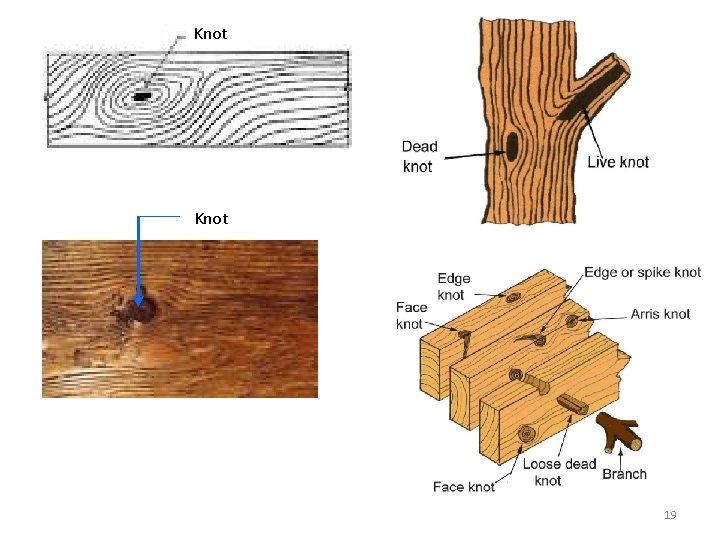
Knot 19
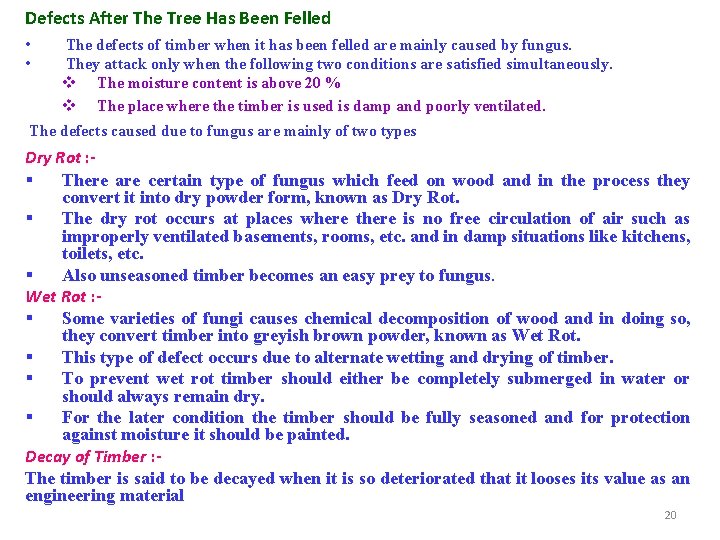
Defects After The Tree Has Been Felled • • The defects of timber when it has been felled are mainly caused by fungus. They attack only when the following two conditions are satisfied simultaneously. v The moisture content is above 20 % v The place where the timber is used is damp and poorly ventilated. The defects caused due to fungus are mainly of two types Dry Rot : § There are certain type of fungus which feed on wood and in the process they convert it into dry powder form, known as Dry Rot. § The dry rot occurs at places where there is no free circulation of air such as improperly ventilated basements, rooms, etc. and in damp situations like kitchens, toilets, etc. § Also unseasoned timber becomes an easy prey to fungus. Wet Rot : § Some varieties of fungi causes chemical decomposition of wood and in doing so, they convert timber into greyish brown powder, known as Wet Rot. § This type of defect occurs due to alternate wetting and drying of timber. § To prevent wet rot timber should either be completely submerged in water or should always remain dry. § For the later condition the timber should be fully seasoned and for protection against moisture it should be painted. Decay of Timber : The timber is said to be decayed when it is so deteriorated that it looses its value as an engineering material 20
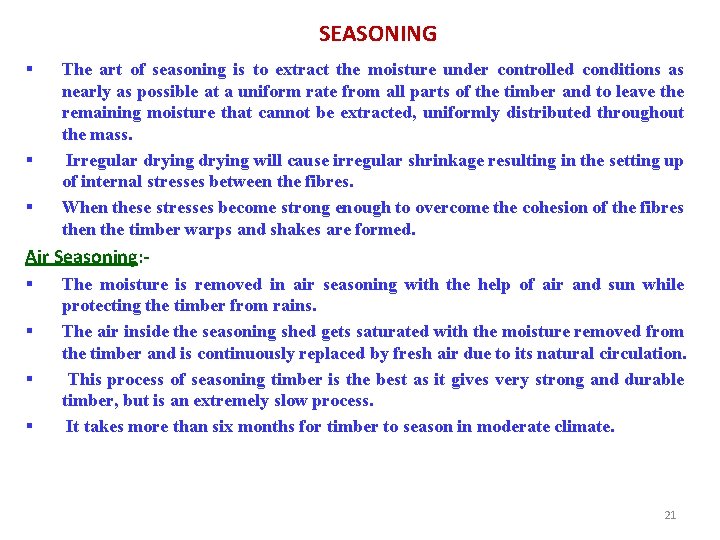
SEASONING § § § The art of seasoning is to extract the moisture under controlled conditions as nearly as possible at a uniform rate from all parts of the timber and to leave the remaining moisture that cannot be extracted, uniformly distributed throughout the mass. Irregular drying will cause irregular shrinkage resulting in the setting up of internal stresses between the fibres. When these stresses become strong enough to overcome the cohesion of the fibres then the timber warps and shakes are formed. Air Seasoning: § § The moisture is removed in air seasoning with the help of air and sun while protecting the timber from rains. The air inside the seasoning shed gets saturated with the moisture removed from the timber and is continuously replaced by fresh air due to its natural circulation. This process of seasoning timber is the best as it gives very strong and durable timber, but is an extremely slow process. It takes more than six months for timber to season in moderate climate. 21
Kiln Seasoning: § Kiln seasoning is a quick method of seasoning timber to the desired moisture content. § For large scale production of seasoned timber, Kilns have become almost an essential part to many timber industries. § Kilns are also indispensable for seasoning timber to low moisture contents for special uses, which cannot be obtained in humid climate by air seasoning. § Seasoning kilns are also used for sterilization of timber against insects and decay. v The seasoning kiln is a chamber equipped with arrangements for heating and humidifying the drying air to desired conditions of temperature and relative humidity over the surface of timber stacked inside the kiln. Generally steam is used for heating and humidifying the air in the kiln. v The seasoning of timber is started at a comparatively low temperature and high relative humidity. As the timber dries these conditions are gradually altered until at the end of the seasoning the temperature of the air inside the chamber is fairly high and relative humidity is low. Seasoning by this method takes about 4 to 5 days normal conditions. 22
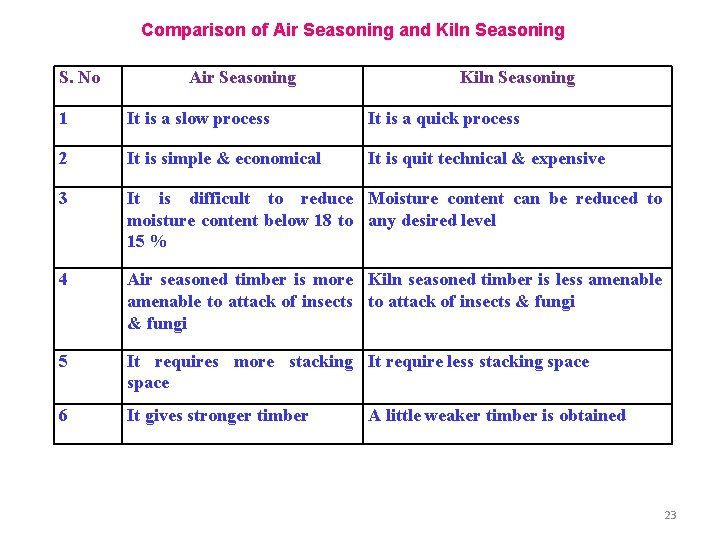
Comparison of Air Seasoning and Kiln Seasoning S. No Air Seasoning Kiln Seasoning 1 It is a slow process It is a quick process 2 It is simple & economical It is quit technical & expensive 3 It is difficult to reduce Moisture content can be reduced to moisture content below 18 to any desired level 15 % 4 Air seasoned timber is more Kiln seasoned timber is less amenable to attack of insects & fungi 5 It requires more stacking It require less stacking space 6 It gives stronger timber A little weaker timber is obtained 23
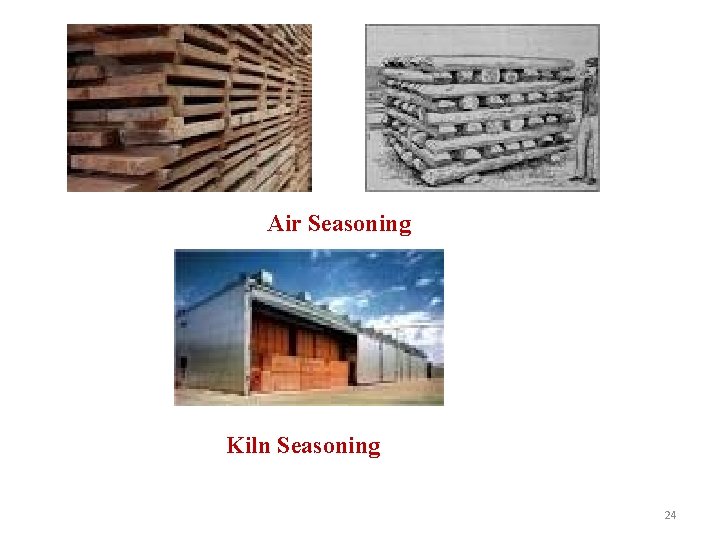
Air Seasoning Kiln Seasoning 24
PRESERVATION OF TIMBER • • • A number of biological agencies such as termite, funguses etc. are likely to attack wood especially in Tropical Climate as in India. The treatment thus, is intended to improve Durability, Performance and consequently the Service Life. The treated timber with chemical preservatives are generally expected to give about 4 to 5 times the service life of non-durable and untreated timber when used in open and 6 to 10 times in the interiors. The efficiency of the treatment depends upon the proper choice of the preservatives and the treatment process. The material should be fabricated before treatment and all cutting and boring operations on the treated wood should be avoided. 25
A. S. C. U Treatment The ASCU is a special preservative developed at the Forest Research Institute, Dehradun. It is a water soluble type of preservative having a composition as follows: v 1 Part by weight of hydrated arsenic pentaoxide (AS 2 O 5. 2 H 2 O) v 3 parts by weight of Blue Vitriol or Copper Sulphate (Cu. SO 4. 5 H 2 O) v 4 parts by weight of Potassium dichromate (K 2 Cr 2 O 7) or Sodium dichromate (Na 2 Cr 2 O 7. 2 H 2 O) § Six parts of this powder is mixed with 100 parts by weight of water. § This odourless solution is then applied or sprayed on the timber surface. § This preservative gives timber the protection against the white ants. § The timber treated with this preservative can be painted, polished or varnished. Chemical Salts: • These are also water soluble type of preservatives. • The usual salts used are • • v Zinc Chloride, v Boric Acid, v Sodium Fluoride, v Copper Sulphate etc. These preservatives are odourless and non inflammable. But these preservatives may gradually be depleted owing to the dissolving effect of water. However the leaching effect can be reduced by applying a coat of water proof paint on the surface of treated timber. The treated timber becomes immune to many types of Fungi that cause the timber to Rot. 26
Creosote Oils: § It is an oil type of preservative black or brown in colour. § The creosoting is carried out in the following manner: v The timber is thoroughly seasoned and dried. v It is then placed in an air tight chamber v The air is then pumped out from the chamber v The creosote oil is then pumped under high pressure of about 7 to 10 Kg/cm 2 § § and at a temperature of about 50 C, so long the timber is fully saturated with oil. The creosote is highly toxic and inflammable and gives out highly unpleasant smell. It is poisonous for wood attacking Fungi and practically doubles the life of timber. It is generally adopted for piles, transmission poles, railway sleepers etc. But it should not be used in the interiors of residential houses, in underground installations and near inflammable surfaces. It does not take paints well. § Painting: § A paint when applied to the timber acts not only as a good preservative but also enhances the appearance of the surface. § Only well treated timber should be painted as otherwise the moisture entrapped because of closing of timber pores by paint, would cause decay. § Paints, however protects seasoned timber against moisture thereby prolonging its life. 27
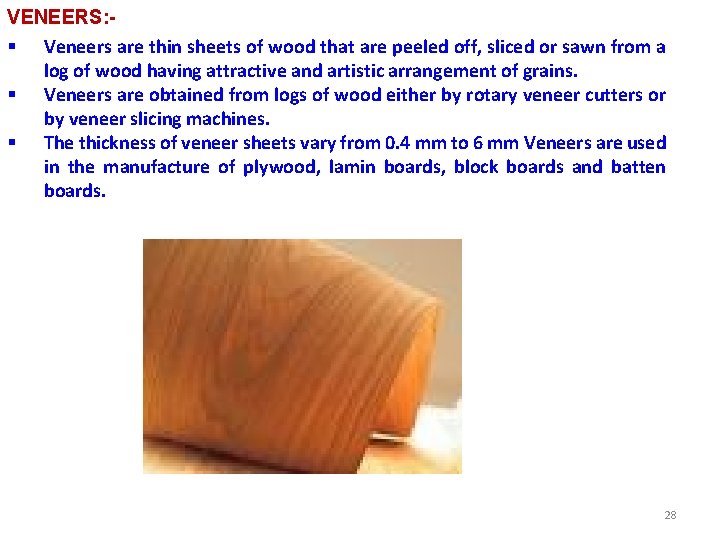
VENEERS: § Veneers are thin sheets of wood that are peeled off, sliced or sawn from a log of wood having attractive and artistic arrangement of grains. § Veneers are obtained from logs of wood either by rotary veneer cutters or by veneer slicing machines. § The thickness of veneer sheets vary from 0. 4 mm to 6 mm Veneers are used in the manufacture of plywood, lamin boards, block boards and batten boards. 28
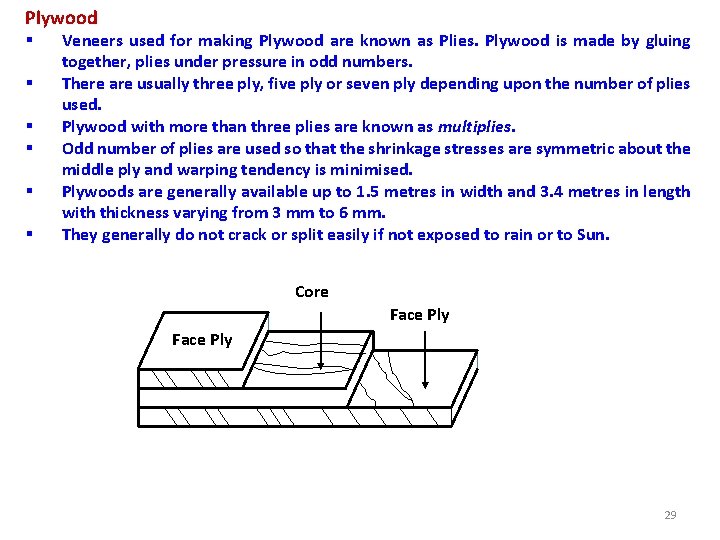
Plywood § § § Veneers used for making Plywood are known as Plies. Plywood is made by gluing together, plies under pressure in odd numbers. There are usually three ply, five ply or seven ply depending upon the number of plies used. Plywood with more than three plies are known as multiplies. Odd number of plies are used so that the shrinkage stresses are symmetric about the middle ply and warping tendency is minimised. Plywoods are generally available up to 1. 5 metres in width and 3. 4 metres in length with thickness varying from 3 mm to 6 mm. They generally do not crack or split easily if not exposed to rain or to Sun. Core Face Ply 29
Advantages: 1. It gives better appearance 2. It is stronger. A three-ply board is three times as strong as a solid board of same thickness. 3. It can be easily bent to give any shape. 4. It is an elastic material and is not very much affected by climatic changes. 5. It has uniform tensile strength in all directions. 6. It is available in such large sizes that are not possible with solid boards. 7. Shrinkage and expansion of best grade plywood is almost negligible. It is due its cross grained nature. 8. Because of its cross grained nature plywood does not split when nailed near the edges. USES: It is used for covering or panelling walls, for doors, furniture, and shuttering & formwork in RCC 30
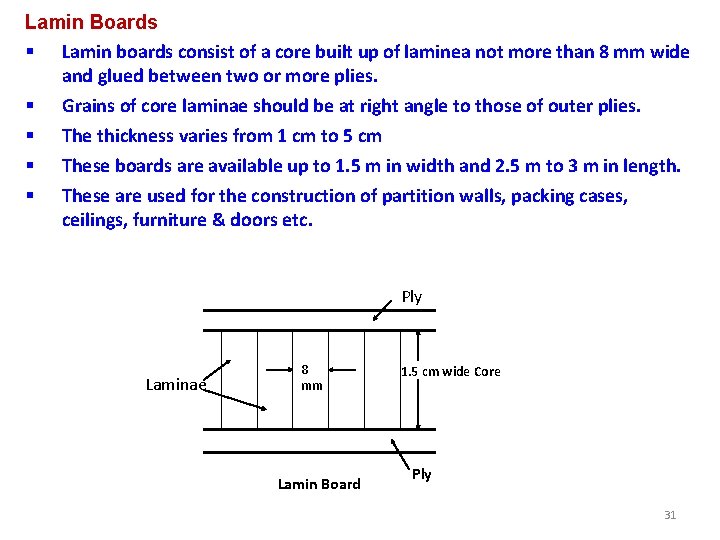
Lamin Boards § Lamin boards consist of a core built up of laminea not more than 8 mm wide and glued between two or more plies. § Grains of core laminae should be at right angle to those of outer plies. § The thickness varies from 1 cm to 5 cm § These boards are available up to 1. 5 m in width and 2. 5 m to 3 m in length. § These are used for the construction of partition walls, packing cases, ceilings, furniture & doors etc. Ply Laminae 8 mm Lamin Board 1. 5 cm wide Core Ply 31
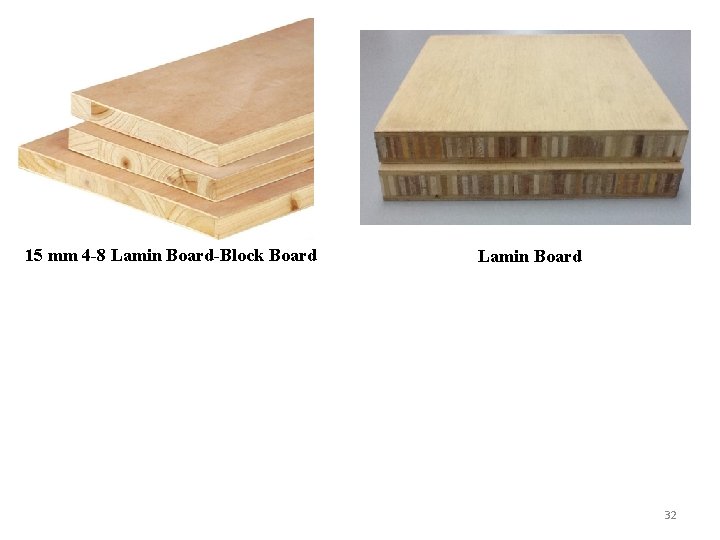
15 mm 4 -8 Lamin Board-Block Board Lamin Board 32
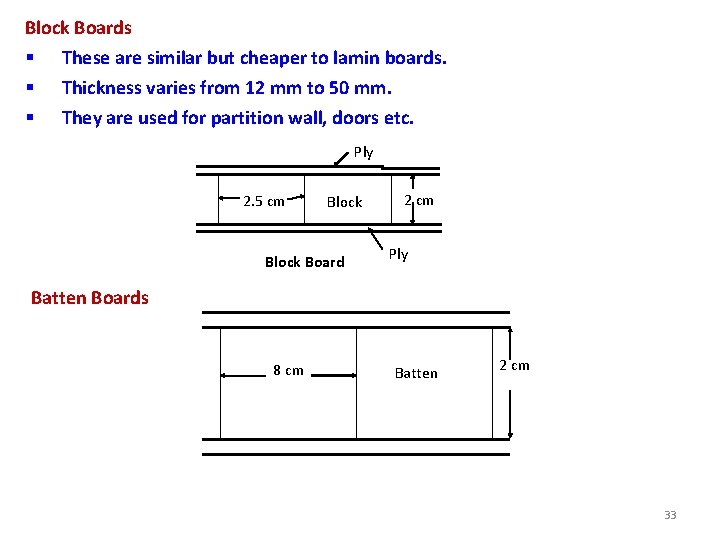
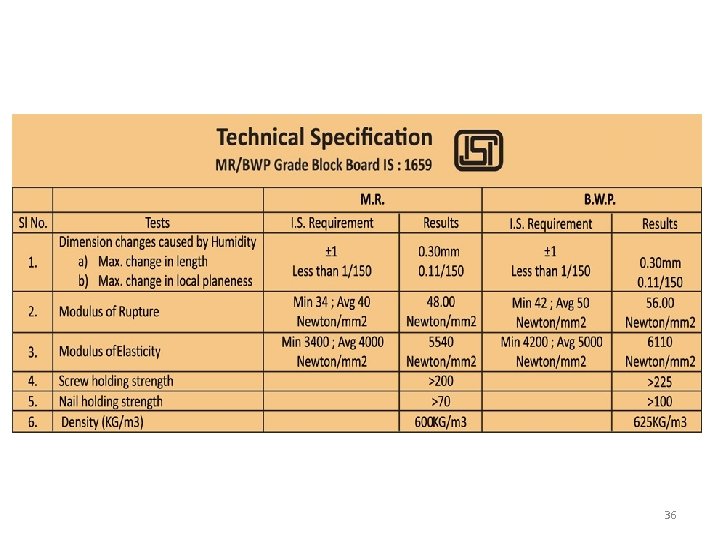
Block Boards § § § These are similar but cheaper to lamin boards. Thickness varies from 12 mm to 50 mm. They are used for partition wall, doors etc. Ply 2. 5 cm Block Board 2 cm Ply Batten Boards 8 cm Batten 2 cm 33
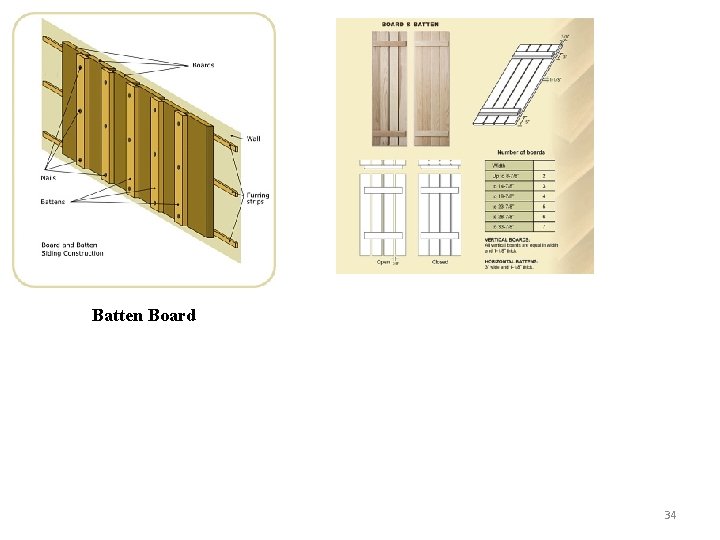
Batten Board 34
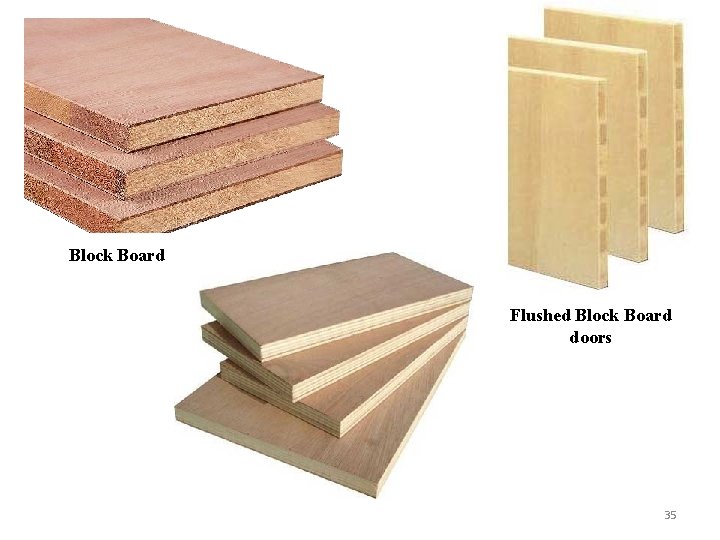
Block Board Flushed Block Board doors 35
36
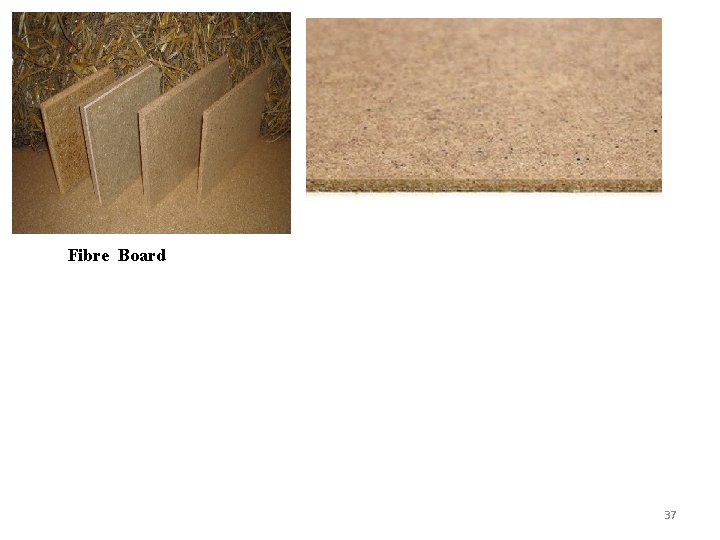
Fibre Board 37
- Slides: 37