
Timber as Construction Material Timber and Wood Products
Timber as Construction Material Timber and Wood Products Basic material properties and characteristics. By Engr. Abbas Qureshi 1
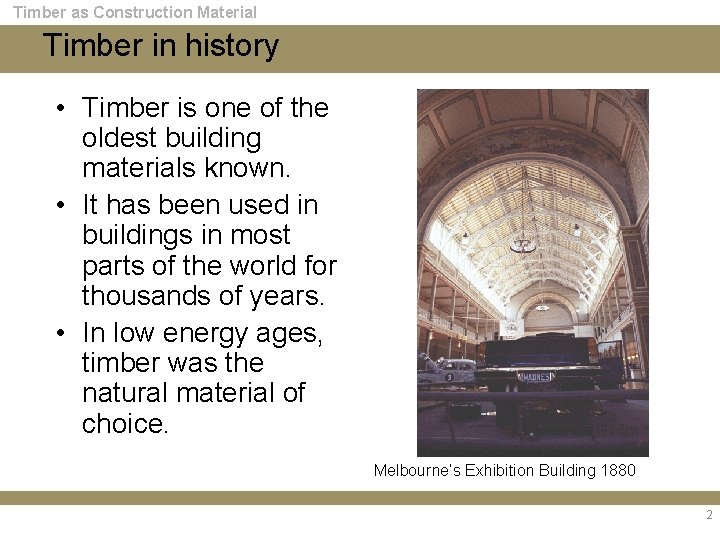
Timber as Construction Material Timber in history • Timber is one of the oldest building materials known. • It has been used in buildings in most parts of the world for thousands of years. • In low energy ages, timber was the natural material of choice. Melbourne’s Exhibition Building 1880 2

Timber as Construction Material Timber’s potential today • Timber is a light construction material with a high strength to weight ratio. • Economic and easy to use, it is available as a structural and appearance product, and suitable for a wide range of uses. Hardwood in a drying yard 3
Timber as Construction Material The timber – American Wood Council “Only one primary building material comes from a renewable resource, cleans the air and water; utilizes nearly 100% of its resource for products; is the lowest of all in its energy requirements for its manufacturing; creates fewer air and water emissions than any of its alternatives; and is totally reusable, recyclable and 100%. And it has been increasing in US net reserves since 1952, with growth exceeding harvest in the US by more than 30%. ” 4
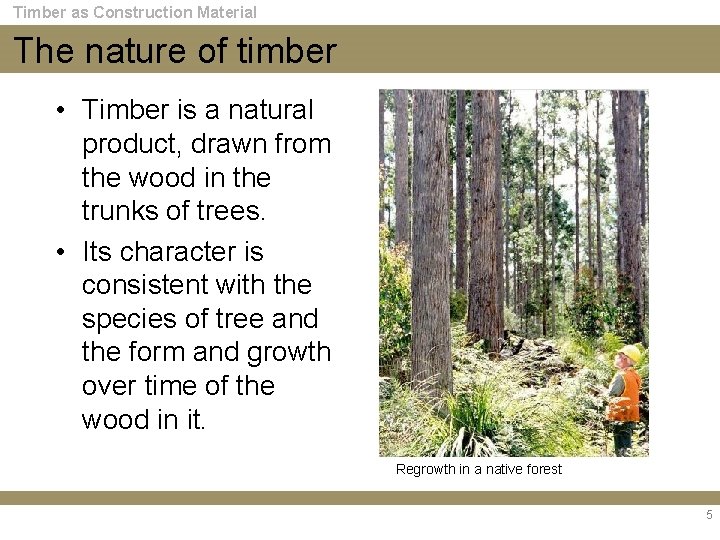
Timber as Construction Material The nature of timber • Timber is a natural product, drawn from the wood in the trunks of trees. • Its character is consistent with the species of tree and the form and growth over time of the wood in it. Regrowth in a native forest 5
Timber as Construction Material Definition • Wood suitable for building or other engineering purposes is called timber – Standing timber – part of a living tree – Rough timber – part of a felled tree – Converted timber – sawn to various forms like beams, battens and planks, etc. – Dressed timber- sawn timber which has been placed and worked to the required condition. – Clear timber- timber free from defects. – Structural timber- timber used in framing and load bearing structures. 6

Timber as Construction Material Classification of Trees • Endogenous. Grow inwards. – Grow in longitudinal fibrous mass like palm, cane, bamboo, banana, etc. Except bamboo unsuitable for engineering purpose. • Exogenous. Grow outwards. – Conifers. Evergreen trees yielding soft wood. Deodar, chir, fir, kail, pine, etc. Distinct annual rings, straight fibers, light color, resinous and light weight – Deciduous. Flat broad leaf trees yielding hard wood. Oak, teak, shishum, poplar and maple. Indistinct annual rings, non-resinous, dark in color and heavy weight 7
Timber as Construction Material Structure of Timber • Tree – Crown, Trunk, Roots • Cross section of a tree – Bark (outer and inner) – outermost protective layer of cells and woody fibers that splits and peels off – Cambium – outermost one ring between the bark and sap wood not yet converted into wood – Sap wood – outer annual rings that transmit sap from root to branches – Heart wood – innermost rings surrounding pith – Pith or Medula – first formed portion of stem of tree, initially to convey sap – Annual rings – Medullary rays – thin horizontal veins from bark to pith to carry sap inwards 8
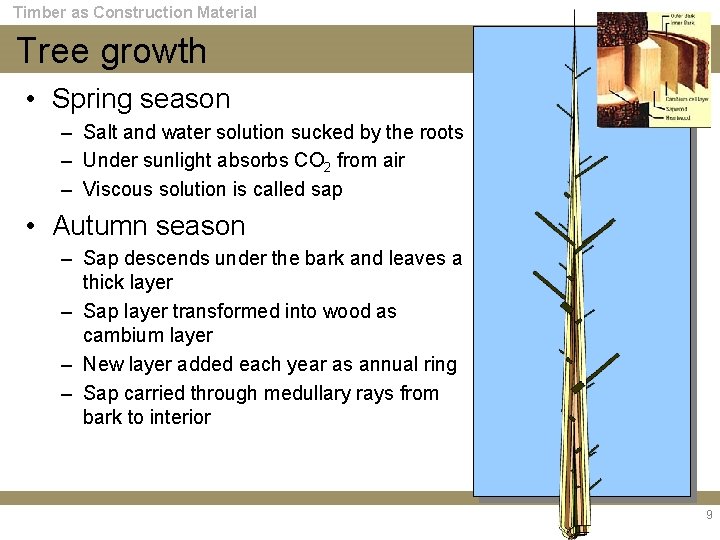
Timber as Construction Material Tree growth • Spring season – Salt and water solution sucked by the roots – Under sunlight absorbs CO 2 from air – Viscous solution is called sap • Autumn season – Sap descends under the bark and leaves a thick layer – Sap layer transformed into wood as cambium layer – New layer added each year as annual ring – Sap carried through medullary rays from bark to interior 9
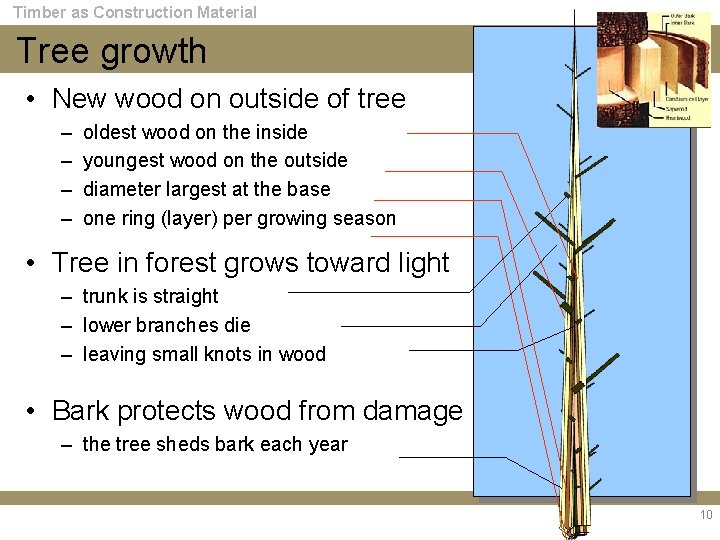
Timber as Construction Material Tree growth • New wood on outside of tree – – oldest wood on the inside youngest wood on the outside diameter largest at the base one ring (layer) per growing season • Tree in forest grows toward light – trunk is straight – lower branches die – leaving small knots in wood • Bark protects wood from damage – the tree sheds bark each year 10
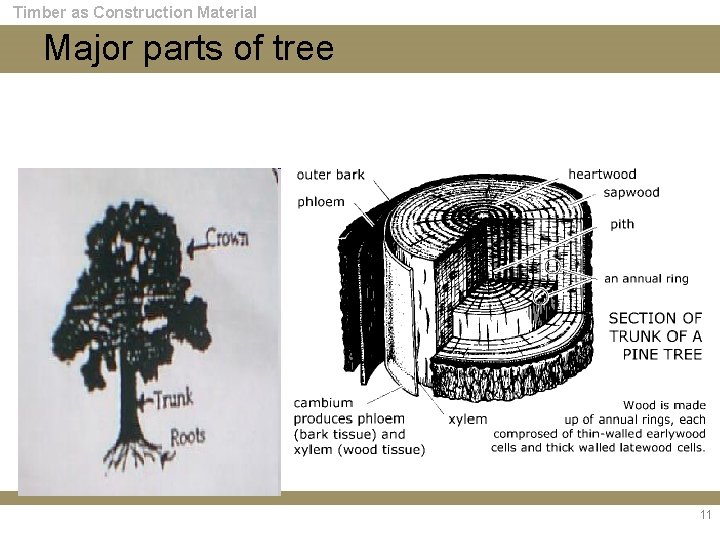
Timber as Construction Material Major parts of tree 11
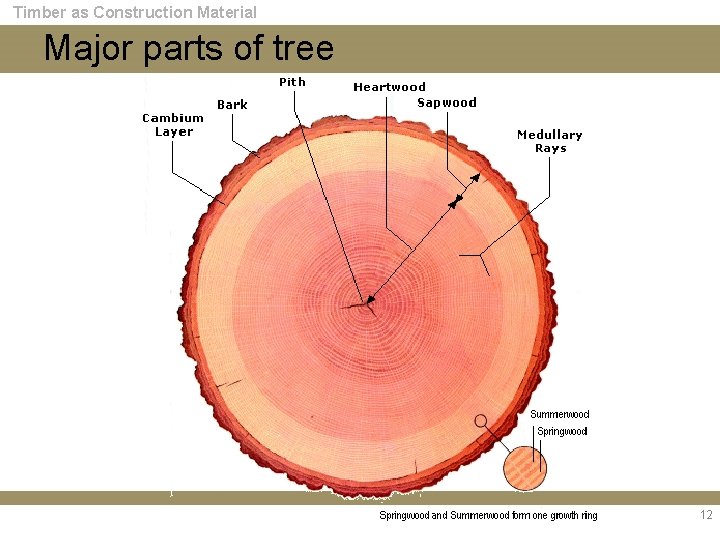
Timber as Construction Material Major parts of tree 12
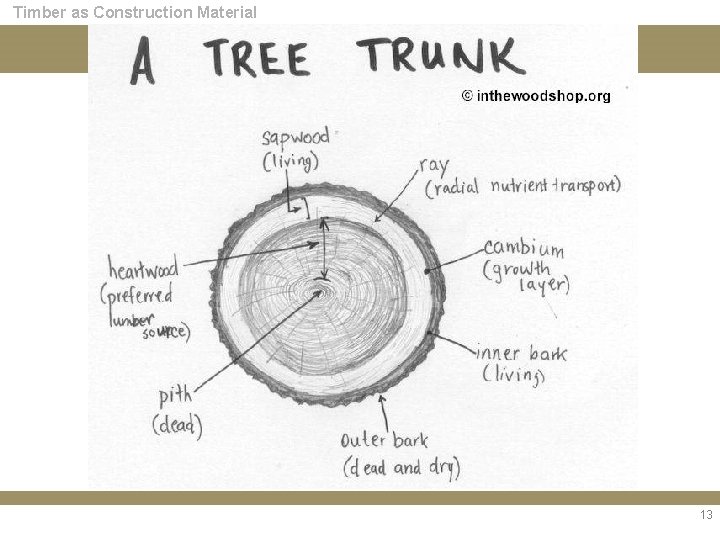
Timber as Construction Material 13
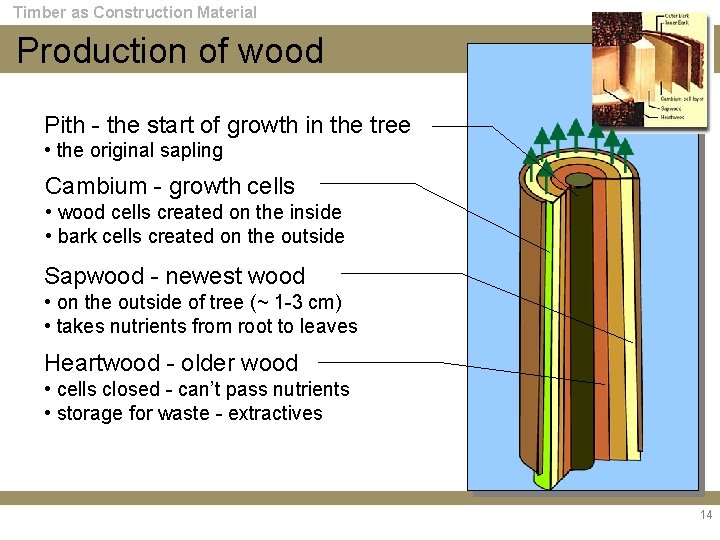
Timber as Construction Material Production of wood Pith - the start of growth in the tree • the original sapling Cambium - growth cells • wood cells created on the inside • bark cells created on the outside Sapwood - newest wood • on the outside of tree (~ 1 -3 cm) • takes nutrients from root to leaves Heartwood - older wood • cells closed - can’t pass nutrients • storage for waste - extractives 14
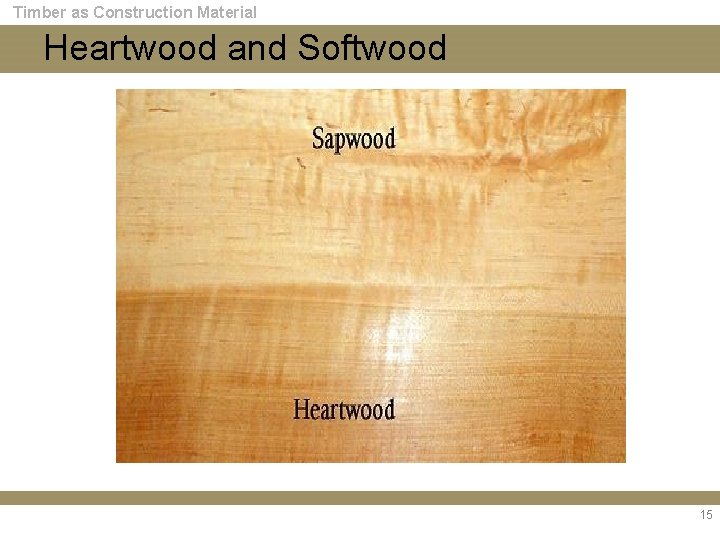
Timber as Construction Material Heartwood and Softwood 15

Timber as Construction Material Hard and Soft Wood Characteristics • • Property Color Growth Weight Density Annual Rings Heart wood & Sap wood Strength • Conversion • Resinous • Examples Soft Wood Lighter Faster Lighter Low Distinct Indistinguishable Hard Wood Darker Slower Heavier High Indistinct distinguishable Strong along grains Strong along & across grains Easy Difficult Exists in pores Does not exist Chir, Fir, Conifer Teak, sal, shisham 16
Timber as Construction Material Characteristics of Good Timber • Obtained from heartwood area of tree and free from sap • Should have straight and close fibers • Dark uniform color with uniform texture • When struck sonorous ringing sound is produced • Narrow annular rings, closer the rings greater is the strength • Compact medullary rays • Sweet smell and a shining fresh cut surface • No clogging of saw teeth during sawing • Free from the defects like dead knots, shakes etc • Heavy weight • No woolliness at fresh cut surface • Bright and smooth surface when planed 17
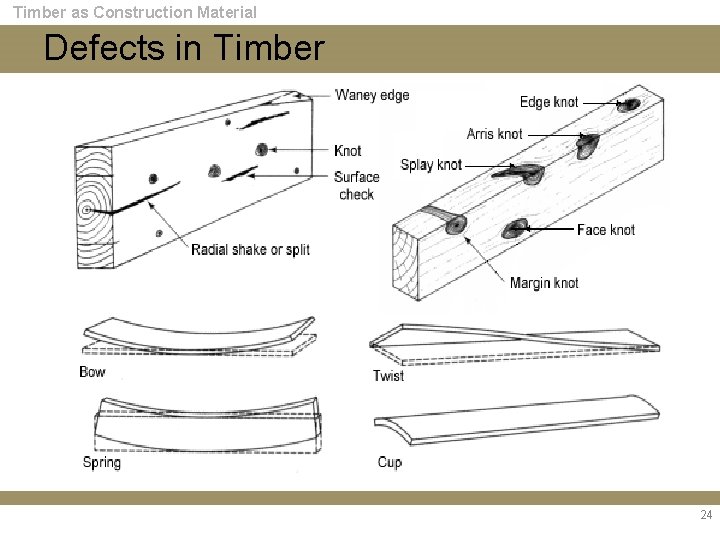
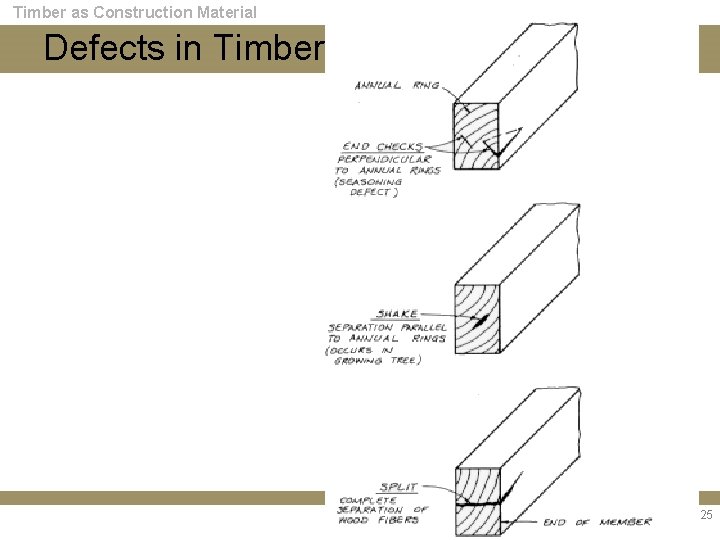
Timber as Construction Material Defects in Timber – during growth • Shakes – separations between annual rings – Star shake – radial splits or cracks wider on surface and narrow inwards, due to severe heat and frost action – Heart shake – radial splits in heartwood due to shrinkage – Cup shake – curved split among annual rings. Also ring shake • Twisted fibers – wind turning the trunk and twisting fibers • Rind gall – growth of sapwood layer over wounds • Upsets – crushing of transverse fibers due to winds • Foxiness – yellow or red stains as sign of decay • Doatiness – speckled stain indicating start of decay due to over maturity or bad ventilation • Druxiness – Whitish spot or streaks indicating early decay • Coarse grains – wide annual rings due to rapid growth 18
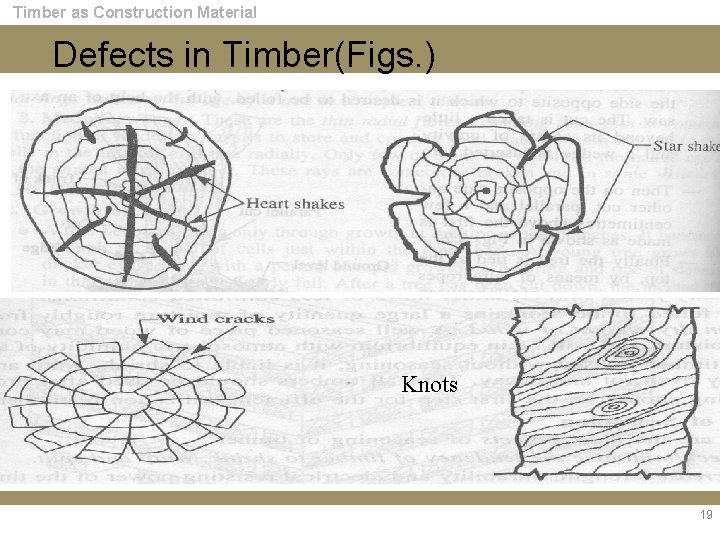
Timber as Construction Material Defects in Timber(Figs. ) Knots 19
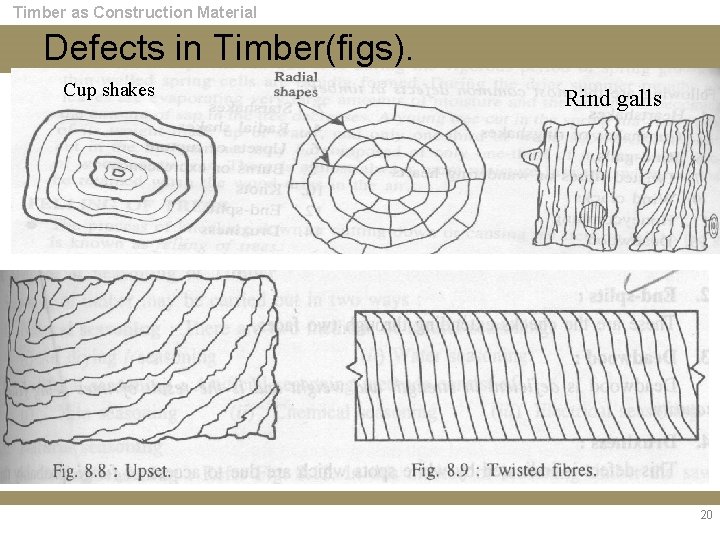
Timber as Construction Material Defects in Timber(figs). Cup shakes Rind galls 20
Timber as Construction Material Defects in Timber – knots • Knots – root of small branches buried in mother branch annual rings. This modifies the tissues in elliptical or concentric circles. Knot disturbs the homogeneity , strength and workability of wood. – Dead or loose knot - separable – Live or sound knot – inseparable • Size based classification – – Pin knot – under 12 mm Small knot – 12 to 20 mm Medium knot – 20 to 40 mm Large knot – over 40 mm • Form based classification – Round knot – Spike knot 21
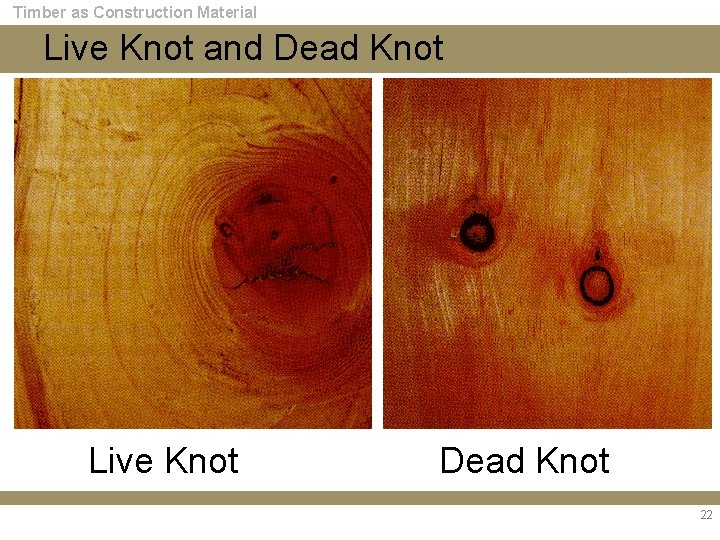
Timber as Construction Material Live Knot and Dead Knot Live Knot Dead Knot 22
Timber as Construction Material Defects in Timber – knots • Quality based classification – Sound knot – hard and solid as surrounding wood – Decayed knot – contains advance decay, softer than surrounding wood – Encased knot – annual rings fail to grow into fibers of surrounding wood – Tight knot – a knot so securely fastened that it holds its position in finished product • Occurrence based classification – Single knot – wood fibers deflect around one knot – Cluster knot – wood fibers deflect around two or more knots as one unit – Branch knot – two or more knots radiating from one common center 23
Timber as Construction Material Defects in Timber 24
Timber as Construction Material Defects in Timber 25
Timber as Construction Material Defects in Timber - Diseases & Decay • Diseases – Dry rot – fungus turns timber to dry powder – Wet rot – decay due to alternate wetting and drying • Decay – Decay due to fungal and bacterial attack – Damage due to insects • Termites, white ants • Beetles – powder post beetles, long horn beetles, ambrosia beetle, furniture beetles, death watch beetles • Carpenter ants – Damage due to rodents 26
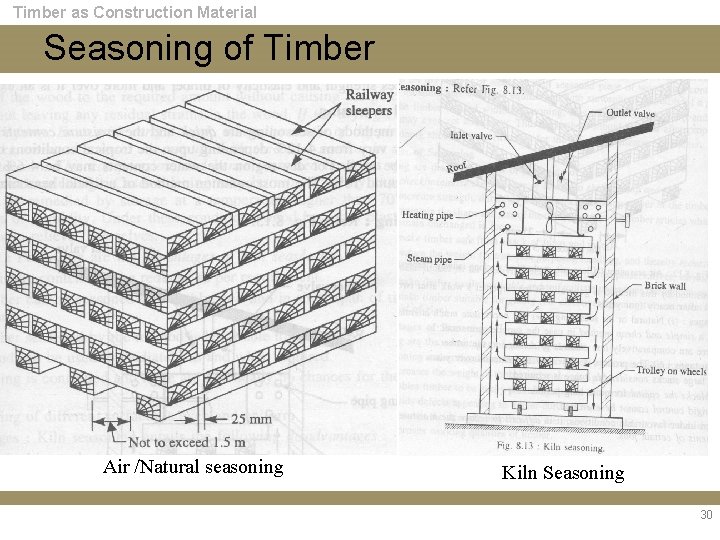
Timber as Construction Material Seasoning of Timber • Seasoning – extraction of moist sap under controlled conditions (as nearly as possible at a uniform rate) from all parts of timber, and to leave inextricable moisture uniformly distributed throughout • Irregular drying causes irregular shrinkage leading to warping and shakes formation • Seasoning methods – Air or natural seasoning – timber stacked in ventilated shady place. Slow process takes six months – Kiln or artificial seasoning – steam chamber with controllable temperature and humidity. Rapid 4 -5 days. 27
Timber as Construction Material Seasoning of Timber(Artificial) • Water Seasoning : - The logs of wood are kept in running water. The sap, sugur, and gum are leached out. The logs are then kept out in air to dry. • Chemical or Salt seasoning: - A water + Chemical( salt, urea) is applied to the timber for seasoning. It reduces the moisture due to the difference in vapour pressure of chemical and pure water. It reduces the internal stress which are the causes of defects as checks. 28
Timber as Construction Material Seasoning of Timber(Artificial) • Electric Seasoning: - The logs are placed in such a way that their two ends touch the electrodes. Current is passed , wood resists the flow of current. During this heat is generated which results in drying of timber. 29
Timber as Construction Material Seasoning of Timber Air /Natural seasoning Kiln Seasoning 30
Timber as Construction Material Seasoning of Timber Air Seasoning • Slow process • Simple and economical • Difficult to reduce moisture content below 15 to 18 % • Timber more prone to fungi and insect attack • More stacking space needed • Stronger timber is obtained Kiln Seasoning • Quick process • Technical and expensive • Moisture reduced to any desired level • Timber less prone to fungi and insect attack • Less stacking space needed • Timber obtained is comparatively weaker 31
Timber as Construction Material Seasoning of Timber (Objectives) • Reduce the shrinkage and warping after placement in structure. • Increase strength, durability, and workability. • Reduce its tendency to split and decay. • Make the timber suitable painting. • Reduce the weight of timber. 32
Timber as Construction Material Seasoning of Timber • Preventing drying of logs – Felled tree roughly squared and sawn – Ends sealed to prevent rapid evaporation of moisture – Logs kept completely submerged in running water • Stacking of square logs – – Stacked under shade, free from weeds and debris One and nine stacking method Close crib stacking method - logs, poles, planks Open crib stacking method - logs, poles, planks 33
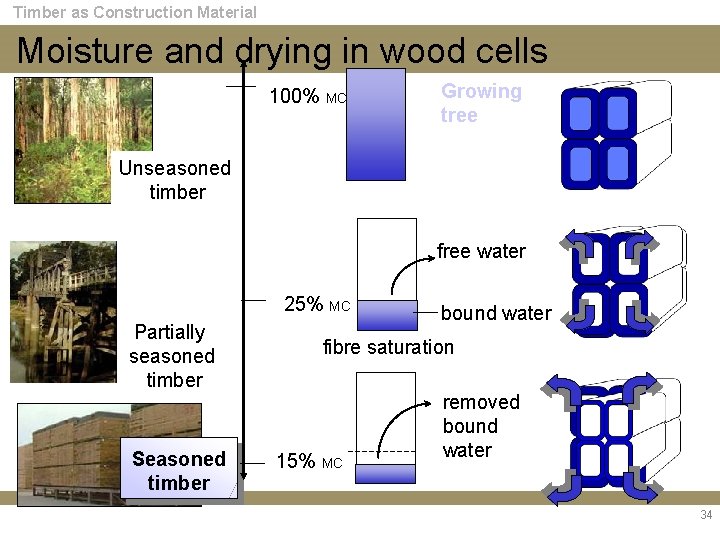
Timber as Construction Material Moisture and drying in wood cells 100% MC Growing tree Unseasoned timber free water 25% MC Partially seasoned timber Seasoned timber bound water fibre saturation 15% MC removed bound water 34
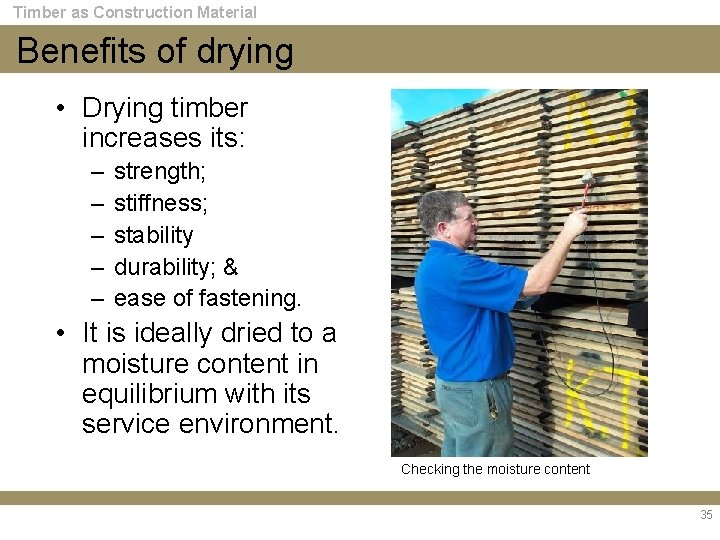
Timber as Construction Material Benefits of drying • Drying timber increases its: – – – strength; stiffness; stability durability; & ease of fastening. • It is ideally dried to a moisture content in equilibrium with its service environment. Checking the moisture content 35
Timber as Construction Material Timber Preservation • Preservation is protection of timber from attack of insects and internal decay • Perfect seasoning is the best form of timber preservation • Charring – ground embedded ends of posts. Quenching post ends in water after charring in wood fire. Prevents dry rot and attack of worms • Tarring – coating with tar or pitch 36
Timber as Construction Material Timber Preservation • Painting – application of paint coat on dry timber to provide good appearance and protection from attack by white ants • Creosoting – application of creosote oil on railway sleepers, piles and electricity poles. Bad color, bad smell, stains plaster • Wolman salt – creosote and salt in water. Na. F, Zn. Cl, Mg. Si. F, Cu. SO 4 • Ascu treatment – application of powder chemicals arsenic pentaoxide, blue vitriol, potassium dichromate • Fire proofing – timber made fire resistance by soaking in NH 4 SO 4, NH 3 Cl, NH 4 PO 3, Na. As, Zn. Cl 37
Timber as Construction Material Tests of Timber • • Specific gravity Volumetric shrinkage Radial and tangential shrinkage Static bending strength – One point loading test – Two point loading test • Impact bending strength 38
Timber as Construction Material Tests of Timber • Compressive strength – Parallel to grain – Perpendicular to grain • Hardness under static indentation test • Shear strength test • Tensile strength test – Parallel to grain – Perpendicular to grain 39
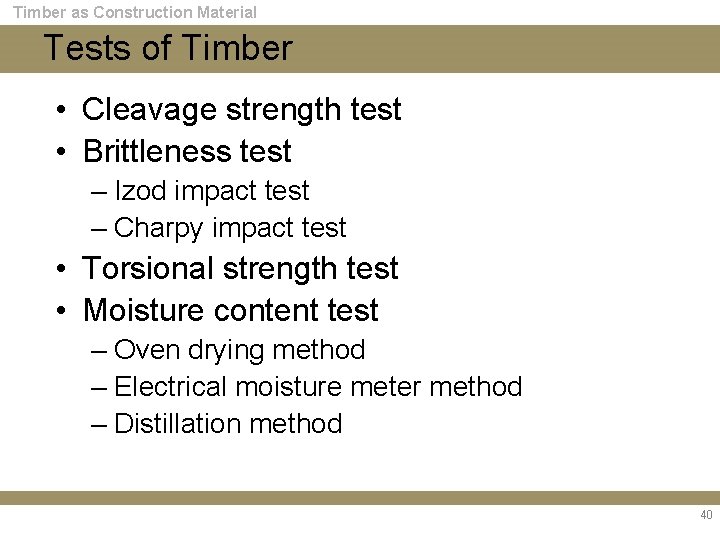
Timber as Construction Material Tests of Timber • Cleavage strength test • Brittleness test – Izod impact test – Charpy impact test • Torsional strength test • Moisture content test – Oven drying method – Electrical moisture meter method – Distillation method 40
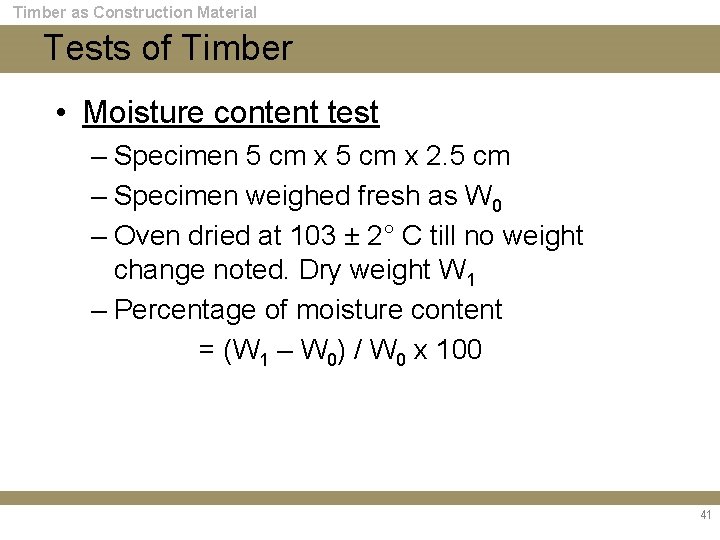
Timber as Construction Material Tests of Timber • Moisture content test – Specimen 5 cm x 2. 5 cm – Specimen weighed fresh as W 0 – Oven dried at 103 ± 2° C till no weight change noted. Dry weight W 1 – Percentage of moisture content = (W 1 – W 0) / W 0 x 100 41
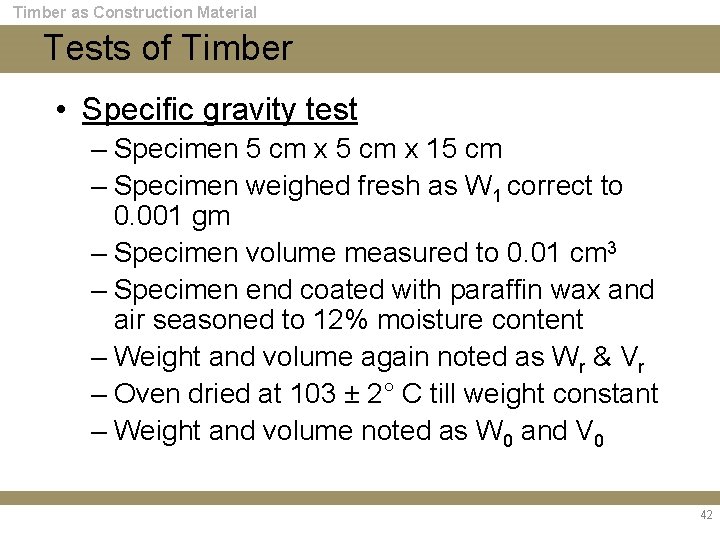
Timber as Construction Material Tests of Timber • Specific gravity test – Specimen 5 cm x 15 cm – Specimen weighed fresh as W 1 correct to 0. 001 gm – Specimen volume measured to 0. 01 cm 3 – Specimen end coated with paraffin wax and air seasoned to 12% moisture content – Weight and volume again noted as Wr & Vr – Oven dried at 103 ± 2° C till weight constant – Weight and volume noted as W 0 and V 0 42
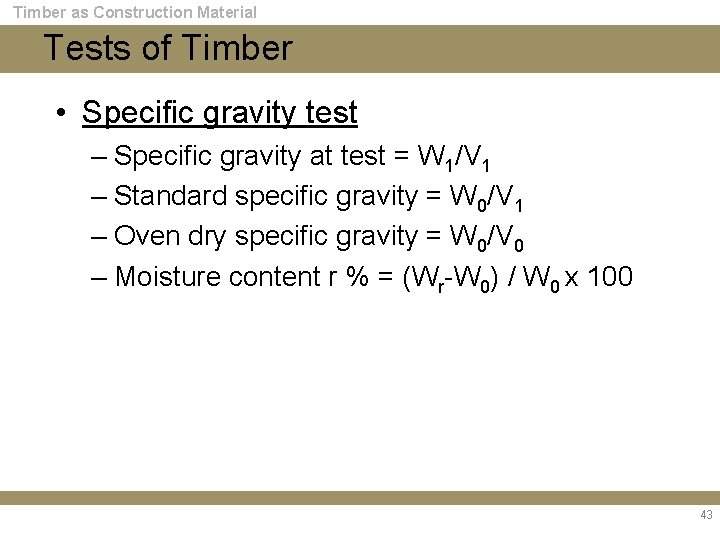
Timber as Construction Material Tests of Timber • Specific gravity test – Specific gravity at test = W 1/V 1 – Standard specific gravity = W 0/V 1 – Oven dry specific gravity = W 0/V 0 – Moisture content r % = (Wr-W 0) / W 0 x 100 43
Timber as Construction Material Wood Products • • • Veneers Plywood Lamina Boards Fiber Boards Block Boards Batten Boards 44
Timber as Construction Material Wood Products • Veneers – Thin sheets of wood peeled off, sliced or sawn from a log of wood having attractive or artistic grain arrangement – Sheet thickness from 0. 4 mm to 6 mm – Walnut, teak and rosewood veneers used in plywood, lamina boards and batten boards 45
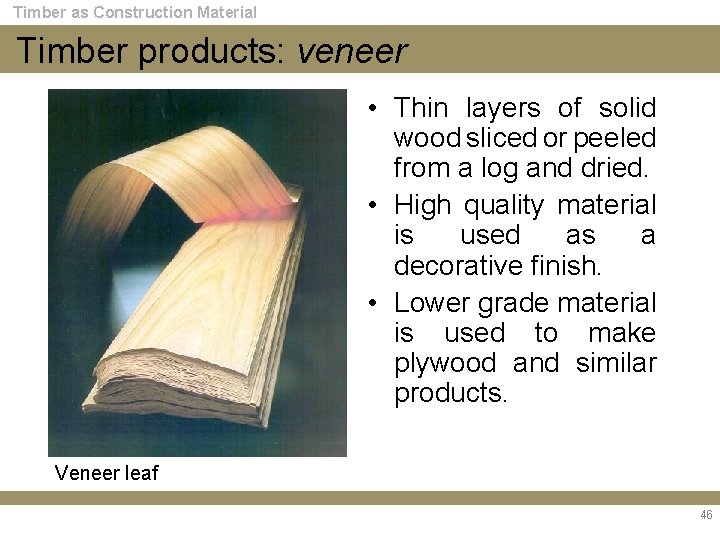
Timber as Construction Material Timber products: veneer • Thin layers of solid wood sliced or peeled from a log and dried. • High quality material is used as a decorative finish. • Lower grade material is used to make plywood and similar products. Veneer leaf 46
Timber as Construction Material Wood Products • Plywood – Under pressure gluing together of veneer plies in odd number to make 3 mm to 6 mm thick sheet – Grains of alternate layers at right angle to each other – Outer plies called face plies or faces – Used for covering or paneling of walls, doors, furniture and shuttering 47
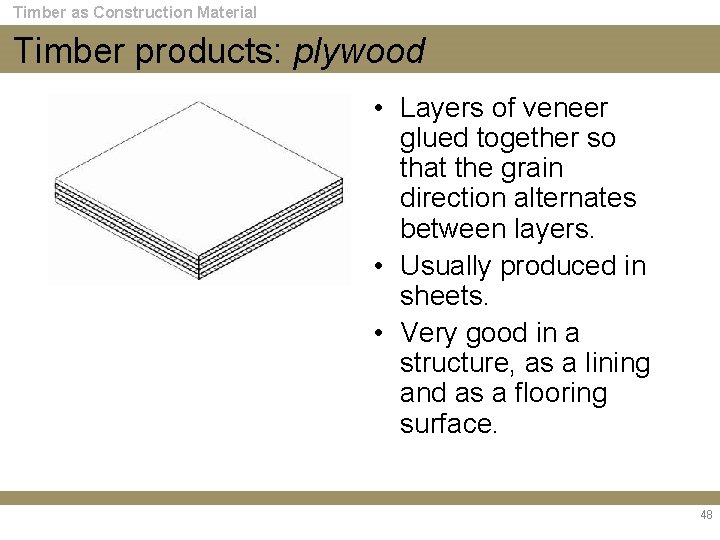
Timber as Construction Material Timber products: plywood • Layers of veneer glued together so that the grain direction alternates between layers. • Usually produced in sheets. • Very good in a structure, as a lining and as a flooring surface. 48
Timber as Construction Material Wood Products • Plywood Advantages – Better appearance – Stronger than same thickness wood – Elastic and may be bent to give any shape – Not much affected by climatic changes – Uniform strength in all directions – Available in large sizes not possible in wood – Almost negligible shrinkage and expansion – Does not split under nails 49
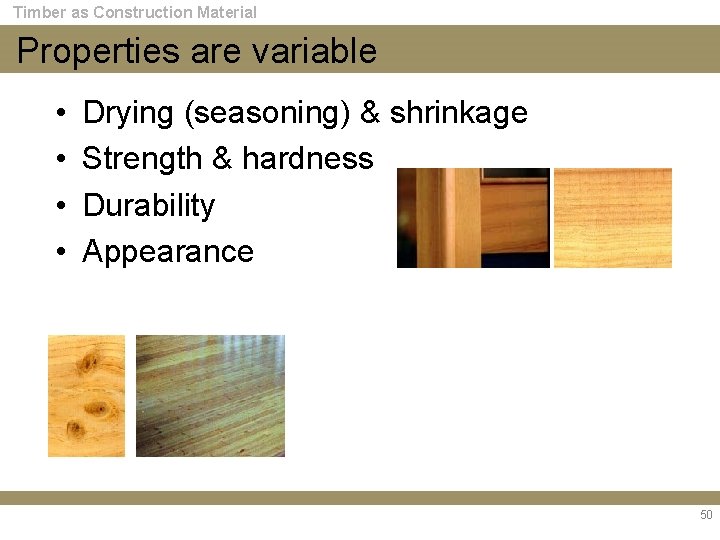
Timber as Construction Material Properties are variable • • Drying (seasoning) & shrinkage Strength & hardness Durability Appearance 50
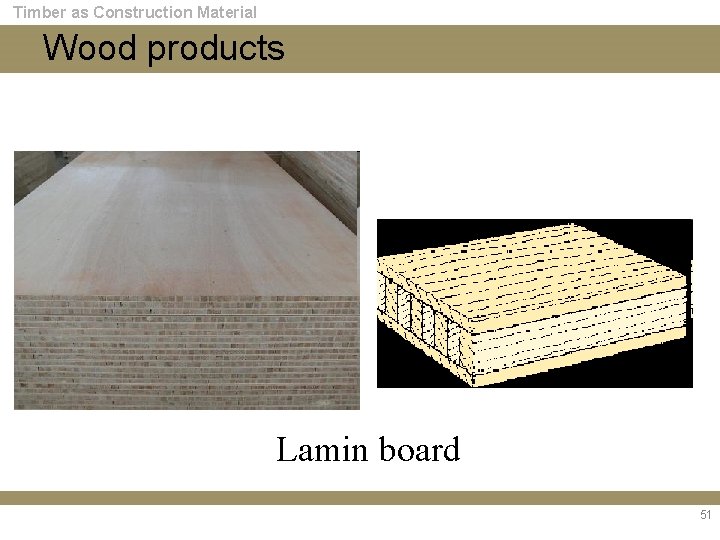
Timber as Construction Material Wood products Lamin board 51
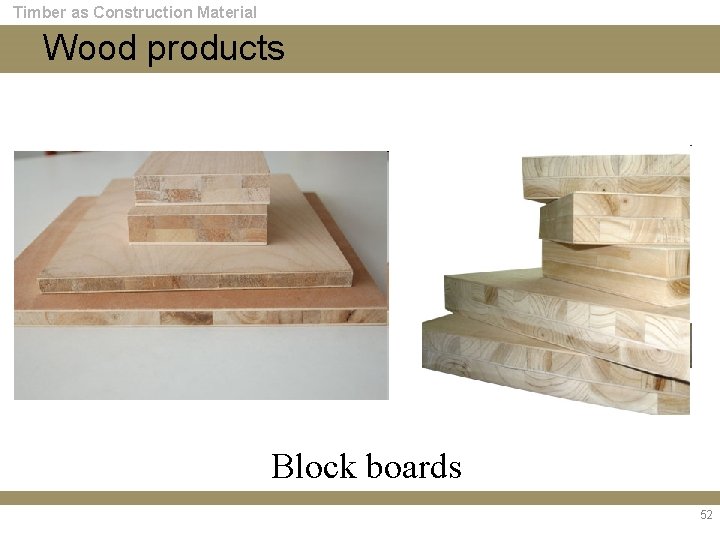
Timber as Construction Material Wood products Block boards 52
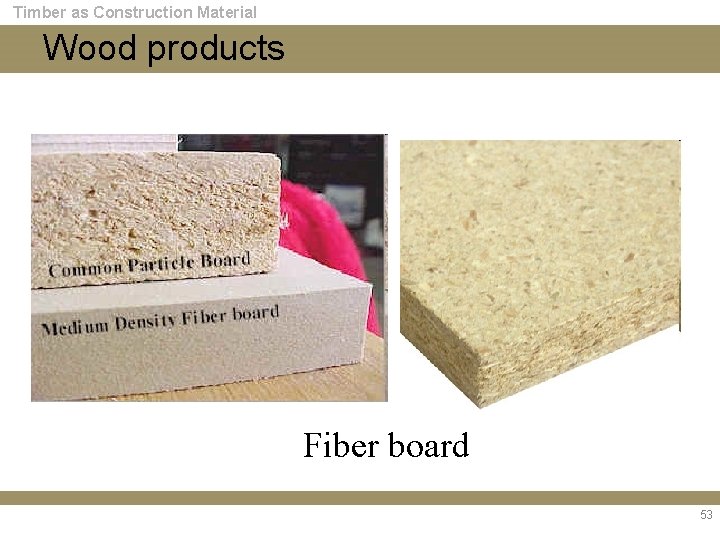
Timber as Construction Material Wood products Fiber board 53
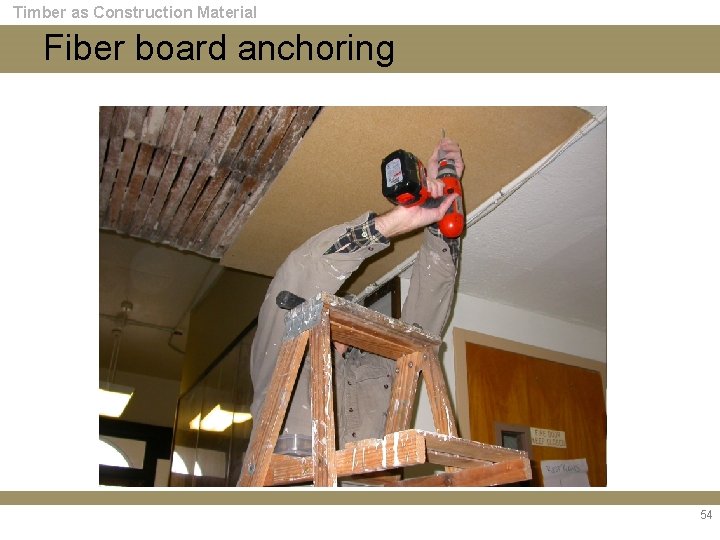
Timber as Construction Material Fiber board anchoring 54
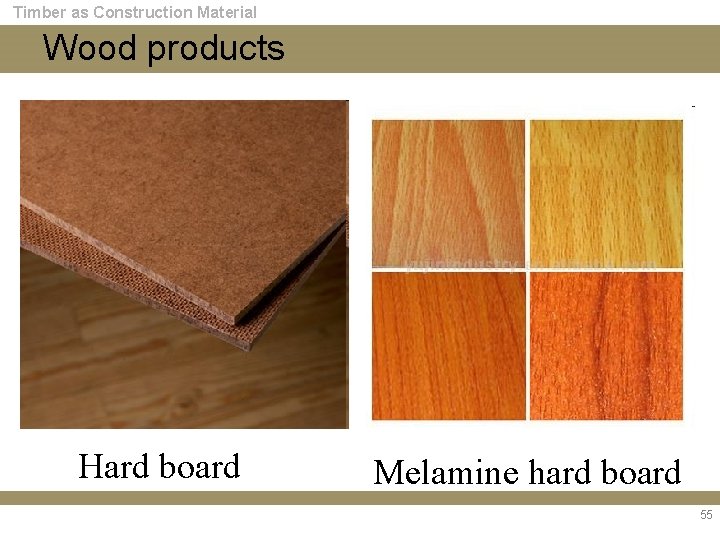
Timber as Construction Material Wood products Hard board Melamine hard board 55
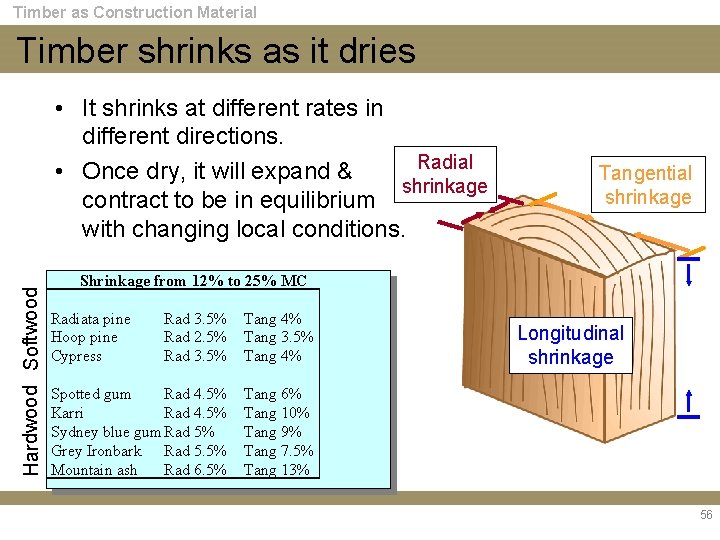
Timber as Construction Material Timber shrinks as it dries Hardwood Softwood • It shrinks at different rates in different directions. Radial • Once dry, it will expand & shrinkage contract to be in equilibrium with changing local conditions. Tangential shrinkage Shrinkage from 12% to 25% MC Radiata pine Hoop pine Cypress Rad 3. 5% Rad 2. 5% Rad 3. 5% Tang 4% Tang 3. 5% Tang 4% Spotted gum Rad 4. 5% Karri Rad 4. 5% Sydney blue gum. Rad 5% Grey Ironbark Rad 5. 5% Mountain ash Rad 6. 5% Tang 6% Tang 10% Tang 9% Tang 7. 5% Tang 13% Longitudinal shrinkage 56
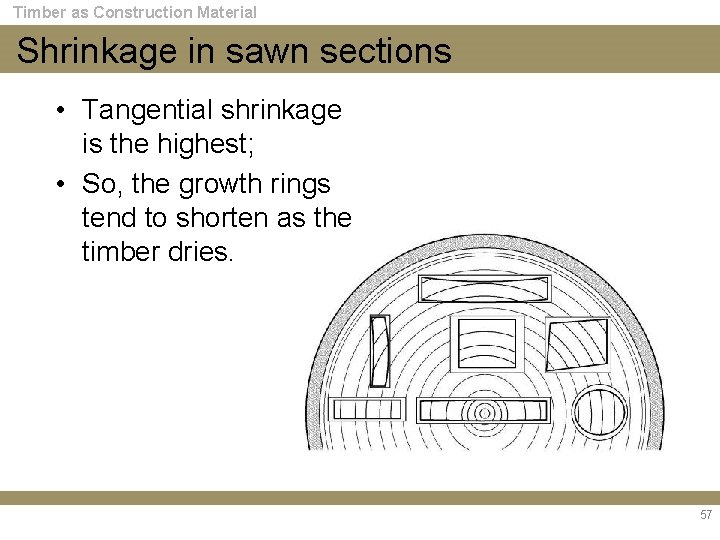
Timber as Construction Material Shrinkage in sawn sections • Tangential shrinkage is the highest; • So, the growth rings tend to shorten as the timber dries. 57
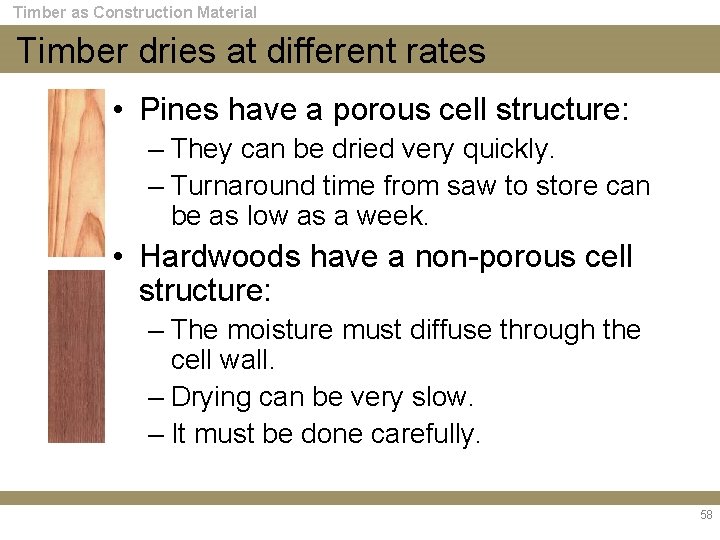
Timber as Construction Material Timber dries at different rates • Pines have a porous cell structure: – They can be dried very quickly. – Turnaround time from saw to store can be as low as a week. • Hardwoods have a non-porous cell structure: – The moisture must diffuse through the cell wall. – Drying can be very slow. – It must be done carefully. 58
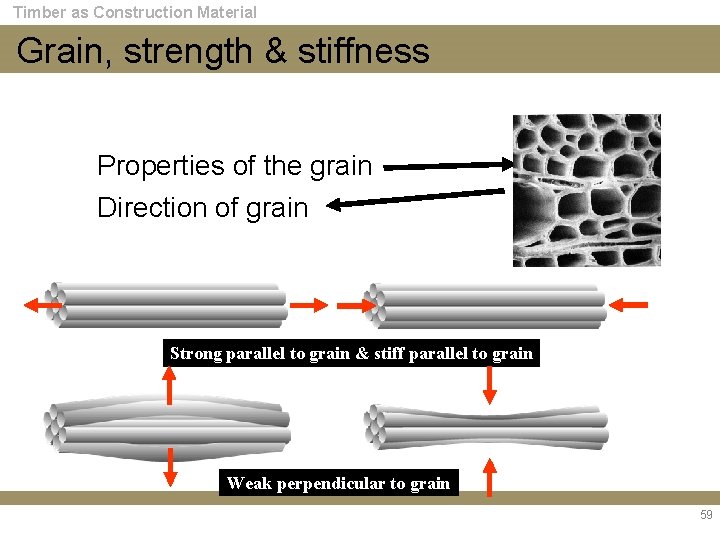
Timber as Construction Material Grain, strength & stiffness Properties of the grain Direction of grain Strong parallel to grain & stiff parallel to grain Weak perpendicular to grain 59
Timber as Construction Material Summary of characteristics • Timber is a natural material • Each piece is unique in fibre, texture and colour • Its strength is dependant on the properties of the wood and the slope of the grain • It takes up and gives up moisture • It expands and shrinks as it does so • It deteriorates in line with exposure 60
Timber as Construction Material Timber products • Timber is available in a wide range of products and species including: – Solid sawn, moulded and laminated timber; – Veneer; – Plywood; and – Wood panels. 61
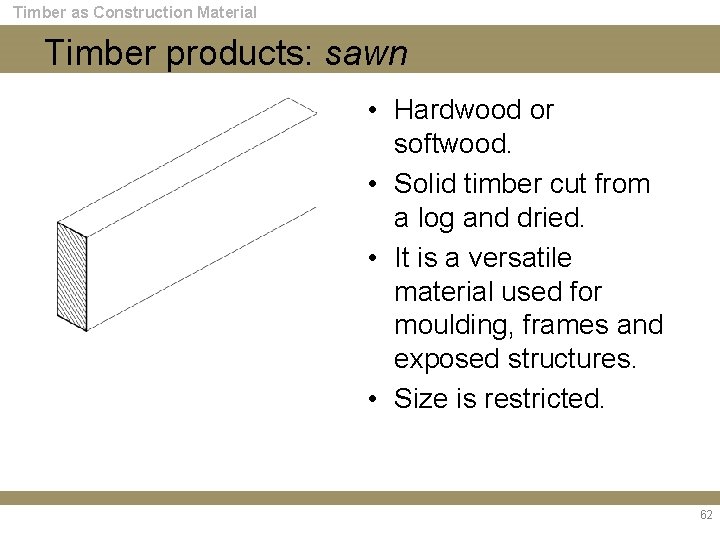
Timber as Construction Material Timber products: sawn • Hardwood or softwood. • Solid timber cut from a log and dried. • It is a versatile material used for moulding, frames and exposed structures. • Size is restricted. 62
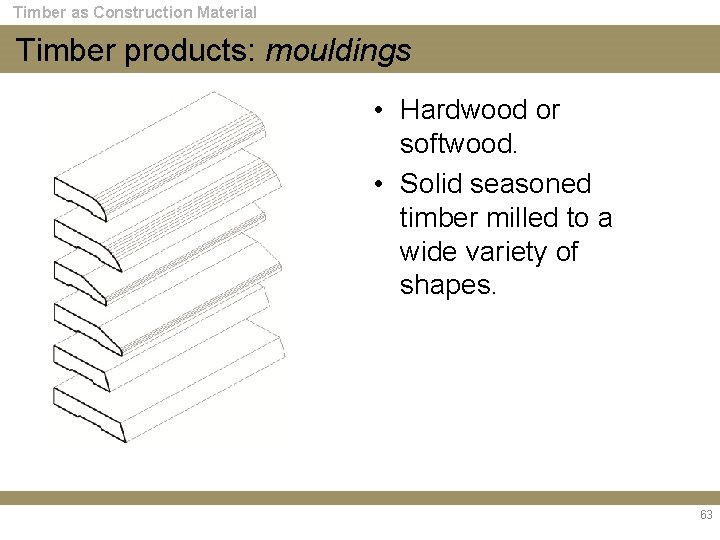
Timber as Construction Material Timber products: mouldings • Hardwood or softwood. • Solid seasoned timber milled to a wide variety of shapes. 63
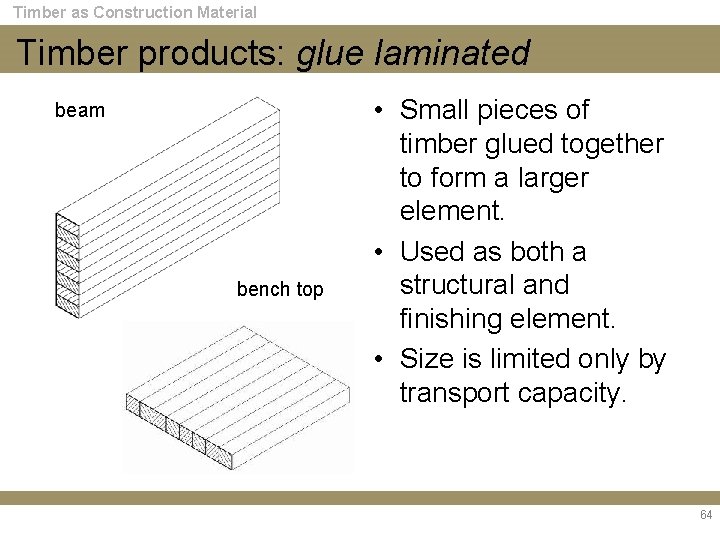
Timber as Construction Material Timber products: glue laminated beam bench top • Small pieces of timber glued together to form a larger element. • Used as both a structural and finishing element. • Size is limited only by transport capacity. 64
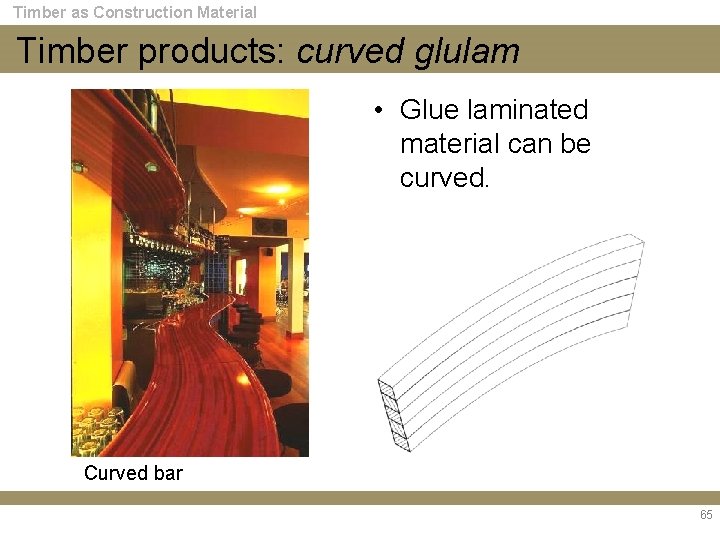
Timber as Construction Material Timber products: curved glulam • Glue laminated material can be curved. Curved bar 65
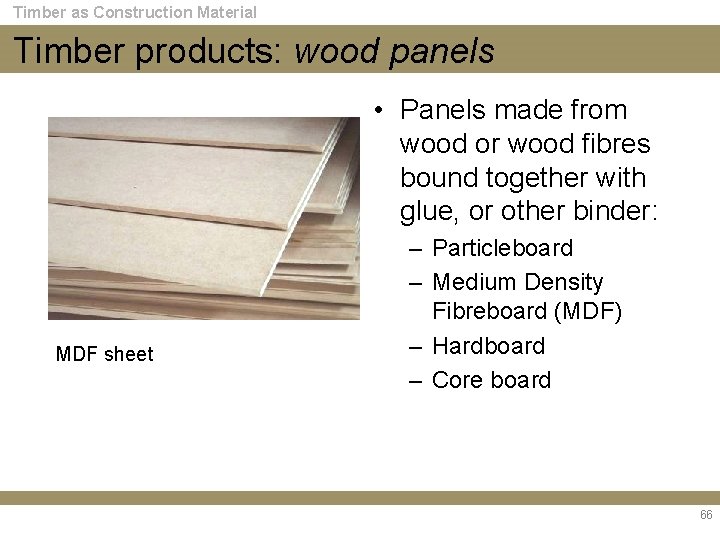
Timber as Construction Material Timber products: wood panels • Panels made from wood or wood fibres bound together with glue, or other binder: MDF sheet – Particleboard – Medium Density Fibreboard (MDF) – Hardboard – Core board 66
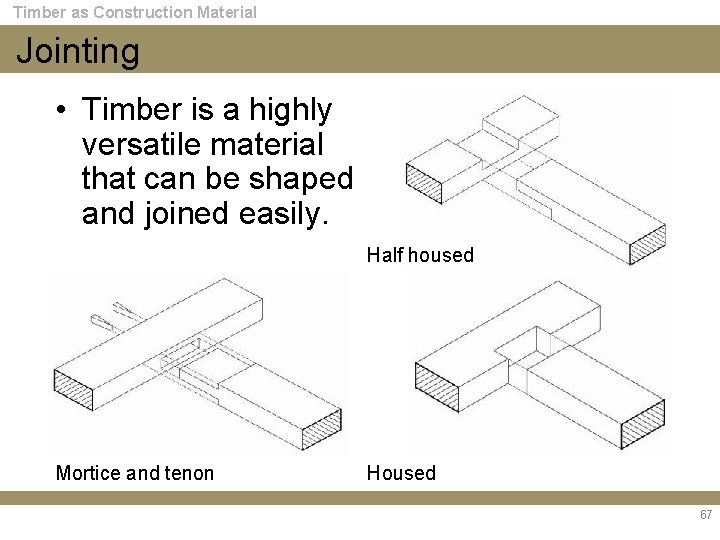
Timber as Construction Material Jointing • Timber is a highly versatile material that can be shaped and joined easily. Half housed Mortice and tenon Housed 67
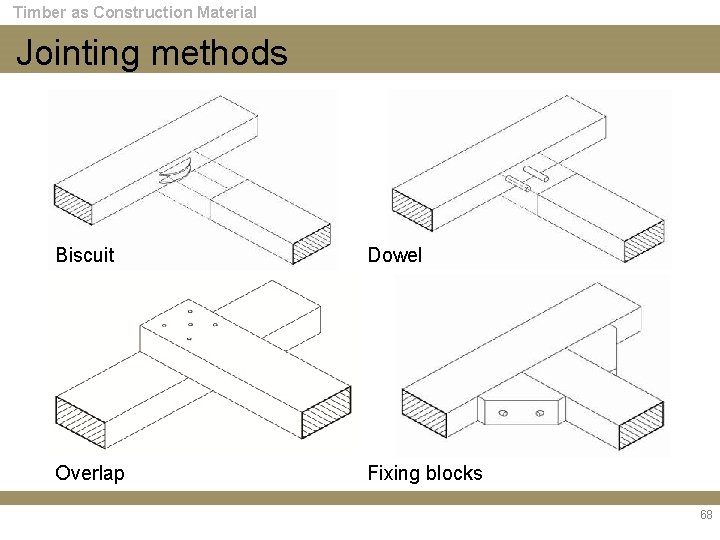
Timber as Construction Material Jointing methods Biscuit Dowel Overlap Fixing blocks 68
Timber as Construction Material Conclusions • Timber is a natural product. • It has been used for centuries. • Skilled use and understanding of the material can yield excellent results. 69
- Slides: 69