
TIGER Initiative and the Alliance for Nursing Informatics
- Slides: 22
TIGER Initiative and the Alliance for Nursing Informatics Carole A. Gassert, RN, Ph. D, FACMI, FAAN Co-Chair ANI (AMIA Representative) TIGER Representative September 25, 2007
Nursing Perspective on HIT Workforce Issues • TIGER Initiative – a program to engage all nursing stakeholders to better prepare our nursing workforce (all practicing nurses and nursing students) to use technology and informatics to improve the delivery of patient care. • Alliance for Nursing Informatics – collaboration of organizations that represent a united voice for nursing informatics. • Technology Targets Study by American Academy of Nursing (supported by Robert Wood Johnson Foundation) – creating a process to improve efficiency in care delivery on medical/surgical units by prompting industry to develop technology and HIT that help with workforce issues. • HIMSS 2007 Nursing Informatics Survey • AACN’s Essentials of Education – proposed recommendations for Baccalaureate and Doctorate of Nursing Practice
Technology Informatics Guiding Education Reform The focus of the TIGER Initiative is to better prepare our nursing workforce (all practicing nurses and nursing students) to use technology and informatics to improve the delivery of patient care. We believe that necessary skills for nurses’ portfolio in 2007 includes computer literacy and information literacy. The TIGER Initiative is a program; not an organization. TIGER has been a grass-roots effort to engage with all stakeholders that are committed to a common “vision” of ideal EHR-enabled nursing practice. Today, more than 70 diverse organizations have joined this effort.
TIGER Vision • Allow informatics tools, principles, theories and practices to be used by nurses to make healthcare safer, effective, efficient, patient-centered, timely and equitable • Interweave enabling technologies transparently into nursing practice and education, making information technology the stethoscope for the 21 st century
Nursing Focus • Nearly 3 million practicing nurses in the U. S. • More than 55% of all health care workers • Nurses are knowledge workers Necessary Skills Nursing Portfolio in 2007 • Computer Literacy Skills • Information Literacy Skills • Informatics Skills
Building the Work Force for HIT A work force capable of innovating, implementing and using health communications and information technologies will be critical to healthcare’s success. For health Information Transformation AHIMA and AMIA http: //www. ahima. org/emerging_issues/Workforce_web. pdf
TIGER Summit – Phase I • October 31 -November 1, 2006 • Held at the Uniformed Services University for Health Sciences (USUHS) in Bethesda, MD • 100 participants representing all stakeholders, 70 organizations • Created a collective vision for nursing practice and education within 10 years if nurses were fully enabled with IT resources • Developed a 3 -year action plan required to achieve this vision • Summary Report published at www. tigersummit. com
Collaborative Work Groups – Phase II • Enabled by the Alliance for Nursing Informatics (ANI) – a collaboration between AMIA and HIMSS • Continue to support progress of each participating organization’s 3 -year action plan • Formalize cross-organizational activities/action steps into collaborative TIGER Teams (9 identified) • Define measurable outcomes of each collaborative team • Provide the infrastructure and support to facilitate the development and dissemination of the activities of the collaborative • Develop educational materials that can be distributed to all practicing nurses and nursing students
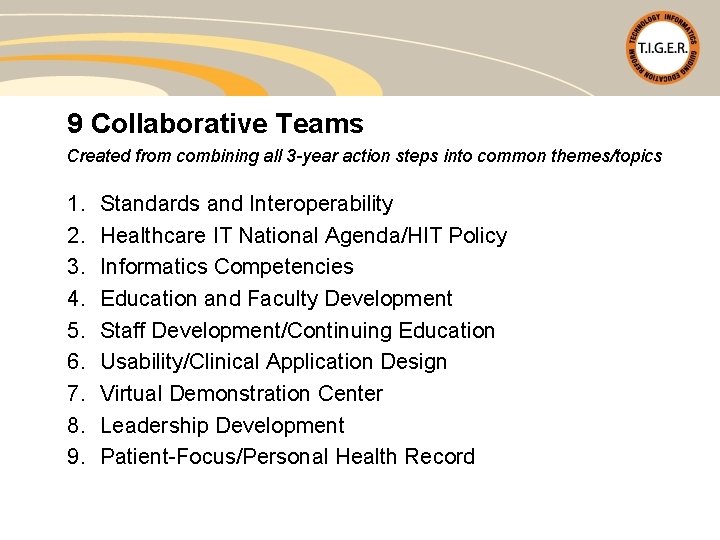
9 Collaborative Teams Created from combining all 3 -year action steps into common themes/topics 1. 2. 3. 4. 5. 6. 7. 8. 9. Standards and Interoperability Healthcare IT National Agenda/HIT Policy Informatics Competencies Education and Faculty Development Staff Development/Continuing Education Usability/Clinical Application Design Virtual Demonstration Center Leadership Development Patient-Focus/Personal Health Record
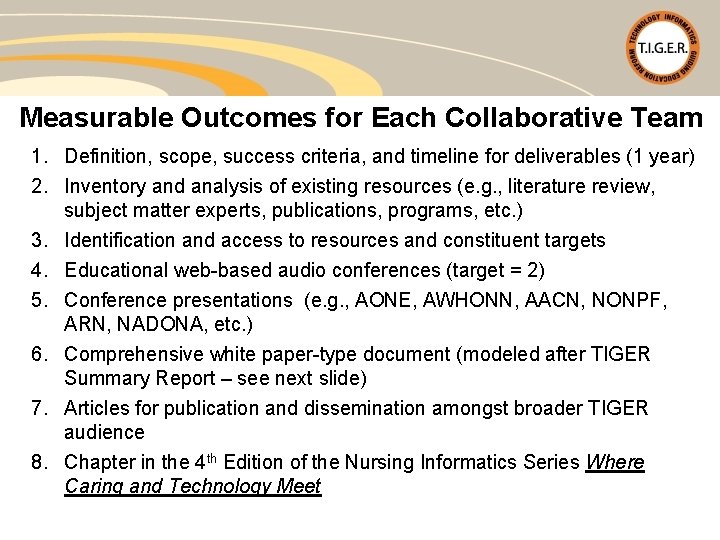
Measurable Outcomes for Each Collaborative Team 1. Definition, scope, success criteria, and timeline for deliverables (1 year) 2. Inventory and analysis of existing resources (e. g. , literature review, subject matter experts, publications, programs, etc. ) 3. Identification and access to resources and constituent targets 4. Educational web-based audio conferences (target = 2) 5. Conference presentations (e. g. , AONE, AWHONN, AACN, NONPF, ARN, NADONA, etc. ) 6. Comprehensive white paper-type document (modeled after TIGER Summary Report – see next slide) 7. Articles for publication and dissemination amongst broader TIGER audience 8. Chapter in the 4 th Edition of the Nursing Informatics Series Where Caring and Technology Meet
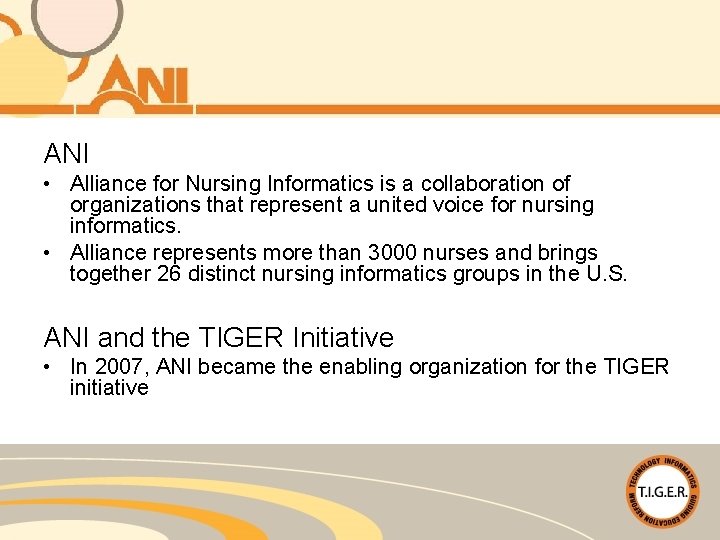
ANI • Alliance for Nursing Informatics is a collaboration of organizations that represent a united voice for nursing informatics. • Alliance represents more than 3000 nurses and brings together 26 distinct nursing informatics groups in the U. S. ANI and the TIGER Initiative • In 2007, ANI became the enabling organization for the TIGER initiative
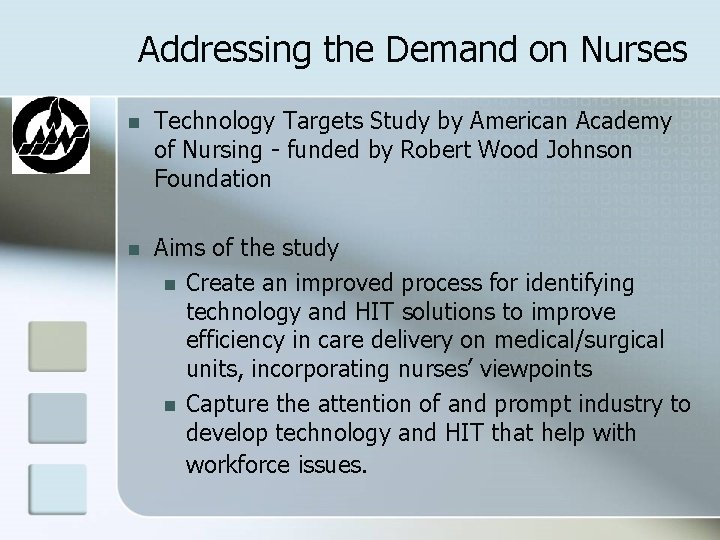
Addressing the Demand on Nurses n Technology Targets Study by American Academy of Nursing - funded by Robert Wood Johnson Foundation n Aims of the study n Create an improved process for identifying technology and HIT solutions to improve efficiency in care delivery on medical/surgical units, incorporating nurses’ viewpoints n Capture the attention of and prompt industry to develop technology and HIT that help with workforce issues.
Technology Drill Down (TD 2) n Two day process of brainstorming and visioning n 20 – 30 multidisciplinary representatives n Primary Purpose n n Map gaps between current workflow & idealized workflow Identify potential technological applications that could close the gaps
Preliminary Findings from Sites Documentation n n Computerized Order Entry included in electronic record Touch screen/Voice activated Global Documentation System n Multidisciplinary n Real time n Universal – physician, hospital, home care Flash Drive/Smart Card
Preliminary Findings from Sites Patient Care Smart Monitoring Devices – interfaced with EHR n Portable devices to quickly add information and updates to patient charts n ID Bracelet or Tracking Chip System Use with a handheld scanner. Linked to chart. Interfaces with screen at bedside. n Smart Bed n
Preliminary Findings from Sites Communications Computerized, centralized patient scheduling system for all departments n Wireless voice communication device/Hands free communication device. n RFID for caregivers. n Universal Translator/Automatic language interpretation device. n
Preliminary Findings from Sites Medications Robotic delivery n Medication Barcode/Chip System (same system for labs, blood products) n Smart IV/Blood Pump n Simplify systems and eliminate redundancies n
Preliminary Findings from Sites Supplies & Equipment RFID tag - item scanned when used Inventory to central computer Include linens, supplies & equipment n Robot to restock and deliver supplies & equipment n Ensure availability at the point of care n
Workforce Development: Nursing Informaticists (n=776) 41% no formal training in informatics 25% job training in informatics 12% informatics certificate 17% masters in informatics, 2% Ph. D 12% enrolled in degree or certificate program (~12 degree granting programs in Nursing Informatics in US) HIMSS 2007 Nursing Informatics Survey, sponsored by Mc. Kesson
Essentials of Baccalaureate Education – AACN (under review) Essential IV – Nursing Informatics and Patient Care Technology within the Practice of the Baccalaureate Generalist • Use IT and patient data for clinical decision making • Use technologies that facilitate clinical care • Evaluate technologies used in patient care • Protect privacy of patients relative to IT • Use safeguards in IT and IS to create safe environment • Demonstrate knowledge of regulations for using IT • Use technologies to assist in effective communication • Develop awareness that new technology requires new workflow and changes in practice
Doctorate of Nursing Practice Essential #4: Information Systems/Technology and Patient Care Technology for the Improvement and Transformation of Health Care • Design, select, use and evaluate programs the evaluate and monitor outcomes including consumer use • Analyze and communicate critical elements in selection, use and evaluate HIT • Demonstrate conceptual ability and technical skills to develop and execute an evaluation plan including data extraction • Provide leadership in resolution of ethical issues related to use of HIT • Evaluate health information sources for accuracy, timeliness, and appropriateness.
TIGER communication www. tigersummit. com • Donna Du. Long, TIGER Program Director donna@tigersummit. com ANI communication www. allianceni. org • Joyce Sensmeier, MS, RN-BC, CPHIMS, FHIMSS – HIMSS Representative – JSensmeier@himss. org • Carole Gassert, RN, Ph. D, FACMI, FAAN – AMIA Representative – Carole. gassert@nurs. utah. org