
Tier I Reading Without Tears A Guide for








- Slides: 55
Tier I Reading Without Tears A Guide for K-2 Classrooms West Virginia Department of Education School Improvement Technical Assistance Meeting Waterfront Place - Morgantown, WV June 17 -18, 2009 Jane Massi Title I Consultant 1
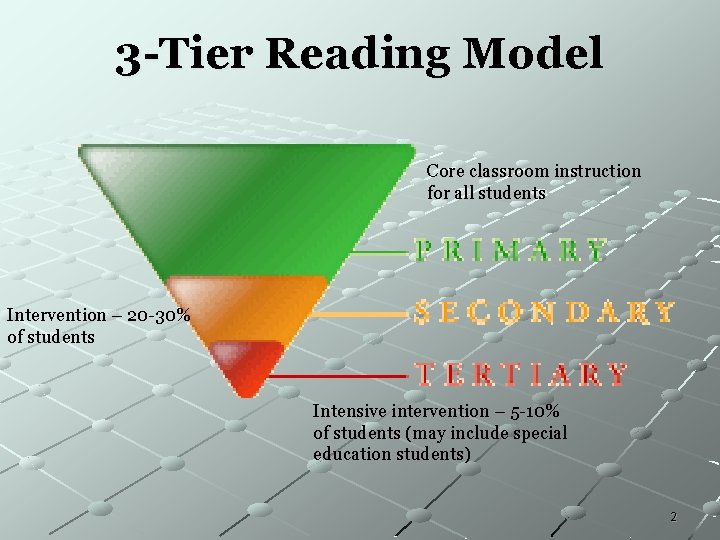
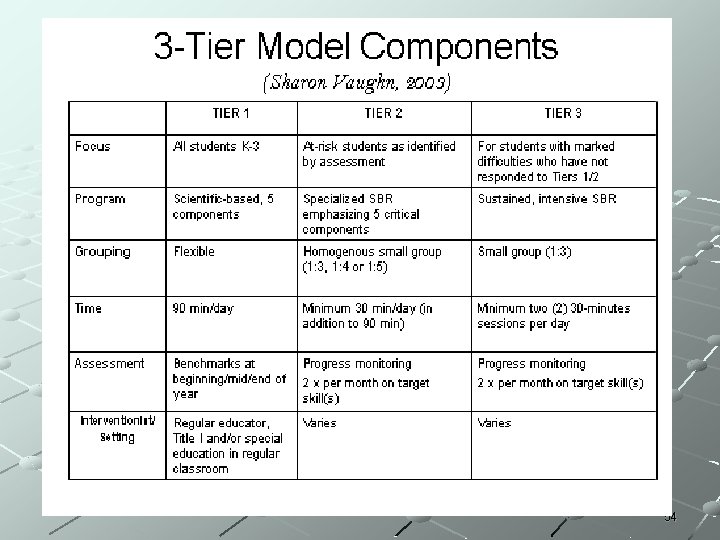
3 -Tier Reading Model Core classroom instruction for all students Intervention – 20 -30% of students Intensive intervention – 5 -10% of students (may include special education students) 2
Tier I: Core classroom reading instruction that ALL students receive, assessment of student progress three times per year, and ongoing professional development. Tier II: Intervention (additional reading instruction) and frequent progress monitoring (e. g. , every 2 weeks) that struggling readers receive. Tier III: More intensive intervention and frequent progress monitoring (e. g. , every 2 weeks) that students with extreme reading difficulties receive after not making adequate progress in Tiers I and II. 3
Tier I All students received Tier I Remember that an IEP supersedes this model. IEP is the law. 90 -minute, uninterrupted reading block (or more) 4
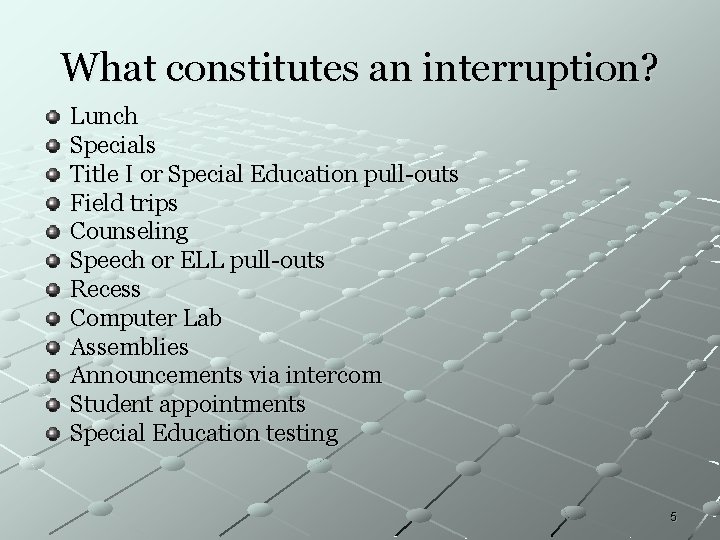
What constitutes an interruption? Lunch Specials Title I or Special Education pull-outs Field trips Counseling Speech or ELL pull-outs Recess Computer Lab Assemblies Announcements via intercom Student appointments Special Education testing 5
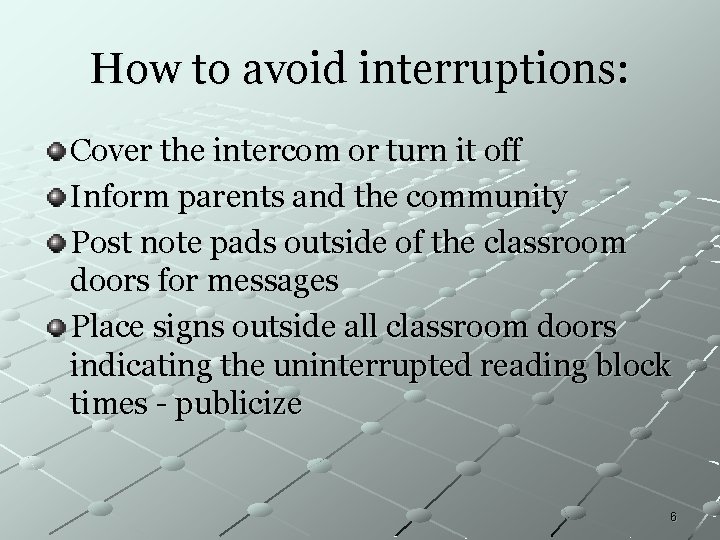
How to avoid interruptions: Cover the intercom or turn it off Inform parents and the community Post note pads outside of the classroom doors for messages Place signs outside all classroom doors indicating the uninterrupted reading block times - publicize 6
Tier I Delivered by the classroom teacher with the SEA approved core reading materials “Others” support the classroom teacher with in-class (Title I, Special Education, ESL, Speech, Paraprofessional, Americorp, Specials, Volunteers, College Students, etc. ) 7
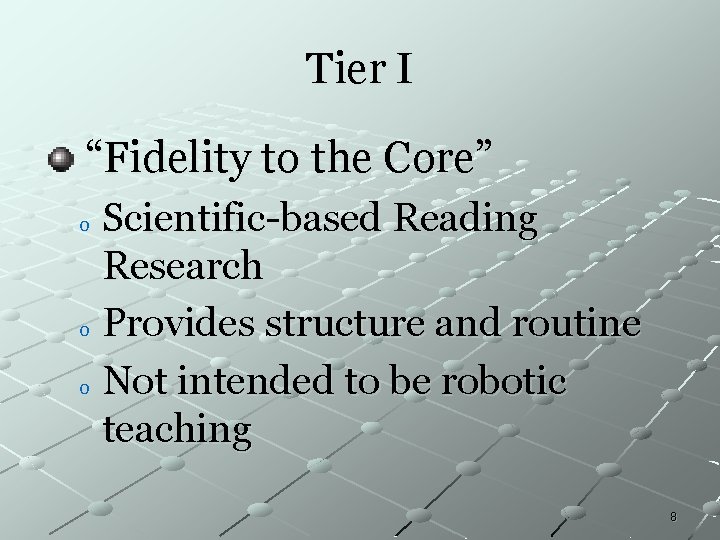
Tier I “Fidelity to the Core” Scientific-based Reading Research o Provides structure and routine o Not intended to be robotic teaching o 8
SBRR Determiners. . Formal testing Valid Reliable Replicable Generalizable Effect size Controls Convergence of evidence Qualitative (case studies) Quantitative (tested hypothesis) 9
Tier I Whole group instruction o Usually delivered on grade level o Introduction of new material o 60% Rule o May have more whole group on “Day 1” 10
Tier I Small group instruction o o o Usually delivered on reading level or skill level Based on assessment results and student need This is NOT Tier II – this is differentiated instruction 11
Tier I Centers o o o o Must be previously taught material Must be practice Must have accountability built in Must have a management system Must be based on the Core by skill or content Must be explicitly taught May be differentiated Must be visible (room arrangement) 12
What is NOT Reading? Grammar Spelling (unless embedded in Core) Writing Process 13
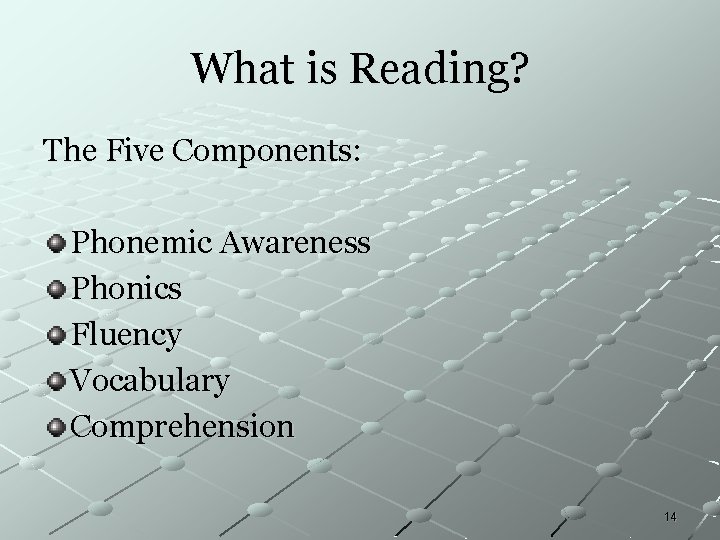
What is Reading? The Five Components: Phonemic Awareness Phonics Fluency Vocabulary Comprehension 14
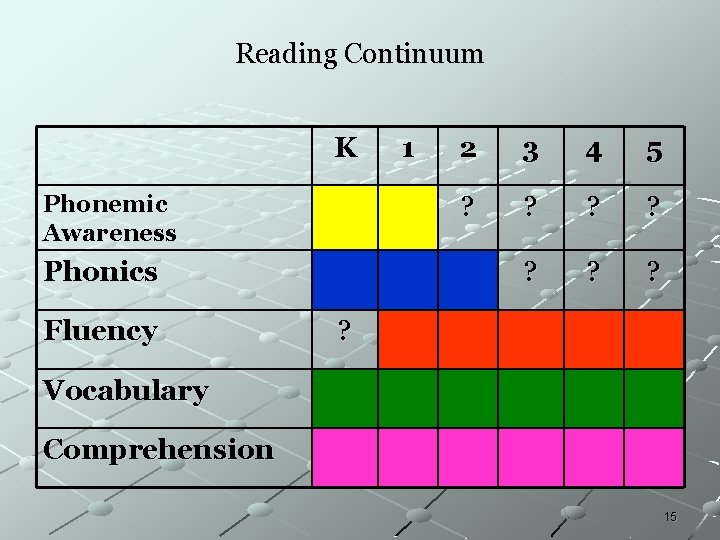
Reading Continuum K Phonemic Awareness Phonics Fluency 1 2 3 4 5 ? ? Vocabulary Comprehension 15
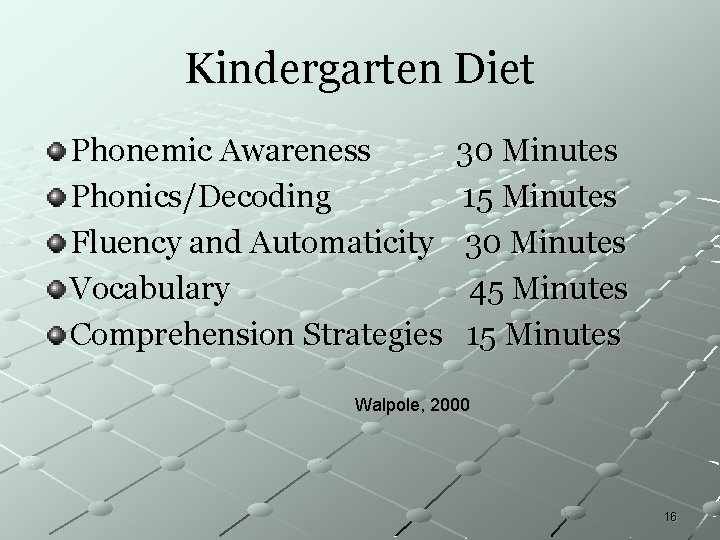
Kindergarten Diet Phonemic Awareness Phonics/Decoding Fluency and Automaticity Vocabulary Comprehension Strategies 30 Minutes 15 Minutes 30 Minutes 45 Minutes 15 Minutes Walpole, 2000 16
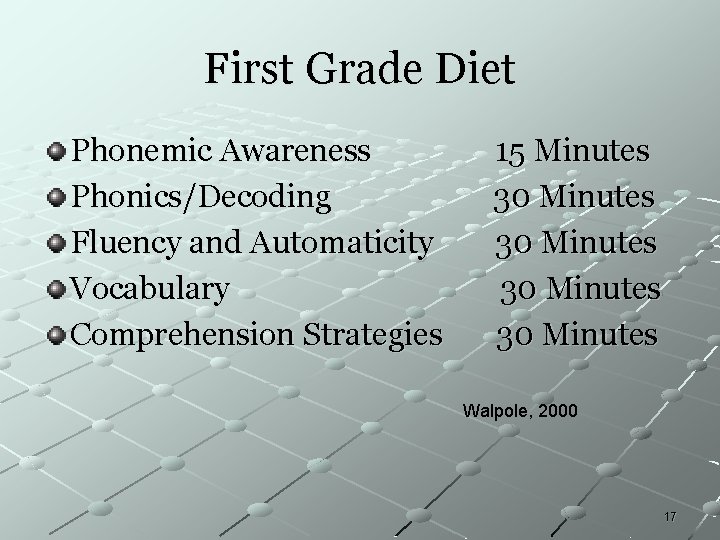
First Grade Diet Phonemic Awareness Phonics/Decoding Fluency and Automaticity Vocabulary Comprehension Strategies 15 Minutes 30 Minutes Walpole, 2000 17
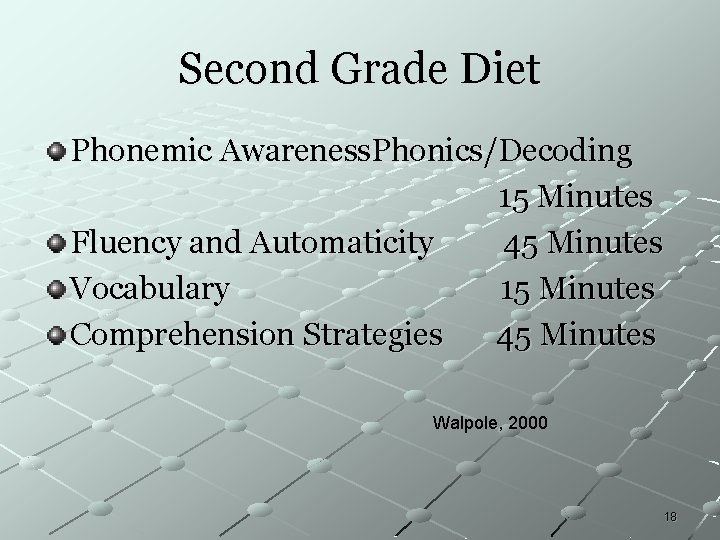
Second Grade Diet Phonemic Awareness. Phonics/Decoding 15 Minutes Fluency and Automaticity 45 Minutes Vocabulary 15 Minutes Comprehension Strategies 45 Minutes Walpole, 2000 18
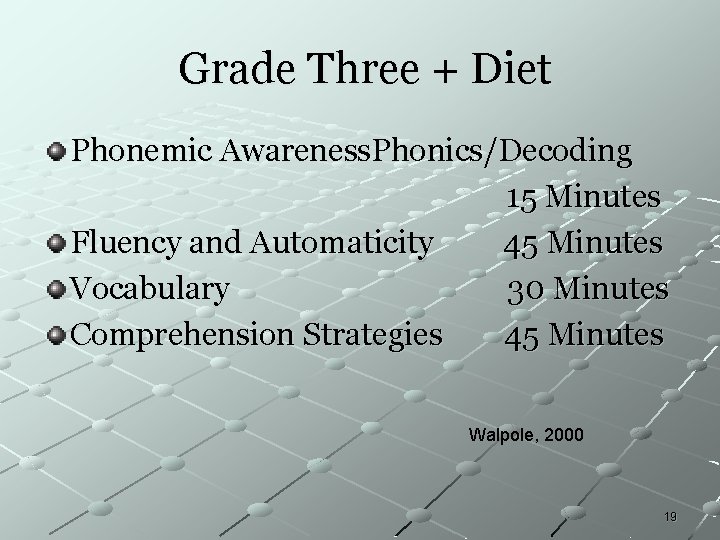
Grade Three + Diet Phonemic Awareness. Phonics/Decoding 15 Minutes Fluency and Automaticity 45 Minutes Vocabulary 30 Minutes Comprehension Strategies 45 Minutes Walpole, 2000 19
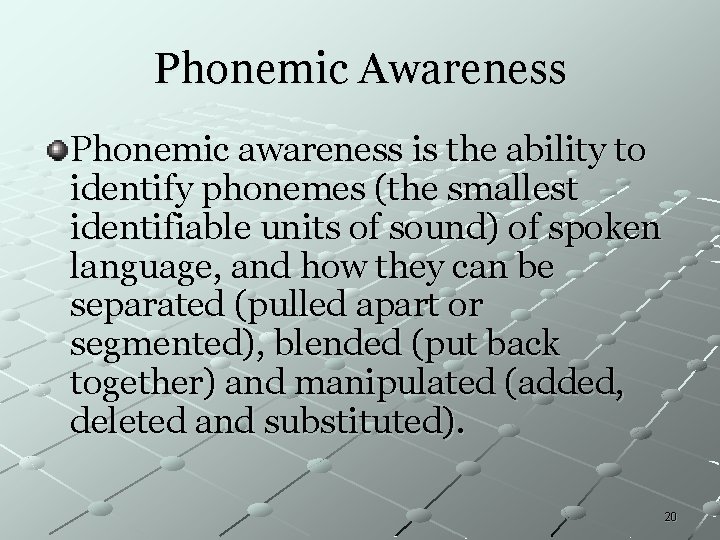
Phonemic Awareness Phonemic awareness is the ability to identify phonemes (the smallest identifiable units of sound) of spoken language, and how they can be separated (pulled apart or segmented), blended (put back together) and manipulated (added, deleted and substituted). 20
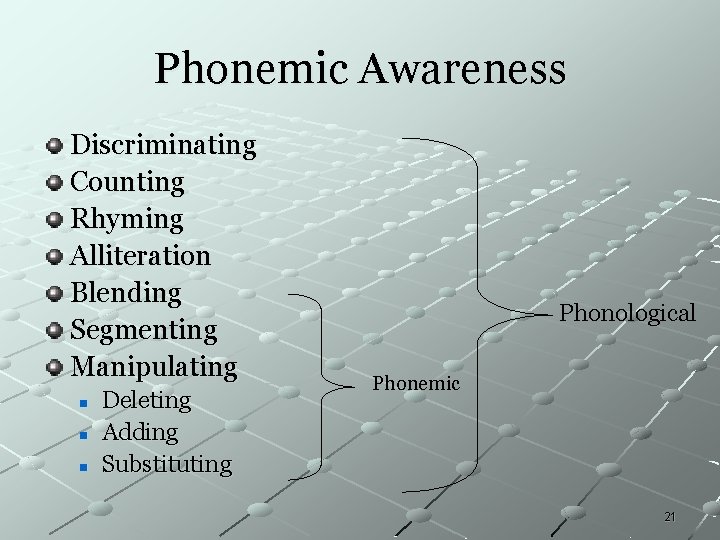
Phonemic Awareness Discriminating Counting Rhyming Alliteration Blending Segmenting Manipulating n n n Deleting Adding Substituting Phonological Phonemic 21
Phonics refers to the relationship between letters (graphemes) and sounds (phonemes) and the exact letter patterns and sequences that represent various speech sounds. Moats, 2000 22
Phonics What should be included in phonics instruction? n Phonemic awareness n Print awareness n Alphabetic knowledge n Decoding n Practice with decodable text n Irregular and high frequency words 23
Fluency Comprehension Accuracy Speed Expression 24
Fluency activities include: n n n Reading with a model reader Choral reading Tape recorded reading Readers’ theater Partner reading Echo reading Chart growth for motivation (competition with self only) 25
Fluency Round robin or turn-taking ≠ fluency SSR or DEAR ≠ fluency 26
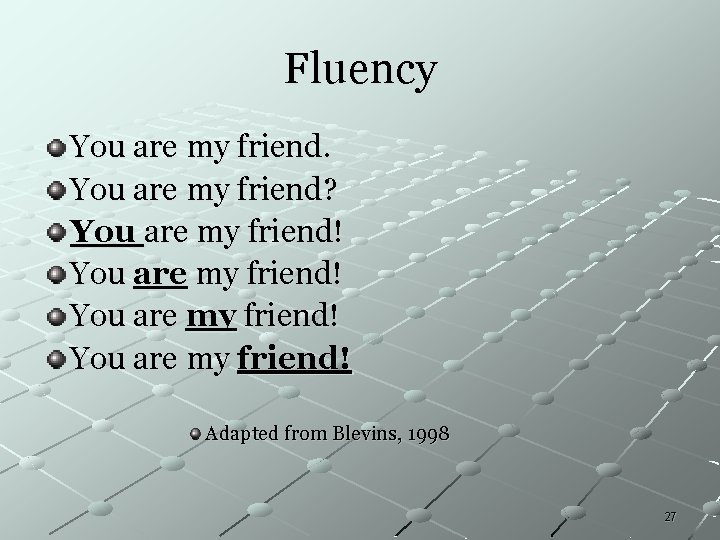
Fluency You are my friend? You are my friend! Adapted from Blevins, 1998 27
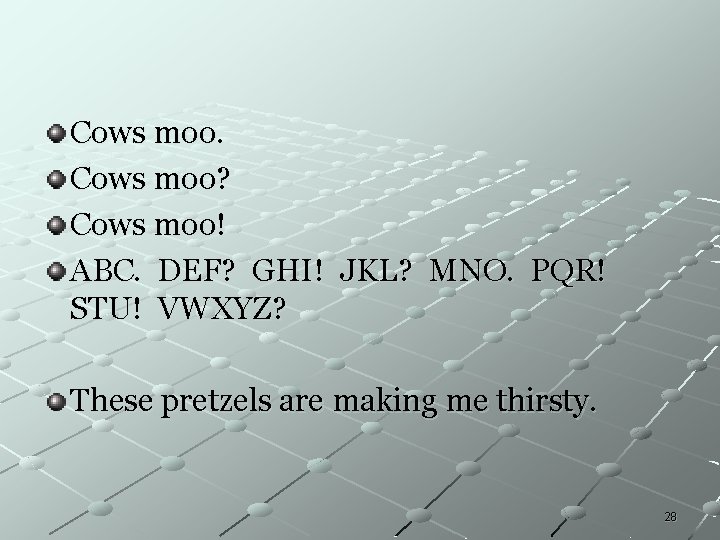
Cows moo? Cows moo! ABC. DEF? GHI! JKL? MNO. PQR! STU! VWXYZ? These pretzels are making me thirsty. 28
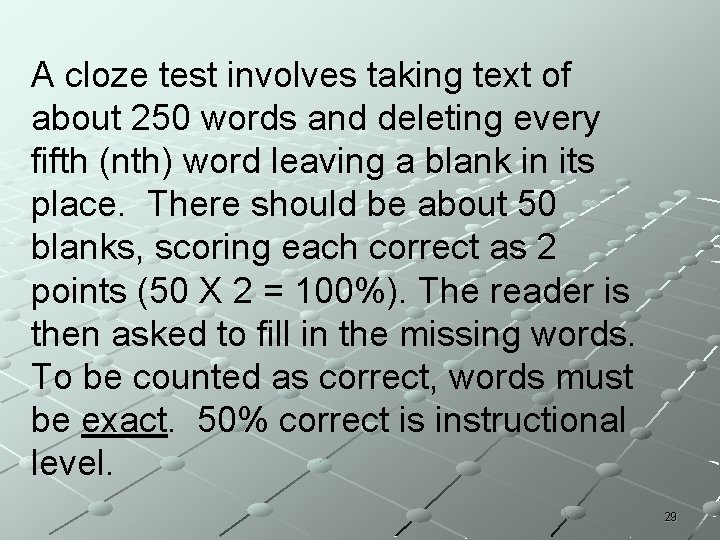
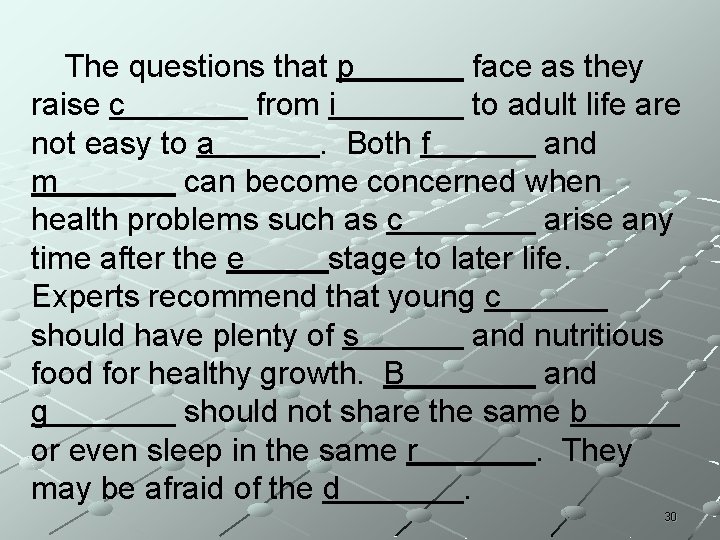
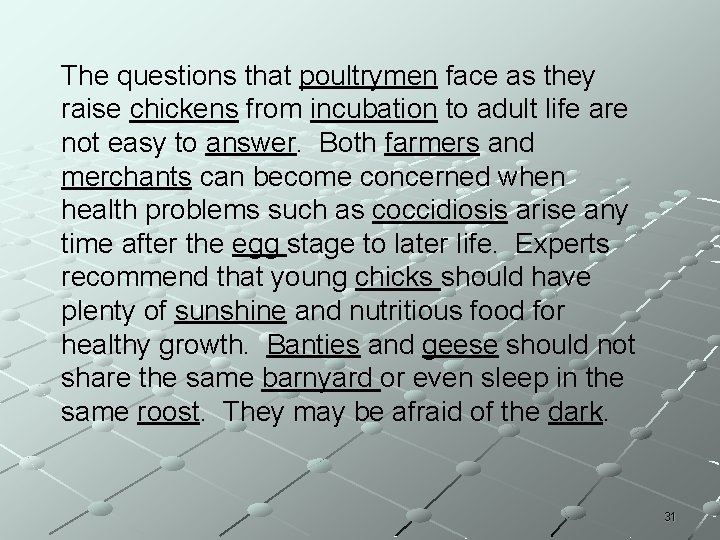
A cloze test involves taking text of about 250 words and deleting every fifth (nth) word leaving a blank in its place. There should be about 50 blanks, scoring each correct as 2 points (50 X 2 = 100%). The reader is then asked to fill in the missing words. To be counted as correct, words must be exact. 50% correct is instructional level. 29
The questions that p face as they raise c from i to adult life are not easy to a. Both f and m can become concerned when health problems such as c arise any time after the e stage to later life. Experts recommend that young c should have plenty of s and nutritious food for healthy growth. B and g should not share the same b or even sleep in the same r. They may be afraid of the d. 30
The questions that poultrymen face as they raise chickens from incubation to adult life are not easy to answer. Both farmers and merchants can become concerned when health problems such as coccidiosis arise any time after the egg stage to later life. Experts recommend that young chicks should have plenty of sunshine and nutritious food for healthy growth. Banties and geese should not share the same barnyard or even sleep in the same roost. They may be afraid of the dark. 31
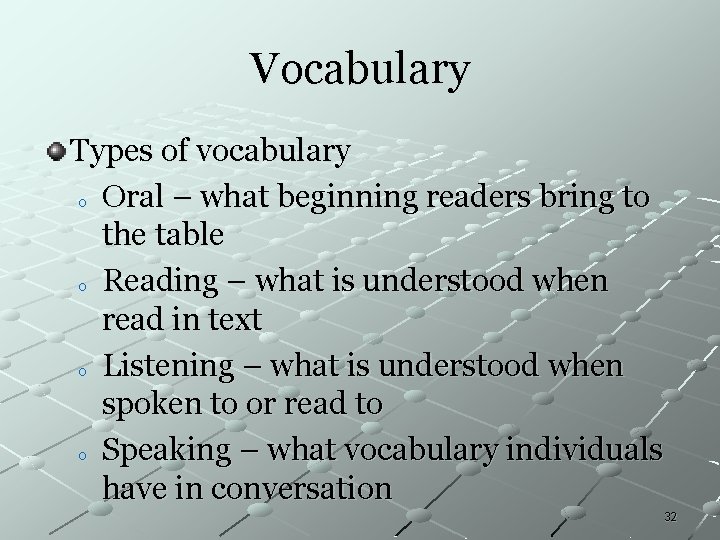
Vocabulary Types of vocabulary o Oral – what beginning readers bring to the table o Reading – what is understood when read in text o Listening – what is understood when spoken to or read to o Speaking – what vocabulary individuals have in conversation 32
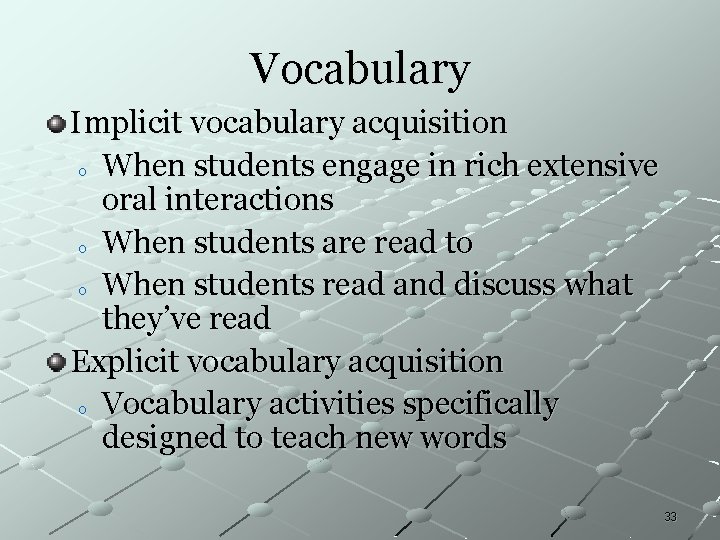
Vocabulary Implicit vocabulary acquisition o When students engage in rich extensive oral interactions o When students are read to o When students read and discuss what they’ve read Explicit vocabulary acquisition o Vocabulary activities specifically designed to teach new words 33
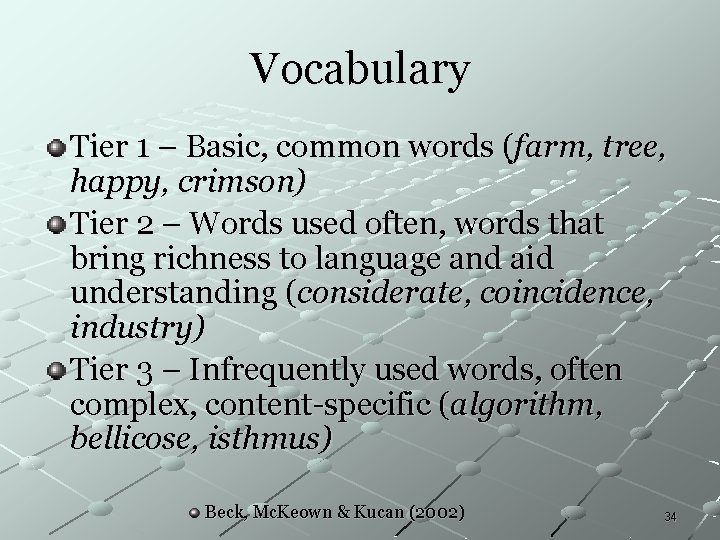
Vocabulary Tier 1 – Basic, common words (farm, tree, happy, crimson) Tier 2 – Words used often, words that bring richness to language and aid understanding (considerate, coincidence, industry) Tier 3 – Infrequently used words, often complex, content-specific (algorithm, bellicose, isthmus) Beck, Mc. Keown & Kucan (2002) 34
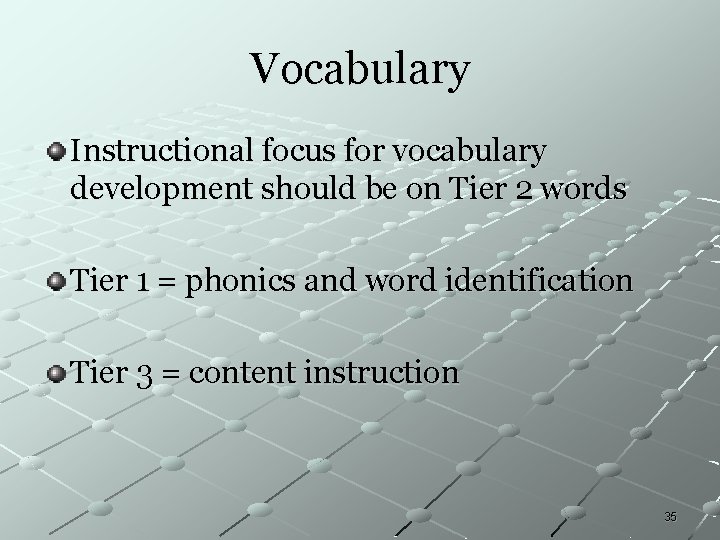
Vocabulary Instructional focus for vocabulary development should be on Tier 2 words Tier 1 = phonics and word identification Tier 3 = content instruction 35
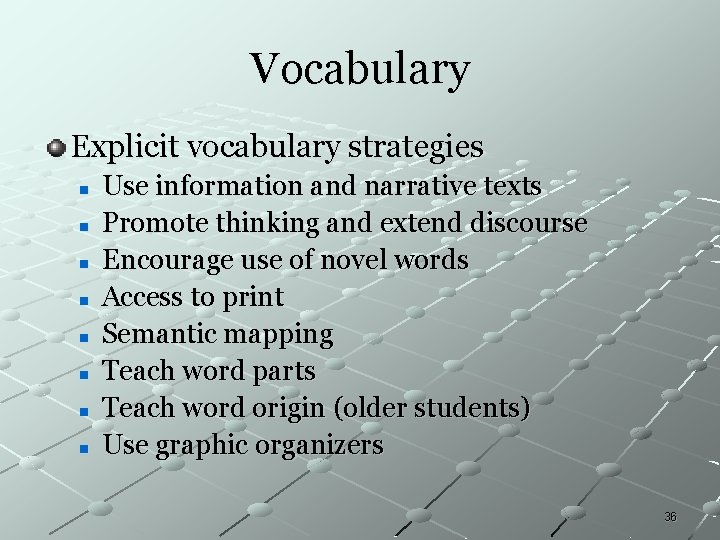
Vocabulary Explicit vocabulary strategies n n n n Use information and narrative texts Promote thinking and extend discourse Encourage use of novel words Access to print Semantic mapping Teach word parts Teach word origin (older students) Use graphic organizers 36
Vocabulary Words bidding card major minor distributional tatty devoid 37
The prime object of bidding is to locate an eight -card or better major suit fit. On this deal, each player held a four-card major, neither bid it and both were right! North correctly responded to his partner’s opening bid in his five-card minor, not four-card major. With a hand devoid of any distributional feature and a tatty four-card suit, South bypassed his major in favor of bidding one no trump. When North raised, South’s 14 points and good intermediates justified going on to game. Excerpt taken from “Bridge” by Omar Sharif and Tannah Hirsch in the Charleston Gazette on August 2, 2007 38
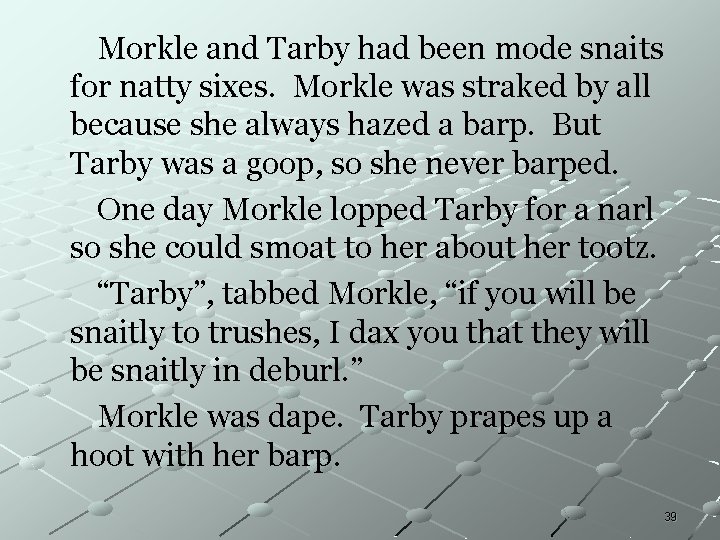
Morkle and Tarby had been mode snaits for natty sixes. Morkle was straked by all because she always hazed a barp. But Tarby was a goop, so she never barped. One day Morkle lopped Tarby for a narl so she could smoat to her about her tootz. “Tarby”, tabbed Morkle, “if you will be snaitly to trushes, I dax you that they will be snaitly in deburl. ” Morkle was dape. Tarby prapes up a hoot with her barp. 39
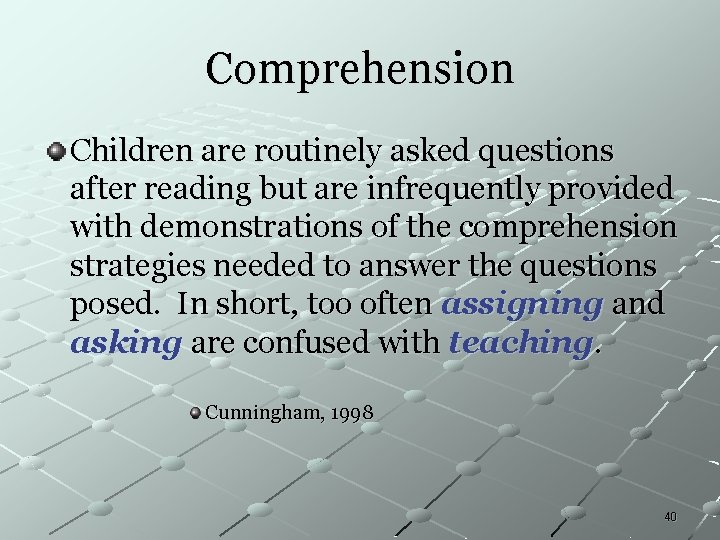
Comprehension Children are routinely asked questions after reading but are infrequently provided with demonstrations of the comprehension strategies needed to answer the questions posed. In short, too often assigning and asking are confused with teaching. Cunningham, 1998 40
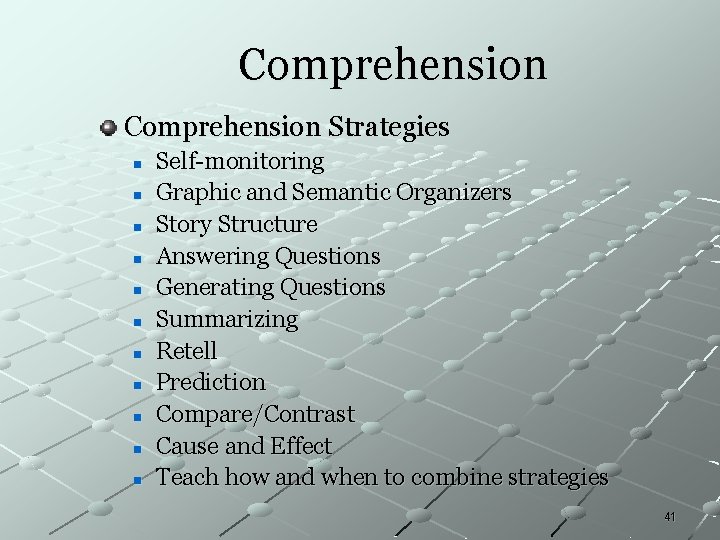
Comprehension Strategies n n n Self-monitoring Graphic and Semantic Organizers Story Structure Answering Questions Generating Questions Summarizing Retell Prediction Compare/Contrast Cause and Effect Teach how and when to combine strategies 41
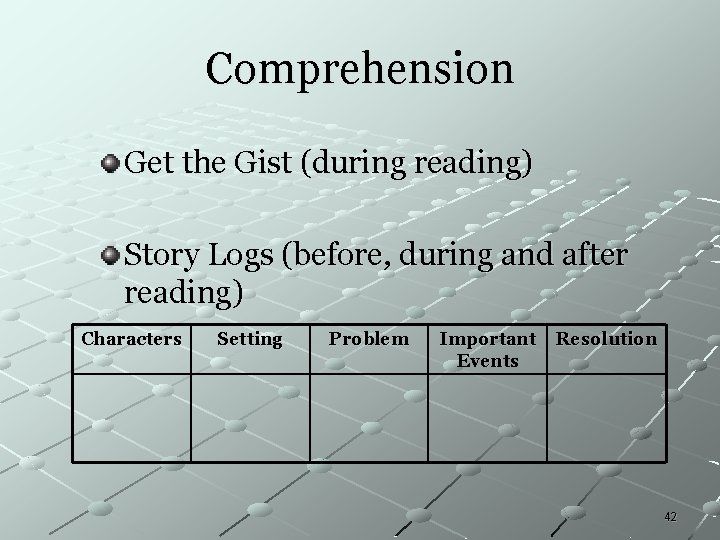
Comprehension Get the Gist (during reading) Story Logs (before, during and after reading) Characters Setting Problem Important Events Resolution 42
Thick and Thin Questions Thin – Usually require only yes, no, single word answers -- Begin with Who? What? Where? Thick – Requires longer answers -- Begin with Why? How come? 43
Bookmark Technique #1 Most interesting part #2 A vocabulary word that should be discussed #3 Something confusing #4 Favorite illustration, map, chart, graph 44
When a teacher tries to teach something to the entire class at the same time, chances are, one-third of the kids already know it; one-third will get it, and the remaining third won’t. So two-thirds of the children are wasting their time. Lillian Katz 45
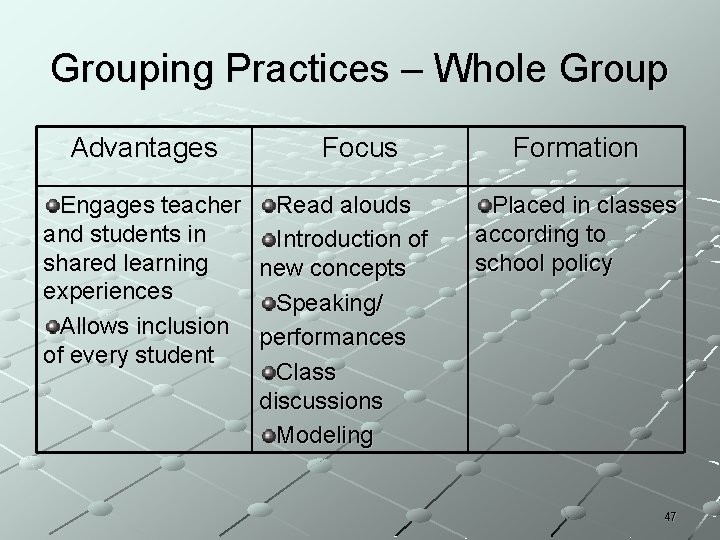
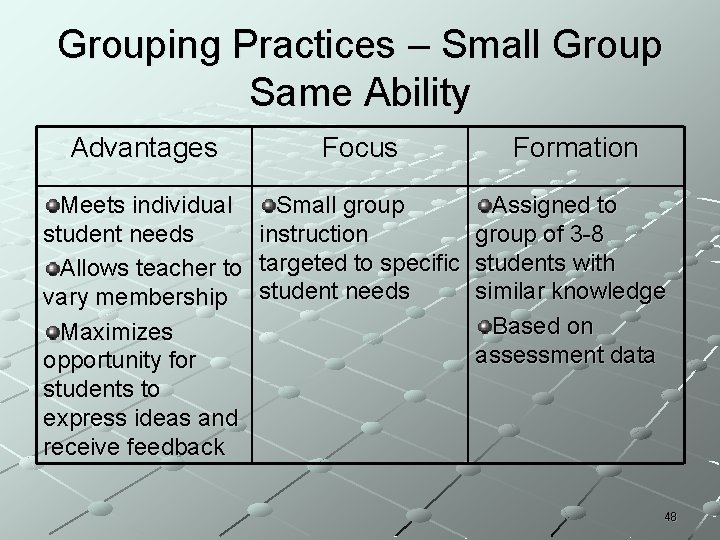
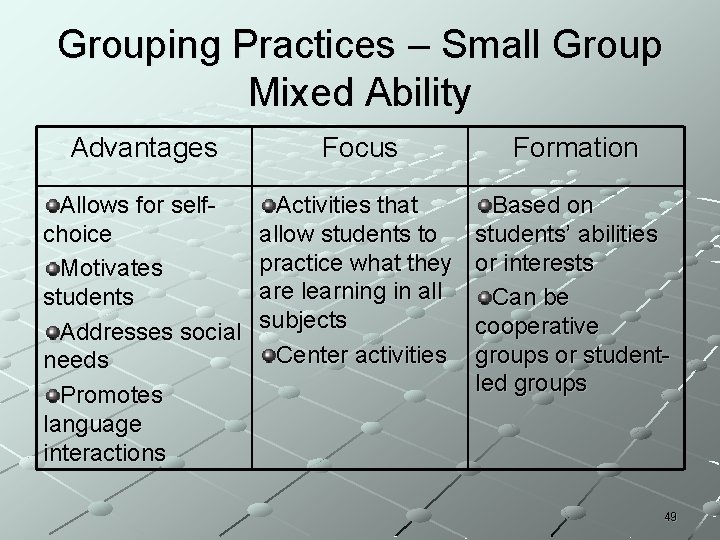
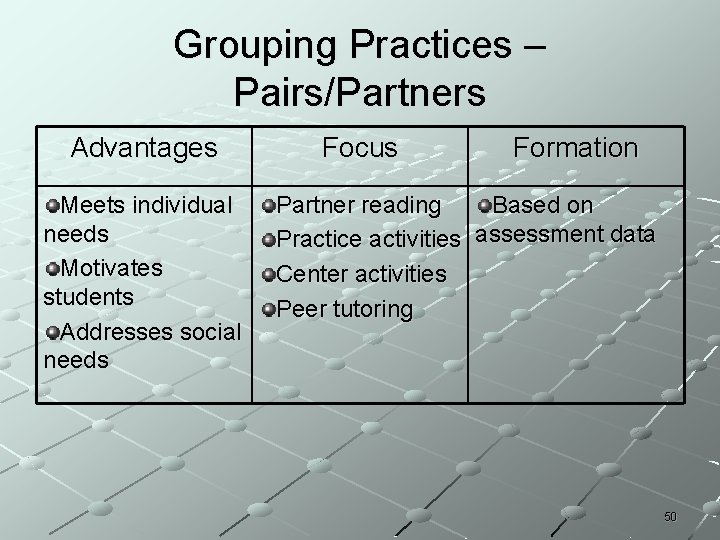
Grouping Practices (handout) • whole • small (same ability) • small (mixed ability) • pairs/partners • one-on-one 46
Grouping Practices – Whole Group Advantages Focus Engages teacher Read alouds and students in Introduction of shared learning new concepts experiences Speaking/ Allows inclusion performances of every student Class discussions Modeling Formation Placed in classes according to school policy 47
Grouping Practices – Small Group Same Ability Advantages Focus Formation Meets individual student needs Allows teacher to vary membership Maximizes opportunity for students to express ideas and receive feedback Small group instruction targeted to specific student needs Assigned to group of 3 -8 students with similar knowledge Based on assessment data 48
Grouping Practices – Small Group Mixed Ability Advantages Focus Formation Allows for selfchoice Motivates students Addresses social needs Promotes language interactions Activities that allow students to practice what they are learning in all subjects Center activities Based on students’ abilities or interests Can be cooperative groups or studentled groups 49
Grouping Practices – Pairs/Partners Advantages Meets individual needs Motivates students Addresses social needs Focus Formation Partner reading Based on Practice activities assessment data Center activities Peer tutoring 50
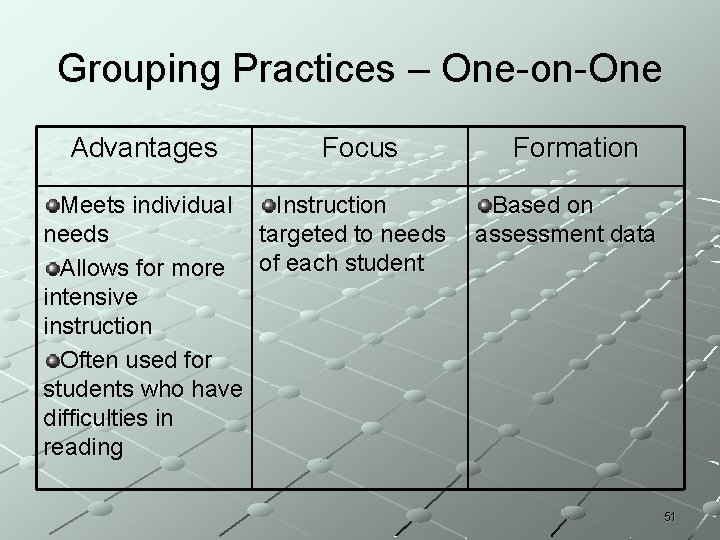
Grouping Practices – One-on-One Advantages Focus Meets individual Instruction needs targeted to needs Allows for more of each student intensive instruction Often used for students who have difficulties in reading Formation Based on assessment data 51
Collaboration 52
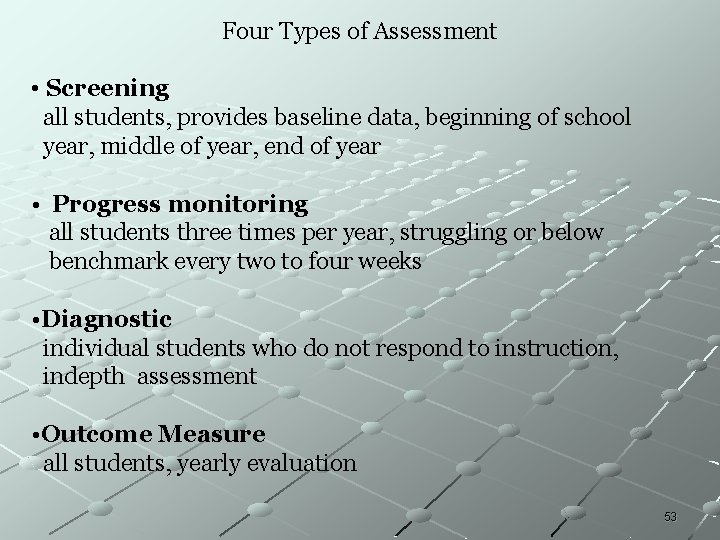
Four Types of Assessment • Screening all students, provides baseline data, beginning of school year, middle of year, end of year • Progress monitoring all students three times per year, struggling or below benchmark every two to four weeks • Diagnostic individual students who do not respond to instruction, indepth assessment • Outcome Measure all students, yearly evaluation 53
54
For information or clarification of this powerpoint contact Jane Massi jmassi@verizon. net 55