
Tier 2 Targeted Supplemental Interventions and Supports Close
- Slides: 18
Tier 2 Targeted Supplemental Interventions and Supports
Close skill gaps to enable successful mastery of Florida State Standards and grade-level instructional goals and expectations for learners who are struggling in the general education curriculum setting, while ensuring the prevention of new content area gaps and supporting student engagement. The Goal of Tier 2
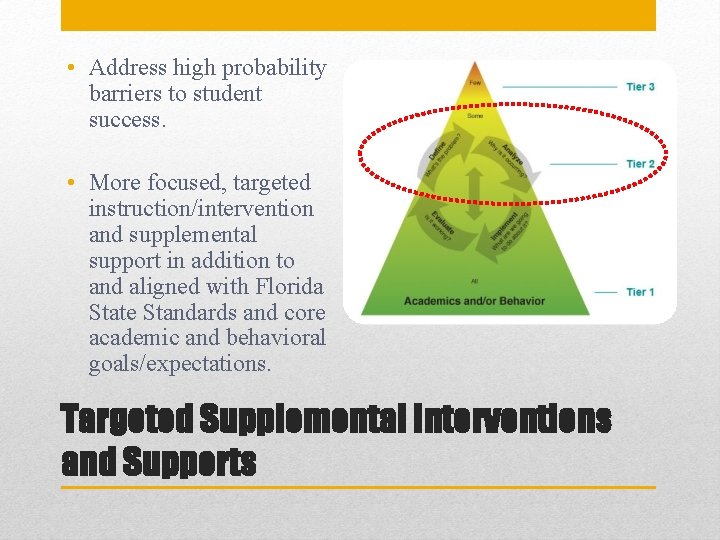
• Address high probability barriers to student success. • More focused, targeted instruction/intervention and supplemental support in addition to and aligned with Florida State Standards and core academic and behavioral goals/expectations. Targeted Supplemental Interventions and Supports
Tier 2 is meant to provide a limited, but targeted, support system for students who struggle to meet grade-level performance standards. Tier 2 is to remediate academic skill deficits with the idea that in doing so, students will be successful in the Tier 1 program without further support. 70% of students receiving core + tier 2 should be able to reach proficiency expectations without additional services. If successful…
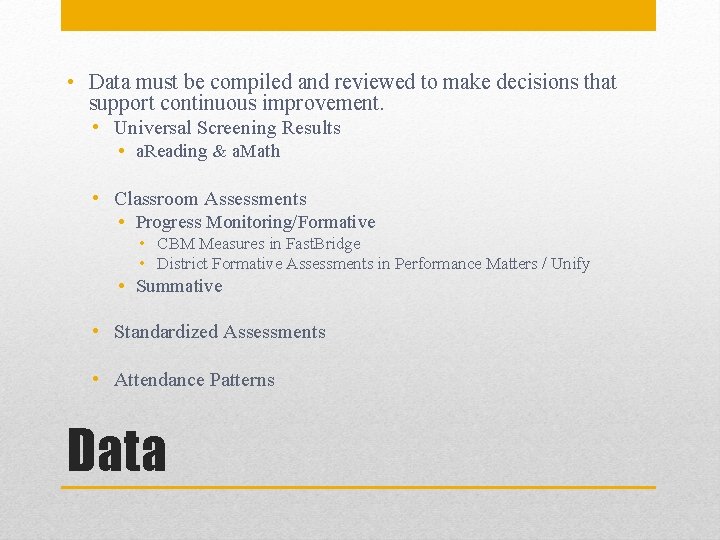
• Data must be compiled and reviewed to make decisions that support continuous improvement. • Universal Screening Results • a. Reading & a. Math • Classroom Assessments • Progress Monitoring/Formative • CBM Measures in Fast. Bridge • District Formative Assessments in Performance Matters / Unify • Summative • Standardized Assessments • Attendance Patterns Data
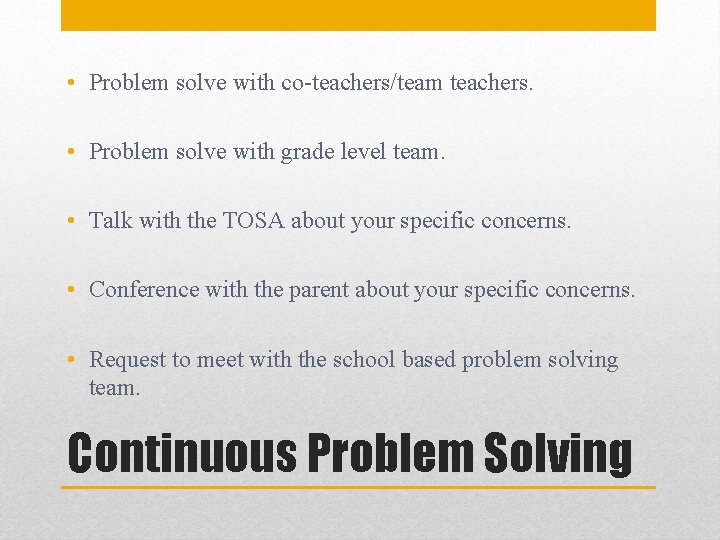
• Problem solve with co-teachers/team teachers. • Problem solve with grade level team. • Talk with the TOSA about your specific concerns. • Conference with the parent about your specific concerns. • Request to meet with the school based problem solving team. Continuous Problem Solving
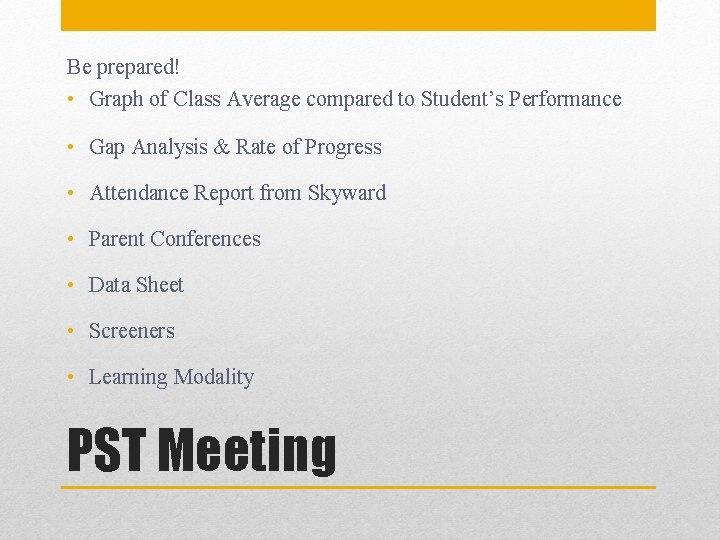
Be prepared! • Graph of Class Average compared to Student’s Performance • Gap Analysis & Rate of Progress • Attendance Report from Skyward • Parent Conferences • Data Sheet • Screeners • Learning Modality PST Meeting
The key to determining the amount of time an intervention should be in place and at what level of intensity in order to close the gap! Gap Analysis & Rate of Progress
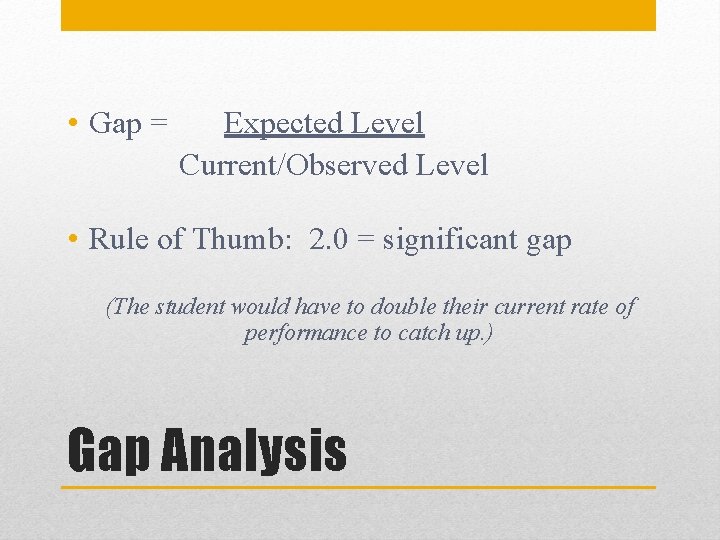
• Gap = Expected Level Current/Observed Level • Rule of Thumb: 2. 0 = significant gap (The student would have to double their current rate of performance to catch up. ) Gap Analysis
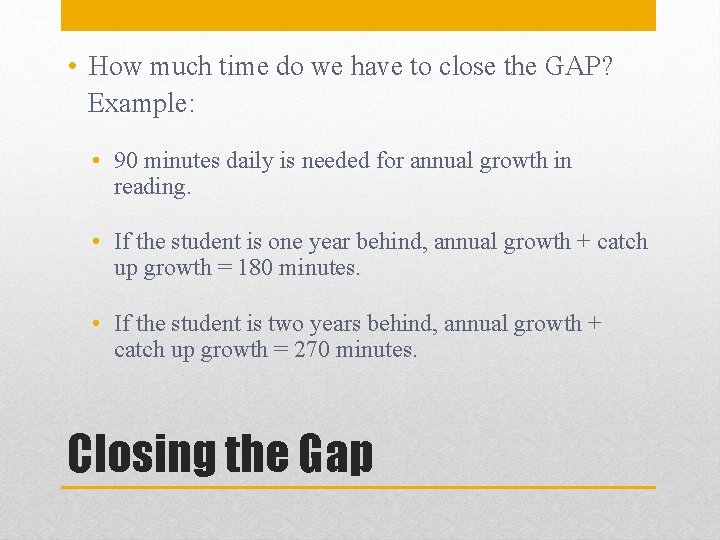
• How much time do we have to close the GAP? Example: • 90 minutes daily is needed for annual growth in reading. • If the student is one year behind, annual growth + catch up growth = 180 minutes. • If the student is two years behind, annual growth + catch up growth = 270 minutes. Closing the Gap
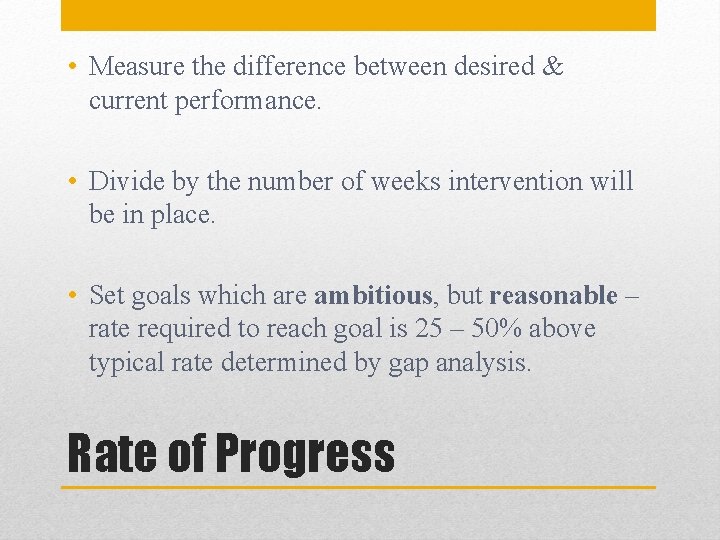
• Measure the difference between desired & current performance. • Divide by the number of weeks intervention will be in place. • Set goals which are ambitious, but reasonable – rate required to reach goal is 25 – 50% above typical rate determined by gap analysis. Rate of Progress
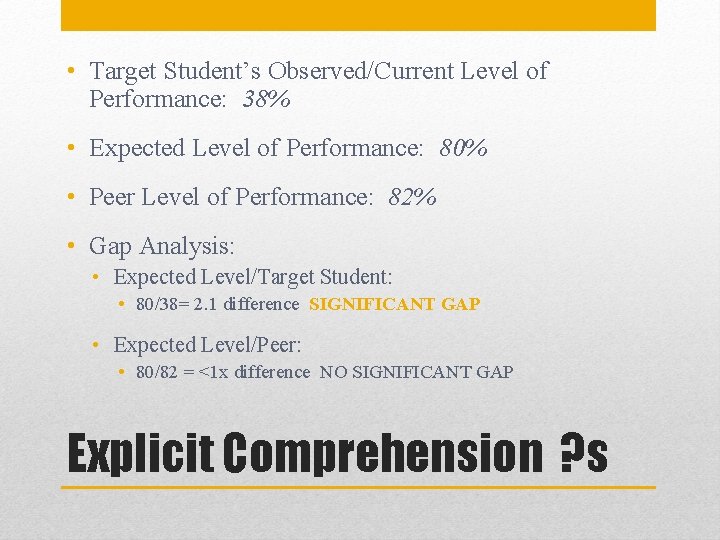
• Target Student’s Observed/Current Level of Performance: 38% • Expected Level of Performance: 80% • Peer Level of Performance: 82% • Gap Analysis: • Expected Level/Target Student: • 80/38= 2. 1 difference SIGNIFICANT GAP • Expected Level/Peer: • 80/82 = <1 x difference NO SIGNIFICANT GAP Explicit Comprehension ? s
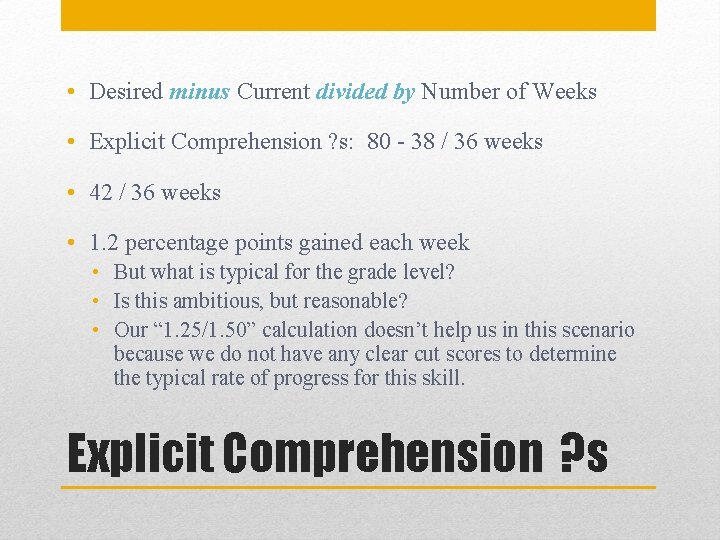
• Desired minus Current divided by Number of Weeks • Explicit Comprehension ? s: 80 - 38 / 36 weeks • 42 / 36 weeks • 1. 2 percentage points gained each week • But what is typical for the grade level? • Is this ambitious, but reasonable? • Our “ 1. 25/1. 50” calculation doesn’t help us in this scenario because we do not have any clear cut scores to determine the typical rate of progress for this skill. Explicit Comprehension ? s
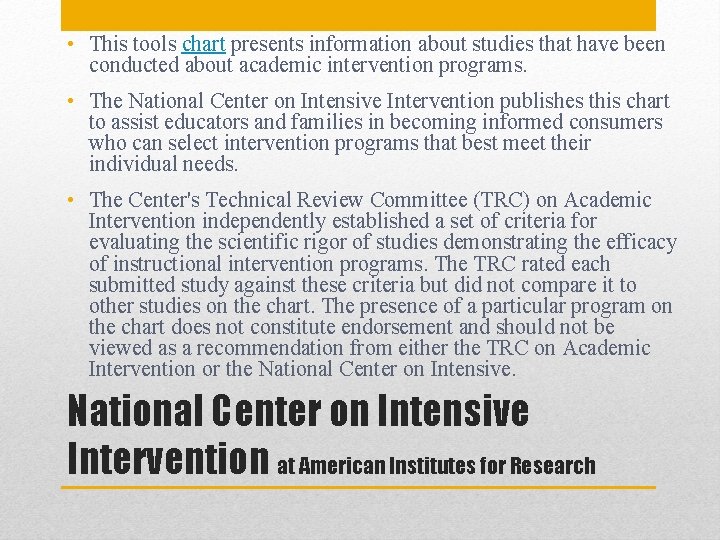
• This tools chart presents information about studies that have been conducted about academic intervention programs. • The National Center on Intensive Intervention publishes this chart to assist educators and families in becoming informed consumers who can select intervention programs that best meet their individual needs. • The Center's Technical Review Committee (TRC) on Academic Intervention independently established a set of criteria for evaluating the scientific rigor of studies demonstrating the efficacy of instructional intervention programs. The TRC rated each submitted study against these criteria but did not compare it to other studies on the chart. The presence of a particular program on the chart does not constitute endorsement and should not be viewed as a recommendation from either the TRC on Academic Intervention or the National Center on Intensive Intervention at American Institutes for Research
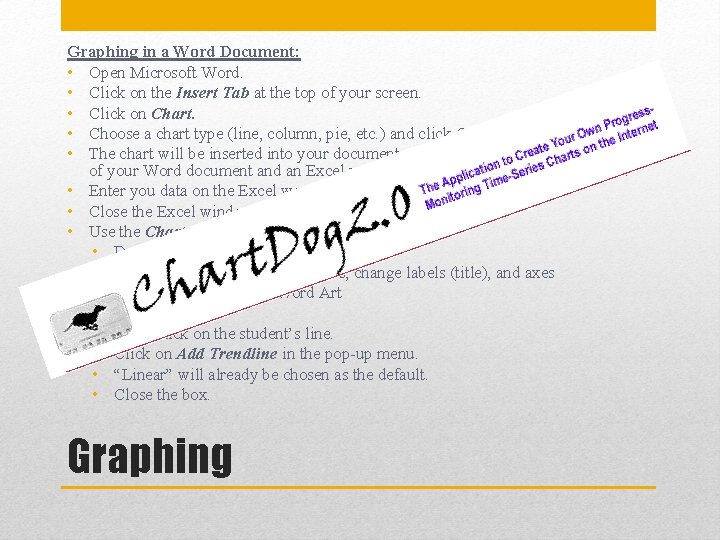
Graphing in a Word Document: • Open Microsoft Word. • Click on the Insert Tab at the top of your screen. • Click on Chart. • Choose a chart type (line, column, pie, etc. ) and click OK. • The chart will be inserted into your document and you will have a “split screen” view of your Word document and an Excel worksheet where you will enter you data. • Enter you data on the Excel worksheet. • Close the Excel window. • Use the Chart Tools Tab to customize your graph: • Design – Type, Data, Layouts, and Style • Layout – Insert shapes, text boxes, change labels (title), and axes • Format – Shape Styles, Word Art • Add a Trendline • Right click on the student’s line. • Click on Add Trendline in the pop-up menu. • “Linear” will already be chosen as the default. • Close the box. Graphing
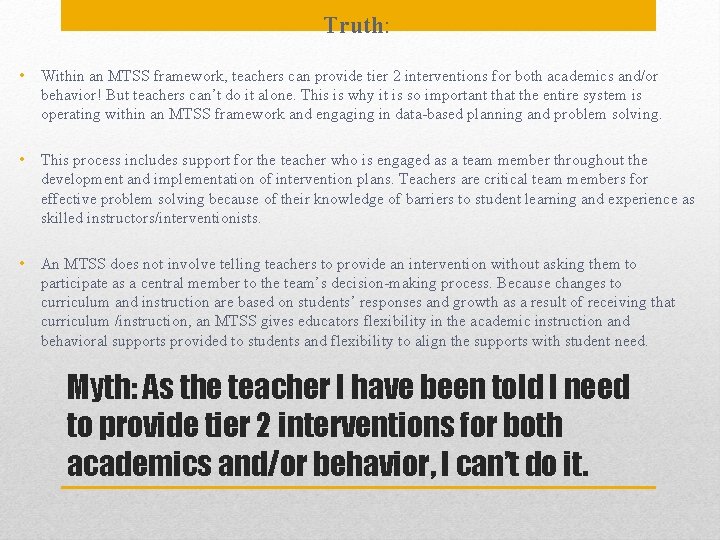
Truth: • Within an MTSS framework, teachers can provide tier 2 interventions for both academics and/or behavior! But teachers can’t do it alone. This is why it is so important that the entire system is operating within an MTSS framework and engaging in data-based planning and problem solving. • This process includes support for the teacher who is engaged as a team member throughout the development and implementation of intervention plans. Teachers are critical team members for effective problem solving because of their knowledge of barriers to student learning and experience as skilled instructors/interventionists. • An MTSS does not involve telling teachers to provide an intervention without asking them to participate as a central member to the team’s decision-making process. Because changes to curriculum and instruction are based on students’ responses and growth as a result of receiving that curriculum /instruction, an MTSS gives educators flexibility in the academic instruction and behavioral supports provided to students and flexibility to align the supports with student need. Myth: As the teacher I have been told I need to provide tier 2 interventions for both academics and/or behavior, I can’t do it.
Truth: • Within an MTSS, some students will still need additional or supplemental help (called tier 2 interventions), in order to achieve academic and behavioral success. Even with the additional help provided, there would still be a small number (about 5%) of students who need very intensive, individualized supports (called tier 3). • A school does not have enough resources to provide large numbers of students with effective tier 3 interventions and supports; therefore, it is important for schools to ensure they are providing varying intensities of supports that match student need. • The success of tier 1 and tier 2 supports is what makes an MTSS an efficient way to organize and deploy a school’s resources. If too many students in a system are in need of tier 2 or 3 supports, the planning and problem-solving process should address the effectiveness of core instruction in tier 1. Myth: We do not need tier 2 because we do not have any students who need that support, but we do have a lot of students who need tier 3 support.
Next time… Tier 3: Intensive Individualized Interventions and Supports