
Tides What are they What causes them Are
- Slides: 29
Tides What are they? What causes them? Are there different kinds of tides?
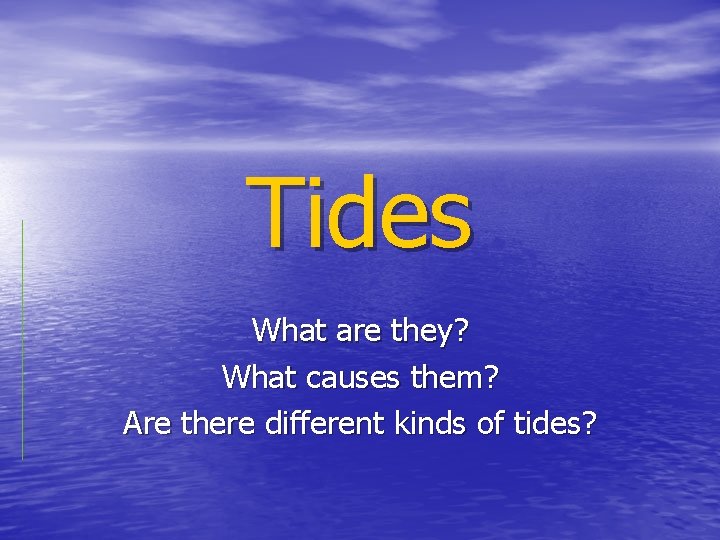
• Those of you who have spent some time on the beach have probably noticed that the water level of the ocean does not stay the same all day long. Although waves continually wash the shore, the actual water level changes as the day passes.
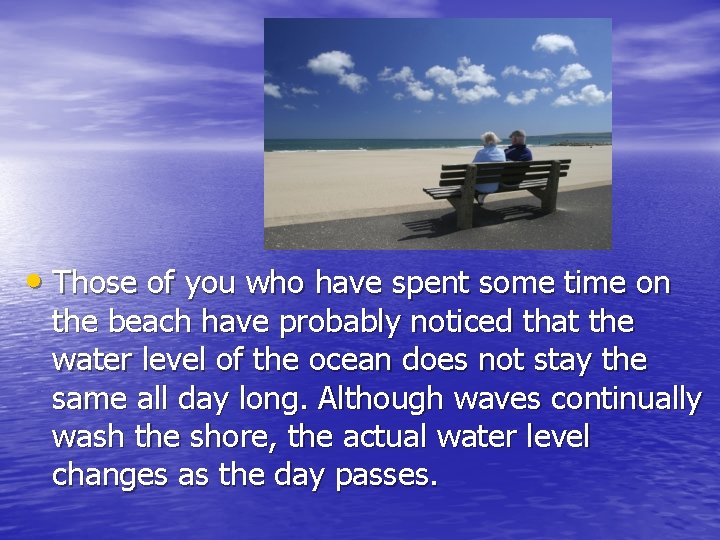
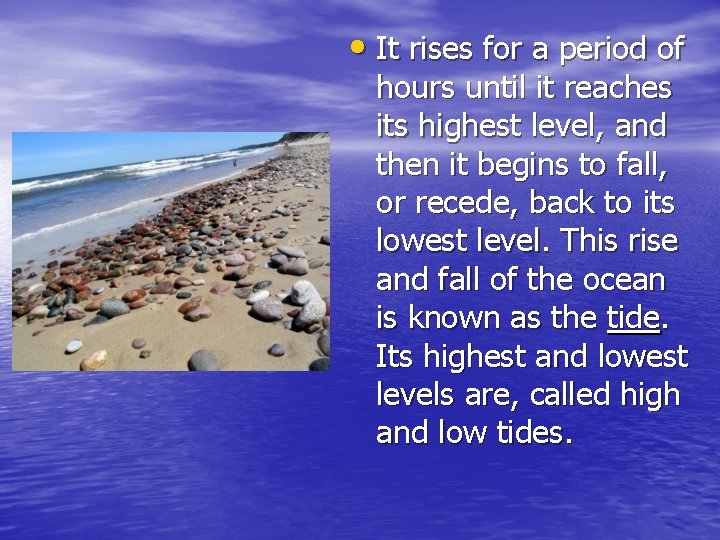
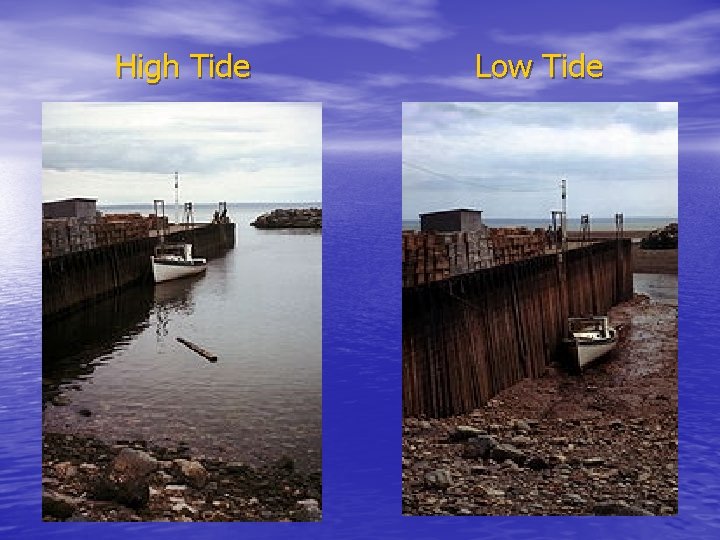
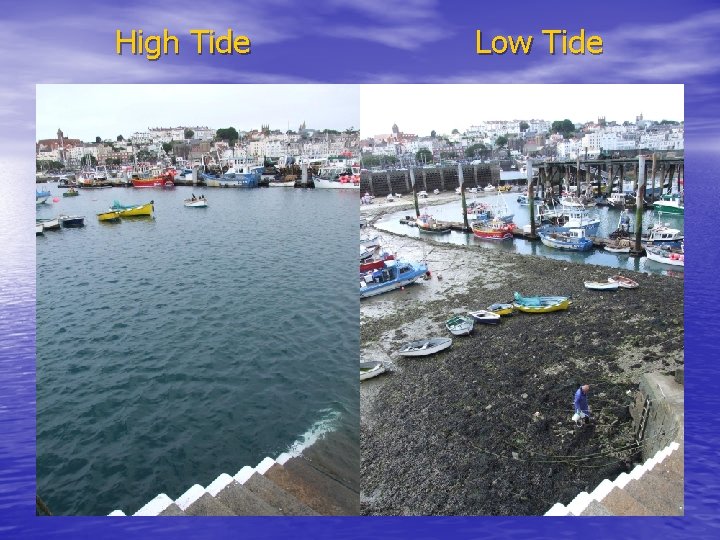
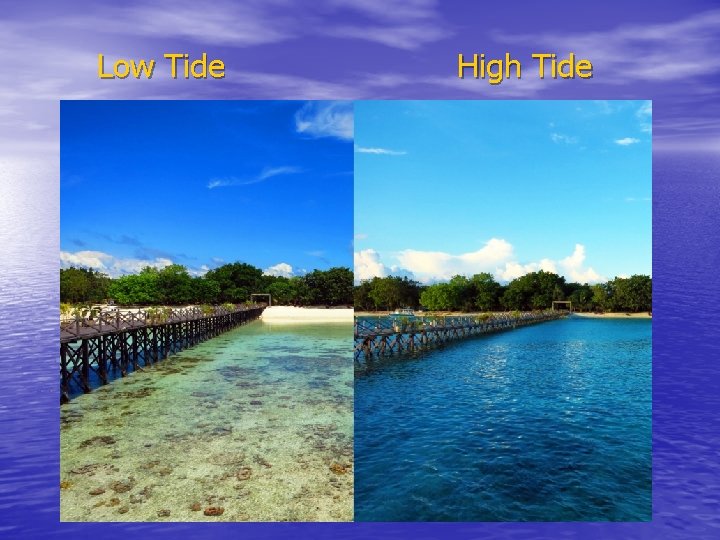
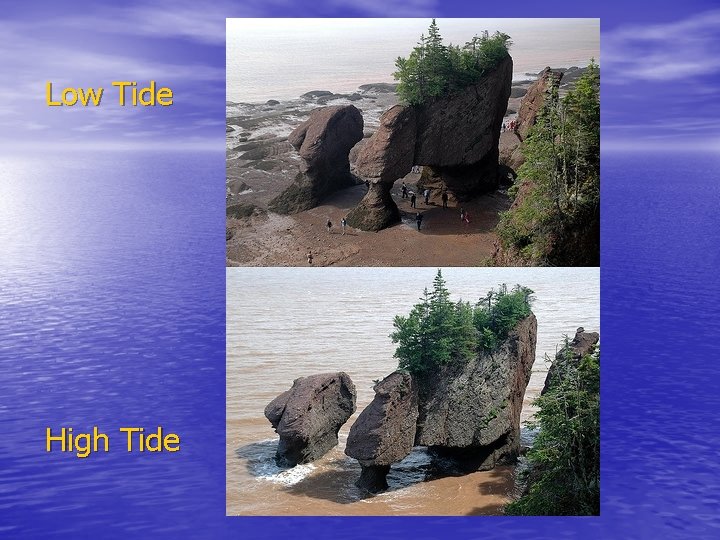
• It rises for a period of hours until it reaches its highest level, and then it begins to fall, or recede, back to its lowest level. This rise and fall of the ocean is known as the tide. Its highest and lowest levels are, called high and low tides.
High Tide Low Tide
High Tide Low Tide
Low Tide High Tide
Low Tide High Tide
Tides – What are they? • Tides are daily changes in the level of ocean water. • They are the periodic rise and fall of the water level in the oceans and other large bodies of water. • I wonder how often this periodic rise and fall happens each day?
What causes tides? What moves ocean water? • Wind • Earthquakes • Plate tectonics • The dominant (main) force that moves ocean water is the gravitational pull from both the moon and the sun.
What did humans use to think? • Some believed the Earth was a living animal and the tides a result of its breathing. • Others, who thought the ocean’s waters were the Earth’s blood, decided the tides were its pulse, caused by the beating of its large heart.
What did humans use to think? • Early followers of the religious prophet Muhammad believed that the rise and fall of the waters were caused when the “Angel of the Sea” placed his foot in and out of the ocean. • Some native people thought the tides were a sign of a sea god’s anger and made human sacrifices to please him.
The Lure of the Moon • The relationship between the phases of the moon and the tides was discovered more than 2, 000 years ago! • People of that time knew the moon had something to do with the tides, but they couldn’t explain why.
Sir Isaac Newton to the Rescue! • Newton’s Universal Gravitation theory helped to explain how the gravity of the moon (and the sun) were related to the tides on Earth.
What causes tides? • The gravity of the moon pulls on everything on the Earth. • The moon’s gravitational pull on liquids is much more noticeable than on solids. • Why? Because liquids move more easily than solid objects do.
What causes tides? • How often tides occur and the difference in tidal levels depend on the position of the moon as it revolves around the Earth. • The moon’s pull is strongest on the part of the Earth directly facing the moon.
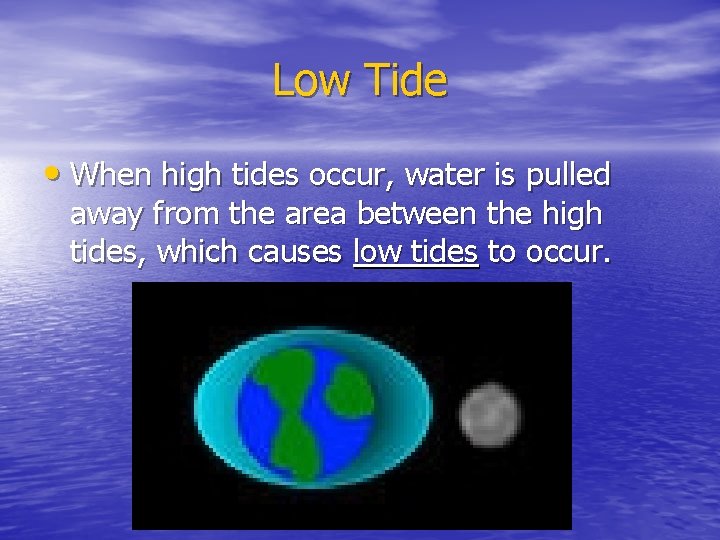
High Tide • The part of the ocean directly facing the moon, bulges towards the moon – pulled by the moon’s gravity. • There is a another bulge on the opposite side of the Earth where the moon’s gravity is weakest. • These bulges are called high tide.
Low Tide • When high tides occur, water is pulled away from the area between the high tides, which causes low tides to occur.
How often is there a change in tides? Try to figure it out. . . • High tides happen on opposite sides of the Earth. • The Earth rotates once on its axis every 24 hours. • How many high tides would any one place in the ocean experience each day?
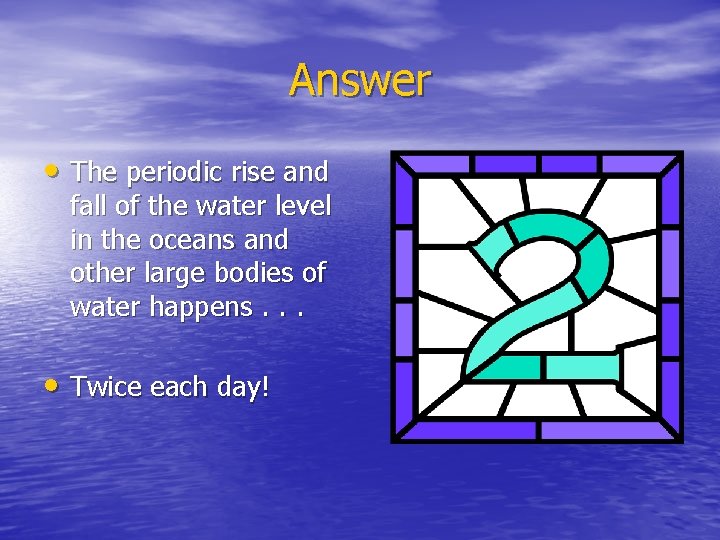
Answer • The periodic rise and fall of the water level in the oceans and other large bodies of water happens. . . • Twice each day!
What effect does the sun have on tides? • The sun is much larger than the moon. • The sun is farther away from the Earth than the moon. Q: Which one (the sun or the moon) do you think has a bigger effect on tides? A: The moon, just because it is closer.
Tidal Variations • Tidal Range = the difference in levels of ocean water at high tide and low tide. • Tidal ranges vary greatly due to the combined forces of the sun and the moon on the Earth. • It all depends on the positions of the Earth, moon, and the sun in space.
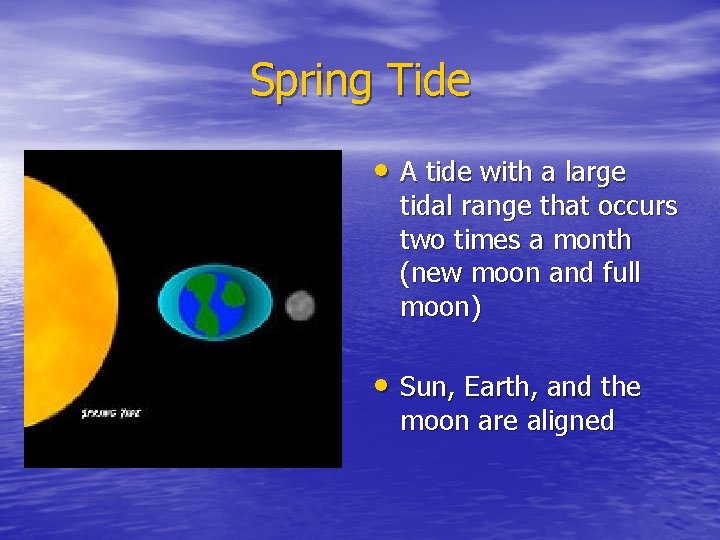
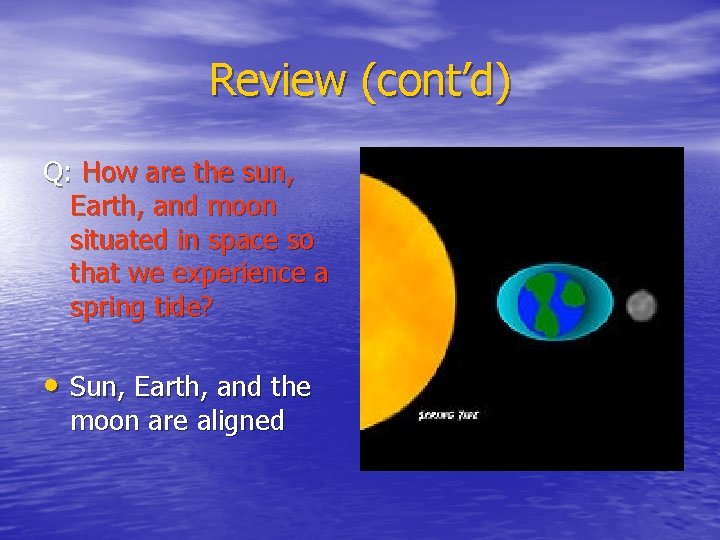
Spring Tide • A tide with a large tidal range that occurs two times a month (new moon and full moon) • Sun, Earth, and the moon are aligned
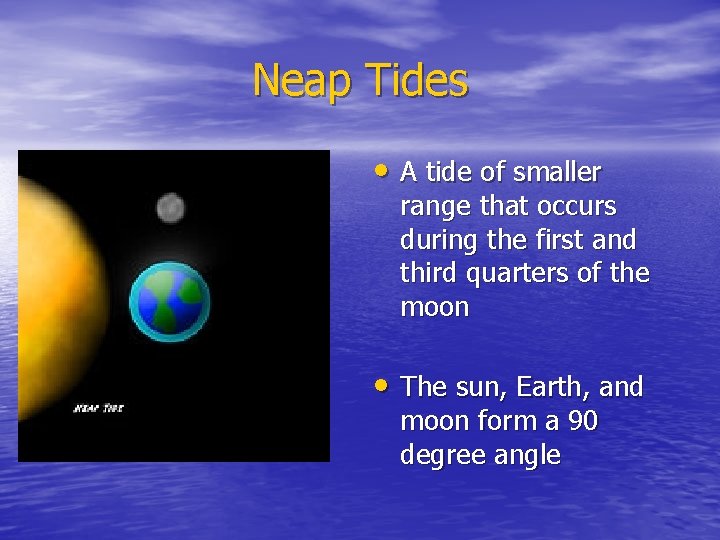
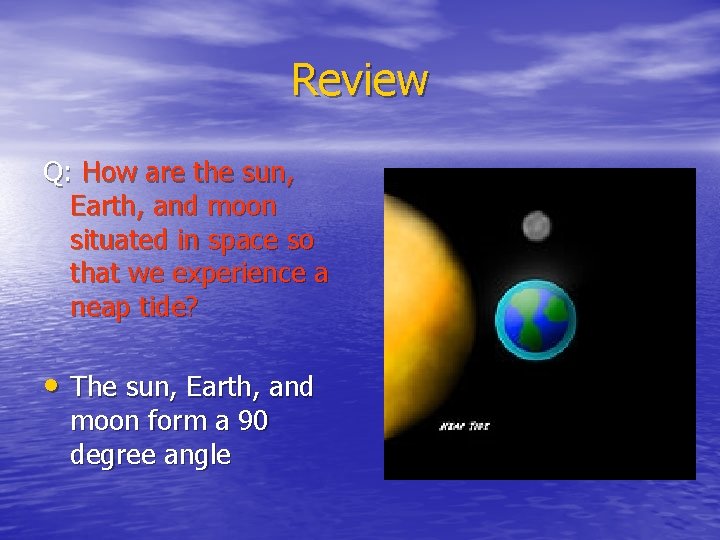
Neap Tides • A tide of smaller range that occurs during the first and third quarters of the moon • The sun, Earth, and moon form a 90 degree angle
Review Q: What are tides? • Tide = the periodic rise and fall of the water level in the oceans and other large bodies of water. Q: What is the dominant force that moves ocean water? • The gravitational forces from both the sun and the moon.
Review Q: Where is the moon’s pull is strongest on the Earth? • The moon’s pull is strongest on the part of the Earth directly facing the moon.
Review (cont’d) Q: Which one (the sun or the moon) has a bigger effect on tides? • The moon
Review (cont’d) Q: What is the difference in levels of ocean water at high tide and low tide called? • Tidal Range Q: Tidal ranges vary greatly due to the combined forces of the _____ and the ____ on the Earth • Sun, moon
Review (cont’d) Q: How are the sun, Earth, and moon situated in space so that we experience a spring tide? • Sun, Earth, and the moon are aligned
Review Q: How are the sun, Earth, and moon situated in space so that we experience a neap tide? • The sun, Earth, and moon form a 90 degree angle