
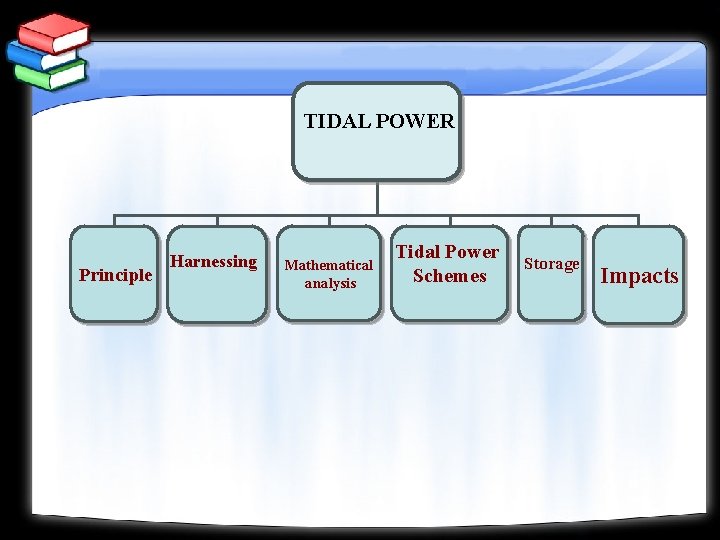
TIDAL POWER Principle Harnessing Mathematical analysis Tidal Power
- Slides: 16
TIDAL POWER Principle Harnessing Mathematical analysis Tidal Power Schemes Storage Impacts
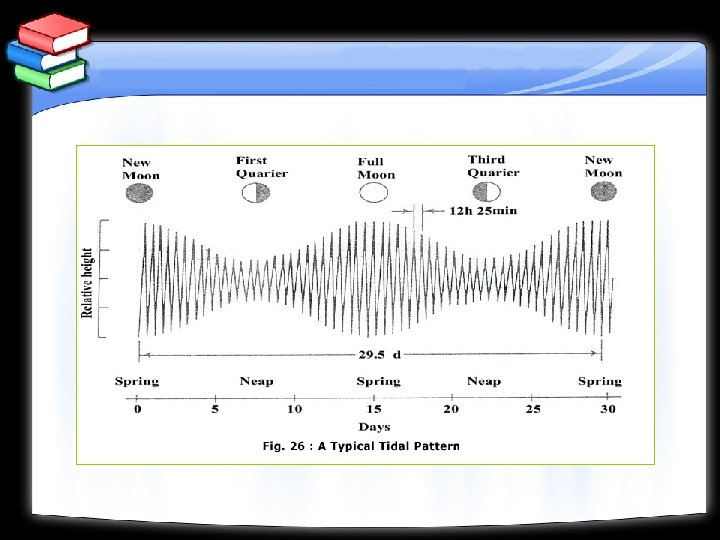
OBJECTIVES OF CHAPTER 3 (TIDAL POWER) By the end of the chapter students should be able to: • Clarifying why and how tides occur and how we can make use of this phenomenon. • Presenting how the amount of tidal energy could be calculated. • Presenting the schemes used for harnessing the tides such as to produce energy from its movement. • Clarifying the means of storing tidal power. • Presenting the possible impacts of tidal schemes, both positive and negative impacts are given. • Helping the students to distinguish and watch the incoming and outgoing tides while they are at the sea shore and how the movement of tides happens four times a day.
• Explain Principles of Tidal Power • Describe Mathematical analysis of Tidal Power • Determine Schemes of Tidal Power • Explain Storage and Possible Impacts of Tidal Schemes • Help making the students familiar with the calculations of the amount of TIDAL POWER • distinguish and watch the incoming and outgoing tides while they are at the sea shore and how the movement of tides happens four times a day.
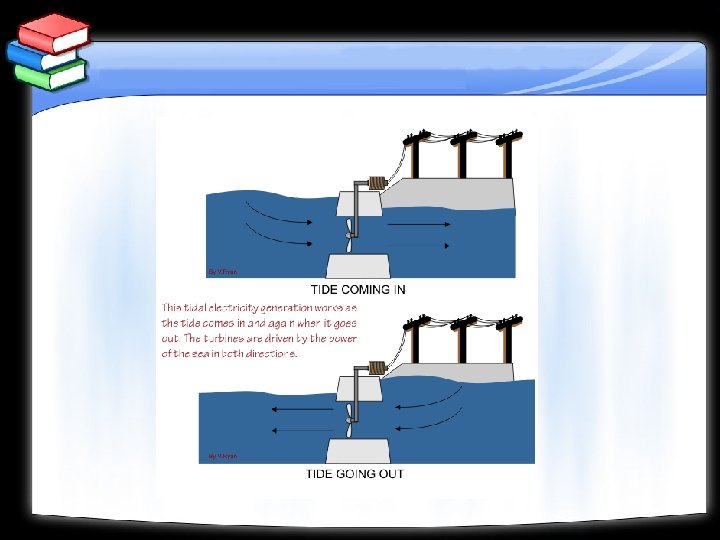
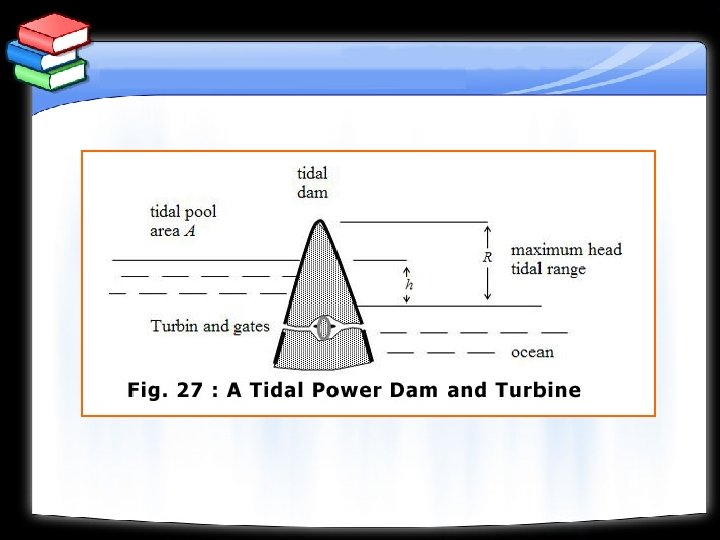
INTRODUCTION Tidal power is another way to generate electricity extracting energy from the sea (see also wave power). Twice a day enormous volumes of water rise and fall with the tides, and the UK is perfectly placed to take advantage of this free energy. Tidal power generation works differently to hydro-electricity, and wave power. A barrage (dam) is built across a river estuary - e. g. The Severn and water is pushed through a turbine and generator (fitted into tunnels in the barrage) as the tide comes in and goes out. For shipping to be able to pass, locks are built into the barrage which can be opened to allow the safe passage. There are obvious benefits to this type of tidal power generation e. g. the dam can act as a road bridge, and the nearby coastline is protected from powerful waves. However, there also disadvantages to local wildlife as the ecosystem is drastically changed near to the dam.
Glossary of chapter 3 Tidal energy g Gravitational energy A Area of basin, m 2 r Tidal range Pday Tidal power for one day Glossary of chapter 3 (wind energy): Coefficient of performance of a wind mill (CP): Is the ratio of power delivered by the rotor to the maximum power available in the wind.
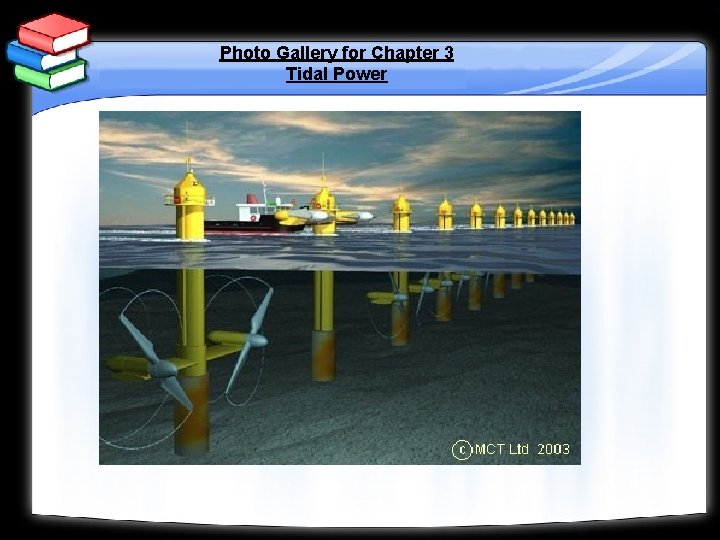
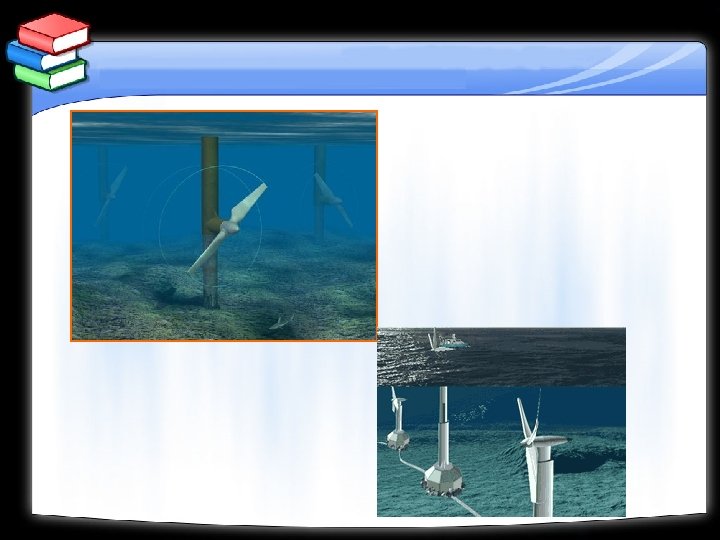
Photo Gallery for Chapter 3 Tidal Power
Advantages - Once you've built it, tidal power is free. - It produces no greenhouse gases or other waste. - It needs no fuel. - It produces electricity reliably. - Not expensive to maintain. - Tides are totally predictable. - Offshore turbines and vertical-axis turbines are not ruinously expensive to build and do not have a large environmental impact.
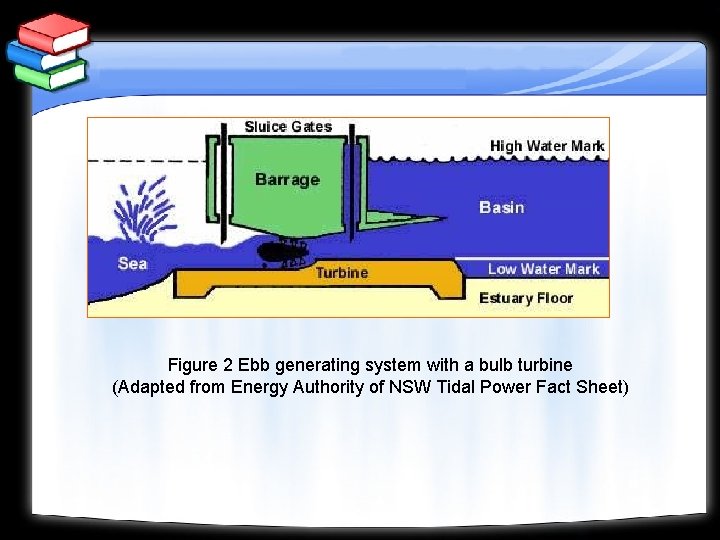
Figure 2 Ebb generating system with a bulb turbine (Adapted from Energy Authority of NSW Tidal Power Fact Sheet)
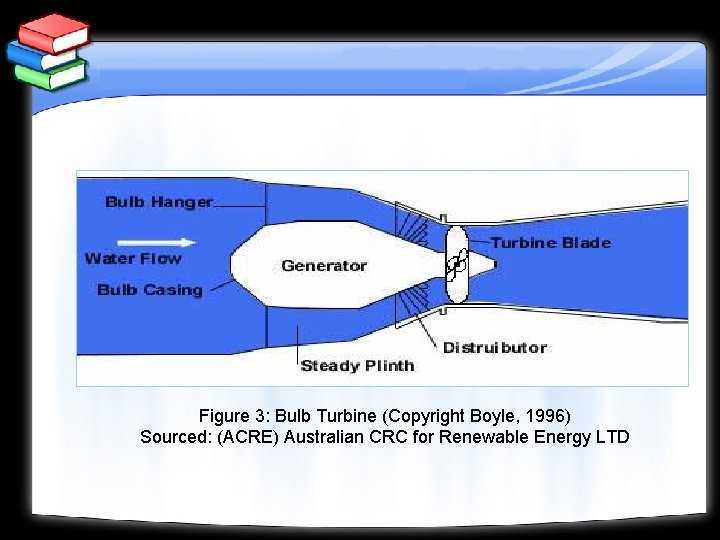
Figure 3: Bulb Turbine (Copyright Boyle, 1996) Sourced: (ACRE) Australian CRC for Renewable Energy LTD
Activities The following activities could be performed on different chapters of the course: Chapter 3 (Tidal power) Reports: • Students are asked to write a report on different ways of tapping tidal power. • Reporting on the possible impacts of tidal power. Chatting: • Students can discuss how tides occur and if they notice it while they are at the beach. • Students can chat on the different techniques used to make use of the tidal power and transferring it into a useful source of energy. • Students can chat on: when and how many times per day do the maximum and minimum tide occur and if they can notice it by themselves. Forum: Students are asked to discuss the areas , allover the world, that may have high potential for tidal power.
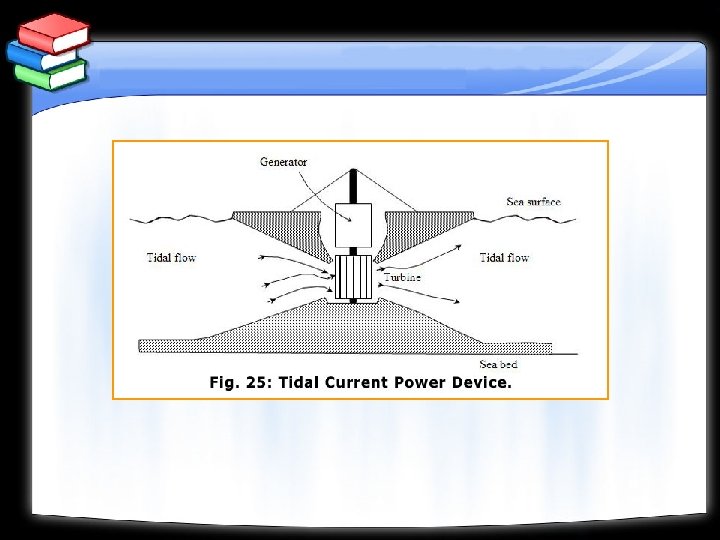
Summary Tidal power In this chapter it is illustrated how tides form and the factors affecting its magnitude. The principles of tidal power, the equations governing it and its potential as a renewable energy source is given. Besides, the differnt schemes used for harnessing tidal power are explained and assessed. Such schemes are: rotors, dams, turbines, pools and basins (both single and double basin schemes). Impacts of tidal schemes, both positive and negative impacts, are given.