
Ticks and the Diseases Blacklegged tick Ixodes scapularis

Ticks and the Diseases
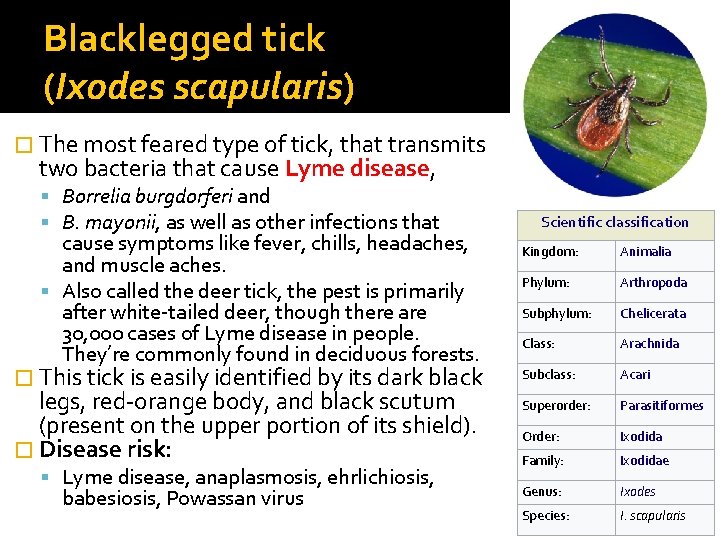
Blacklegged tick (Ixodes scapularis) � The most feared type of tick, that transmits two bacteria that cause Lyme disease, Borrelia burgdorferi and B. mayonii, as well as other infections that cause symptoms like fever, chills, headaches, and muscle aches. Also called the deer tick, the pest is primarily after white-tailed deer, though there are 30, 000 cases of Lyme disease in people. They’re commonly found in deciduous forests. � This tick is easily identified by its dark black legs, red-orange body, and black scutum (present on the upper portion of its shield). � Disease risk: Lyme disease, anaplasmosis, ehrlichiosis, babesiosis, Powassan virus Scientific classification Kingdom: Animalia Phylum: Arthropoda Subphylum: Chelicerata Class: Arachnida Subclass: Acari Superorder: Parasitiformes Order: Ixodida Family: Ixodidae Genus: Ixodes Species: I. scapularis
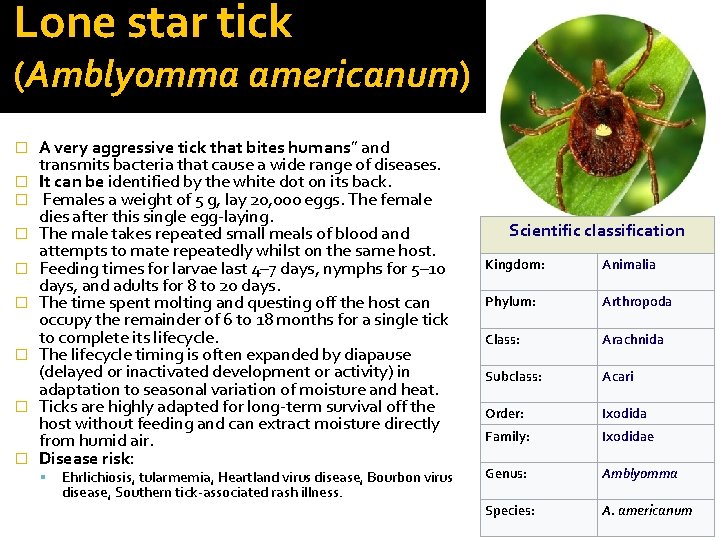
Lone star tick (Amblyomma americanum) � � � � � A very aggressive tick that bites humans” and transmits bacteria that cause a wide range of diseases. It can be identified by the white dot on its back. Females a weight of 5 g, lay 20, 000 eggs. The female dies after this single egg-laying. The male takes repeated small meals of blood and attempts to mate repeatedly whilst on the same host. Feeding times for larvae last 4– 7 days, nymphs for 5– 10 days, and adults for 8 to 20 days. The time spent molting and questing off the host can occupy the remainder of 6 to 18 months for a single tick to complete its lifecycle. The lifecycle timing is often expanded by diapause (delayed or inactivated development or activity) in adaptation to seasonal variation of moisture and heat. Ticks are highly adapted for long-term survival off the host without feeding and can extract moisture directly from humid air. Disease risk: Ehrlichiosis, tularmemia, Heartland virus disease, Bourbon virus disease, Southern tick-associated rash illness. Scientific classification Kingdom: Animalia Phylum: Arthropoda Class: Arachnida Subclass: Acari Order: Ixodida Family: Ixodidae Genus: Amblyomma Species: A. americanum
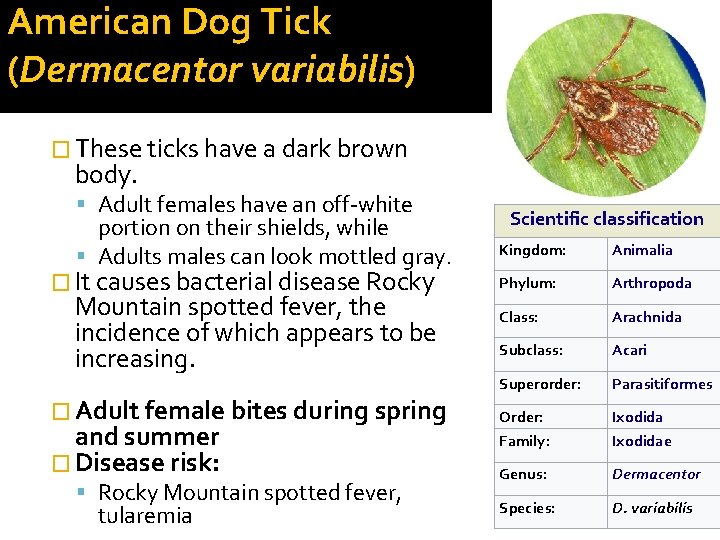
American Dog Tick (Dermacentor variabilis) � These ticks have a dark brown body. Adult females have an off-white portion on their shields, while Adults males can look mottled gray. � It causes bacterial disease Rocky Mountain spotted fever, the incidence of which appears to be increasing. � Adult female bites during spring and summer � Disease risk: Rocky Mountain spotted fever, tularemia Scientific classification Kingdom: Animalia Phylum: Arthropoda Class: Arachnida Subclass: Acari Superorder: Parasitiformes Order: Family: Ixodidae Genus: Dermacentor Species: D. variabilis
Lone star tick Contd…. Symptoms of Rocky Mountain spotted fever can first be noted by the appearance of a rash around the wrists and ankles that moves slowly up to the rest of the body and develops within 2– 5 days. � Other symptoms include � depression, lethargy, anorexia, blood in the urine, irregular heartbeat, discolored spots along the skin, inability to walk normally, loss of coordination, swelling or edema in the limbs, sudden bleeding from the nose or in the stools, difficulty with blood clotting, swollen lymph nodes, pain in the eyes, inflammation, hemorrhage, or conjunctivitis in the mucosal membranes. Symptoms of tularemia usually appear within 3– 5 days, but can appear as late as 21 days after transmission. Oftentimes, patients experience chills, swollen lymph nodes, and an ulceration at the site of the bite. � A tick bite does not automatically transfer diseases to the host. Instead, the tick must be attached to the host for a period of time, generally 6– 8 hours but sometimes as little as 3– 6 hours, before it is capable of transferring disease. The earlier the tick is removed from a host, the less likely it is to contract the illness. �
Treatment Lone star tick Contd…. � � � Doxycycline is effective to treat Rocky Mountain spotted fever in dogs. Doxycycline is given for 7– 21 days dependent on the dosage. Tetracycline is effective and administered more frequently, being given for 14– 21 days. Other antibiotic choices include enrofloxacin and chloramphenicol. Regularly checking dogs and oneself for ticks after hiking or playing in grassy areas and removing ticks as soon as possible decrease the chances a dog will contract a secondary illness carried by the tick. Spread the dog’s fur, grasp the tick as close to the skin as possible, and very gently pull straight upward in a slow, steady motion. Another removal method is a tick removal hook: one places the prongs of the device on either side of the tick and twists upward. Tick removal hooks are recommended in areas where ticks are common. Removing the tick with fingers is never a good idea because squeezing to grasp the tick could potentially inject more infectious material. � Apply rubbing alcohol to the bite area afterward to thoroughly clean the wound. �
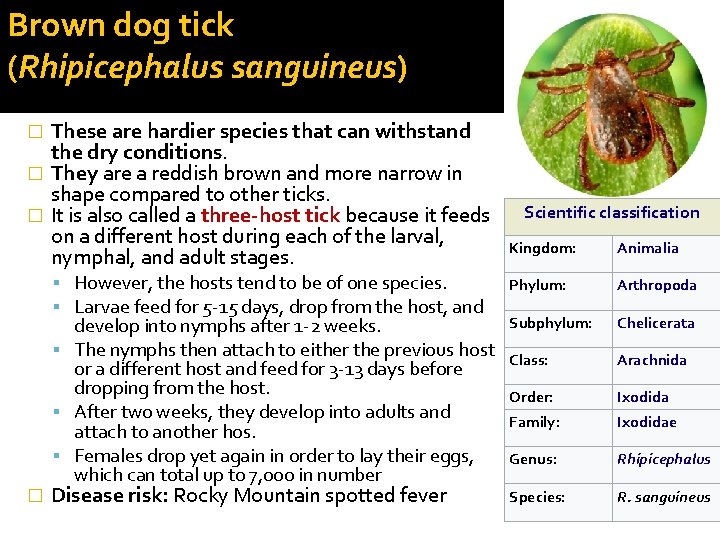
Brown dog tick (Rhipicephalus sanguineus) These are hardier species that can withstand the dry conditions. � They are a reddish brown and more narrow in shape compared to other ticks. � It is also called a three-host tick because it feeds on a different host during each of the larval, nymphal, and adult stages. � However, the hosts tend to be of one species. Larvae feed for 5 -15 days, drop from the host, and � develop into nymphs after 1 -2 weeks. The nymphs then attach to either the previous host or a different host and feed for 3 -13 days before dropping from the host. After two weeks, they develop into adults and attach to another hos. Females drop yet again in order to lay their eggs, which can total up to 7, 000 in number Disease risk: Rocky Mountain spotted fever Scientific classification Kingdom: Animalia Phylum: Arthropoda Subphylum: Chelicerata Class: Arachnida Order: Ixodida Family: Ixodidae Genus: Rhipicephalus Species: R. sanguineus
Contd…. �Vector-borne pathogens found in R. sanguineus[ Babesia vogeli Babesia canis Coxiella burnetii Ehrlichia canis Hepatozoon canis Mycoplasma haemocanis Rickettsia conorii Rickettsia rickettsii Wolbachia spp
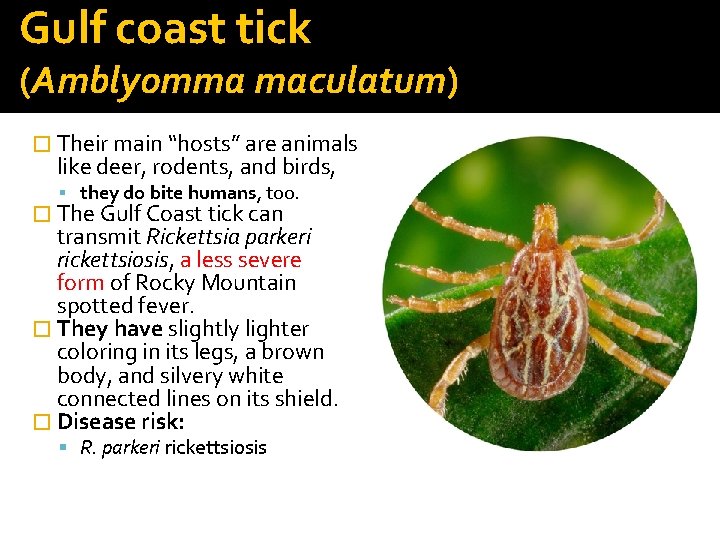
Gulf coast tick (Amblyomma maculatum) � Their main “hosts” are animals like deer, rodents, and birds, they do bite humans, too. � The Gulf Coast tick can transmit Rickettsia parkeri rickettsiosis, a less severe form of Rocky Mountain spotted fever. � They have slightly lighter coloring in its legs, a brown body, and silvery white connected lines on its shield. � Disease risk: R. parkeri rickettsiosis
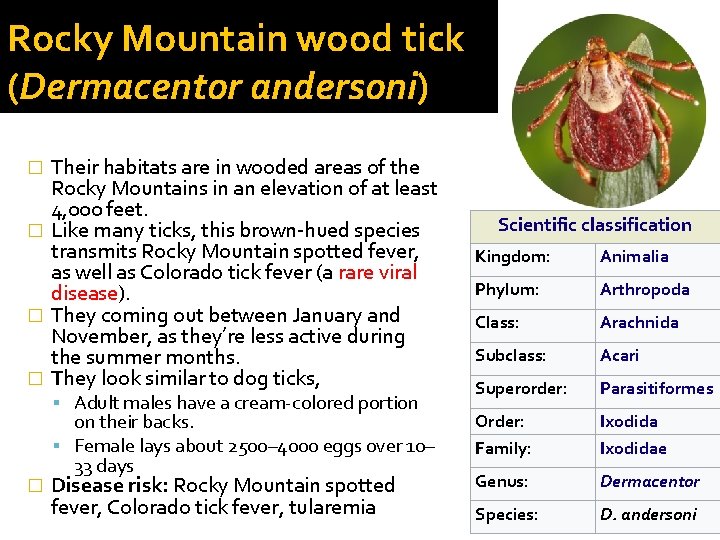
Rocky Mountain wood tick (Dermacentor andersoni) Their habitats are in wooded areas of the Rocky Mountains in an elevation of at least 4, 000 feet. � Like many ticks, this brown-hued species transmits Rocky Mountain spotted fever, as well as Colorado tick fever (a rare viral disease). � They coming out between January and November, as they’re less active during the summer months. � They look similar to dog ticks, � Adult males have a cream-colored portion � on their backs. Female lays about 2500– 4000 eggs over 10– 33 days Disease risk: Rocky Mountain spotted fever, Colorado tick fever, tularemia Scientific classification Kingdom: Animalia Phylum: Arthropoda Class: Arachnida Subclass: Acari Superorder: Parasitiformes Order: Family: Ixodidae Genus: Dermacentor Species: D. andersoni
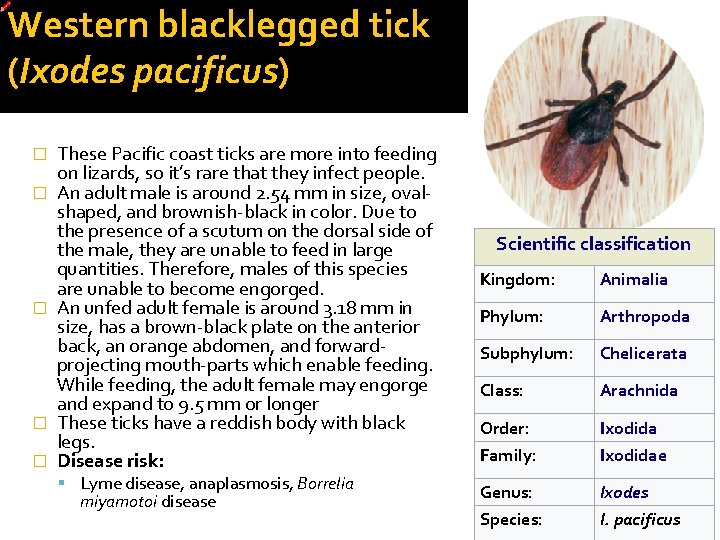
Western blacklegged tick (Ixodes pacificus) � � � These Pacific coast ticks are more into feeding on lizards, so it’s rare that they infect people. An adult male is around 2. 54 mm in size, ovalshaped, and brownish-black in color. Due to the presence of a scutum on the dorsal side of the male, they are unable to feed in large quantities. Therefore, males of this species are unable to become engorged. An unfed adult female is around 3. 18 mm in size, has a brown-black plate on the anterior back, an orange abdomen, and forwardprojecting mouth-parts which enable feeding. While feeding, the adult female may engorge and expand to 9. 5 mm or longer These ticks have a reddish body with black legs. Disease risk: Lyme disease, anaplasmosis, Borrelia miyamotoi disease Scientific classification Kingdom: Animalia Phylum: Arthropoda Subphylum: Chelicerata Class: Arachnida Order: Ixodida Family: Ixodidae Genus: Ixodes Species: I. pacificus
How to keep ticks away? � Wear protective clothing, like a long-sleeved shirt and pants, hat, and long socks. � Use tick repellents, which contain insect-repelling ingredients like DEET, oil of lemon eucalyptus, picaridin, and IR 3535. � Treating your clothing and gear with a permethrin- based product can also help to keep ticks away while in outdoors. � Once you’re at home, always do a full-body check under your arms, around your ears, inside your belly button, behind your knees, between your legs, and in your hair.
- Slides: 12