
Tick Size Constraints High Frequency Trading and Liquidity


- Slides: 50
Tick Size Constraints, High Frequency Trading and Liquidity Chen Yao University of Warwick Mao Ye University of Illinois at Urbana-Champaign December 8, 2014
What Are Tick Size Constraints Standard Walrasian equilibrium – Continuous price Reality – Discrete prices – SEC rule 612: 1 penny tick size • Prohibits stock exchanges from displaying orders in an increment smaller than $0. 01 if the quotation, order, or indication of interest is priced equal to or greater than $1. 00 per share. – Price control • Price competition on liquidity provision is constrained
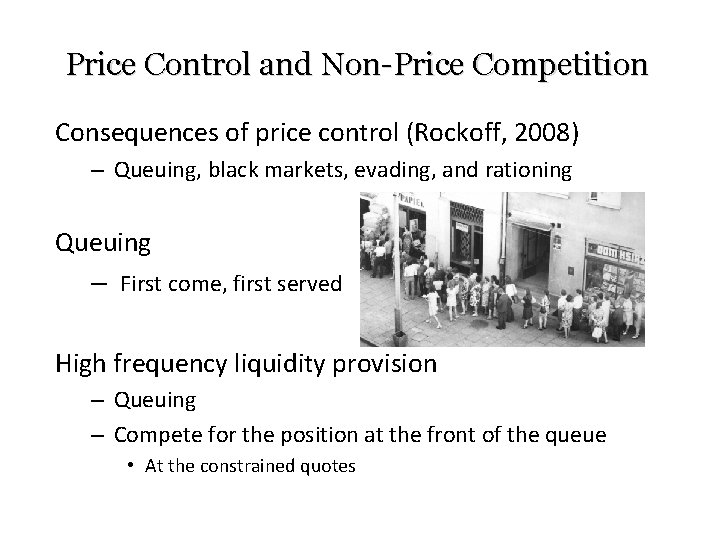
Price Control and Non-Price Competition Consequences of price control (Rockoff, 2008) – Queuing, black markets, evading, and rationing Queuing – First come, first served High frequency liquidity provision – Queuing – Compete for the position at the front of the queue • At the constrained quotes
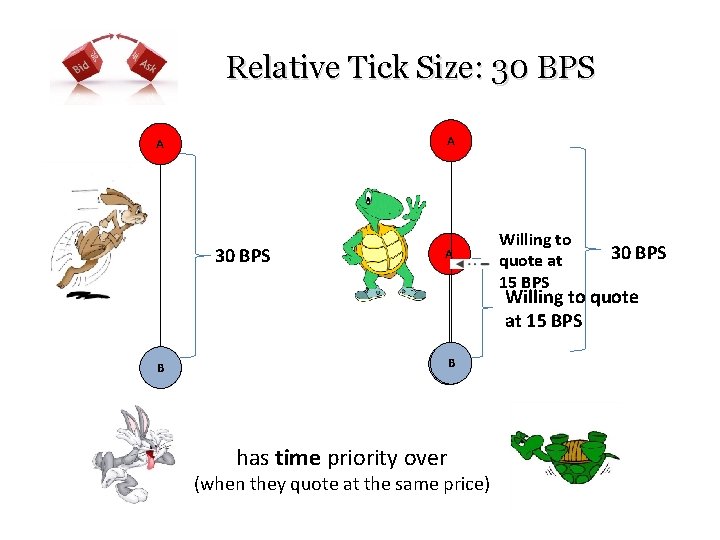
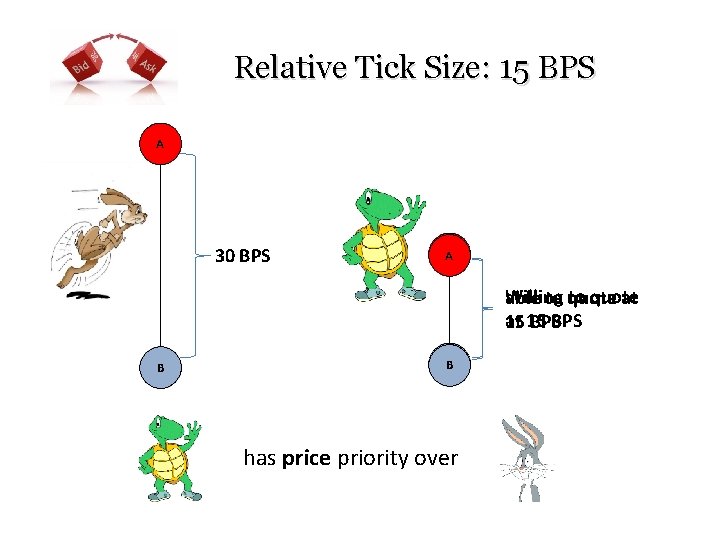
Price vs. Time Priority • NASDAQ market – Liquidity is provided by limit orders • Price priority – limit orders offering better prices execute first • limit sells at lower prices • limit buys at higher prices • Time priority – Limit orders at the same price are executed in the order in which they have been submitted
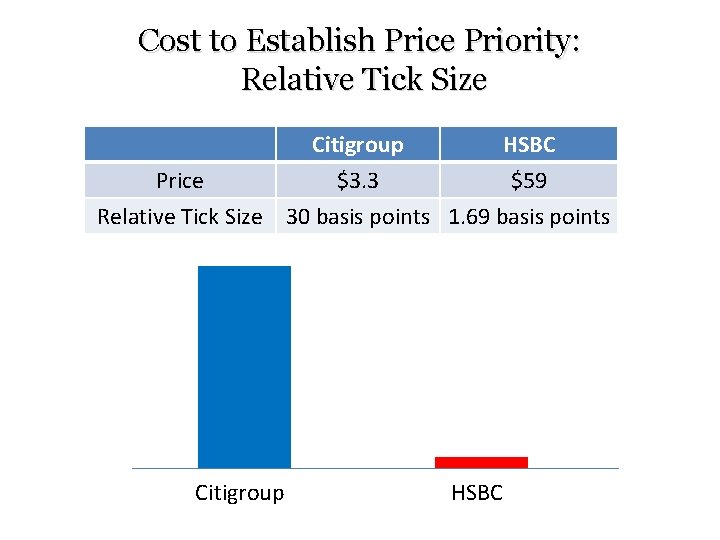
Cost to Establish Price Priority: Relative Tick Size Citigroup HSBC Price $3. 3 $59 Relative Tick Size 30 basis points 1. 69 basis points Citigroup HSBC
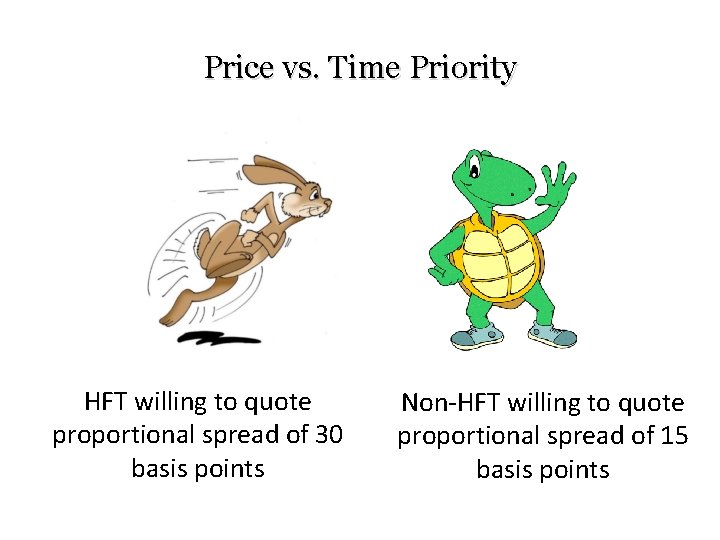
Price vs. Time Priority HFT willing to quote proportional spread of 30 basis points Non-HFT willing to quote proportional spread of 15 basis points
Relative Tick Size: 30 BPS A A 30 BPS A Willing to quote at 15 BPS 30 BPS Willing to quote at 15 BPS BB B has time priority over (when they quote at the same price)
Relative Tick Size: 15 BPS A 30 BPS A Willing to quote able to quote at at 15 15 BPSBPS B B has price priority over
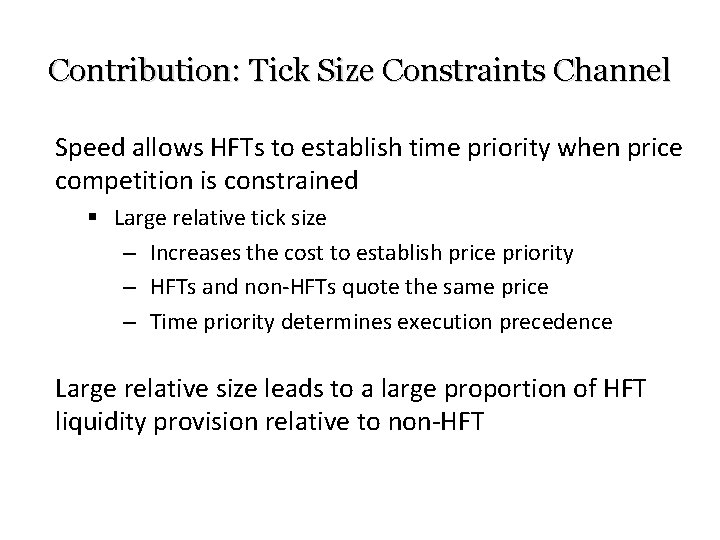
Contribution: Tick Size Constraints Channel Speed allows HFTs to establish time priority when price competition is constrained § Large relative tick size – Increases the cost to establish price priority – HFTs and non-HFTs quote the same price – Time priority determines execution precedence Large relative size leads to a large proportion of HFT liquidity provision relative to non-HFT
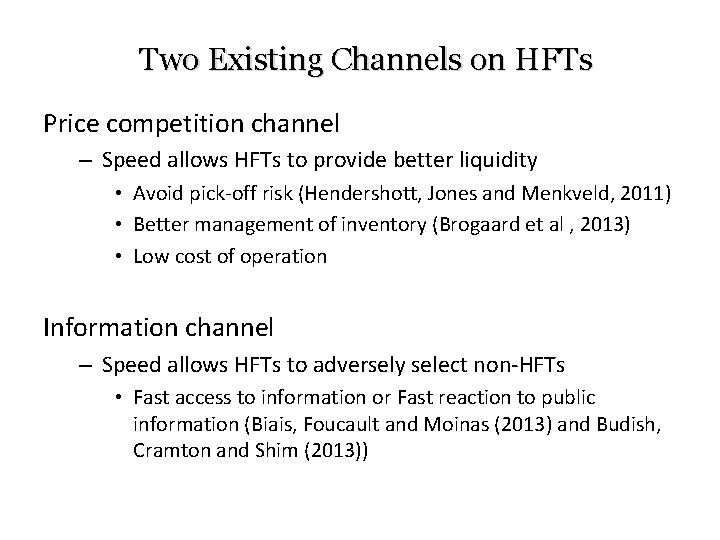
Two Existing Channels on HFTs Price competition channel – Speed allows HFTs to provide better liquidity • Avoid pick-off risk (Hendershott, Jones and Menkveld, 2011) • Better management of inventory (Brogaard et al , 2013) • Low cost of operation Information channel – Speed allows HFTs to adversely select non-HFTs • Fast access to information or Fast reaction to public information (Biais, Foucault and Moinas (2013) and Budish, Cramton and Shim (2013))
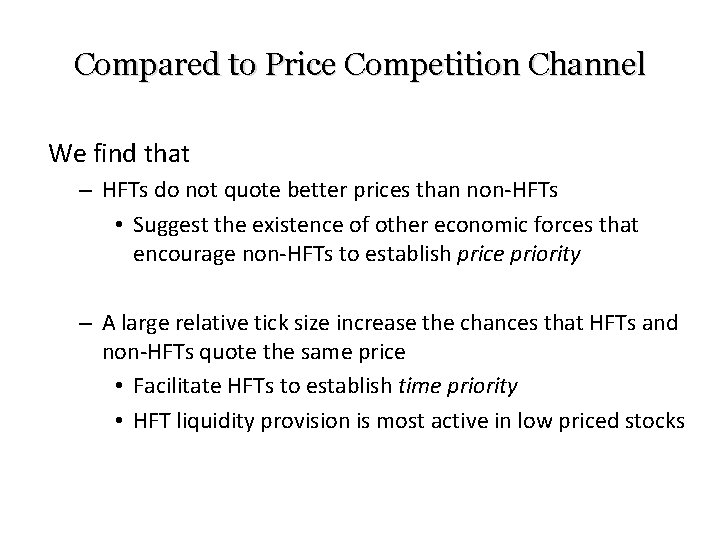
Compared to Price Competition Channel We find that – HFTs do not quote better prices than non-HFTs • Suggest the existence of other economic forces that encourage non-HFTs to establish price priority – A large relative tick size increase the chances that HFTs and non-HFTs quote the same price • Facilitate HFTs to establish time priority • HFT liquidity provision is most active in low priced stocks
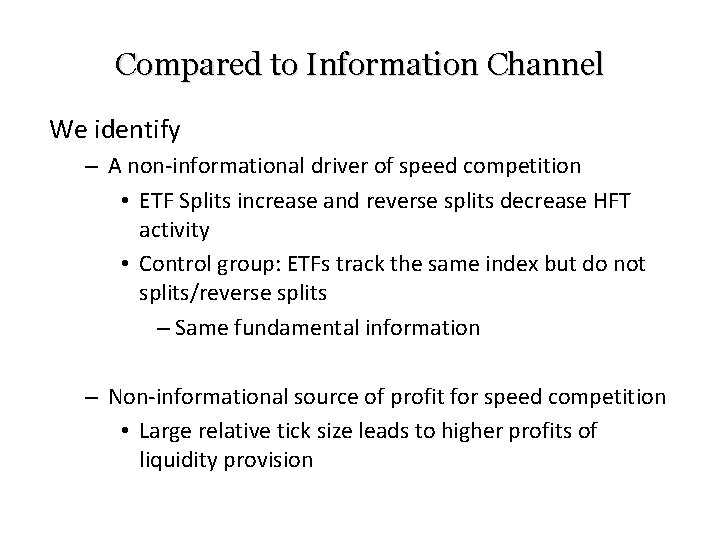
Compared to Information Channel We identify – A non-informational driver of speed competition • ETF Splits increase and reverse splits decrease HFT activity • Control group: ETFs track the same index but do not splits/reverse splits – Same fundamental information – Non-informational source of profit for speed competition • Large relative tick size leads to higher profits of liquidity provision
Roadmap Relative tick size and HFT liquidity provision – – Double sorting Regression analysis Diff-in-diff test Robustness checks Relative tick size and profit of liquidity provision
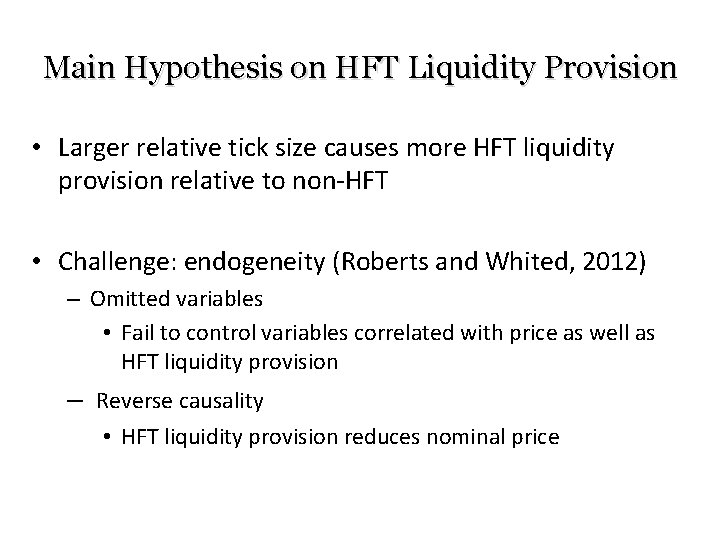
Main Hypothesis on HFT Liquidity Provision • Larger relative tick size causes more HFT liquidity provision relative to non-HFT • Challenge: endogeneity (Roberts and Whited, 2012) – Omitted variables • Fail to control variables correlated with price as well as HFT liquidity provision – Reverse causality • HFT liquidity provision reduces nominal price
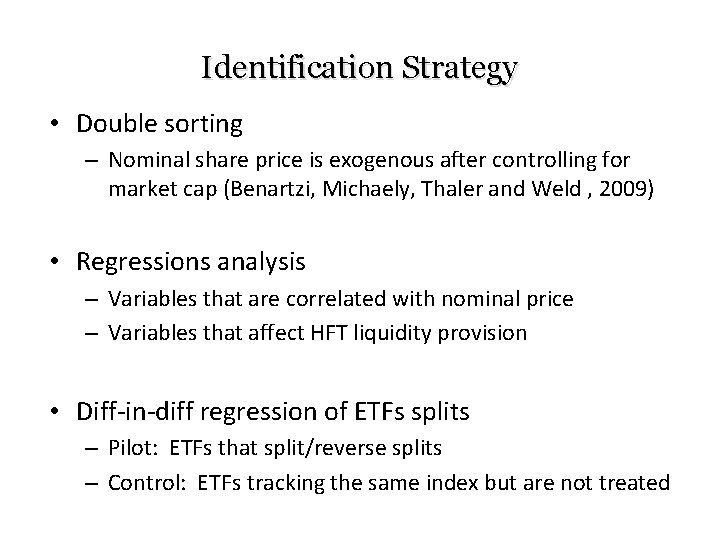
Identification Strategy • Double sorting – Nominal share price is exogenous after controlling for market cap (Benartzi, Michaely, Thaler and Weld , 2009) • Regressions analysis – Variables that are correlated with nominal price – Variables that affect HFT liquidity provision • Diff-in-diff regression of ETFs splits – Pilot: ETFs that split/reverse splits – Control: ETFs tracking the same index but are not treated
Roadmap Relative tick size and HFT liquidity provision – – Double sorting Regression analysis Diff-in-diff test Robustness checks Relative tick size and profit of liquidity provision
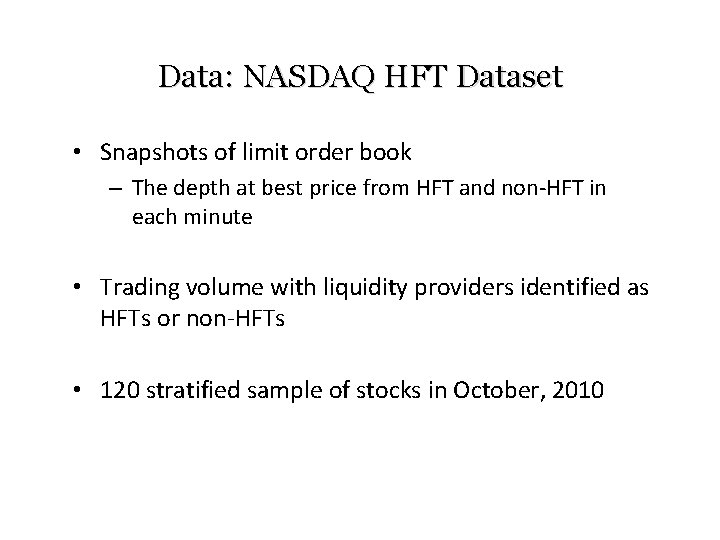
Data: NASDAQ HFT Dataset • Snapshots of limit order book – The depth at best price from HFT and non-HFT in each minute • Trading volume with liquidity providers identified as HFTs or non-HFTs • 120 stratified sample of stocks in October, 2010
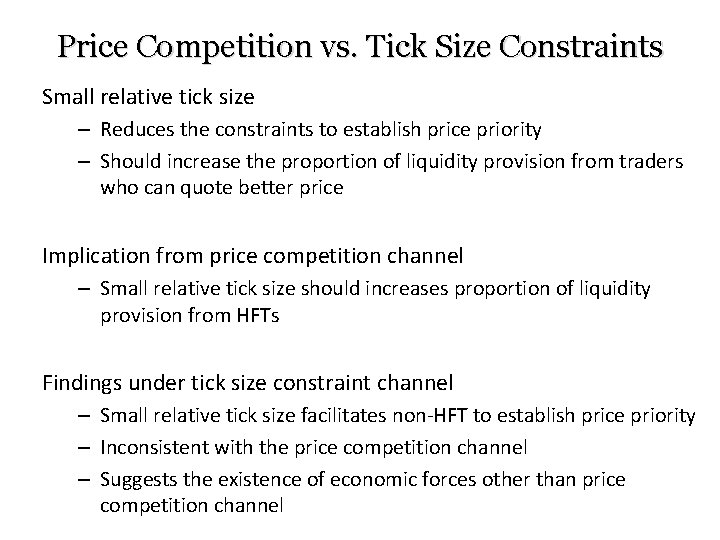
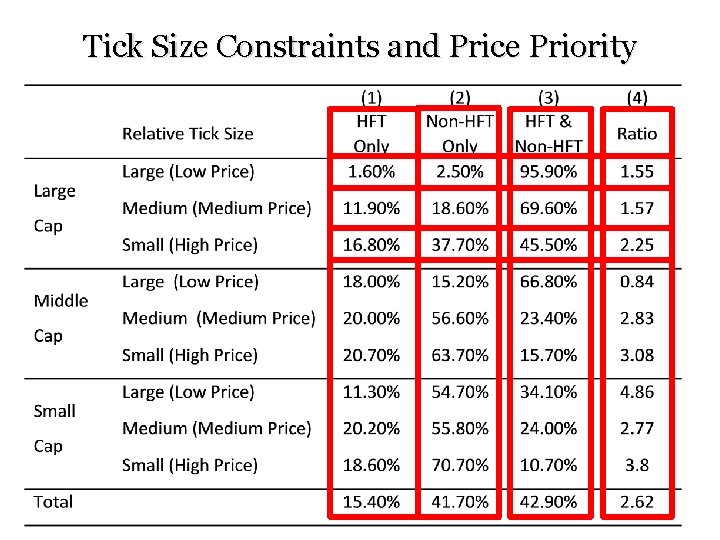
Price Competition vs. Tick Size Constraints Small relative tick size – Reduces the constraints to establish price priority – Should increase the proportion of liquidity provision from traders who can quote better price Implication from price competition channel – Small relative tick size should increases proportion of liquidity provision from HFTs Findings under tick size constraint channel – Small relative tick size facilitates non-HFT to establish price priority – Inconsistent with the price competition channel – Suggests the existence of economic forces other than price competition channel
Tick Size Constraints and Price Priority
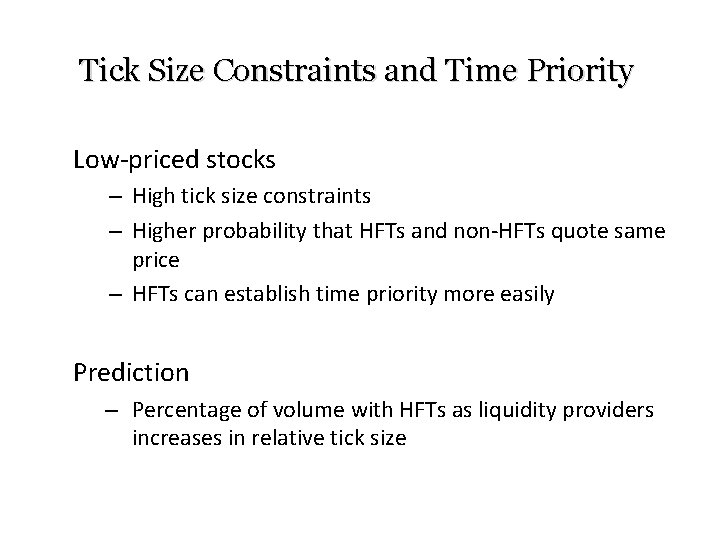
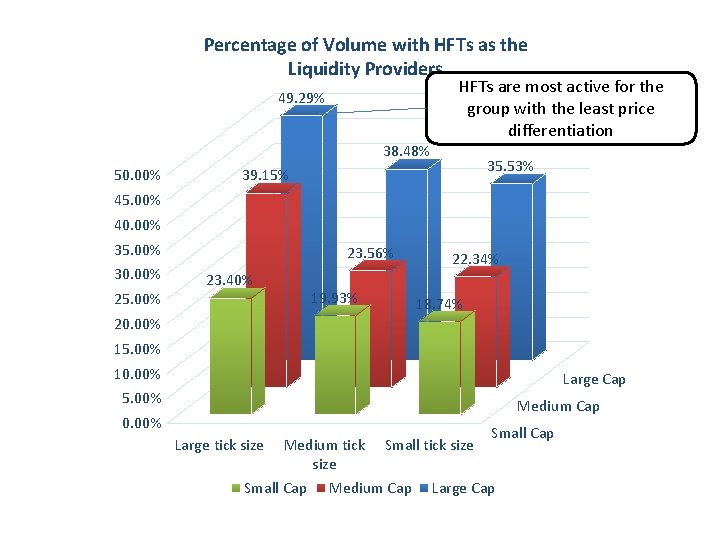
Tick Size Constraints and Time Priority Low-priced stocks – High tick size constraints – Higher probability that HFTs and non-HFTs quote same price – HFTs can establish time priority more easily Prediction – Percentage of volume with HFTs as liquidity providers increases in relative tick size
Percentage of Volume with HFTs as the Liquidity Providers HFTs are most active for the group with the least price differentiation 49. 29% 38. 48% 50. 00% 35. 53% 39. 15% 45. 00% 40. 00% 35. 00% 30. 00% 25. 00% 23. 56% 23. 40% 19. 93% 22. 34% 18. 74% 20. 00% 15. 00% 10. 00% 5. 00% 0. 00% Large Cap Medium Cap Small Cap Medium tick Small tick size Small Cap Medium Cap Large tick size
Roadmap Relative tick size and HFT liquidity provision – – Double sorting Regression analysis Diff-in-diff test More robustness checks Relative tick size and profit of liquidity provision
Omitted Variable Bias Causal relationship we aim to establish – Large relative tick size increases proportion of liquidity provided by HFT Biases occur if we fail to control variables correlated with both – Nominal prices (relative tick size) – HFT liquidity provision We search for control variables affecting at least one of them – Benartzi, Michaely, Thaler and Weld (2009)
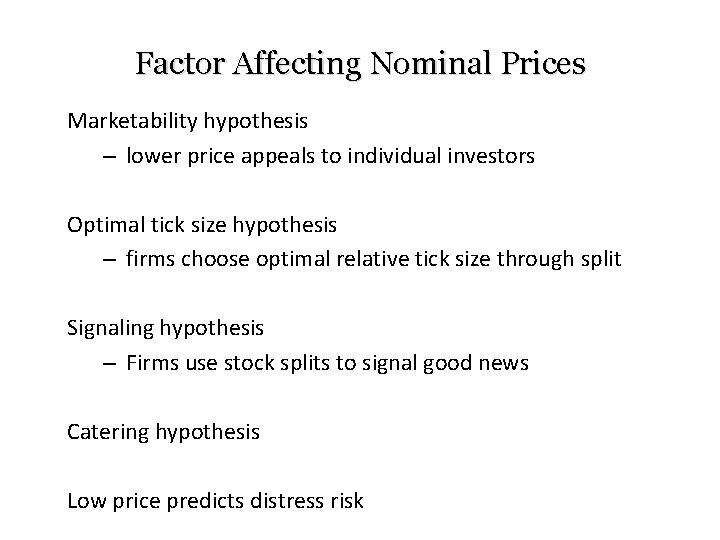
Factor Affecting Nominal Prices Marketability hypothesis – lower price appeals to individual investors Optimal tick size hypothesis – firms choose optimal relative tick size through split Signaling hypothesis – Firms use stock splits to signal good news Catering hypothesis Low price predicts distress risk
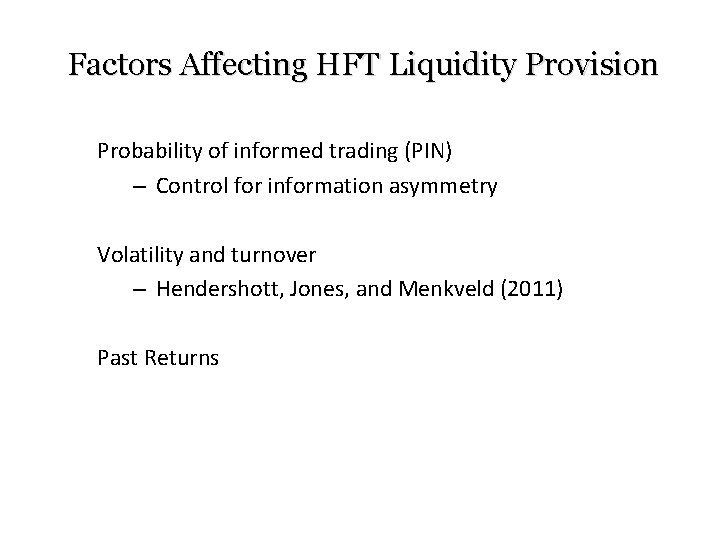
Factors Affecting HFT Liquidity Provision Probability of informed trading (PIN) – Control for information asymmetry Volatility and turnover – Hendershott, Jones, and Menkveld (2011) Past Returns
Tick Size Constraints and Time Priority •
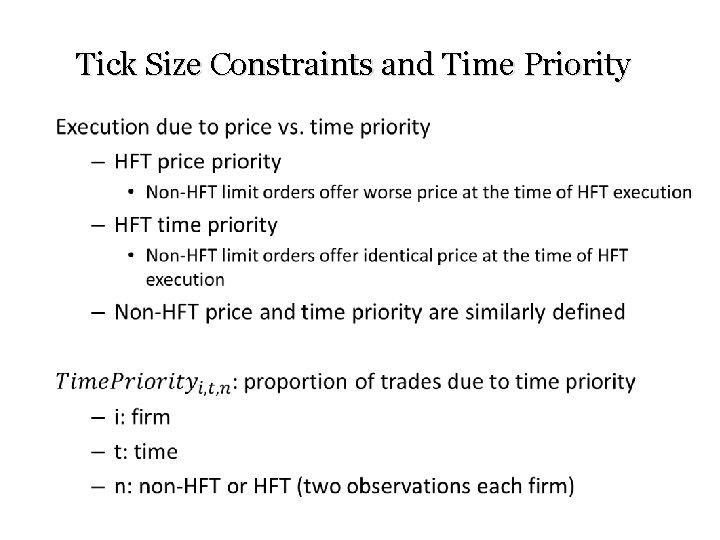
Specification and Results • Dependent Variable: Proportional of Volume due to Time Priority tick 3. 374*** (17. 94) HFTdummy 0. 077*** (8. 53) tick * HFTdummy 0. 439** (2. 09) R 2 0. 695 N 1074 Other Controls Yes Industry*time FE Yes More trades due to time priority with large relative tick size
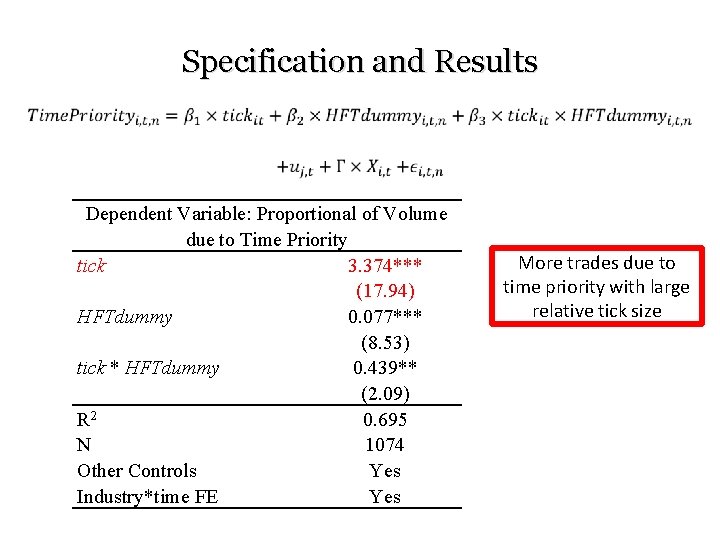
Specification and Results • Dependent Variable: Proportional of Volume due to Time Priority tick 3. 374*** (17. 94) HFTdummy 0. 077*** (8. 53) tick * HFTdummy 0. 439** (2. 09) R 2 0. 695 N 1074 Other Controls Yes Industry*time FE Yes More trades due to time priority for HFT
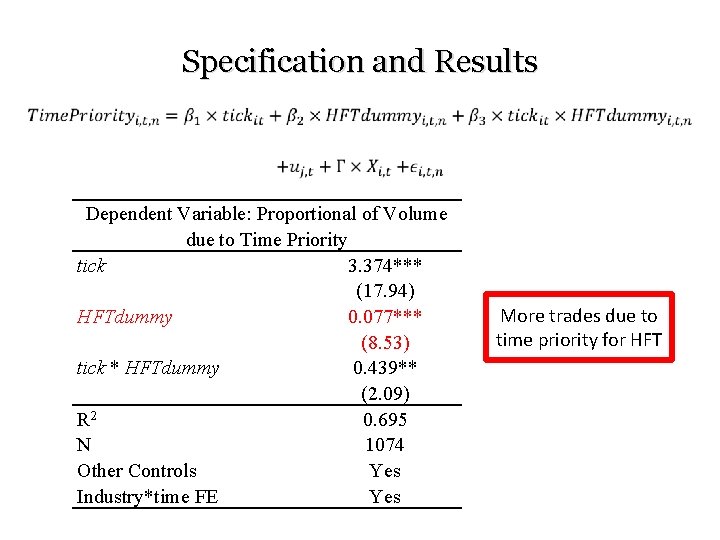
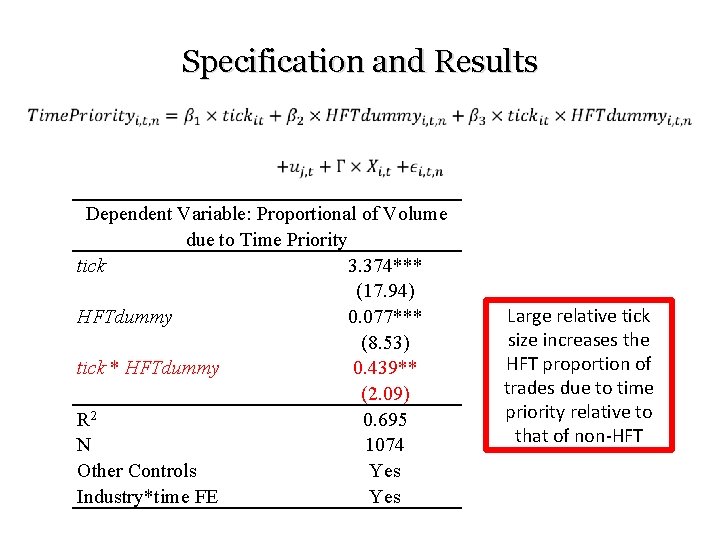
Specification and Results • Dependent Variable: Proportional of Volume due to Time Priority tick 3. 374*** (17. 94) HFTdummy 0. 077*** (8. 53) tick * HFTdummy 0. 439** (2. 09) R 2 0. 695 N 1074 Other Controls Yes Industry*time FE Yes Large relative tick size increases the HFT proportion of trades due to time priority relative to that of non-HFT
Roadmap Relative tick size and HFT liquidity provision – – Double sorting Regression analysis Diff-in-diff test More robustness checks Relative tick size and profit of liquidity provision
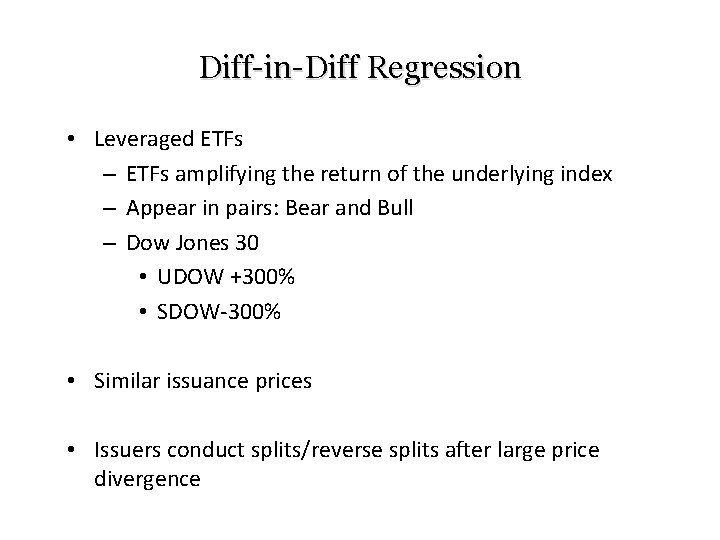
Diff-in-Diff Regression • Leveraged ETFs – ETFs amplifying the return of the underlying index – Appear in pairs: Bear and Bull – Dow Jones 30 • UDOW +300% • SDOW-300% • Similar issuance prices • Issuers conduct splits/reverse splits after large price divergence
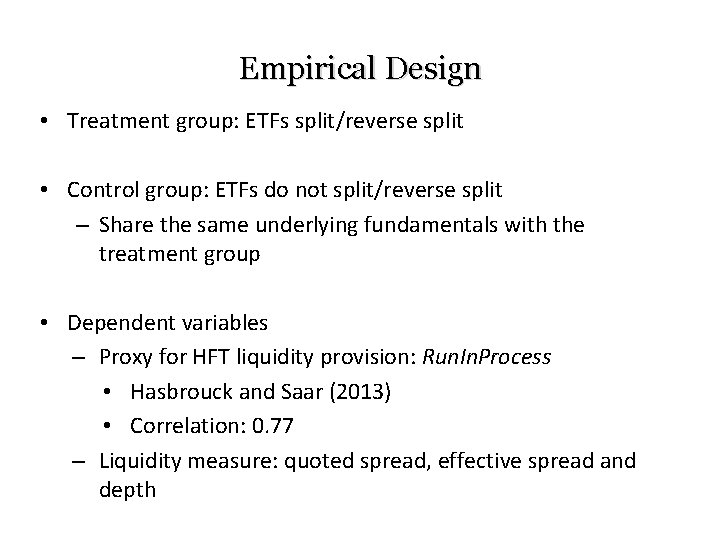
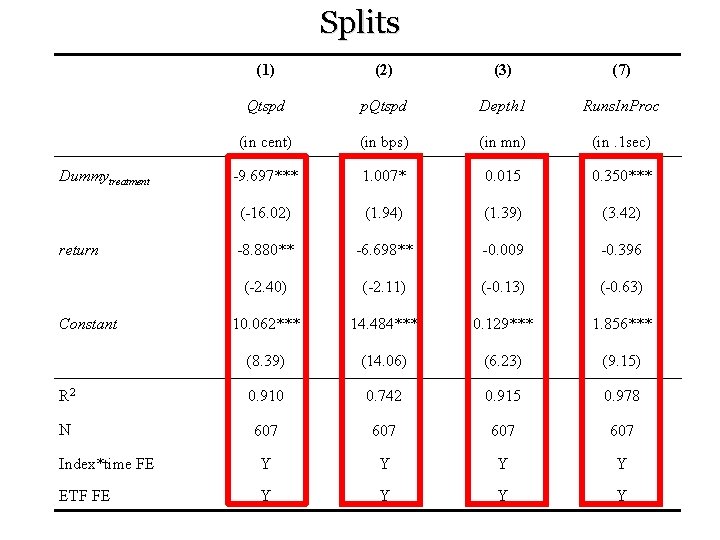
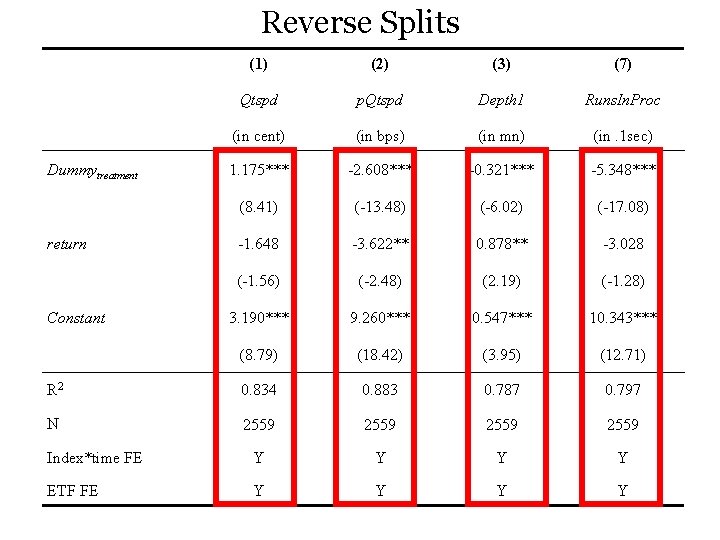
Empirical Design • Treatment group: ETFs split/reverse split • Control group: ETFs do not split/reverse split – Share the same underlying fundamentals with the treatment group • Dependent variables – Proxy for HFT liquidity provision: Run. In. Process • Hasbrouck and Saar (2013) • Correlation: 0. 77 – Liquidity measure: quoted spread, effective spread and depth
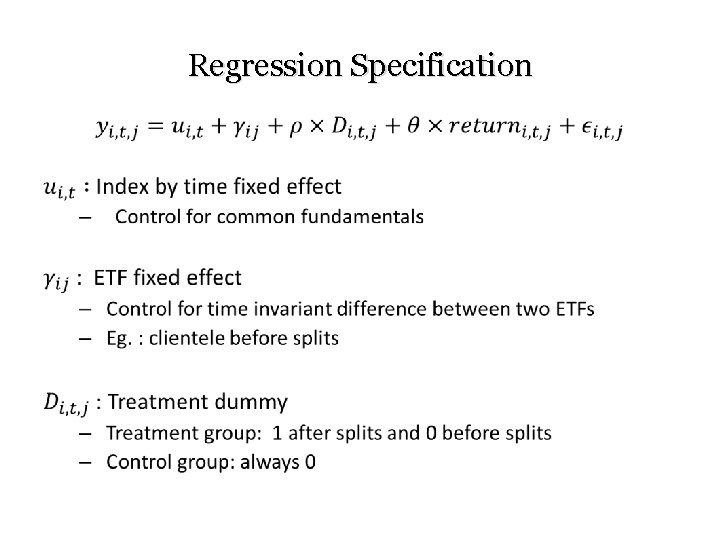
Regression Specification •
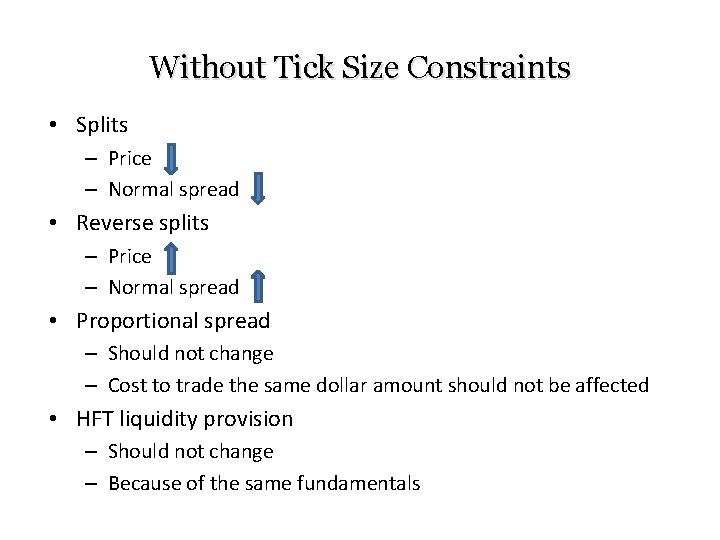
Without Tick Size Constraints • Splits – Price – Normal spread • Reverse splits – Price – Normal spread • Proportional spread – Should not change – Cost to trade the same dollar amount should not be affected • HFT liquidity provision – Should not change – Because of the same fundamentals
Splits (1) (2) (3) (7) Qtspd p. Qtspd Depth 1 Runs. In. Proc (in cent) (in bps) (in mn) (in. 1 sec) -9. 697*** 1. 007* 0. 015 0. 350*** (-16. 02) (1. 94) (1. 39) (3. 42) -8. 880** -6. 698** -0. 009 -0. 396 (-2. 40) (-2. 11) (-0. 13) (-0. 63) 10. 062*** 14. 484*** 0. 129*** 1. 856*** (8. 39) (14. 06) (6. 23) (9. 15) R 2 0. 910 0. 742 0. 915 0. 978 N 607 607 Index*time FE Y Y ETF FE Y Y Dummytreatment return Constant
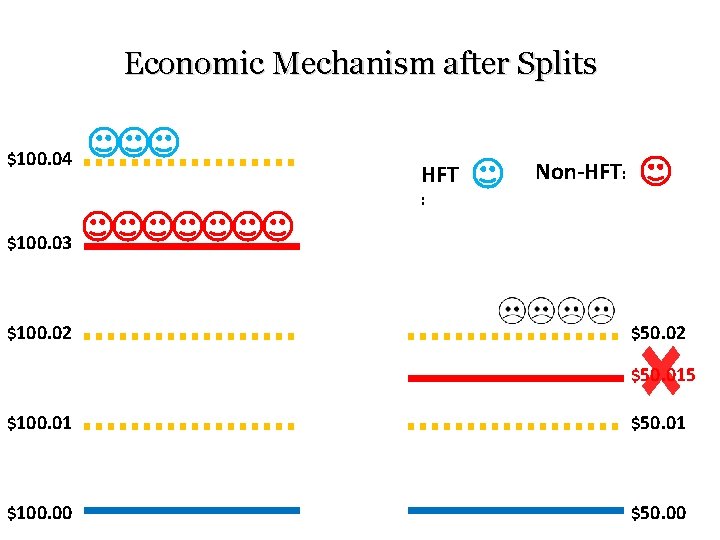
Economic Mechanism after Splits $100. 04 HFT Non-HFT: : $100. 03 $100. 02 $50. 015 $100. 01 $50. 01 $100. 00 $50. 00
Reverse Splits (1) (2) (3) (7) Qtspd p. Qtspd Depth 1 Runs. In. Proc (in cent) (in bps) (in mn) (in. 1 sec) 1. 175*** -2. 608*** -0. 321*** -5. 348*** (8. 41) (-13. 48) (-6. 02) (-17. 08) -1. 648 -3. 622** 0. 878** -3. 028 (-1. 56) (-2. 48) (2. 19) (-1. 28) 3. 190*** 9. 260*** 0. 547*** 10. 343*** (8. 79) (18. 42) (3. 95) (12. 71) R 2 0. 834 0. 883 0. 787 0. 797 N 2559 Index*time FE Y Y ETF FE Y Y Dummytreatment return Constant
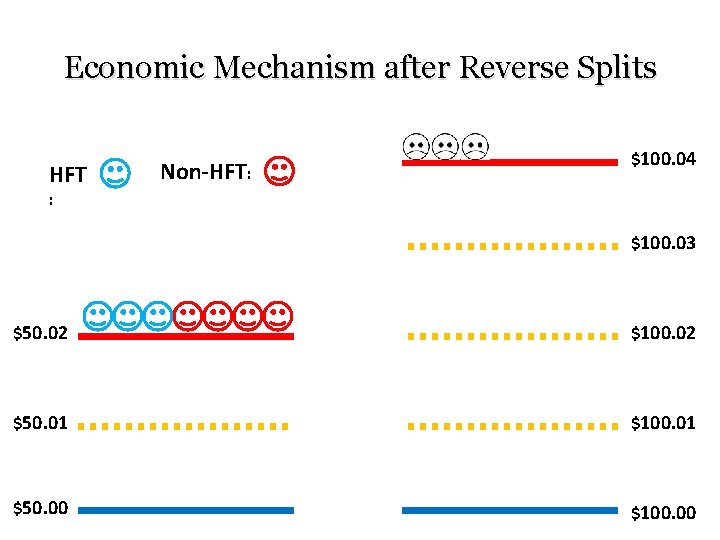
Economic Mechanism after Reverse Splits HFT Non-HFT: $100. 04 : $100. 03 $50. 02 $100. 02 $50. 01 $100. 01 $50. 00 $100. 00
Roadmap Relative tick size and HFT liquidity provision – – Double sorting Regression analysis Diff-in-diff test More robustness checks Relative tick size and profit of liquidity provision
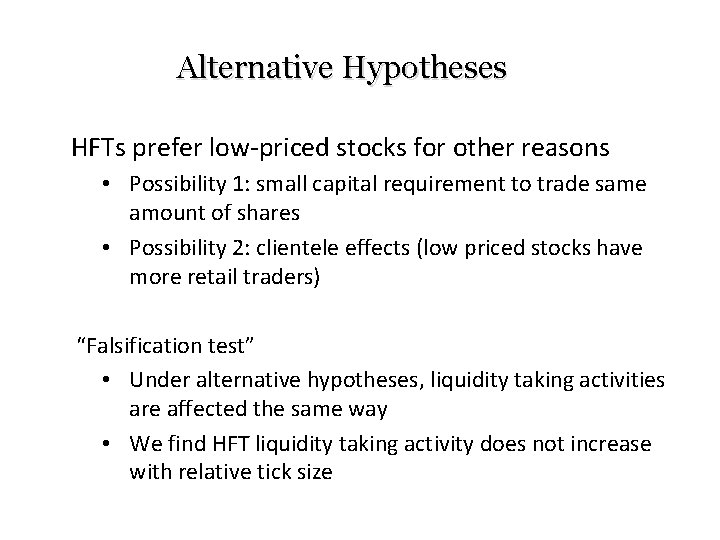
Alternative Hypotheses HFTs prefer low-priced stocks for other reasons • Possibility 1: small capital requirement to trade same amount of shares • Possibility 2: clientele effects (low priced stocks have more retail traders) “Falsification test” • Under alternative hypotheses, liquidity taking activities are affected the same way • We find HFT liquidity taking activity does not increase with relative tick size
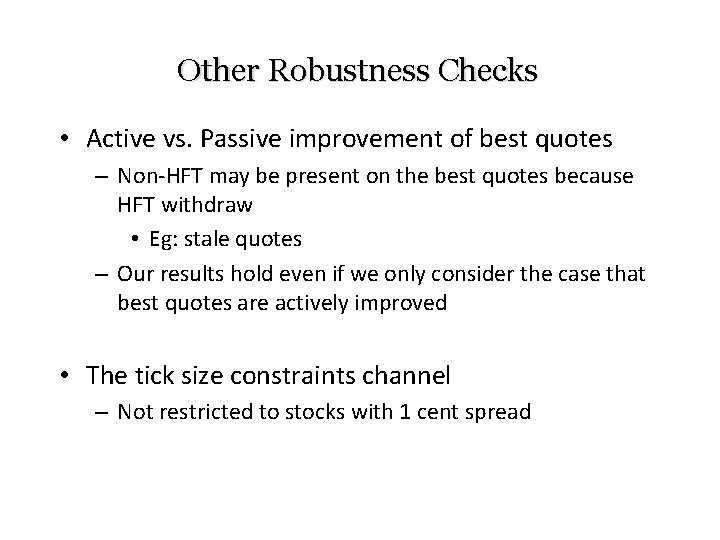
Other Robustness Checks • Active vs. Passive improvement of best quotes – Non-HFT may be present on the best quotes because HFT withdraw • Eg: stale quotes – Our results hold even if we only consider the case that best quotes are actively improved • The tick size constraints channel – Not restricted to stocks with 1 cent spread
Roadmap Relative tick size and HFT liquidity provision – – Double sorting Regression analysis Diff-in-diff test More robustness checks Relative tick size and profit of liquidity provision
Microstructure on Real Economy • Arms race in speed directly affect real resource allocation – Physical capital: investment in facilities to reduce latency – Human capital: competition for human talents • Indirect channels for market structure to affect real economy – Asset pricing channel (through affecting cost of capital) • Liquidity • Information risk • Ambiguity – Corporate finance channel • Liquidity • Price discovery
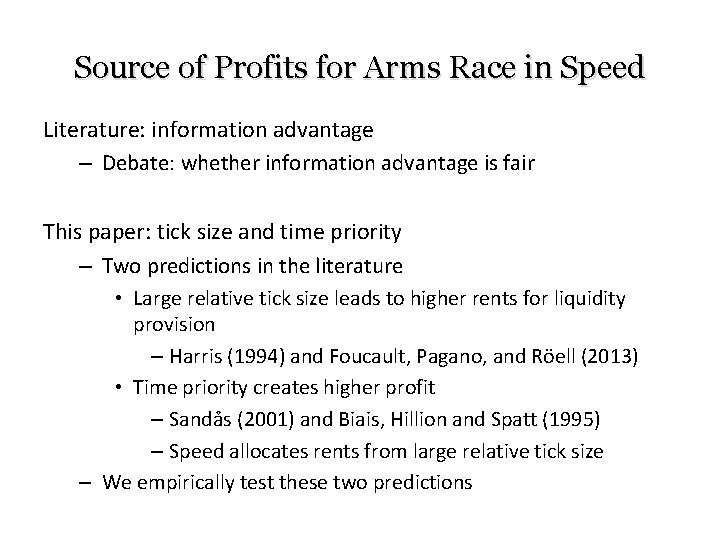
Source of Profits for Arms Race in Speed Literature: information advantage – Debate: whether information advantage is fair This paper: tick size and time priority – Two predictions in the literature • Large relative tick size leads to higher rents for liquidity provision – Harris (1994) and Foucault, Pagano, and Röell (2013) • Time priority creates higher profit – Sandås (2001) and Biais, Hillion and Spatt (1995) – Speed allocates rents from large relative tick size – We empirically test these two predictions
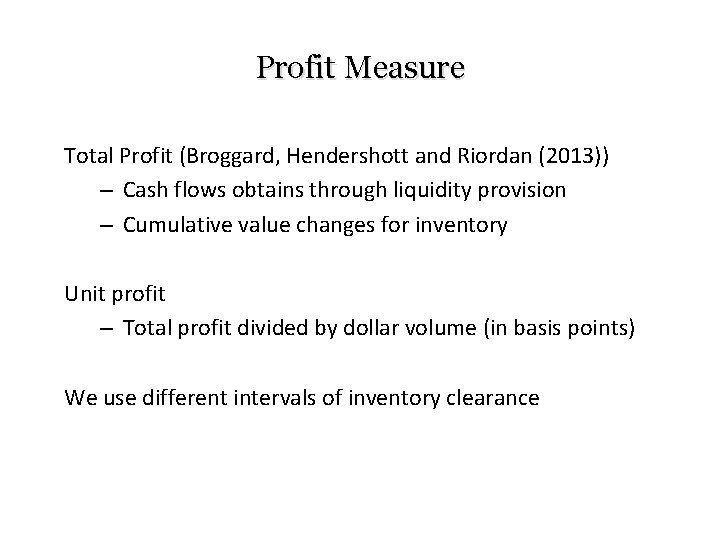
Profit Measure Total Profit (Broggard, Hendershott and Riordan (2013)) – Cash flows obtains through liquidity provision – Cumulative value changes for inventory Unit profit – Total profit divided by dollar volume (in basis points) We use different intervals of inventory clearance
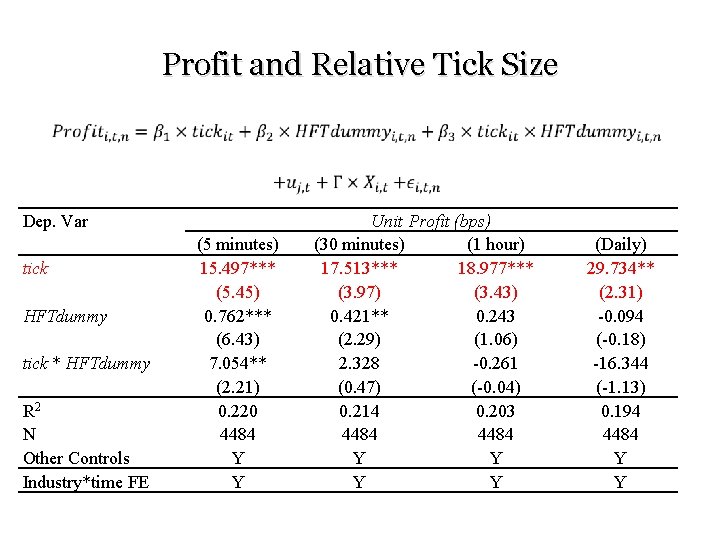
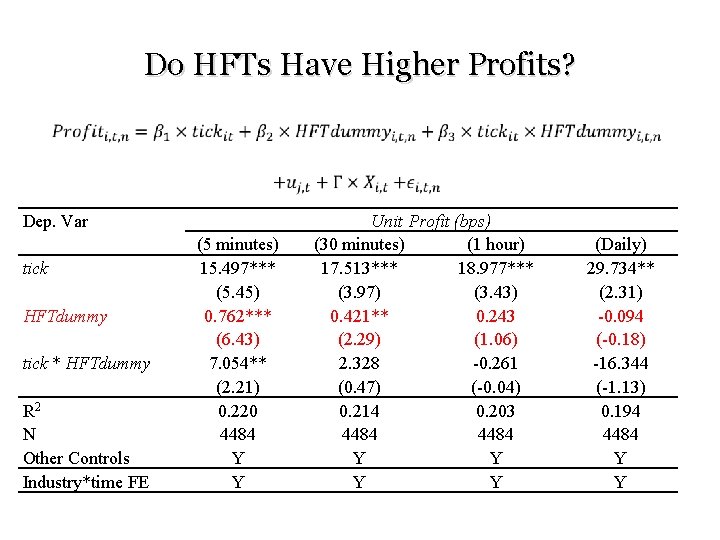
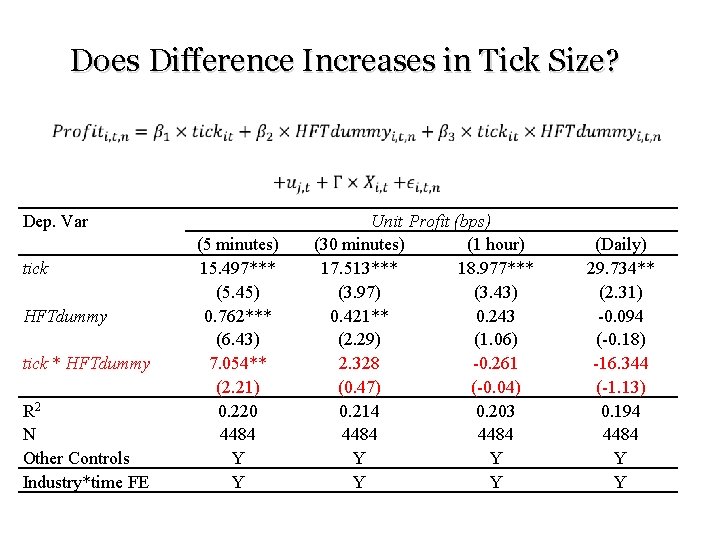
Profit and Relative Tick Size • Dep. Var tick HFTdummy tick * HFTdummy R 2 N Other Controls Industry*time FE (5 minutes) 15. 497*** (5. 45) 0. 762*** (6. 43) 7. 054** (2. 21) 0. 220 4484 Y Y Unit Profit (bps) (30 minutes) (1 hour) 17. 513*** 18. 977*** (3. 97) (3. 43) 0. 421** 0. 243 (2. 29) (1. 06) 2. 328 -0. 261 (0. 47) (-0. 04) 0. 214 0. 203 4484 Y Y (Daily) 29. 734** (2. 31) -0. 094 (-0. 18) -16. 344 (-1. 13) 0. 194 4484 Y Y
Do HFTs Have Higher Profits? • Dep. Var tick HFTdummy tick * HFTdummy R 2 N Other Controls Industry*time FE (5 minutes) 15. 497*** (5. 45) 0. 762*** (6. 43) 7. 054** (2. 21) 0. 220 4484 Y Y Unit Profit (bps) (30 minutes) (1 hour) 17. 513*** 18. 977*** (3. 97) (3. 43) 0. 421** 0. 243 (2. 29) (1. 06) 2. 328 -0. 261 (0. 47) (-0. 04) 0. 214 0. 203 4484 Y Y (Daily) 29. 734** (2. 31) -0. 094 (-0. 18) -16. 344 (-1. 13) 0. 194 4484 Y Y
Does Difference Increases in Tick Size? • Dep. Var tick HFTdummy tick * HFTdummy R 2 N Other Controls Industry*time FE (5 minutes) 15. 497*** (5. 45) 0. 762*** (6. 43) 7. 054** (2. 21) 0. 220 4484 Y Y Unit Profit (bps) (30 minutes) (1 hour) 17. 513*** 18. 977*** (3. 97) (3. 43) 0. 421** 0. 243 (2. 29) (1. 06) 2. 328 -0. 261 (0. 47) (-0. 04) 0. 214 0. 203 4484 Y Y (Daily) 29. 734** (2. 31) -0. 094 (-0. 18) -16. 344 (-1. 13) 0. 194 4484 Y Y
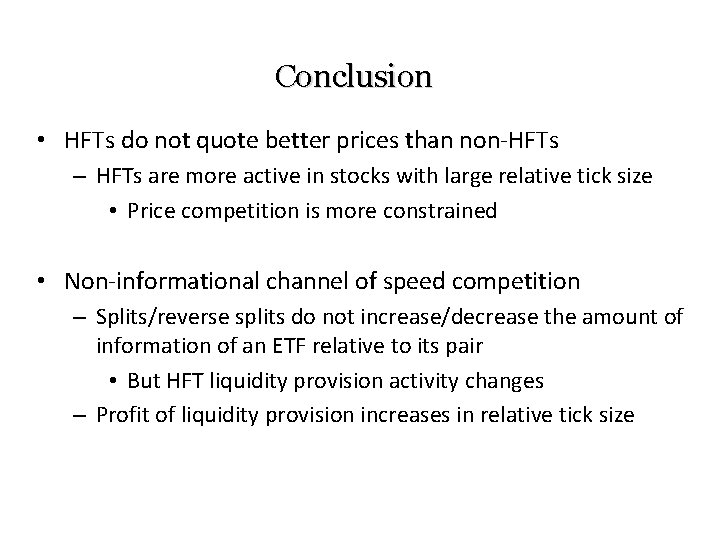
Conclusion • HFTs do not quote better prices than non-HFTs – HFTs are more active in stocks with large relative tick size • Price competition is more constrained • Non-informational channel of speed competition – Splits/reverse splits do not increase/decrease the amount of information of an ETF relative to its pair • But HFT liquidity provision activity changes – Profit of liquidity provision increases in relative tick size
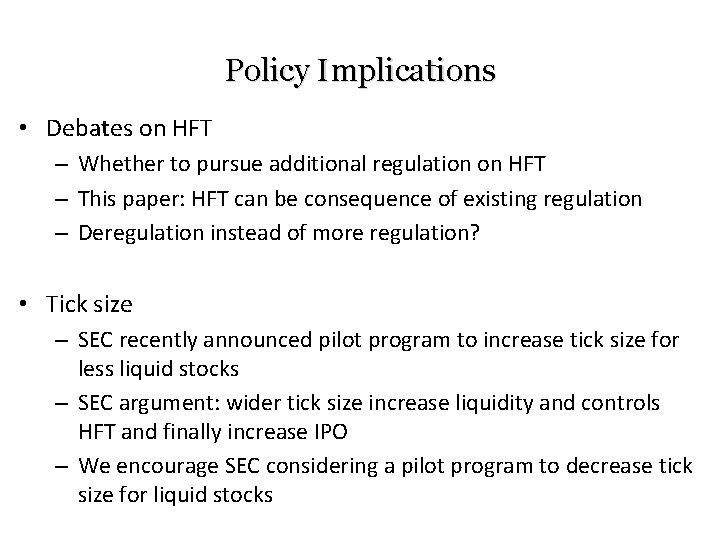
Policy Implications • Debates on HFT – Whether to pursue additional regulation on HFT – This paper: HFT can be consequence of existing regulation – Deregulation instead of more regulation? • Tick size – SEC recently announced pilot program to increase tick size for less liquid stocks – SEC argument: wider tick size increase liquidity and controls HFT and finally increase IPO – We encourage SEC considering a pilot program to decrease tick size for liquid stocks