
Tic Taxes Presented by Dr Julie Heath University
Tic Taxes Presented by Dr. Julie Heath, University of Cincinnati October 5, 2020 julia. heath@uc. edu

Econ. Ed. Link Membership You can now access CEE’s professional development webinars directly on Econ. Ed. Link. org! To receive these new professional development benefits, become an Econ. Ed. Link member. As a member, you will now be able to: • Automatically receive a professional development certificate via e-mail within 24 hours after viewing any webinar for a minimum of 45 minutes • Register for upcoming webinars with a simple one-click process • Easily download presentations, lesson plan materials and activities for each webinar • Search and view all webinars at your convenience • Save webinars to your Econ. Ed. Link dashboard for easy access to the event You may access our new Professional Development page here
Professional Development Certificate To earn your professional development certificate for this webinar, you must: • Watch a minimum of 45 -minutes and you will automatically receive a professional development certificate via e-mail within 24 hours. Accessing resources: • You can now easily download presentations, lesson plan materials, and activities for each webinar from Econ. Ed. Link. org/professional-development/
Agenda • Warm-up • Kinds of taxes • Purpose of taxes • Levels of government • Matching game • Individual activity

Objectives • Understand several kinds of taxes • Explore the connection between taxes and public goods • Analyze why different govts (federal, state, local) collect different taxes • Illustrate why govts provide public goods
National Standards--Economics Name: Government Failure Standard: 17 • Students will understand that: Costs of government policies sometimes exceed benefits. This may occur because of incentives facing voters, government officials, and government employees, because of actions by special interest groups that can impose costs on the general public, or because social goals other than economic efficiency are being pursued.
National Standards--Economics Name: Government Failure Standard: 17 • Students will be able to use this knowledge to: Identify some public policies that may cost more than the benefits they generate, and assess who enjoys the benefits and who bears the costs. Explain why the policies exist.
National Standards—Fin. Lit. Name: Earning an Income • Students will understand that: Income for most people is determined by the market value of their labor, paid as wages and salaries. People can increase their income and job opportunities by choosing to acquire more education, work experience, and job skills. The decision to undertake an activity that increases income or job opportunities is affected by the expected benefits and costs of such an activity. Income also is obtained from other sources such as interest, rents, capital gains, dividends, and profits.

Lesson Overview Students learn about taxes: different types of taxes, and why we have them. Time: 45 -60 minutes Materials: • Receipt • Goods and Services Cards/Gov’t or Business Cards • Taxing Activity • Where Does Your $1 Go? • Fun Tax Facts • Tic-Taxes Game
Lesson Demo
We Need a New School! A new middle school costs about $26 million. How can we get the money to build it? Will we be able to raise enough?

Kinds of Taxes

Sales Tax—What Is It? • Tax levied by local/state governments on purchases of goods and some services • A percentage of purchases—flat rate • Example, in Cincinnati: • City sales tax 0% • County sales tax 1. 25% • State sales tax • Total 5. 75% 7. 00%
Sales Tax—Who Collects It? • Local (city and/or county) and state governments • More important for state governments • US has no federal sales tax, but other countries do
Income Tax—What Is It? Not a fixed percentage in U. S. —increases as income increases (progressive) – Ex: Federal marginal tax rate on $50, 000 = 22% Federal marginal tax rate on $200, 000 = 32%

Income Tax—Who Collects It? Income taxes can be collected by one, two, or all three levels of government • Usually all income tax payments for previous year’s income are due on April 15
Excise Tax—What Is It? • Tax on particular goods and services like gasoline, alcohol, airplane tickets, and tobacco • Can be either a percentage or per unit • Consumers often don’t see how much an excise tax is because it is a part of the price

Excise Tax—Who Collects It? Any or all of the three levels: local, state, federal • Ex: federal excise tax on gasoline = 18. 4 cents/gallon States additional excise tax; CA is highest at 61. 2 cents/gallon Many states do not charge an additional sales tax on gasoline
Property Tax—What Is It? • Tax on things we own, like a house, or in some states, personal property like a car and other belongings. • Percentage of value

Property Tax—Who Collects It? • Any of the three levels: local, state, or federal, but primarily local

What Do Taxes Pay For? Ask students to name things they think taxes pay for • Local: schools, roads, police/fire, libraries, parks • State: roads, state parks, bridges, education, social services • National: military, interstate highways, education, national parks, social services What is common among these…? They benefit everyone

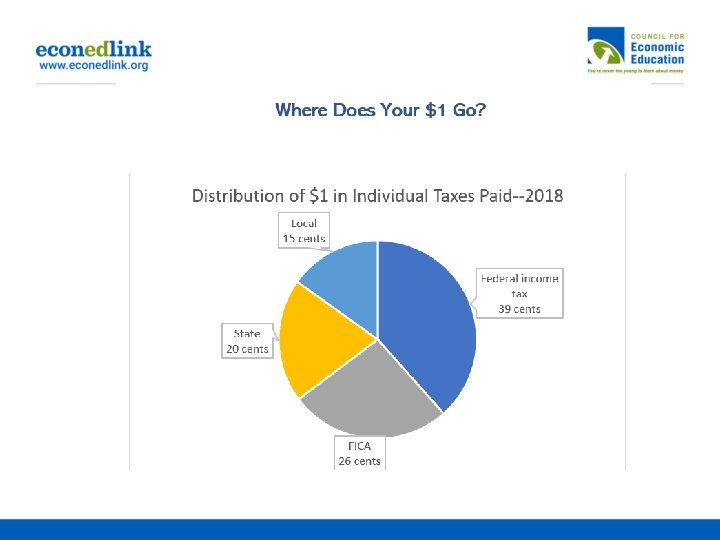
Tax Distribution Students probably have an easier time naming things provided by local/state governments than the federal government • Ask students to guess how much of each $1 collected in taxes goes to each of the three levels • Refer to Where Does Your $1 Go? • Point out that most of each $1 in taxes goes to the federal government, including that the two portions of federal taxes make up 65 cents of every dollar collected in taxes
Why Not Business? • Businesses exist to make a profit • They do that by selling goods and services for more than it costs them to make/provide them. • Ex. What is the market for fire protection? – Your house is on fire, and you call the fire department. They say, we’ll come and put the fire out for $800, pay by cash or credit. You don’t have $800. What do you do?
Why Taxes? Imagine you earn $5, 000 every month or $60, 000/yr. • Think about what the federal government provides. • How much of that $60, 000 are you willing to contribute to federal taxes? • Solicit answers from class and add up total contributions and get average for class.
Why Taxes? Cont’d Tell students that the federal govt spent $13, 415 person in 2019. • Compute the difference between $13, 415 and the class average, pointing out the shortfall. • Point out that if we leave funding of federallyprovided goods and services to contributions, we have to choose: fewer goods and services or find the money elsewhere. And what if people change their minds?
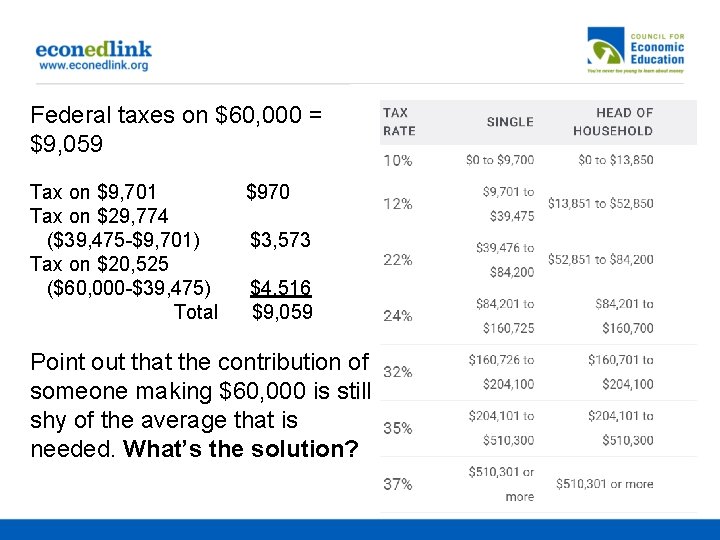
Federal taxes on $60, 000 = $9, 059 Tax on $9, 701 Tax on $29, 774 ($39, 475 -$9, 701) Tax on $20, 525 ($60, 000 -$39, 475) Total $970 $3, 573 $4, 516 $9, 059 Point out that the contribution of someone making $60, 000 is still shy of the average that is needed. What’s the solution?
Concentration Game

Math Connection Percentages Generate charts, graphs Compute “effective” (or average) tax rate Ex. Effective tax rate on $60, 000 = $9059/$60, 000 = 15%

Paired Activity In pairs, students complete a Tic-Tac-Toe activity
Reflection Activity • The average contribution needed from each person to fully meet federal government spending is $13, 415. Some people pay more than that, and some people pay less than that (as in our example) • Is this “fair”? That some pay more and some pay less? In what cases is it fair or not?
Fun Tax Facts • See accompanying sheet
CEE Affiliates https: //www. councilforeconed. org/resources/local-affiliates/
Thank You to Our Sponsors!

The Conference is your pathway to learn about the opportunities to incorporate personal finance and economics into your K-12 classroom and to exchange ideas with hundreds of peers. Register by August 15, 2020 to receive the early bird special discount: $79 Early Bird ($99 thereafter) Register Today >>> https: //www. councilforeconed. org/events/conference
- Slides: 38