
Tic Tac Toe Game playing strategies Lecture Module
- Slides: 27
Tic Tac Toe Game playing strategies Lecture Module 2 Prof Saroj Kaushik 1
Tic–Tac–Toe game playing n Two players q q n n n human computer. The objective is to write a computer program in such a way that computer wins most of the time. Three approaches are presented to play this game which increase in q Complexity q Use of generalization q Clarity of their knowledge q Extensibility of their approach These approaches will move towards being representations of what we will call AI techniques. Prof Saroj Kaushik 2
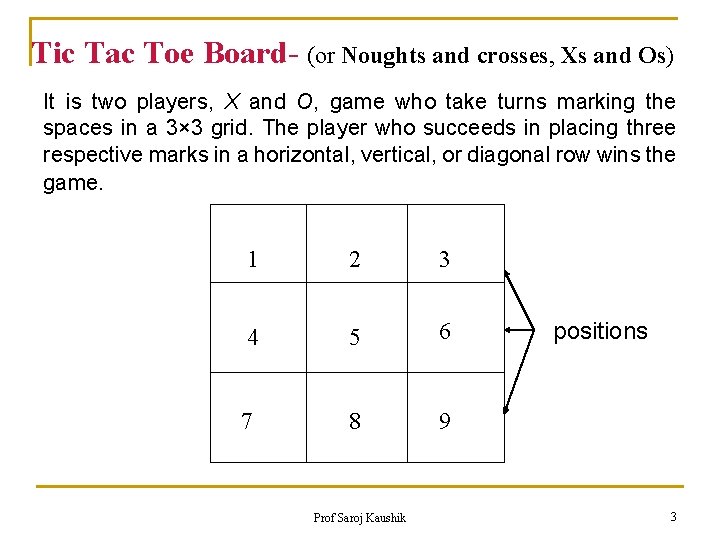
Tic Tac Toe Board- (or Noughts and crosses, Xs and Os) It is two players, X and O, game who take turns marking the spaces in a 3× 3 grid. The player who succeeds in placing three respective marks in a horizontal, vertical, or diagonal row wins the game. 1 2 3 4 5 6 7 8 9 Prof Saroj Kaushik positions 3
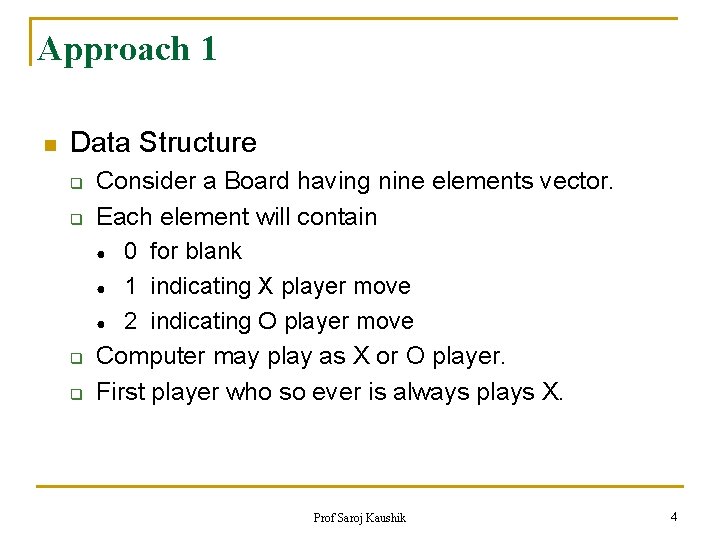
Approach 1 n Data Structure q q Consider a Board having nine elements vector. Each element will contain ● 0 for blank ● 1 indicating X player move ● 2 indicating O player move Computer may play as X or O player. First player who so ever is always plays X. Prof Saroj Kaushik 4
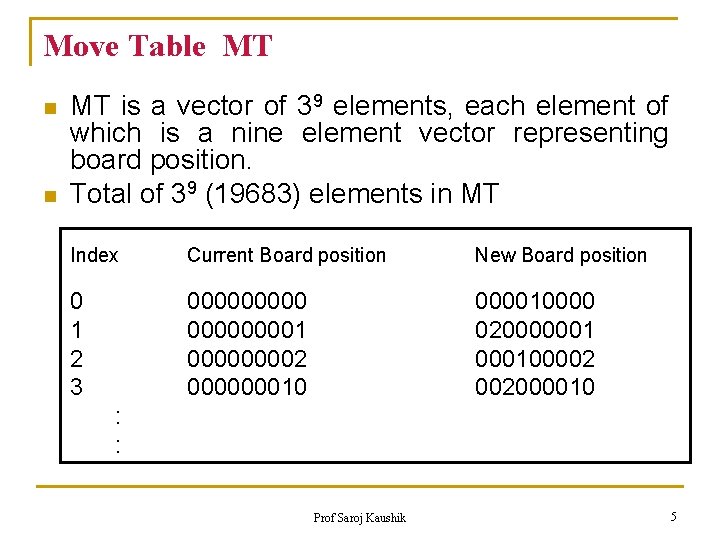
Move Table MT n n MT is a vector of 39 elements, each element of which is a nine element vector representing board position. Total of 39 (19683) elements in MT Index Current Board position New Board position 0 1 2 3 000001 00002 000000010000 02000000100002 002000010 : : Prof Saroj Kaushik 5
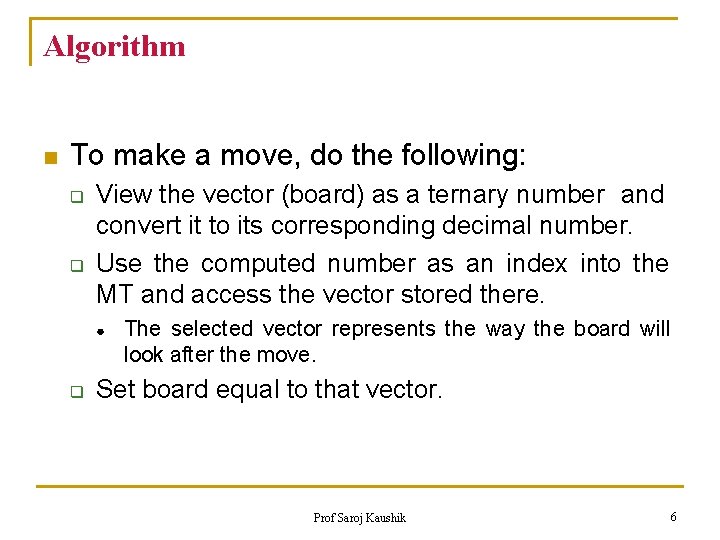
Algorithm n To make a move, do the following: q q View the vector (board) as a ternary number and convert it to its corresponding decimal number. Use the computed number as an index into the MT and access the vector stored there. ● q The selected vector represents the way the board will look after the move. Set board equal to that vector. Prof Saroj Kaushik 6
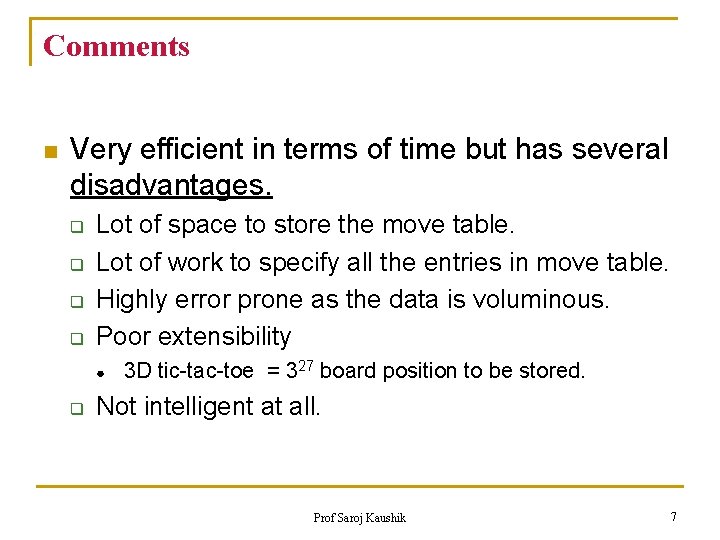
Comments n Very efficient in terms of time but has several disadvantages. q q Lot of space to store the move table. Lot of work to specify all the entries in move table. Highly error prone as the data is voluminous. Poor extensibility ● q 3 D tic-tac-toe = 327 board position to be stored. Not intelligent at all. Prof Saroj Kaushik 7
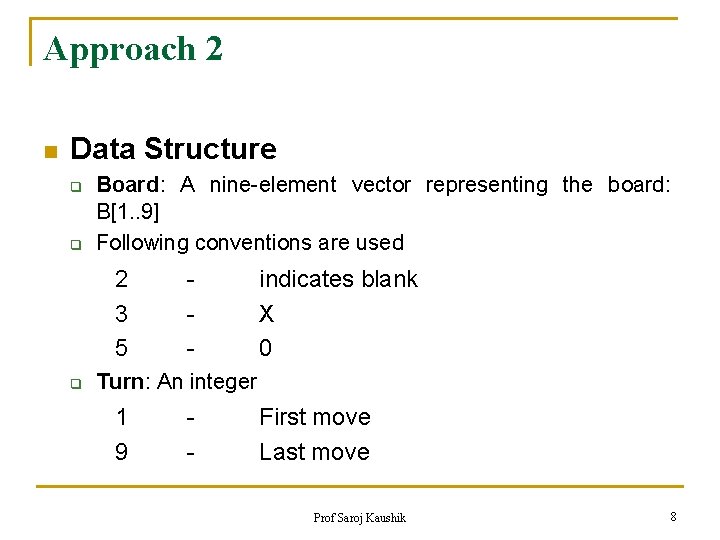
Approach 2 n Data Structure q q Board: A nine-element vector representing the board: B[1. . 9] Following conventions are used 2 3 5 q - indicates blank X 0 Turn: An integer 1 9 - First move Last move Prof Saroj Kaushik 8
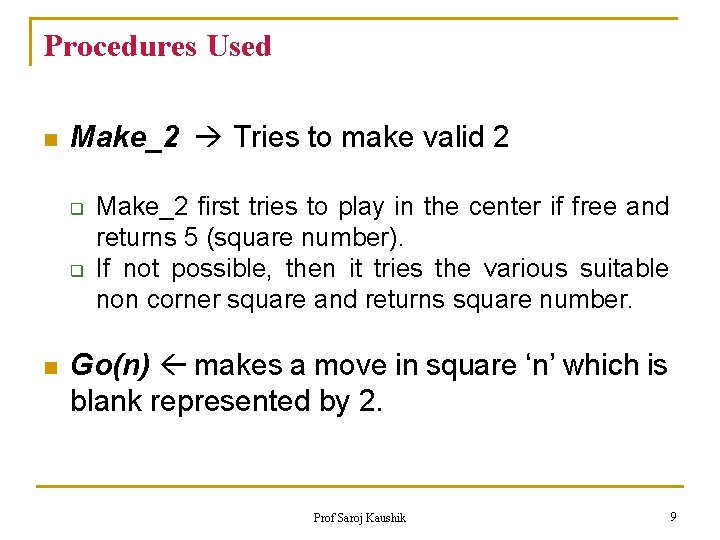
Procedures Used n Make_2 Tries to make valid 2 q q n Make_2 first tries to play in the center if free and returns 5 (square number). If not possible, then it tries the various suitable non corner square and returns square number. Go(n) makes a move in square ‘n’ which is blank represented by 2. Prof Saroj Kaushik 9
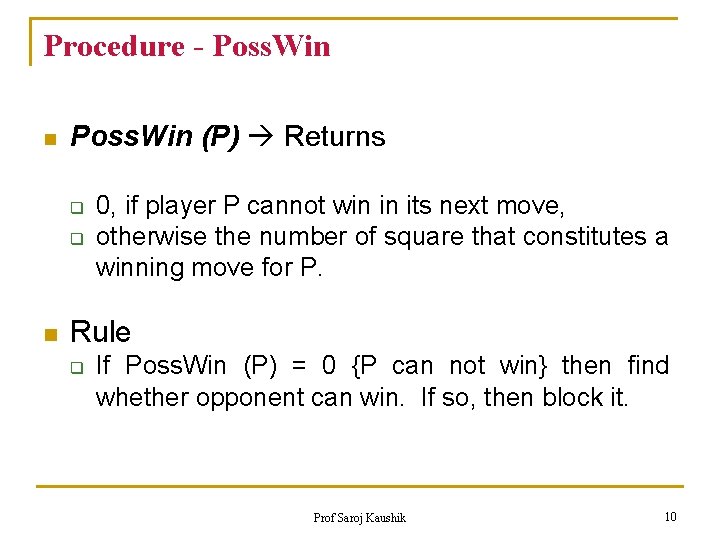
Procedure - Poss. Win n Poss. Win (P) Returns q q n 0, if player P cannot win in its next move, otherwise the number of square that constitutes a winning move for P. Rule q If Poss. Win (P) = 0 {P can not win} then find whether opponent can win. If so, then block it. Prof Saroj Kaushik 10
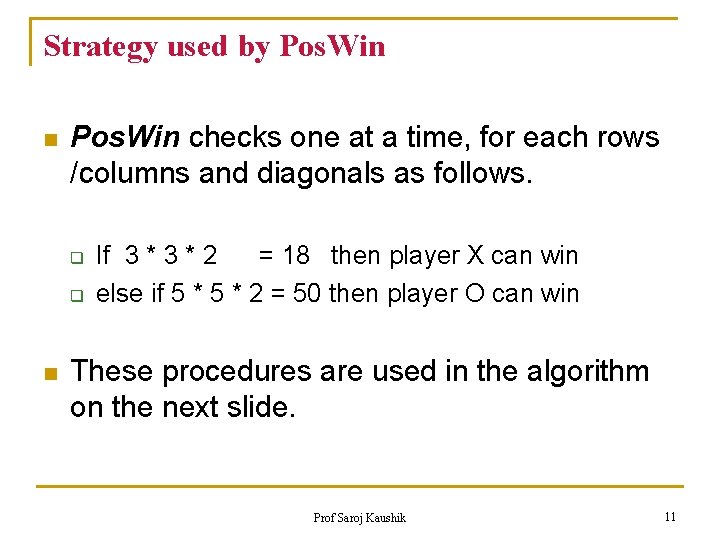
Strategy used by Pos. Win n Pos. Win checks one at a time, for each rows /columns and diagonals as follows. q q n If 3 * 2 = 18 then player X can win else if 5 * 2 = 50 then player O can win These procedures are used in the algorithm on the next slide. Prof Saroj Kaushik 11
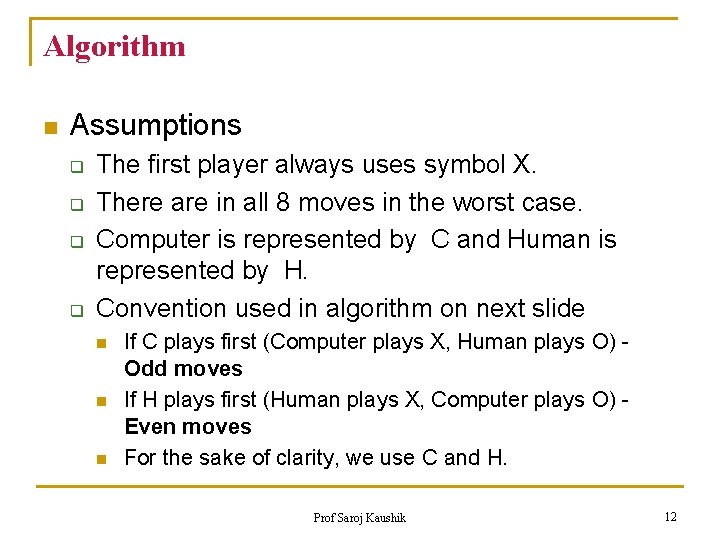
Algorithm n Assumptions q q The first player always uses symbol X. There are in all 8 moves in the worst case. Computer is represented by C and Human is represented by H. Convention used in algorithm on next slide n n n If C plays first (Computer plays X, Human plays O) Odd moves If H plays first (Human plays X, Computer plays O) Even moves For the sake of clarity, we use C and H. Prof Saroj Kaushik 12
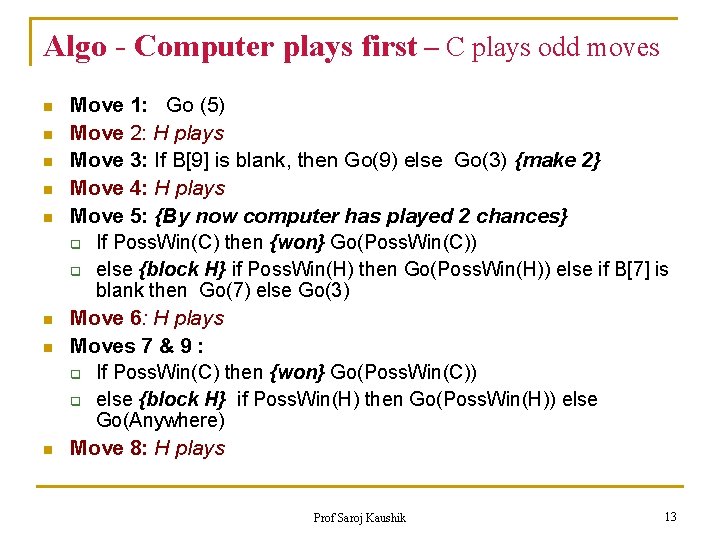
Algo - Computer plays first – C plays odd moves n n n n Move 1: Go (5) Move 2: H plays Move 3: If B[9] is blank, then Go(9) else Go(3) {make 2} Move 4: H plays Move 5: {By now computer has played 2 chances} q If Poss. Win(C) then {won} Go(Poss. Win(C)) q else {block H} if Poss. Win(H) then Go(Poss. Win(H)) else if B[7] is blank then Go(7) else Go(3) Move 6: H plays Moves 7 & 9 : q If Poss. Win(C) then {won} Go(Poss. Win(C)) q else {block H} if Poss. Win(H) then Go(Poss. Win(H)) else Go(Anywhere) Move 8: H plays Prof Saroj Kaushik 13
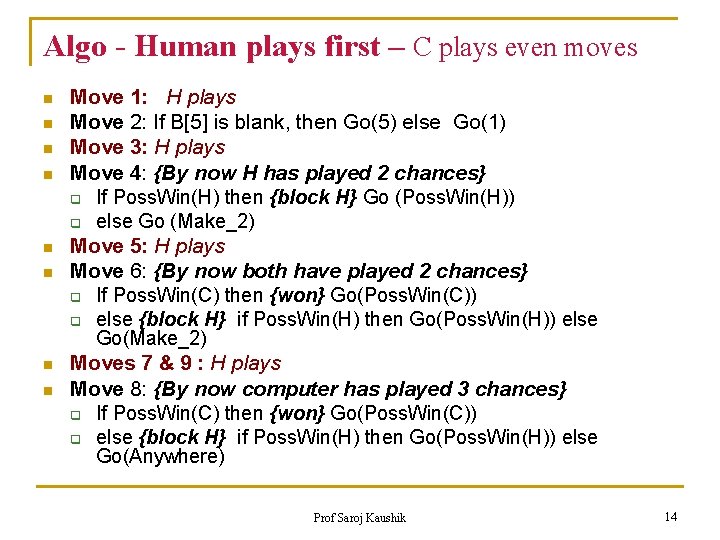
Algo - Human plays first – C plays even moves n n n n Move 1: H plays Move 2: If B[5] is blank, then Go(5) else Go(1) Move 3: H plays Move 4: {By now H has played 2 chances} q If Poss. Win(H) then {block H} Go (Poss. Win(H)) q else Go (Make_2) Move 5: H plays Move 6: {By now both have played 2 chances} q If Poss. Win(C) then {won} Go(Poss. Win(C)) q else {block H} if Poss. Win(H) then Go(Poss. Win(H)) else Go(Make_2) Moves 7 & 9 : H plays Move 8: {By now computer has played 3 chances} q If Poss. Win(C) then {won} Go(Poss. Win(C)) q else {block H} if Poss. Win(H) then Go(Poss. Win(H)) else Go(Anywhere) Prof Saroj Kaushik 14
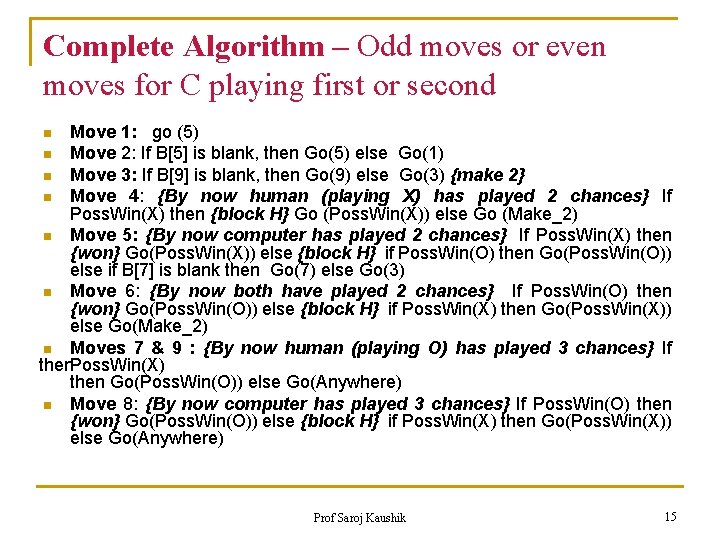
Complete Algorithm – Odd moves or even moves for C playing first or second Move 1: go (5) n Move 2: If B[5] is blank, then Go(5) else Go(1) n Move 3: If B[9] is blank, then Go(9) else Go(3) {make 2} n Move 4: {By now human (playing X) has played 2 chances} If Poss. Win(X) then {block H} Go (Poss. Win(X)) else Go (Make_2) n Move 5: {By now computer has played 2 chances} If Poss. Win(X) then {won} Go(Poss. Win(X)) else {block H} if Poss. Win(O) then Go(Poss. Win(O)) else if B[7] is blank then Go(7) else Go(3) n Move 6: {By now both have played 2 chances} If Poss. Win(O) then {won} Go(Poss. Win(O)) else {block H} if Poss. Win(X) then Go(Poss. Win(X)) else Go(Make_2) n Moves 7 & 9 : {By now human (playing O) has played 3 chances} If then. Poss. Win(X) then Go(Poss. Win(O)) else Go(Anywhere) n Move 8: {By now computer has played 3 chances} If Poss. Win(O) then {won} Go(Poss. Win(O)) else {block H} if Poss. Win(X) then Go(Poss. Win(X)) else Go(Anywhere) n Prof Saroj Kaushik 15
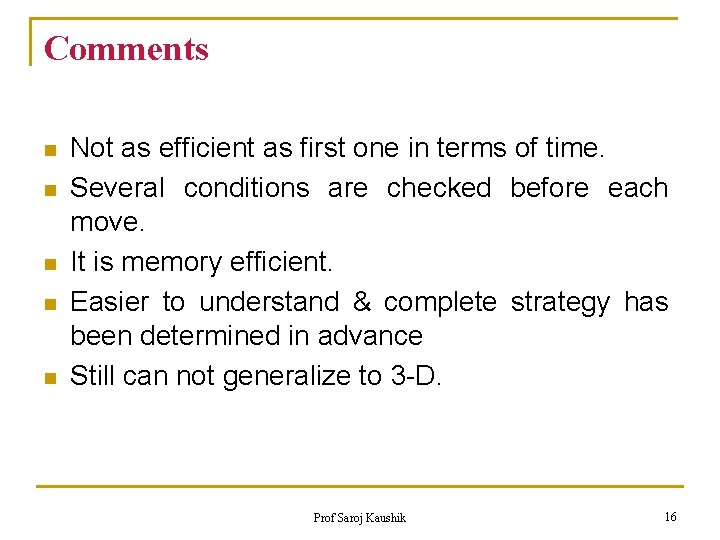
Comments n n n Not as efficient as first one in terms of time. Several conditions are checked before each move. It is memory efficient. Easier to understand & complete strategy has been determined in advance Still can not generalize to 3 -D. Prof Saroj Kaushik 16
Approach 3 n Same as approach 2 except for one change in the representation of the board. q n Board is considered to be a magic square of size 3 X 3 with 9 blocks numbered by numbers indicated by magic square. This representation makes process checking for a possible win more simple. Prof Saroj Kaushik of 17
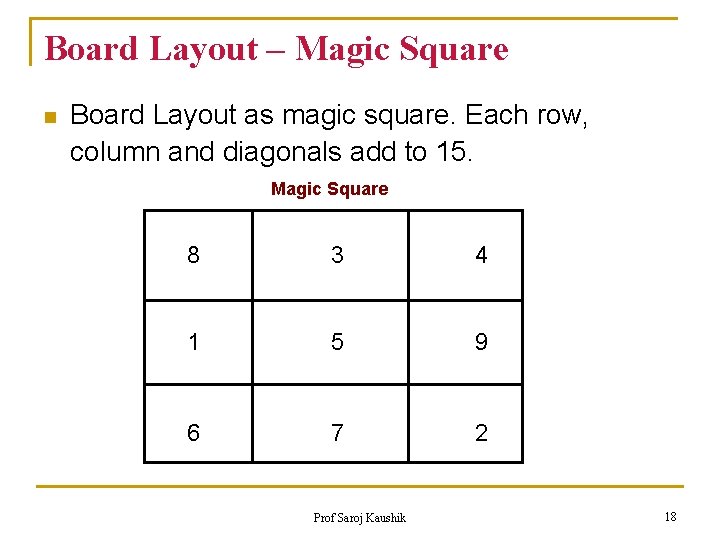
Board Layout – Magic Square n Board Layout as magic square. Each row, column and diagonals add to 15. Magic Square 8 3 4 1 5 9 6 7 2 Prof Saroj Kaushik 18
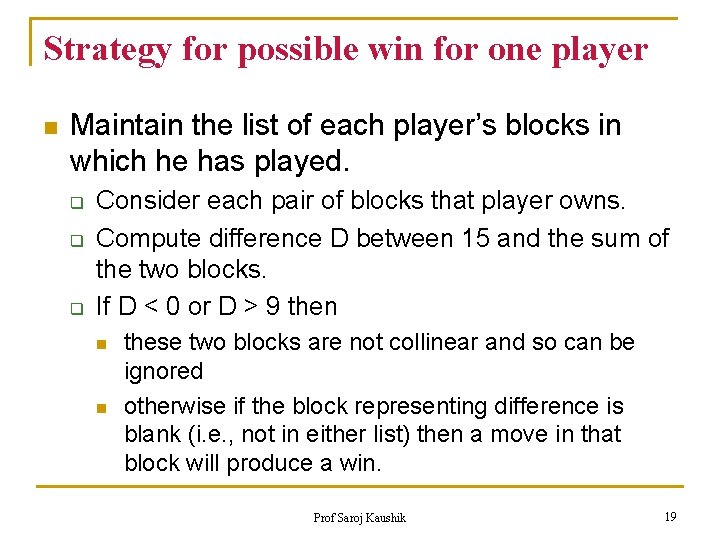
Strategy for possible win for one player n Maintain the list of each player’s blocks in which he has played. q q q Consider each pair of blocks that player owns. Compute difference D between 15 and the sum of the two blocks. If D < 0 or D > 9 then n n these two blocks are not collinear and so can be ignored otherwise if the block representing difference is blank (i. e. , not in either list) then a move in that block will produce a win. Prof Saroj Kaushik 19
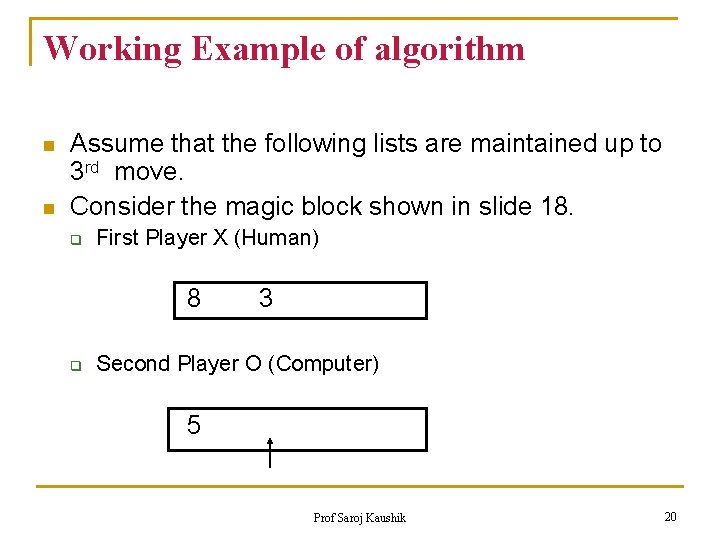
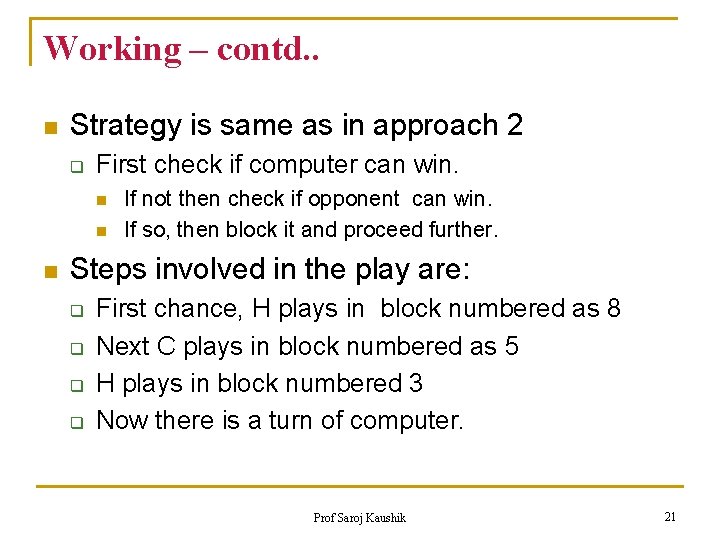
Working Example of algorithm n n Assume that the following lists are maintained up to 3 rd move. Consider the magic block shown in slide 18. q First Player X (Human) 8 q 3 Second Player O (Computer) 5 Prof Saroj Kaushik 20
Working – contd. . n Strategy is same as in approach 2 q First check if computer can win. n n n If not then check if opponent can win. If so, then block it and proceed further. Steps involved in the play are: q q First chance, H plays in block numbered as 8 Next C plays in block numbered as 5 H plays in block numbered 3 Now there is a turn of computer. Prof Saroj Kaushik 21
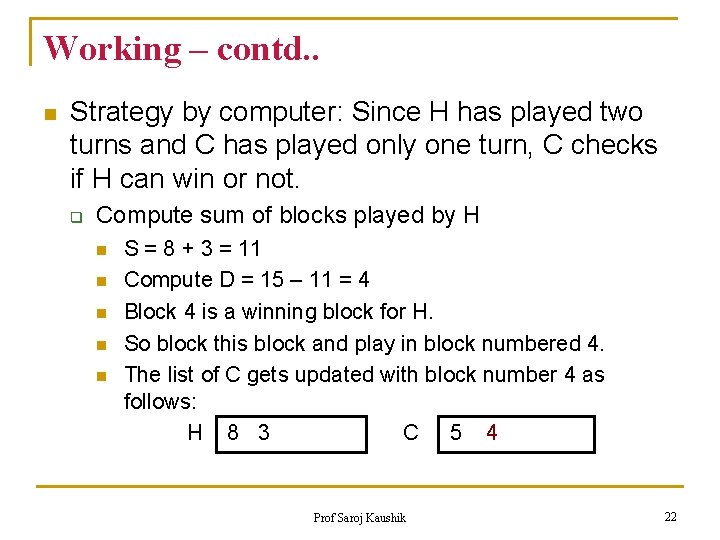
Working – contd. . n Strategy by computer: Since H has played two turns and C has played only one turn, C checks if H can win or not. q Compute sum of blocks played by H n n n S = 8 + 3 = 11 Compute D = 15 – 11 = 4 Block 4 is a winning block for H. So block this block and play in block numbered 4. The list of C gets updated with block number 4 as follows: H 8 3 C 5 4 Prof Saroj Kaushik 22
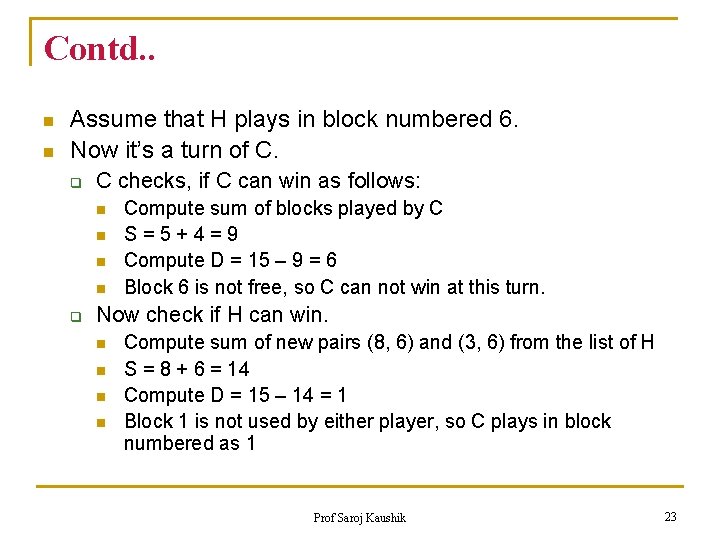
Contd. . n n Assume that H plays in block numbered 6. Now it’s a turn of C. q C checks, if C can win as follows: n n q Compute sum of blocks played by C S=5+4=9 Compute D = 15 – 9 = 6 Block 6 is not free, so C can not win at this turn. Now check if H can win. n n Compute sum of new pairs (8, 6) and (3, 6) from the list of H S = 8 + 6 = 14 Compute D = 15 – 14 = 1 Block 1 is not used by either player, so C plays in block numbered as 1 Prof Saroj Kaushik 23
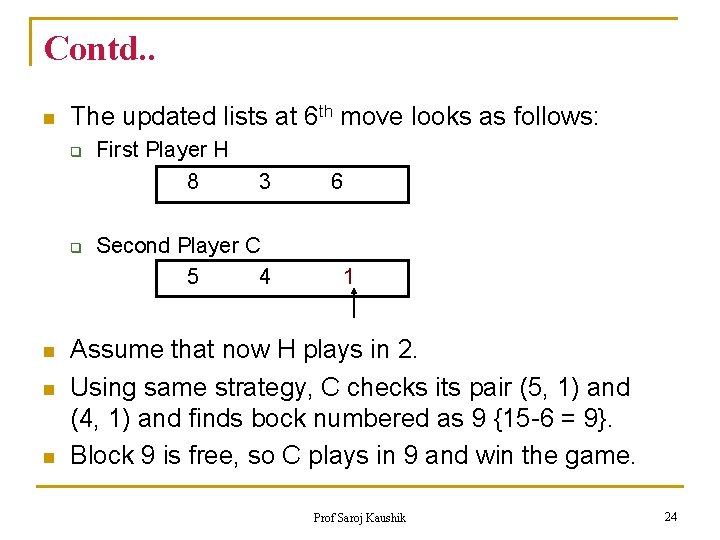
Contd. . n The updated lists at 6 th move looks as follows: q q n n n First Player H 8 3 Second Player C 5 4 6 1 Assume that now H plays in 2. Using same strategy, C checks its pair (5, 1) and (4, 1) and finds bock numbered as 9 {15 -6 = 9}. Block 9 is free, so C plays in 9 and win the game. Prof Saroj Kaushik 24
Comments n This program will require more time than two others as q n it has to search a tree representing all possible move sequences before making each move. This approach is extensible to handle q q 3 -dimensional tic-tac-toe. games more complicated than tic-tac-toe. Prof Saroj Kaushik 25
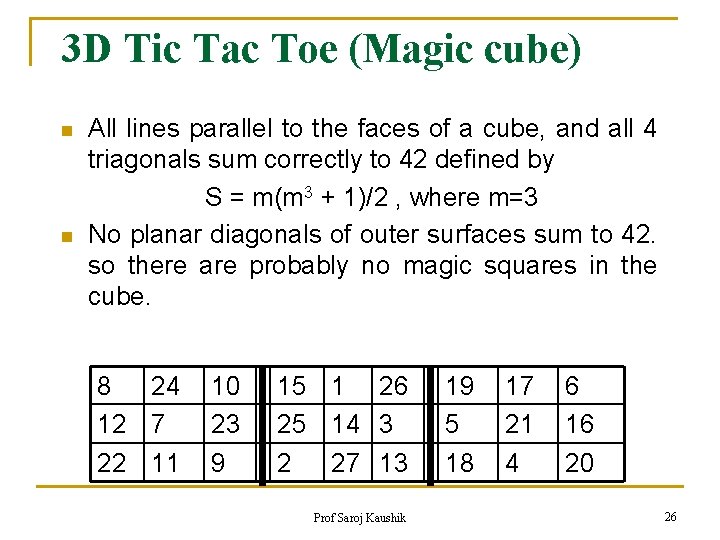
3 D Tic Tac Toe (Magic cube) n n All lines parallel to the faces of a cube, and all 4 triagonals sum correctly to 42 defined by S = m(m 3 + 1)/2 , where m=3 No planar diagonals of outer surfaces sum to 42. so there are probably no magic squares in the cube. 8 24 12 7 22 11 10 23 9 15 1 26 25 14 3 2 27 13 Prof Saroj Kaushik 19 5 18 17 21 4 6 16 20 26
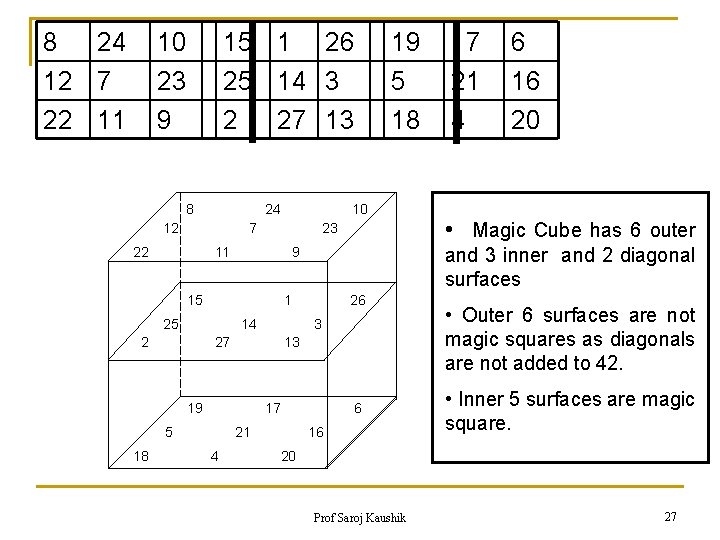
8 24 10 15 1 26 19 17 6 12 7 22 11 23 9 25 14 3 2 27 13 5 18 21 4 16 20 8 24 12 7 22 23 11 1 25 14 2 26 3 27 13 19 17 5 6 21 4 • Magic Cube has 6 outer and 3 inner and 2 diagonal surfaces 9 15 18 10 16 • Outer 6 surfaces are not magic squares as diagonals are not added to 42. • Inner 5 surfaces are magic square. 20 Prof Saroj Kaushik 27