
TI Keystone Networking Coprocessor Introduction Key Stone Training
- Slides: 22
TI Keystone Networking Coprocessor Introduction Key. Stone Training
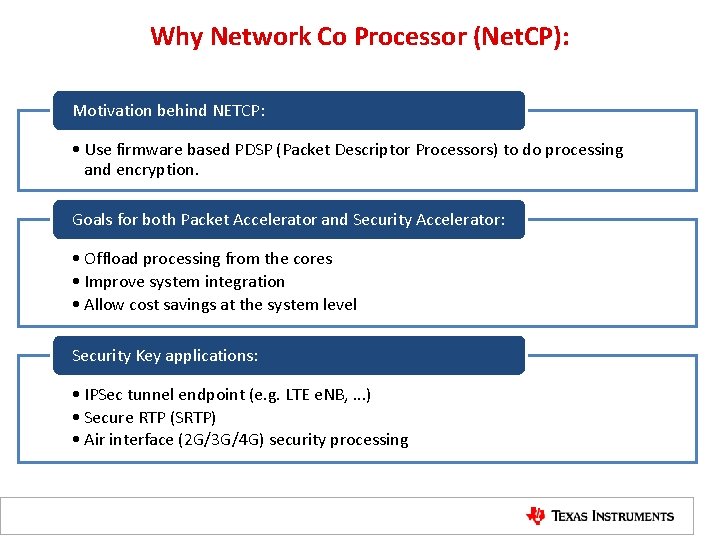
Why Network Co Processor (Net. CP): Motivation behind NETCP: • Use firmware based PDSP (Packet Descriptor Processors) to do processing and encryption. Goals for both Packet Accelerator and Security Accelerator: • Offload processing from the cores • Improve system integration • Allow cost savings at the system level Security Key applications: • IPSec tunnel endpoint (e. g. LTE e. NB, . . . ) • Secure RTP (SRTP) • Air interface (2 G/3 G/4 G) security processing
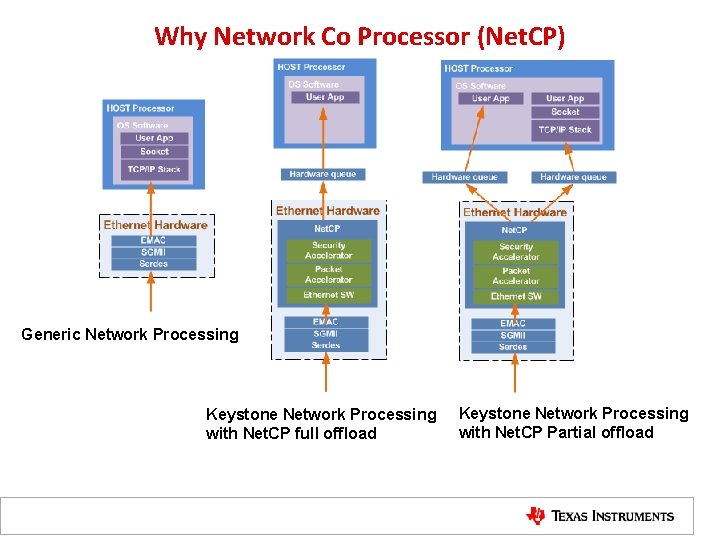
Why Network Co Processor (Net. CP) Generic Network Processing Keystone Network Processing with Net. CP full offload Keystone Network Processing with Net. CP Partial offload
Agenda • Key. Stone I/Net. CP 1. 0 – Overview – Typical Application – PA 1. 0 • Key. Stone II/ Net. CP 1. 5 – – Overview Typical Application PA 1. 5 Net. CP QMSS/PDSP Firmware/RA • Net. CP 1. 0 Vs Net. CP 1. 5 • Security Accelerator – Overview – Channel Configuration – Data Process 4
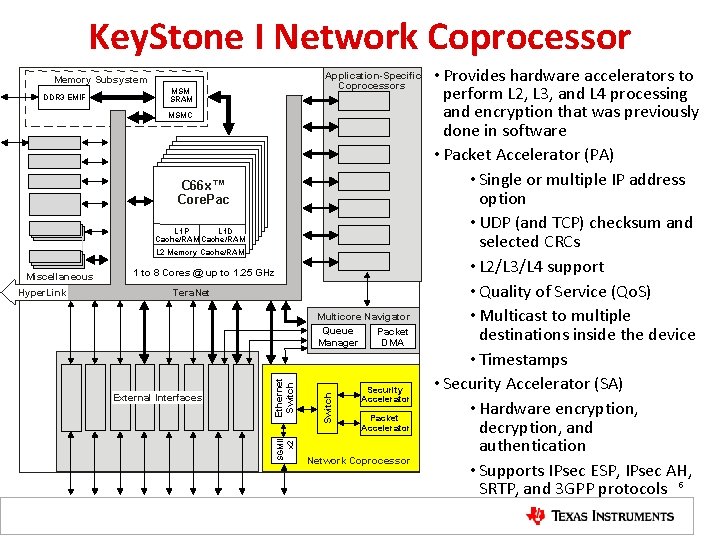
Key. Stone I Network Coprocessor Application-Specific Coprocessors Memory Subsystem DDR 3 EMIF MSM SRAM MSMC C 66 x™ Core. Pac L 1 D L 1 P Cache/RAM L 2 Memory Cache/RAM Tera. Net External Interfaces Switch Multicore Navigator Queue Packet Manager DMA Ethernet Switch Hyper. Link 1 to 8 Cores @ up to 1. 25 GHz SGMII x 2 Miscellaneous Security Accelerator Packet Accelerator Network Coprocessor • Provides hardware accelerators to perform L 2, L 3, and L 4 processing and encryption that was previously done in software • Packet Accelerator (PA) • Single or multiple IP address option • UDP (and TCP) checksum and selected CRCs • L 2/L 3/L 4 support • Quality of Service (Qo. S) • Multicast to multiple destinations inside the device • Timestamps • Security Accelerator (SA) • Hardware encryption, decryption, and authentication • Supports IPsec ESP, IPsec AH, SRTP, and 3 GPP protocols 5
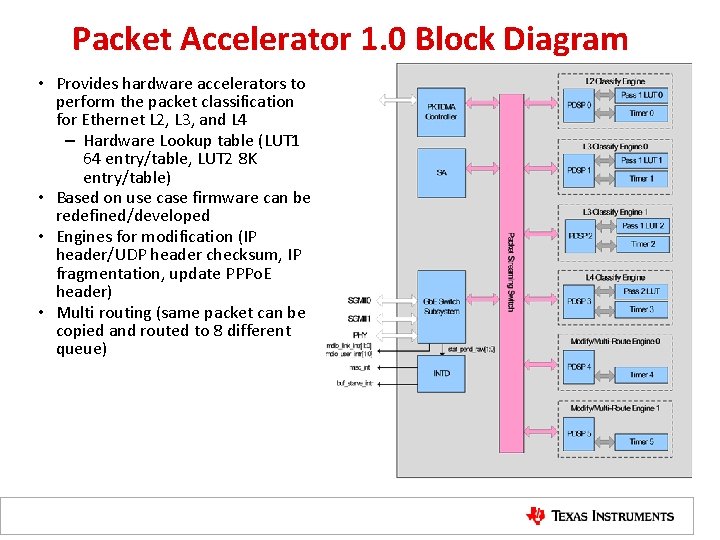
Packet Accelerator 1. 0 Block Diagram • Provides hardware accelerators to perform the packet classification for Ethernet L 2, L 3, and L 4 – Hardware Lookup table (LUT 1 64 entry/table, LUT 2 8 K entry/table) • Based on use case firmware can be redefined/developed • Engines for modification (IP header/UDP header checksum, IP fragmentation, update PPPo. E header) • Multi routing (same packet can be copied and routed to 8 different queue)
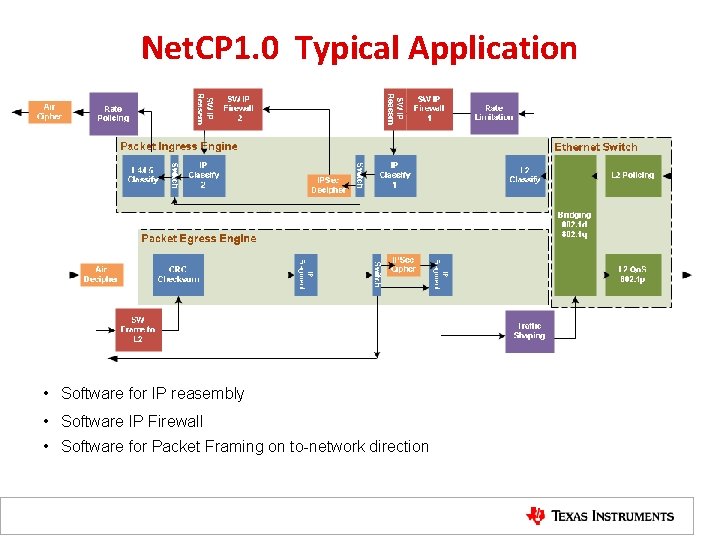
Net. CP 1. 0 Typical Application • Software for IP reasembly • Software IP Firewall • Software for Packet Framing on to-network direction
Agenda • Key. Stone I/Net. CP 1. 0 – Overview – Typical Application – PA 1. 0 • Key. Stone II/ Net. CP 1. 5 – – Overview Typical Application PA 1. 5 Net. CP QMSS/PDSP Firmware/RA • Net. CP 1. 0 Vs Net. CP 1. 5 • Security Accelerator – Overview – Channel Configuration – Data Process 8
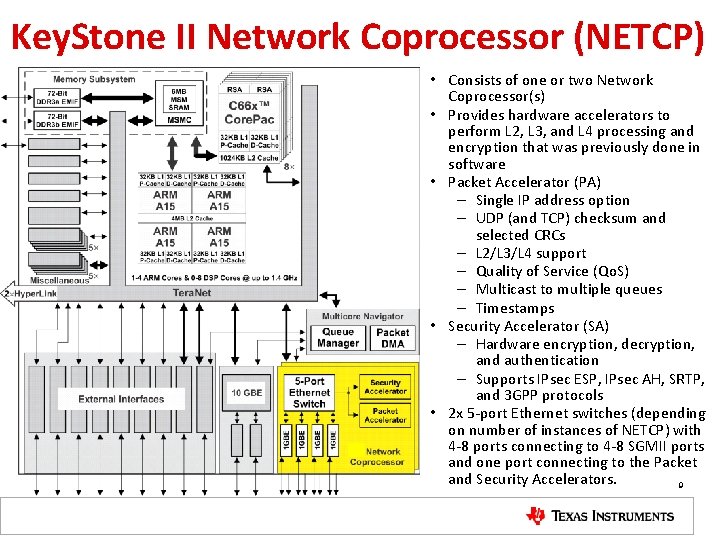
Key. Stone II Network Coprocessor (NETCP) • Consists of one or two Network Coprocessor(s) • Provides hardware accelerators to perform L 2, L 3, and L 4 processing and encryption that was previously done in software • Packet Accelerator (PA) – Single IP address option – UDP (and TCP) checksum and selected CRCs – L 2/L 3/L 4 support – Quality of Service (Qo. S) – Multicast to multiple queues – Timestamps • Security Accelerator (SA) – Hardware encryption, decryption, and authentication – Supports IPsec ESP, IPsec AH, SRTP, and 3 GPP protocols • 2 x 5 -port Ethernet switches (depending on number of instances of NETCP) with 4 -8 ports connecting to 4 -8 SGMII ports and one port connecting to the Packet and Security Accelerators. 9
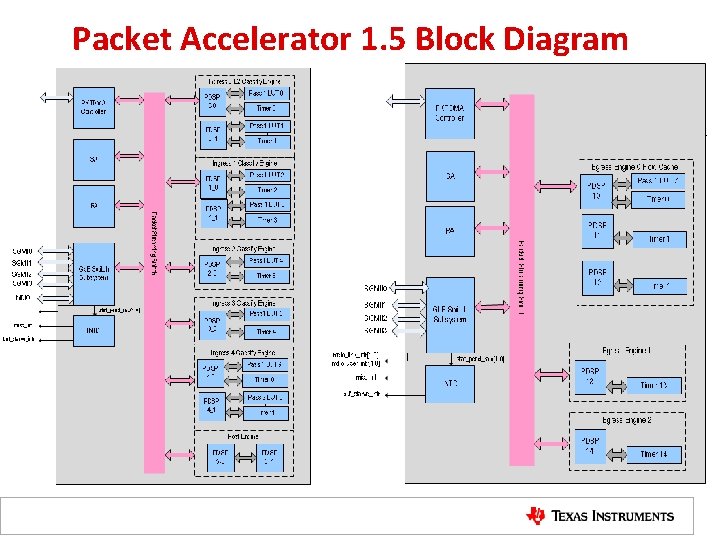
Packet Accelerator 1. 5 Block Diagram
Packet Accelerator 1. 5 • PA LLD interface and features are compatible with Net. CP 1. 0 • Provides hardware accelerators to perform the packet classification for Ethernet L 2, L 3, and L 4 – Hardware Lookup table (LUT 1 256 entry/table, LUT 2 3 K entry/table) with mask/range configuration • Each PDSP can do more complex processing (MAX to 3 K instructions) • Egress direction has capability to modify a packet as configuration and route it to Ethernet directly
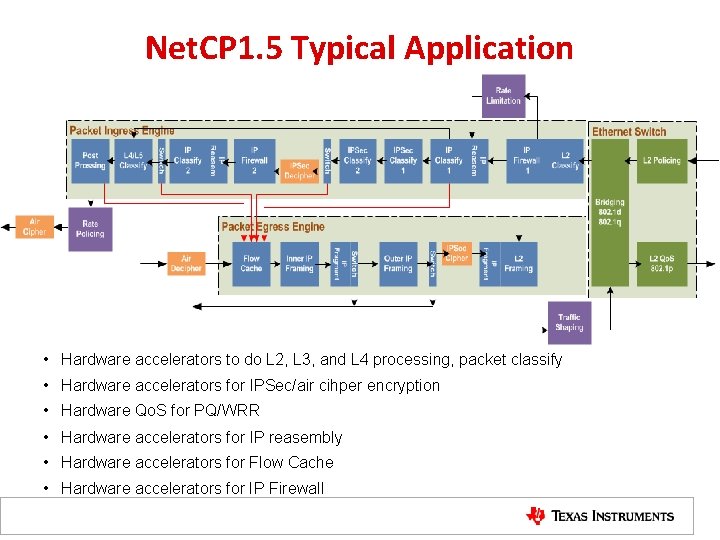
Net. CP 1. 5 Typical Application • Hardware accelerators to do L 2, L 3, and L 4 processing, packet classify • Hardware accelerators for IPSec/air cihper encryption • Hardware Qo. S for PQ/WRR • Hardware accelerators for IP reasembly • Hardware accelerators for Flow Cache • Hardware accelerators for IP Firewall
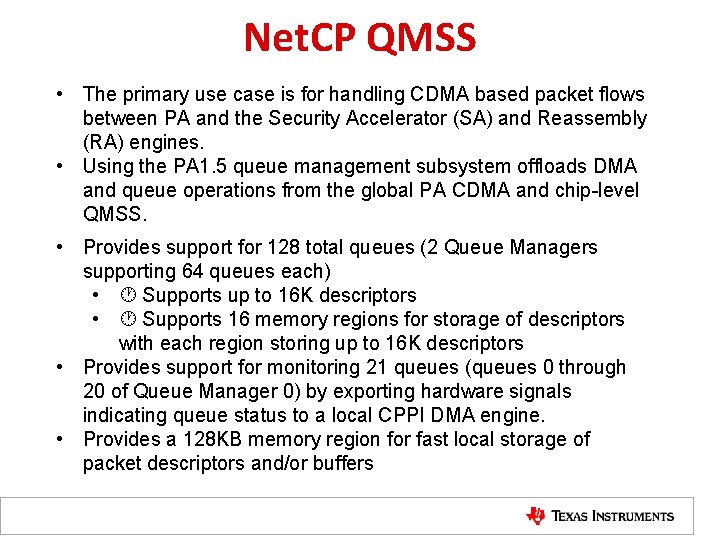
Net. CP QMSS • The primary use case is for handling CDMA based packet flows between PA and the Security Accelerator (SA) and Reassembly (RA) engines. • Using the PA 1. 5 queue management subsystem offloads DMA and queue operations from the global PA CDMA and chip-level QMSS. • Provides support for 128 total queues (2 Queue Managers supporting 64 queues each) • Supports up to 16 K descriptors • Supports 16 memory regions for storage of descriptors with each region storing up to 16 K descriptors • Provides support for monitoring 21 queues (queues 0 through 20 of Queue Manager 0) by exporting hardware signals indicating queue status to a local CPPI DMA engine. • Provides a 128 KB memory region for fast local storage of packet descriptors and/or buffers
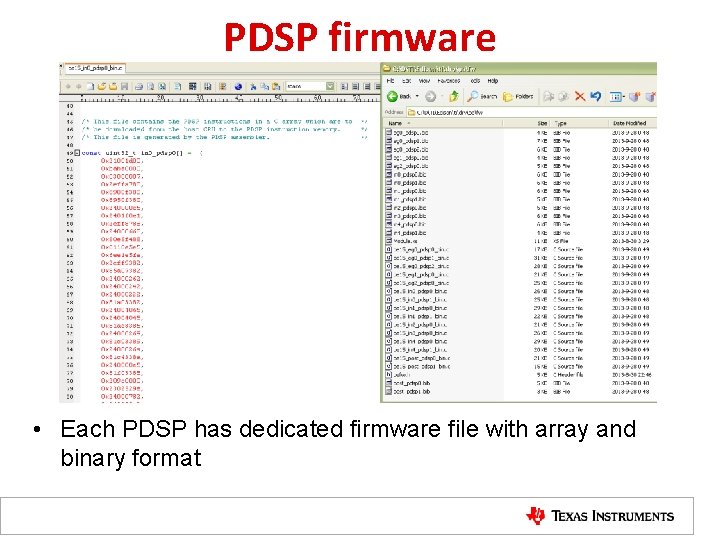
PDSP firmware • Each PDSP has dedicated firmware file with array and binary format
Reassembly Engine • The Reassembly engine is a hardware accelerator block for reassembling fragmented IPv 4 and IPv 6 Packets • Supports reassembly at 10 Gbps rate for up to 1 K concurrent contexts • There will be 2 in the system – Pre-SA decrypt – Post-SA decrypt • The timeouts will be from 100 to 232 * 210 clock cycles@400 MHz 15
Agenda • Key. Stone I/Net. CP 1. 0 – Overview – Typical Application – PA 1. 0 • Key. Stone II/ Net. CP 1. 5 – – Overview Typical Application PA 1. 5 Net. CP QMSS/PDSP Firmware/RA • Net. CP 1. 0 Vs Net. CP 1. 5 • Security Accelerator – Overview – Channel Configuration – Data Process 16
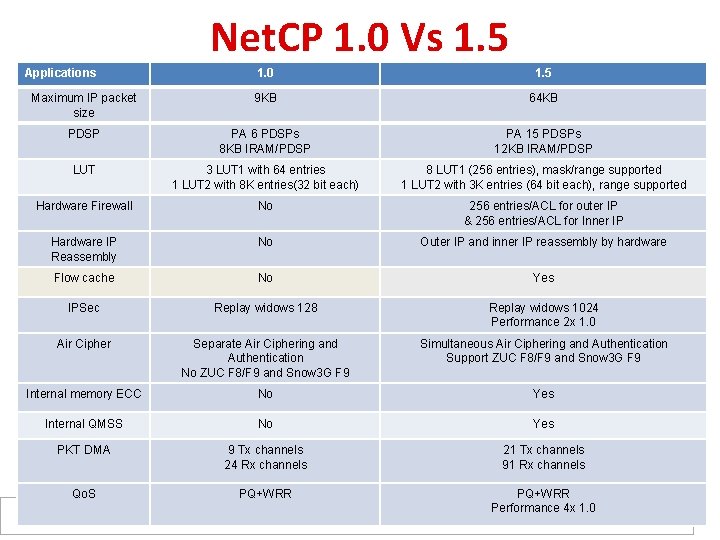
Net. CP 1. 0 Vs 1. 5 Applications 1. 0 1. 5 Maximum IP packet size 9 KB 64 KB PDSP PA 6 PDSPs 8 KB IRAM/PDSP PA 15 PDSPs 12 KB IRAM/PDSP LUT 3 LUT 1 with 64 entries 1 LUT 2 with 8 K entries(32 bit each) 8 LUT 1 (256 entries), mask/range supported 1 LUT 2 with 3 K entries (64 bit each), range supported Hardware Firewall No 256 entries/ACL for outer IP & 256 entries/ACL for Inner IP Hardware IP Reassembly No Outer IP and inner IP reassembly by hardware Flow cache No Yes IPSec Replay widows 128 Replay widows 1024 Performance 2 x 1. 0 Air Cipher Separate Air Ciphering and Authentication No ZUC F 8/F 9 and Snow 3 G F 9 Simultaneous Air Ciphering and Authentication Support ZUC F 8/F 9 and Snow 3 G F 9 Internal memory ECC No Yes Internal QMSS No Yes PKT DMA 9 Tx channels 24 Rx channels 21 Tx channels 91 Rx channels Qo. S PQ+WRR Performance 4 x 1. 0 17
Agenda • Key. Stone I/Net. CP 1. 0 – Overview – Typical Application – PA 1. 0 • Key. Stone II/ Net. CP 1. 5 – – Overview Typical Application PA 1. 5 Net. CP QMSS/PDSP Firmware/RA • Net. CP 1. 0 Vs Net. CP 1. 5 • Security Accelerator – Overview – Channel Configuration – Data Process 18
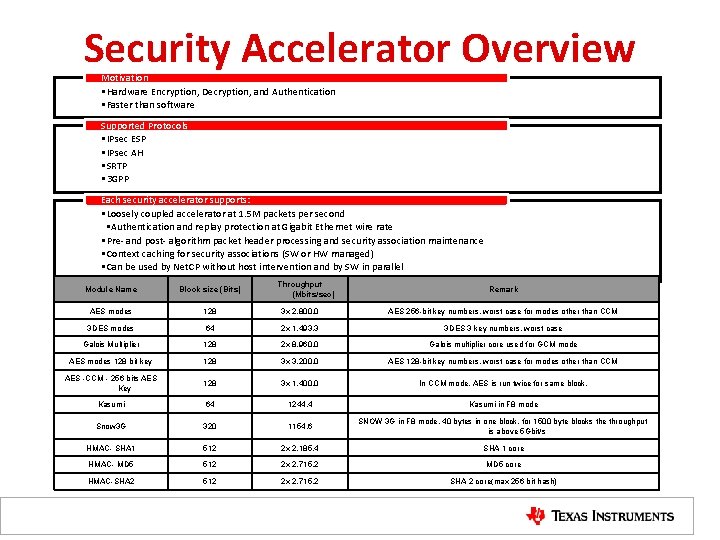
Security Accelerator Overview Motivation • Hardware Encryption, Decryption, and Authentication • Faster than software Supported Protocols • IPsec ESP • IPsec AH • SRTP • 3 GPP Each security accelerator supports: • Loosely coupled accelerator at 1. 5 M packets per second • Authentication and replay protection at Gigabit Ethernet wire rate • Pre- and post- algorithm packet header processing and security association maintenance • Context caching for security associations (SW or HW managed) • Can be used by Net. CP without host intervention and by SW in parallel Throughput (Mbits/sec) Module Name Block size (Bits) Remark AES modes 128 3 x 2, 800. 0 AES 256 -bit key numbers, worst case for modes other than CCM 3 DES modes 64 2 x 1, 493. 3 3 DES 3 key numbers, worst case Galois Multiplier 128 2 x 8, 960. 0 Galois multiplier core used for GCM mode AES modes 128 bit key 128 3 x 3, 200. 0 AES 128 -bit key numbers, worst case for modes other than CCM AES -CCM - 256 bits AES Key 128 3 x 1, 400. 0 In CCM mode, AES is run twice for same block. Kasumi 64 1244. 4 Kasumi in F 8 mode Snow 3 G 320 1154. 6 SNOW 3 G in F 8 mode. 40 bytes in one block, for 1500 byte blocks the throughput is above 5 Gbit/s HMAC- SHA 1 512 2 x 2, 185. 4 SHA 1 core HMAC- MD 5 512 2 x 2, 715. 2 MD 5 core HMAC-SHA 2 512 2 x 2, 715. 2 SHA 2 core(max 256 bit hash)
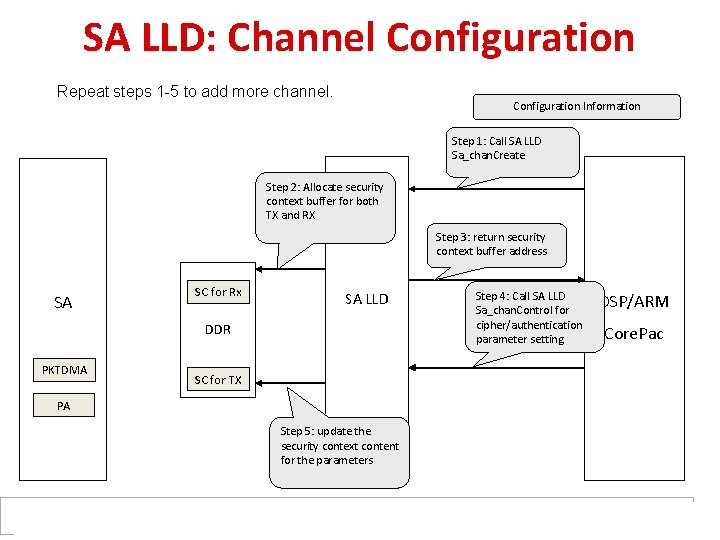
SA LLD: Channel Configuration Repeat steps 1 -5 to add more channel. Configuration Information Step 1: Call SA LLD Sa_chan. Create Step 2: Allocate security context buffer for both TX and RX Step 3: return security context buffer address SA SC for Rx SA LLD DDR PKTDMA SC for TX PA Step 5: update the security context content for the parameters Step 4: Call SA LLD Sa_chan. Control for cipher/authentication parameter setting DSP/ARM Core. Pac
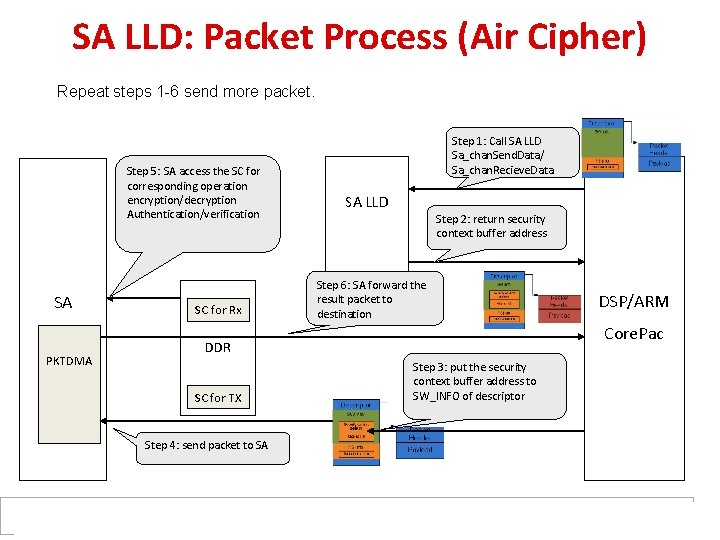
SA LLD: Packet Process (Air Cipher) Repeat steps 1 -6 send more packet. Step 5: SA access the SC for corresponding operation encryption/decryption Authentication/verification SA PKTDMA SC for Rx Step 1: Call SA LLD Sa_chan. Send. Data/ Sa_chan. Recieve. Data SA LLD Step 2: return security context buffer address Step 6: SA forward the result packet to destination Core. Pac DDR SC for TX Step 4: send packet to SA DSP/ARM Step 3: put the security context buffer address to SW_INFO of descriptor
For More Information • Device-specific Data Manuals for the Key. Stone So. Cs can be found at TI. com/multicore. • Multicore articles, tools, and software available at Embedded Processors Wiki for the Key. Stone Device Architecture. • View the complete C 66 x Multicore SOC Online Training for Key. Stone Devices, including details on the individual modules. • For questions regarding topics covered in this training, visit the support forums at the TI E 2 E Community and Deyisupport website. 22