
THYROIDECTOMY CARE Dilum Weliwita B Sc Nursing U
THYROIDECTOMY CARE Dilum Weliwita B. Sc Nursing ( U. K. )
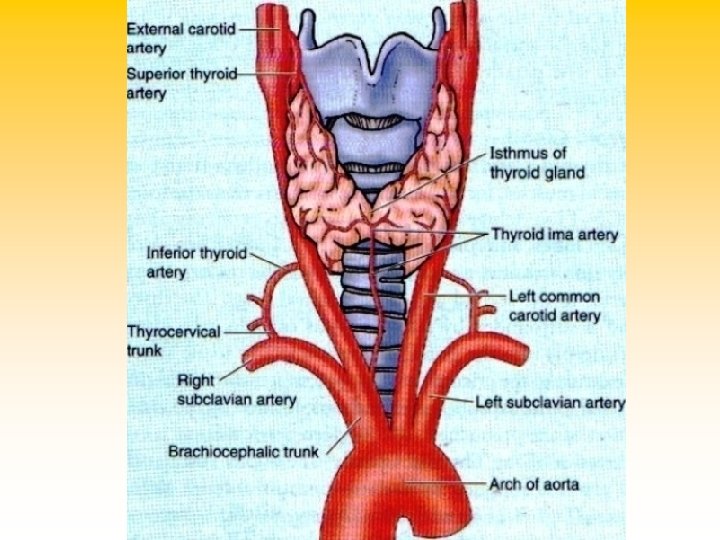
Thyroid gland surgical anatomy • Location: Thyroid is situated in the neck in relation to 2 nd 3 rd and 4 th tracheal rings • Two lobes: Right and left, joined by an ‘isthmus’ • Arteries: Supplied by superior and inferior thyroid arteries • Veins: Drained by superior, middle and inferior thyroid veins
Surgical anatomy – cont’d • Important nerves in relation to thyroid – External laryngeal nerve: Close to superior pole of thyroid. • Injury produces voice weakness – Recurrent laryngeal nerve: Related to lower pole of gland as it runs upwards in the tracheo-esophageal groove. • Injury produces vocal cord paralysis.
Surgical anatomy – cont’d • From superficial to deep: – Skin – Platysma (a muscle in superficial fascia of neck) – Investing layer of deep cervical fascia – Pre-tracheal layer of deep cervical fascia – Strap muscles of neck (thin flat muscles)
Thyroidectomy – Indications • Goitre (any non-neoplastic swelling of the thyroid gland is classified as a goitre) – Single swelling (Solitary nodular goitre) – Multiple swellings (Multi-nodular goitre) • Carcinoma – Follicular carcinoma – Papillary carcinoma – Rare varieties
Thyroidectomy – Types • Hemi-thyroidectomy: Removal of half of thyroid gland (Hemi = Half) • Lobectomy: Removal of either right of left lobe of thyroid gland Both these are done in solitary goitre • Total thyroidectomy: Removal of whole thyroid gland This is done in cases of malignancy

Thyroidectomy types – cont’d • Subtotal thyroidectomy: Removal of a little less than total; done in multi-nodular goitre • Near-total thyroidectomy: Almost same as total, but a little thyroid tissue around one parathyroid gland is preserved • Isthmusectomy: Dividing the isthmus
Pre-operative investigations • • • Full blood count (CBC) Serum Urea, Electrolytes, Creatinine Thyroid Profile: T 3, T 4, TSH Ultrasound thyroid gland Radio-iodine (99 m. Tc / 131 I) scan of thyroid
Pre-operative investigations • X-ray neck • X-ray chest – (Both AP / lateral) • Fine Needle Aspiration Cytology (FNAC) of thyroid nodule, if any palpable • Indirect laryngoscopy to assess preoperative function of both vocal cords.
Pre-operative care • Administer antithyroid medication – promote a euthyroid state • Iodine preparation- decrease vascularity of the gland risk of haemorrhage • Teach how to support the neck- placing both hand behind the neck • Explain , Answer questions, concent- reduce anxiety , fear
INFORMED CONSENT FOR THE SURGERY IS ESSENTIAL
Post-operative management • Patient is kept NPO/NBM (Nil Per Oral / Nil By Mouth) on the day of surgery. • Supplemental IV fluid usually given on day of surgery; usually between 2. 5 to 3 litres. • Compatible blood may be transfused if there had been excessive blood loss during surgery.
Post-operative management • Oral intake initiated from next day, starting with ‘clear fluids’, going on to ‘free fluids’, then to soft diet and finally to normal diet • Analgesics essential in post-operative period; there is invariably severe pain during first night. • Monitor effectiveness of analgesia • Antibiotics avoided in clean elective surgeries
Post-operative management • Daily vital (PTR, BP) chart is maintained. • Rise of temperature after 3 rd postoperative day indicates infection. – This may require inspection of suture line. • Careful note is made of daily output from Redivac drain. • Drain removed after 48 hours or when drainage falls to few ml during last 24 -hour period, whichever is earlier.
Post-operative management • Initial dressing changed after 48 -72 hours (to inspect for infection of suture line), • Unless there is soakage, when it should be removed earlier. • Dry dressings sufficient every alternate day, if suture line is clean and dry. • Sutures usually removed on 5 th postoperative day. – This gives minimum scarring.
Thyroidectomy – Possible complications • • • Hemorrhage Respiratory distress or stridor Hoarseness of voice Total vocal cord paralysis – aphonia Hypocalcemic tetany (due to accidental removal of parathyroid glands during total thyroidectomy) • Wound infection: This may manifest after 48 hours of surgery
Perform focused assessment to monitor complications
Haemorrhage • Assess dressing & area under the patient’s neck and shoulder for drainage • Monitor BP , Pulse for hypovolemic shock • Assess the tightness of the dressing • Vascularity of the gland increases risk of haemorrhage • Grater in first 12 -24 hrs after surgery
Respiratory distress • • Assess respiratory rate, rhythm, depth and effort. Humidification as needed Assist with coughing deep breathing Have suction equipment , oxygen tracheostomy set available • As a result from haemorrhage and oedema may compress the trachea
Laryngeal nerve damage • Assess the ability to speak aloud, tone of voice. • location of laryngeal nerve increases the risk of damage during the surgery • Hoarseness may due to oedema or endotracheal tube used in the surgery -will subside • If permanent loss of vocal volume is potential danger
Tetany • Assess for calcium deficiency • Including tingling of toes, fingers & lips • Keep ca gluconate or ca chloride available for IV use • As parathyroid glands are near to thyroid gland , during the surgery it can injure or remove resulting hypocalcemia and tetany • Occur in 1 -7 days after surgery

THANK YOU
- Slides: 23