
Thyroid Cytopathology and Its Histopathological Bases Doc MUDr
Thyroid Cytopathology and Its Histopathological Bases Doc. MUDr. Jaroslava Dušková, CSc, FIAC Inst. of Pathol. 1 st Med. Faculty, Charles Univ. & Chair of Pathol. Inst. of Postgraduate Studies Prague, Czech Rep. ,

Thyroid Gland - embryology and fetal endocrinology v mouth epithelium, end of the 1 st iu. month ductus thyreoglosus v lateral pharynx v v v ultimobranchial bodies C- bb. parathyroid glands fetal secretion starts in 12 weeks v v effect on GROWTH effect on DIFFERENTIATION
Thyroid Gland Weight in adults - anatomy 15 -20 g over 60 g (7 g in a neonate) struma v lobus v ismus v lobus dexter a lobus pyramidalis sinister v aberant, accesory, ectopic gland (polyclonality should help to tell from ca)

Thyroid Gland - ectopic tissue „Parasitic“ thyroid nodule v Rosai (1990) - mediastinum v Assi (1996) - laterally in the neck v Shimizu et al. (1999) - only for laterally on the neck localised thyroid tissue without any relation to the lymph nodes
Main Tasks in the Thyroid Cytology v reduction of the unnecessary surgery v diagnosis & follow-up of subclinical inflammation v EARLY DIAGNOSIS of NEOPLASMS

Thyroid Cytology getting sample v v needle 0. 6 -0. 8 mm min. 2 punctions v aspiration v nonaspiration v v – reduction of the blood content cyst: evacuate and aspirate with the second punction the periphery fluid: whole volume for cytology

Thyroid Cytology - processing Fixation v air dried etanol / spray v (cytospin) CYTOBLOCK Staining: v MGG, HE v polychrom v all histo v imunocyto TGB, calcitonin, parathormon
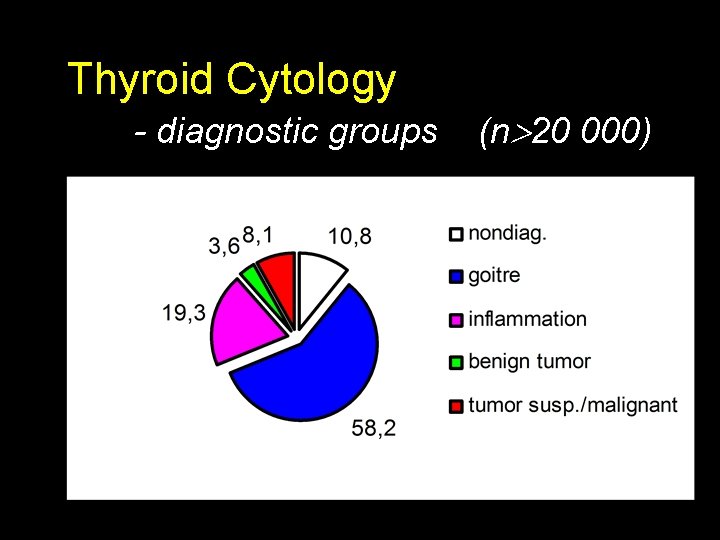
Thyroid Cytology - diagnostic groups (n 20 000)
Main Tasks in the Thyroid Histology v v diagnosis of all lesions in malignancies p. TNM

Processing of Thyroid Resecate v v orientation division – lobus dx. – isthmus (+lobus pyramidalis) – lobus sin. v cutting in cca 3 mm thick lamellae – revision and extensive/complete blocking of the encapsulated nodules periphery – any suspicious focus for histology
Benign Thyroid Nodule Histological diagnosis – adenomatous goitre – macrofollicular adenoma 1. Cytologic features – low cellularity – colloid background – phragments of macrofollicules v tct regular small or slightly enlarged v small and middle size bare nuclei v oncocytes esp. in elderly people
Benign Thyroid Nodule Histological diagnosis – adenomatoid goitre – macrofollicular adenoma with regressive changes 2. Cytologic features – low cellularity – colloid background – phragments of macrofollicules v tct regular small or slightly enlarged v small and middle size bare nuclei v pigmented macrophages v oncocytes esp. in elderly people
Benign Thyroid Nodule Histological diagnosis v micromacrofollicular goitre v micromacrofollicular adenoma cystic transformation (often with signs of older haemorrhage) 3. Cytologic features – low cellularity – regresively changed erythrocytes and colloid – macrophages (abundant, pigmented) – thyreocytes small or slightly enlarged v scatterred groups v may be damaged v may be absent
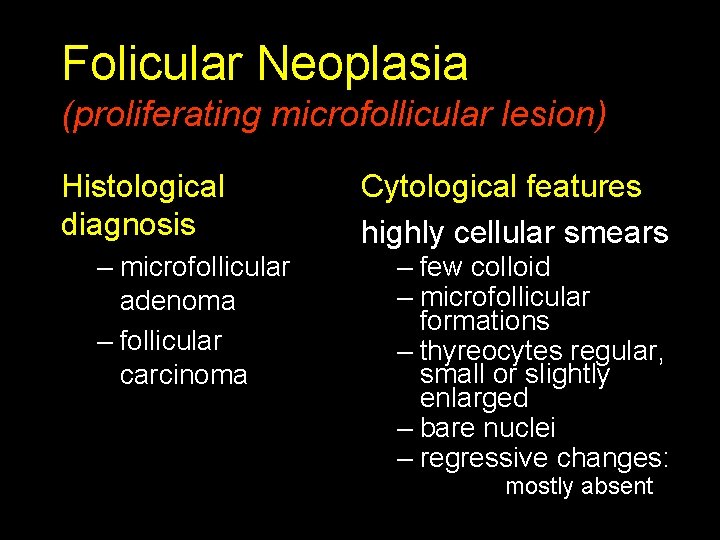
Folicular Neoplasia (proliferating microfollicular lesion) Histological diagnosis – microfollicular adenoma – follicular carcinoma Cytological features highly cellular smears – few colloid – microfollicular formations – thyreocytes regular, small or slightly enlarged – bare nuclei – regressive changes: mostly absent
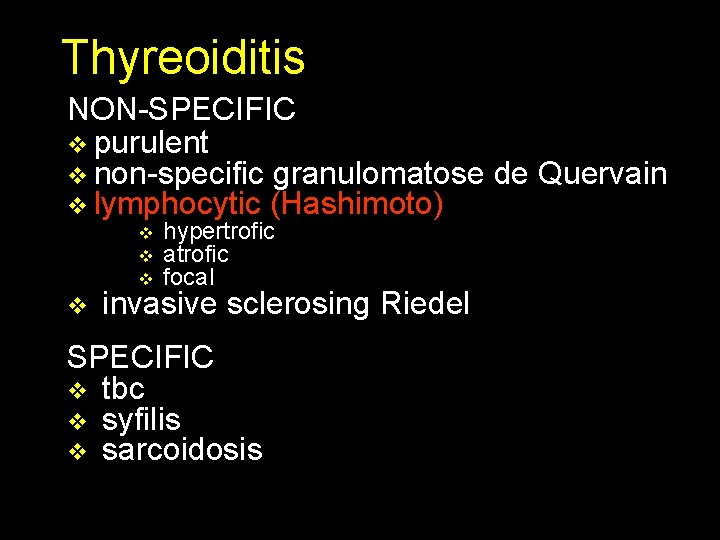
Thyreoiditis NON-SPECIFIC v purulent v non-specific granulomatose de Quervain v lymphocytic (Hashimoto) v v hypertrofic atrofic focal invasive sclerosing Riedel SPECIFIC v tbc v syfilis v sarcoidosis
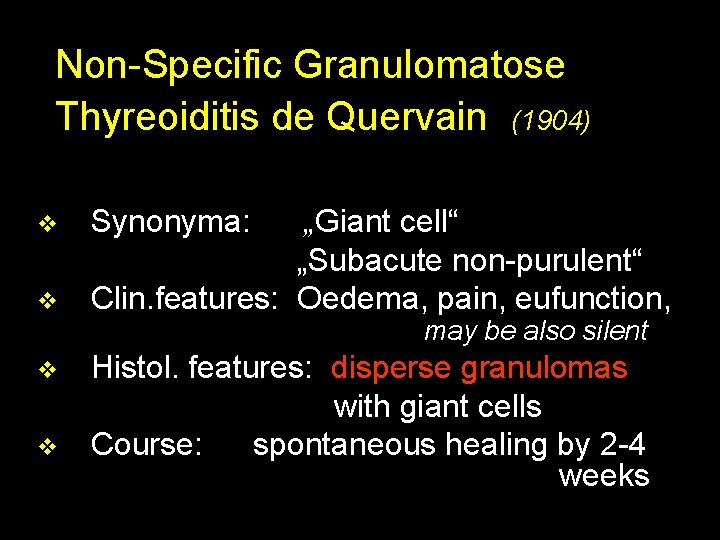
Non-Specific Granulomatose Thyreoiditis de Quervain (1904) v v Synonyma: „Giant cell“ „Subacute non-purulent“ Clin. features: Oedema, pain, eufunction, may be also silent v v Histol. features: disperse granulomas with giant cells Course: spontaneous healing by 2 -4 weeks
Thyreoiditis lymphoplasmocellularis Hashimoto - HT Hashimoto, H. : Zur Kenntniss der lymphomatösen Veränderung der Schilddrüse (struma lymphomatosa) Arch. f. klin. Chir. 97, 1912, 219
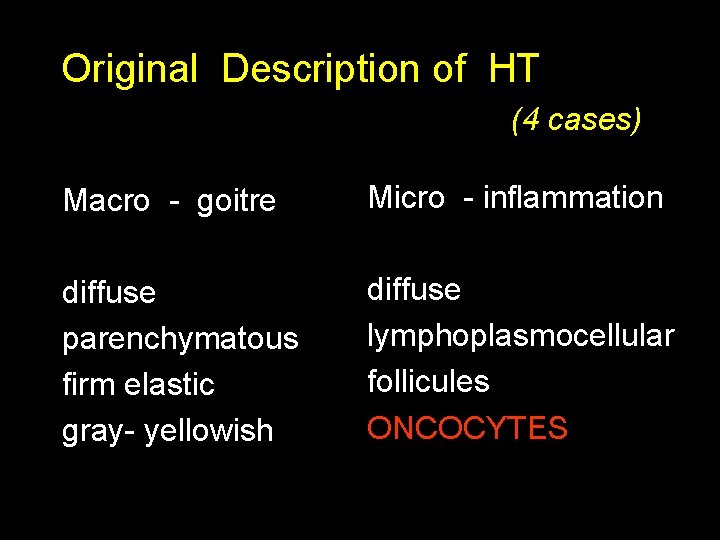
Original Description of HT (4 cases) Macro - goitre Micro - inflammation diffuse parenchymatous firm elastic gray- yellowish diffuse lymphoplasmocellular follicules ONCOCYTES
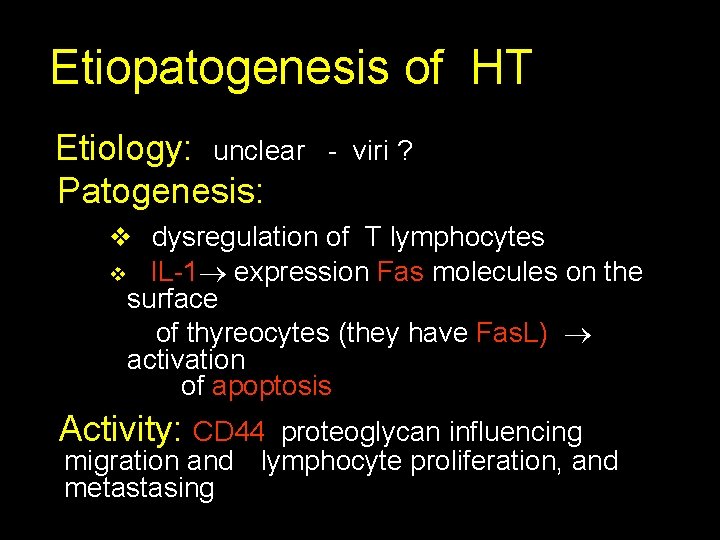
Etiopatogenesis of HT Etiology: unclear Patogenesis: - viri ? v dysregulation of T lymphocytes v IL-1 expression Fas molecules on the surface of thyreocytes (they have Fas. L) activation of apoptosis Activity: CD 44 proteoglycan influencing migration and lymphocyte proliferation, and metastasing
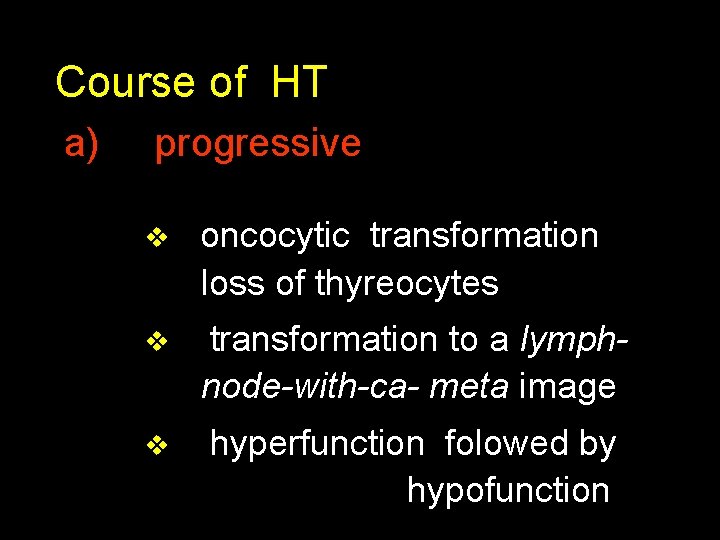
Course of HT a) progressive v oncocytic transformation loss of thyreocytes v transformation to a lymphnode-with-ca- meta image v hyperfunction folowed by hypofunction
Course of HT b) regressive v loss of parenchyma, v fibrosis v hypofunction
Course of HT c) neoplasia v carcinoma v lymphoma MALT) (mostly B -
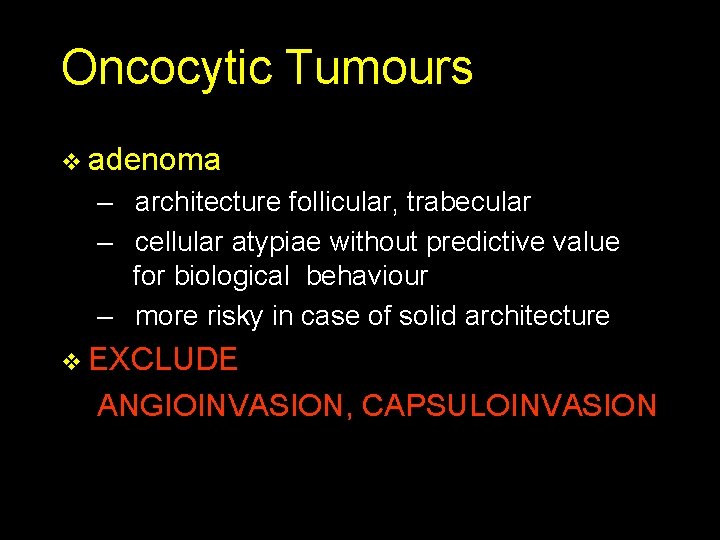
Oncocytic Tumours v adenoma – architecture follicular, trabecular – cellular atypiae without predictive value for biological behaviour – more risky in case of solid architecture v EXCLUDE ANGIOINVASION, CAPSULOINVASION
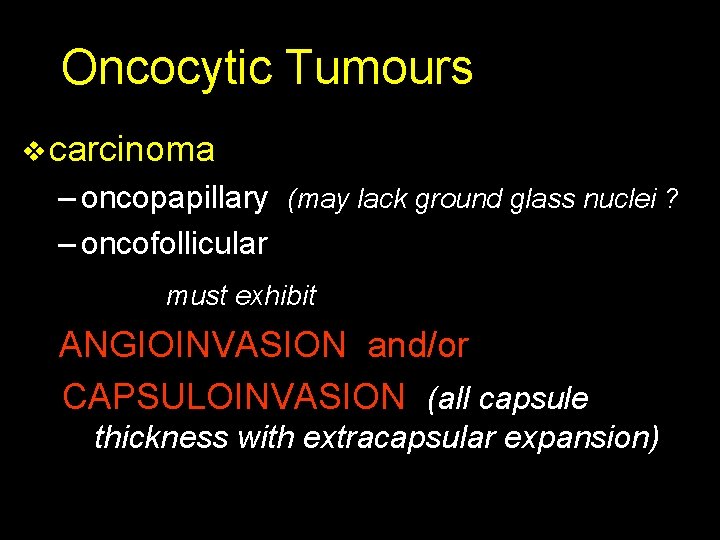
Oncocytic Tumours v carcinoma – oncopapillary (may lack ground glass nuclei ? – oncofollicular must exhibit ANGIOINVASION and/or CAPSULOINVASION (all capsule thickness with extracapsular expansion)
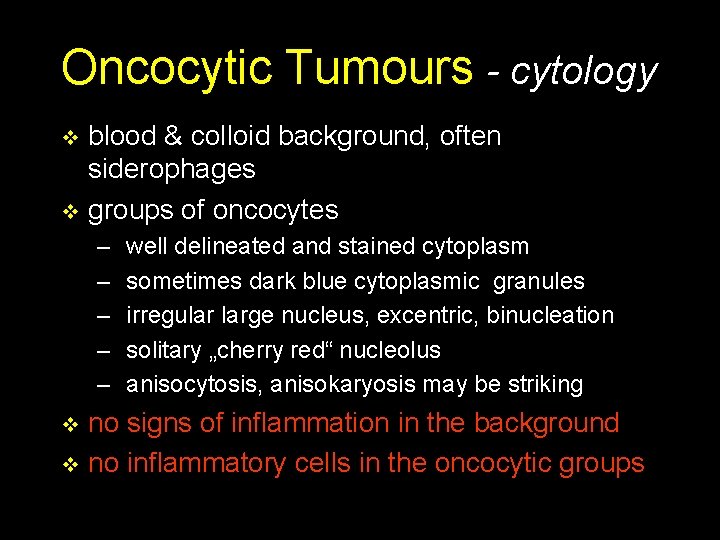
Oncocytic Tumours - cytology blood & colloid background, often siderophages v groups of oncocytes v – – – well delineated and stained cytoplasm sometimes dark blue cytoplasmic granules irregular large nucleus, excentric, binucleation solitary „cherry red“ nucleolus anisocytosis, anisokaryosis may be striking no signs of inflammation in the background v no inflammatory cells in the oncocytic groups v

HT - differential diagnosis HT versus HT + lymphoma HT versus HT + carcinoma oncocytic papillary medullary
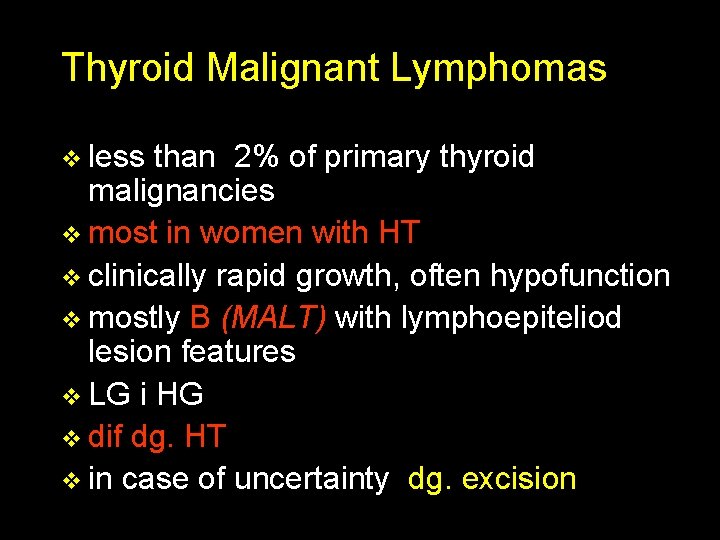
Thyroid Malignant Lymphomas v less than 2% of primary thyroid malignancies v most in women with HT v clinically rapid growth, often hypofunction v mostly B (MALT) with lymphoepiteliod lesion features v LG i HG v dif dg. HT v in case of uncertainty dg. excision
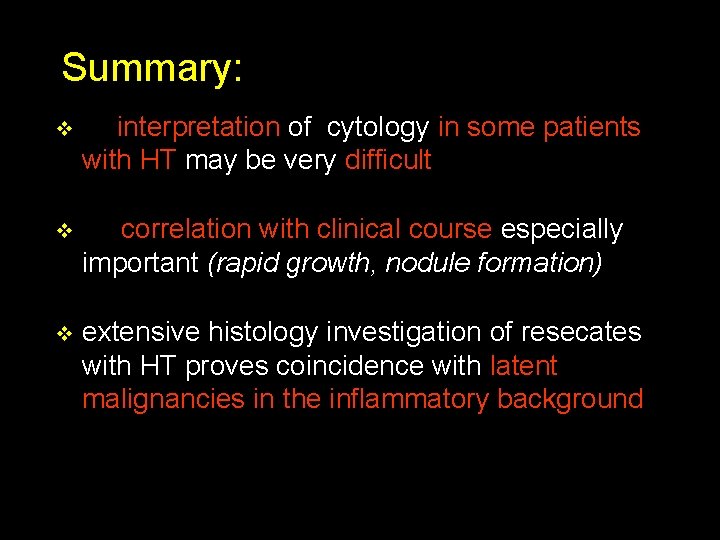
Summary: v interpretation of cytology in some patients with HT may be very difficult v correlation with clinical course especially important (rapid growth, nodule formation) v extensive histology investigation of resecates with HT proves coincidence with latent malignancies in the inflammatory background
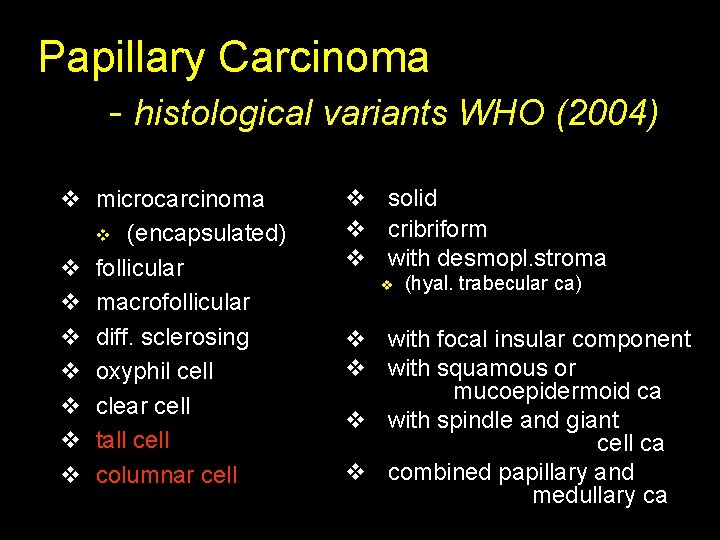
Papillary Carcinoma - histological variants WHO (2004) v microcarcinoma v (encapsulated) v follicular v macrofollicular v diff. sclerosing v oxyphil cell v clear cell v tall cell v columnar cell v solid v cribriform v with desmopl. stroma v (hyal. trabecular ca) v with focal insular component v with squamous or mucoepidermoid ca v with spindle and giant cell ca v combined papillary and medullary ca
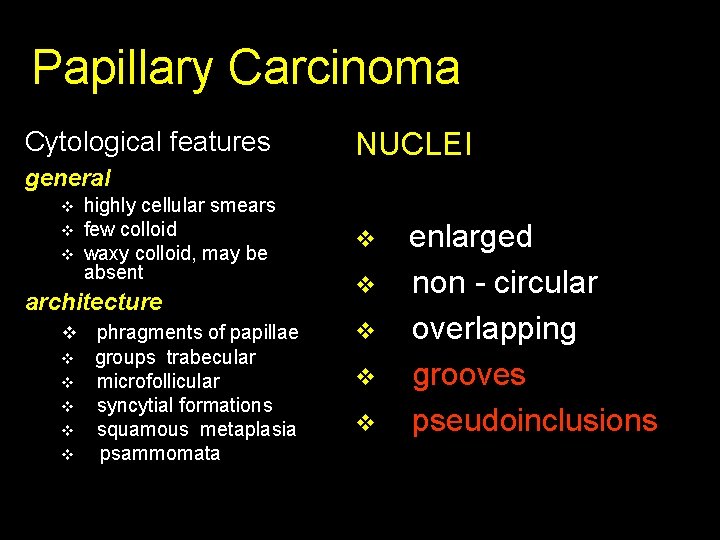
Papillary Carcinoma Cytological features NUCLEI general v v v highly cellular smears few colloid waxy colloid, may be absent architecture v v v phragments of papillae groups trabecular microfollicular syncytial formations squamous metaplasia psammomata v v v enlarged non - circular overlapping grooves pseudoinclusions
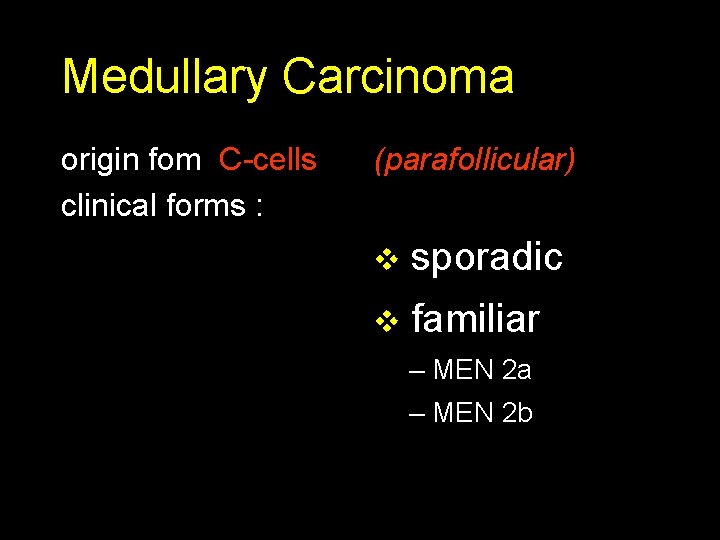
Medullary Carcinoma origin fom C-cells clinical forms : (parafollicular) v sporadic v familiar – MEN 2 a – MEN 2 b
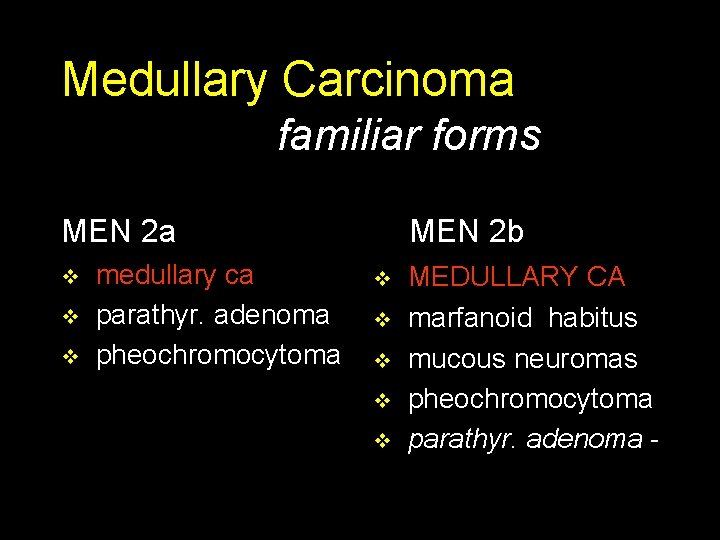
Medullary Carcinoma familiar forms MEN 2 a v v v medullary ca parathyr. adenoma pheochromocytoma MEN 2 b v v v MEDULLARY CA marfanoid habitus mucous neuromas pheochromocytoma parathyr. adenoma -
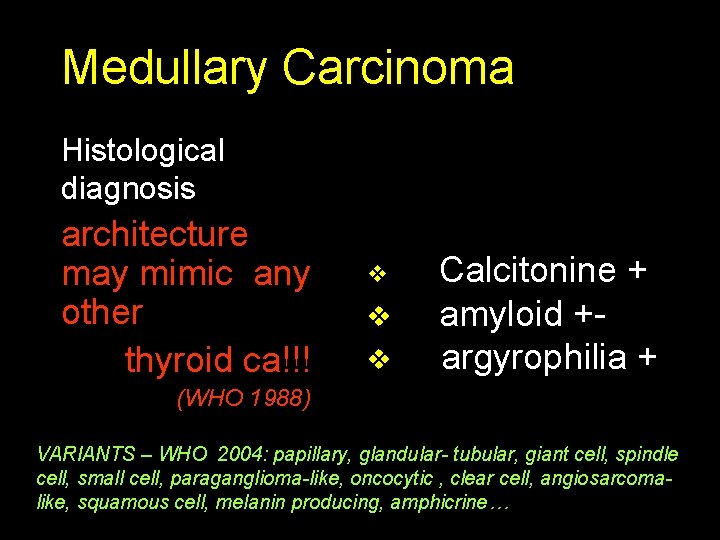
Medullary Carcinoma Histological diagnosis architecture may mimic any other thyroid ca!!! v v v Calcitonine + amyloid +argyrophilia + (WHO 1988) VARIANTS – WHO 2004: papillary, glandular- tubular, giant cell, spindle cell, small cell, paraganglioma-like, oncocytic , clear cell, angiosarcomalike, squamous cell, melanin producing, amphicrine…
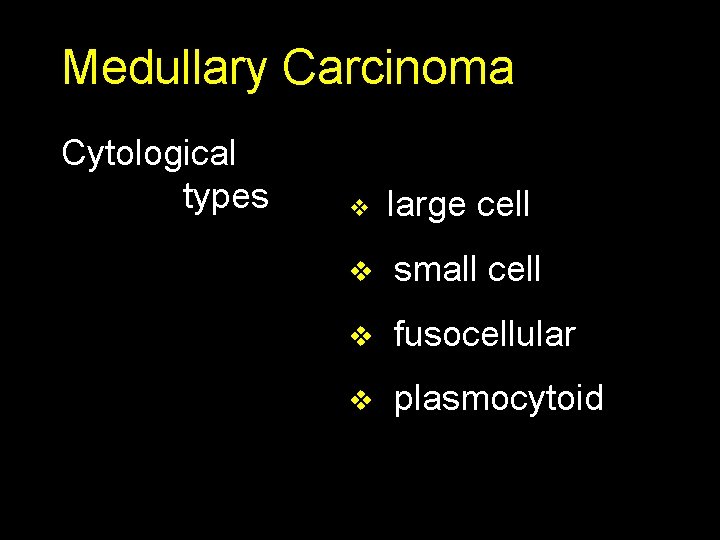
Medullary Carcinoma Cytological types v large cell v small cell v fusocellular v plasmocytoid
Medullary Carcinoma Cytological features blood background v colloid absent (amyloid +-) v groups of cells – oncocytoid (granules rose!) – plasmocytoid – fusocellular – small round cells v HYPERCHROMATIC NUCLEI (overlapping, oval or spindle shaped)
Undifferentiated Carcinoma (anaplastic) highly malignant neoplasm of the old age with rapid progression origin: v v non diag. differentiated ca hyperplastic goitre chronic inflammation without preceeding goitre
Undifferentiated Carcinoma Histological variants v v v (often combined) fusocellular small cell (? ) exclude lymphoma! giant cell (monstrous cells) squamous metaplasia composed v lmsa, rmsa, osa, chsa, hae, MFH, classify as carcinoma!
Undifferentiated Carcinoma Cytological features v blood background without colloid v isolated and grouped atypical cells – fusiform – polygonal – giant v striking anisocytosis, anisokaryosis v HYPERCHROMATIC NUCLEI v squamous metaplasia
Mixed Medullary-Follicular Carcinoma v mixture v both of structures components in metastases v provable even without meta (differentiation, ihch, ISH, PCR co-expression of TGB and Calcitonine) Two own cases published in: Acta Cytol 2003; 47 (1): 71 -7
Other Types of Primary. Thyroid Carcinomas v epidermoid v mucoepidermoid v mixed follicular and mucoepidermoid
Metastases to the. Thyroid v kidney v lung v breast v others
Pitfalls in Thyroid FNAB v combined diagnoses v repair v medullary ca v rare tumours
The Unified Approach to Breast Fine Needle Aspiration Biopsy. A synopsis. Acta Cytol. , 1996, 40, 6, 1120 -6 Applicable to the Thyroid FNAB
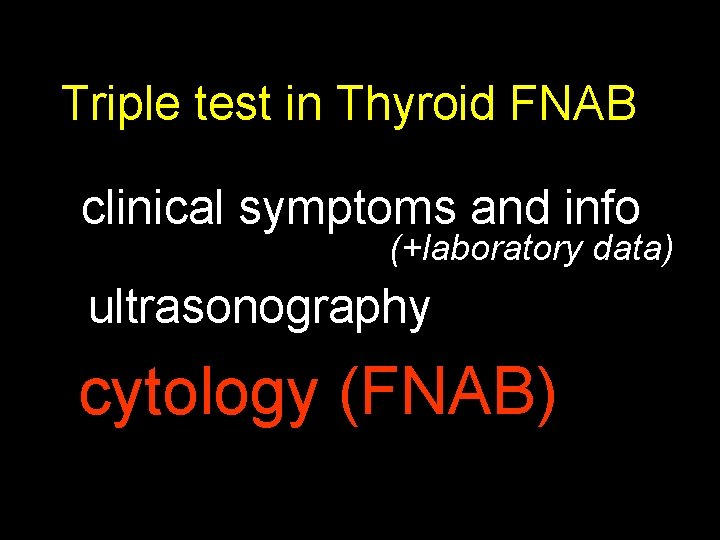
Triple test in Thyroid FNAB clinical symptoms and info (+laboratory data) ultrasonography cytology (FNAB)
What to do? Listen to the patient´s history and clin. info BUT

Consider material limitations both quantitative and qualitative
evaluate what IS on the slide
If uncertainty considering malignancy presence persists ASK for
extensive histological investigation
- Slides: 49