
Thyroid and Antithyroid Drugs By Bohlooli S Ph
Thyroid and Antithyroid Drugs By: Bohlooli S, Ph. D School of Medicine, Ardabil University of Medical Sciences (Ar. UMS)
THYROID PHYSIOLOGY n Iodide Metabolism n n n The recommended daily adult iodide (I-) intake is 150 mcg Biosynthesis of Thyroid Hormones Transport of Thyroid Hormones n n thyroxine-binding globulin (TBG) about 0. 04% of total T 4 and 0. 4% of T 3 exist in the free form.
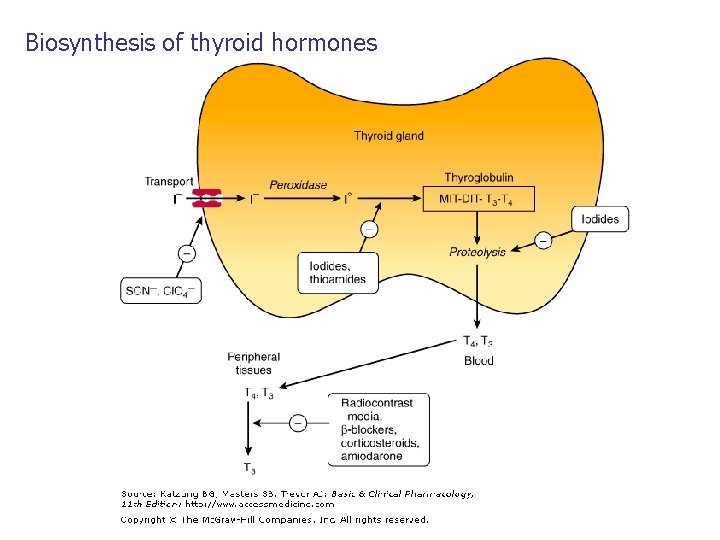
Biosynthesis of thyroid hormones
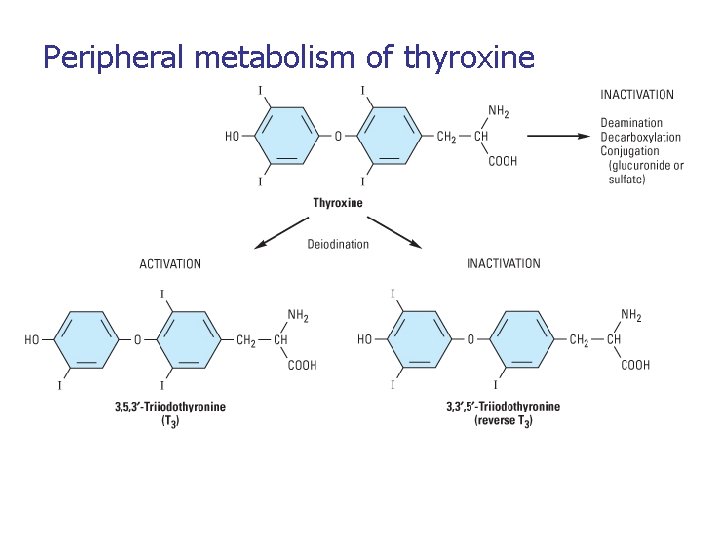
Peripheral metabolism of thyroxine
Evaluation of Thyroid Function n THYROID-PITUITARY RELATIONSHIPS AUTOREGULATION OF THE THYROID GLAND ABNORMAL THYROID STIMULATORS

Typical values for thyroid function tests Name of Test Normal Value 1 Results in Hypothyroidism Results in Hyperthyroidism Total thyroxine by RIA (T 4 [RIA]) 5 -12 mcg/d. L (64 -154 nmol/L) Low High Total triiodothyronine by RIA (T 3 [RIA]) 70 -132 ng/d. L (1. 1 -2. 0 nmol/L) Normal or low High Free T 4 (FT 4) 0. 7 -1. 86 mg/d. L (9 -24 pmol/L) Low High Free T 3 (FT 3) 0. 2 -0. 42 ng/d. L (3 -6. 5 pmol/L) Low High Thyrotropic hormone (TSH) 0. 5 -5. 0 u. IU/m. L (0. 5 -5. 0 m. IU/L) High 2 Low 123 I uptake at 24 hours 5 -35% Low High Thyroglobulin autoantibodies (Tgab) < 1 IU/m. L Often present Usually present Thyroid peroxidase antibodies (TPA) < 1 IU/m. L Often present Usually present Isotope scan with 123 I or 99 m. Tc. O 4 Normal pattern Test not indicated Diffusely enlarged gland Fine-needle aspiration biopsy (FNA) Normal pattern Test not indicated Serum thyroglobulin < 56 ng/m. L Test not indicated Serum calcitonin Male: < 8 ng/L (< 2. 3 pmol/L); female: < 4 ng/L (< 1. 17 pmol/L) Test not indicated TSH receptor-stimulating antibody (thyroid stimulating imunoglobulin) < 125% Test not indicated Elevated in Graves' disease

The hypothalamic-pituitary -thyroid axis
BASIC PHARMACOLOGY

THYROID HORMONES n Chemistry n n Are levo (L) isomers Dextro (D) isomer of thyroxine, dextrothyroxine, has approximately 4% of the biologic activity of the L isomer Pharmacokinetics Mechanism of Action

Summary of thyroid hormone kinetics. Variable T 4 T 3 Volume of distribution 10 L 40 L Extrathyroidal pool 800 mcg 54 mcg Daily production 75 mcg 25 mcg Fractional turnover per day 10% 60% Metabolic clearance per day 1. 1 L 24 L Half-life (biologic) 7 days 1 day Serum levels Total 5 -12 mcg/d. L (64 -164 70 -132 ng/d. L (1. 1 nmol/L) 2. 0 nmol/L) Free 0. 7 -1. 86 ng/d. L (9 -24 0. 23 -0. 42 ng/d. L (3. 5 pmol/L) 6. 47 pmol/L) Amount bound 99. 96% 99. 6% Biologic potency 1 4 Oral absorption 80% 95%
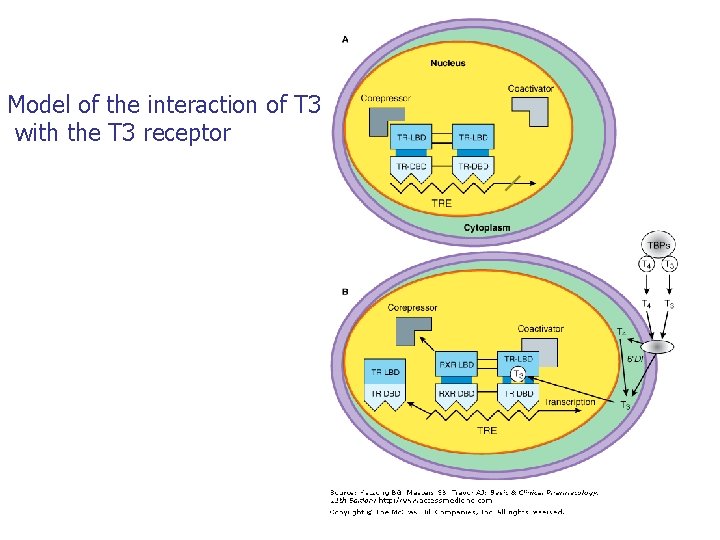
Model of the interaction of T 3 with the T 3 receptor
Effects of Thyroid Hormones n The thyroid hormones are responsible for : n n Optimal growth Development Function Maintenance of all body tissues

Manifestations of thyrotoxicosis and hypothyroidism (1) System Thyrotoxicosis Hypothyroidism Skin and appendages Warm, moist skin; sweating; heat intolerance; fine, thin hair; Plummer's nails; pretibial dermopathy (Graves' disease) Pale, cool, puffy skin; dry and brittle hair; brittle nails Eyes, face Retraction of upper lid with wide stare; periorbital edema; exophthalmos; diplopia (Graves' disease) Drooping of eyelids; periorbital edema; loss of temporal aspects of eyebrows; puffy, nonpitting facies; large tongue Cardiovascular system Decreased peripheral vascular resistance, increased heart rate, stroke volume, cardiac output, pulse pressure; high-output heart failure; increased inotropic and chronotropic effects; arrhythmias; angina Increased peripheral vascular resistance; decreased heart rate, stroke volume, cardiac output, pulse pressure; low-output heart failure; ECG: bradycardia, prolonged PR interval, flat T wave, low voltage; pericardial effusion Respiratory system Dyspnea; decreased vital capacity Pleural effusions; hypoventilation and CO 2 retention

Manifestations of thyrotoxicosis and hypothyroidism (2) System Thyrotoxicosis Hypothyroidism Gastrointestinal system Increased appetite; increased frequency of bowel movements; hypoproteinemia Decreased appetite; decreased frequency of bowel movements; ascites Central nervous system Nervousness; hyperkinesia; emotional lability Lethargy; general slowing of mental processes; neuropathies Musculoskeletal system Weakness and muscle fatigue; Stiffness and muscle fatigue; increased deep tendon reflexes; decreased deep tendon reflexes; hypercalcemia; osteoporosis increased alkaline phosphatase, LDH, AST Renal system Mild polyuria; increased renal blood flow; increased glomerular filtration rate Impaired water excretion; decreased renal blood flow; decreased glomerular filtration rate Hematopoietic system Increased erythropoiesis; anemia 1 Decreased erythropoiesis; anemia 1 Reproductive system Menstrual irregularities; decreased fertility; increased gonadal steroid metabolism Hypermenorrhea; infertility; decreased libido; impotence; oligospermia; decreased gonadal steroid metabolism
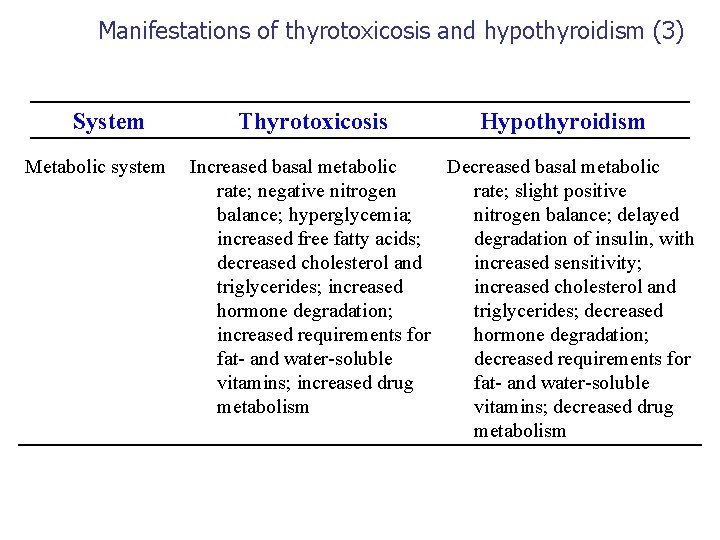
Manifestations of thyrotoxicosis and hypothyroidism (3) System Metabolic system Thyrotoxicosis Hypothyroidism Increased basal metabolic Decreased basal metabolic rate; negative nitrogen rate; slight positive balance; hyperglycemia; nitrogen balance; delayed increased free fatty acids; degradation of insulin, with decreased cholesterol and increased sensitivity; triglycerides; increased cholesterol and hormone degradation; triglycerides; decreased increased requirements for hormone degradation; fat- and water-soluble decreased requirements for vitamins; increased drug fat- and water-soluble metabolism vitamins; decreased drug metabolism
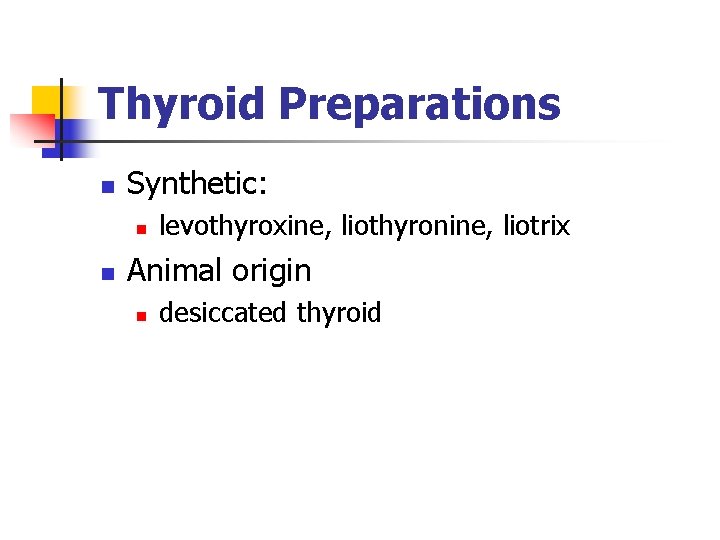
Thyroid Preparations n Synthetic: n n levothyroxine, liothyronine, liotrix Animal origin n desiccated thyroid
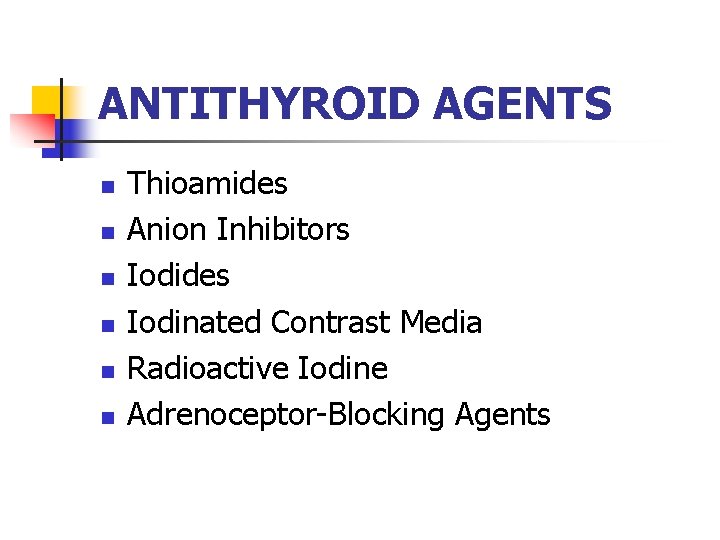
ANTITHYROID AGENTS n n n Thioamides Anion Inhibitors Iodides Iodinated Contrast Media Radioactive Iodine Adrenoceptor-Blocking Agents
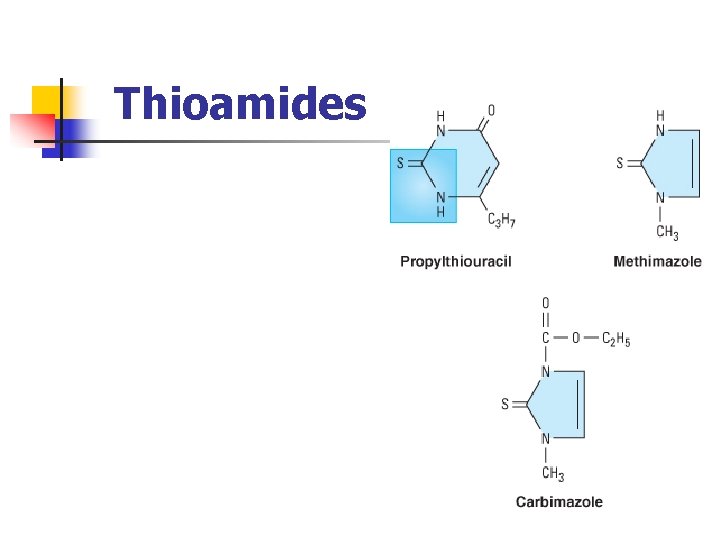
Thioamides

Thioamides n Pharmacokinetics n n n Propylthiouracil is rapidly absorbed and the bioavailability is 50 -80% Methimazole is completely absorbed Both thioamides cross the placental barrier

Thioamides; Pharmacodynamics n n Act by multiple mechanisms Prevent hormone synthesis by inhibiting the thyroid peroxidase Inhibiting the peripheral deiodination of T 4 and T 3 The onset of these agents is slow, often requiring 3 -4 weeks

Thioamides: Toxicity: n n Occur in 3 -12% of treated patients Nausea and gastrointestinal distress The most common adverse effect is a maculopapular pruritic rash (4 -6%) Rare adverse effects include: n n n an urticarial rash, vasculitis, a lupus-like reaction, lymphadenopathy, hypoprothrombinemia, exfoliative dermatitis, polyserositis, and acute arthralgia. Hepatitis can be fatal The most dangerous complication is agranulocytosis
Anion Inhibitors n n n Perchlorate (Cl. O 4 -) Pertechnetate (Tc. O 4 -) Thiocyanate (SCN-)
Iodides n n n Inhibit organification Hormone release Decrease the size and vascularity of the hyperplastic gland
Iodinated Contrast Media n n diatrizoate iohexol inhibit the conversion of T 4 to T 3 inhibition of hormone release
Radioactive Iodine n n 131 I is the only isotope used for treatment of thyrotoxicosis therapeutic effect depends on emission of rays
Adrenoceptor-Blocking Agents n n Metoprolol Propranolol Atenolol effective therapeutic adjuncts in the management of thyrotoxicosis
CLINICAL PHARMACOLOGY OF THYROID & ANTITHYROID DRUGS HYPOTHYROIDISM HYPERTHYROIDISM Thyroid Storm Ophthalmopathy Dermopathy
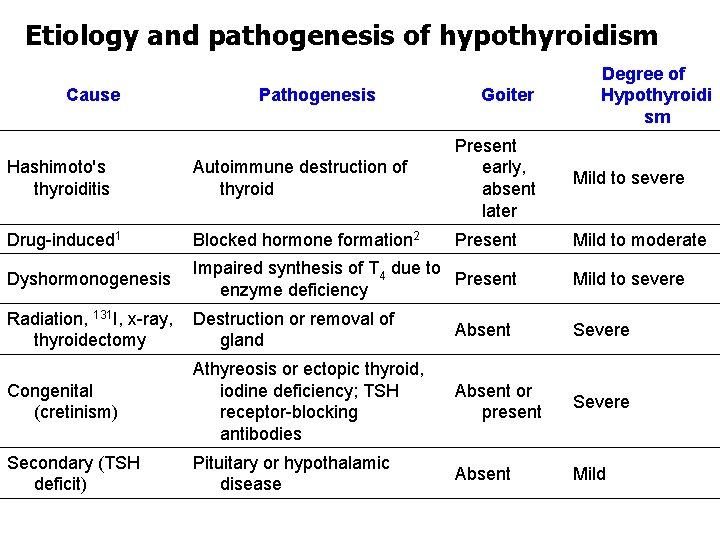
Etiology and pathogenesis of hypothyroidism Cause Pathogenesis Goiter Hashimoto's thyroiditis Autoimmune destruction of thyroid Present early, absent later Drug-induced 1 Blocked hormone formation 2 Present Dyshormonogenesis Impaired synthesis of T 4 due to Present enzyme deficiency Radiation, 131 I, x-ray, Destruction or removal of thyroidectomy gland Degree of Hypothyroidi sm Mild to severe Mild to moderate Mild to severe Absent Severe Congenital (cretinism) Athyreosis or ectopic thyroid, iodine deficiency; TSH receptor-blocking antibodies Absent or present Severe Secondary (TSH deficit) Pituitary or hypothalamic disease Absent Mild
- Slides: 28