
Thunderbolt in Machine Vision Arlin Kalenchuk Allied Vision

Thunderbolt in Machine Vision Arlin Kalenchuk, Allied Vision Product Manager

Contents Thunderbolt Specifications High Speed Machine Vision Interface Comparison Thunderbolt Cameras for Machine Vision

Thunderbolt Specifications
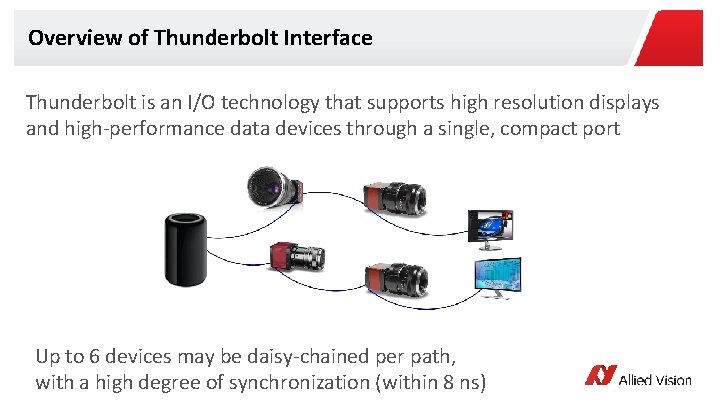
Overview of Thunderbolt Interface Thunderbolt is an I/O technology that supports high resolution displays and high-performance data devices through a single, compact port Up to 6 devices may be daisy-chained per path, with a high degree of synchronization (within 8 ns)
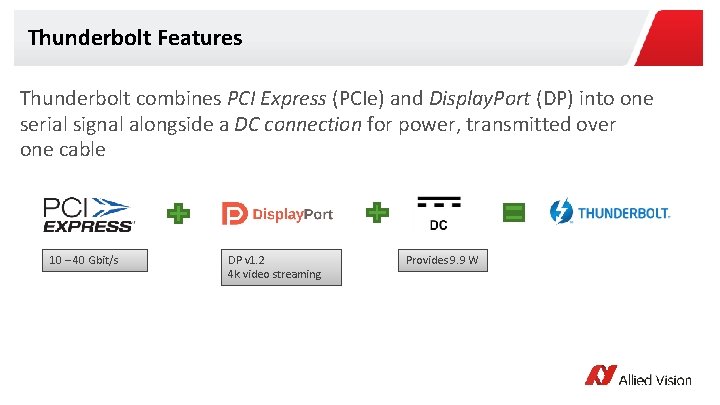
Thunderbolt Features Thunderbolt combines PCI Express (PCIe) and Display. Port (DP) into one serial signal alongside a DC connection for power, transmitted over one cable 10 – 40 Gbit/s DP v 1. 2 4 k video streaming Provides 9. 9 W
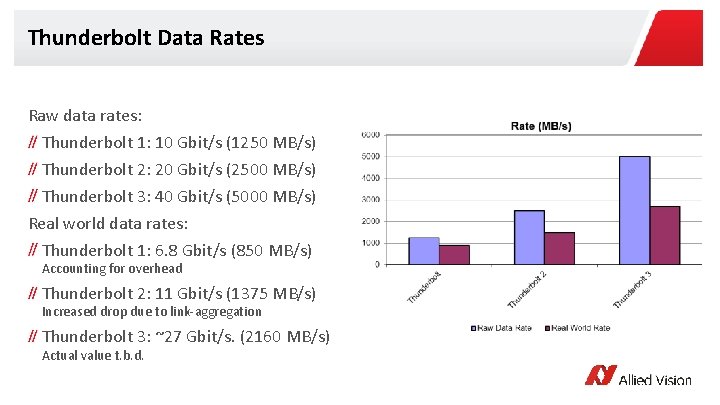
Thunderbolt Data Rates Raw data rates: Thunderbolt 1: 10 Gbit/s (1250 MB/s) Thunderbolt 2: 20 Gbit/s (2500 MB/s) Thunderbolt 3: 40 Gbit/s (5000 MB/s) Real world data rates: Thunderbolt 1: 6. 8 Gbit/s (850 MB/s) Accounting for overhead Thunderbolt 2: 11 Gbit/s (1375 MB/s) Increased drop due to link-aggregation Thunderbolt 3: ~27 Gbit/s. (2160 MB/s) Actual value t. b. d.
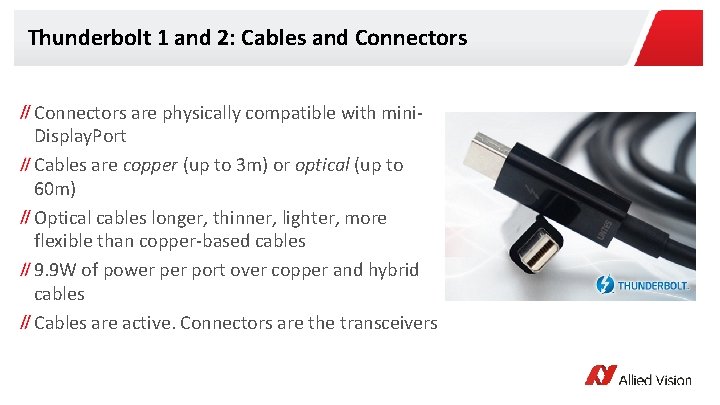
Thunderbolt 1 and 2: Cables and Connectors are physically compatible with mini. Display. Port Cables are copper (up to 3 m) or optical (up to 60 m) Optical cables longer, thinner, lighter, more flexible than copper-based cables 9. 9 W of power port over copper and hybrid cables Cables are active. Connectors are the transceivers
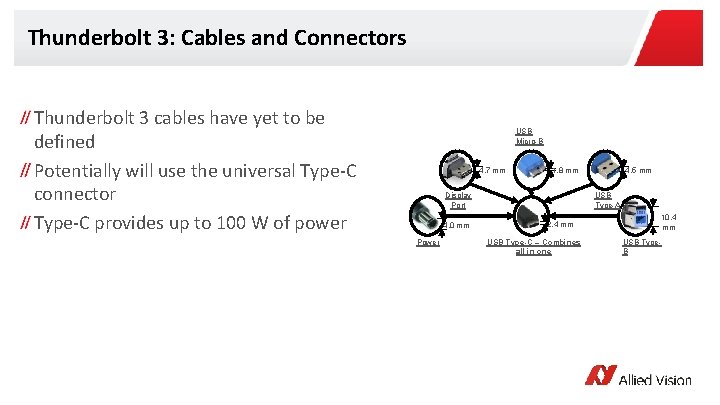
Thunderbolt 3: Cables and Connectors Thunderbolt 3 cables have yet to be defined Potentially will use the universal Type-C connector Type-C provides up to 100 W of power USB Micro-B 4. 7 mm USB Type-A Display Port 4. 0 mm Power 4. 5 mm 1. 8 mm 2. 4 mm USB Type-C – Combines all in one 10. 4 mm USB Type. B
High Speed Machine Vision Interface Comparison

Machine Vision Interface Speeds
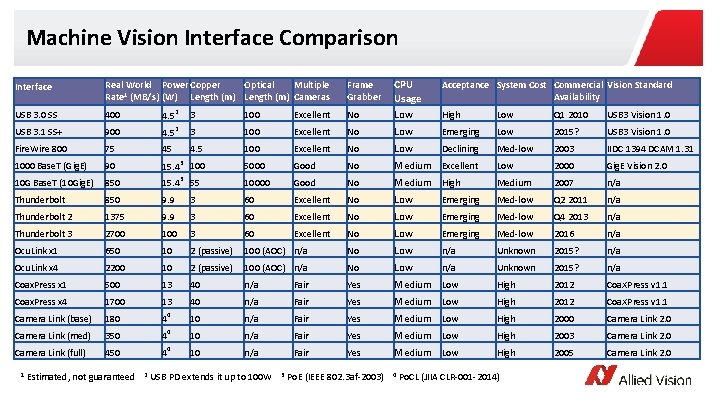
Machine Vision Interface Comparison Frame Grabber CPU Usage Acceptance System Cost Commercial Vision Standard Availability Excellent No Low High Low Q 1 2010 USB 3 Vision 1. 0 100 Excellent No Low Emerging Low 2015? USB 3 Vision 1. 0 Declining Med-low 2003 IIDC 1394 DCAM 1. 31 Interface Real World Power Copper Optical Multiple Rate 1 (MB/s) (W) Length (m) Cameras USB 3. 0 SS 400 4. 52 3 100 USB 3. 1 SS+ 900 4. 5 2 3 Fire. Wire 800 75 45 1000 Base. T (Gig. E) 90 4. 5 100 Excellent No Low 15. 4 3 100 5000 Good No Medium Excellent Low 2000 Gig. E Vision 2. 0 3 55 10000 Good No Medium High Medium 2007 n/a 10 G Base. T (10 Gig. E) 850 15. 4 Thunderbolt 850 9. 9 3 60 Excellent No Low Emerging Med-low Q 2 2011 n/a Thunderbolt 2 1375 9. 9 3 60 Excellent No Low Emerging Med-low Q 4 2013 n/a Thunderbolt 3 2700 100 3 60 Excellent No Low Emerging Med-low 2016 n/a Ocu. Link x 1 650 10 2 (passive) 100 (AOC) n/a No Low n/a Unknown 2015? n/a Ocu. Link x 4 2200 10 2 (passive) 100 (AOC) n/a No Low n/a Unknown 2015? n/a Coax. Press x 1 500 13 40 n/a Fair Yes Medium Low High 2012 Coa. XPress v 1. 1 Coax. Press x 4 1700 13 40 n/a Fair Yes Medium Low High 2012 Coa. XPress v 1. 1 4 4 10 n/a Fair Yes Medium Low High 2000 Camera Link 2. 0 4 4 10 n/a Fair Yes Medium Low High 2003 Camera Link 2. 0 4 4 10 n/a Fair Yes Medium Low High 2005 Camera Link 2. 0 Camera Link (base) Camera Link (med) Camera Link (full) 1 180 350 450 Estimated, not guaranteed 2 USB PD extends it up to 100 W 3 Po. E (IEEE 802. 3 af-2003) 4 Po. CL (JIIA CLR-001 -2014)
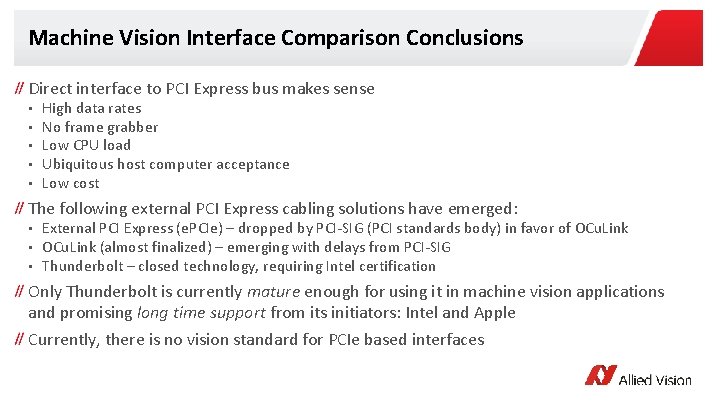
Machine Vision Interface Comparison Conclusions Direct interface to PCI Express bus makes sense • • • High data rates No frame grabber Low CPU load Ubiquitous host computer acceptance Low cost The following external PCI Express cabling solutions have emerged: • • • External PCI Express (e. PCIe) – dropped by PCI-SIG (PCI standards body) in favor of OCu. Link (almost finalized) – emerging with delays from PCI-SIG Thunderbolt – closed technology, requiring Intel certification Only Thunderbolt is currently mature enough for using it in machine vision applications and promising long time support from its initiators: Intel and Apple Currently, there is no vision standard for PCIe based interfaces
Thunderbolt Cameras for Machine Vision
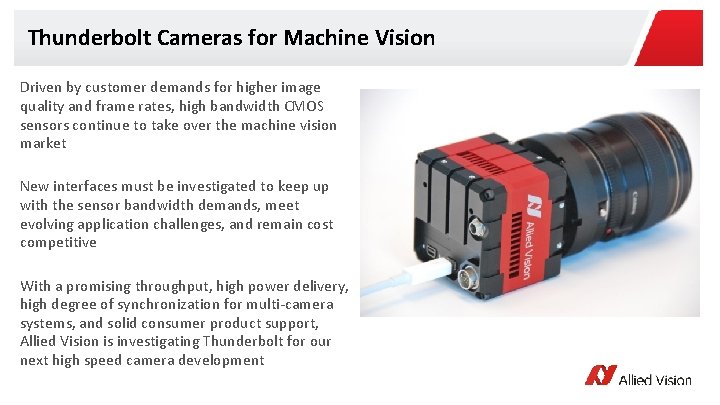
Thunderbolt Cameras for Machine Vision Driven by customer demands for higher image quality and frame rates, high bandwidth CMOS sensors continue to take over the machine vision market New interfaces must be investigated to keep up with the sensor bandwidth demands, meet evolving application challenges, and remain cost competitive With a promising throughput, high power delivery, high degree of synchronization for multi-camera systems, and solid consumer product support, Allied Vision is investigating Thunderbolt for our next high speed camera development

Thank you!
- Slides: 15