
Throughput Profit Multiplier Based on the books Building
Throughput Profit Multiplier Based on the books: Building Lean Supply Chains with the Theory of Constraints Managing Business Process Flow
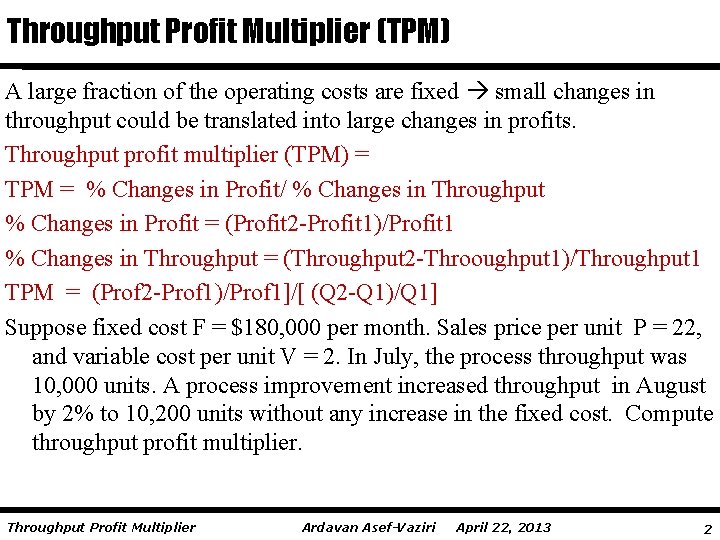
Throughput Profit Multiplier (TPM) A large fraction of the operating costs are fixed small changes in throughput could be translated into large changes in profits. Throughput profit multiplier (TPM) = TPM = % Changes in Profit/ % Changes in Throughput % Changes in Profit = (Profit 2 -Profit 1)/Profit 1 % Changes in Throughput = (Throughput 2 -Throoughput 1)/Throughput 1 TPM = (Prof 2 -Prof 1)/Prof 1]/[ (Q 2 -Q 1)/Q 1] Suppose fixed cost F = $180, 000 per month. Sales price per unit P = 22, and variable cost per unit V = 2. In July, the process throughput was 10, 000 units. A process improvement increased throughput in August by 2% to 10, 200 units without any increase in the fixed cost. Compute throughput profit multiplier. Throughput Profit Multiplier Ardavan Asef-Vaziri April 22, 2013 2
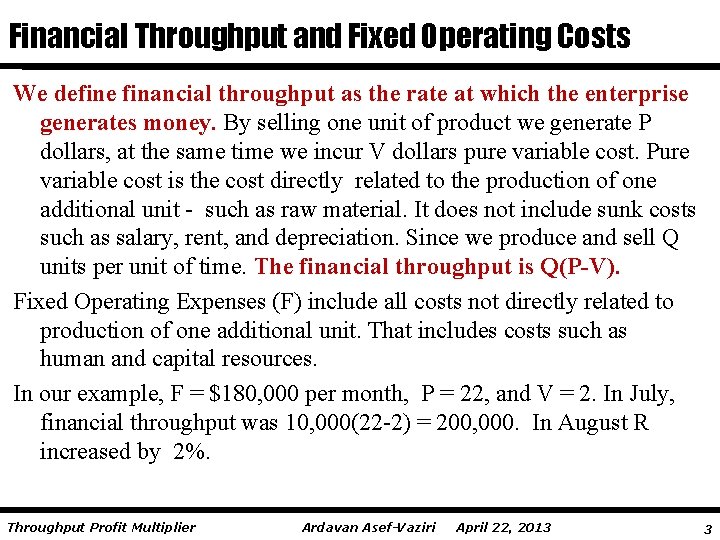
Financial Throughput and Fixed Operating Costs We define financial throughput as the rate at which the enterprise generates money. By selling one unit of product we generate P dollars, at the same time we incur V dollars pure variable cost. Pure variable cost is the cost directly related to the production of one additional unit - such as raw material. It does not include sunk costs such as salary, rent, and depreciation. Since we produce and sell Q units per unit of time. The financial throughput is Q(P-V). Fixed Operating Expenses (F) include all costs not directly related to production of one additional unit. That includes costs such as human and capital resources. In our example, F = $180, 000 per month, P = 22, and V = 2. In July, financial throughput was 10, 000(22 -2) = 200, 000. In August R increased by 2%. Throughput Profit Multiplier Ardavan Asef-Vaziri April 22, 2013 3
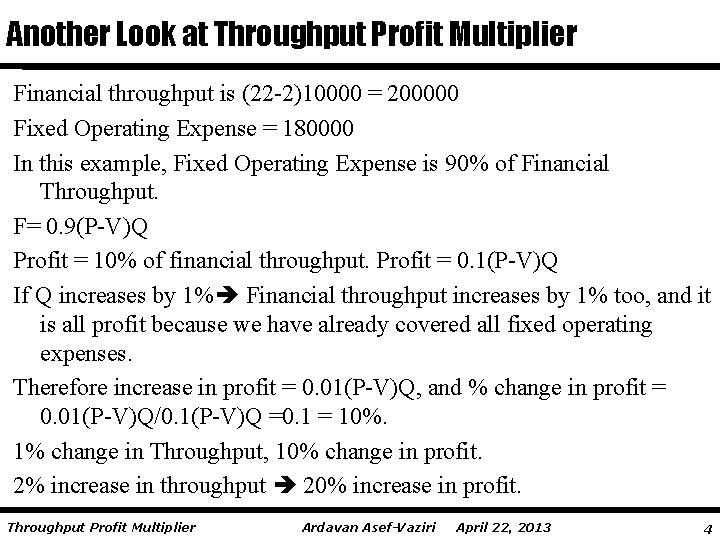
Another Look at Throughput Profit Multiplier Financial throughput is (22 -2)10000 = 200000 Fixed Operating Expense = 180000 In this example, Fixed Operating Expense is 90% of Financial Throughput. F= 0. 9(P-V)Q Profit = 10% of financial throughput. Profit = 0. 1(P-V)Q If Q increases by 1% Financial throughput increases by 1% too, and it is all profit because we have already covered all fixed operating expenses. Therefore increase in profit = 0. 01(P-V)Q, and % change in profit = 0. 01(P-V)Q/0. 1(P-V)Q =0. 1 = 10%. 1% change in Throughput, 10% change in profit. 2% increase in throughput 20% increase in profit. Throughput Profit Multiplier Ardavan Asef-Vaziri April 22, 2013 4
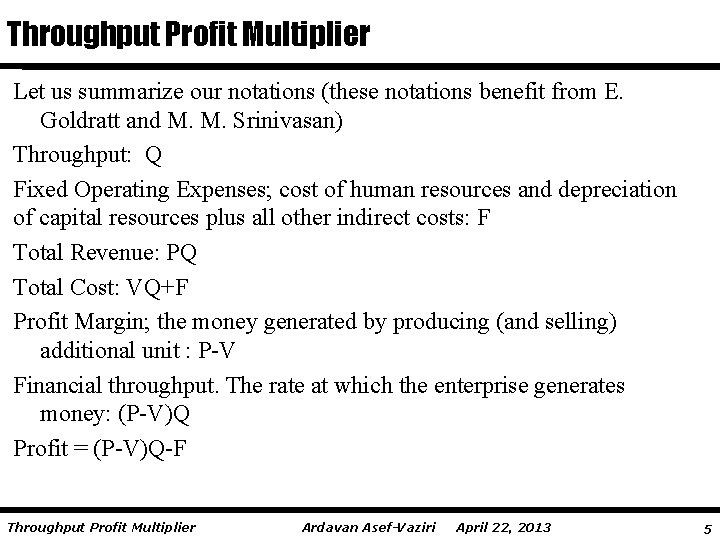
Throughput Profit Multiplier Let us summarize our notations (these notations benefit from E. Goldratt and M. M. Srinivasan) Throughput: Q Fixed Operating Expenses; cost of human resources and depreciation of capital resources plus all other indirect costs: F Total Revenue: PQ Total Cost: VQ+F Profit Margin; the money generated by producing (and selling) additional unit : P-V Financial throughput. The rate at which the enterprise generates money: (P-V)Q Profit = (P-V)Q-F Throughput Profit Multiplier Ardavan Asef-Vaziri April 22, 2013 5
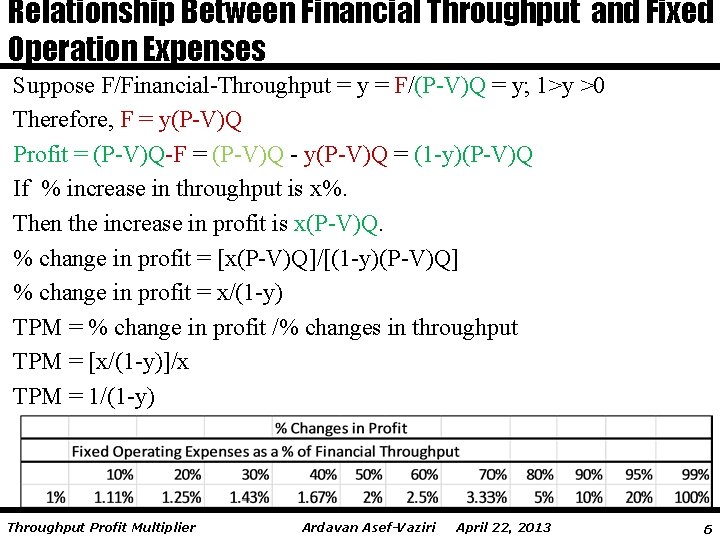
Relationship Between Financial Throughput and Fixed Operation Expenses Suppose F/Financial-Throughput = y = F/(P-V)Q = y; 1>y >0 Therefore, F = y(P-V)Q Profit = (P-V)Q-F = (P-V)Q - y(P-V)Q = (1 -y)(P-V)Q If % increase in throughput is x%. Then the increase in profit is x(P-V)Q. % change in profit = [x(P-V)Q]/[(1 -y)(P-V)Q] % change in profit = x/(1 -y) TPM = % change in profit /% changes in throughput TPM = [x/(1 -y)]/x TPM = 1/(1 -y) Throughput Profit Multiplier Ardavan Asef-Vaziri April 22, 2013 6
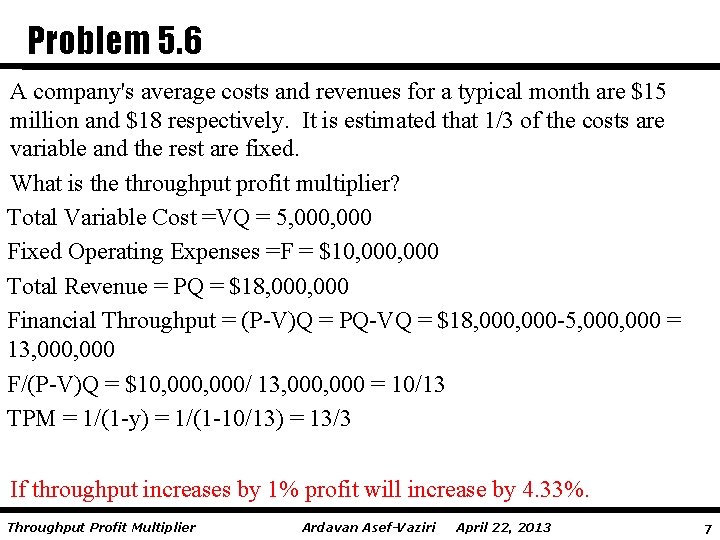
Problem 5. 6 A company's average costs and revenues for a typical month are $15 million and $18 respectively. It is estimated that 1/3 of the costs are variable and the rest are fixed. What is the throughput profit multiplier? Total Variable Cost =VQ = 5, 000 Fixed Operating Expenses =F = $10, 000 Total Revenue = PQ = $18, 000 Financial Throughput = (P-V)Q = PQ-VQ = $18, 000 -5, 000 = 13, 000 F/(P-V)Q = $10, 000/ 13, 000 = 10/13 TPM = 1/(1 -y) = 1/(1 -10/13) = 13/3 If throughput increases by 1% profit will increase by 4. 33%. Throughput Profit Multiplier Ardavan Asef-Vaziri April 22, 2013 7
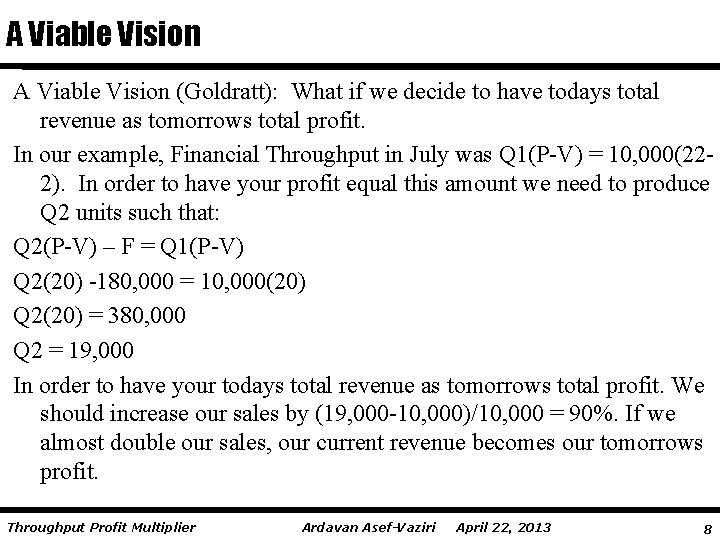
A Viable Vision (Goldratt): What if we decide to have todays total revenue as tomorrows total profit. In our example, Financial Throughput in July was Q 1(P-V) = 10, 000(222). In order to have your profit equal this amount we need to produce Q 2 units such that: Q 2(P-V) – F = Q 1(P-V) Q 2(20) -180, 000 = 10, 000(20) Q 2(20) = 380, 000 Q 2 = 19, 000 In order to have your todays total revenue as tomorrows total profit. We should increase our sales by (19, 000 -10, 000)/10, 000 = 90%. If we almost double our sales, our current revenue becomes our tomorrows profit. Throughput Profit Multiplier Ardavan Asef-Vaziri April 22, 2013 8
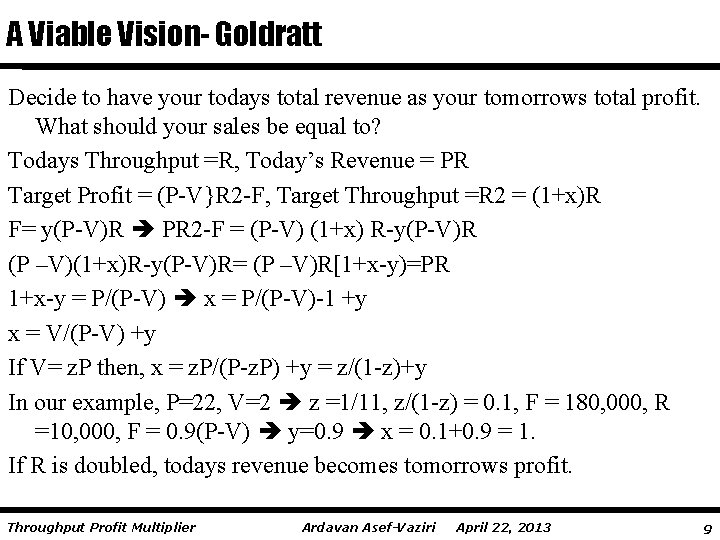
A Viable Vision- Goldratt Decide to have your todays total revenue as your tomorrows total profit. What should your sales be equal to? Todays Throughput =R, Today’s Revenue = PR Target Profit = (P-V}R 2 -F, Target Throughput =R 2 = (1+x)R F= y(P-V)R PR 2 -F = (P-V) (1+x) R-y(P-V)R (P –V)(1+x)R-y(P-V)R= (P –V)R[1+x-y)=PR 1+x-y = P/(P-V) x = P/(P-V)-1 +y x = V/(P-V) +y If V= z. P then, x = z. P/(P-z. P) +y = z/(1 -z)+y In our example, P=22, V=2 z =1/11, z/(1 -z) = 0. 1, F = 180, 000, R =10, 000, F = 0. 9(P-V) y=0. 9 x = 0. 1+0. 9 = 1. If R is doubled, todays revenue becomes tomorrows profit. Throughput Profit Multiplier Ardavan Asef-Vaziri April 22, 2013 9
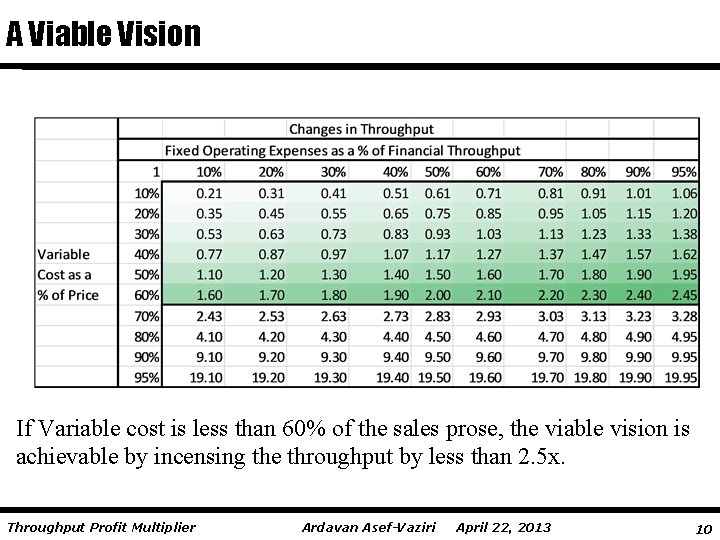
A Viable Vision If Variable cost is less than 60% of the sales prose, the viable vision is achievable by incensing the throughput by less than 2. 5 x. Throughput Profit Multiplier Ardavan Asef-Vaziri April 22, 2013 10
- Slides: 10