
Through a Glass Darkly Dark Energy and The
- Slides: 58
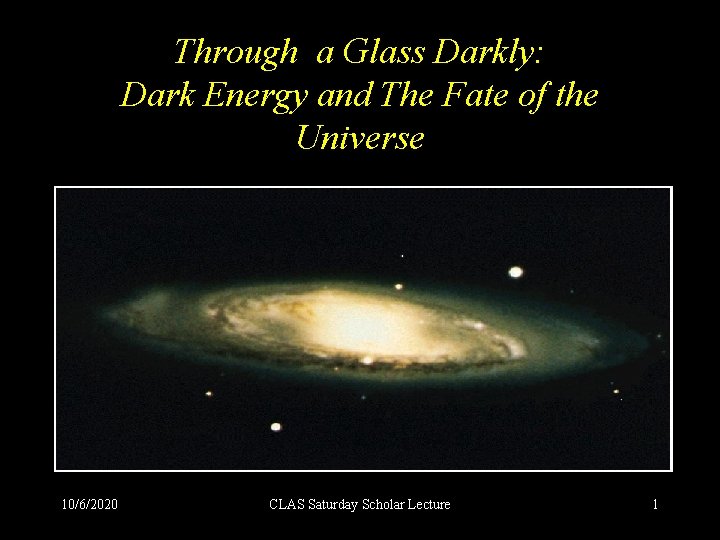
Through a Glass Darkly: Dark Energy and The Fate of the Universe 10/6/2020 CLAS Saturday Scholar Lecture 1
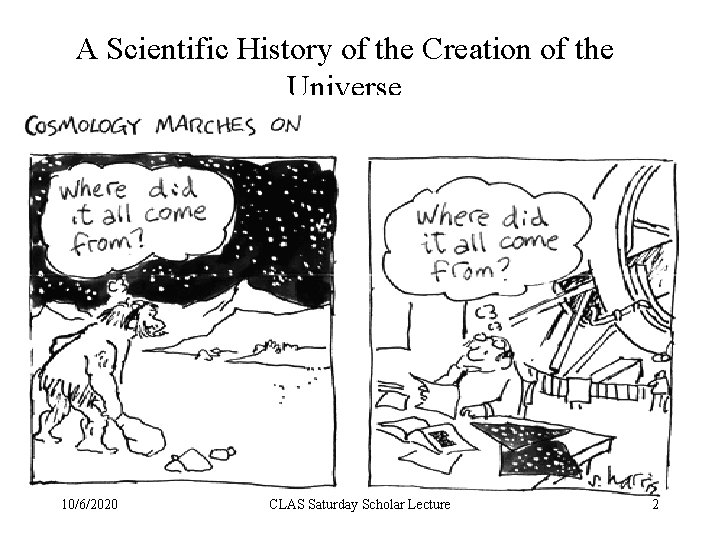
A Scientific History of the Creation of the Universe • What was the Universe like during its earliest moments? • Brief description of the key eras since the Big Bang • Note: Cosmology doesn’t address WHY creation occurs 10/6/2020 CLAS Saturday Scholar Lecture 2
Earliest ideas about cosmology: A story of three (very clever) ancient Greek Astronomers : Aristarchus, Eratosthenes, Ptolemy 10/6/2020 CLAS Saturday Scholar Lecture 3
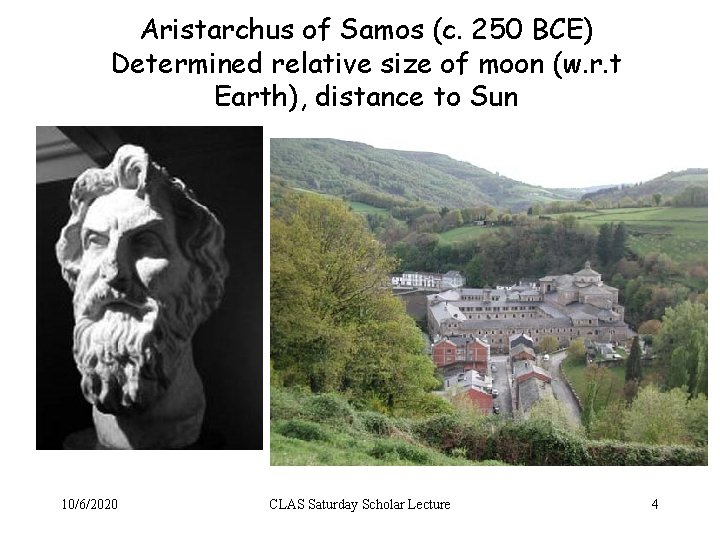
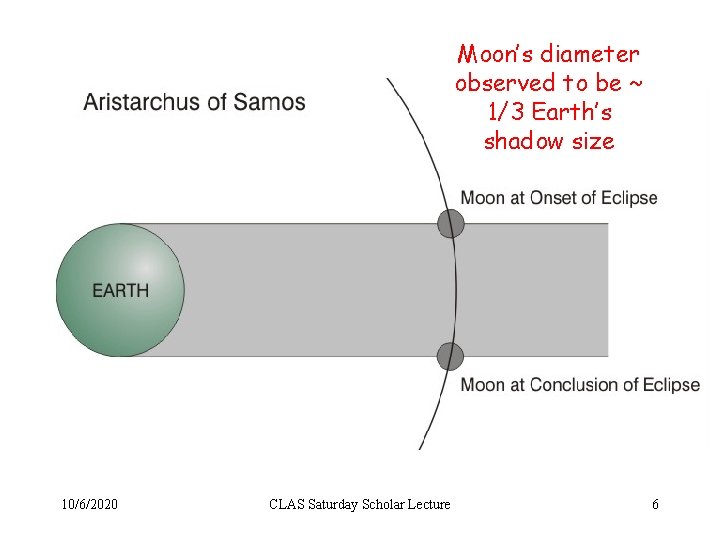
Aristarchus of Samos (c. 250 BCE) Determined relative size of moon (w. r. t Earth), distance to Sun 10/6/2020 CLAS Saturday Scholar Lecture 4
Lunar Eclipse Movie (Notice radius of Earth in Shadow) 10/6/2020 CLAS Saturday Scholar Lecture 5
Moon’s diameter observed to be ~ 1/3 Earth’s shadow size 10/6/2020 CLAS Saturday Scholar Lecture 6
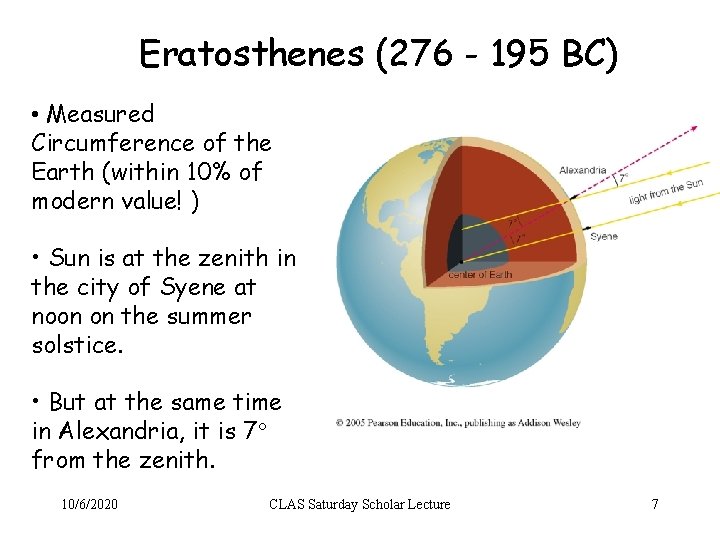
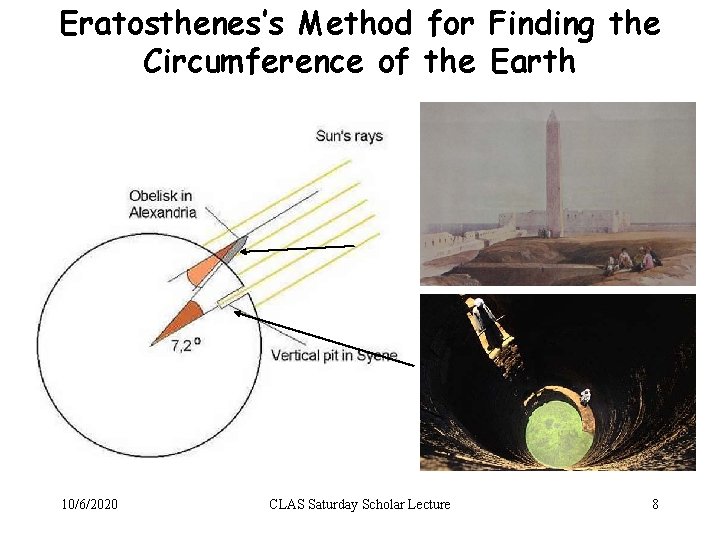
Eratosthenes (276 - 195 BC) • Measured Circumference of the Earth (within 10% of modern value! ) • Sun is at the zenith in the city of Syene at noon on the summer solstice. • But at the same time in Alexandria, it is 7 from the zenith. 10/6/2020 CLAS Saturday Scholar Lecture 7
Eratosthenes’s Method for Finding the Circumference of the Earth 10/6/2020 CLAS Saturday Scholar Lecture 8
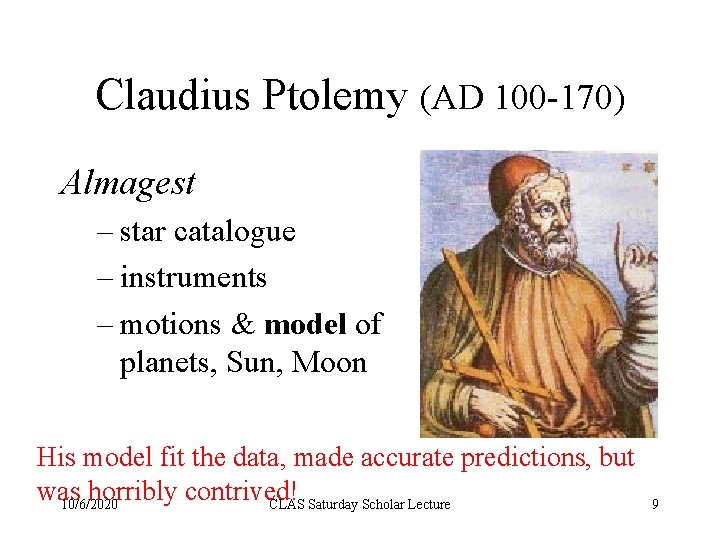
Claudius Ptolemy (AD 100 -170) Almagest – star catalogue – instruments – motions & model of planets, Sun, Moon His model fit the data, made accurate predictions, but was horribly contrived! 10/6/2020 CLAS Saturday Scholar Lecture 9
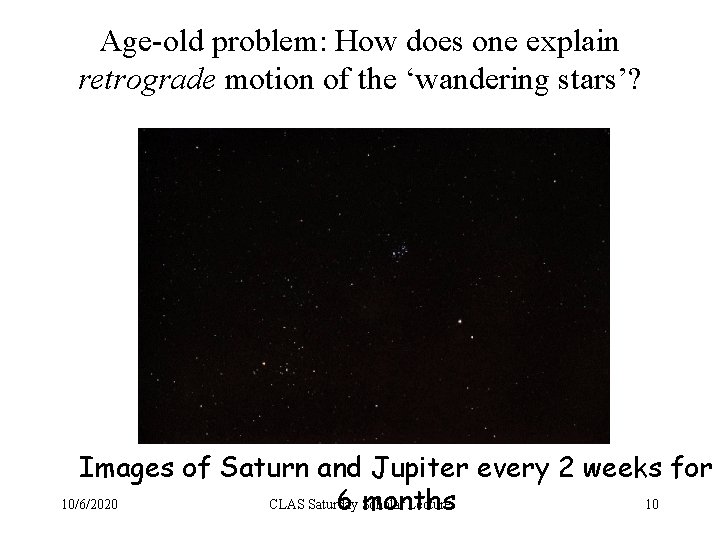
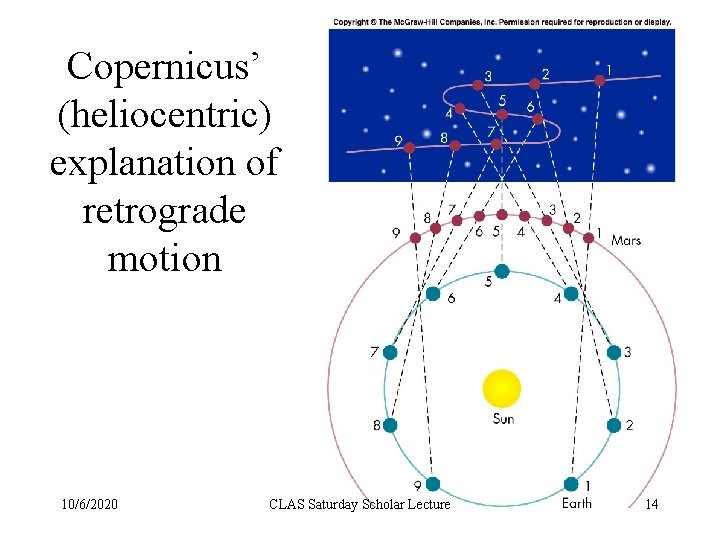
Age-old problem: How does one explain retrograde motion of the ‘wandering stars’? Movie. Click to play. Images of Saturn and Jupiter every 2 weeks for 10/6/2020 CLAS Saturday Scholar Lecture 10 6 months
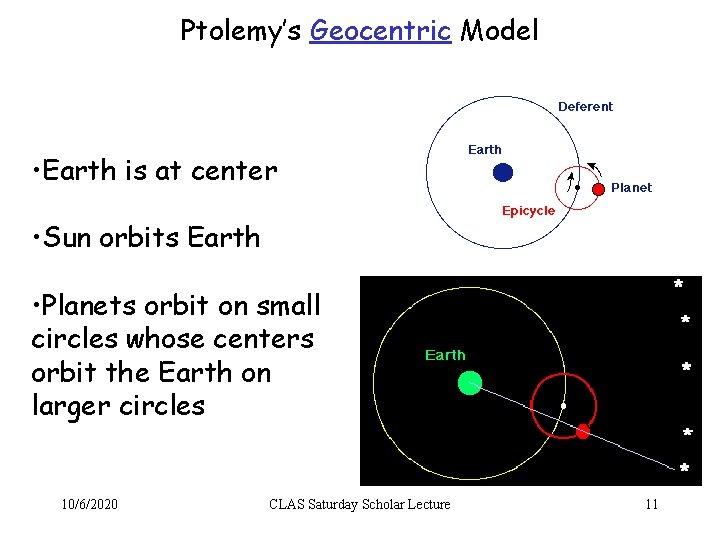
Ptolemy’s Geocentric Model • Earth is at center • Sun orbits Earth • Planets orbit on small circles whose centers orbit the Earth on larger circles 10/6/2020 CLAS Saturday Scholar Lecture 11
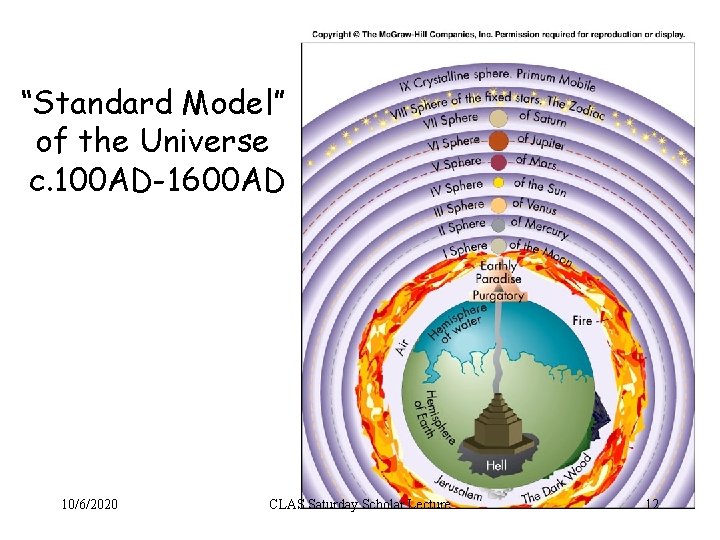
“Standard Model” of the Universe c. 100 AD-1600 AD 10/6/2020 CLAS Saturday Scholar Lecture 12
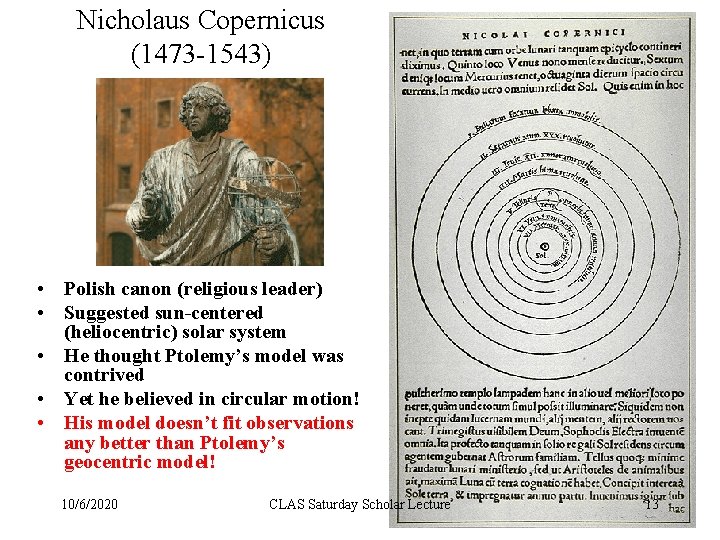
Nicholaus Copernicus (1473 -1543) • Polish canon (religious leader) • Suggested sun-centered (heliocentric) solar system • He thought Ptolemy’s model was contrived • Yet he believed in circular motion! • His model doesn’t fit observations any better than Ptolemy’s geocentric model! 10/6/2020 CLAS Saturday Scholar Lecture 13
Copernicus’ (heliocentric) explanation of retrograde motion 10/6/2020 CLAS Saturday Scholar Lecture 14
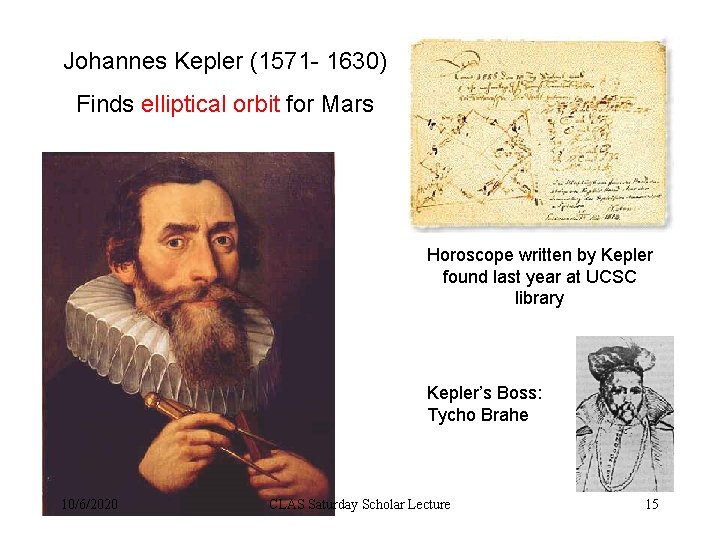
Johannes Kepler (1571 - 1630) Finds elliptical orbit for Mars Horoscope written by Kepler found last year at UCSC library Kepler’s Boss: Tycho Brahe 10/6/2020 CLAS Saturday Scholar Lecture 15
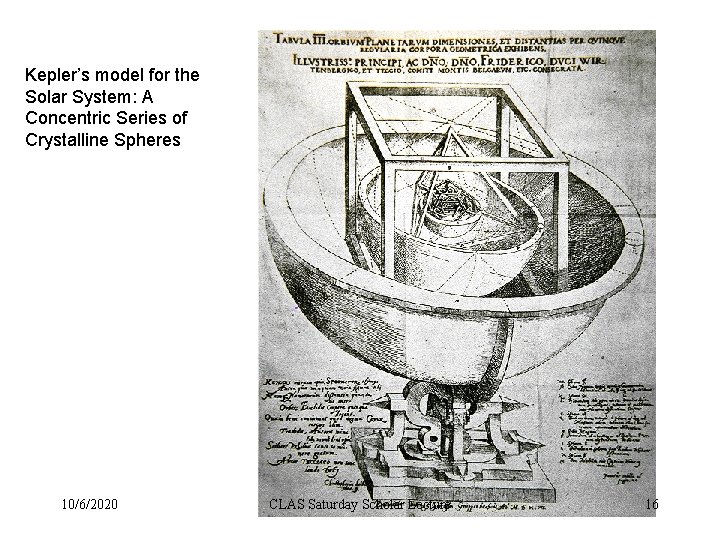
Kepler’s model for the Solar System: A Concentric Series of Crystalline Spheres 10/6/2020 CLAS Saturday Scholar Lecture 16
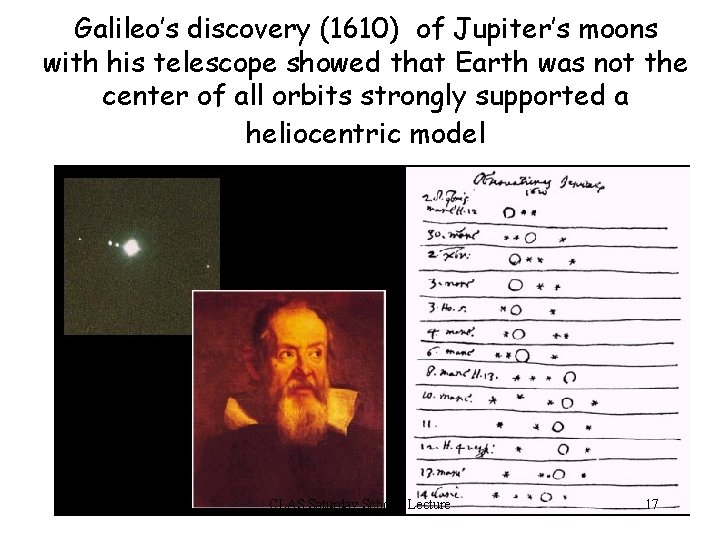
Galileo’s discovery (1610) of Jupiter’s moons with his telescope showed that Earth was not the center of all orbits strongly supported a heliocentric model 10/6/2020 CLAS Saturday Scholar Lecture 17
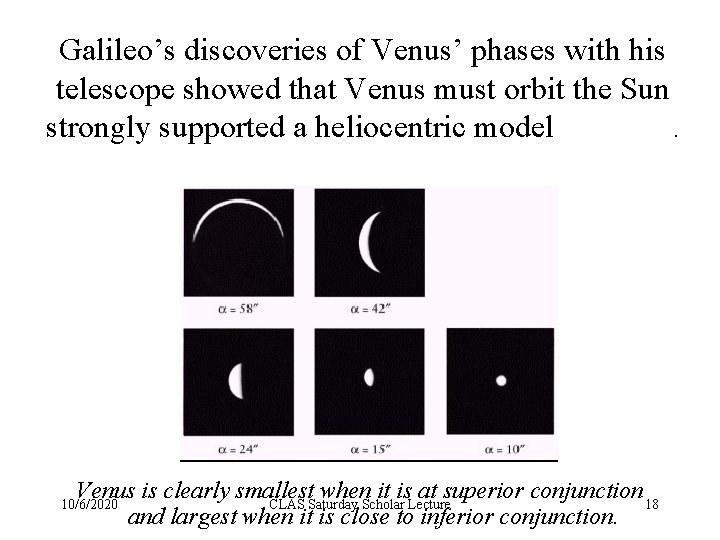
Galileo’s discoveries of Venus’ phases with his telescope showed that Venus must orbit the Sun strongly supported a heliocentric model. Venus is clearly smallest when it is at superior conjunction CLAS Saturday Scholar Lecture 18 and largest when it is close to inferior conjunction. 10/6/2020
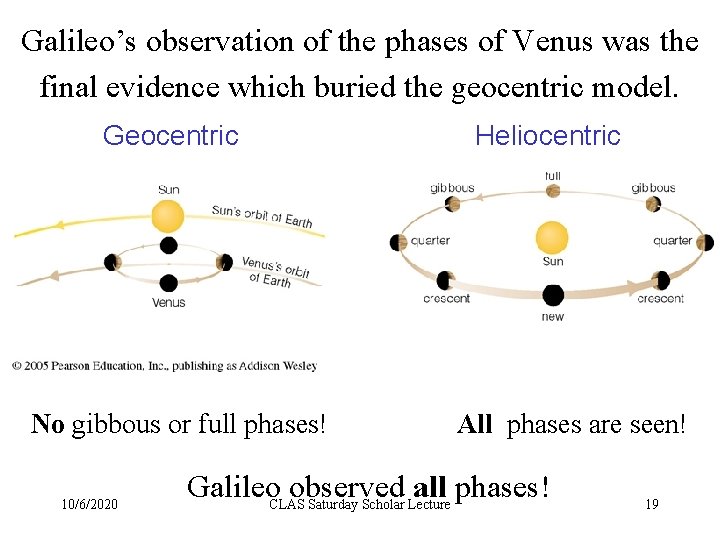
Galileo’s observation of the phases of Venus was the final evidence which buried the geocentric model. Geocentric No gibbous or full phases! 10/6/2020 Heliocentric All phases are seen! Galileo. CLASobserved all phases! Saturday Scholar Lecture 19
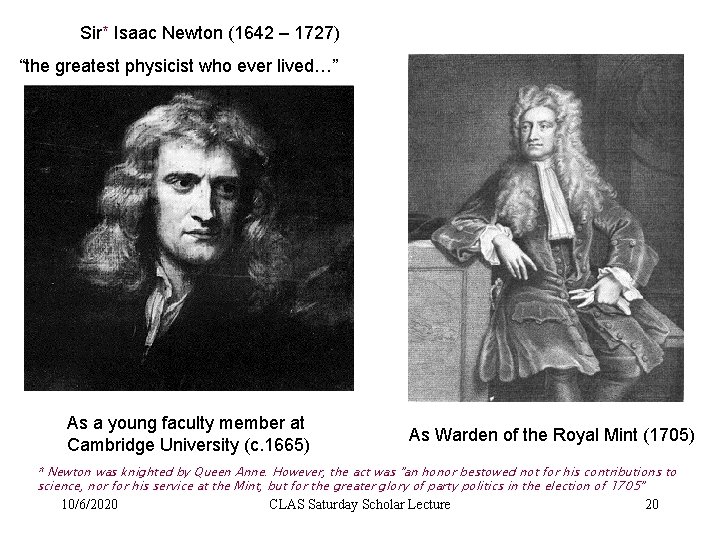
Sir* Isaac Newton (1642 – 1727) “the greatest physicist who ever lived…” As a young faculty member at Cambridge University (c. 1665) As Warden of the Royal Mint (1705) * Newton was knighted by Queen Anne. However, the act was "an honor bestowed not for his contributions to science, nor for his service at the Mint, but for the greater glory of party politics in the election of 1705" 10/6/2020 CLAS Saturday Scholar Lecture 20
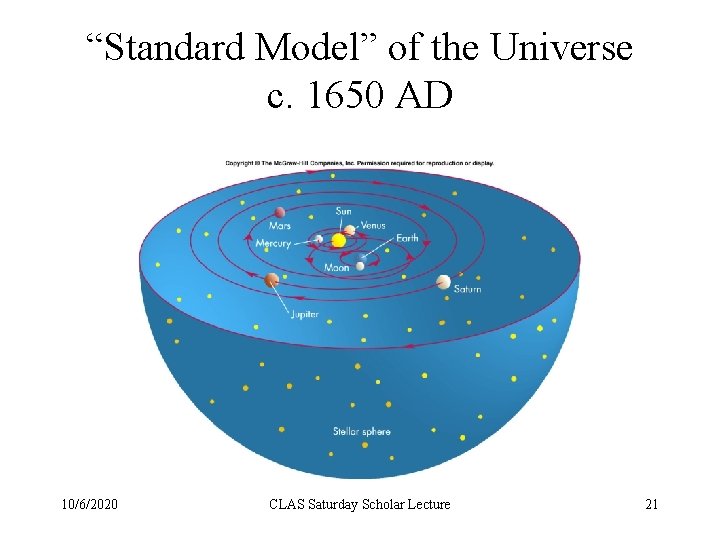
“Standard Model” of the Universe c. 1650 AD 10/6/2020 CLAS Saturday Scholar Lecture 21
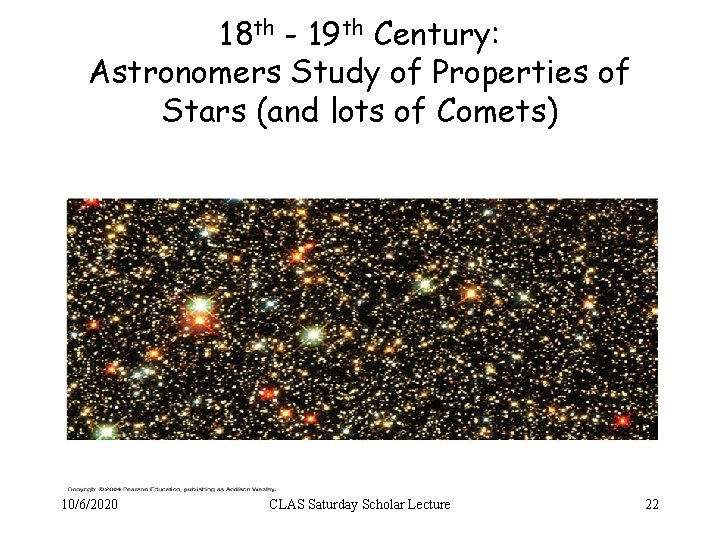
18 th - 19 th Century: Astronomers Study of Properties of Stars (and lots of Comets) 10/6/2020 CLAS Saturday Scholar Lecture 22
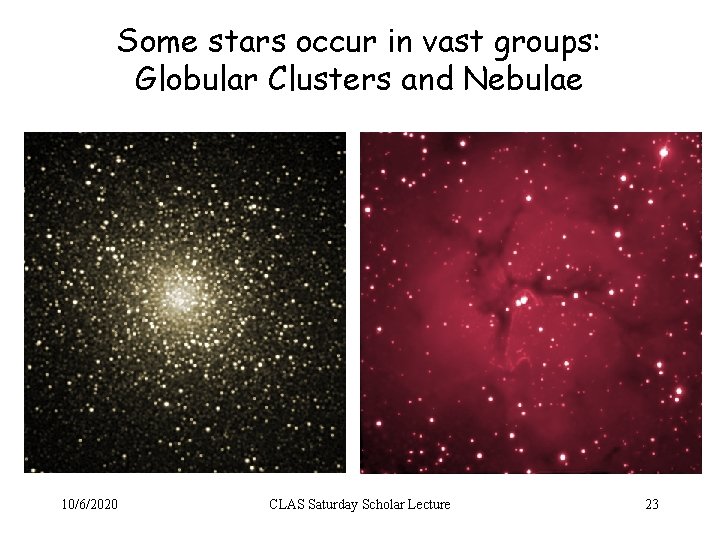
Some stars occur in vast groups: Globular Clusters and Nebulae 10/6/2020 CLAS Saturday Scholar Lecture 23
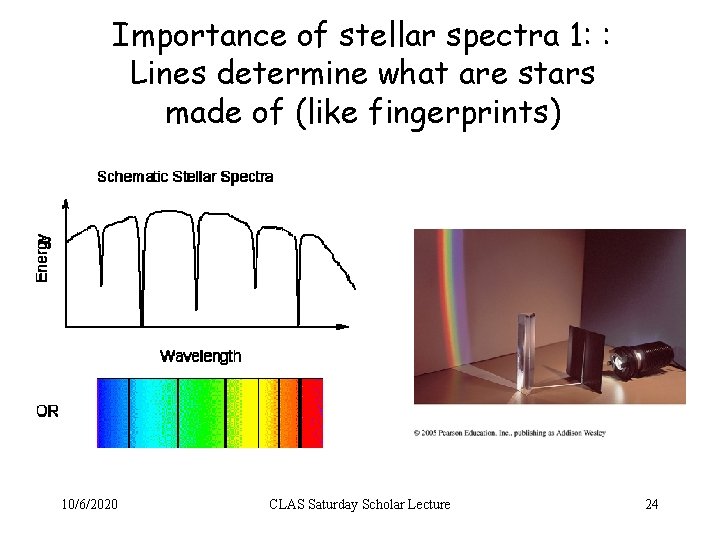
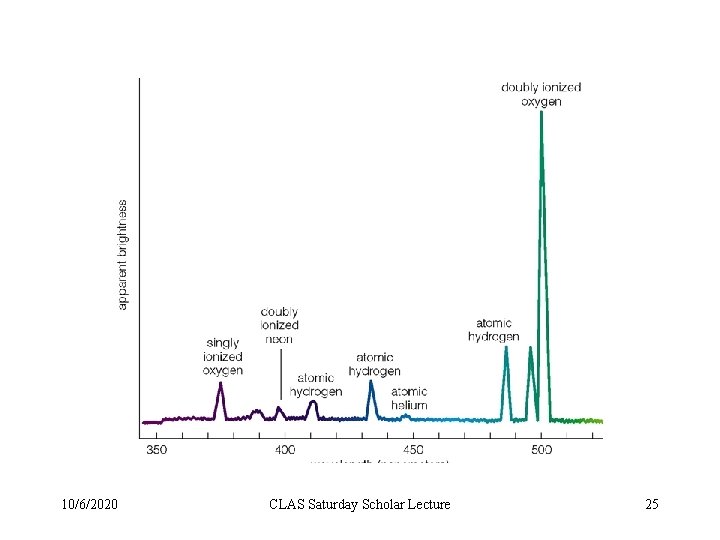
Importance of stellar spectra 1: : Lines determine what are stars made of (like fingerprints) 10/6/2020 CLAS Saturday Scholar Lecture 24
10/6/2020 CLAS Saturday Scholar Lecture 25
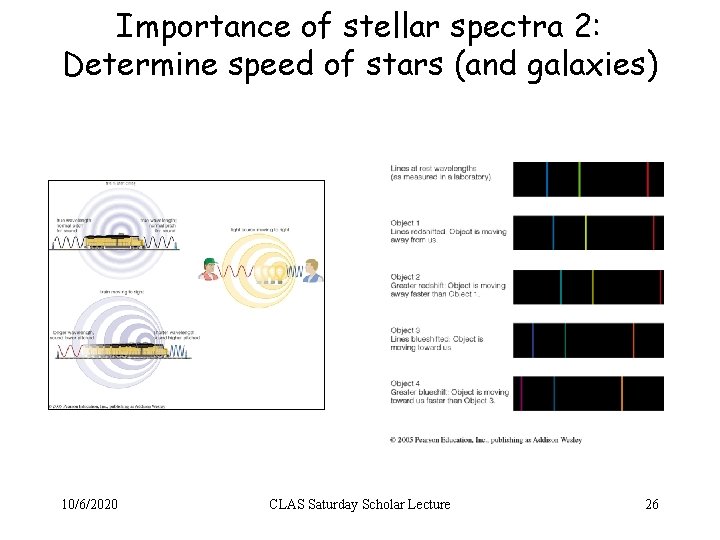
Importance of stellar spectra 2: Determine speed of stars (and galaxies) 10/6/2020 CLAS Saturday Scholar Lecture 26
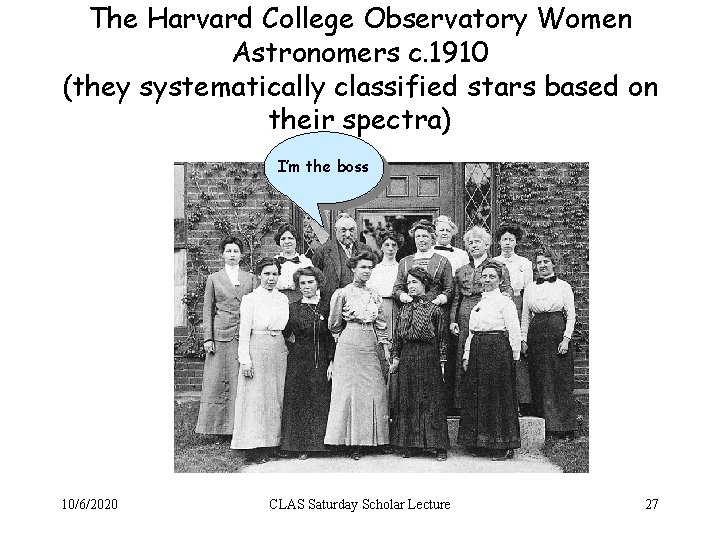
The Harvard College Observatory Women Astronomers c. 1910 (they systematically classified stars based on their spectra) I’m the boss 10/6/2020 CLAS Saturday Scholar Lecture 27
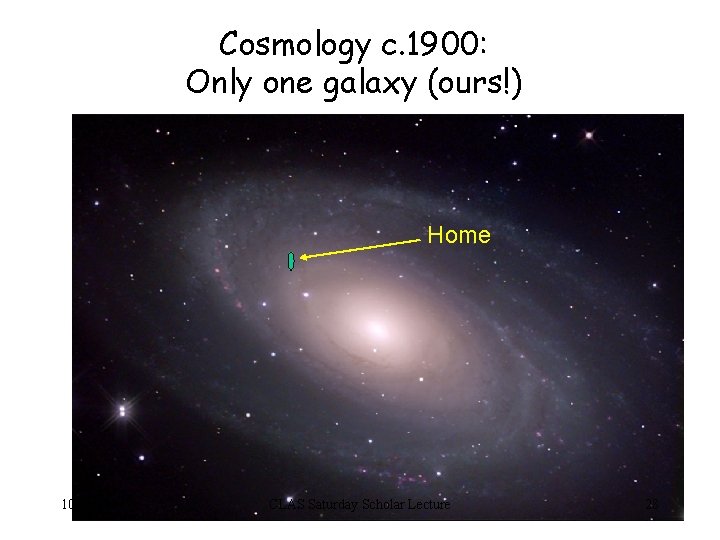
Cosmology c. 1900: Only one galaxy (ours!) Home 10/6/2020 CLAS Saturday Scholar Lecture 28
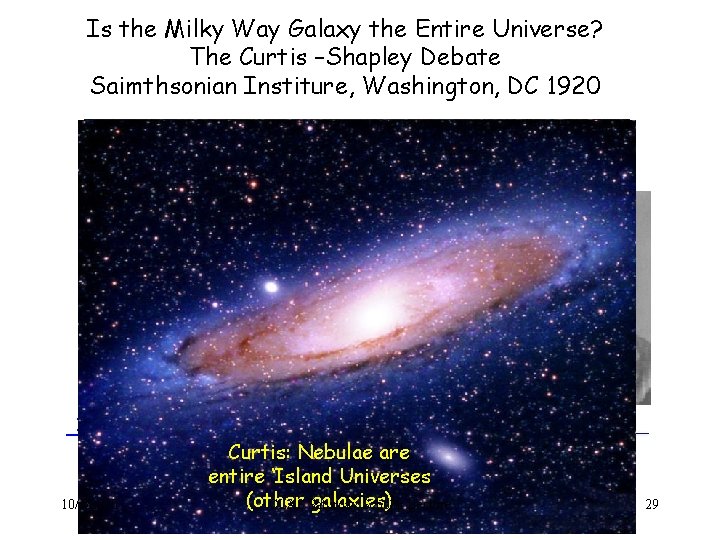
Is the Milky Way Galaxy the Entire Universe? The Curtis –Shapley Debate Saimthsonian Institure, Washington, DC 1920 10/6/2020 Curtis: Nebulae are Shapley: Nebulae entire ‘Island Universes nearby stars, gas, dust (other galaxies) CLAS Saturday Scholar Lecture 29
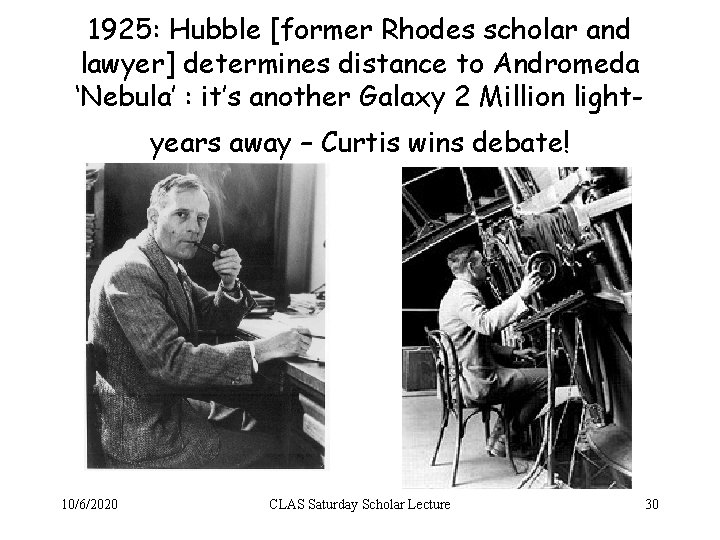
1925: Hubble [former Rhodes scholar and lawyer] determines distance to Andromeda ‘Nebula’ : it’s another Galaxy 2 Million lightyears away – Curtis wins debate! 10/6/2020 CLAS Saturday Scholar Lecture 30
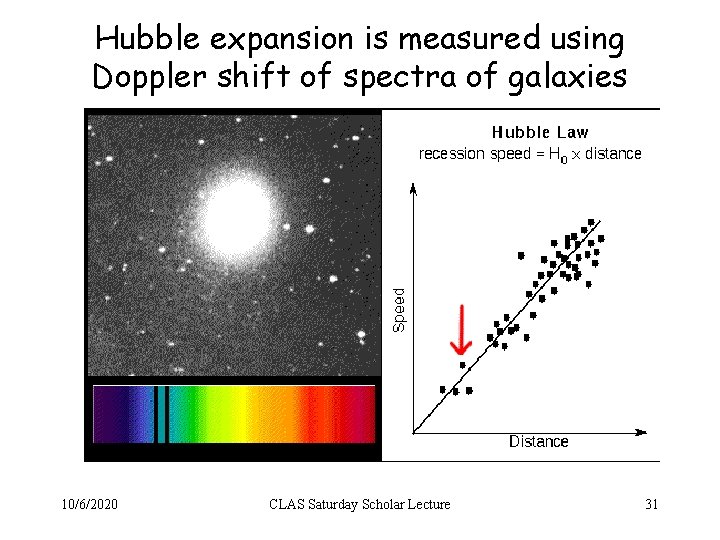
Hubble expansion is measured using Doppler shift of spectra of galaxies 10/6/2020 CLAS Saturday Scholar Lecture 31
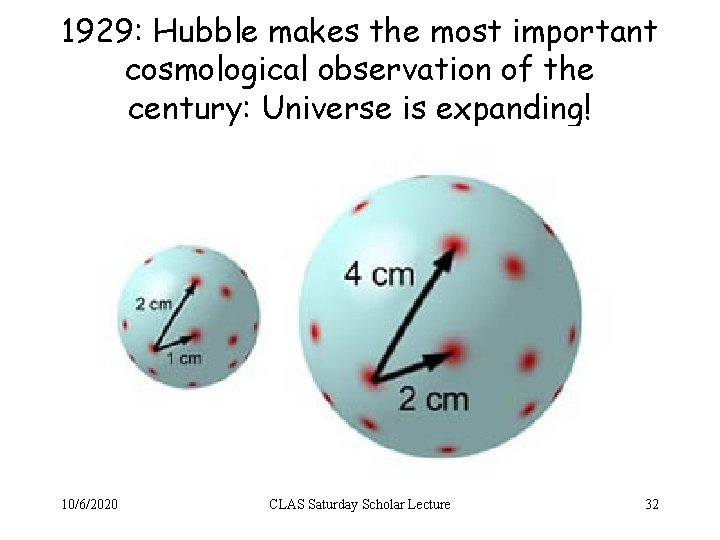
1929: Hubble makes the most important cosmological observation of the century: Universe is expanding! 10/6/2020 CLAS Saturday Scholar Lecture 32
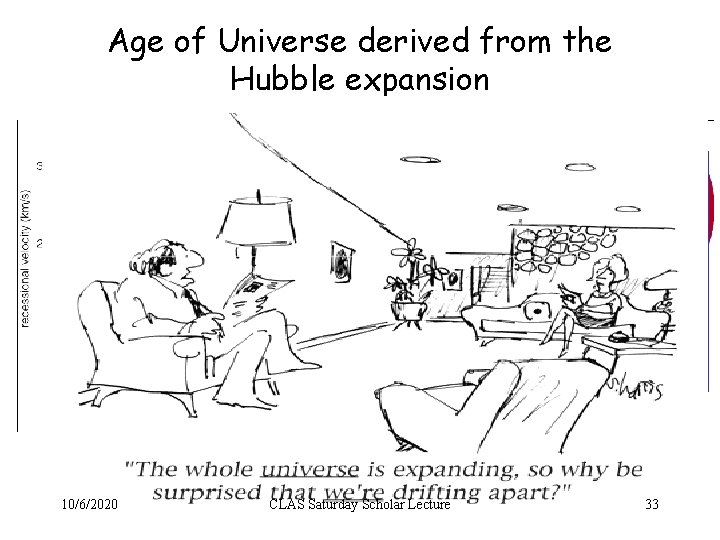
Age of Universe derived from the Hubble expansion Ho=72 ± 8 km/s 10/6/2020 At t=0 The Universe has radius = 0 (Big Bang!) 9 yrs Age = 1/H = 13. 6 · 10 o CLAS Saturday Scholar Lecture 33
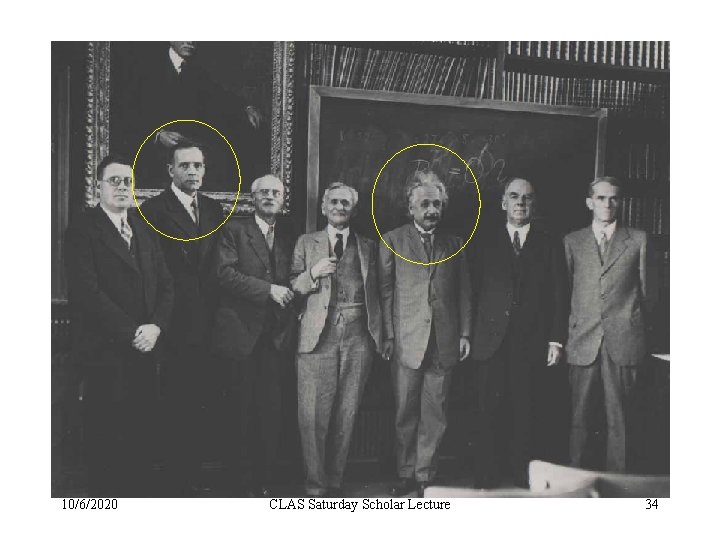
10/6/2020 CLAS Saturday Scholar Lecture 34
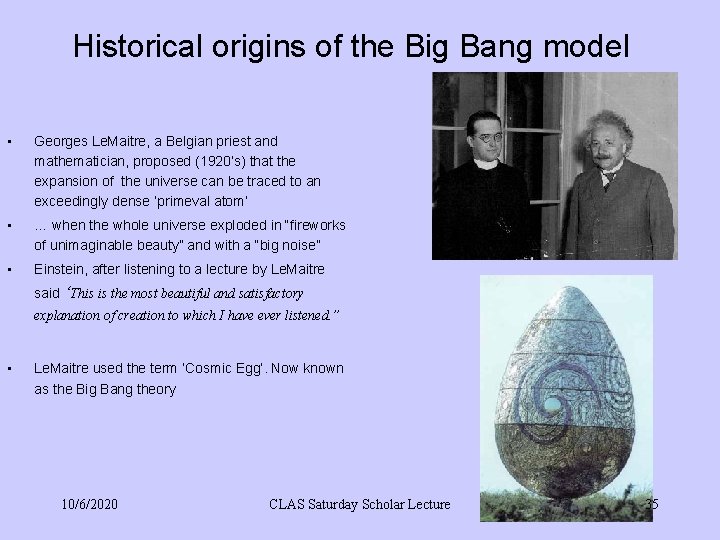
Historical origins of the Big Bang model • Georges Le. Maitre, a Belgian priest and mathematician, proposed (1920’s) that the expansion of the universe can be traced to an exceedingly dense ‘primeval atom’ • … when the whole universe exploded in “fireworks of unimaginable beauty” and with a “big noise” • Einstein, after listening to a lecture by Le. Maitre said ‘This is the most beautiful and satisfactory explanation of creation to which I have ever listened. ” • Le. Maitre used the term ‘Cosmic Egg’. Now known as the Big Bang theory 10/6/2020 CLAS Saturday Scholar Lecture 35
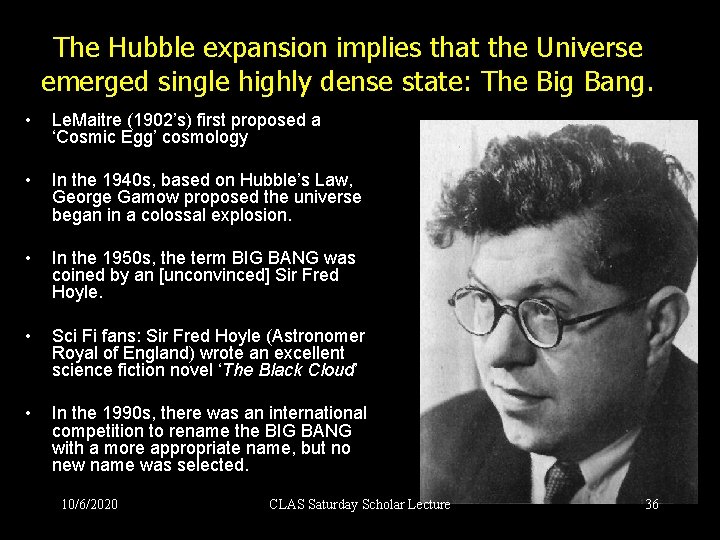
The Hubble expansion implies that the Universe emerged single highly dense state: The Big Bang. • Le. Maitre (1902’s) first proposed a ‘Cosmic Egg’ cosmology • In the 1940 s, based on Hubble’s Law, George Gamow proposed the universe began in a colossal explosion. • In the 1950 s, the term BIG BANG was coined by an [unconvinced] Sir Fred Hoyle. • Sci Fi fans: Sir Fred Hoyle (Astronomer Royal of England) wrote an excellent science fiction novel ‘The Black Cloud’ • In the 1990 s, there was an international competition to rename the BIG BANG with a more appropriate name, but no new name was selected. 10/6/2020 CLAS Saturday Scholar Lecture 36
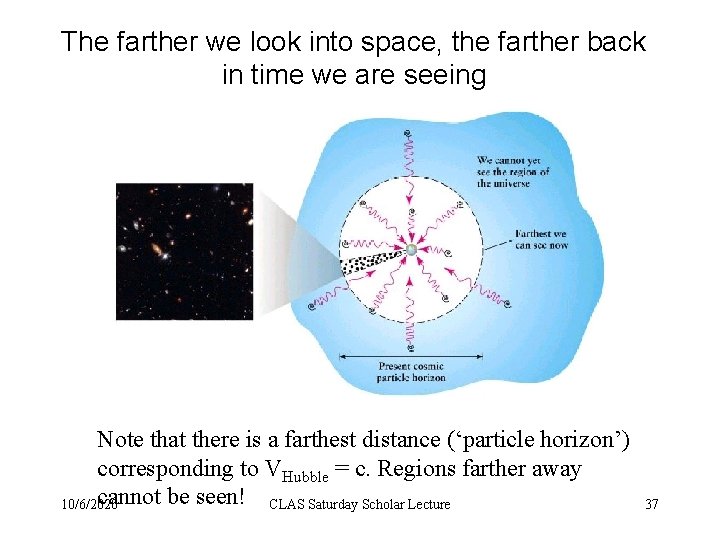
The farther we look into space, the farther back in time we are seeing Note that there is a farthest distance (‘particle horizon’) corresponding to VHubble = c. Regions farther away cannot be seen! CLAS Saturday Scholar Lecture 10/6/2020 37
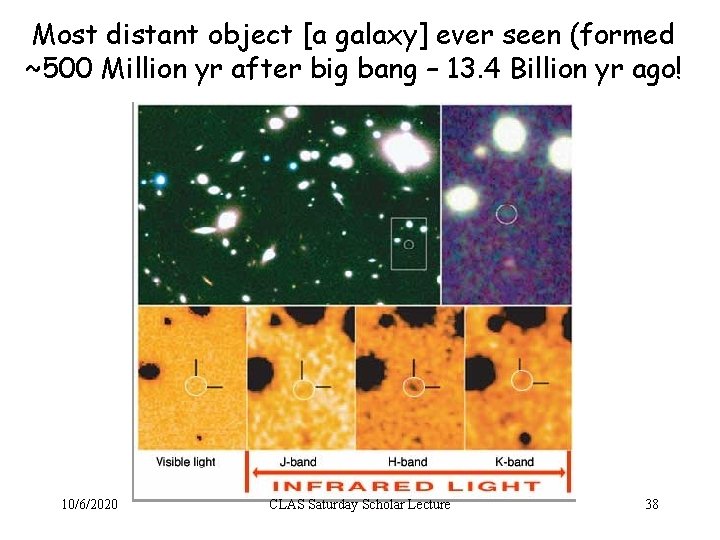
Most distant object [a galaxy] ever seen (formed ~500 Million yr after big bang – 13. 4 Billion yr ago! 10/6/2020 CLAS Saturday Scholar Lecture 38
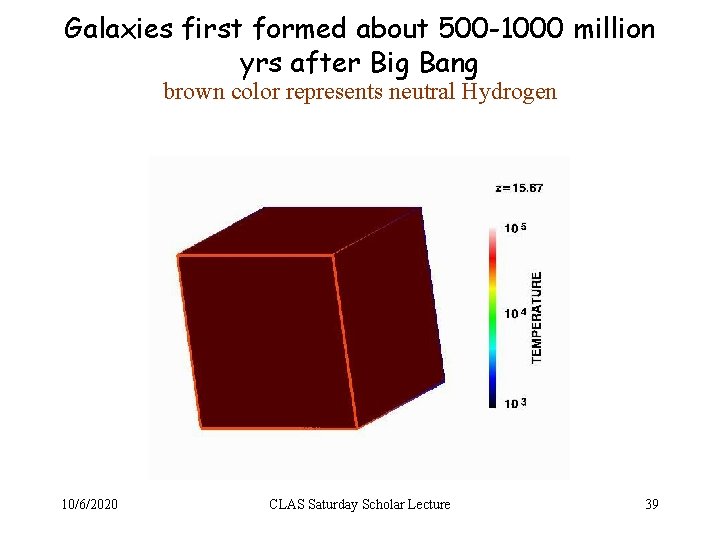
Galaxies first formed about 500 -1000 million yrs after Big Bang brown color represents neutral Hydrogen Movie. Click to play. 10/6/2020 CLAS Saturday Scholar Lecture 39
10/6/2020 CLAS Saturday Scholar Lecture 40
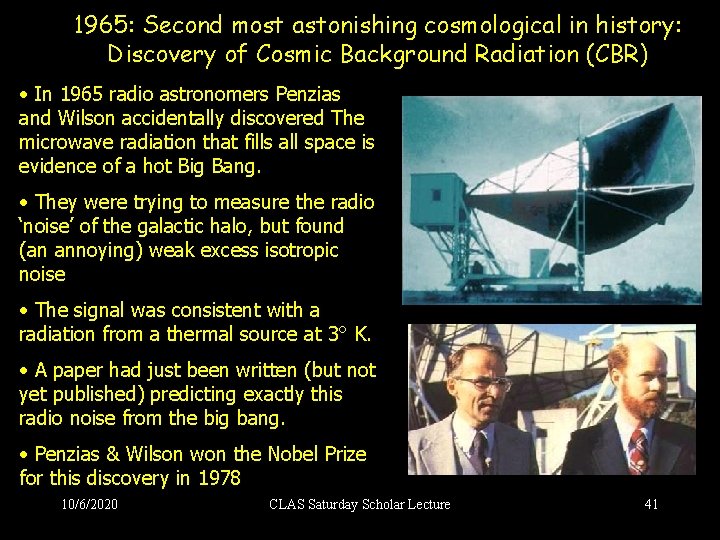
1965: Second most astonishing cosmological in history: Discovery of Cosmic Background Radiation (CBR) • In 1965 radio astronomers Penzias and Wilson accidentally discovered The microwave radiation that fills all space is evidence of a hot Big Bang. • They were trying to measure the radio ‘noise’ of the galactic halo, but found (an annoying) weak excess isotropic noise • The signal was consistent with a radiation from a thermal source at 3° K. • A paper had just been written (but not yet published) predicting exactly this radio noise from the big bang. • Penzias & Wilson won the Nobel Prize for this discovery in 1978 10/6/2020 CLAS Saturday Scholar Lecture 41
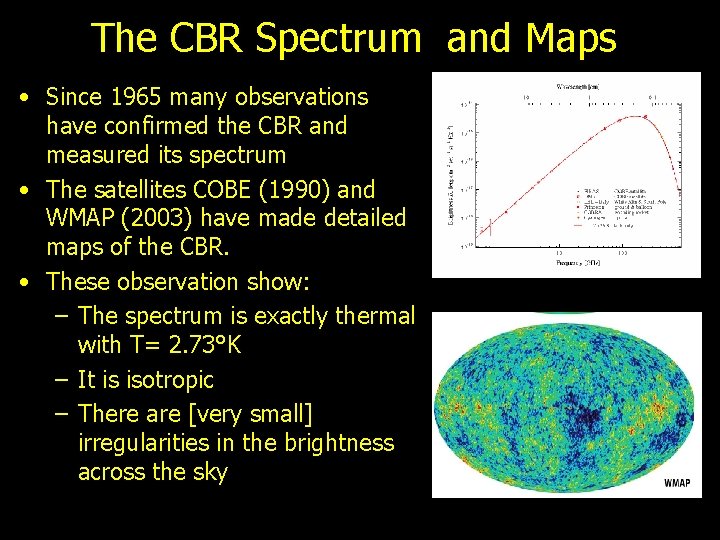
The CBR Spectrum and Maps • Since 1965 many observations have confirmed the CBR and measured its spectrum • The satellites COBE (1990) and WMAP (2003) have made detailed maps of the CBR. • These observation show: – The spectrum is exactly thermal with T= 2. 73°K – It is isotropic – There are [very small] irregularities in the brightness across the sky 10/6/2020 CLAS Saturday Scholar Lecture 42
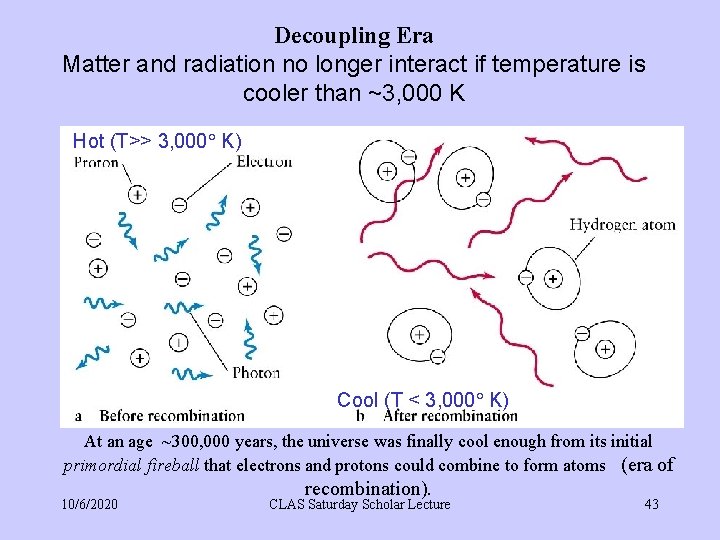
Decoupling Era Matter and radiation no longer interact if temperature is cooler than ~3, 000 K Hot (T>> 3, 000 K) Cool (T < 3, 000 K) At an age ~300, 000 years, the universe was finally cool enough from its initial primordial fireball that electrons and protons could combine to form atoms (era of 10/6/2020 recombination). CLAS Saturday Scholar Lecture 43
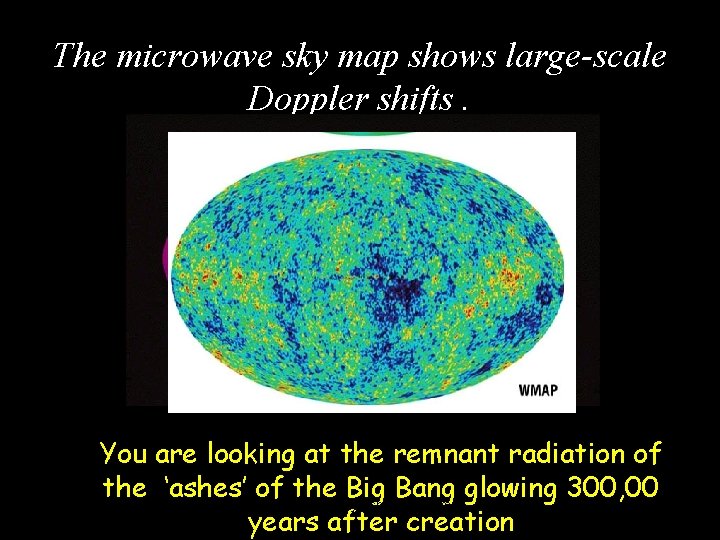
The microwave sky map shows large-scale Doppler shifts. You are looking at the remnant radiation of the ‘ashes’ of the Big Bang glowing 300, 00 10/6/2020 CLAS Saturday Scholar Lecture 44 years after creation
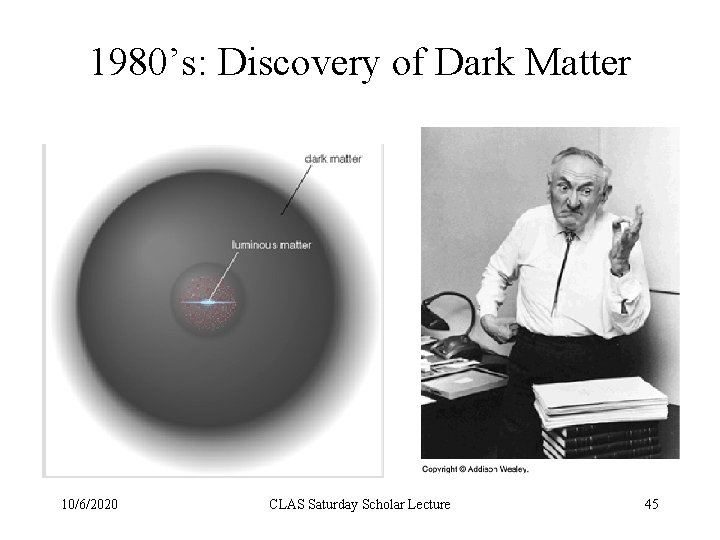
1980’s: Discovery of Dark Matter 10/6/2020 CLAS Saturday Scholar Lecture 45
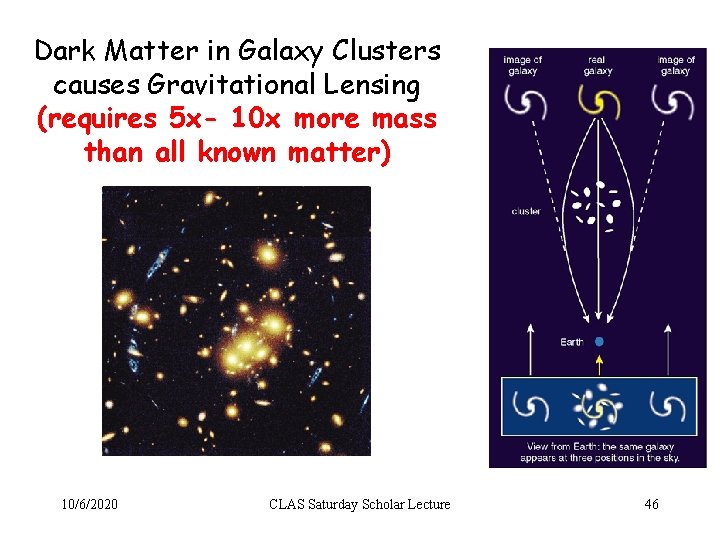
Dark Matter in Galaxy Clusters causes Gravitational Lensing (requires 5 x- 10 x more mass than all known matter) 10/6/2020 CLAS Saturday Scholar Lecture 46
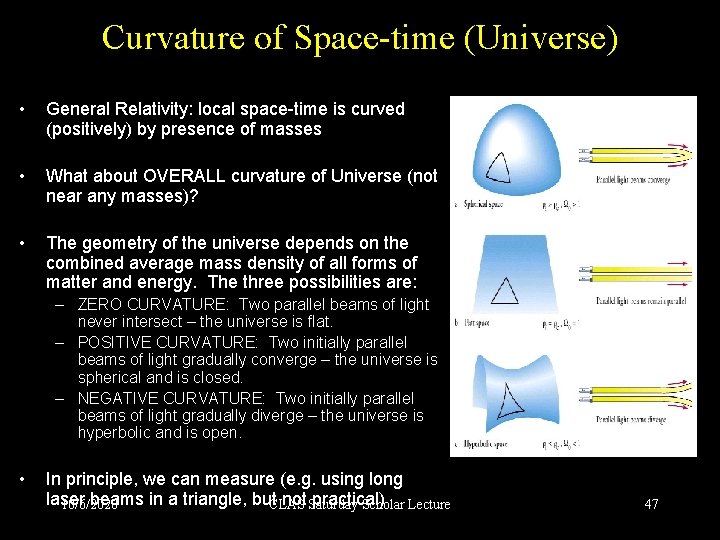
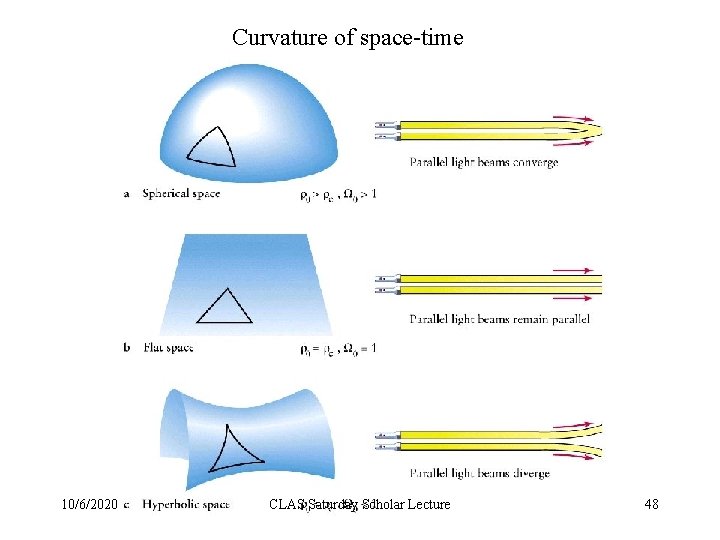
Curvature of Space-time (Universe) • General Relativity: local space-time is curved (positively) by presence of masses • What about OVERALL curvature of Universe (not near any masses)? • The geometry of the universe depends on the combined average mass density of all forms of matter and energy. The three possibilities are: – ZERO CURVATURE: Two parallel beams of light never intersect – the universe is flat. – POSITIVE CURVATURE: Two initially parallel beams of light gradually converge – the universe is spherical and is closed. – NEGATIVE CURVATURE: Two initially parallel beams of light gradually diverge – the universe is hyperbolic and is open. • In principle, we can measure (e. g. using long laser beams in a triangle, but. CLAS not Saturday practical) 10/6/2020 Scholar Lecture 47
Curvature of space-time 10/6/2020 CLAS Saturday Scholar Lecture 48
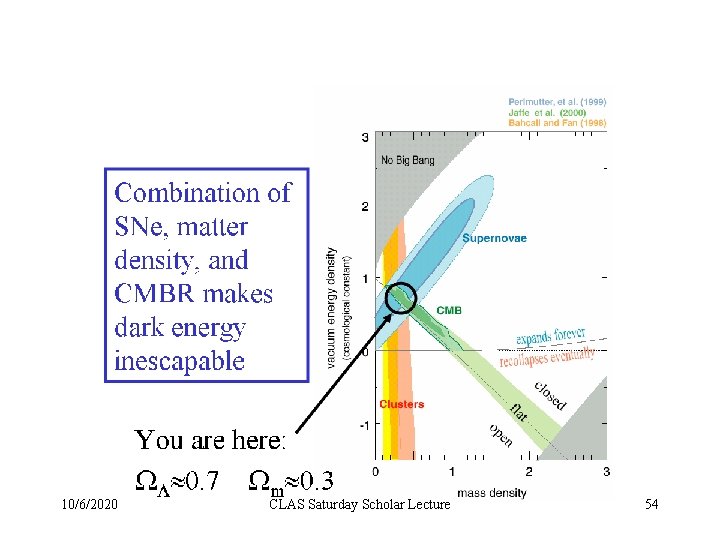
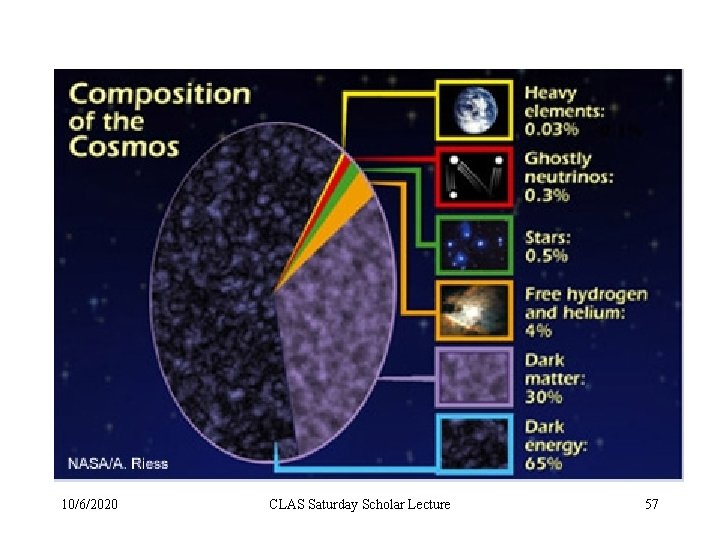
1998: The universe appears to be filled with dark energy. • Our observations suggest that the universe is flat. • This conflicts somewhat with our observation that all known radiation, matter, and dark matter only account for ~ 30% of the total density of the universe. • There must be an additional source somewhere – dark energy. 10/6/2020 CLAS Saturday Scholar Lecture 49
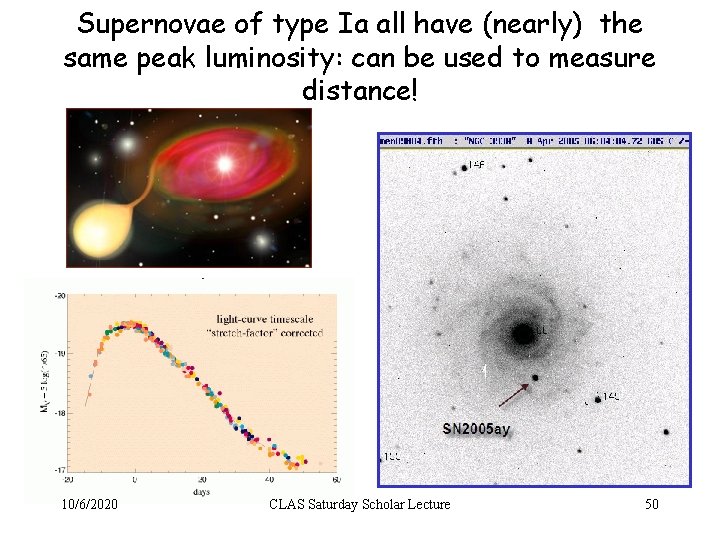
Supernovae of type Ia all have (nearly) the same peak luminosity: can be used to measure distance! 10/6/2020 CLAS Saturday Scholar Lecture 50
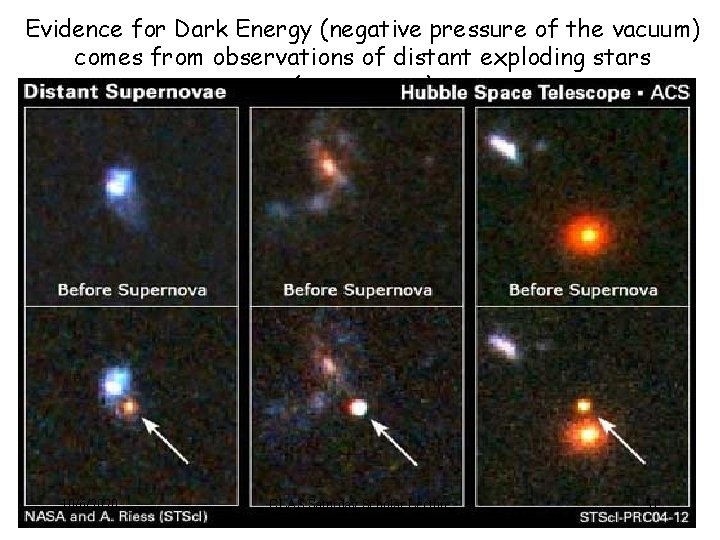
Evidence for Dark Energy (negative pressure of the vacuum) comes from observations of distant exploding stars (supernovae) 10/6/2020 CLAS Saturday Scholar Lecture 51
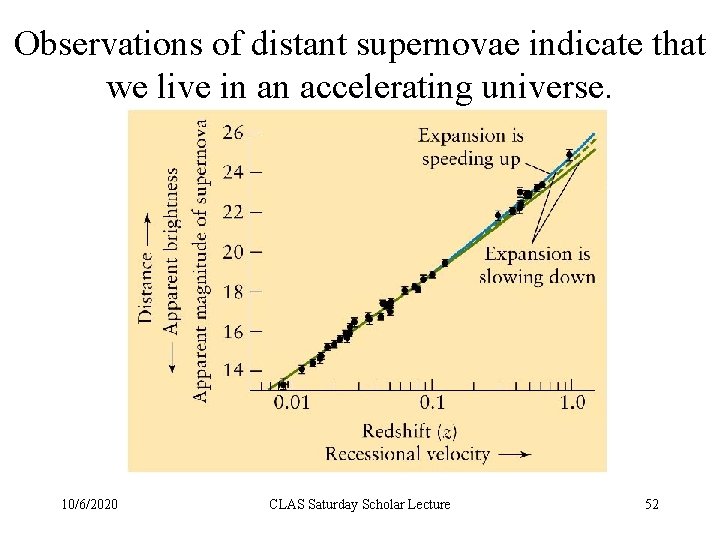
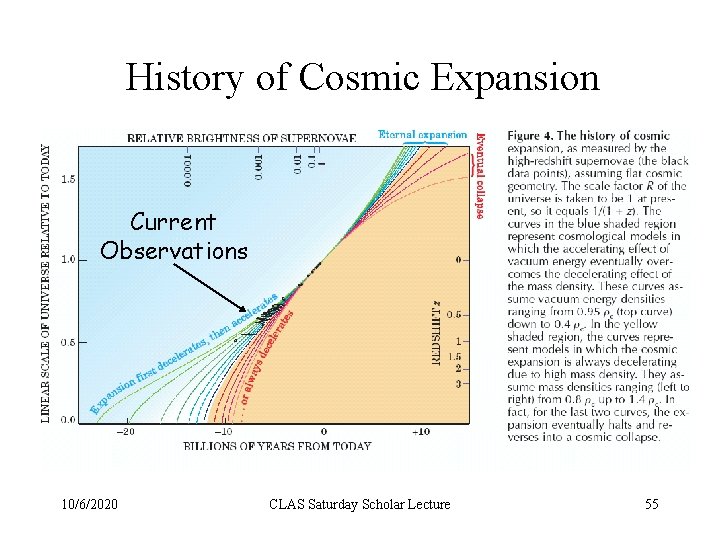
Observations of distant supernovae indicate that we live in an accelerating universe. 10/6/2020 CLAS Saturday Scholar Lecture 52
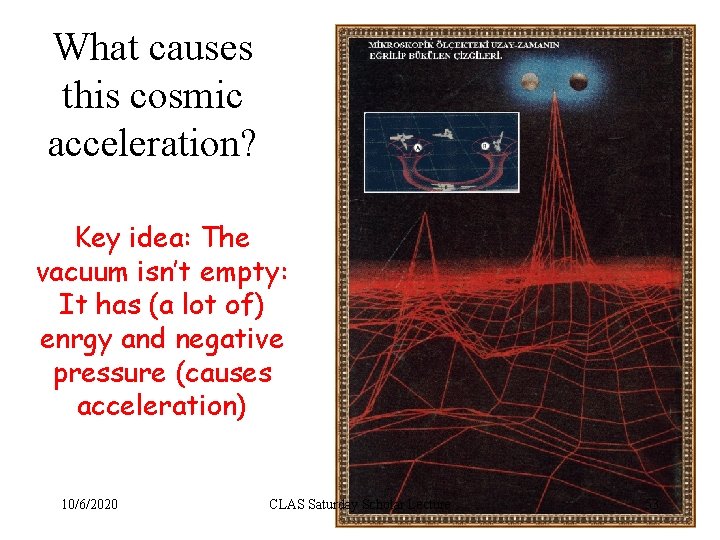
What causes this cosmic acceleration? Key idea: The vacuum isn’t empty: It has (a lot of) enrgy and negative pressure (causes acceleration) 10/6/2020 CLAS Saturday Scholar Lecture 53
10/6/2020 CLAS Saturday Scholar Lecture 54
History of Cosmic Expansion Current Observations 10/6/2020 CLAS Saturday Scholar Lecture 55
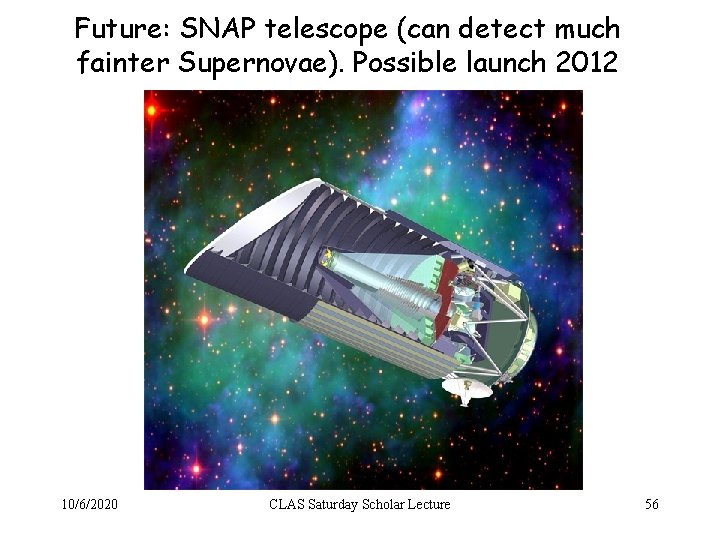
Future: SNAP telescope (can detect much fainter Supernovae). Possible launch 2012 10/6/2020 CLAS Saturday Scholar Lecture 56
10/6/2020 CLAS Saturday Scholar Lecture 57
Another cosmological ‘standard model’…. 10/6/2020 CLAS Saturday Scholar Lecture 58