
Thrombophlebitis Authors Ryan Nipp MD Level Basic Academic
Thrombophlebitis Author(s): Ryan Nipp, MD Level: Basic Academic Affiliation : Duke University Internal Medicine Residency Version No: 1. 0 Submitted: March 2012 Editors’ Review:
2 Disclaimer/Liability • The information provided in the VAP is made available in good faith and is derived from sources believed to be reliable and accurate at the time of release. • The materials presented on the VAP may include links to external Internet sites. These external information sources are outside the control of Duke-NUS. The user of the Internet links is responsible for making his or her own decision about the accuracy, reliability and correctness of the information found. • In no event shall Duke-NUS be liable for any indirect, special, incidental, or consequential damages arising out of any use of reliance of any information contained in the VAP. Nor does Duke-NUS assume any responsibility for failure or delay in updating or removing the information contained in the VAP. • Moreover, information provided on the VAP does not constitute medical advice or treatment nor should it be considered as a replacement of the patient/physician relationship or a physician’s professional judgment. Duke-NUS expressly disclaims all liability for treatment, diagnosis, decisions and actions taken or not taken in reliance upon information contained in the VAP. This work is licensed under a Creative Commons Attribution-Non. Commercial-No. Derivs 3. 0 Unported License To view a copy of this license, visit [http: //creativecommons. org/licenses/by-nc-nd/3. 0/]
3 Financial Disclosures (past 3 years) • No Disclosures
4 Learning Objectives • Know the definition of thrombophlebitis • Understand how a thrombus forms • Recognize how thrombophlebitis presents • Identify the appropriate diagnosis strategy • Have a broad differential diagnosis • Learn how to prevent this problem • Appreciate the treatment options
5 Outline • What is thrombophlebitis? • Risk Factors • Virchow's Triad • History and Physical Exam • Diagnosis and Differential Diagnosis • Prevention and Treatment
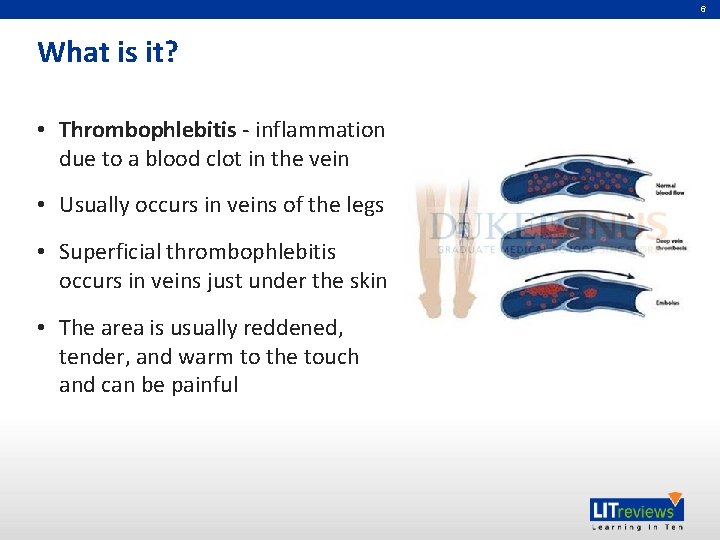
6 What is it? • Thrombophlebitis - inflammation due to a blood clot in the vein • Usually occurs in veins of the legs • Superficial thrombophlebitis occurs in veins just under the skin • The area is usually reddened, tender, and warm to the touch and can be painful
7 Risk Factors • Inactivity : recent injury, surgery, prolonged sitting, recent travel • Pregnancy or recent childbirth • Oral contraceptive use or estrogen therapy • Cancer • Stroke or other diseases that limit movement • Familial clotting disorders (thrombophilia) • Central venous catheters (used for injection or medications or for dialysis)

8 Virchow's Triad Venous Stasis CLOT Hypercoagulable State Vascular Wall Injury
9 History • Gradual onset • Local tenderness • Erythema along path of vein • Trauma at the site • Recent Travel • Hormone Use • Tobacco Use • Coagulopathy in the Family
10 Physical Exam 1. Visual Inspection - erythema, edema, and pain 2. Palpation - firm, thick, thrombosed vein 3. Percussion - Propagation of a palpable pulse wave suggests that a fluid-filled vessel with open or incompetent valves connects the two locations
11 Diagnosis • Physical Exam • Elevated D-dimer • Ultrasound • If pulmonary embolism is suspected, computed tomography (CT)
12 Differential Diagnosis • DVT (deep venous thrombosis – Blood clot usually in the large veins in the lower leg and thigh • Venous Insufficiency • Cellulitis • Lymphedema • Tendonitis • Varicosities Buerger's disease clinical features of thromboangiitis obliterans often include a triad of claudication of the affected extremity, Raynaud's phenomenon, and migratory superficial thrombophlebitis.
13 Prevention • Move your legs, especially during prolonged sitting (such as air travel) or bed rest • Use compression (strong support) stockings • Discuss your personal and family history with your doctor before considering hormone therapy
14 Treatment • Elevate the leg • Warm compresses to the area, and medication to decrease pain and inflammation • Support stockings may be worn to reduce swelling NSAIDs vs LMWH - Cochrane 2012 NSAIDs (Nonsteroidal anti-inflammatory drugs) LMWH (low-molecular-weight heparin) • DVT or pulmonary embolism anticoagulation with heparin (by injection) or warfarin • Pregnant women no warfarin, it can harm the developing fetus
15 Summary • Know the definition of thrombophlebitis • Understand how a thrombus forms • Recognize how thrombophlebitis presents • Identify the appropriate diagnosis strategy • Have a broad differential diagnosis • Learn how to prevent this problem • Appreciate the treatment options
16 Key References • Di Nisio M, Wichers IM, Middeldorp S. Cochrane Database Syst Rev. 2012 Mar 14; 3: CD 004982. Treatment for superficial thrombophlebitis of the leg. • JAMA. 2011 Apr 6; 305(13): 1372. JAMA patient page. Thrombophlebitis. Torpy JM, Burke AE, Golub RM.
17 Acknowledgements

Partners in Academic Medicine
- Slides: 18