
THROMBOLYTIC DRUGS Fibrinolytic drugs By Prof Hanan Hagar
THROMBOLYTIC DRUGS (Fibrinolytic drugs) By Prof. Hanan Hagar Dr. Ishfaq Bukhari
OBJECTIVES n To know mechanism of action of thrombolytic therapy. n To differentiate between different types of thrombolytic drugs. n To describe indications, side effects and contraindications of thrombolytic drugs. n To recognize the mechanisms, uses and side effects of antiplasmins.
Definition of Thrombolytics Thrombolytic agents are drugs used to lyse already formed blood clots in clinical settings where ischemia may be fatal.
thrombolytic therapy n The goal of thrombolytic therapy is rapid restoration of blood flow in an occluded vessel by accelerating proteolysis of the thrombus. n Thrombolytic therapy is one part of an overall antithrombotic plan that frequently includes anticoagulants, antiplatelet agents and mechanical approaches to rapidly restore flow and prevent re-occlusion.
Indications of thrombolytics used for the treatment of: q q q Acute myocardial infarction (ST elevation, STEMI). Acute ischemic stroke. Peripheral artery occlusion. Deep venous thrombosis. Pulmonary embolism.
Rational for use of thrombolytic drugs in AMI n improvement of ventricular function; reduction of the incidence of congestive heart failure and the reduction of mortality following AMI. n Thrombolytic drugs need to be given immediately to the patient after diagnosis of MI, delay in administration will be of no value.
Mechanism of Action of thrombolytic drugs They have common mechanism of action by stimulating plasminogen activation via converting plasminogen (proenzyme) to plasmin (active enzyme) lysis of the insoluble fibrin clot into soluble derivatives.
Mechanism of Action of thrombolytic drugs Plasmin: is a nonspecific protease capable of breaking down fibrin as well as other circulating proteins, including fibrinogen, factor V, and factor VIII.
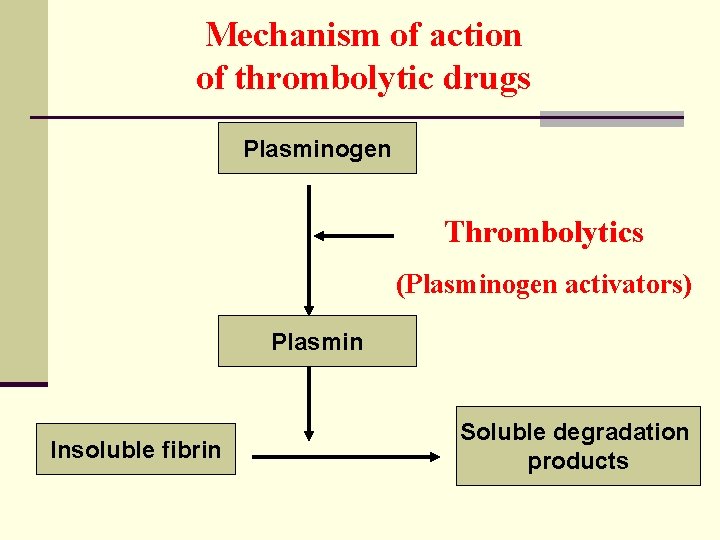
Mechanism of action of thrombolytic drugs Plasminogen Thrombolytics (Plasminogen activators) Plasmin Insoluble fibrin Soluble degradation products
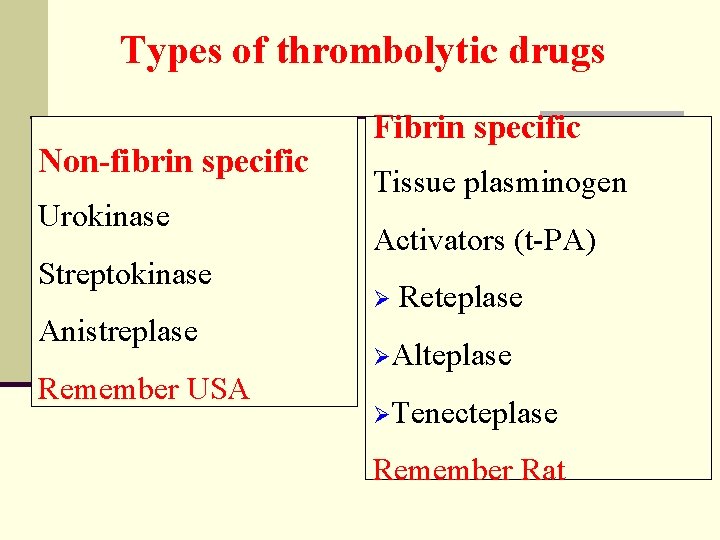
Types of thrombolytic drugs Non-fibrin specific Urokinase Streptokinase Anistreplase Remember USA Fibrin specific Tissue plasminogen Activators (t-PA) Ø Reteplase ØAlteplase ØTenecteplase Remember Rat
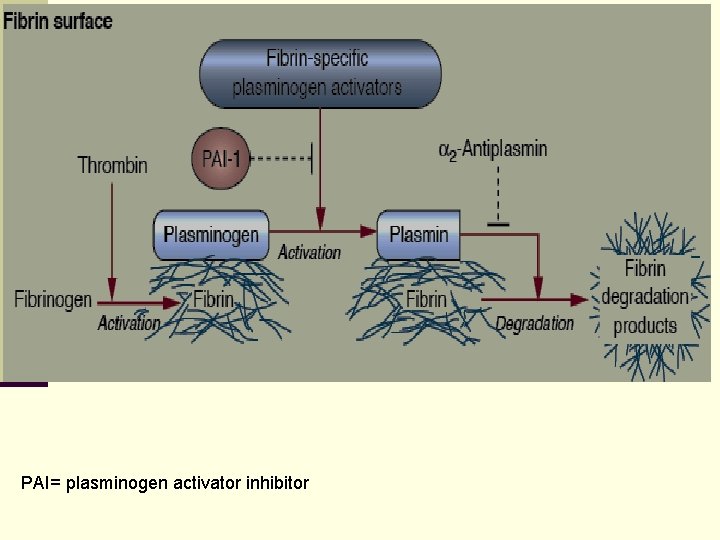
PAI= plasminogen activator inhibitor
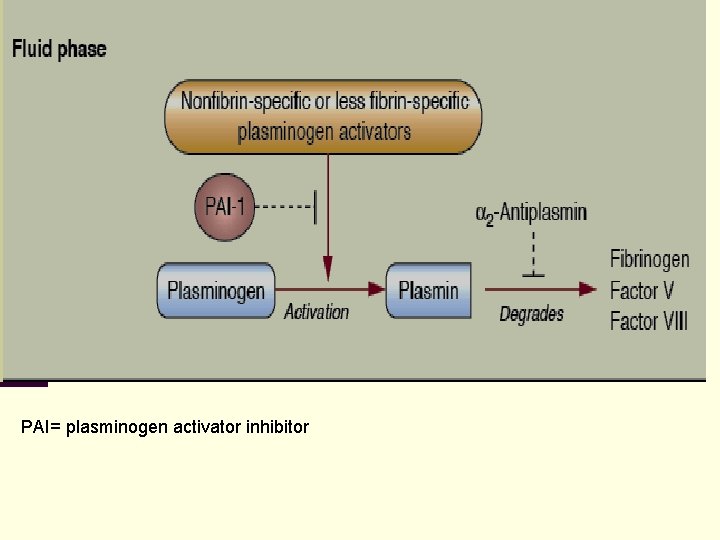
PAI= plasminogen activator inhibitor
Types of thrombolytic drugs Non fibrin-specific agents Urokinase-Streptokinase – Anistreplase binds equally to circulating and non-circulating plasminogen. Ø produces breakdown of clot (local fibrinolysis) and circulating plasminogen and other plasma proteins thus cause an unwanted (systemic fibrinolysis) leading to bleeding.
Types of thrombolytic drugs fibrin-specific agents Ø are tissue plaminogen activators Ø e. g. Alteplase – Reteplase -Tenecteplase Ø selective in action (clot or fibrin specific) binds preferentially to plasminogen at the fibrin surface (non-circulating) rather than circulating plasminogen in blood. Ø Ø Risk of bleeding is less than non specific agents. Ø Activity is enhanced upon binding to fibrin.
Streptokinase (SK) Is a bacterial protein produced by B-hemolytic streptococci. Ø It acts indirectly by forming plasminogenstreptokinase complex "activator complex" which converts inactive plasminogen into active plasmin. Ø Sk is non-fibrin specific Ø can degrade fibrin clots as well as fibrinogen and other plasma proteins. Ø
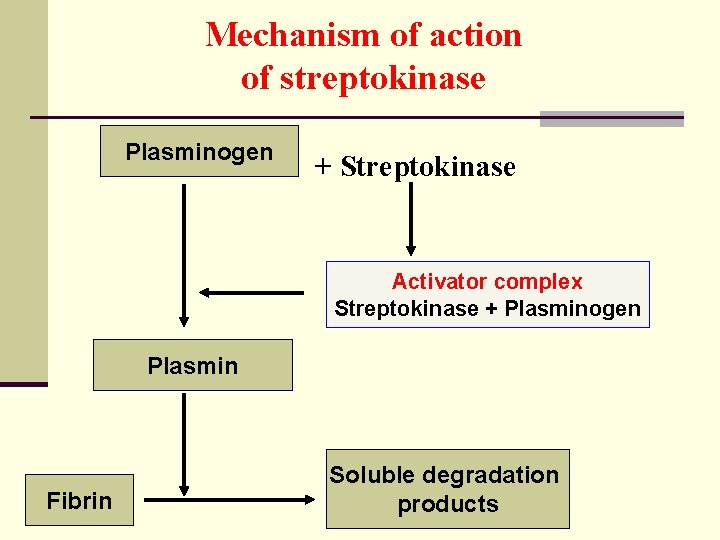
Mechanism of action of streptokinase Plasminogen + Streptokinase Activator complex Streptokinase + Plasminogen Plasmin Fibrin Soluble degradation products
Streptokinase Ø T 1/2 = less than 20 minutes. Ø given as intravenous infusion (250, 000 U then 100, 000 U/h for 24 -72 h). Ø It is the least expensive. Ø used for venous or arterial thrombosis.
Side effects of streptokinase Ø Antigenicity: high-titer antibodies develop 1 to 2 weeks after use, precluding retreatment until the titer declines. Ø Allergic reaction: like rashes, fever, hypotension Ø Bleeding due to activation of circulating plasminogen (systemic fibrinolysis). Ø Not fibrin specific.
Precautions Not used in patients with: Ø Recent streptococcal infections or Ø Previous Ø These administration of the drug patients may develop fever, allergic reactions and resistance upon treatment with streptokinase due to antistreptococcal antibodies
Anistreplase (APSAC) n Anisoylated Plasminogen Streptokinase Activator Complex (APSAC) acylated plasminogen combined with streptokinase n It is a prodrug, de-acylated in circulation into the active plasminogen-streptokinase complex. n T 1/2 is 70 -120 min
Advantages n n Given as a bolus I. V. injection (30 U over 3 5 min. ). Longer duration of action than streptokinase. More thrombolytic activity. Greater clot selectivity.
Disadvantages Similar but less than streptokinase alone in: Antigenicity. q Allergic reactions. q Minimal fibrin specificity q Systemic lysis. But more expensive than streptokinase q
Urokinase Ø Ø Human enzyme synthesized by the kidney obtained from either urine or cultures of human embryonic kidney cells. Ø Ø is a direct plasminogen activator Given by intravenous infusion (300, 000 U over 10 min then 300, 000 U/h for 12 h).
Urokinase n Has an elimination half-life of 12 -20 minutes. n Used for the lyses of acute massive pulmonary emboli Advantages No anaphylaxis (not antigenic). Disadvantages q Minimal fibrin specificity q Systemic lysis (acts upon fibrin-bound and circulating plasminogen). q Expensive (its use is now limited).
Tissue Plasminogen Activators (t - PA) • All are recombinant tissue plasminogen activators (t –PA). • Prepared by recombinant DNA technology. • Include drugs as Ø Reteplase Ø Alteplase Ø Tenecteplase
Mechanism of t-PA Ø Direct action: They activate fibrin-bound plasminogen rather than free plasminogen in blood. Ø Their action is enhanced by the presence of fibrin. Ø It binds to fibrin in a thrombus and converts the entrapped plasminogen to plasmin followed by activated local fibrinolysis with limited systemic fibrinolysis.
Advantages of t-PA Ø Fibrin-specific Ø Limited systemic fibrinolysis. Ø Reduced Ø Not drugs (clot specific). risk of bleeding -antigenic (Can be used in patients with antistreptococcal antibodies).
Alteplase Ø is a recombinant form of human t. PA. Ø has very short half life (~5 min) Ø is usually administered as an intravenous bolus followed by an infusion. Ø (60 mg i. v. bolus + 40 mg infusion over 2 h). Uses Ø In ST-elevation myocardial infarction (STEMI) Ø Pulmonary embolism.
Reteplase ØA variant of recombinant t. PA has longer duration than alteplase (15 min. ) Ø Has enhanced fibrin specificity Ø Given as two I. V. bolus injections of 10 U each Uses Ø In ST-elevation myocardial infarction (STEMI) Ø Pulmonary embolism. Ø It
Tenecteplase (TNK-t. PA) Ø Is another modified human t-PA. Ø prepared by recombinant technology Ø It has half life of more than 30 min. Ø It can be administered as a single IV bolus. is more fibrin-specific & longer duration than alteplase. Ø It is only approved for use in acute myocardial infarction.
Contraindications to thrombolytics Ø Active internal bleeding Ø Cerebral hemorrhagic stroke Ø Cerebrovascular disease Ø Major surgery within two weeks Ø Active peptic ulcer Ø Severe uncontrolled hypertension Ø Recent intracranial trauma or neoplasm
Fibrinolytic Inhibitors Antiplasmin inhibit plasminogen activation and thus inhibit fibrinolysis and promote clot stabilization.
Fibrinolytic Inhibitors Antiplasmins q Aminocaproic Acid & tranexamic cid ü acts by competitive inhibition of plasminogen activation ü Given orally q Aprotinin ü It inhibits fibrinolysis by blocking the action of plasmin (plasmin antagonist) ü Gien orally or i. v.
Uses of Fibrinolytic Inhibitors ü Adjuvant therapy in hemophilia ü Fibrinolytic therapy-induced bleeding (antidote). ü Post-surgical bleeding ü These drugs work like antidotes for fibrinolytic drugs. Similar to Protamine (Antidote of the anticoagulant, heparin) or Vitamin K (Antidote of the oral anticoagulant warfarin).
- Slides: 34