
Thriving on Theory A New Model for Synchronous
- Slides: 19
Thriving on Theory: A New Model for Synchronous Reference Encounters Marie L. Radford, Ph. D. Associate Professor, Rutgers, The State University of NJ Lynn Silipigni Connaway, Ph. D. Senior Research Scientist, OCLC ASIS&T 2009 Annual Meeting November 6 -11, 2009 Vancouver, BC
Need for Integrated Theoretical Model • “In time, perhaps an overarching model of all reference, regardless of medium of delivery, will be developed. ” (Pomerantz, 2005) • Today will present new model grounded in Communication & Sociology Theory
Relational Theory & Approach to Interpersonal Communication • Every message has dual dimensions – both content & relational. (Watzlawick, Beavin, & Jackson, 1967)
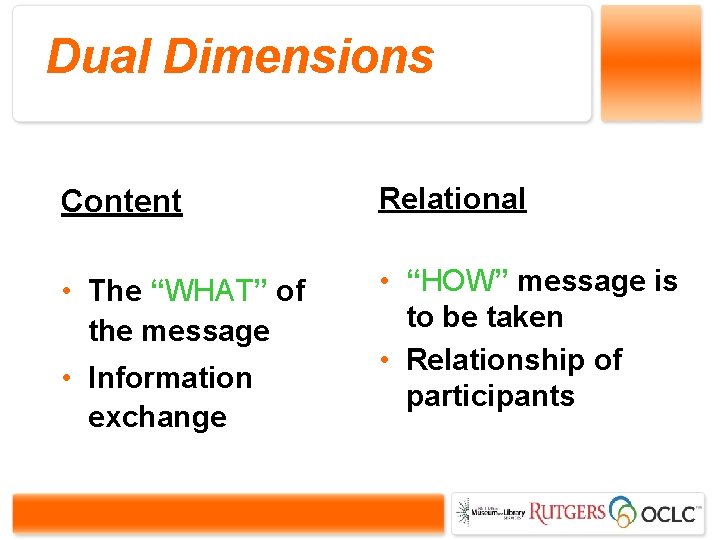
Dual Dimensions Content Relational • The “WHAT” of the message • “HOW” message is to be taken • Relationship of participants • Information exchange
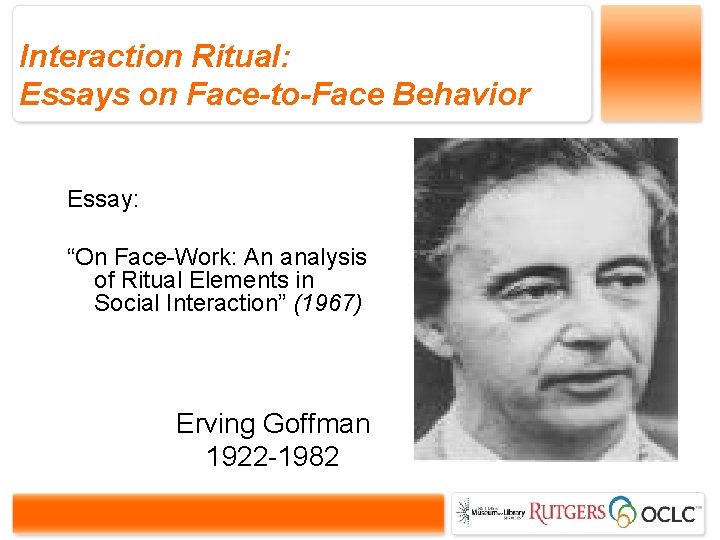
Interaction Ritual: Essays on Face-to-Face Behavior Essay: “On Face-Work: An analysis of Ritual Elements in Social Interaction” (1967) Erving Goffman 1922 -1982
Model Grounded in Research Identify what is critically important to users & librarians in successful reference interactions • Ft. F Environment – Reference Encounter (Radford, 1999) • Virtual Reference, Live Chat Environment – Seeking Synchronicity (Radford & Connaway, 2005 - 2008)
The Reference Encounter – Ft. F (Radford, 1999) • “Interpersonal relationships & communication of great importance in librarian & user perceptions. ” • Librarians value content more. • Users value relational aspects more.
Seeking Synchronicity – VR • Librarians AND users value BOTH information (content) & relational aspects • Greater portion of users value content in VR than in Ft. F • Librarians sensitive to user’s attitude in unsuccessful VR encounters (as found in Ft. F)
Findings from Interpersonal Communication Analysis • Relational & Content Facilitators – Interpersonal aspects of Ft. F or chat conversation that have a positive impact on librarian-client interaction & that enhance communication. • Relational & Content Barriers – Interpersonal aspects of Ft. F or chat conversation that have a negative impact on librarian-client interaction & that impede communication.
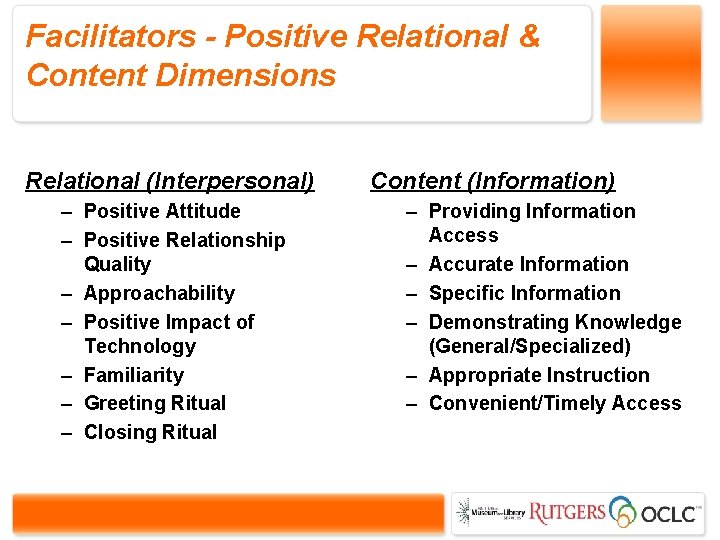
Facilitators - Positive Relational & Content Dimensions Relational (Interpersonal) – Positive Attitude – Positive Relationship Quality – Approachability – Positive Impact of Technology – Familiarity – Greeting Ritual – Closing Ritual Content (Information) – Providing Information Access – Accurate Information – Specific Information – Demonstrating Knowledge (General/Specialized) – Appropriate Instruction – Convenient/Timely Access
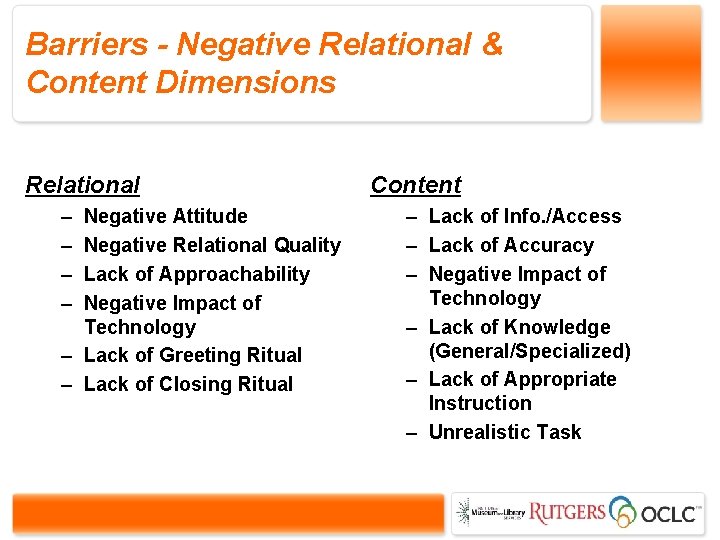
Barriers - Negative Relational & Content Dimensions Relational – – Negative Attitude Negative Relational Quality Lack of Approachability Negative Impact of Technology – Lack of Greeting Ritual – Lack of Closing Ritual Content – Lack of Info. /Access – Lack of Accuracy – Negative Impact of Technology – Lack of Knowledge (General/Specialized) – Lack of Appropriate Instruction – Unrealistic Task
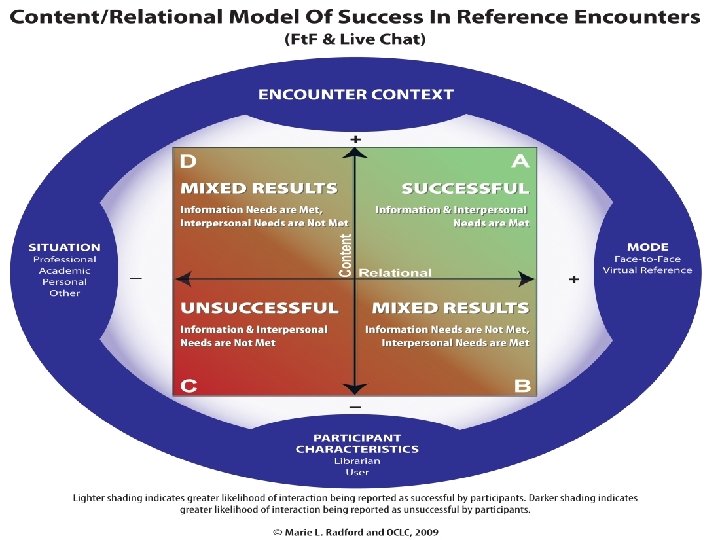
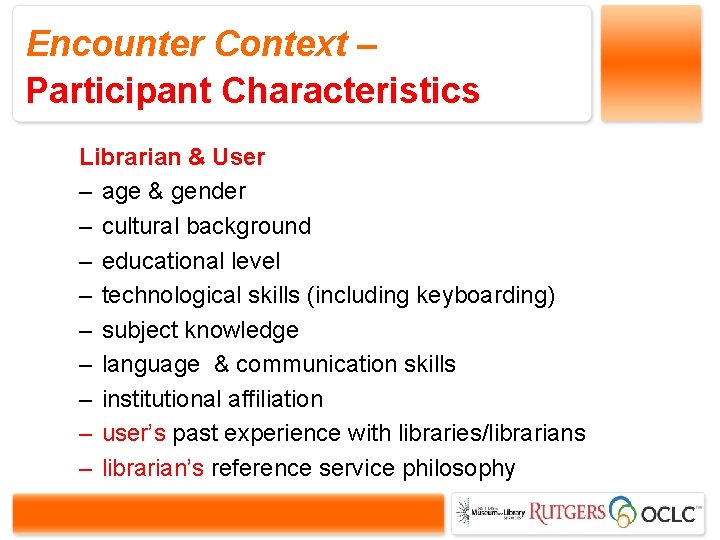
Encounter Context – Participant Characteristics Librarian & User – age & gender – cultural background – educational level – technological skills (including keyboarding) – subject knowledge – language & communication skills – institutional affiliation – user’s past experience with libraries/librarians – librarian’s reference service philosophy
Encounter Context – Situation • Reference queries are related to different situations including – professional – academic – personal – other
Encounter Context – Mode of Communication • Synchronous reference modes – Ft. F, traditional reference – VR (live chat) encounters
Implications • Information & relationship development critical to successful interactions • Sustainability dependant upon developing & maintaining positive relationships with VR & Ft. F users • For LIS education – Content & technical skills vitally important – Increase emphasis on interpersonal communication – Emphasize user’s point of view
Future Research • More testing of Theoretical Model – Does it hold up in other modes (IM)? – Non-synchronous modes (email)? – Quasi-synchronous modes (SMS text messaging? ) • Next will investigate Instant Messaging (IM) reference environment – growing steadily – IM believed to be congruent with model, closely related to live chat
Special Thanks • Rutgers University & OCLC Seeking Synchronicity Grant Project Team • • • Jocelyn De. Angelis Williams Susanna Sabolsci-Boros Timothy J. Dickey Patrick Confer Mary Anne Reilly Julie Strange Lisa Rose-Wiles Andrea Simzak Jannica Heinstrom • Those helping with the graphic design of the model • Nathan Graham (Rutgers), Mor Naaman (Rutgers), & Gary P. Radford (Fairleigh Dickinson University)
End Notes • This is one of the outcomes from the project Seeking Synchronicity: Evaluating Virtual Reference Services from User, Non-User, and Librarian Perspectives • Funded by IMLS, Rutgers University, & OCLC Online Computer Library Center, Inc. • Slides available at project web site: http: //www. oclc. org/research/projects/synchronicity/