
Three Types of Placement Students Which type do
- Slides: 52
Three Types of Placement Students: Which type do you belong? Three Types of Learners (52)
l Intellectual Learner l Intuitive Learner l Experiential Learners 2021/10/28 Three Types of Learners (52) 2
Intellectual Learner Three Types of Learners (52)
Behavioral characteristics of Intellectual Learner l At the beginning of the field placement experience: l they tend to assume a great deal of initiative in learning. 2021/10/28 Three Types of Learners (52) 4
They feel secure. . . they have read widely, analyzed their situation, l and developed a frame of reference to work with professionals and clients. l because 2021/10/28 Three Types of Learners (52) 5
Strength: l They l the are stimulated by: theoretical content of academic courses and l are successful in this area. 2021/10/28 Three Types of Learners (52) 6
Recordings: early case recordings reflect interest in people, l Their to speculate about the meaning of behavior, and l freedom to identify both tangible problems and problems that deal with feelings. l able 2021/10/28 Three Types of Learners (52) 7
Special Skills: As the field experience progresses, they demonstrate a special skill in the diagnostic area. l They are organized, logical, concise, and able to conceptualize. l However, difficulties may arise when l they must do more than provide tangible services. 2021/10/28 Three Types of Learners (52) 8
Frustration: Since theoretical learning is so effortless for them, l they become frustrated with the need to think through the interactions involved in the relationship process. l Their levels of self-expectation are high, and they become easily discouraged by their lack of success in 2021/10/28 Three Types of Learners (52) "doing. " l 9
Difficulties: In their early contacts with the client, l they are able to identify obstacles. l l but difficult to move them from problem focus to client l focus. They are overly prepared for interviews and are frustrated when flexibility is required. 2021/10/28 Three Types of Learners (52) 10
Warning: l As a result, they sometimes fail to grasp the importance of working at the pace of the client. The students' need to effect change quickly may overwhelm the client and l result in termination or l lack of any significant response. l 2021/10/28 Three Types of Learners (52) 11
Problems: l They experience problems with: l field learning, and many demands on field instructors. l place 2021/10/28 Three Types of Learners (52) 12
Causes of Problem: l Many l their of their problems stem from: strong desire to succeed, and l their fear of being forced to act before they have sufficient knowledge based on course content. 2021/10/28 Three Types of Learners (52) 13
Threatening experience: l Consequently, when they are forced to focus on l the emotional content of the helping relationship, l their security is threatened. 2021/10/28 Three Types of Learners (52) 14
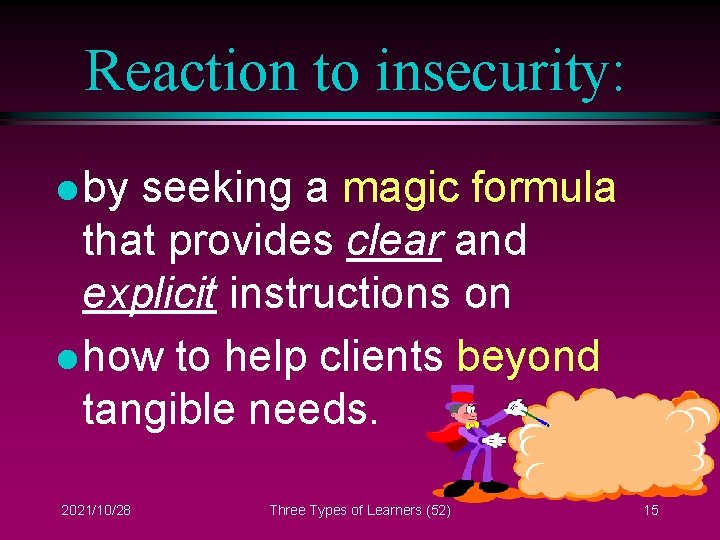
Reaction to insecurity: l by seeking a magic formula that provides clear and explicit instructions on l how to help clients beyond tangible needs. 2021/10/28 Three Types of Learners (52) 15
Further Reactions: l are threatened by criticism and lless free to expose themselves to risk, l protect themselves by attempting to control supervision sessions. 2021/10/28 Three Types of Learners (52) 16
Further Reactions: focus on details about which l they are knowledgeable, or l attempt to engage in l may abstract reasoning. 2021/10/28 Three Types of Learners (52) 17
Difficult to change: l Making changes in their manner of relating to clients is difficult; l frequently, they can adapt superficially without really changing. 2021/10/28 Three Types of Learners (52) 18
Areas of Concern: Self-awareness, consequently, is much more painful for these students. l They struggle hard and long to hold onto old patterns of learning and performing, l l frequently fearing that they will lose status in the intellectual area and will regress rather than 2021/10/28 Three Types of Learners (52) develop. l 19
Intuitive Learner Three Types of Learners (52)
Behavioral characteristics of Intuitive Learner l At the beginning of their placement, they meet with few major problems. l They are practical, extremely sensitive, and l have a high degree of natural talent and established security in relating to people. 2021/10/28 Three Types of Learners (52) 21
The kind of person l Basically giving persons, l they are enthusiastic about beginning with their cases, and l keenly motivated to understand how the agency can be utilized for the benefit 2021/10/28 of clients. Three Types of Learners (52) 22
Performing well in the early stage: Utilizing tangible services reinforces feelings of adequacy and l encourages them to exhibit more l initiative in discovering additional resources. They work steadily and diligently and assume considerable responsibility for managing. Three their 2021/10/28 Types work of Learners (52)load. 23 l
Weakness: At times, they move ahead too quickly and fail to realize the need to explore existing agency policies and procedures. l This failure is not usually based on an undue amount of conflict with authority but l rather on their desire to follow their l feeling instincts. 2021/10/28 Three Types of Learners (52) 24
Trying to avoid: avoid an analytical, orderly approach to problem solving and l tend to l spend a disproportionate amount of time on field-practice activities, l often to the detriment of classroom demands for acquiring a broad base of theoretical knowledge. 2021/10/28 Three Types of Learners (52) 25
Enthusiastic about social work theory: l l Early in their field-placement experience, they are quite enthusiastic about social work theory l because they find it so compatible with their natural others. 2021/10/28 way of responding to Three Types of Learners (52) 26
Courses they like: l "Human Behavior in the Social Environment" and other theoretical courses are viewed as interesting, l but not especially useful except for its contribution to their general fund of knowledge. 2021/10/28 Three Types of Learners (52) 27
Questions the value of knowledge: l Because they are so actively involved with the current functioning of clients, l they question the emphasis on acquiring knowledge and understanding the dynamics of behavior. 2021/10/28 Three Types of Learners (52) 28
Turning point: l When they begin to appreciate the benefits of an orderly, structured approach to problem-solving, begin to integrate theoretical content, l they l improve their conceptual ability, and consciously use self in the helping process. 2021/10/28 Three Types of Learners (52) 29
Recordings: l Early recordings reveal special skills in l individualizing clients, l recognizing strengths, and, to a lesser degree, weaknesses. 2021/10/28 Three Types of Learners (52) 30
Special Skills: to identify client needs and focus on practical problems l pay less attention to viewing the entire case situation. l Feeling responses toward clients are easily available to them, readily heard, and usually appropriate. l able 2021/10/28 Three Types of Learners (52) 31
Frustration: As greater conceptualization is demanded from them, l their style becomes more stilted and recordings briefer. l Sometimes especially resistant to integrating and using new knowledge. l l Increasing anxiety push them toward self-examination in ofthe helping process. 32 2021/10/28 Three Types Learners (52)
Identification with the profession Initially, field instructors are quite impressed by their ability to verbalize his/her identification with the profession. l Students are amazed to find a profession in which they feel so l comfortable, curious, and eager to learn. 2021/10/28 Three Types of Learners (52) 33
Use of Supervision: free to question, and l are eager to engage the instructor in l They feel interesting discussions about the profession. l However, when discussions are limited to helping students see concepts and understand principles in social work, they often resist. Three Types of Learners (52) 2021/10/28 34
Fear: They know they are successful with clients and initially feel defensive and fearful that they will lose their intuitive skill in helping people. l Rather than becoming dependent on field instruction, they go through a phase in which they operate quite independently and often experience difficulty turning recordings in on time. 35 2021/10/28 Three Types of Learners (52) l
Area of Concern: l Delay continues until they gain confidence in themselves as learners. l After they realize that integrating theoretical content with practical experience is not a major problem, l they begin asking for and using instructional help. 2021/10/28 Three Types of Learners (52) 36
Experiential Learner Three Types of Learners (52)
l. Behavioral characteristics of Experiential Learner 2021/10/28 Three Types of Learners (52) 38
At the beginning of their placement, l l l They are sometimes described as "late bloomers" because they start slow and experience problems. They seem unable to tap previously learned resources as easily as other types of learners do, and may appear to operate vacuum. 2021/10/28 Three Types of Learners (52) in a 39
Presenting Problems: l Their tolerance for frustration is low and their self-confidence weak, l especially in young, beginning students who experience additional problems with regard to achieving independence and l who lack related work experience or 2021/10/28 Three Types of Learners (52) have limited life experiences. l 40
Difficulties: l Unlike the intuitive learners who cling to old ways of doing things at the beginning, are frequently unable to use past life and work experiences, l even when field instructors are l they active and supportive. 2021/10/28 Three Types of Learners (52) 41
Difficulties: l Often regress at the beginning of the second field placement, and lact as though they had learned little from their first field experience. 2021/10/28 Three Types of Learners (52) 42
During the first few days of work: are confused about basic instructions. l Their ability to comprehend or their intellectual endowment l They may be questioned. 2021/10/28 Three Types of Learners (52) 43
What they need: may even be immobilized during the early weeks of field placement. l In effect, these students are saying, l They I must do before I understand. " l" 2021/10/28 Three Types of Learners (52) 44
Mixed results: l As their anxieties increase, they become self-focused, which in turn produces mixed results. They attempt to rationalize their lack of progress or lack of response from clients; l on the other hand, they begin early on to l deal with self-awareness. 2021/10/28 Three Types of Learners (52) 45
Weaknesses: dependent and l need approval and recognition, l l They are overly they feel an urgency to obtain positive signs that they really can perform and l place demands on the field instructor's l time. 2021/10/28 Three Types of Learners (52) 46
Similarity: l Like intellectual learners, l they look for a magical formula, although they are more attuned to feelings and l are more flexible in their response to structure. 2021/10/28 Three Types of Learners (52) 47
Problems: l They are similar to those of the intuitive learner with regard to conceptualization, l but their problem-solving approach is l far less creative than that of the intuitive learner. 2021/10/28 Three Types of Learners (52) 48
Strengths: l Because they develop selfawareness early, l they recognize their need to learn. 2021/10/28 Three Types of Learners (52) 49
Further difficulties: l They find it difficult to accept the fact that l they are muddling through and lmay not produce the same quantity of work l as do many other students. 2021/10/28 Three Types of Learners (52) 50
Further difficulties: l Even after these students begin to work through some of their problems, continue to demonstrate lack of originality in approach and planning and l they l difficulty 2021/10/28 in conceptualizing. Three Types of Learners (52) 51
The End Three Types of Learners (52)