
Three Types of Atomic Nuclear Changes Radioactive decay
- Slides: 7
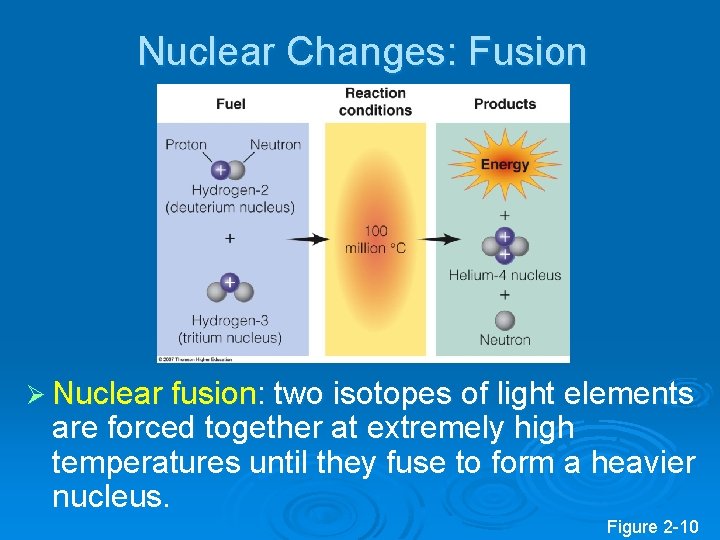
Three Types of Atomic Nuclear Changes Ø Radioactive decay- atoms “break down” by emitting ionizing radiation Ø Fission- splitting large atoms (like uranium) l l First atomic bombs All nuclear power plants Ø Fusion- fusing atoms together (like hydrogen) l l l “H-Bomb” Sun and all other stars 100 million degrees Celsius to begin reaction
Nuclear Changes: Radioactive Decay Ø Natural radioactive decay: unstable isotopes spontaneously emit fast moving chunks of matter (alpha or beta particles), high-energy radiation (gamma rays), or both at a fixed rate. l l Radiation is commonly used in energy production and medical applications. The rate of decay is expressed as a half-life (the time needed for one-half of the nuclei to decay to form a different isotope).
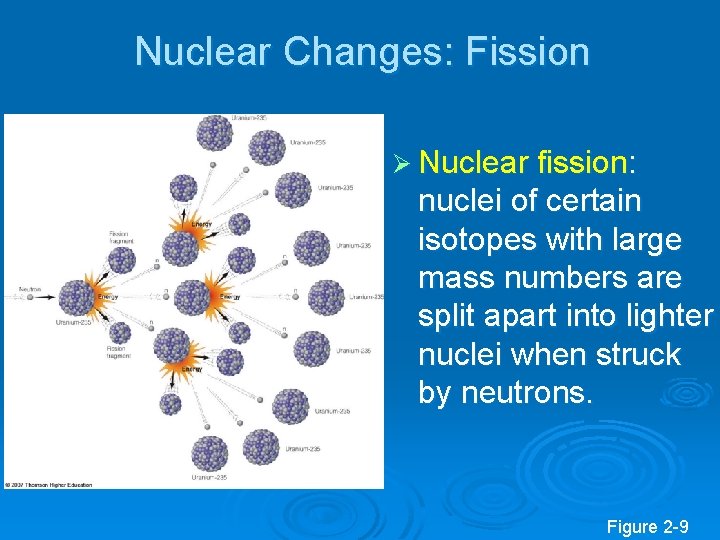
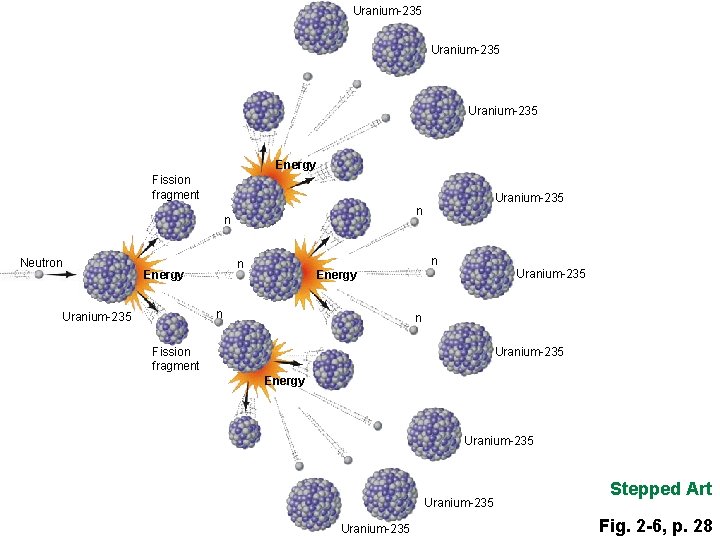
Nuclear Changes: Fission Ø Nuclear fission: nuclei of certain isotopes with large mass numbers are split apart into lighter nuclei when struck by neutrons. Figure 2 -9
Uranium-235 Energy Fission fragment n Neutron n n Energy Uranium-235 Energy n Uranium-235 n n Fission fragment Uranium-235 Energy Uranium-235 Stepped Art Fig. 2 -6, p. 28
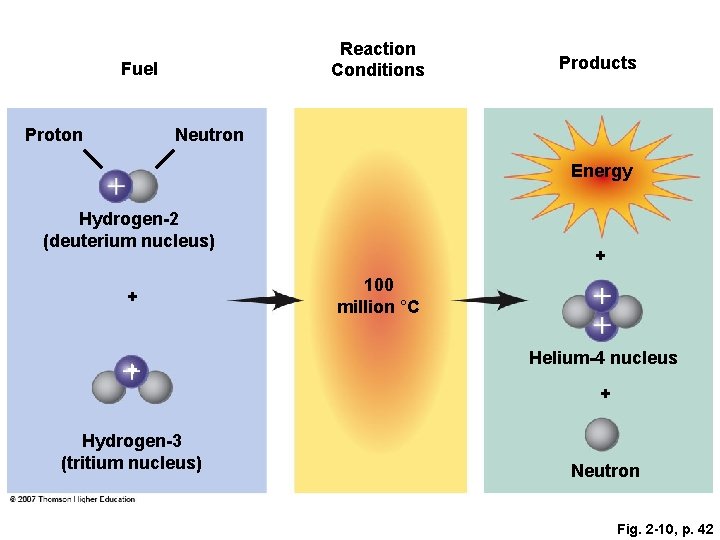
Nuclear Changes: Fusion Ø Nuclear fusion: two isotopes of light elements are forced together at extremely high temperatures until they fuse to form a heavier nucleus. Figure 2 -10
Reaction Conditions Fuel Proton Products Neutron Energy Hydrogen-2 (deuterium nucleus) + + + 100 million °C Helium-4 nucleus + Hydrogen-3 (tritium nucleus) Neutron Fig. 2 -10, p. 42
ENERGY Ø Energy is the ability to do work and transfer heat. l Kinetic energy – • energy in motion l l heat, electromagnetic radiation Potential energy – • stored for possible use l batteries, glucose molecules