
Three Tier Model for Preventing Academic Mental Health






- Slides: 62
Three Tier Model for Preventing Academic, Mental Health, Behavior Problems Virginia W. Berninger University of Washington Director, Multidisciplinary Learning Disabilities Research Center, Literacy Trek Longitudinal Study, and The Write Stuff Intervention Project, and School Psychology Internship Program vwb@u. washington. edu CASP March 4, 2005 Riverside, CA
Greetings from UW School Psychology Program, Seattle, WA
Acknowledgements Ø NICHD RO 1 25858 Ø NICHD P 50 33812 Ø Graduate Students in School Psychology Ø Co-Investigators at the University of Washington and External Consultants Ø Harcourt (norming research measures)
Research Evidence Ø Based on longitudinal study 1984 -85 of beginning reading Ø Based on NICHD-funded cross-sectional research of writing and reading 1989 -92 Ø Based on NICHD-funded longitudinal and instructional research on writing and writing -reading connections 1992 -2006
Research Evidence Based on NICHD-funded Multidisciplinary Research on Learning Disabilities: Links between Biology and Schools 1995 -2005 Ø School-based prevention and clinic-based treatment Ø Teacher training Ø Family genetics Ø Brain imaging
Today’s Presentation Implementing a Three-Tier Model of Assessment-Intervention Links: Ø The purpose of assessment is to plan and introduce intervention to directly improve academic learning (treatment validity), which indirectly improves mental health and behavior, Ø especially if coupled with C 3
Questions to Ponder 1. 2. 3. Would Larry P against California have happened if schools were using diagnostic instruments validated for prevention and treatment validity coupled with C 3? Are tests (particularly IQ tests) the culprit? Or, is the problem practitioners’ lack of scientific knowledge of individual differences in learners relevant to academic learning and of effective instructional practices? Are educational practices that do not promote caring, connecting with children and their families and communities, and communicating effectively with children and their families at the heart of school failure and school drop out?
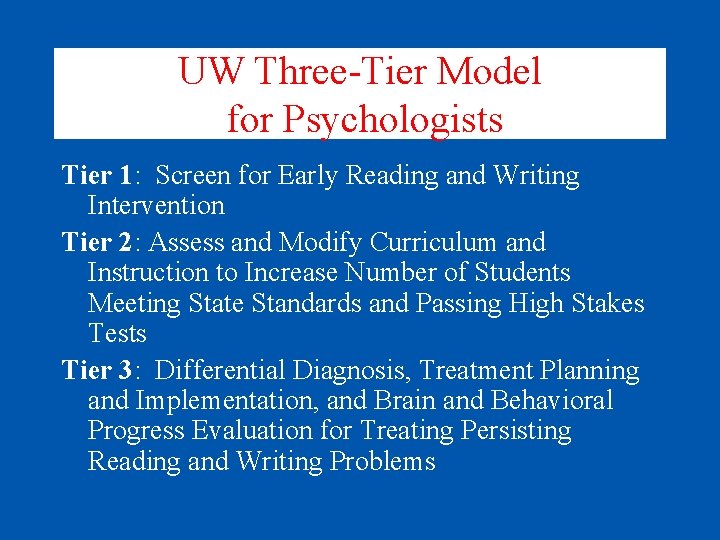
UW Three-Tier Model for Psychologists Tier 1: Screen for Early Reading and Writing Intervention Tier 2: Assess and Modify Curriculum and Instruction to Increase Number of Students Meeting State Standards and Passing High Stakes Tests Tier 3: Differential Diagnosis, Treatment Planning and Implementation, and Brain and Behavioral Progress Evaluation for Treating Persisting Reading and Writing Problems
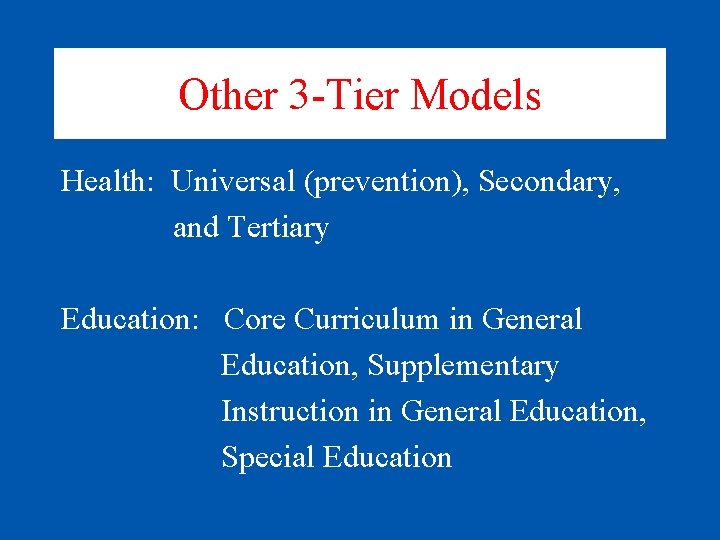
Other 3 -Tier Models Health: Universal (prevention), Secondary, and Tertiary Education: Core Curriculum in General Education, Supplementary Instruction in General Education, Special Education
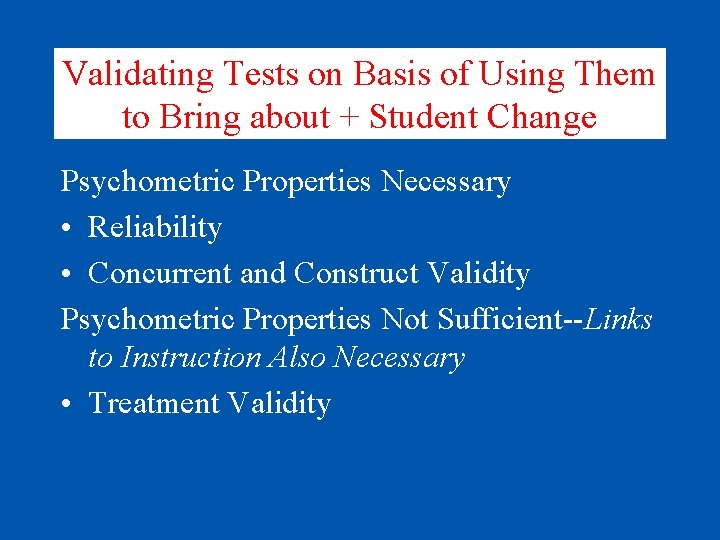
Validating Tests on Basis of Using Them to Bring about + Student Change Psychometric Properties Necessary • Reliability • Concurrent and Construct Validity Psychometric Properties Not Sufficient--Links to Instruction Also Necessary • Treatment Validity
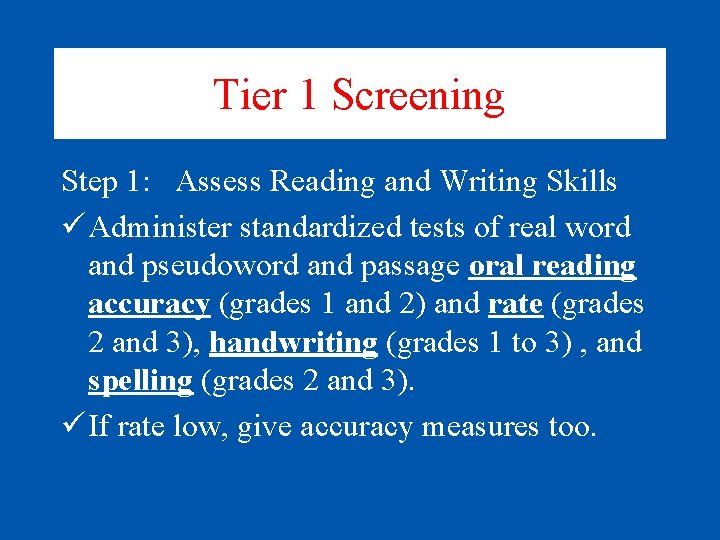
Tier 1 Screening Step 1: Assess Reading and Writing Skills ü Administer standardized tests of real word and pseudoword and passage oral reading accuracy (grades 1 and 2) and rate (grades 2 and 3), handwriting (grades 1 to 3) , and spelling (grades 2 and 3). ü If rate low, give accuracy measures too.
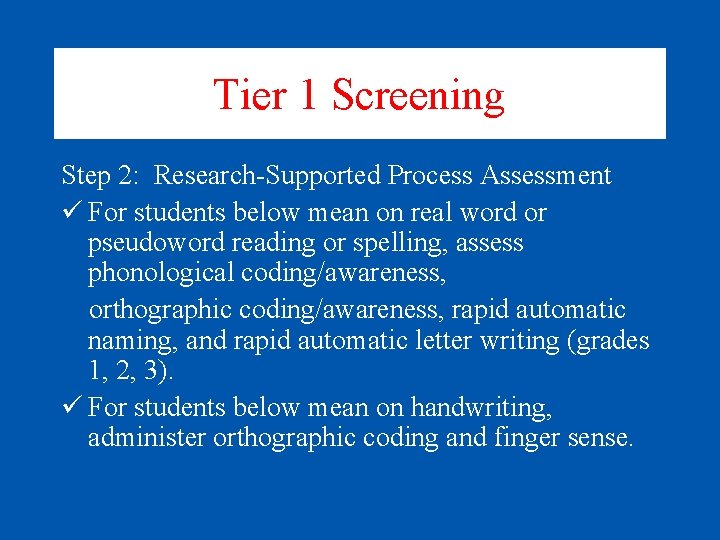
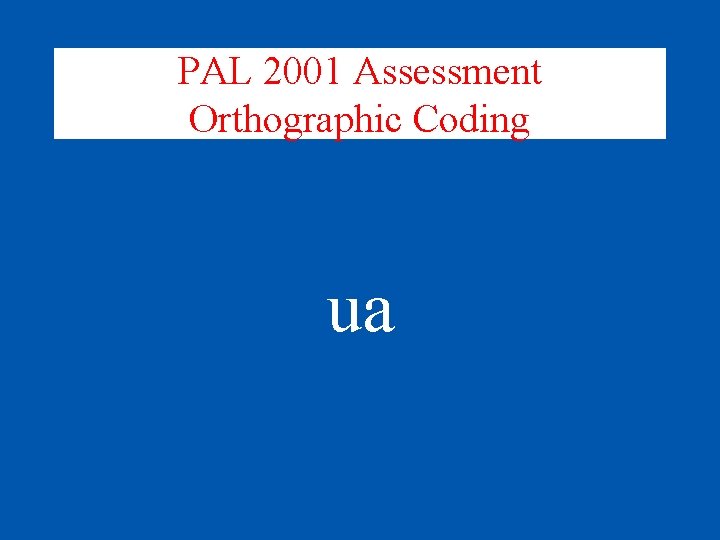
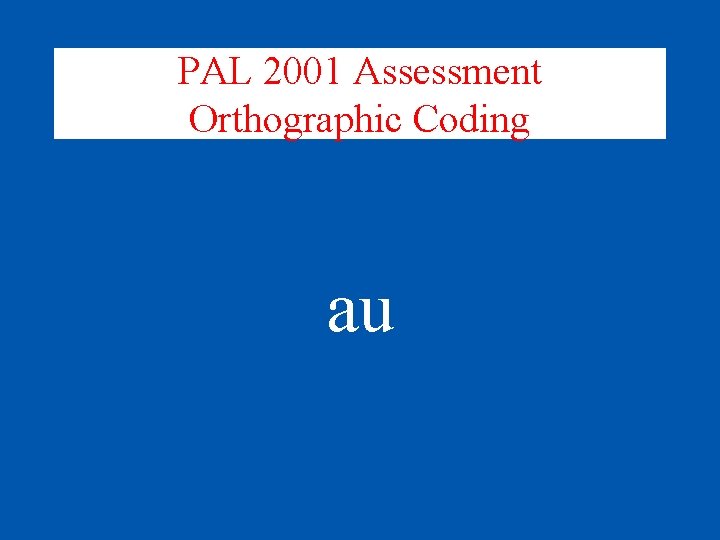
Tier 1 Screening Step 2: Research-Supported Process Assessment ü For students below mean on real word or pseudoword reading or spelling, assess phonological coding/awareness, orthographic coding/awareness, rapid automatic naming, and rapid automatic letter writing (grades 1, 2, 3). ü For students below mean on handwriting, administer orthographic coding and finger sense.
Tier 1 Treatment Step 3: Go directly to treatment! ü Linked to the process weakness ü Linked to research-supported instructional component for teaching reading or writing
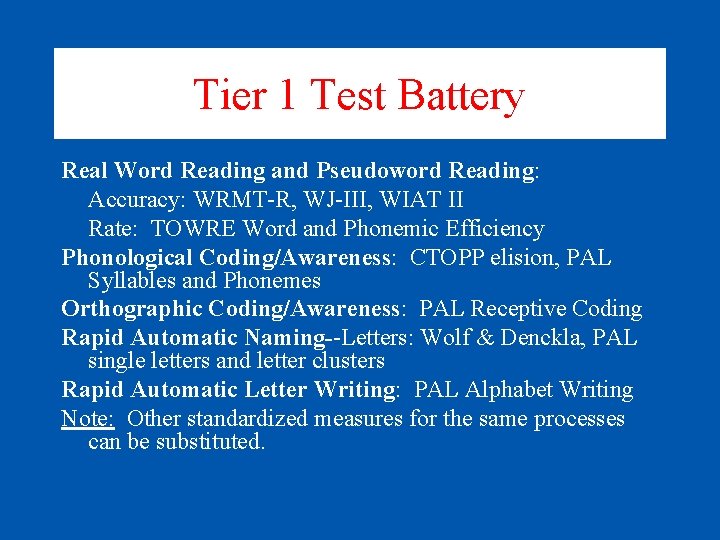
Tier 1 Test Battery Real Word Reading and Pseudoword Reading: Accuracy: WRMT-R, WJ-III, WIAT II Rate: TOWRE Word and Phonemic Efficiency Phonological Coding/Awareness: CTOPP elision, PAL Syllables and Phonemes Orthographic Coding/Awareness: PAL Receptive Coding Rapid Automatic Naming--Letters: Wolf & Denckla, PAL single letters and letter clusters Rapid Automatic Letter Writing: PAL Alphabet Writing Note: Other standardized measures for the same processes can be substituted.
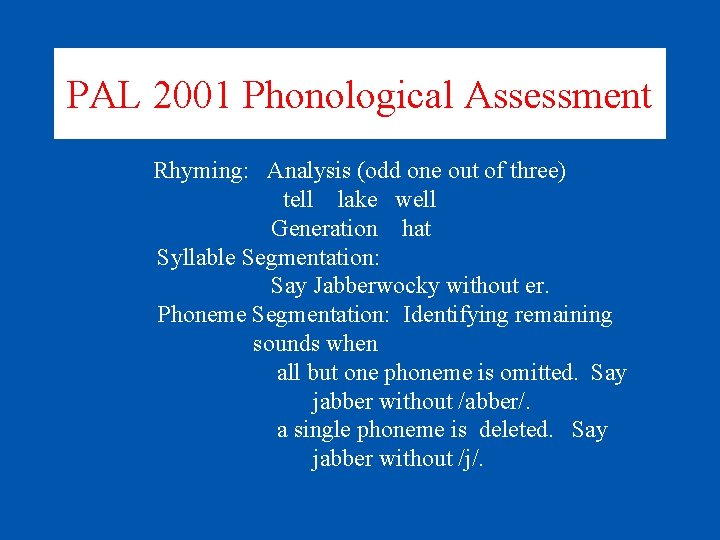
PAL 2001 Phonological Assessment Rhyming: Analysis (odd one out of three) tell lake well Generation hat Syllable Segmentation: Say Jabberwocky without er. Phoneme Segmentation: Identifying remaining sounds when all but one phoneme is omitted. Say jabber without /abber/. a single phoneme is deleted. Say jabber without /j/.
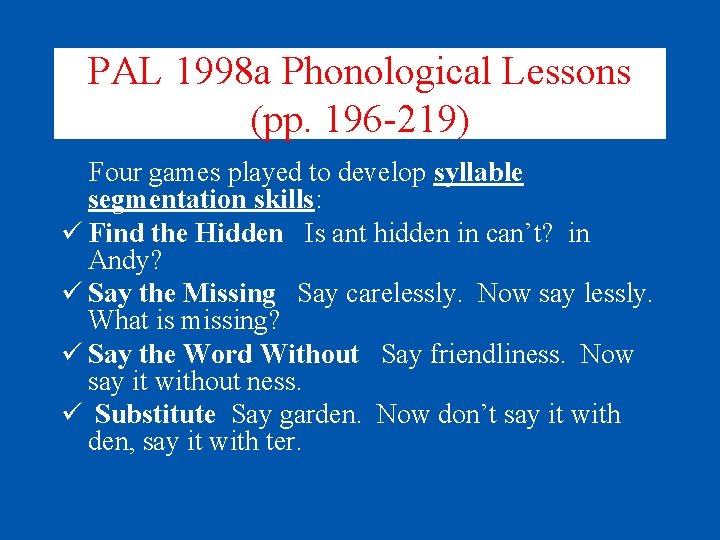
PAL 1998 a Phonological Lessons (pp. 196 -219) Four games played to develop syllable segmentation skills: ü Find the Hidden Is ant hidden in can’t? in Andy? ü Say the Missing Say carelessly. Now say lessly. What is missing? ü Say the Word Without Say friendliness. Now say it without ness. ü Substitute Say garden. Now don’t say it with den, say it with ter.
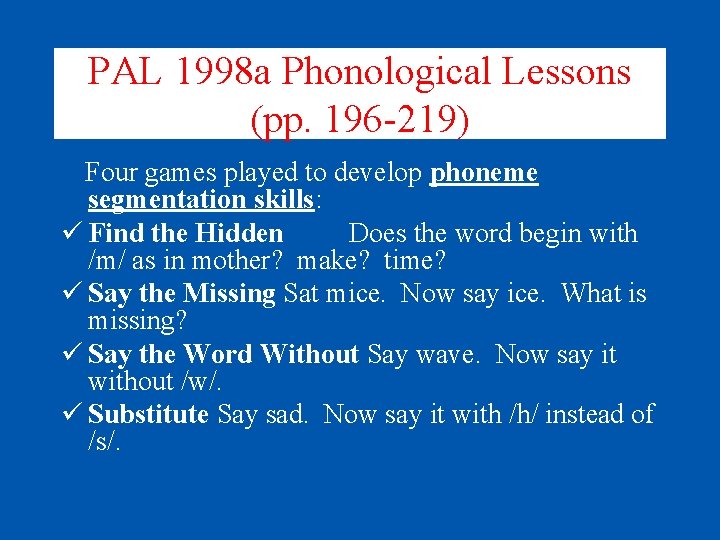
PAL 1998 a Phonological Lessons (pp. 196 -219) Four games played to develop phoneme segmentation skills: ü Find the Hidden Does the word begin with /m/ as in mother? make? time? ü Say the Missing Sat mice. Now say ice. What is missing? ü Say the Word Without Say wave. Now say it without /w/. ü Substitute Say sad. Now say it with /h/ instead of /s/.
PAL 2001 Assessment of (Receptive Orthographic Coding) (STM/WM) because
PAL 2001 Assessment Orthographic Coding because
PAL 2001 Assessment Orthographic Coding because
PAL 2001 Assessment Orthographic Coding became
PAL 2001 Assessment Orthographic Coding because
PAL 2001 Assessment Orthographic Coding o
PAL 2001 Assessment Orthographic Coding because
PAL 2001 Assessment Orthographic Coding a
PAL 2001 Assessment Orthographic Coding because
PAL 2001 Assessment Orthographic Coding ua
PAL 2001 Assessment Orthographic Coding because
PAL 2001 Assessment Orthographic Coding au
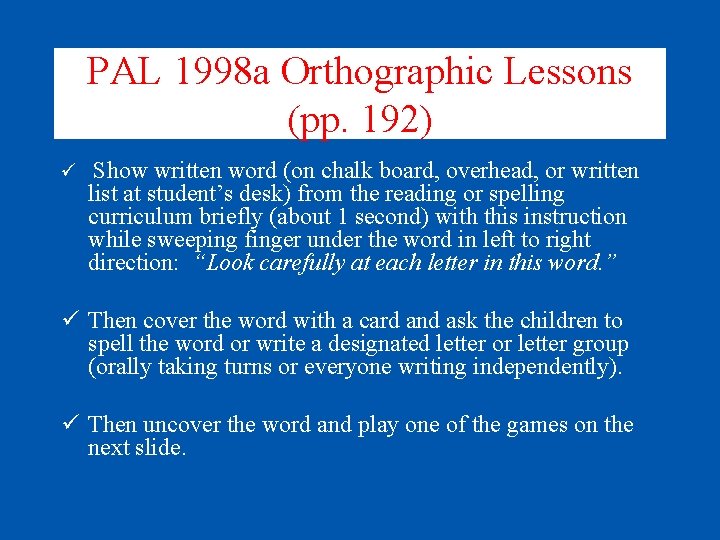
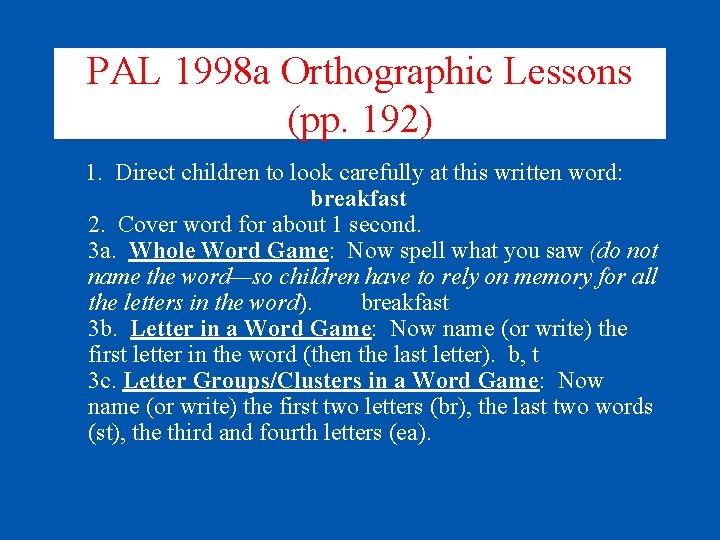
PAL 1998 a Orthographic Lessons (pp. 192) ü Show written word (on chalk board, overhead, or written list at student’s desk) from the reading or spelling curriculum briefly (about 1 second) with this instruction while sweeping finger under the word in left to right direction: “Look carefully at each letter in this word. ” ü Then cover the word with a card and ask the children to spell the word or write a designated letter or letter group (orally taking turns or everyone writing independently). ü Then uncover the word and play one of the games on the next slide.
PAL 1998 a Orthographic Lessons (pp. 192) 1. Direct children to look carefully at this written word: breakfast 2. Cover word for about 1 second. 3 a. Whole Word Game: Now spell what you saw (do not name the word—so children have to rely on memory for all the letters in the word). breakfast 3 b. Letter in a Word Game: Now name (or write) the first letter in the word (then the last letter). b, t 3 c. Letter Groups/Clusters in a Word Game: Now name (or write) the first two letters (br), the last two words (st), the third and fourth letters (ea).
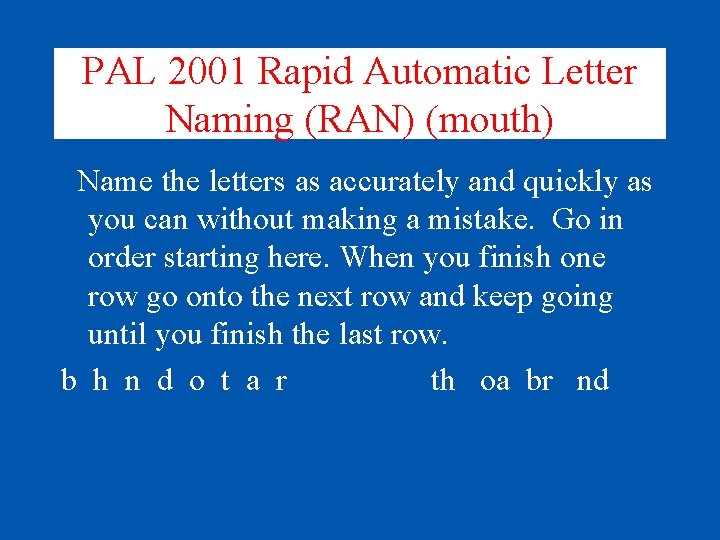
PAL 2001 Rapid Automatic Letter Naming (RAN) (mouth) Name the letters as accurately and quickly as you can without making a mistake. Go in order starting here. When you finish one row go onto the next row and keep going until you finish the last row. b h n d o t a r th oa br nd
PAL 2001 Assessing Rapid Automatic Letter Writing (hand) Print the letters of the alphabet in order as accurately and quickly as you can without making a mistake. Use manuscript not cursive writing.
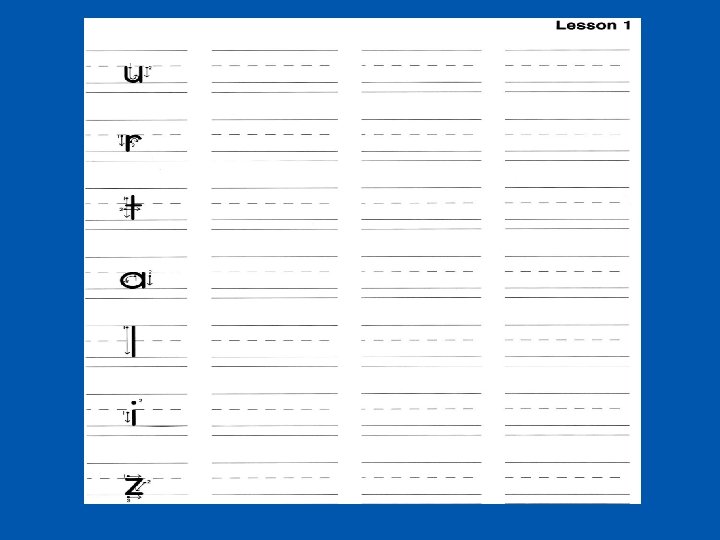
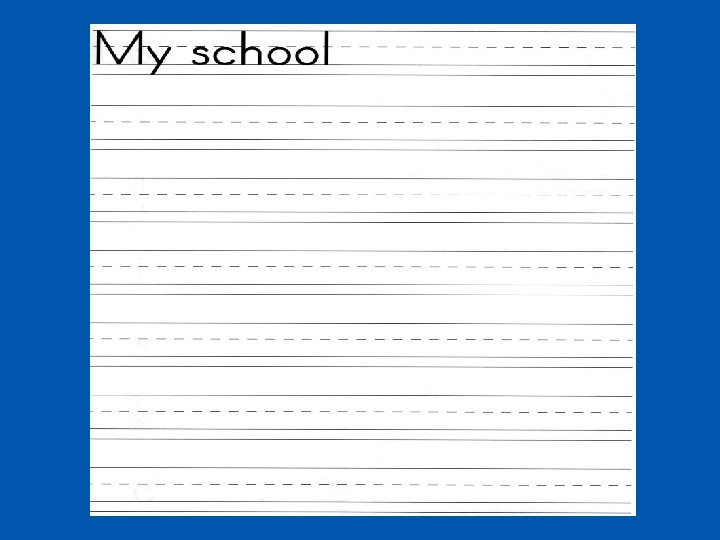
PAL 1998 b Handwriting Lessons for Treating Slow RAN and Letter Writing • Each lesson consists of 4 pages of letter models and space to practice each of 26 letters once and lined paper with composition topic to compose for 5 minutes. Each lesson can be used up to three times. • 24 lessons in ball and stick lower case manuscript letter and 24 lessons in lower case manuscript D’Nealian.
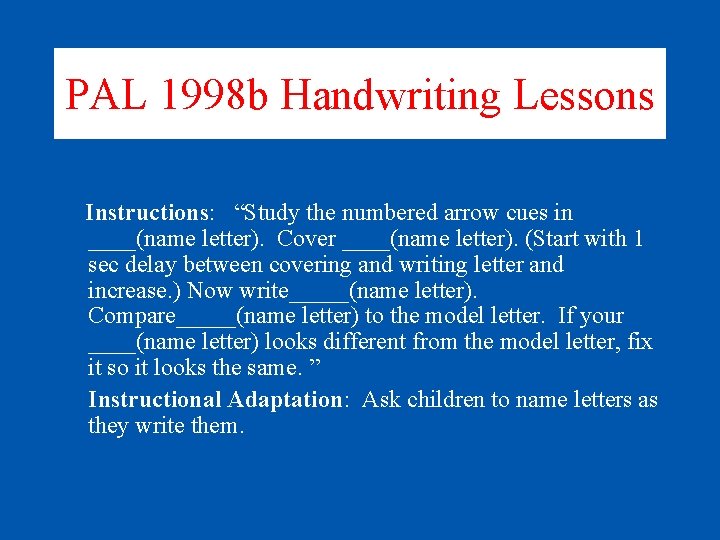
PAL 1998 b Handwriting Lessons Instructions: “Study the numbered arrow cues in ____(name letter). Cover ____(name letter). (Start with 1 sec delay between covering and writing letter and increase. ) Now write_____(name letter). Compare_____(name letter) to the model letter. If your ____(name letter) looks different from the model letter, fix it so it looks the same. ” Instructional Adaptation: Ask children to name letters as they write them.
Teach for Transfer to Composing Important Instructional Design Features: ü Only practice each letter once in a lesson (avoids habituation) ü Always compose for 5 minutes and share with peers
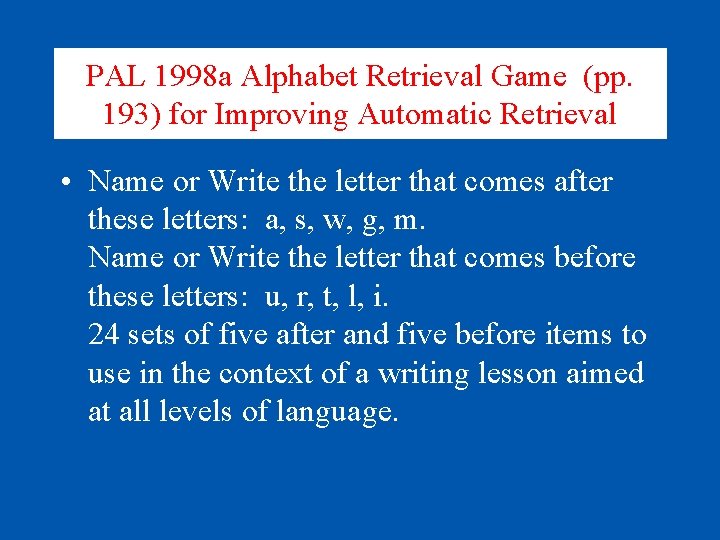
PAL 1998 a Alphabet Retrieval Game (pp. 193) for Improving Automatic Retrieval • Name or Write the letter that comes after these letters: a, s, w, g, m. Name or Write the letter that comes before these letters: u, r, t, l, i. 24 sets of five after and five before items to use in the context of a writing lesson aimed at all levels of language.
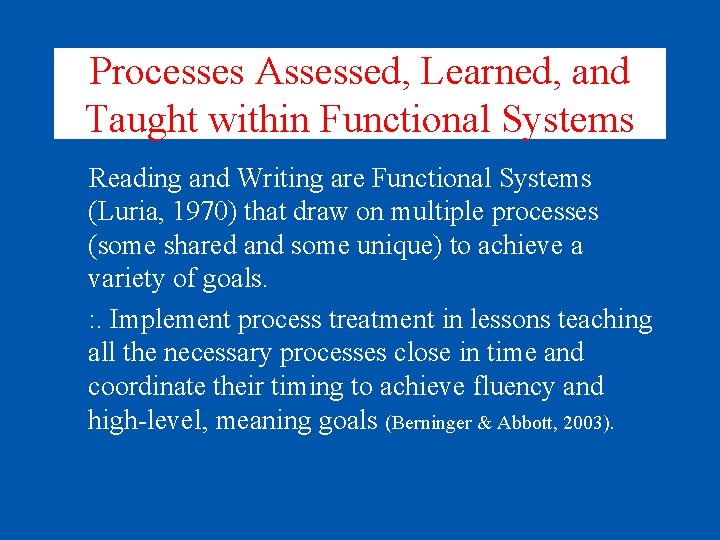
Processes Assessed, Learned, and Taught within Functional Systems Reading and Writing are Functional Systems (Luria, 1970) that draw on multiple processes (some shared and some unique) to achieve a variety of goals. : . Implement process treatment in lessons teaching all the necessary processes close in time and coordinate their timing to achieve fluency and high-level, meaning goals (Berninger & Abbott, 2003).
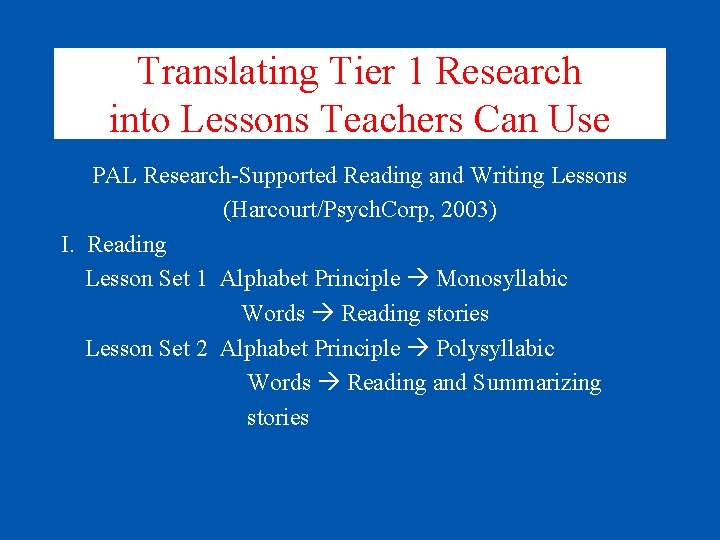
Translating Tier 1 Research into Lessons Teachers Can Use PAL Research-Supported Reading and Writing Lessons (Harcourt/Psych. Corp, 2003) I. Reading Lesson Set 1 Alphabet Principle Monosyllabic Words Reading stories Lesson Set 2 Alphabet Principle Polysyllabic Words Reading and Summarizing stories
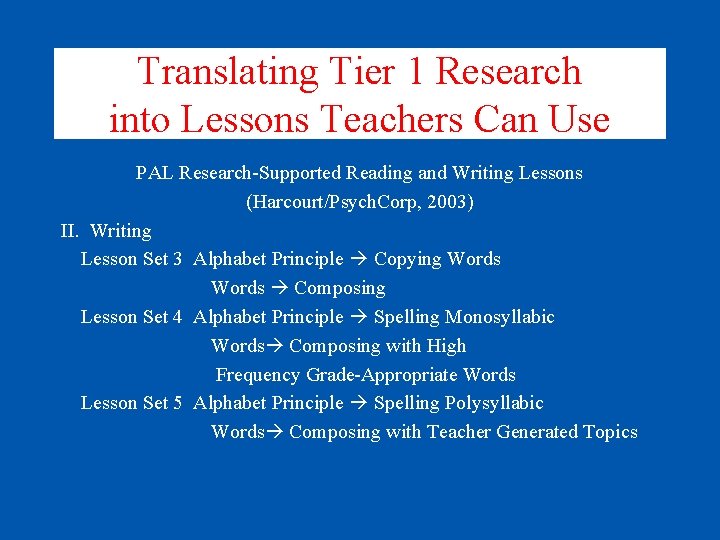
Translating Tier 1 Research into Lessons Teachers Can Use PAL Research-Supported Reading and Writing Lessons (Harcourt/Psych. Corp, 2003) II. Writing Lesson Set 3 Alphabet Principle Copying Words Composing Lesson Set 4 Alphabet Principle Spelling Monosyllabic Words Composing with High Frequency Grade-Appropriate Words Lesson Set 5 Alphabet Principle Spelling Polysyllabic Words Composing with Teacher Generated Topics
Reading More about the Three Tier Model Berninger, V. , Stage, S. , Smith, D. , & Hildebrand, D. (2001). Assessment for reading and writing intervention: A 3 -tier model for prevention and intervention. In J. Andrews, H. , D. Saklofske, & H. Janzen (Eds. ). Ability, achievement, and behavior assessment. A practical handbook (pp. 195 -223). New York: Academic Press. sstage@u. washington. edu for additional publications about problem solving consultation. Berninger, V. (2002). Best practices in reading, writing, and math assessment-intervention links: A systems approach for schools, classrooms, and individuals. In A. Thomas & J. Grimes (Eds. ) Best Practices in School Psychology IV. Vol 1 (pp. 851 -865). Bethesda, MD: National Association of School Psychologists.
Tier 1 Contribution to Bridging General-Special Education Gap ü Prevents learning problems in general education ü Will be emphasized in the reauthorization of IDEA ü Requires partnerships among school psychologists, speech and language specialists, special education teachers AND general education teachers ü Contributes to educational evolution (optimizing learning of all students)
Preventing Mental Health Problems through Academic Instruction Current treatment research uses usual treatment as the control. Counseling did not lead to added gains beyond academic instruction. Weiss, B. , Catron, T. , Harris, V. , & Phung, T. (1999). The effectiveness of traditional child psychotherapy. Journal of Consulting and Clinical Psychology, 67, 82 -94.
Preventing Behavior Problems through Teacher Consultation 1. Visit Dr. Sylvia Rosenfield’s website on statewide school consultation model. www. icteams. umd. edu 2. and Dr. Carol Lidz’s website for dynamic assessment www. dynamicassessment. com
Preventing Mental Health Problems through Research-Supported Social Skills Training Committee For Children www. cfchildren. org Phone Number 800 -634 -4449. • Second Step • Grossman, D. C. , Neckerman, H. J. , Koepsell, T. D. , Liu, P. Y. , Asher, K. N. Beland, K. , Frey, K. S. & Rivara, F. P. (1997). The effectiveness of a violence prevention curriculum among children in elementary school. Journal of the American Medical Association, 277, 1605 -1611. • Frey, K. S. , Nolen, S. B. , Van. Schoiak-Edstrom, L. , & Hirschstein, M. (2005). Evaluating a school-based social competence program: Linking behavior, goals and beliefs. Journal of Applied Developmental Psychology, 26, 171 – 200.
Preventing Mental Health Problems through Research-Supported Social Skills Training Committee For Children www. cfchildren. org Phone Number 800 -634 -4449. • Van Schoiack, L. , Frey, K. S. , & Beland, K. (2002). Changing adolescents' attitudes about relational and physical aggression: An early evaluation of a school-based intervention. School Psychology Review, 31, 201 -216. • Steps to Respect—due out in the May Issue. • Frey, K. S. , Hirschstein, M. K. , Snell, J. L. , Edstrom, L. V. , Mac. Kenzie, E. P. & Broderick, C. (in press). Reducing playground bullying and supporting beliefs: An experimental trial of the Steps to Respect program. Developmental Psychology.
Preventing Mental Health Problems through Research-Supported Mental Health Prevention Ø Contact Dr. Carolyn Webster Stratton for research-supported strategies for parents and schools to use with conduct disordered children. cws@u. washington. edu Ø Contact Dan Lovitt (dlovitt@u. washington. edu) and request paper on “Emotional Coaching in the Classroom”
Facilitating School Success through Enhancing Teacher-Student Relationships Ø Read Pianta, R. (1999). Enhancing Relationships between Children and Teachers. Washington, D. C. : American Psychological Association.
School Psychologists as Miracle Workers The Los Angeles Unified School District (LAUSD) Partnership between School Psychologists and General Education Teachers Dr. Alnita Dunn, Psychology Services Coordinator in LAUSD, headed the effort. Participating school psychologists included: Debby Barth Carrera, Rosalie Bell, Ph. D. , Debbie Bloom, Patricia Burrows, Ruben Carranza, June Durr, Christina Harrell, Erin Holman, Chris Mealy. Ures, Nicole Mock, Anne. Marie Serrano, Christine Toleson, Tiana Thorpe, Reymundo Verastigui, and Didi Watts) and the teachers at the participating schools (24 th St. School, 96 th St. School, 116 th St. School, Fernangeles, Fletcher Dr. , Hoover St. , Hyde Park Blvd. , Kittridge St. , Los Angeles Elementary School, Murchison St. , Pio Pico, Russell, Sierra Park, Westminster Ave. , and Woodcrest.
Further Information on School Psychology Partnerships 1. 2. 3. Berninger, V. , Dunn, A. , Lin, S. . , & Shimada, S. (2004). School Evolution: Scientist-Practitioner Educators Creating Optimal Learning Environments for ALL Students. Journal of Learning Disabilities, 37, 500 -508. Berninger, V. , Dunn, A. , & Alper, T. (2004). Integrated models for branching assessment, instructional assessment, and profile assessment. In A. Prifitera, D. Saklofske, L. Weiss, & E. Rolfhus (Eds. ), WISC-IV Clinical use and interpretation (pp. 151 -185). San Diego, CA: Academic Press. Articles by Dunn in CASP newsletter.
School Psychologists as Miracle Workers UW School Psychology Interns 2004 -2005: ü Care, Connect, and Communicate C 3 ü and then implement research-supported instruction ü Proof in principle (stories of school psychology interns)
Research into Practice within 3 C Kindergartener with severe behavior problems is retained—teacher wants the child in special education School psychology intern has read NASP position paper on retention, assesses child using research-supported tests, pinpoints cognitive strengths and specific literacy weaknesses
Research into Practice within 3 C School has not contacted parent who does not have phone. School psychology intern visits home and invites mom to school, does “active” listening about the family situation, and assists mom in obtaining services through Catholic Charities. School psychology intern uses consultation skills to convince the kindergarten and first grade teacher to allow the student to visit the first grade classroom for reading instruction and to receive supplementary, research-supported instruction to work on weaknesses in literacy-related processes.
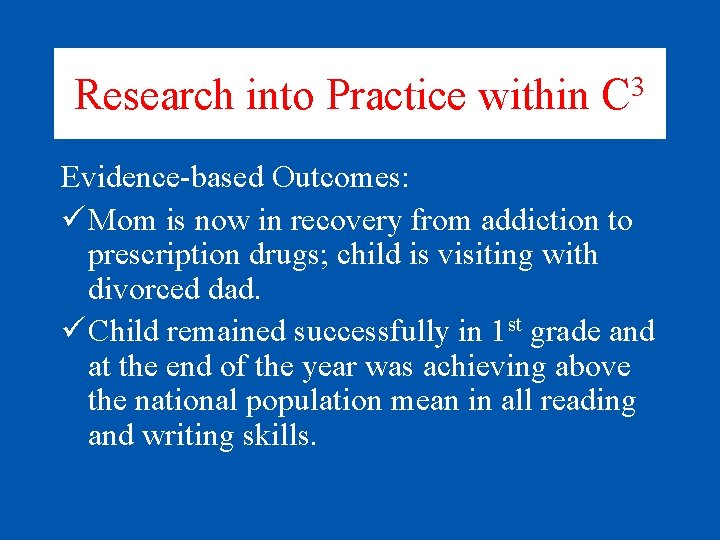
Research into Practice within 3 C Evidence-based Outcomes: ü Mom is now in recovery from addiction to prescription drugs; child is visiting with divorced dad. ü Child remained successfully in 1 st grade and at the end of the year was achieving above the national population mean in all reading and writing skills.
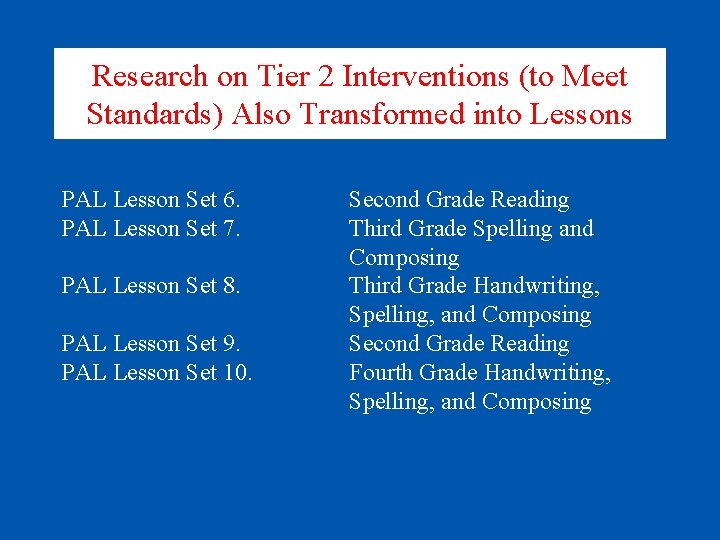
Research on Tier 2 Interventions (to Meet Standards) Also Transformed into Lessons PAL Lesson Set 6. PAL Lesson Set 7. PAL Lesson Set 8. PAL Lesson Set 9. PAL Lesson Set 10. Second Grade Reading Third Grade Spelling and Composing Third Grade Handwriting, Spelling, and Composing Second Grade Reading Fourth Grade Handwriting, Spelling, and Composing
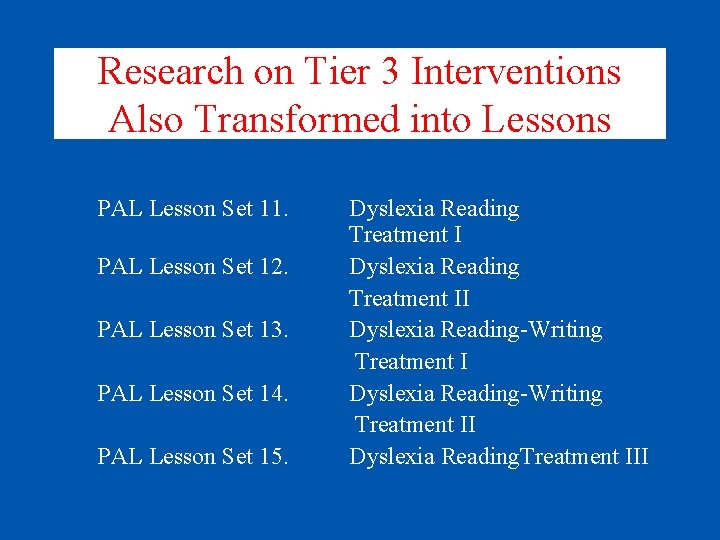
Research on Tier 3 Interventions Also Transformed into Lessons PAL Lesson Set 11. PAL Lesson Set 12. PAL Lesson Set 13. PAL Lesson Set 14. PAL Lesson Set 15. Dyslexia Reading Treatment II Dyslexia Reading-Writing Treatment II Dyslexia Reading. Treatment III
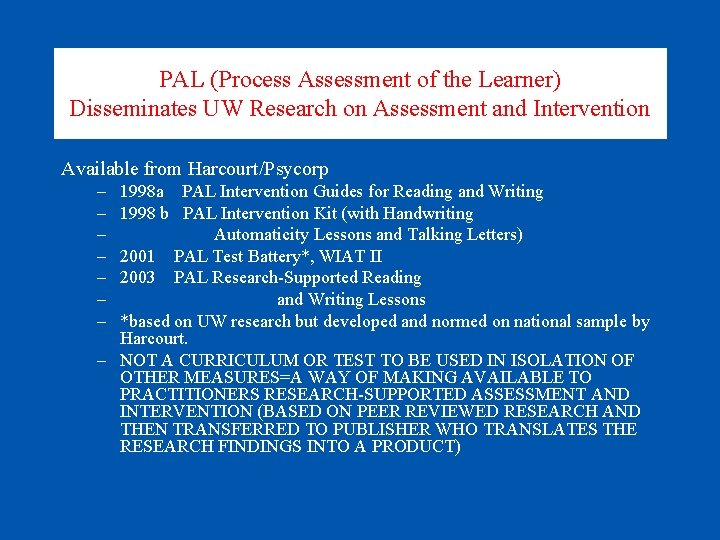
PAL (Process Assessment of the Learner) Disseminates UW Research on Assessment and Intervention Available from Harcourt/Psycorp – – – – 1998 a PAL Intervention Guides for Reading and Writing 1998 b PAL Intervention Kit (with Handwriting Automaticity Lessons and Talking Letters) 2001 PAL Test Battery*, WIAT II 2003 PAL Research-Supported Reading and Writing Lessons *based on UW research but developed and normed on national sample by Harcourt. – NOT A CURRICULUM OR TEST TO BE USED IN ISOLATION OF OTHER MEASURES=A WAY OF MAKING AVAILABLE TO PRACTITIONERS RESEARCH-SUPPORTED ASSESSMENT AND INTERVENTION (BASED ON PEER REVIEWED RESEARCH AND THEN TRANSFERRED TO PUBLISHER WHO TRANSLATES THE RESEARCH FINDINGS INTO A PRODUCT)