
Three Phase Motor Braking Methods of Braking Acknowledgements
Three Phase Motor Braking Methods of Braking
Acknowledgements �International Journal of Engineering and Innovative Technology (IJEIT) Volume 1, Issue 6, June 2012. �Electrical Trade Principles – A Practical approach (Jeffrey Hampson & Steven Hanssen) 3 rd Edition,
There are many types of Braking systems that can be used with three phase induction motors. Each of these types can be placed into one of the following groups. • Internal Braking. • Exterior Braking
Internal Braking • Internal braking systems generate torque by converting the electric motor into a braking device. • Internal braking use electrical switch gear and electronic circuitry to perform the braking. • Internal brakes can only be used for stopping; they are incapable of providing a holding function.

External Braking • Exterior braking requires the addition of a braking device connected to the shaft of the three phase induction motor which provides a holding torque external to the motor. • External braking is essentially the removal of stored kinetic energy in the form of motion from a motor mechanical load. This kinetic energy is then converted into heat via the friction pads applied to the rotor shaft.
The Types of External Braking • Friction brakes. • Eddy Current brakes.
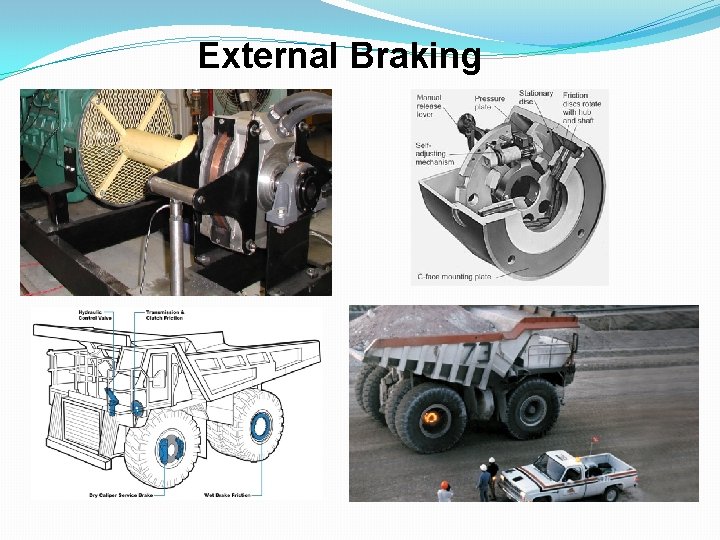
External Braking Friction brakes • Electromechanical actuated adhesion brakes is essentially the removal of stored kinetic energy in the form of motion from a motor by pushing friction material via a solenoid action against rotating or moving parts. • This kinetic energy is then converted into heat via the friction pads applied to the rotor shaft. Applications • All applications where you want the load stopped. Electromechanical brakes are the only means to hold the rotor shaft in the stop position.
External Braking
External Braking Eddy Current brakes • Are primarily used with variable speed three phase induction motors. • A field coil is placed around the rotor shaft. When DC is applied to the coil a magnetic flux is produced which induces Eddy currents into the rotor, these eddy currents react with the magnetic field in the field assembly and produce a torque that opposes motion of the rotor, which slow the motor down. Applications • Hoist • Crane Electromechanical brakes are the only means to hold the rotor shaft in the stop position.

External Braking Eddy Current brakes
The Three Types of Internal Braking • Plugging. • Dynamic Braking • Regenerative Braking.

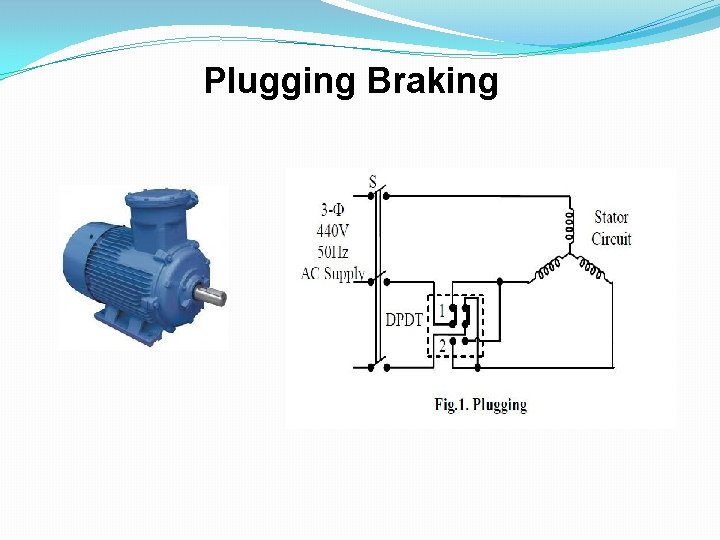
Plugging Braking Plugging is the fast de-acceleration of a motor by reversing any two of the three phase line feeds to the stator terminals while it is still running at full speed. Advantages - Simplest and Quickest braking method. - Strong counter torque is produced for rapid stopping. Applications - Larger production lathes doing repetitious process work.
Plugging Braking

Plugging Braking Dis – Advantages • Draws a high line current even exceeding the locked rotor current. • Places considerable stress on the stator, rotor windings and motor bearings. • The generated heat losses can be 3 times the normal acceleration values. • The contact switching and out of phase reclosing can cause severe torque and current transients. • The torque transients can loosen the rotor bars, twist or break the rotor shaft, create flat spots on the balls or rollers of the motor bearings. The motor has to be specially designed for this application. Electromechanical brakes are required to hold the rotor shaft in the stop position.

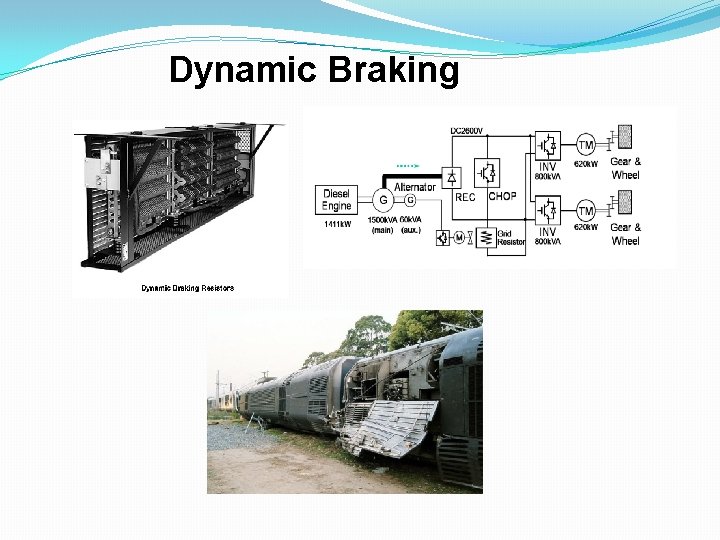
Dynamic Braking also called DC injection braking utilises the ability of the AC drive motor to act as a generator. It does this by disconnecting the AC feed to the stator and injecting DC across any two of the stator terminals. The DC produces a magnetic field which is cut by the rotor motion producing an EMF. The current is dissipate as heat in huge resistors at the expense of rotational energy. Applications • Slowing Trains • Slowing of Haul Paks. • Large Cranes
Dynamic Braking
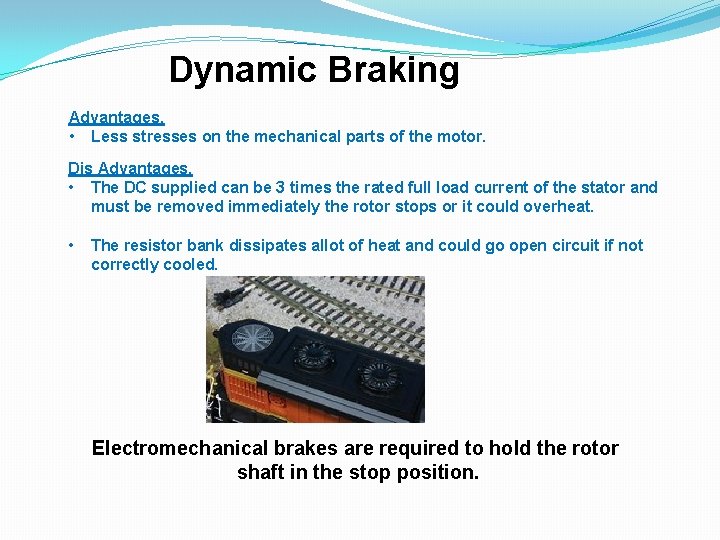
Dynamic Braking Advantages. • Less stresses on the mechanical parts of the motor. Dis Advantages. • The DC supplied can be 3 times the rated full load current of the stator and must be removed immediately the rotor stops or it could overheat. • The resistor bank dissipates allot of heat and could go open circuit if not correctly cooled. Electromechanical brakes are required to hold the rotor shaft in the stop position.
Regenerative Braking This form of braking is an extension to Dynamic Braking with the generated energy available to do work instead of being dissipated as heat. With the energy being fed back into the system it can now power other devices. Applications - with overhauling type loads. • Slowing of a flywheel. • Slowing of Trams & Trains. • Control of a elevator car under the force of gravity as it descends. • Drilling and sawing operations where a sudden drop in torque occurs when the machines complete their designated operation
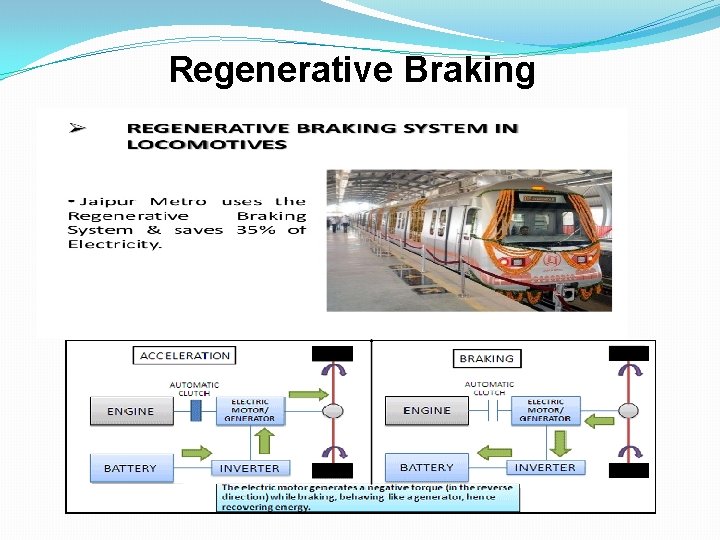
Regenerative Braking
Regenerative Braking Advantages. • Generates energy that is available to do work instead of being dissipated as heat. • Lot less stress full on all mechanical parts. Dis - Advantages. • The amount of energy fed back into system decreases as motor speed decreases. Electromechanical brakes are required to hold the rotor shaft in the stop position.

THE END
- Slides: 22