
Three Phase Induction Motors Lecture 4 Introduction Power
- Slides: 10
Three Phase Induction Motors
Lecture 4 • Introduction • Power Stages • Additional Exercises • Induction Motor Starting Considerations • Starting Methods • Summary Dept of E & E, MIT Manipal L 4 – 01
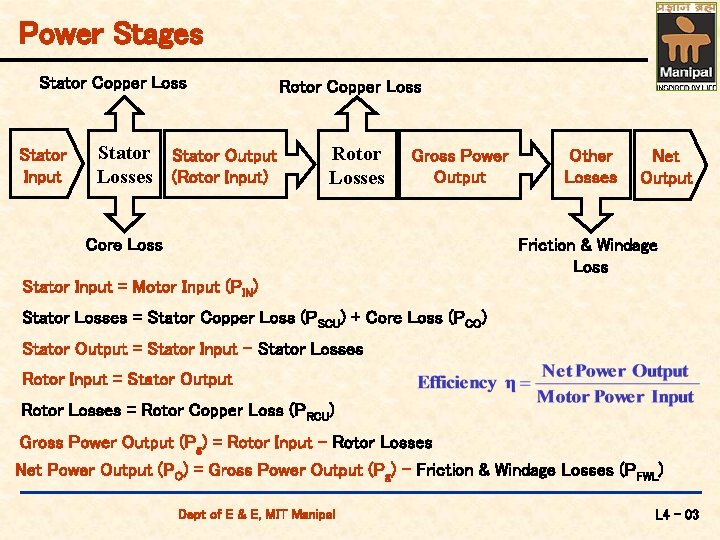
Power Stages Stator Copper Loss Stator Input Stator Output Losses (Rotor Input) Rotor Copper Loss Rotor Losses Gross Power Output Core Loss Other Losses Net Output Friction & Windage Loss Stator Input = Motor Input (PIN) Stator Losses = Stator Copper Loss (PSCU) + Core Loss (PCO) Stator Output = Stator Input - Stator Losses Rotor Input = Stator Output Rotor Losses = Rotor Copper Loss (PRCU) Gross Power Output (Pg) = Rotor Input - Rotor Losses Net Power Output (PO) = Gross Power Output (Pg) – Friction & Windage Losses (PFWL) Dept of E & E, MIT Manipal L 4 – 03
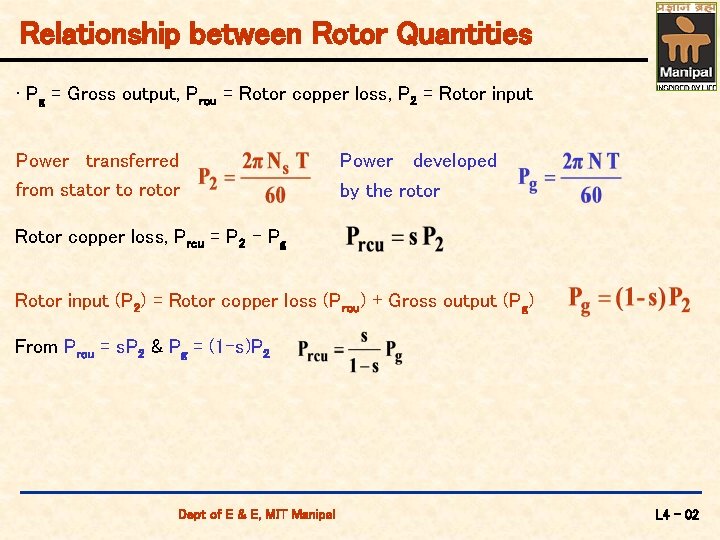
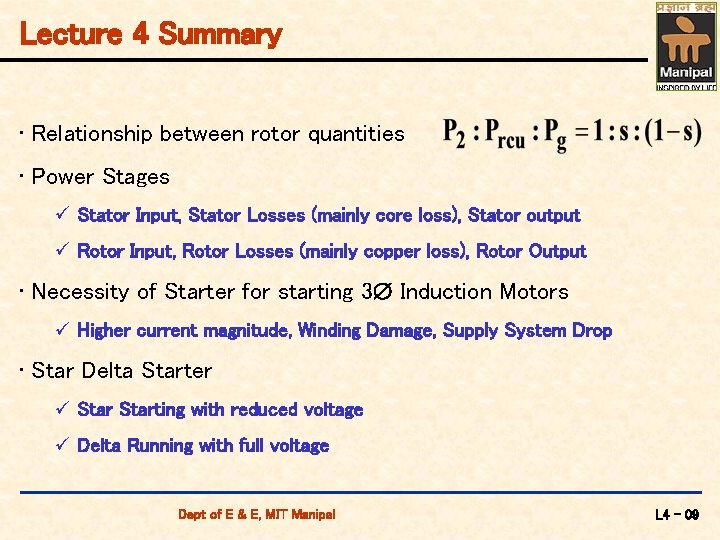
Relationship between Rotor Quantities • Pg = Gross output, Prcu = Rotor copper loss, P 2 = Rotor input Power transferred from stator to rotor Power developed by the rotor Rotor copper loss, Prcu = P 2 - Pg Rotor input (P 2) = Rotor copper loss (Prcu) + Gross output (Pg) From Prcu = s. P 2 & Pg = (1 -s)P 2 Dept of E & E, MIT Manipal L 4 – 02
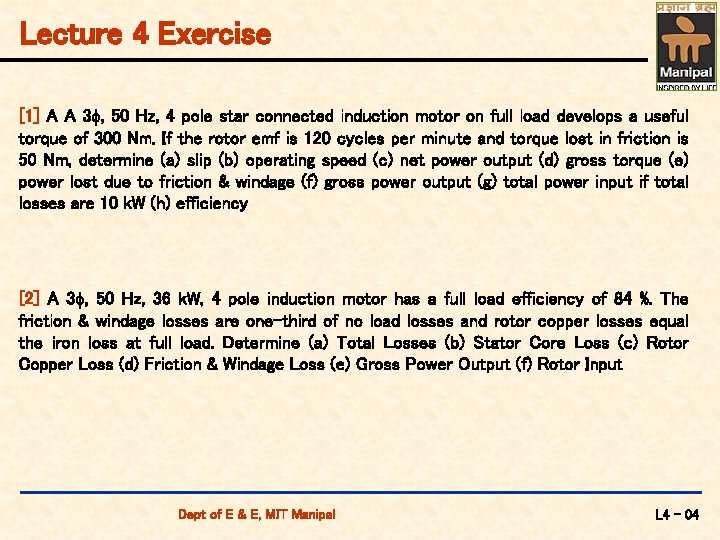
Lecture 4 Exercise [1] A A 3 , 50 Hz, 4 pole star connected induction motor on full load develops a useful torque of 300 Nm. If the rotor emf is 120 cycles per minute and torque lost in friction is 50 Nm, determine (a) slip (b) operating speed (c) net power output (d) gross torque (e) power lost due to friction & windage (f) gross power output (g) total power input if total losses are 10 k. W (h) efficiency [2] A 3 , 50 Hz, 36 k. W, 4 pole induction motor has a full load efficiency of 84 %. The friction & windage losses are one-third of no load losses and rotor copper losses equal the iron loss at full load. Determine (a) Total Losses (b) Stator Core Loss (c) Rotor Copper Loss (d) Friction & Windage Loss (e) Gross Power Output (f) Rotor Input Dept of E & E, MIT Manipal L 4 – 04
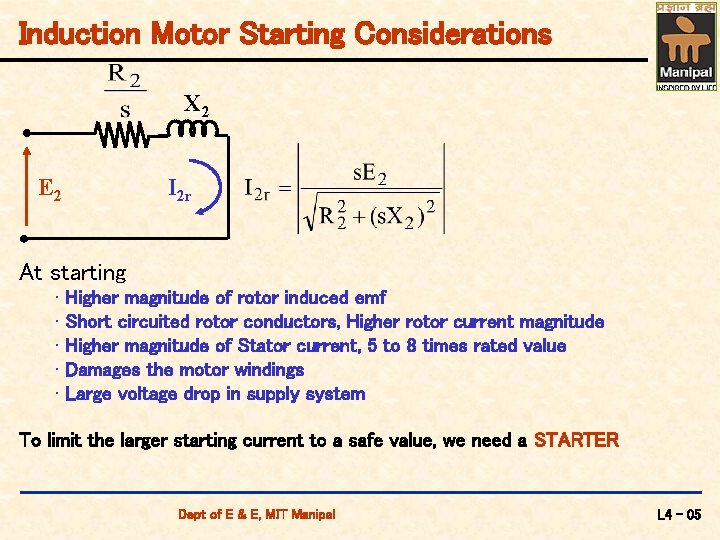
Induction Motor Starting Considerations X 2 E 2 I 2 r At starting • Higher magnitude of rotor induced emf • Short circuited rotor conductors, Higher rotor current magnitude • Higher magnitude of Stator current, 5 to 8 times rated value • Damages the motor windings • Large voltage drop in supply system To limit the larger starting current to a safe value, we need a STARTER Dept of E & E, MIT Manipal L 4 – 05
Starting Methods • Direct Online Starter (DOL) • Star-Delta Starter • Auto transformer starter • Rotor resistance starter (Slip ring Type only) Dept of E & E, MIT Manipal L 4 – 06
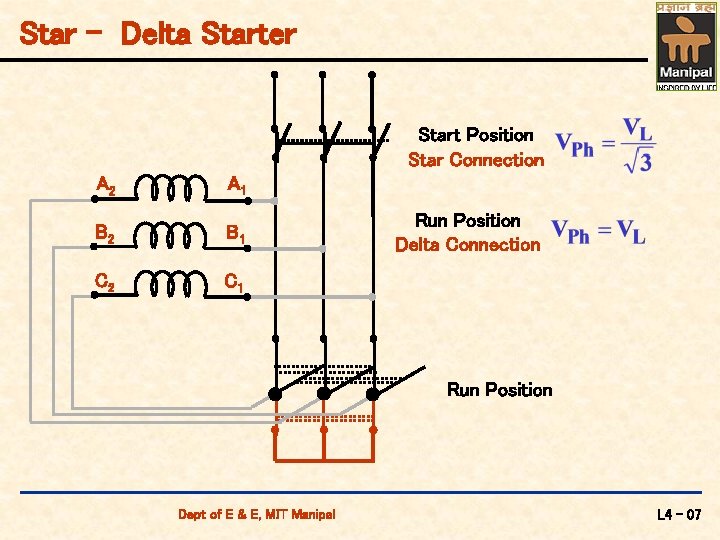
Star - Delta Starter Start Position Star Connection A 2 A 1 B 2 B 1 C 2 C 1 Run Position Delta Connection Run Position Dept of E & E, MIT Manipal L 4 – 07
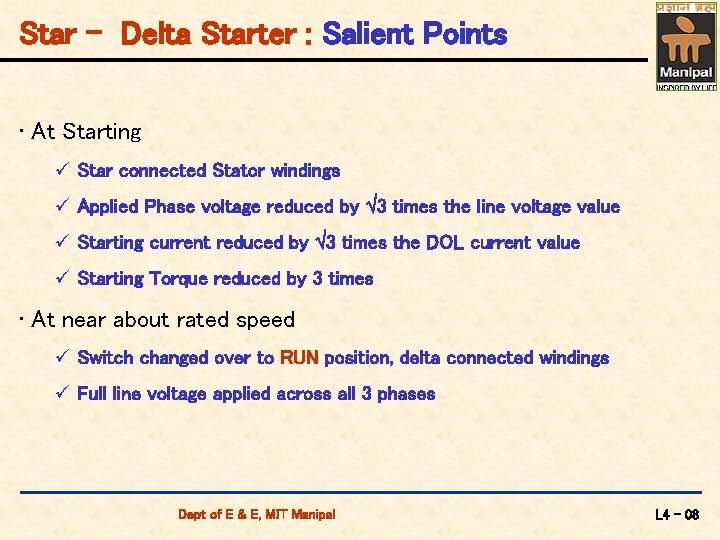
Star - Delta Starter : Salient Points • At Starting ü Star connected Stator windings ü Applied Phase voltage reduced by 3 times the line voltage value ü Starting current reduced by 3 times the DOL current value ü Starting Torque reduced by 3 times • At near about rated speed ü Switch changed over to RUN position, delta connected windings ü Full line voltage applied across all 3 phases Dept of E & E, MIT Manipal L 4 – 08
Lecture 4 Summary • Relationship between rotor quantities • Power Stages ü Stator Input, Stator Losses (mainly core loss), Stator output ü Rotor Input, Rotor Losses (mainly copper loss), Rotor Output • Necessity of Starter for starting 3 Induction Motors ü Higher current magnitude, Winding Damage, Supply System Drop • Star Delta Starter ü Starting with reduced voltage ü Delta Running with full voltage Dept of E & E, MIT Manipal L 4 – 09