
Three Mile Island Unit 2 By Kenton Kiser
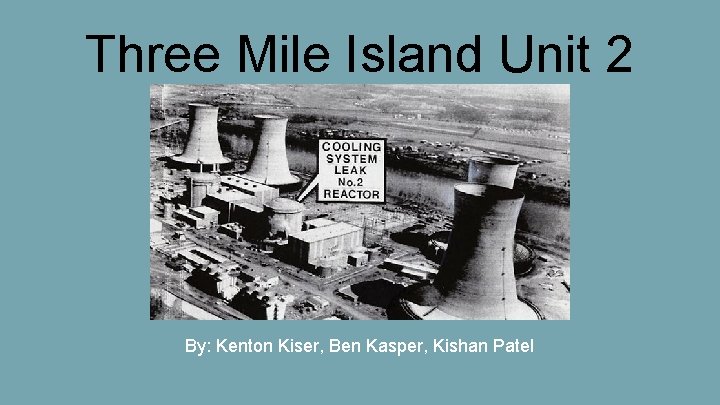
Three Mile Island Unit 2 By: Kenton Kiser, Ben Kasper, Kishan Patel
Overview Description of Event Root Causes Safety Lessons Learned and Established View of the Incident at the Time vs Now After Effects
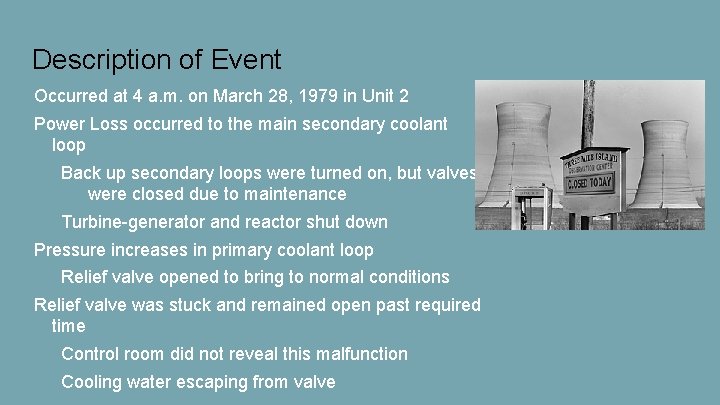
Description of Event Occurred at 4 a. m. on March 28, 1979 in Unit 2 Power Loss occurred to the main secondary coolant loop Back up secondary loops were turned on, but valves were closed due to maintenance Turbine-generator and reactor shut down Pressure increases in primary coolant loop Relief valve opened to bring to normal conditions Relief valve was stuck and remained open past required time Control room did not reveal this malfunction Cooling water escaping from valve
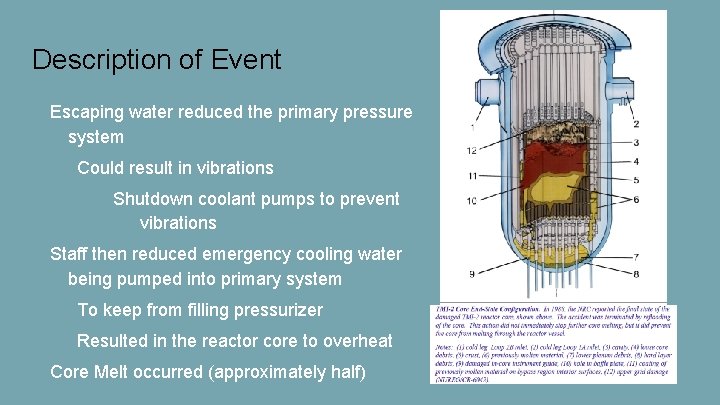
Description of Event Escaping water reduced the primary pressure system Could result in vibrations Shutdown coolant pumps to prevent vibrations Staff then reduced emergency cooling water being pumped into primary system To keep from filling pressurizer Resulted in the reactor core to overheat Core Melt occurred (approximately half)
Root Causes Simple Malfunctions Valve getting stuck Control Room providing incorrect information Saying valve was closed Staff Error Turning off reactor coolant pumps to prevent vibrations Reducing emergency cooling water Not knowing exactly what was going on (i. e. assumptions)

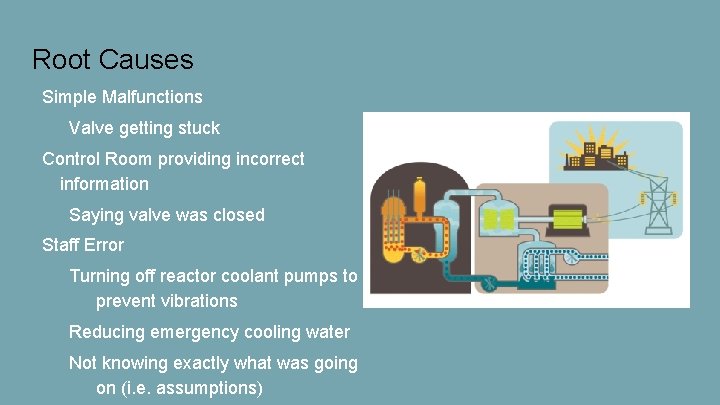
Diagram of Reactor/Cooling System
Safety Lessons NRC Modifications NRC safety goals adopted WASH-1400 used to identify safety vulnerabilities Emergency Response Center established at NRC Combined operation licensing and construction licensing (one-step process) Personnel Modifications Operators should be required graduate from a training institution Training on simulators should be done by operators Plants now have simulators that replicates most accident conditions
Safety Lessons Utilities and Suppliers Modifications Symptom based emergency operating procedures Replaced event based Provide technical help during an event Implement INPO to self-police Public Information Modifications Utilities are mostly responsible for releasing information to public Emergency Response Center releases official status
Safety Lessons Plant Modifications Every plant has safety display systems to monitor critical safety functions Helps operators identify source of accidents fast When plant approaches limits Water-level monitors now in PWR Vent points installed at the high points of RCS to release hydrogen Auxiliary feedwater system should be initiated automatically Hydrogen control systems implemented
Safety Lessons Worker Exposure Modifications ALARA implemented for radiation workers Exposure levels decreased Emergency Planning Modifications Emergency Response Center Calls for evacuation if needed and response activities Develop and test emergency planning Emergency response for the planning zone area
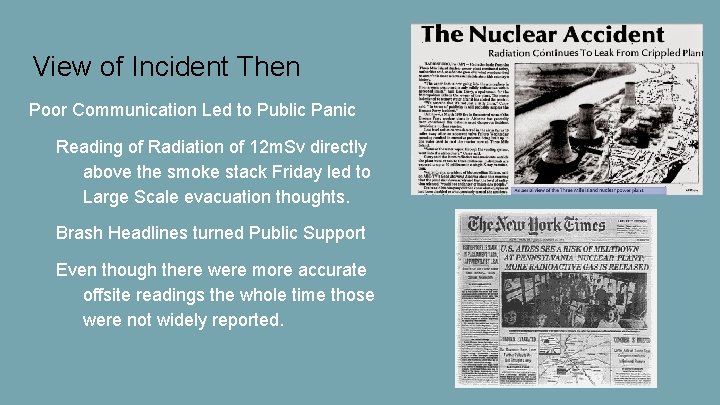
View of Incident Then Poor Communication Led to Public Panic Reading of Radiation of 12 m. Sv directly above the smoke stack Friday led to Large Scale evacuation thoughts. Brash Headlines turned Public Support Even though there were more accurate offsite readings the whole time those were not widely reported.
View of Incident Years Later In actuality a dose of 1 mrem was received by 2 million people Exposure from chest x-ray is 6 mrem Government Agencies ran tests of the surrounding environment and found that there was no harmful level of radionuclides found in samples of air, soil, water, milk, vegetation, or foodstuffs Pennsylvania Health Department monitored more than 30, 000 people who lived in a 5 mile radius of the plant until 1997 when it was determined that there were not any health differences compared to the general public.
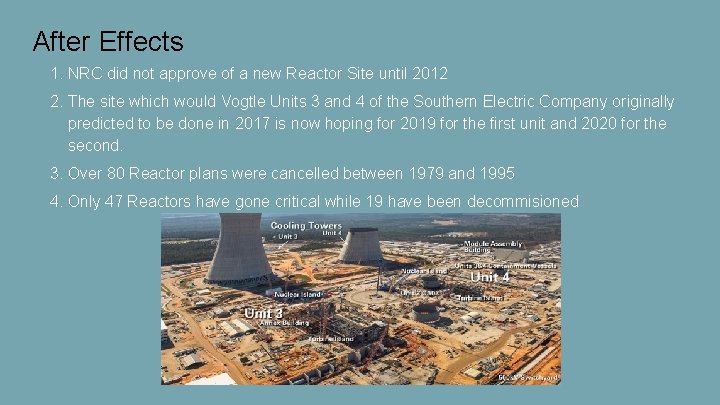
After Effects 1. NRC did not approve of a new Reactor Site until 2012 2. The site which would Vogtle Units 3 and 4 of the Southern Electric Company originally predicted to be done in 2017 is now hoping for 2019 for the first unit and 2020 for the second. 3. Over 80 Reactor plans were cancelled between 1979 and 1995 4. Only 47 Reactors have gone critical while 19 have been decommisioned

Questions?
- Slides: 14