
Three major paradigms in the history of social
- Slides: 43
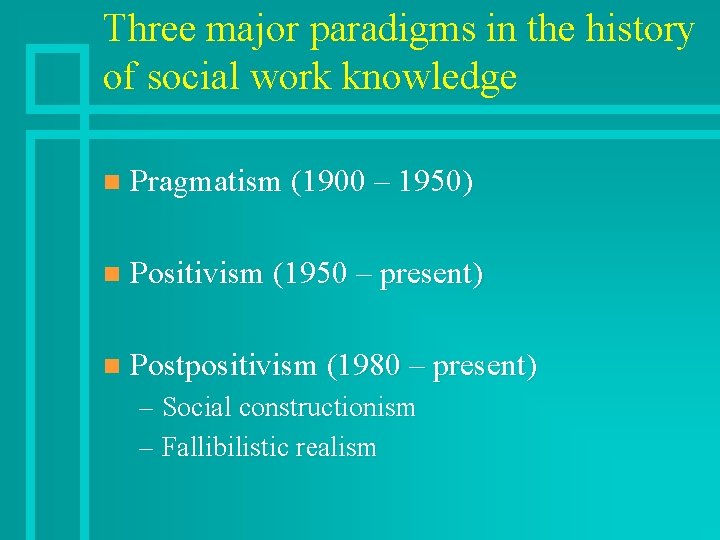
Three major paradigms in the history of social work knowledge n Pragmatism (1900 – 1950) n Positivism (1950 – present) n Postpositivism (1980 – present) – Social constructionism – Fallibilistic realism
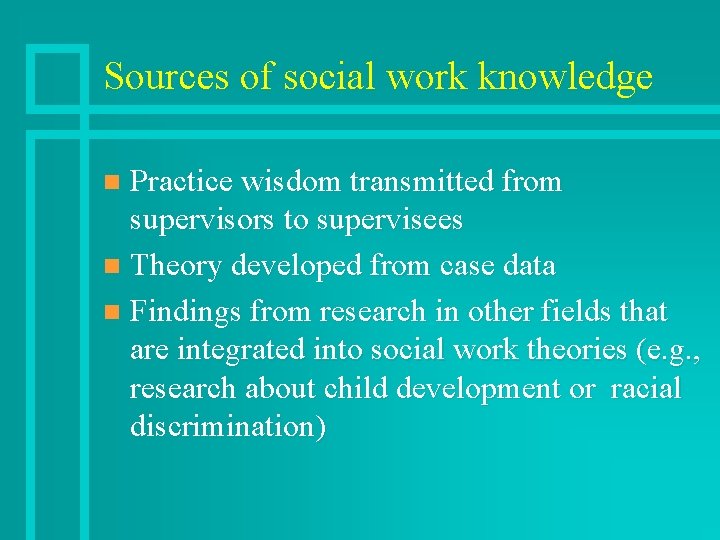
Sources of social work knowledge Practice wisdom transmitted from supervisors to supervisees n Theory developed from case data n Findings from research in other fields that are integrated into social work theories (e. g. , research about child development or racial discrimination) n
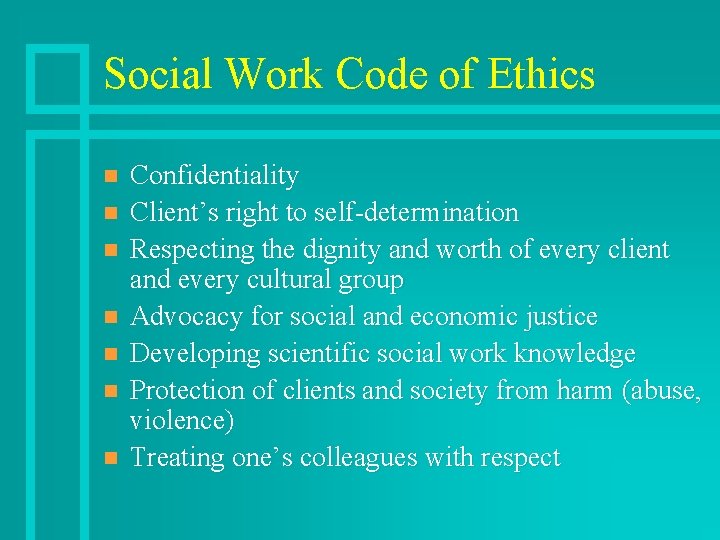
Social Work Code of Ethics n n n n Confidentiality Client’s right to self-determination Respecting the dignity and worth of every client and every cultural group Advocacy for social and economic justice Developing scientific social work knowledge Protection of clients and society from harm (abuse, violence) Treating one’s colleagues with respect
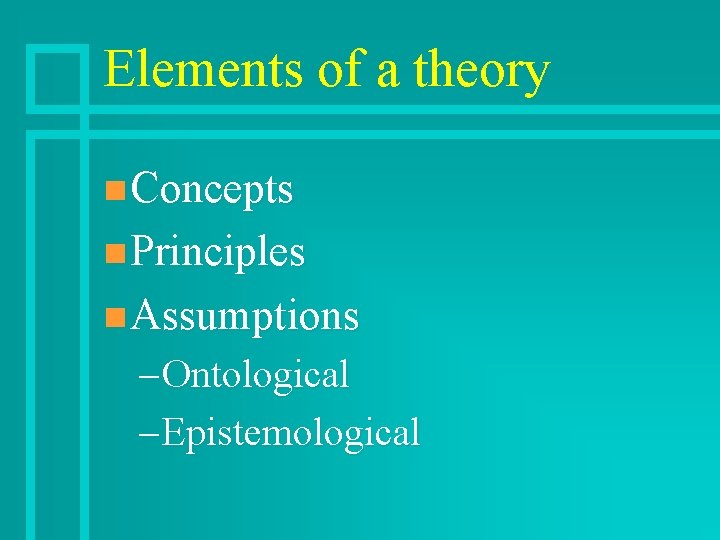
Elements of a theory n Concepts n Principles n Assumptions – Ontological – Epistemological
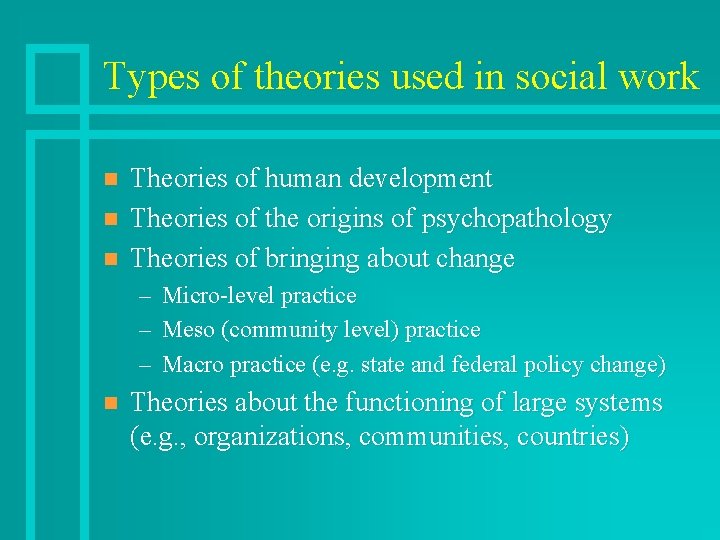
Types of theories used in social work n n n Theories of human development Theories of the origins of psychopathology Theories of bringing about change – – – n Micro-level practice Meso (community level) practice Macro practice (e. g. state and federal policy change) Theories about the functioning of large systems (e. g. , organizations, communities, countries)
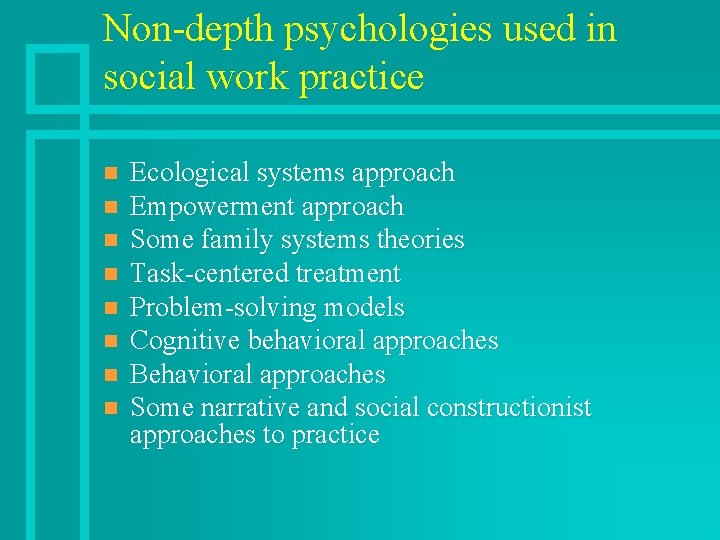
Non-depth psychologies used in social work practice n n n n Ecological systems approach Empowerment approach Some family systems theories Task-centered treatment Problem-solving models Cognitive behavioral approaches Behavioral approaches Some narrative and social constructionist approaches to practice
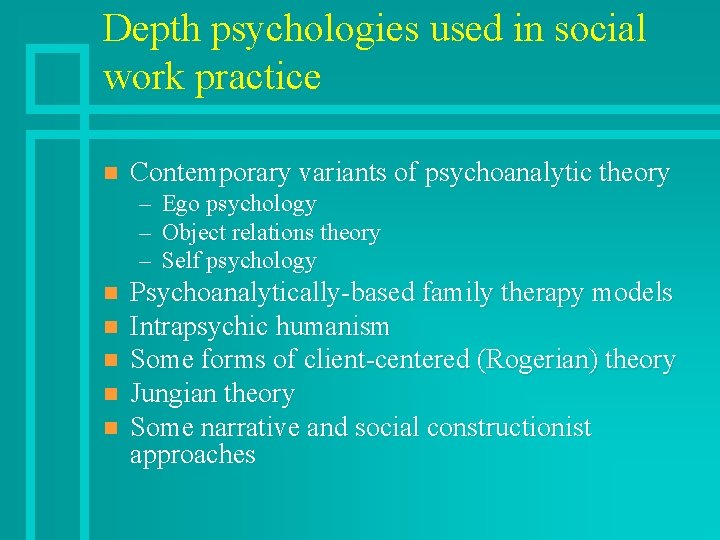
Depth psychologies used in social work practice n Contemporary variants of psychoanalytic theory – – – n n n Ego psychology Object relations theory Self psychology Psychoanalytically-based family therapy models Intrapsychic humanism Some forms of client-centered (Rogerian) theory Jungian theory Some narrative and social constructionist approaches
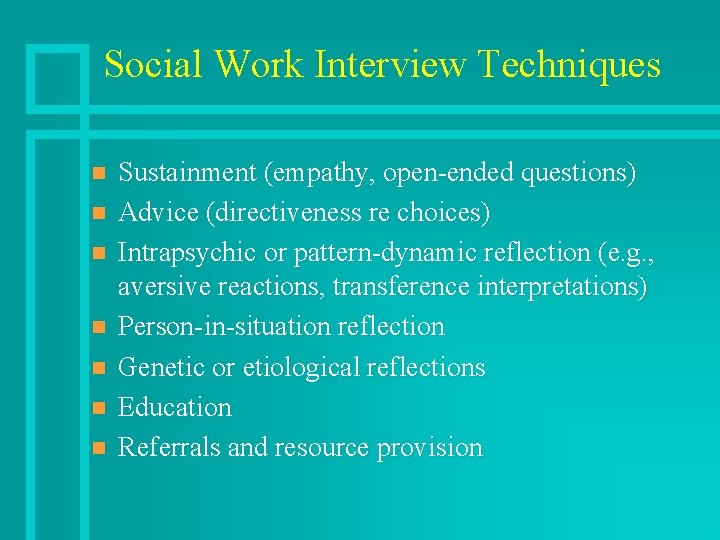
Social Work Interview Techniques n n n n Sustainment (empathy, open-ended questions) Advice (directiveness re choices) Intrapsychic or pattern-dynamic reflection (e. g. , aversive reactions, transference interpretations) Person-in-situation reflection Genetic or etiological reflections Education Referrals and resource provision
Ego functions Synthetic function n Reality testing n Secondary process thinking (problem solving) n Object relations n Defense mechanisms n
An unconscious motive is indicated by • doing something one knows is not good for oneself • not doing something that is good for oneself • patterned conflict in making and pursuing choices
Common defense mechanisms Identification with the aggressor (blaming the victim) n Projection n Displacement n Reaction formation n Somatization n Denial n Acting-out n
Defense mechanisms Operate unconsciously, although they can be reflectively experienced with support n Are subjectively experienced, when a person becomes aware of them, as protective n Change a person’s experience of internal and/or external reality and so impede reality -testing and/or insight n
Transference Psychoanalytic theory: The transfer of instinctual wishes from a prior relationship (usually with family of origin) into the relationship with therapist n Self psychology: Narcissistic, self-object transferences can be of three kinds: idealizing, mirroring, and twinship n Intrapsychic humanism: the use of self and nonself meanings for personal meaning n
Countertransference n Psychoanalytic theory: – 1) therapist’s transference to the patient; – 2) therapist’s reaction to the patient’s transference to therapist n Intrapsychic humanism: negative and other unrealistic motives and experiences in the relationship with the client are produced by personal motives that have (unbeknownst to therapist) perempted therapist’s caregiving motives
Assessment can occur naturally through therapeutic interview process n is ongoing and cumulative -- new priorities are revealed as treatment proceeds n can change as treatment progresses and the alliance deepens -- e. g. a client’s diagnosis will change, transference emerges n should incorporate micro, meso, and macro systems considerations n
Basic categories of psychosocial assessment n Presenting problem – – – n n History of presenting problem Client’s psychosocial environment – – n n From client’s point of view From the point of view of others involved with the client From the social worker’s point of view Significant relationships and their history School or employment Community supports (church, support groups, etc. ) Medical care Diagnosis and Formulation Treatment plan
Diagnostic Formulation n Why is this client here now? Based on: – – – client’s expressed purpose, past relationships and losses, ongoing client functioning and internal psychic structure, – social support network, – current stressors. n n Mental status exam Diagnosis (DSM-IV if needed)
Treatment Planning n Goals (optimal and practicable) – Short-term goals – Long-term goals n Treatment modalities to be employed – long-term, short-term, crisis-oriented? – individual, couples, family, group, a combination? n Referrals and resources needed? – Who will be contacted for coordination? (school, physician, pastor, etc. ) n Agency mandate/capabilities?
Central principles in practice with children n n Consider the impact of adultcentrism on the child and your relationship with her/him The child has the right to a confidential treatment and to making her/his own treatment contract Offer an environment that allows the child to communicate naturally There is always a third party influencing the treatment relationship: the child’s parents Keep in mind that any psychosocial diagnosis made will have an impact on how those in the child’s environment perceive the child, as well as on the child’s entire developmental process
Central etiological concepts in family systems theory n n Family of origin experiences are repeated in an individual’s subsequent relationship patterns Individual symptoms reflect an effort to resolve a problem in the individual’s family system Equifinality”: “the same origin may lead to different outcomes, and the same outcome may result from different origins. ” (Walsh, 1983, p. 468); Family systems theory asserts that: “the influence of initial conditions or events will be outweighed by the impact of the family organization--its ongoing interactional patterns and response to events. ” (Walsh, 1983, p. 468)
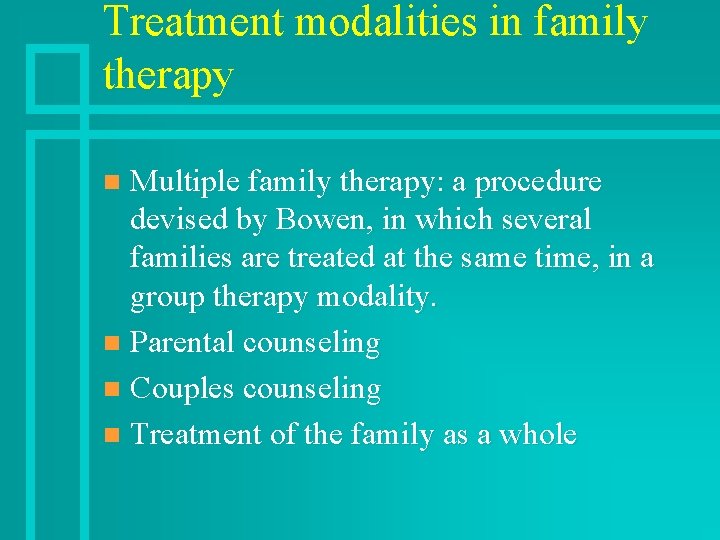
Treatment modalities in family therapy Multiple family therapy: a procedure devised by Bowen, in which several families are treated at the same time, in a group therapy modality. n Parental counseling n Couples counseling n Treatment of the family as a whole n
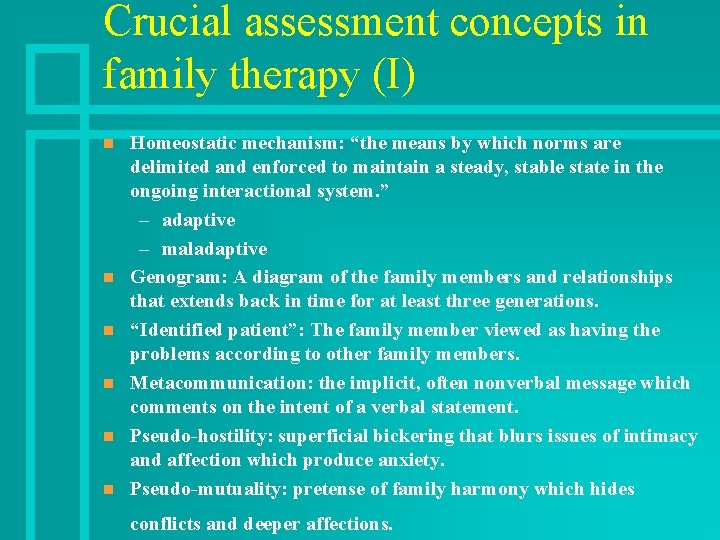
Crucial assessment concepts in family therapy (I) n n n Homeostatic mechanism: “the means by which norms are delimited and enforced to maintain a steady, stable state in the ongoing interactional system. ” – adaptive – maladaptive Genogram: A diagram of the family members and relationships that extends back in time for at least three generations. “Identified patient”: The family member viewed as having the problems according to other family members. Metacommunication: the implicit, often nonverbal message which comments on the intent of a verbal statement. Pseudo-hostility: superficial bickering that blurs issues of intimacy and affection which produce anxiety. Pseudo-mutuality: pretense of family harmony which hides conflicts and deeper affections.
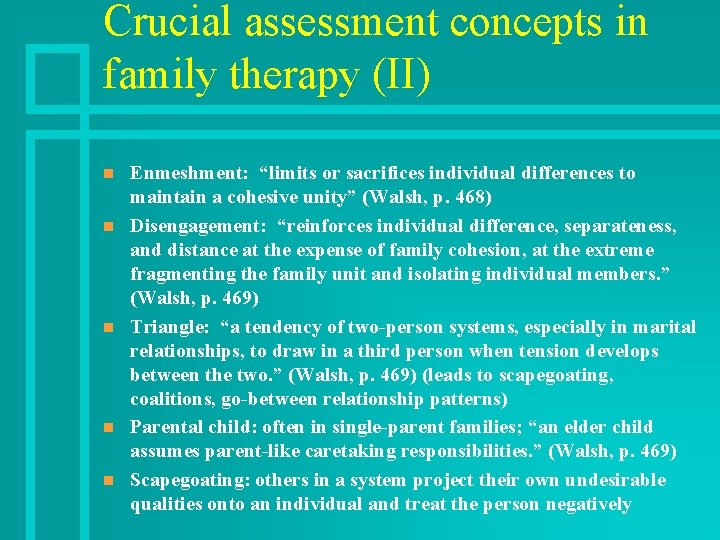
Crucial assessment concepts in family therapy (II) n n n Enmeshment: “limits or sacrifices individual differences to maintain a cohesive unity” (Walsh, p. 468) Disengagement: “reinforces individual difference, separateness, and distance at the expense of family cohesion, at the extreme fragmenting the family unit and isolating individual members. ” (Walsh, p. 469) Triangle: “a tendency of two-person systems, especially in marital relationships, to draw in a third person when tension develops between the two. ” (Walsh, p. 469) (leads to scapegoating, coalitions, go-between relationship patterns) Parental child: often in single-parent families; “an elder child assumes parent-like caretaking responsibilities. ” (Walsh, p. 469) Scapegoating: others in a system project their own undesirable qualities onto an individual and treat the person negatively
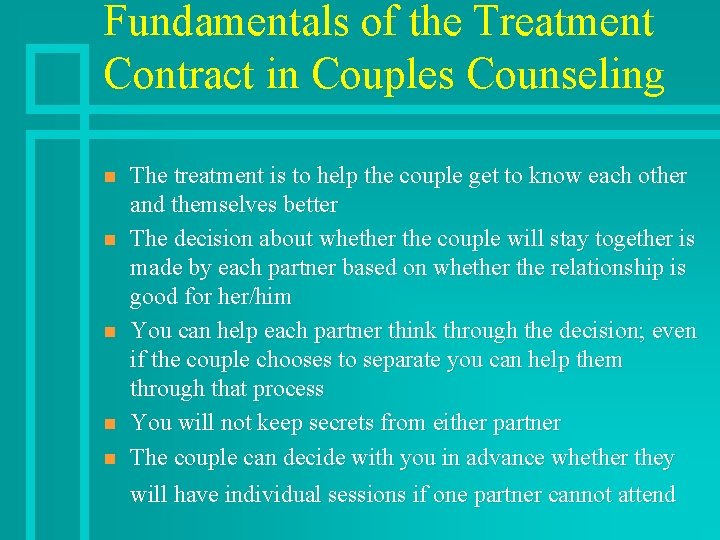
Fundamentals of the Treatment Contract in Couples Counseling n n n The treatment is to help the couple get to know each other and themselves better The decision about whether the couple will stay together is made by each partner based on whether the relationship is good for her/him You can help each partner think through the decision; even if the couple chooses to separate you can help them through that process You will not keep secrets from either partner The couple can decide with you in advance whether they will have individual sessions if one partner cannot attend
Central Elements of Couples Counseling n n Focus on the interactions you see occurring with you and share your observations Aid the couple in bringing conflicts into the relationship with you Prevent the increased potential for negative transference with increased support Unless there is a clear power differential (e. g. , physical strength) be even-handed in interpreting each partners’ contribution to problematic patterns
Principles forming treatment alliances across barriers associated with color, sexual orientation, age, status of health and disability, and gender (Boyd-Franklin, Hagen & Davis, Pinderhughes, Spaulding, Padrone) n n n SW recognizes (internally) the history of discrimination the client has faced SW recognizes (internally and perhaps in relationship with the client) that unless s/he is a member of the client’s oppressed group, s/he cannot know what that discrimination is like and thus needs to be available to hear about it from the client SW recognizes (internally) her/his own unwanted internalization of oppressive prejudices, stereotypes, including an assumption that the client might resent her/him for her/his power SW prioritizes not repeating in the relationship with the client the oppressive patterns that exist in the wider society SW actively plans how to assist in redressing injustices the client is experiencing in her/his daily life SW recognizes that anger, fear, and sadness about experiences of discrimination are not pathological but are natural and healthy responses that need to be heard and respected by the SW
Fundamental assumptions in the Empowerment models of social work practice (e. g. , Guttierez, Pinderhughes) n "issues of power and powerlessness are central. . . proposes concrete and specific ways in which practice can help resolve personal problems by increasing power” and helping individuals improve their life situations (Guttierez, p. 149) n Empowerment practice incorporates the macro level: improve collective political power; micro level: improve personal feeling of power and control. n "based on a conflict model that assumes that a society consists of separate groups possessing different levels of power and control over resources" (Guttierez, p. 150) n "Social problems stem not from individual deficits, but rather from the failure of the society to meet the needs of all its members. The potential for positive change exists in every person, and many of the negative symptoms of the powerless emerge from their strategies to cope with a hostile world. " (Guttierez, p. 150)
Fundamental goals of the empowerment approach to social work practice (Guttierez) increasing self-efficacy n developing group consciousness (“awareness of how political structures affect individual and group experiences”, p. 150) n reducing self-blame n assuming personal responsibility for change (p. 150) n
Specific empowerment treatment techniques (Guttierez) n n n n n helping relationship based on collaboration, trust, and the sharing of power accept client’s definition of the problem identify and build upon existing strengths engage in power analysis of client’s situation (have students give examples) teach specific skills – ‘how to’– modeling is a central way mobilize resources and advocate for clients help client experience a sense of personal power within the relationship, e. g. , role playing, support clients in their efforts to help others, let them set the agenda of the treatment and research resources support development of alternative structures in the community praxis – blending of reflection and action
Social constructionism n n n What we define as reality, and the meanings we attach to it, are socially constructed (heuristics) All theories are social constructions (heuristics) Examples of concepts that are social constructions or heuritics: – the family – disability – gender roles
Gender in family therapy theories (acc. to Hare-Mustin): n n n “Gender is the basic category by which our species, the family and all societies are organized. Because gender inequities are embedded in the larger social system, they are assumed to be part of the natural order. What results is the implicit and often unintended support of sexism. ” Women have constituted an underclass Two forms of bias in family therapy theories – Alpha bias: exaggerates differences between groups of people (ex. psychoanalysis) – Beta bias: ignores differences when they do exist (ex. systems theories)
Helping multicultural students and families in complex systems (Ishibashi) n n Recognize the stress on each person and group of people caused by differences in culture Identify sources of the conflict in terms of the differing motives of each person and system To aid in conflict resolution, identify the constructive motivation in each person and system Motivating people to change is best accomplished by eliciting each person’s constructive motivation and helping people make choices based on that self-caretaking motivation
Goals of social work practice with disabled people and their families n n Help family members to adapt and possibly change roles Assist family with reactions to the disability, such as shock, anger, grief, and blocking in the adaptation process Relief may develop only when a distinction can made between the disability, per se, and the person with it Avoid encouraging acceptance of the disability, because that represents passivity in the face of a terrible loss, and leads to client resistance and resentment
Psychotherapists working with people with disabilities should consider: n n n n n focus of attention extent and type of disability phase of rehabilitation family relationships stage of life circumstances of onset of disability meaning of disability psychodynamic functioning countertransference
Facts about women in families: n n n Less than 10% of American households still consist of the traditional family with a working father, a mother at home, and two school-aged children The American mother has the least childcare and housework help of any mother in the world Housework is at a preindustrial stage -- it has no exchange value in the marketplace. Women's depression is often associated with the mindless and unappreciated routines of housework One-fifth of all children live with a single parent; 25% of all births are now to unwed mothers n Fifty-six percent of American wives work outside the home, the majority in sex-segregated, low-paying jobs
Goals of Family Treatment: n n n Stimulating new interaction patterns; Offering new ways of thinking about relationships; Improvement of family communication opens up the system, removes blocks to more healthy interactions, so the family can respond to the developmental needs of its members; Problem-solving; Mourning unresolved losses.
Common Family Treatment Techniques n n Paradoxical instructions: “a type of directive that seems to be in opposition to the goals being sought but actually serves to move the family towards them. ” (Walsh, 1983, p. 478). Family sculpting Reframing and relabeling: “the strategic redefinition of a problem or situation in order to cast it in a new light or perspective. . . useful in shifting a family’s rigid view or stereotyped response, in altering an unproductive blaming or scapegoating process, and in overcoming resistance to change. ” (Walsh, 1983, p. 478) Education: instructing parents about developmental needs; or educating a family about severe mental illness.
Assessment of Homicidal and Suicidal Risk n n n History of prior violence (avowed, inferred) Substance abuse and other predisposing syndromes (e. g. , post-traumatic stress disorder) Gender, age, and cultural variances Plan – presence of a plan – access to means – lethality of plan Evaluate “imminent harm” as opposed to ongoing but not imminent
Important facts about family violence We do not permit among strangers the violence permitted in the family n Attacks by boyfriends and husbands on girlfriends and wives result in more injuries requiring medical treatment than rapes, muggings, and automobile accidents combined n One-third of all women slain are killed by their husbands or boyfriends n
Types of family violence n Partner abuse: sexual, physical, emotional n Child abuse: sexual, physical, emotional n Abuse of dependent adults: – elderly – severely mentally ill – mentally retarded
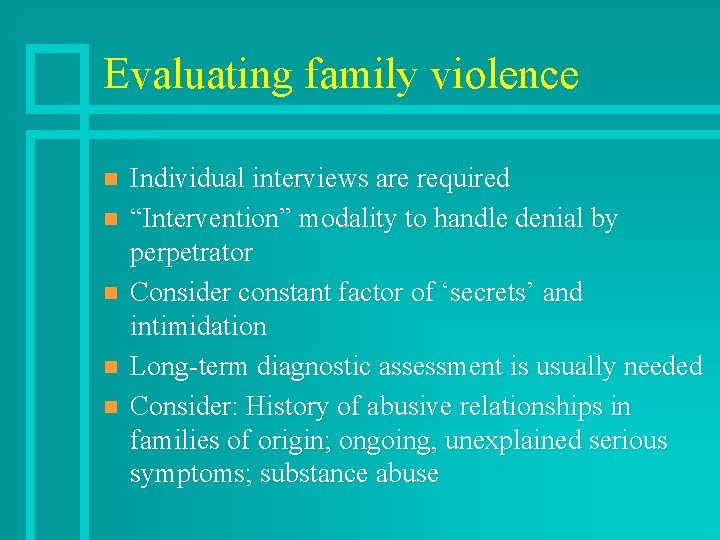
Evaluating family violence n n n Individual interviews are required “Intervention” modality to handle denial by perpetrator Consider constant factor of ‘secrets’ and intimidation Long-term diagnostic assessment is usually needed Consider: History of abusive relationships in families of origin; ongoing, unexplained serious symptoms; substance abuse
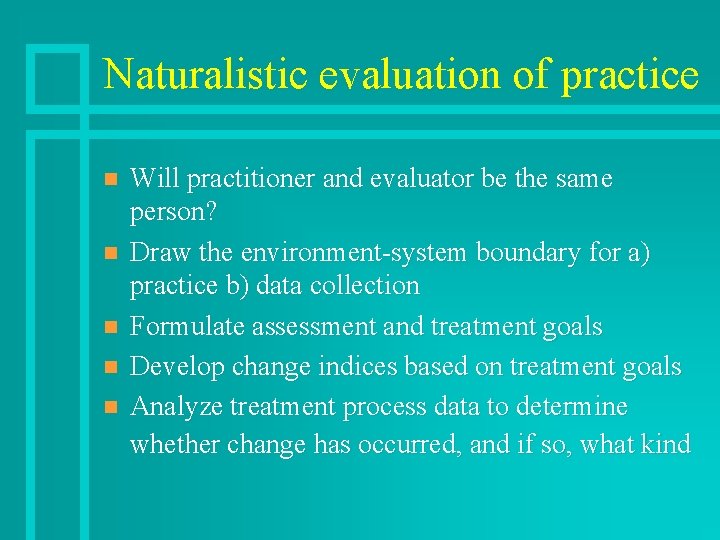
Naturalistic evaluation of practice n n n Will practitioner and evaluator be the same person? Draw the environment-system boundary for a) practice b) data collection Formulate assessment and treatment goals Develop change indices based on treatment goals Analyze treatment process data to determine whether change has occurred, and if so, what kind
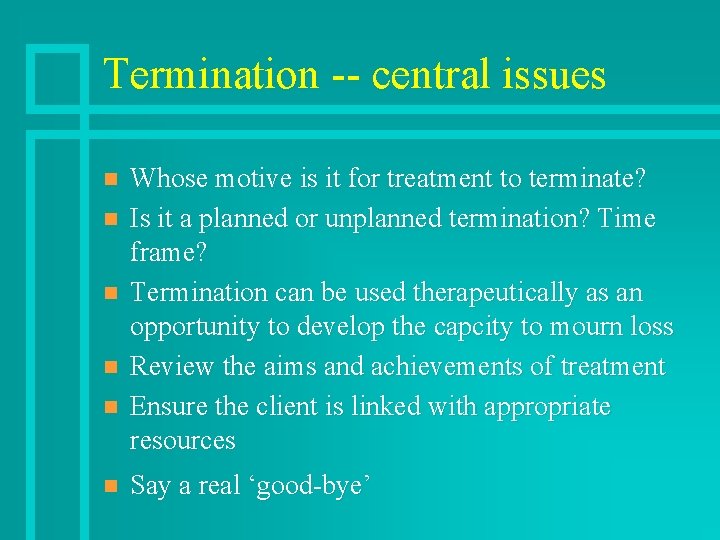
Termination -- central issues n n n Whose motive is it for treatment to terminate? Is it a planned or unplanned termination? Time frame? Termination can be used therapeutically as an opportunity to develop the capcity to mourn loss Review the aims and achievements of treatment Ensure the client is linked with appropriate resources Say a real ‘good-bye’