
Three major categories of biblical interpretation Early premodern
Three major categories of biblical interpretation Early (premodern) Modern Postmodern
Four assumptions that distinguish early from modern Cryptic – scripture means much more than what it appears to mean, has hidden meanings, might “imply” much more than what it says Relevant – scripture is about us and our time, not the times in which it was written Perfect – scripture is a unified whole so any part can enlighten any other part, has no contradictions within itself, does not contradict “later” beliefs Divine – from God… but wide variety of ideas about what that means See Kugel pp. 17 -23
Modern biblical interpretation Questions, rejects, or brackets the four assumptions True meaning is the meaning intended by the original author Historical context and textual history can be discovered through historical-critical methods: ◦ archaeology, social science, form criticism, source criticism, redaction criticism, canonical criticism (see Collins pp. 12 -13) The role of the interpreter is to be a neutral observer

Postmodern biblical interpretation Meaning arises from the interaction between the reader and the text. The original author’s intent is irrecoverable or irrelevant ◦ “Readerly” interpretation There is no such thing as a neutral observer. We are all conditioned by our environment, whether or not we are aware of it. ◦ Contextual biblical interpretation (consciously speaking from one’s context, e. g. , feminist, womanist, post-colonial, Latin American, Native American) How to avoid relativism? (any reader’s interpretation is as valid as any other’s)
Biblical law and American law Direct causal continuities Cultural continuities Anthropological commonalities Discontinuities and contrasts
Counting to ten Is recognizing God independent of not having other gods? Are other gods and sculpted images the same thing? Are women property? How many on each tablet?

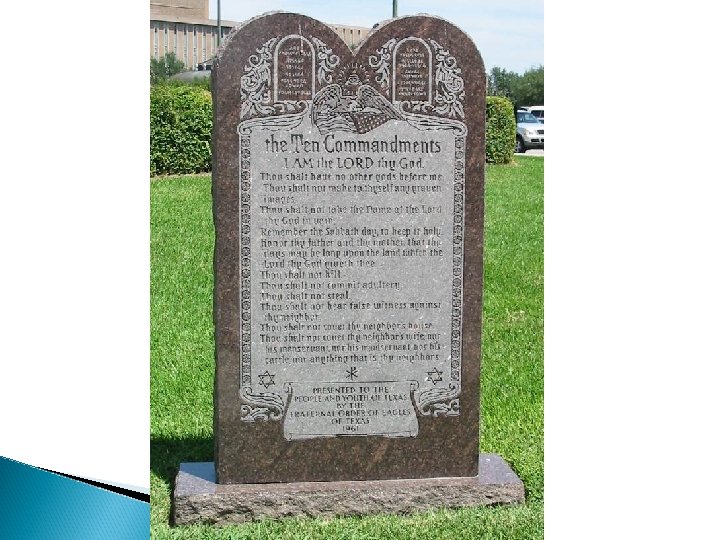

What other gods? Henotheism – having one god for oneself, but acknowledging the existence of other gods (cf. being devoted to the Spurs but acknowledging the existence of other teams) Monotheism – only one god exists (the Lakers do not exist) The position that the idea of monotheism developed over time and is not always assumed in the Bible is a good example of modern (not early) biblical interpretation.
Transgenerational punishment Does God visit the guilt of parents upon the children, upon the third and fourth generations of those who reject God?
- Slides: 10