
Three is a Lucky Number Short story by
“Three is a Lucky Number” Short story by Margery Allingham (1904 -1966) José Viera – Literary Thrills
“Three is a Lucky Number” � “At five o’clock in a September afternoon Ronald Frederick Torbay was making preparations for his third murder. He was being very wary, forcing himself to go slowly because he was perfectly sane and was well aware of the dangers of carelessness. ”
� “A career of homicide got more chancy as one went on. That piece of information had impressed him as being true as soon as he had read it in a magazine article way back before his first marriage. Also, he realized, success was liable to go to a man’s head, so he kept a tight hold on himself. He was certain he was infinitely more clever than most human beings but he did not dwell on the fact and as soon as he felt the old thrill at the sense of his power welling up inside him, he quelled it firmly. ”
� “Of the three homely middle-aged women whom so far he had persuaded first to marry him and then to will him their modest possessions, Edyth was proving easily the most annoying. […] He hated her being out of doors alone. She was shy and reserved but now that new people had moved in next door there was the danger of some over-friendly woman starting up an acquaintance with her and that was the last thing to be tolerated at this juncture. ”
� “From the moment he had first seen Edyth, sitting alone at a little table under the window in a seaside hotel dining -room, he had known that she was to be his next subject. He always thought of his wives as ‘subjects. ’ It lent his designs upon them a certain pseudo-scientific atmosphere which he found satisfying. […] That evening in the lounge he had spoken to her, had weathered the initial snub, tried again and, finally, had got her to talk. […] His methods were old-fashioned and heavily romantic and within weeks she was hopelessly infatuated. ”
� “It had been the pleasantest conquest he had ever made. Mary had been moody and hysterical, Dorothy grudging and suspicious but Edyth had revealed an unexpected streak of gaiety and, but for her stupidity in not realizing that a man would hardly fall romantically in love with her at first sight, was a sensible person. Any other man, Ronald reflected smugly, might have made the fatal mistake of feeling sorry for her, but he was ‘above’ all that, he told himself, and he began to make plans for what he described in his own mind rather grimly as ‘her future. ’”
![� “Edyth accepted [Ronald’s job] without question, but almost at once she had begun](http://slidetodoc.com/presentation_image/2e29c0468505bfe4b16300ac88223e0c/image-7.jpg "� “Edyth accepted [Ronald’s job] without question, but almost at once she had begun")
� “Edyth accepted [Ronald’s job] without question, but almost at once she had begun to plan a visit to the office and the factory, and was always talking about the new clothes she must buy so as not to ‘disgrace’ him. At the same time she kept all her business papers locked in an old-writing case and steadfastly refused to discuss them however cautiously he raised the subject. Ronald had given up feeling angry with her and decided to act. ”
� “Edyth’s leather writing-case in which she kept all her private papers was in the bottom of her soft-topped canvas hatbox. She had really believed he had not known of its existence, he reflected bitterly. It was locked, as he had discovered when he had at last located it, and he had not prized the catch for fear of putting her on her guard, but now there was nothing to stop him.

� “I am afraid, Ronald, that in some ways you are very old-fashioned. Had it not occurred to you that any homely middle-aged woman who has been swept into hasty marriage to a stranger must, unless she is a perfect idiot, be just a little suspicious and touchy on the subject of baths? ”
� “What I am trying to say is this: if you should ever lose me, Ronald, out of the bathroom I mean, you will find that I have gone out over the roof and am sitting in my dressing-gown in the kitchen next door. I was a fool to marry you but not quite such a fool as you assumed. Women may be silly but they are not as stupid as they used to be. We are picking up the idea, Ronald. ”
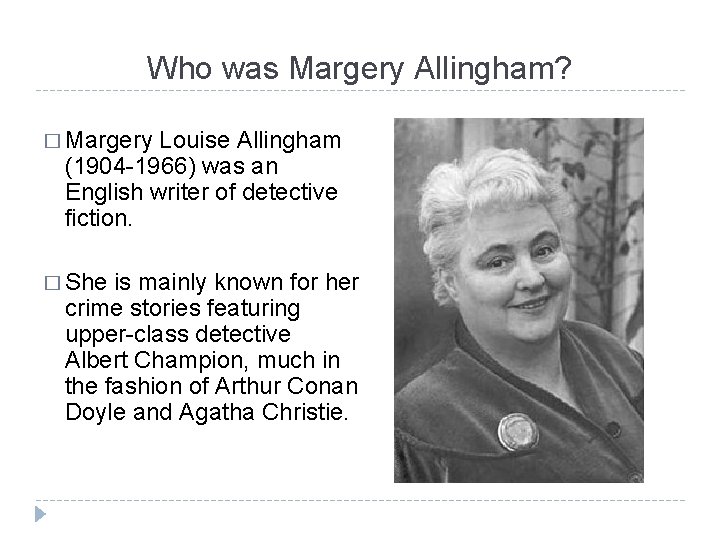
Who was Margery Allingham? � Margery Louise Allingham (1904 -1966) was an English writer of detective fiction. � She is mainly known for her crime stories featuring upper-class detective Albert Champion, much in the fashion of Arthur Conan Doyle and Agatha Christie.
� Ronald’s methods are seemingly impeccable. . . at first glance. What are his main flaws?
� In what ways does Ronald try to control Edyth? � How does Edyth challenge Ronald’s expectations? � As we know, the story is recounted from Ronald’s story. How would it change in Edyth’s case?
� Could � How you guess when the story was written? Why? is “Three. . . ” different from other crime stories?
- Slides: 14