
THREE IMPORTANT CELL REGIONS 1 Cell Membrane 2
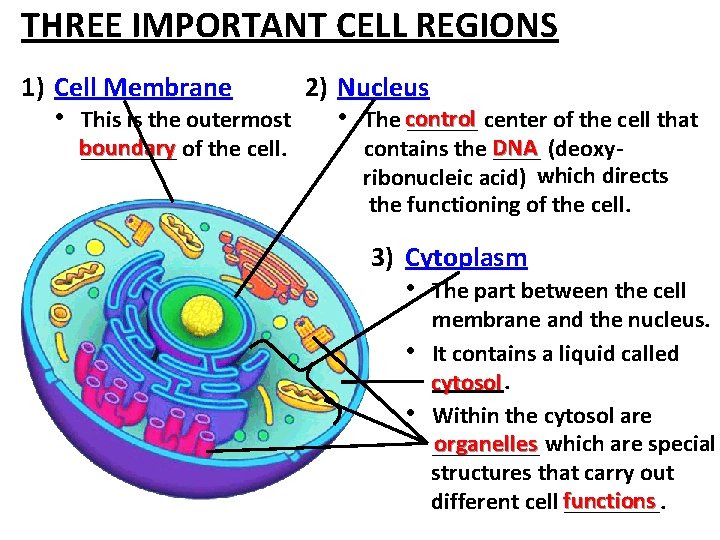
THREE IMPORTANT CELL REGIONS 1) Cell Membrane 2) Nucleus • This is the outermost • The control ______ center of the cell that boundary ____ of the cell. contains the DNA ____ (deoxyribonucleic acid) which directs the functioning of the cell. 3) Cytoplasm • The part between the cell • • membrane and the nucleus. It contains a liquid called ______. cytosol Within the cytosol are organelles which are special _____ structures that carry out different cell functions ____.
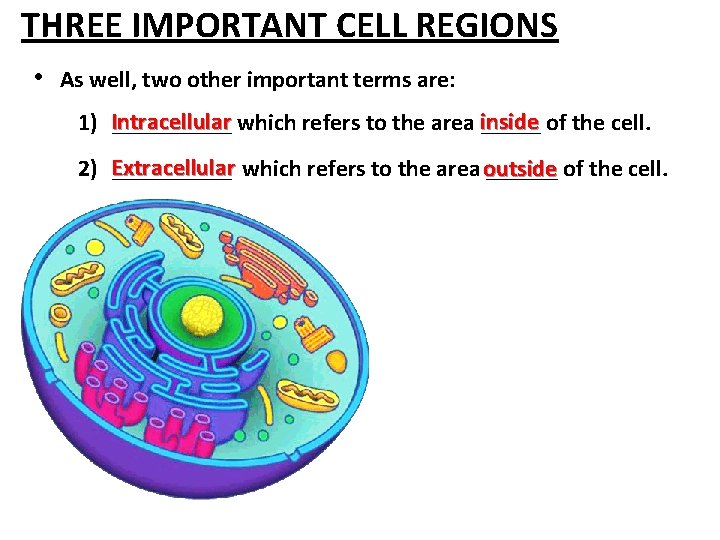
THREE IMPORTANT CELL REGIONS • As well, two other important terms are: ntracellular which refers to the area inside 1) I_____ of the cell. xtracellular which refers to the area outside 2) E______ of the cell.
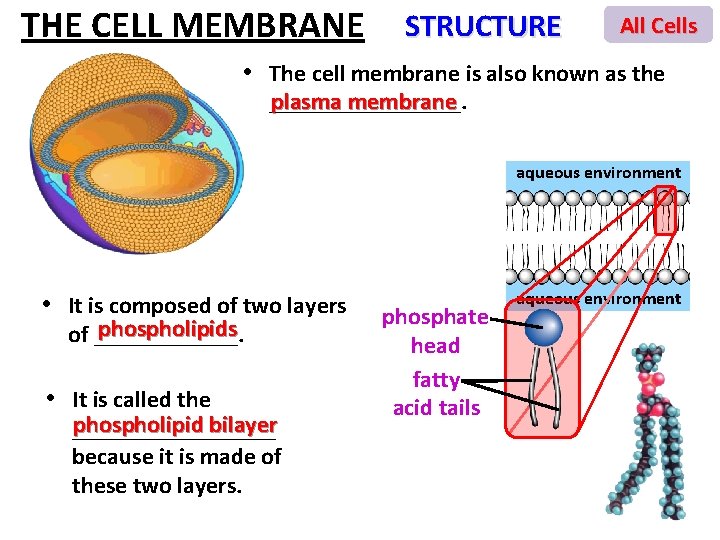
THE CELL MEMBRANE STRUCTURE All Cells • The cell membrane is also known as the plasma membrane ________. aqueous environment • It is composed of two layers phospholipids of ______. • It is called the phospholipid bilayer _________ because it is made of these two layers. phosphate head fatty acid tails aqueous environment
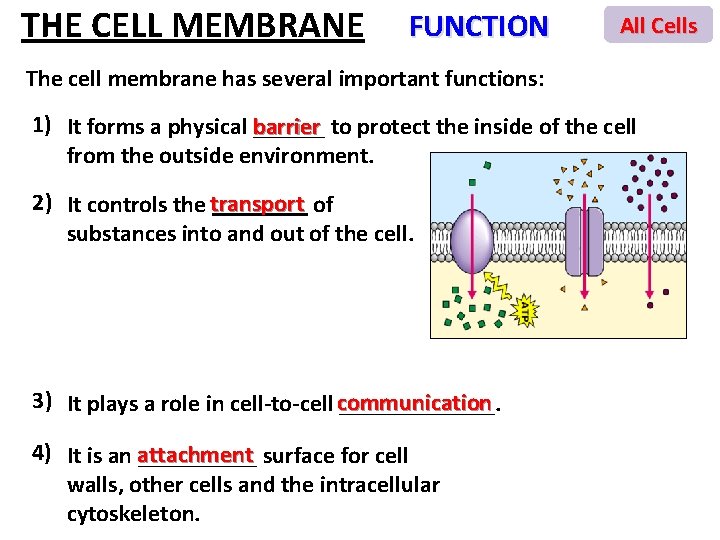
THE CELL MEMBRANE FUNCTION All Cells The cell membrane has several important functions: 1) It forms a physical barrier ______ to protect the inside of the cell from the outside environment. 2) It controls the transport ____ of substances into and out of the cell. 3) It plays a role in cell-to-cell communication _______. 4) It is an attachment _____ surface for cell walls, other cells and the intracellular cytoskeleton.

THE NUCLEUS FUNCTIONS Eukaryotes center for • The main function of the nucleus is to be the control ______ the cell. • The _______ DNA contains all the instructions needed to make proteins cell division and direct all the activities for the cell, to control _____ of the cell. Animal Cell Division

MITOCHONDRIA FUNCTION Eukaryotes • The main function of mitochondria is to produce energy ______ for the cellular respiration cell in a chemical process called ________. oxygen as reactants. • It uses glucose ______ and ______ dioxide and water • It produces carbon ______ as products, as well as energy in the form of a molecule called ATP ___ (adenosine ______ triphosphate). carbon dioxide glucose water oxygen energy (ATP) Chemical formula for cellular respiration: C 6 H 12 O 6 + O 2 CO 2 + H 2 O + ENERGY (ATP)
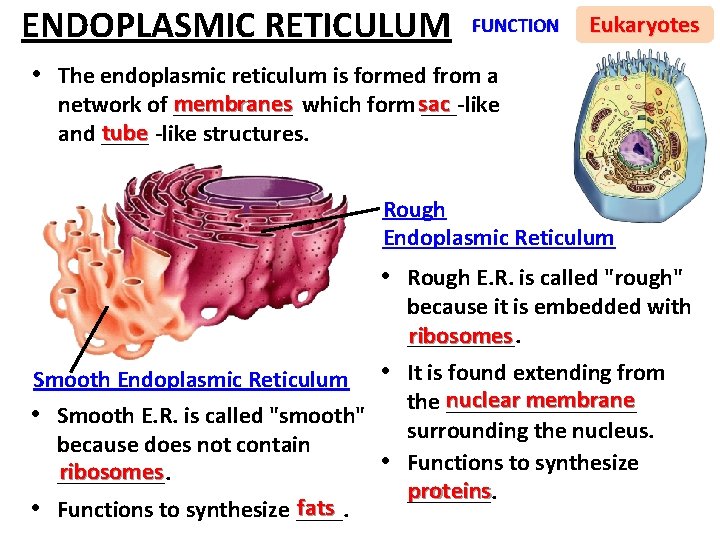
ENDOPLASMIC RETICULUM FUNCTION Eukaryotes • The endoplasmic reticulum is formed from a membranes which form sac ___-like network of _____ tube -like structures. and ____ Rough Endoplasmic Reticulum • Rough E. R. is called "rough" because it is embedded with ribosomes _____. Smooth Endoplasmic Reticulum • It is found extending from nuclear membrane the ________ • Smooth E. R. is called "smooth" surrounding the nucleus. because does not contain • Functions to synthesize ribosomes _____. proteins _______. fats • Functions to synthesize ____.
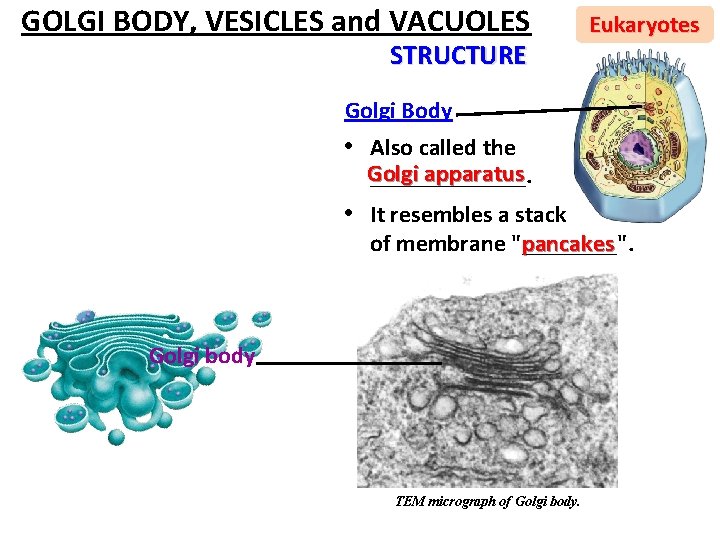
GOLGI BODY, VESICLES and VACUOLES STRUCTURE Eukaryotes Golgi Body • Also called the Golgi apparatus _______. • It resembles a stack pancakes of membrane "____". Golgi body TEM micrograph of Golgi body.
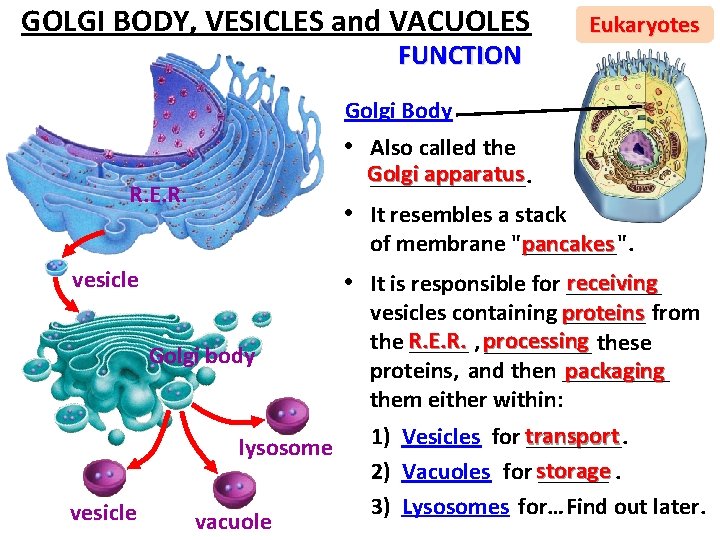
GOLGI BODY, VESICLES and VACUOLES FUNCTION Eukaryotes Golgi Body • Also called the Golgi apparatus _______. R. E. R. • It resembles a stack pancakes of membrane "____". vesicle receiving • It is responsible for ____ Golgi body lysosome vesicle vacuole vesicles containing proteins _______ from the R. E. R. _____ , processing _____ these packaging proteins, and then _____ them either within: 1) Vesicles for transport ____. 2) Vacuoles for storage ______. 3) Lysosomes for…Find out later.
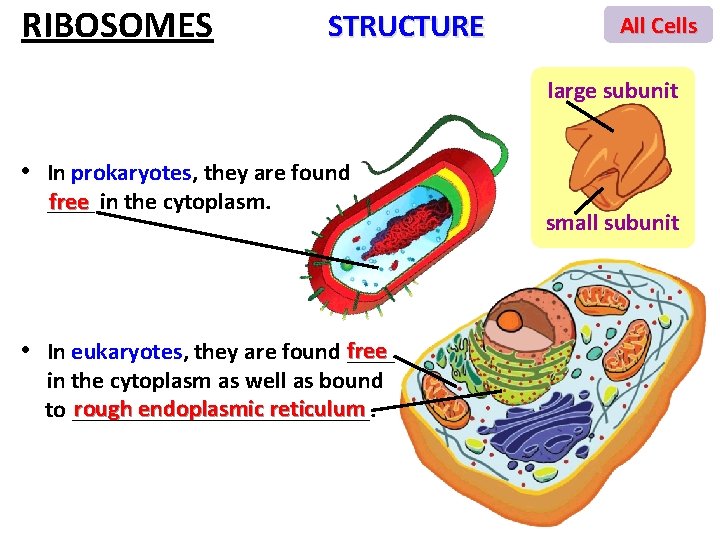
RIBOSOMES STRUCTURE All Cells large subunit • In prokaryotes, they are found free in the cytoplasm. ____ free • In eukaryotes, they are found ____ in the cytoplasm as well as bound rough endoplasmic reticulum to _____________. small subunit
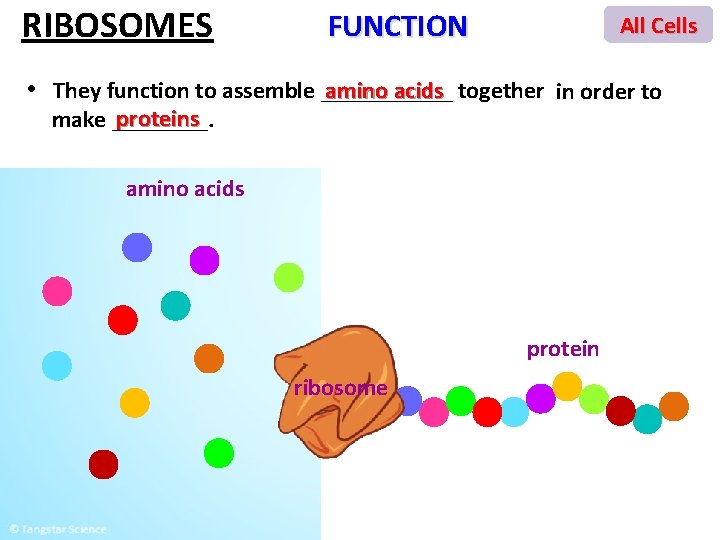
RIBOSOMES FUNCTION All Cells amino acids together in order to • They function to assemble ______ proteins make ____. amino acids protein ribosome
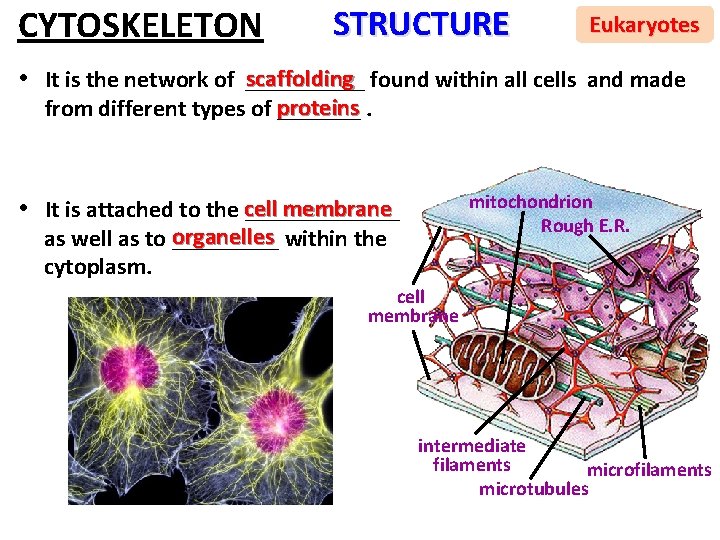
CYTOSKELETON STRUCTURE Eukaryotes scaffolding found within all cells and made • It is the network of _____ from different types of proteins _______. mitochondrion Rough E. R. membrane • It is attached to the cell _______ organelles within the as well as to _____ cytoplasm. cell membrane intermediate filaments microtubules
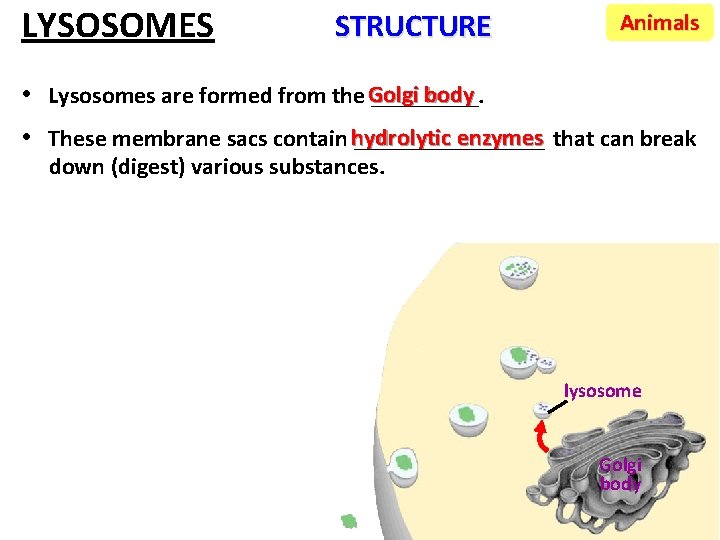
LYSOSOMES STRUCTURE Animals body • Lysosomes are formed from the Golgi _____. enzymes that can break • These membrane sacs contain hydrolytic ________ down (digest) various substances. lysosome Golgi body
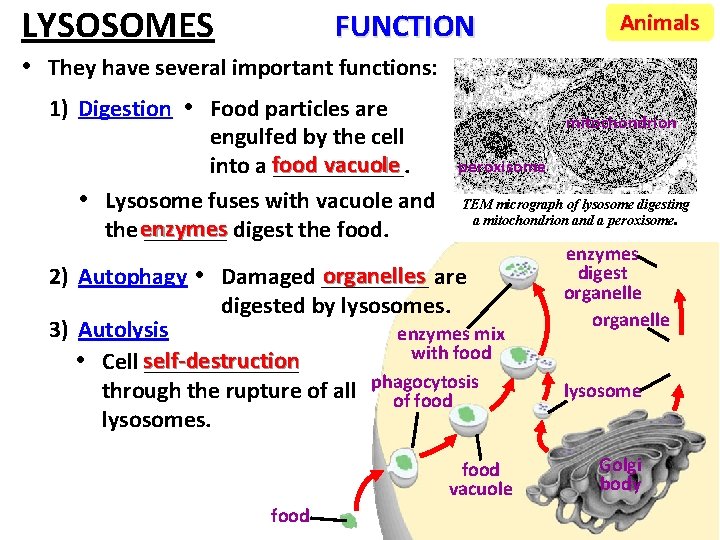
LYSOSOMES FUNCTION • They have several important functions: 1) Digestion • Food particles are engulfed by the cell vacuole into a food ______. • Lysosome fuses with vacuole and the enzymes _______ digest the food. mitochondrion peroxisome TEM micrograph of lysosome digesting a mitochondrion and a peroxisome. organelles are 2) Autophagy • Damaged _____ digested by lysosomes. 3) Autolysis enzymes mix with food • Cell self-destruction _______ through the rupture of all phagocytosis of food lysosomes. food vacuole food Animals enzymes digest organelle lysosome Golgi body
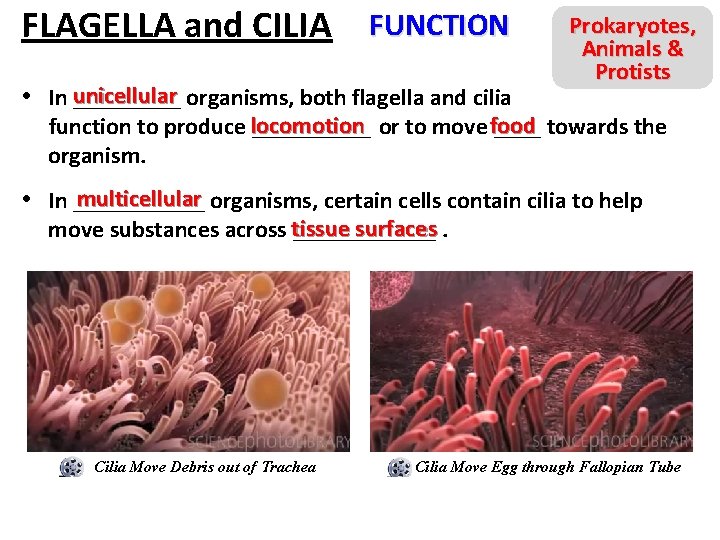
FLAGELLA and CILIA FUNCTION • In unicellular _____ organisms, both flagella and cilia Prokaryotes, Animals & Protists function to produce locomotion _____ or to move food ____ towards the organism. multicellular organisms, certain cells contain cilia to help • In ______ surfaces. move substances across tissue ______ Cilia Move Debris out of Trachea Cilia Move Egg through Fallopian Tube
CENTRAL VACUOLE STRUCTURE Plants largest organelle within a plant cell, and often takes up • It is the ______ the majority _______ of the cytoplasm of a plant cell.
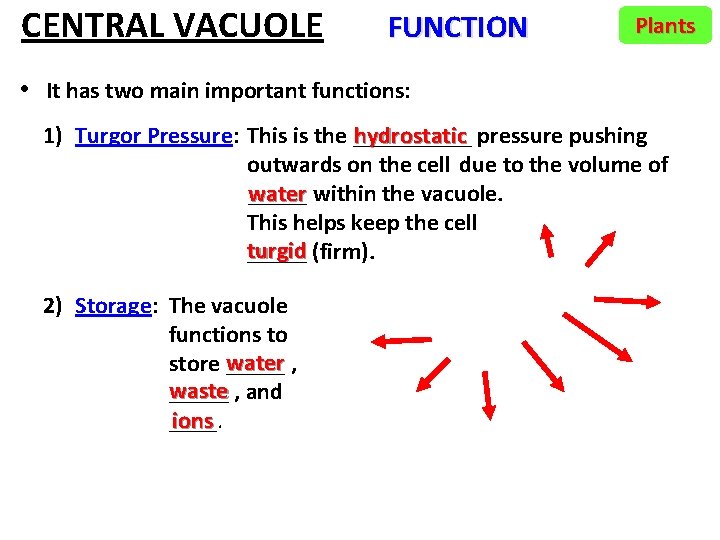
CENTRAL VACUOLE FUNCTION Plants • It has two main important functions: hydrostatic pressure pushing 1) Turgor Pressure: This is the _____ outwards on the cell due to the volume of _____ water within the vacuole. This helps keep the cell turgid _____ (firm). 2) Storage: The vacuole functions to water , store _____ waste , and _____ ions ____.
CELL WALL STRUCTURE Plants • The cell wall in plants is located outside of the cell membrane , and is _______ composed of a polysaccharide called cellulose ____.
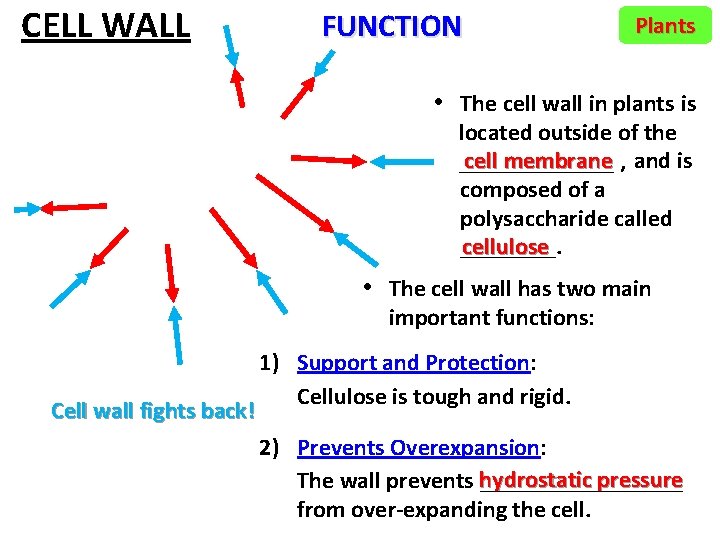
CELL WALL FUNCTION Plants • The cell wall in plants is located outside of the cell membrane , and is _______ composed of a polysaccharide called cellulose ____. • The cell wall has two main important functions: Cell wall fights back! 1) Support and Protection: Cellulose is tough and rigid. 2) Prevents Overexpansion: pressure The wall prevents hydrostatic _________ from over-expanding the cell.
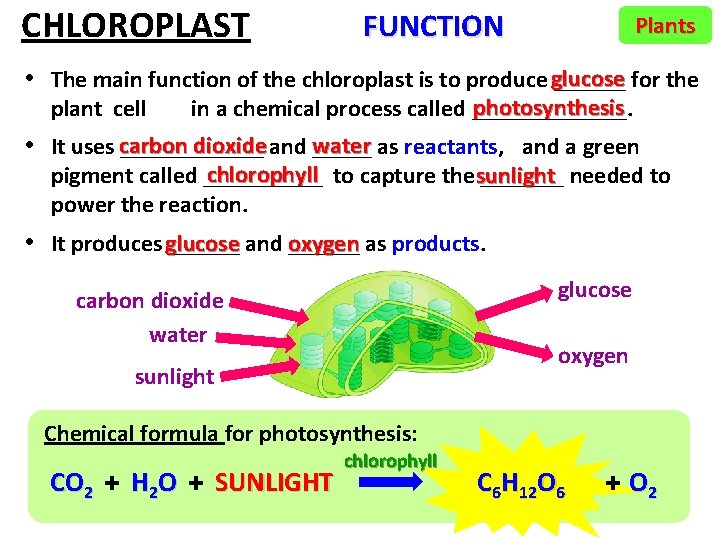
CHLOROPLAST FUNCTION Plants • The main function of the chloroplast is to produce glucose ______ for the plant cell photosynthesis in a chemical process called _______. dioxide and _____ water as reactants, and a green • It uses carbon ______ chlorophyll to capture the sunlight pigment called _______ needed to power the reaction. • It produces glucose ______ and oxygen ______ as products. glucose carbon dioxide water oxygen sunlight Chemical formula for photosynthesis: CO 2 + H 2 O + SUNLIGHT chlorophyll C 6 H 12 O 6 + O 2
- Slides: 20