
Three hydrologic models comparison contrast modeling storm runoff

- Slides: 62
Three hydrologic models comparison & contrast modeling storm runoff
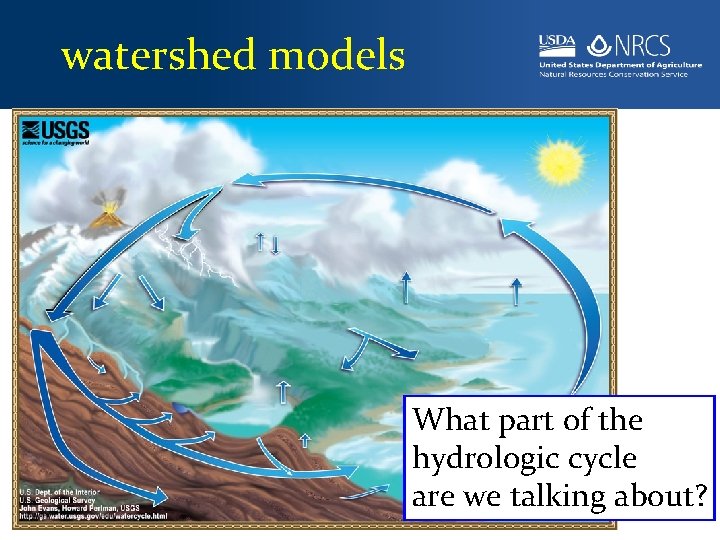
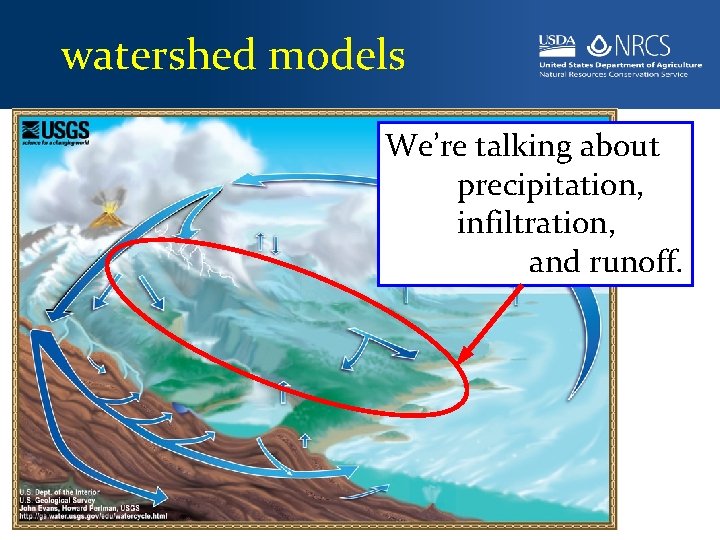
watershed models What part of the hydrologic cycle are we talking about?
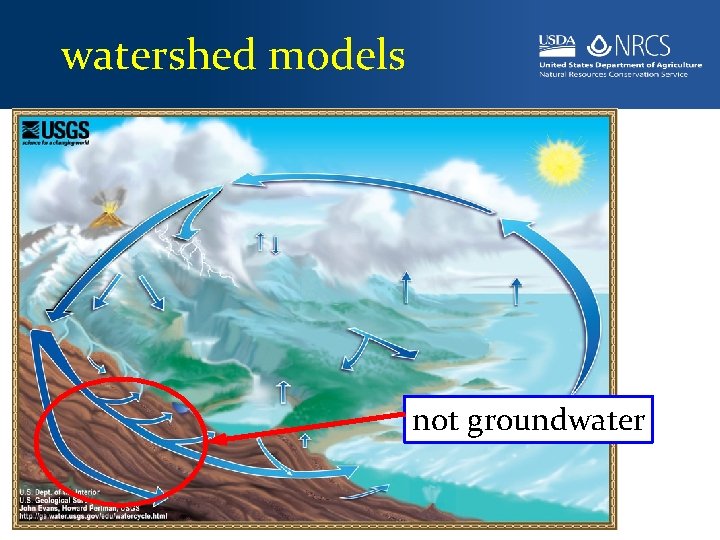
watershed models not groundwater
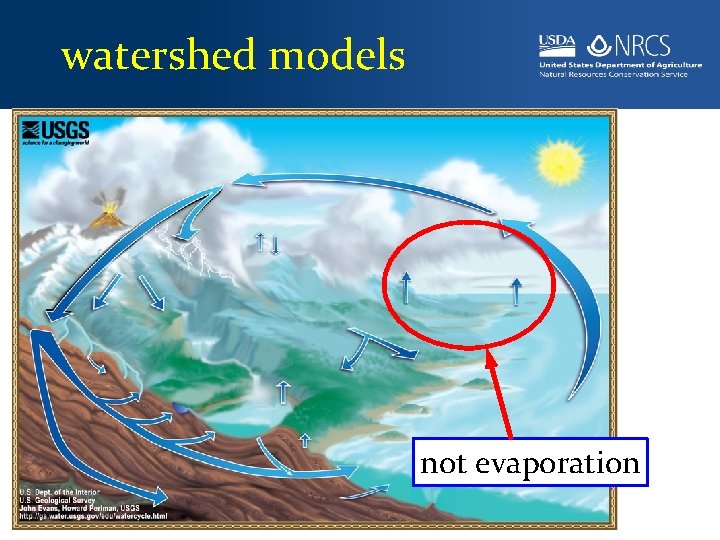
watershed models not evaporation
watershed models We’re talking about precipitation, infiltration, and runoff.
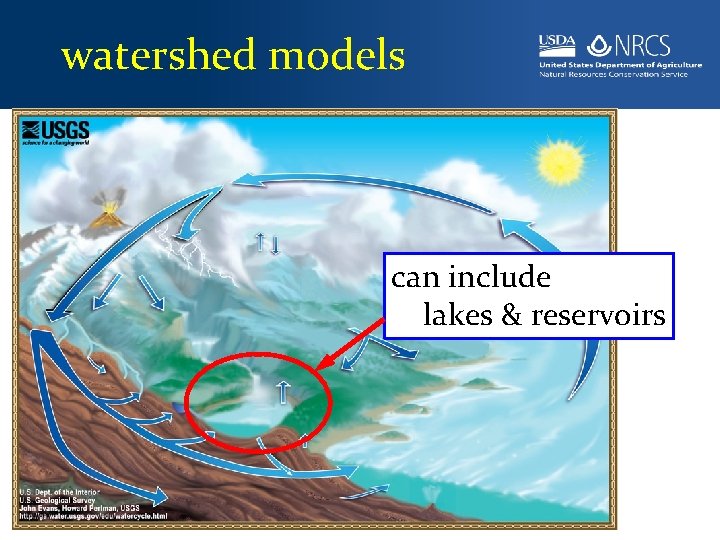
watershed models can include lakes & reservoirs
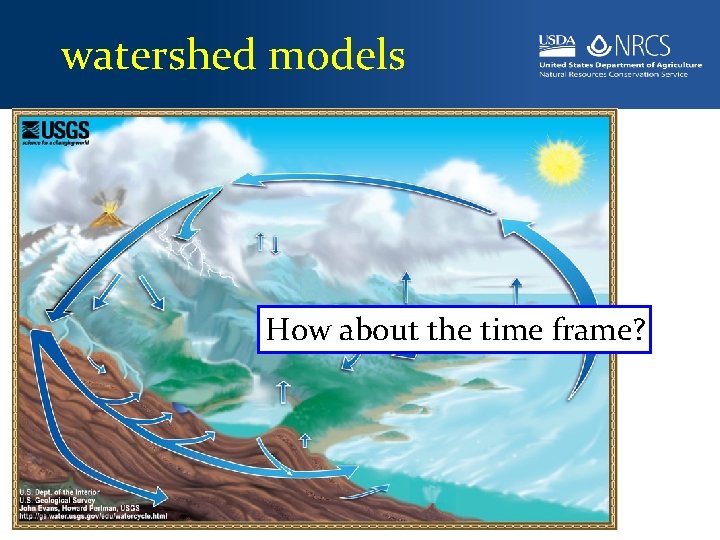
watershed models How about the time frame?
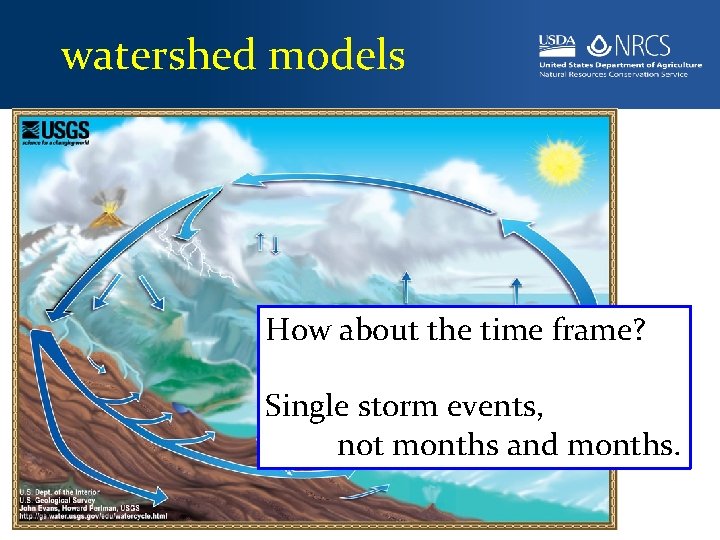
watershed models How about the time frame? Single storm events, not months and months.
Three hydrologic models Win. TR-55 Win. TR-20 Hec. HMS All three programs model sub-basins of a watershed.
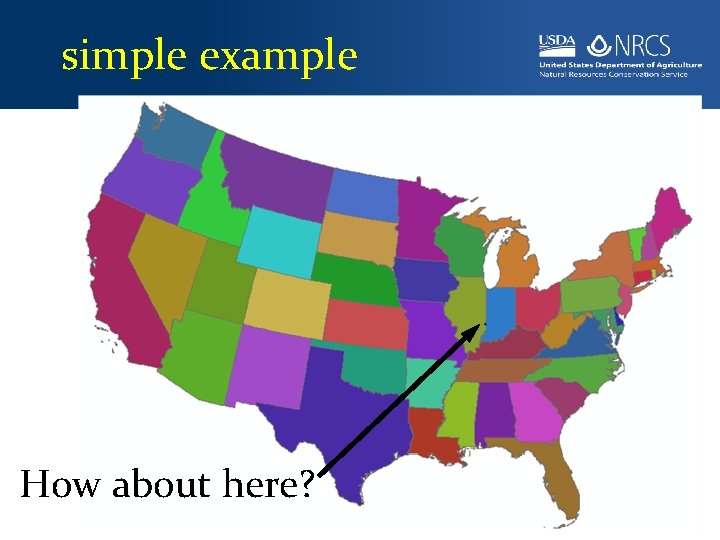
simple example How about here?
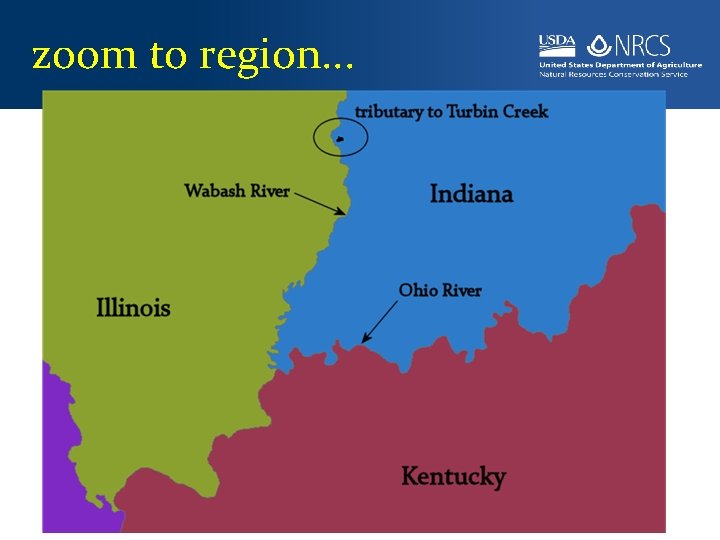
zoom to region. . .
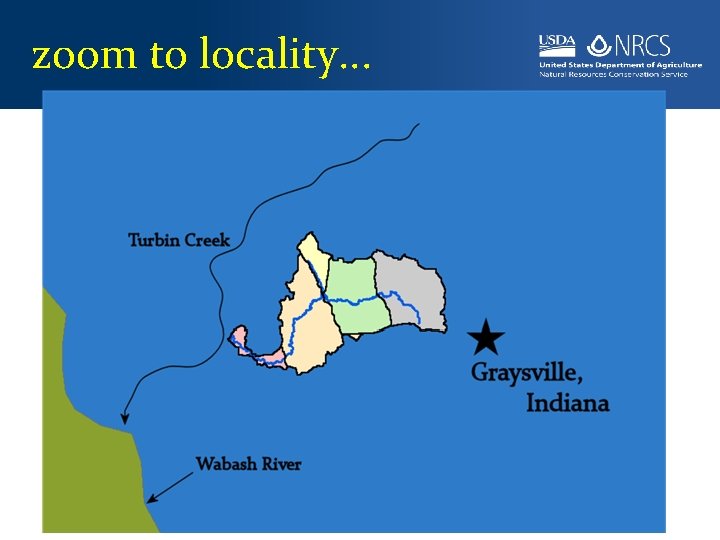
zoom to locality. . .
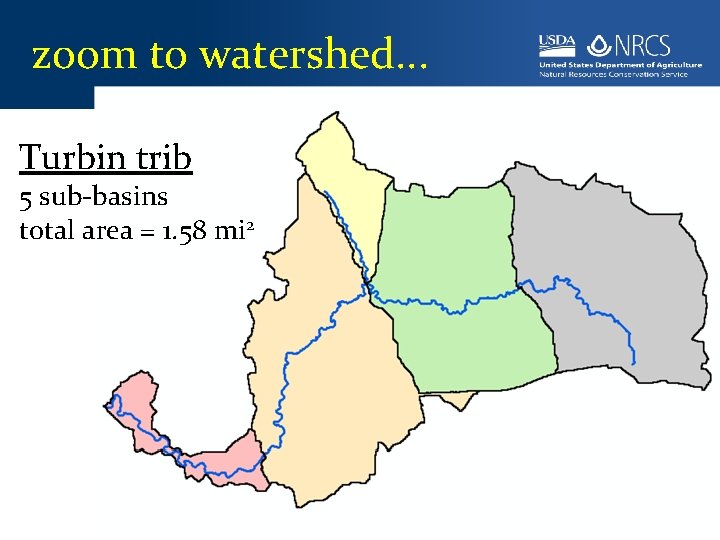
zoom to watershed. . . Turbin trib 5 sub-basins total area = 1. 58 mi 2
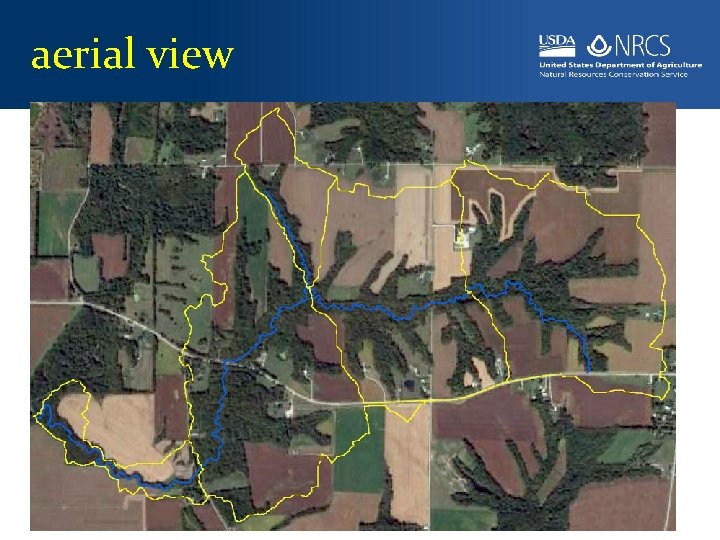
aerial view
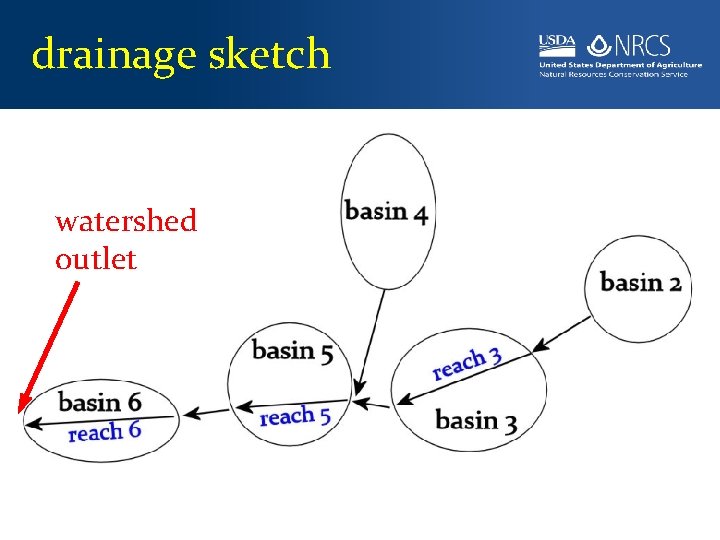
drainage sketch watershed outlet
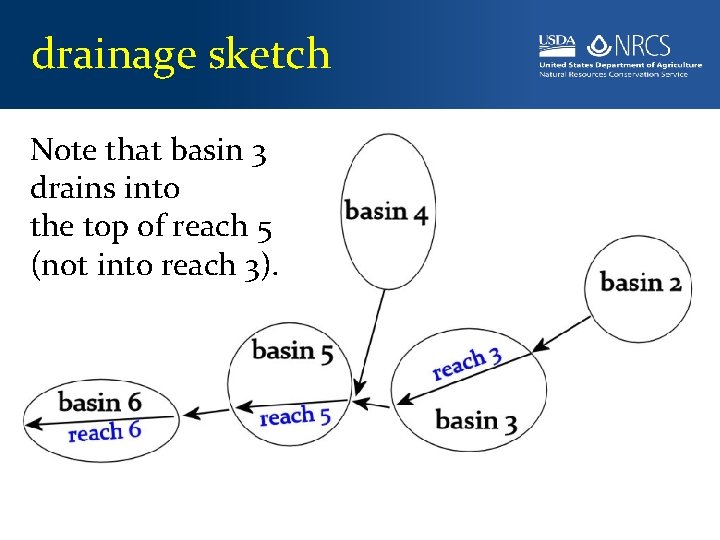
drainage sketch Note that basin 3 drains into the top of reach 5 (not into reach 3).
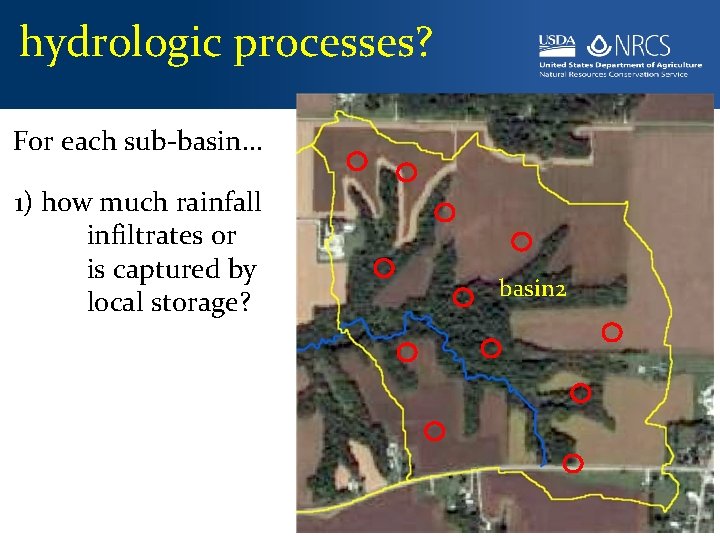
hydrologic processes? For each sub-basin. . . 1) how much rainfall infiltrates or is captured by local storage? basin 2
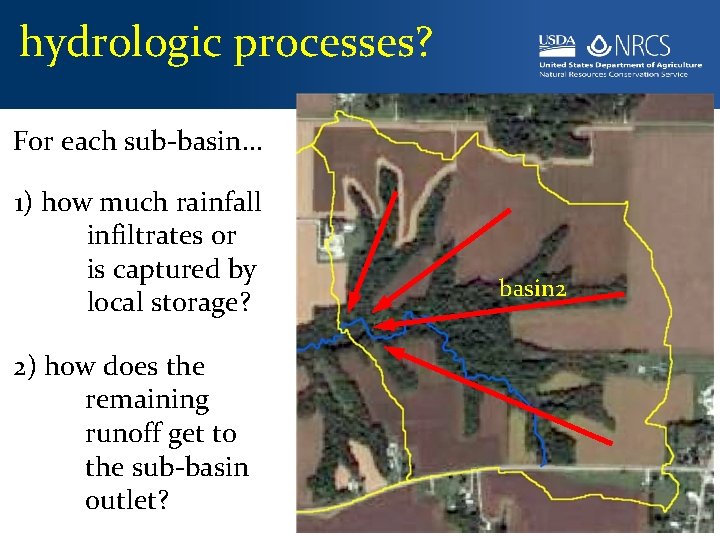
hydrologic processes? For each sub-basin. . . 1) how much rainfall infiltrates or is captured by local storage? 2) how does the remaining runoff get to the sub-basin outlet? basin 2
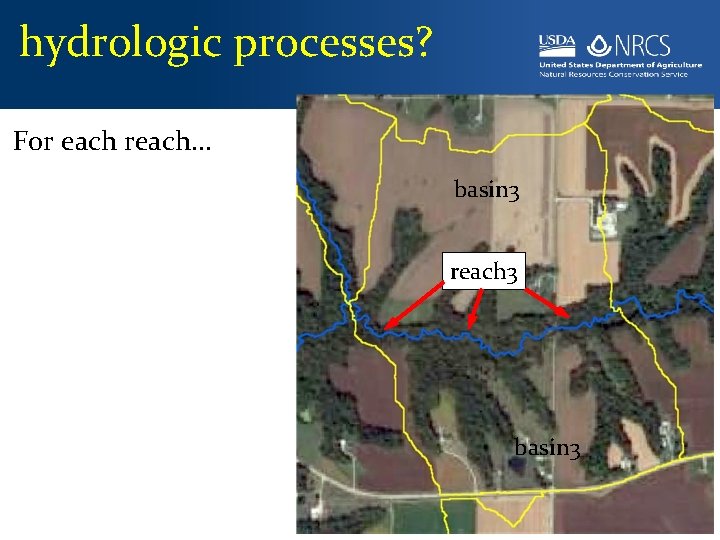
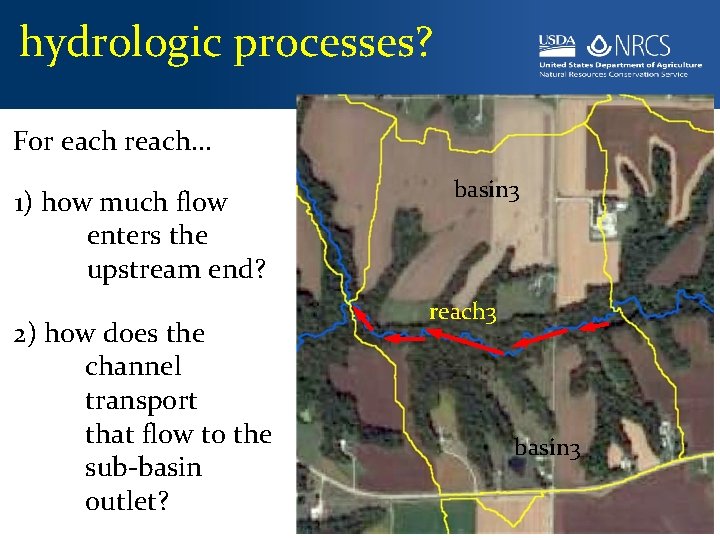
hydrologic processes? For each reach. . . basin 3 reach 3 basin 3
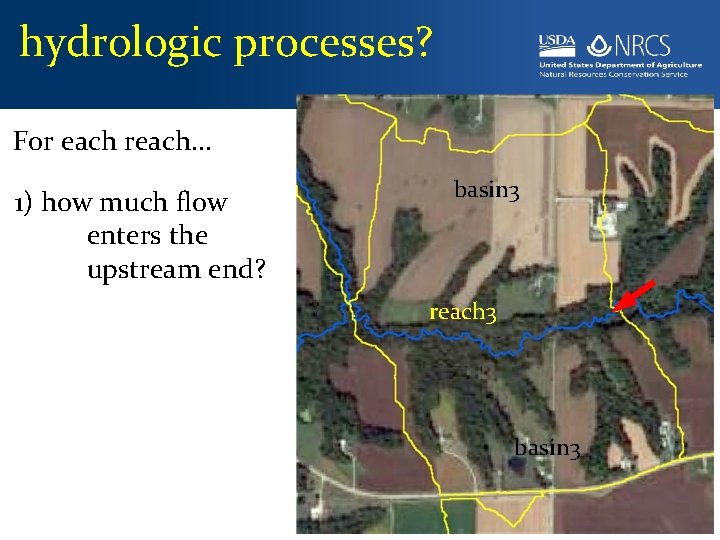
hydrologic processes? For each reach. . . 1) how much flow enters the upstream end? basin 3 reach 3 basin 3
hydrologic processes? For each reach. . . 1) how much flow enters the upstream end? 2) how does the channel transport that flow to the sub-basin outlet? basin 3 reach 3 basin 3
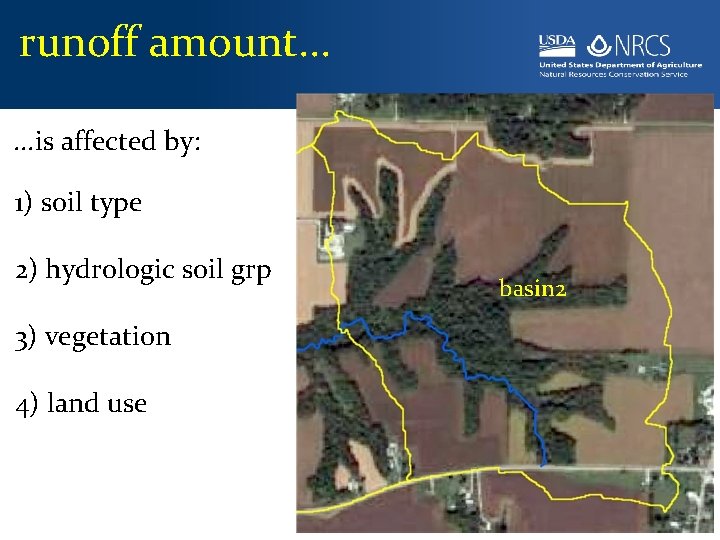
runoff amount. . . is affected by: 1) soil type 2) hydrologic soil grp 3) vegetation 4) land use basin 2
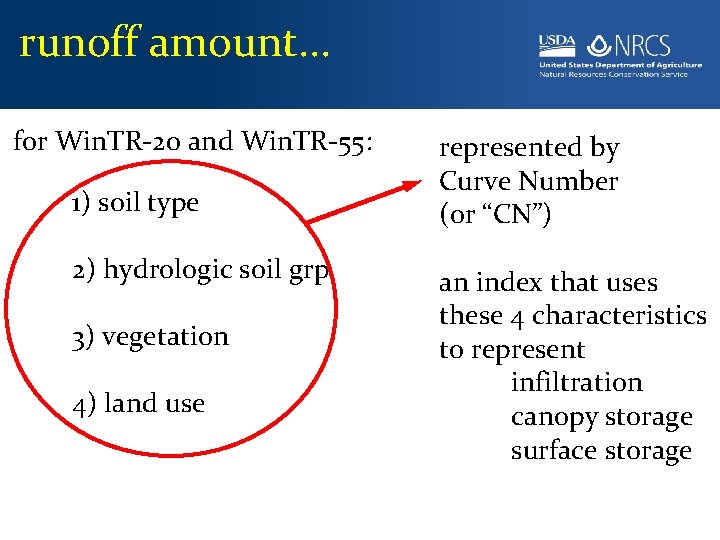
runoff amount. . . for Win. TR-20 and Win. TR-55: 1) soil type 2) hydrologic soil grp 3) vegetation 4) land use represented by Curve Number (or “CN”) an index that uses these 4 characteristics to represent infiltration canopy storage surface storage
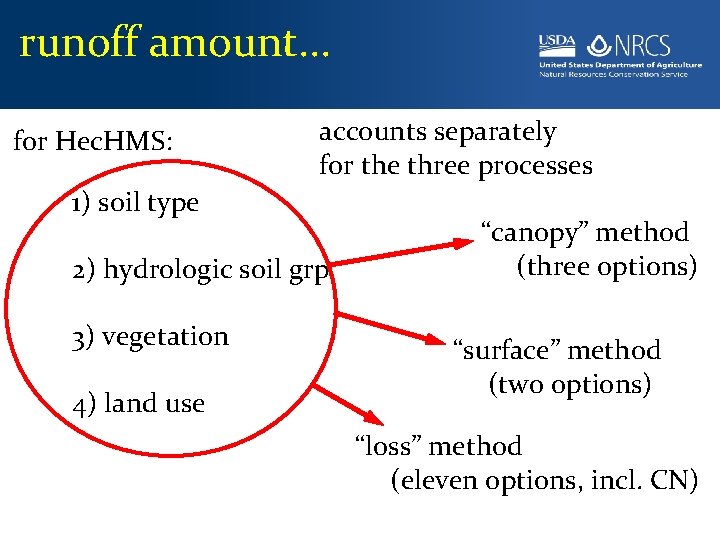
runoff amount. . . for Hec. HMS: accounts separately for the three processes 1) soil type 2) hydrologic soil grp 3) vegetation 4) land use “canopy” method (three options) “surface” method (two options) “loss” method (eleven options, incl. CN)
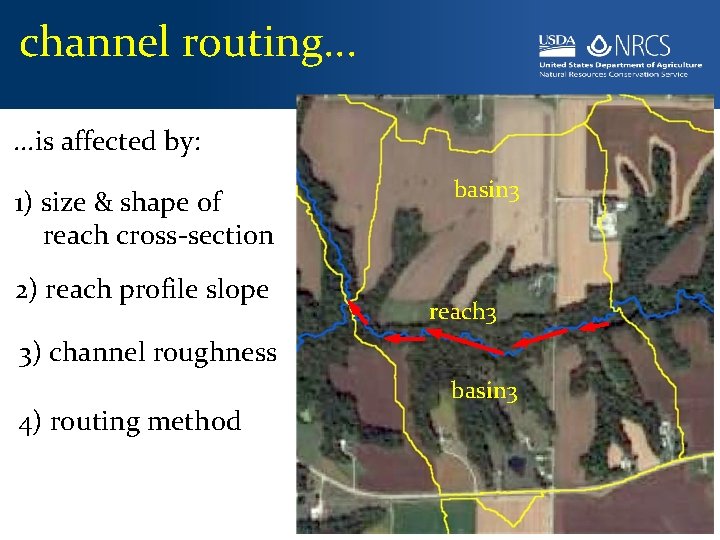
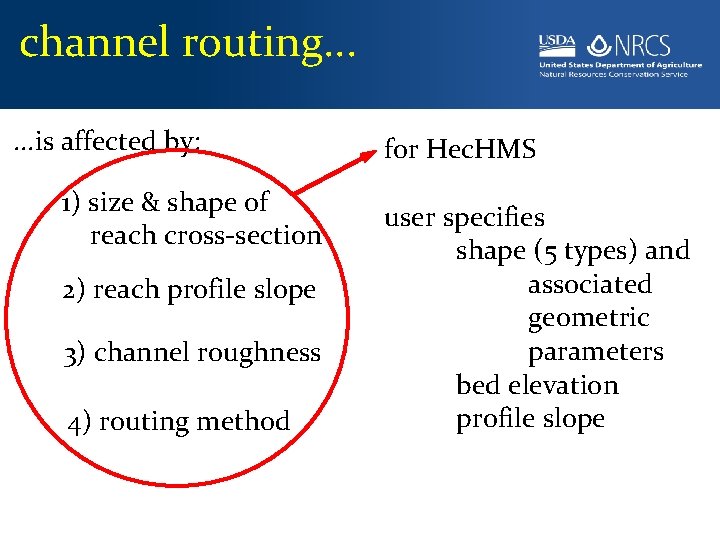
channel routing. . . is affected by: 1) size & shape of reach cross-section 2) reach profile slope basin 3 reach 3 3) channel roughness 4) routing method basin 3
channel routing. . . is affected by: 1) size & shape of reach cross-section 2) reach profile slope 3) channel roughness 4) routing method for all three programs each sub-basin reach is represented by a single cross-section
channel routing. . . is affected by: 1) size & shape of reach cross-section 2) reach profile slope for Win. TR-55 3) channel roughness user specifies bottom width side slope Manning n profile slope 4) routing method
channel routing. . . is affected by: 1) size & shape of reach cross-section 2) reach profile slope 3) channel roughness 4) routing method for Win. TR-20 user specifies rating table containing elevation discharge flow area top width profile slope
channel routing. . . is affected by: 1) size & shape of reach cross-section 2) reach profile slope 3) channel roughness 4) routing method for Hec. HMS user specifies shape (5 types) and associated geometric parameters bed elevation profile slope
channel routing algorithm Win. TR-55 and Win. TR-20 use the “Muskingum-Cunge” method, an approximation of the dynamic wave momentum equations that allows for peak diffusion over time (by contrast, for example, the “Kinematic Wave” method is an approximation of the same equations that does not account for peak diffusion)
channel routing algorithm Hec. HMS allows the choice of one of six methods including “Muskingum-Cunge” and “Kinematic Wave”
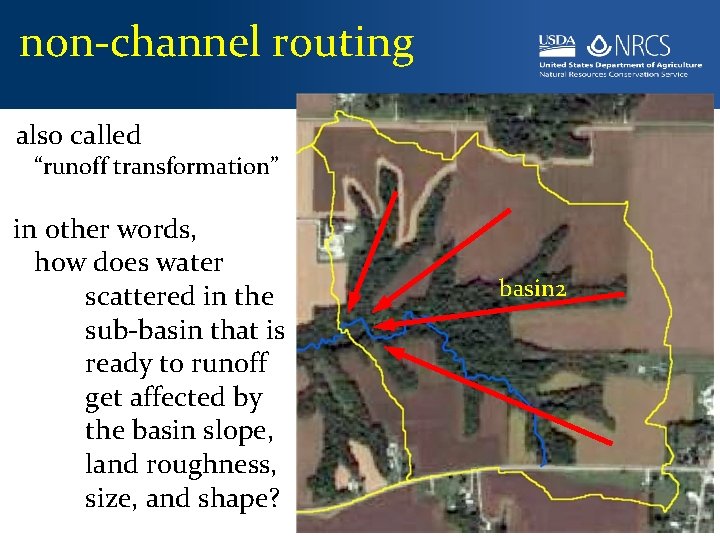
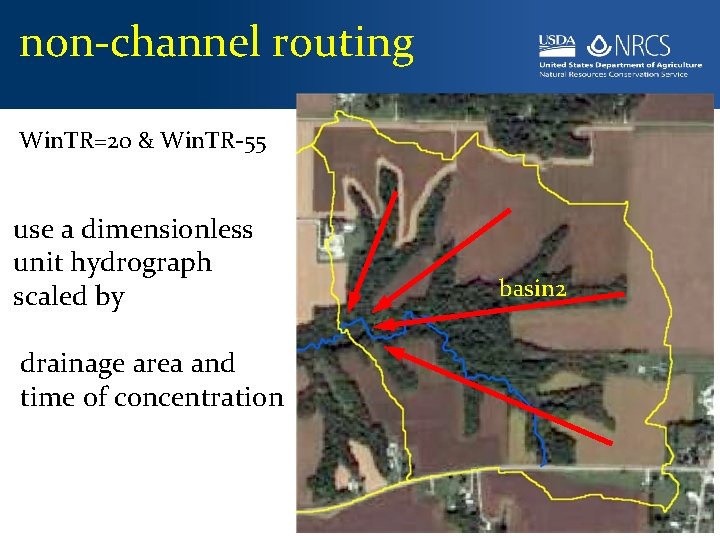
non-channel routing also called “runoff transformation” in other words, how does water scattered in the sub-basin that is ready to runoff get affected by the basin slope, land roughness, size, and shape? basin 2
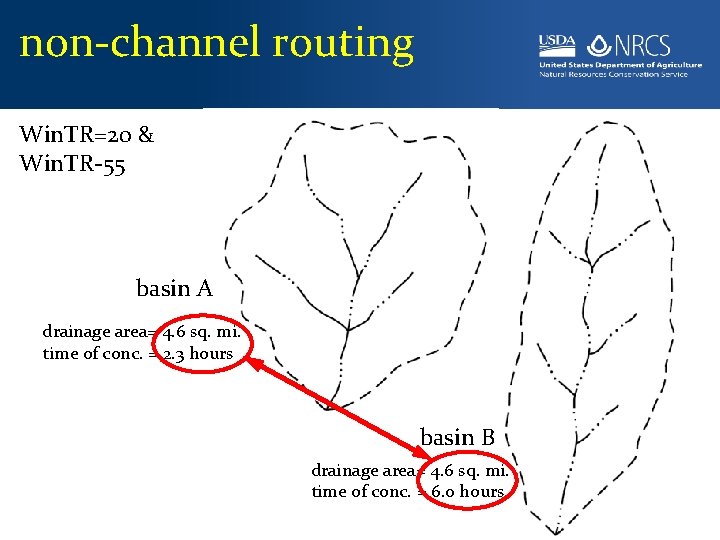
non-channel routing Win. TR=20 & Win. TR-55 use a dimensionless unit hydrograph scaled by drainage area and time of concentration basin 2
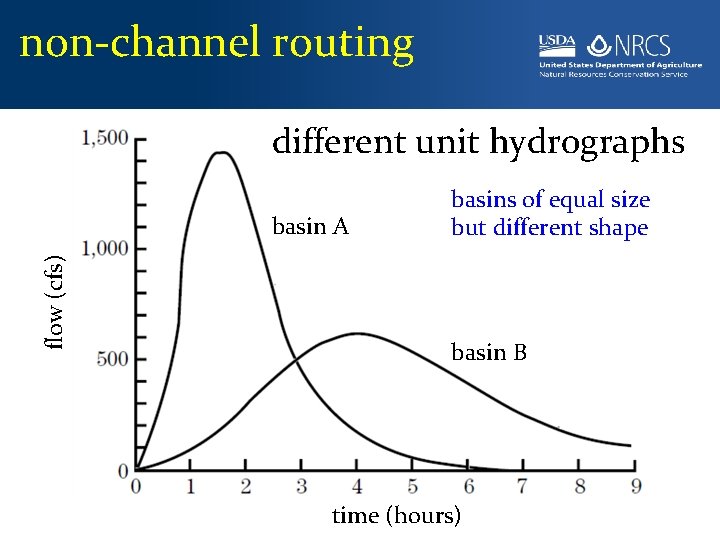
non-channel routing Win. TR=20 & Win. TR-55 basin A drainage area= 4. 6 sq. mi. time of conc. = 2. 3 hours basin B drainage area= 4. 6 sq. mi. time of conc. = 6. 0 hours
non-channel routing different unit hydrographs flow (cfs) basin A basins of equal size but different shape basin B time (hours)
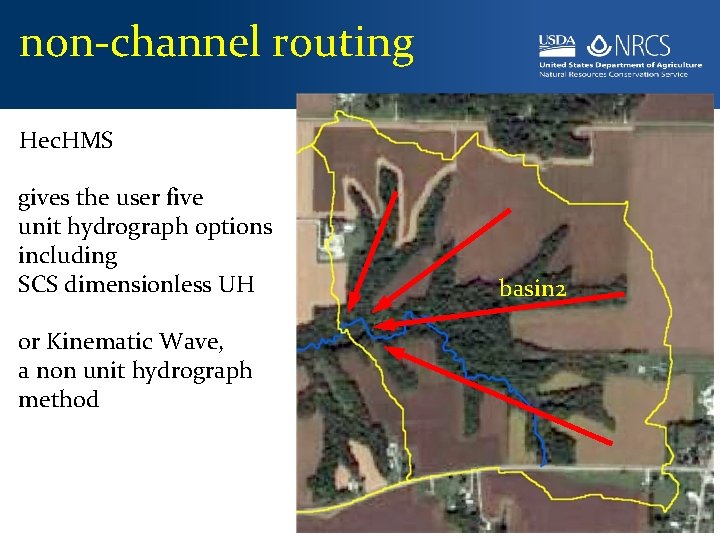
non-channel routing Hec. HMS gives the user five unit hydrograph options including SCS dimensionless UH or Kinematic Wave, a non unit hydrograph method basin 2
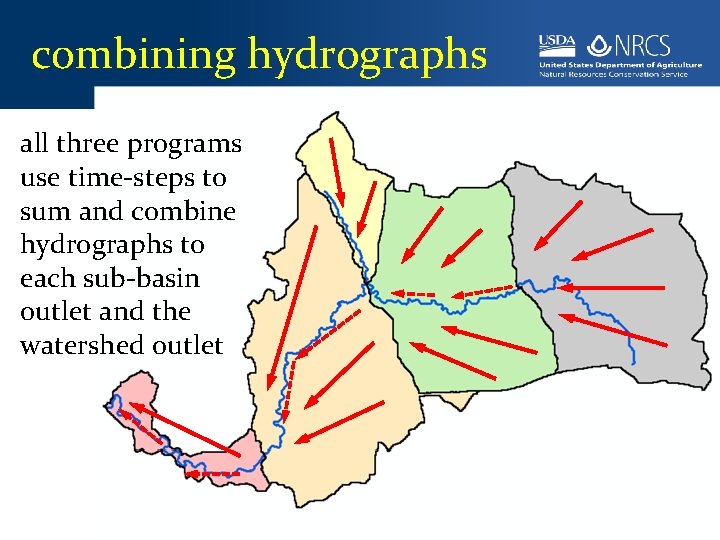
combining hydrographs all three programs use time-steps to sum and combine hydrographs to each sub-basin outlet and the watershed outlet
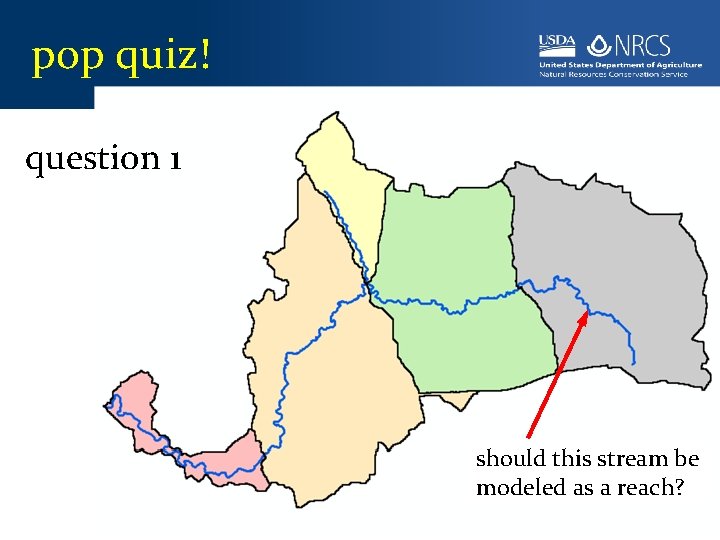
pop quiz! question 1 should this stream be modeled as a reach?
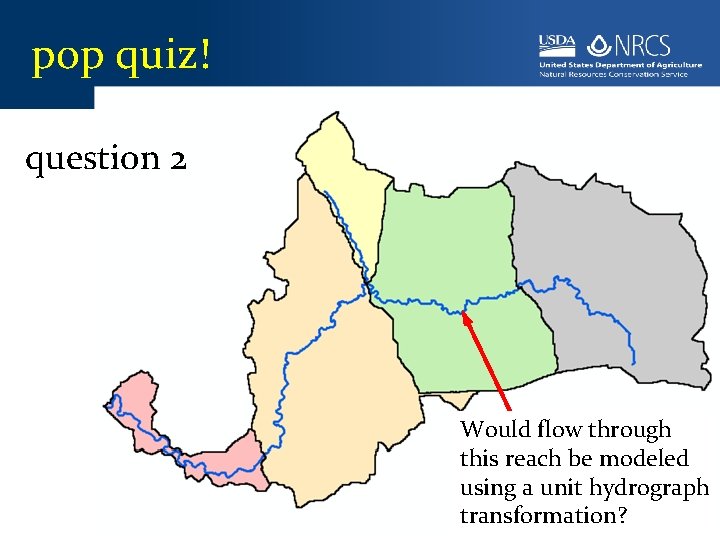
pop quiz! question 2 Would flow through this reach be modeled using a unit hydrograph transformation?
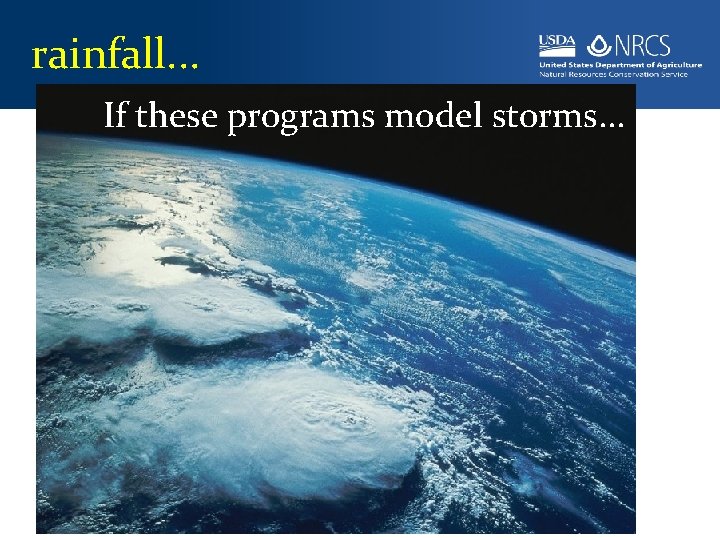
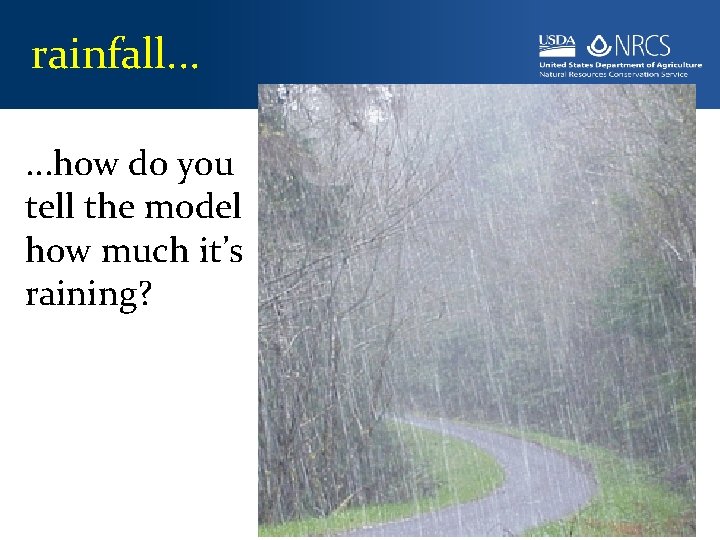
rainfall. . . If these programs model storms. . .
rainfall. . . how do you tell the model how much it’s raining?
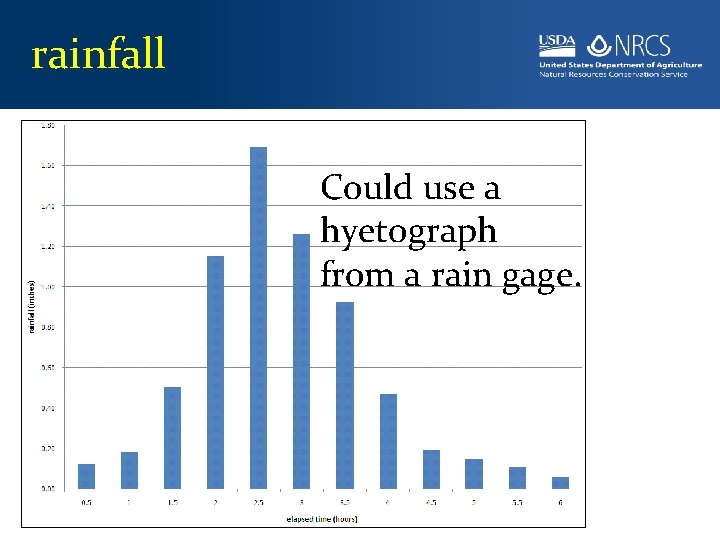
rainfall Could use a hyetograph from a rain gage.
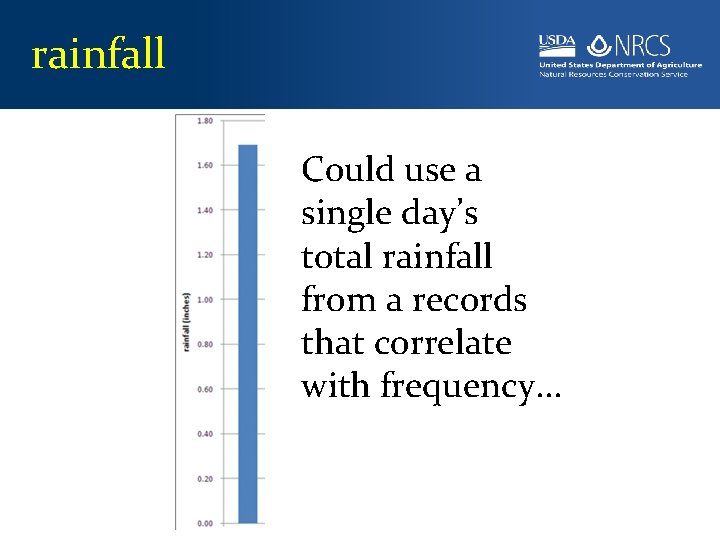
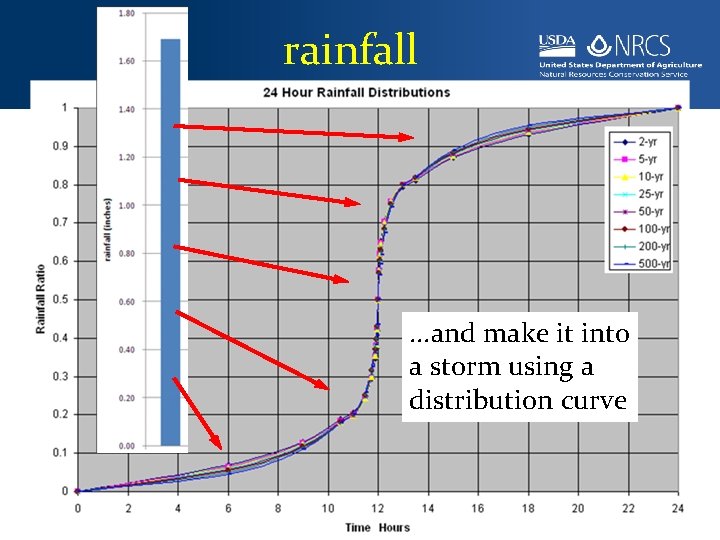
rainfall Could use a single day’s total rainfall from a records that correlate with frequency. . .
rainfall . . . and make it into a storm using a distribution curve
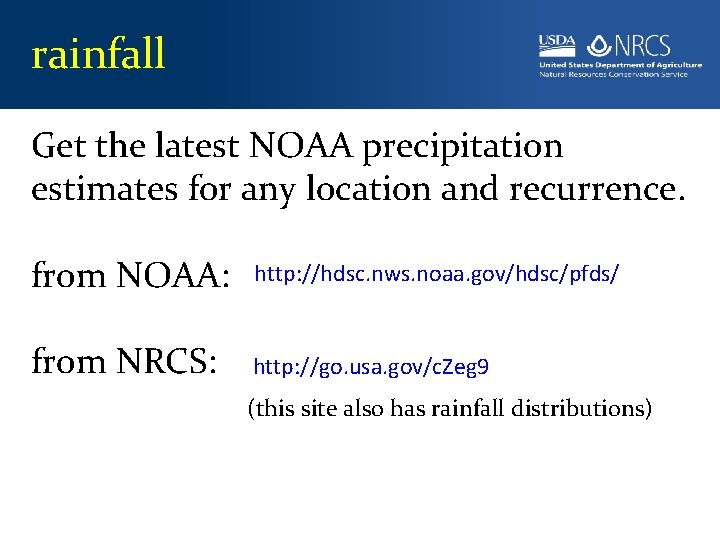
rainfall Get the latest NOAA precipitation estimates for any location and recurrence. from NOAA: http: //hdsc. nws. noaa. gov/hdsc/pfds/ from NRCS: http: //go. usa. gov/c. Zeg 9 (this site also has rainfall distributions)
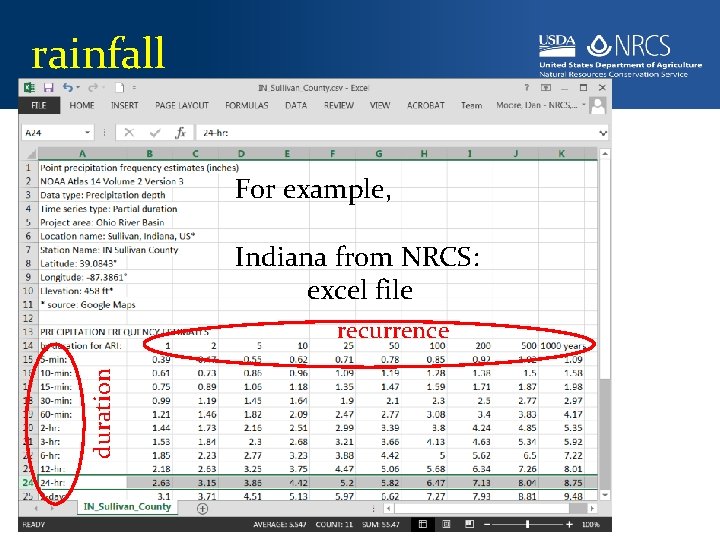
rainfall For example, Indiana from NRCS: excel file duration recurrence
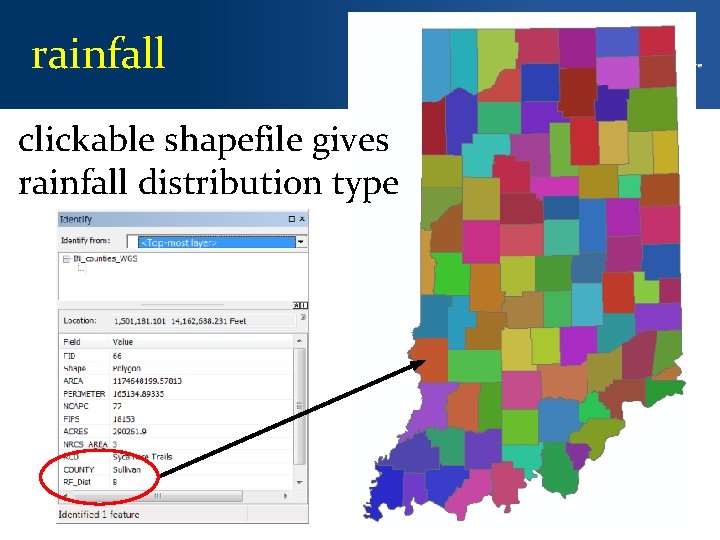
rainfall clickable shapefile gives rainfall distribution type
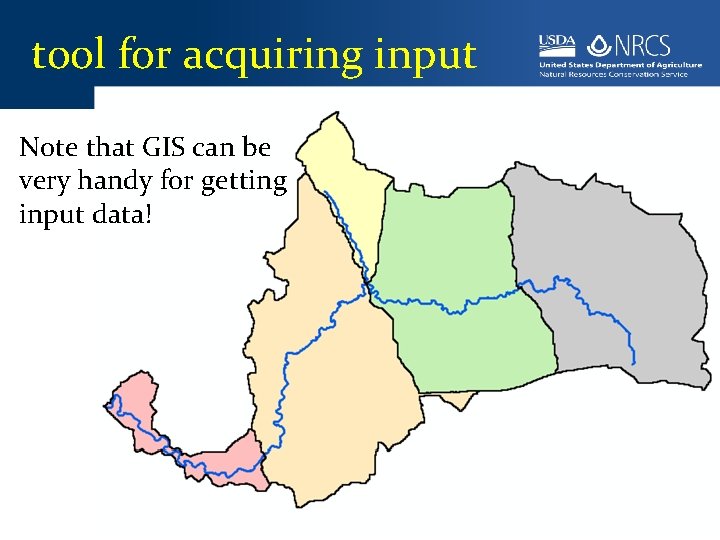
tool for acquiring input Note that GIS can be very handy for getting input data!
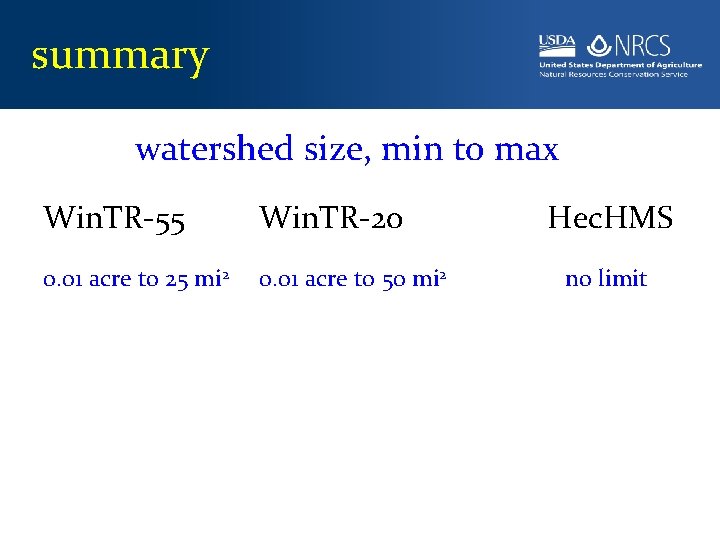
summary watershed size, min to max Win. TR-55 Win. TR-20 0. 01 acre to 25 mi 2 0. 01 acre to 50 mi 2 Hec. HMS no limit
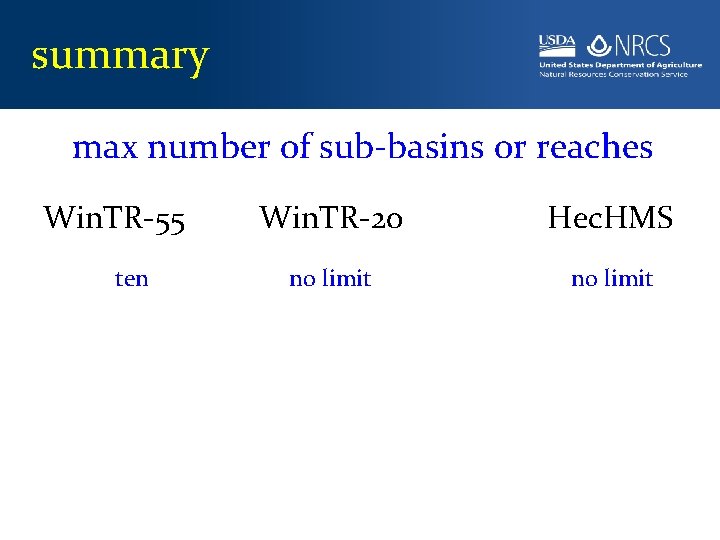
summary max number of sub-basins or reaches Win. TR-55 ten Win. TR-20 Hec. HMS no limit
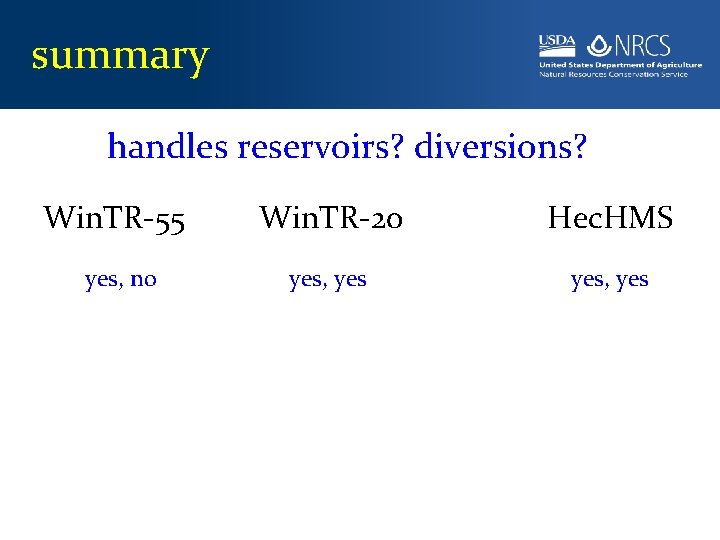
summary handles reservoirs? diversions? Win. TR-55 Win. TR-20 Hec. HMS yes, no yes, yes
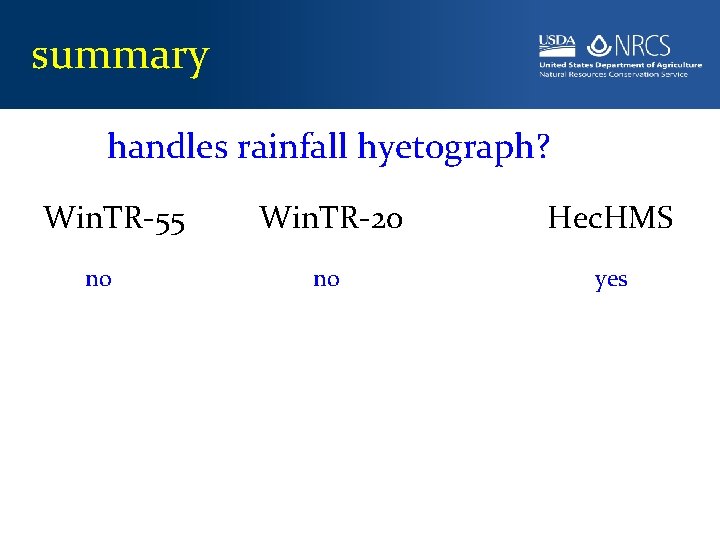
summary handles rainfall hyetograph? Win. TR-55 no Win. TR-20 Hec. HMS no yes
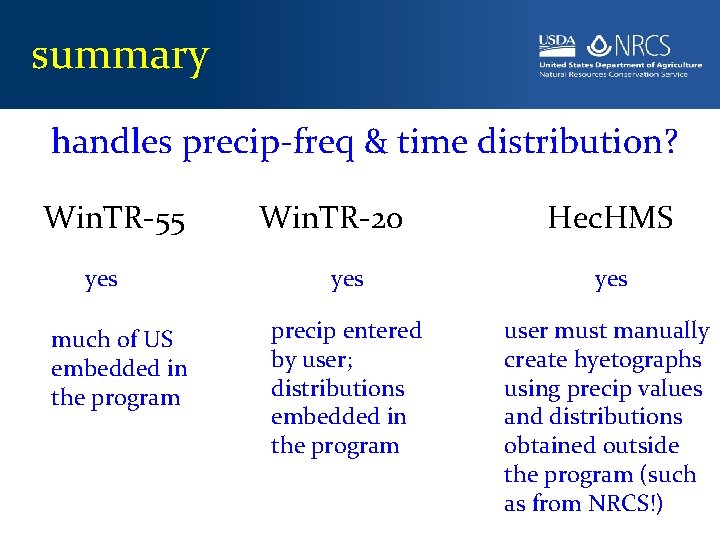
summary handles precip-freq & time distribution? Win. TR-55 yes much of US embedded in the program Win. TR-20 Hec. HMS yes precip entered by user; distributions embedded in the program user must manually create hyetographs using precip values and distributions obtained outside the program (such as from NRCS!)
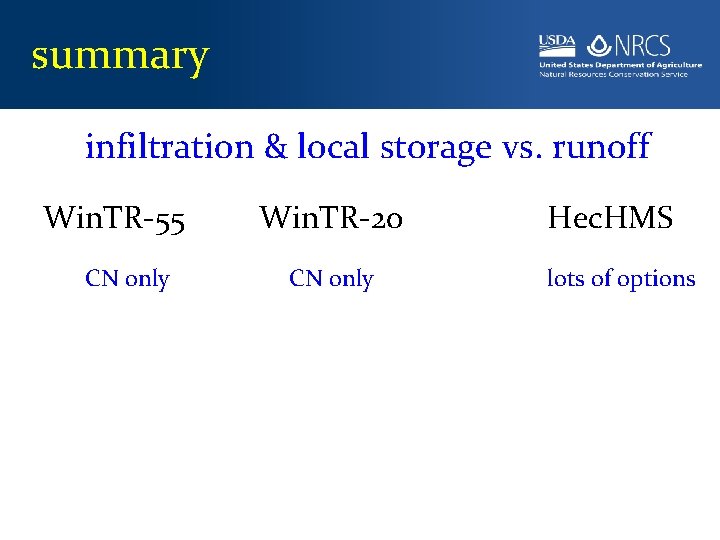
summary infiltration & local storage vs. runoff Win. TR-55 CN only Win. TR-20 CN only Hec. HMS lots of options
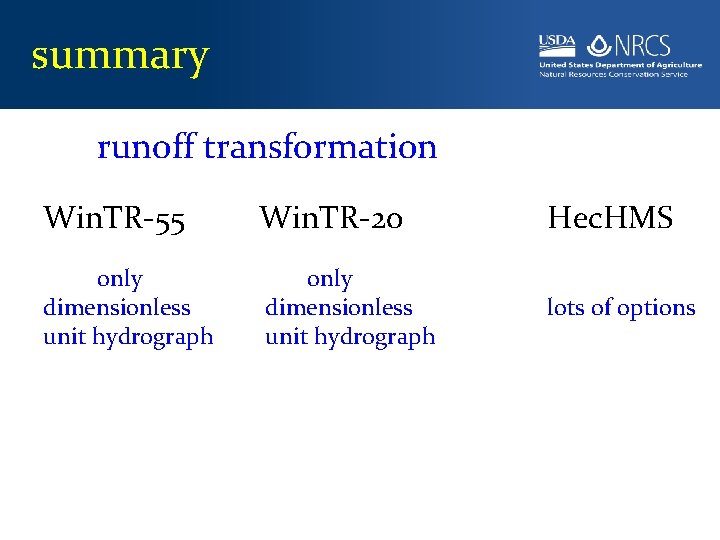
summary runoff transformation Win. TR-55 Win. TR-20 Hec. HMS only dimensionless unit hydrograph lots of options
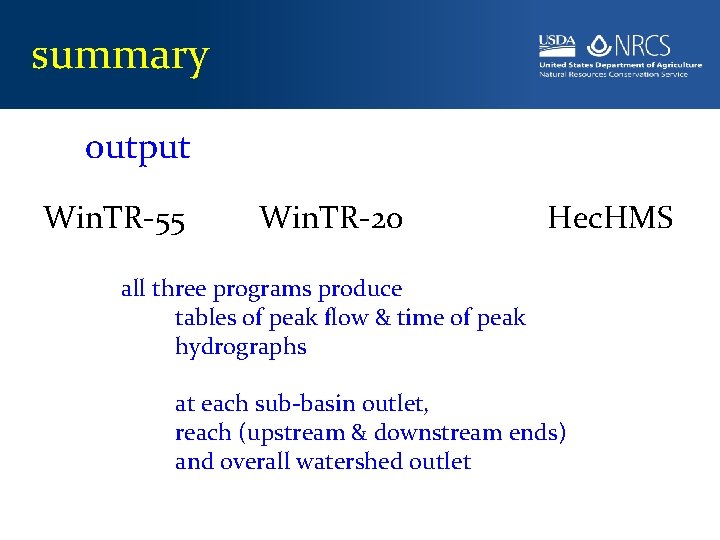
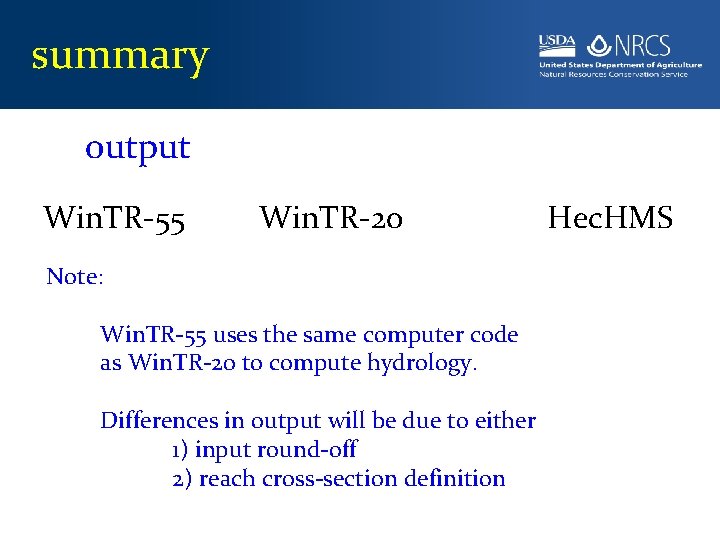
summary output Win. TR-55 Win. TR-20 Hec. HMS all three programs produce tables of peak flow & time of peak hydrographs at each sub-basin outlet, reach (upstream & downstream ends) and overall watershed outlet
summary output Win. TR-55 Win. TR-20 Note: Win. TR-55 uses the same computer code as Win. TR-20 to compute hydrology. Differences in output will be due to either 1) input round-off 2) reach cross-section definition Hec. HMS
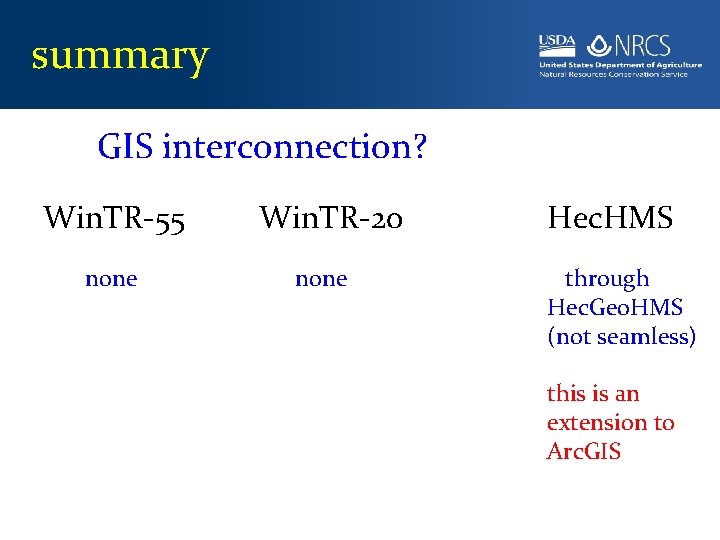
summary GIS interconnection? Win. TR-55 none Win. TR-20 none Hec. HMS through Hec. Geo. HMS (not seamless) this is an extension to Arc. GIS
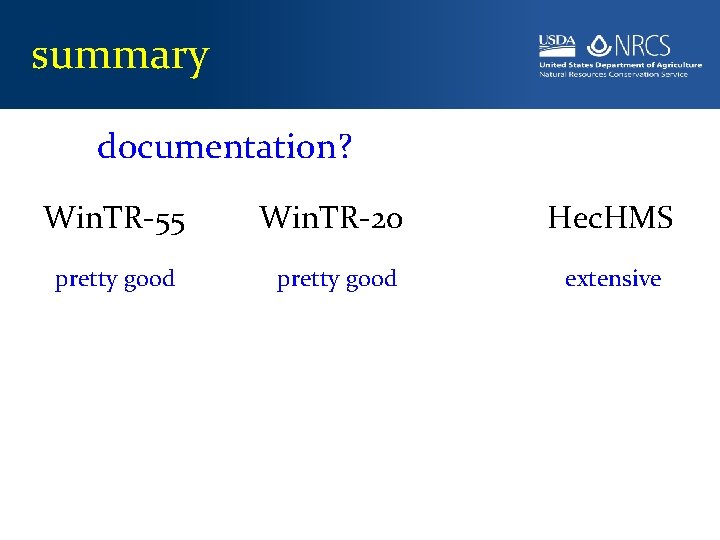
summary documentation? Win. TR-55 Win. TR-20 Hec. HMS pretty good extensive
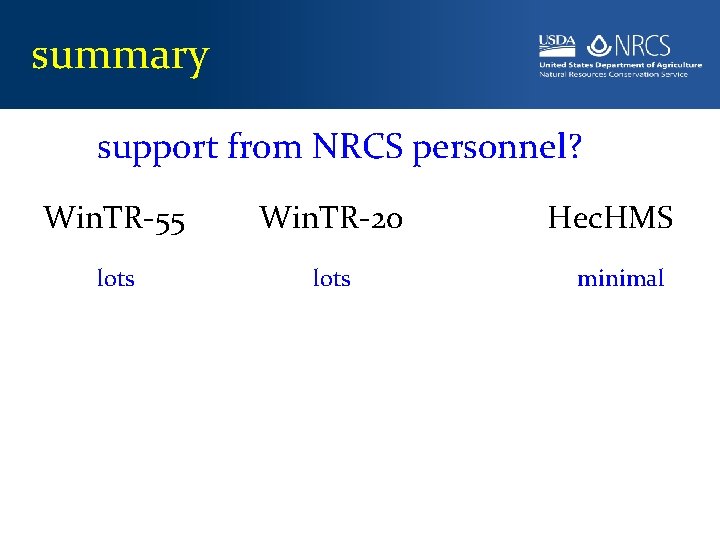
summary support from NRCS personnel? Win. TR-55 Win. TR-20 lots Hec. HMS minimal
let’s do a workshop! The workshop is a tour of how all three programs model Turbin trib watershed.
The U. S. Department of Agriculture (USDA) prohibits discrimination in all its programs and activities on the basis of race, color, national origin, age, disability, and where applicable, sex, marital status, familial status, parental status, religion, sexual orientation, genetic information, political beliefs, reprisal, or because all or a part of an individual's income is derived from any public assistance program. (Not all prohibited bases apply to all programs. ) Persons with disabilities who require alternative means for communication of program information (Braille, large print, audiotape, etc. ) should contact USDA's TARGET Center at (202) 720 -2600 (voice and TDD). To file a complaint of discrimination write to USDA, Director, Office of Civil Rights, 1400 Independence Avenue, S. W. , Washington, D. C. 20250 -9410 or call (800) 795 -3272 (voice) or (202) 720 -6382 (TDD). USDA is an equal opportunity provider and employer.