
Three Dimensional Systems of Linear Ordinary Differential Equations

- Slides: 20
Three Dimensional Systems of Linear Ordinary Differential Equations Stephen Heim and Ellie O’Brien
Outline I. General Solution of 3 D Linear System of Ordinary Differential Equations II. Techniques of Solving for Eigenvalues in 3 D linear systems A. The Easy Case B. Traditional way to find the determinant (linear algebra) C. Characteristic Polynomial for finding the eigenvalues 3 x 3 matrix III. Characteristics of 3 D Linear Systems A. Sinks B. Sources
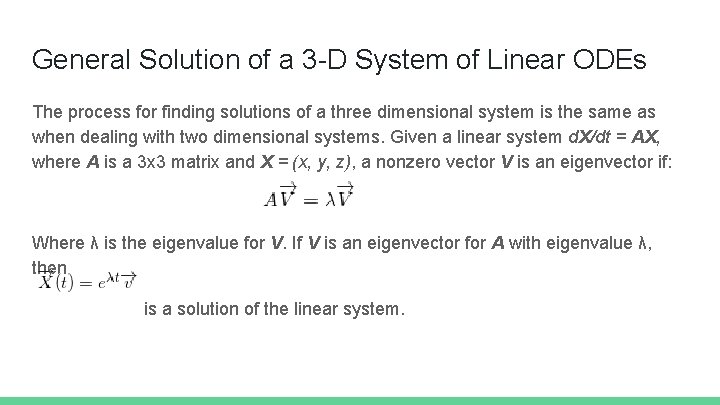
General Solution of a 3 -D System of Linear ODEs The process for finding solutions of a three dimensional system is the same as when dealing with two dimensional systems. Given a linear system d. X/dt = AX, where A is a 3 x 3 matrix and X = (x, y, z), a nonzero vector V is an eigenvector if: Where λ is the eigenvalue for V. If V is an eigenvector for A with eigenvalue λ, then is a solution of the linear system.
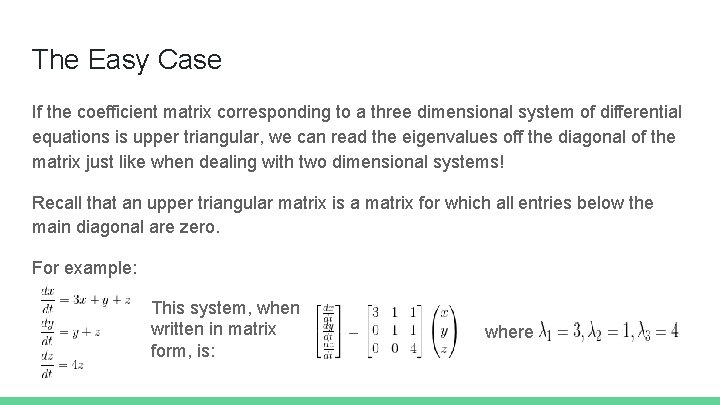
The Easy Case If the coefficient matrix corresponding to a three dimensional system of differential equations is upper triangular, we can read the eigenvalues off the diagonal of the matrix just like when dealing with two dimensional systems! Recall that an upper triangular matrix is a matrix for which all entries below the main diagonal are zero. For example: This system, when written in matrix form, is: where
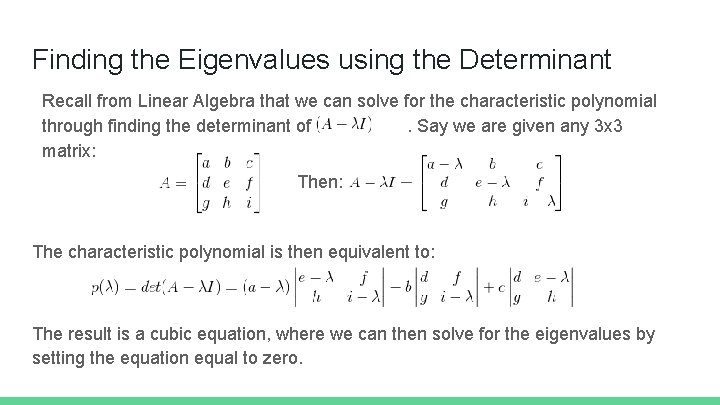
Finding the Eigenvalues using the Determinant Recall from Linear Algebra that we can solve for the characteristic polynomial through finding the determinant of. Say we are given any 3 x 3 matrix: Then: The characteristic polynomial is then equivalent to: The result is a cubic equation, where we can then solve for the eigenvalues by setting the equation equal to zero.
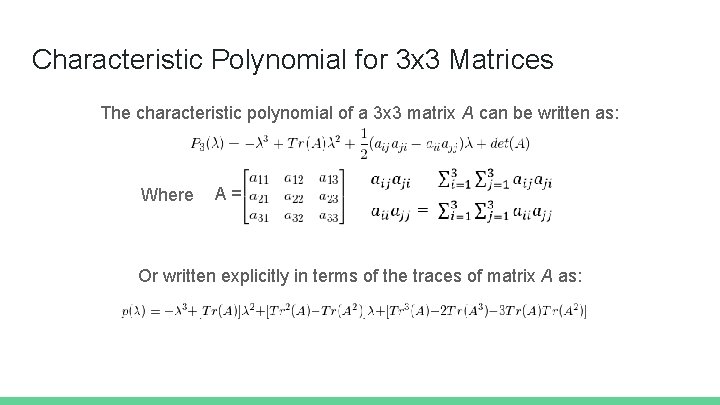
Characteristic Polynomial for 3 x 3 Matrices The characteristic polynomial of a 3 x 3 matrix A can be written as: Where A= Or written explicitly in terms of the traces of matrix A as:
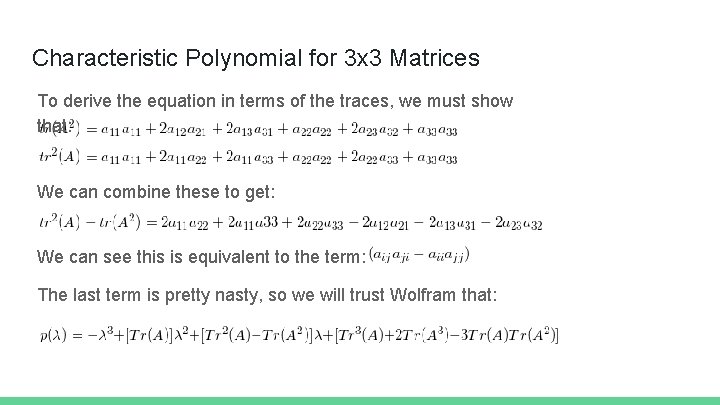
Characteristic Polynomial for 3 x 3 Matrices To derive the equation in terms of the traces, we must show that: We can combine these to get: We can see this is equivalent to the term: The last term is pretty nasty, so we will trust Wolfram that:
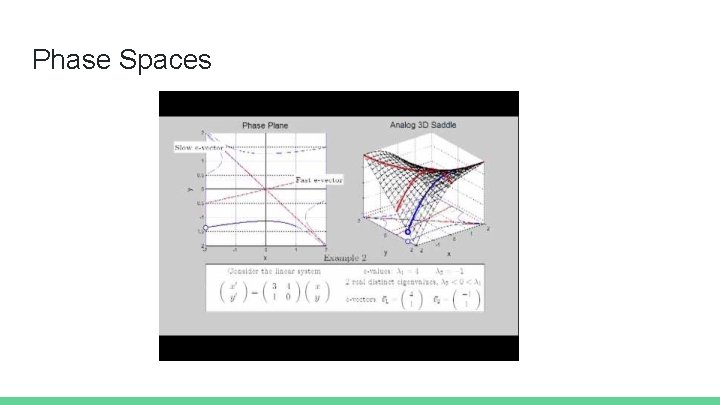
Equilibrium Points Some equilibrium points of 3 dimensional systems have similar classifications to those of 2 dimensional systems. Sinks: As time approaches infinity, solutions tend towards the point. Sources: As time approaches infinity, solutions tend away from the point. Others differ more noticeably from their two dimensional counterparts, as seen in saddle equilibrium points and several special cases.
Phase Spaces
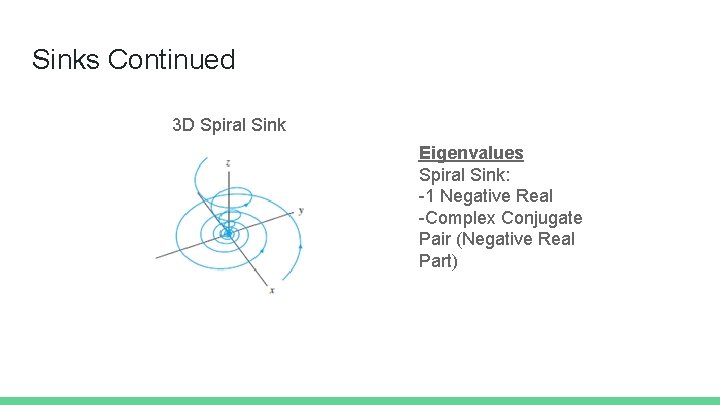
Sinks Characteristics of Sinks for 3 D systems: Three negative real eigenvalues, each with a corresponding straight line of solutions tending towards the equilibrium point. Or… One negative real eigenvalue with a corresponding straight line of solutions tending towards the equilibrium point, and a complex conjugate pair of eigenvalues with a negative real component and a corresponding plane of solutions spiraling towards the equilibrium point.
Sinks Continued 3 D Spiral Sink Eigenvalues Spiral Sink: -1 Negative Real -Complex Conjugate Pair (Negative Real Part)
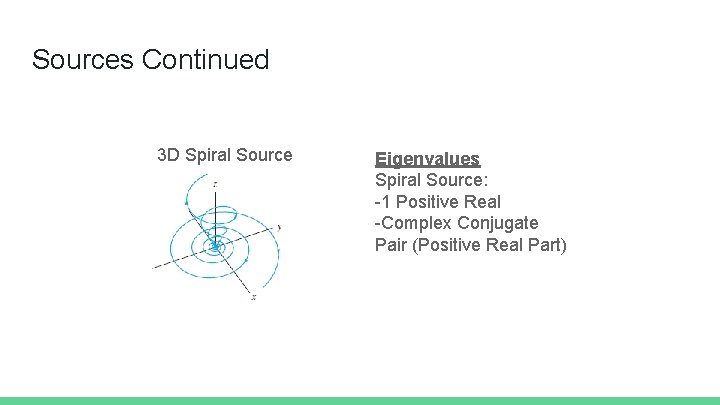
Sources Characteristics of Sources for 3 D systems: Three positive real eigenvalues, each with a corresponding straight line of solutions tending away from the equilibrium point. Or… One positive real eigenvalue with a corresponding straight line of solutions tending away from the equilibrium point, and a complex conjugate pair of eigenvalues with a positive real component and a corresponding plane of solutions spiraling away from the equilibrium point.
Sources Continued 3 D Spiral Source Eigenvalues Spiral Source: -1 Positive Real -Complex Conjugate Pair (Positive Real Part)
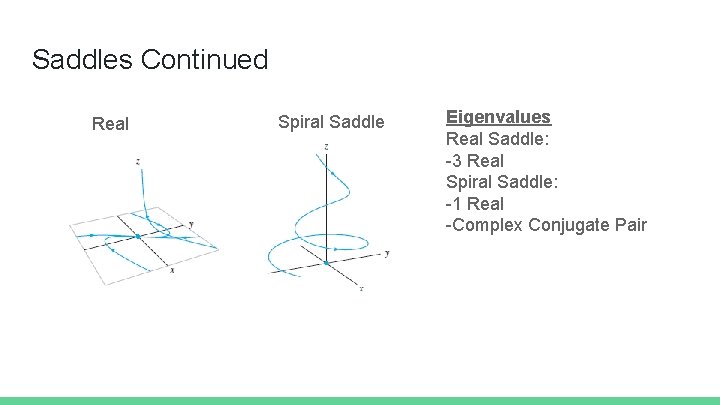
Saddles Saddle equilibrium points of 3 D systems have a greater number of possible characteristics than sinks or sources (4 to be precise). These are: One positive real eigenvalue with a corresponding straight line of solutions tending away from the equilibrium point, and a complex conjugate pair of eigenvalues with a negative real component and a corresponding plane of solutions spiraling towards the equilibrium point. One negative real eigenvalue with a corresponding straight line of solutions tending towards the equilibrium point, and a complex conjugate pair of eigenvalues with a positive real component and a corresponding plane of solutions spiraling away from the equilibrium point.
Saddles Continued One positive real eigenvalue with a corresponding straight line of solutions tending away from the equilibrium point, and two negative real eigenvalues with a corresponding plane of solutions tending towards the origin (a two dimensional sink). One negative real eigenvalue with a corresponding straight line of solutions tending towards the equilibrium point, and two positive real eigenvalues with a corresponding plane of solutions tending away from the origin (a two dimensional source).
Saddles Continued Real Saddle Spiral Saddle Eigenvalues Real Saddle: -3 Real Spiral Saddle: -1 Real -Complex Conjugate Pair
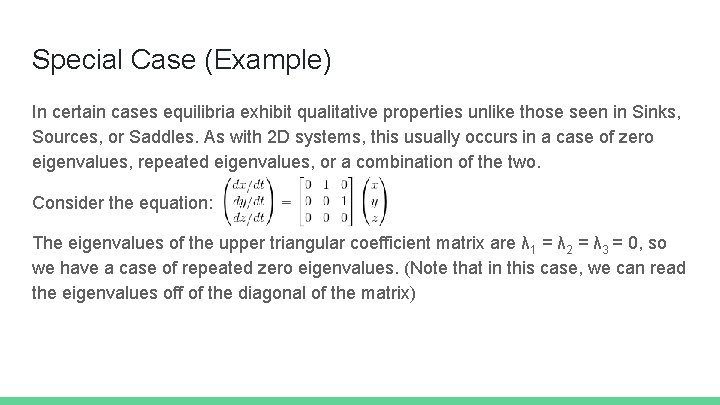
Special Case (Example) In certain cases equilibria exhibit qualitative properties unlike those seen in Sinks, Sources, or Saddles. As with 2 D systems, this usually occurs in a case of zero eigenvalues, repeated eigenvalues, or a combination of the two. Consider the equation: The eigenvalues of the upper triangular coefficient matrix are λ 1 = λ 2 = λ 3 = 0, so we have a case of repeated zero eigenvalues. (Note that in this case, we can read the eigenvalues off of the diagonal of the matrix)
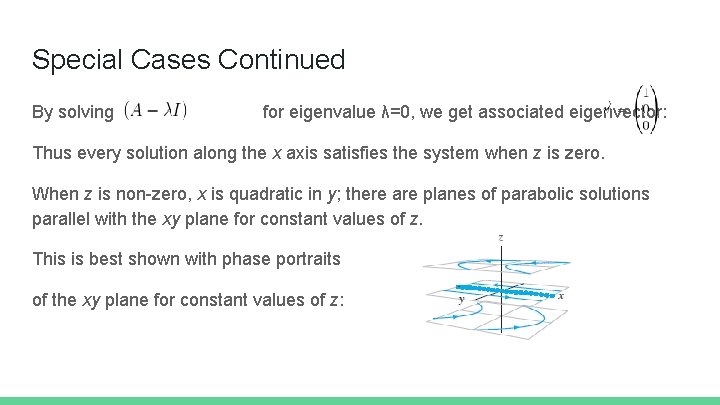
Special Cases Continued By solving for eigenvalue λ=0, we get associated eigenvector: Thus every solution along the x axis satisfies the system when z is zero. When z is non-zero, x is quadratic in y; there are planes of parabolic solutions parallel with the xy plane for constant values of z. This is best shown with phase portraits of the xy plane for constant values of z:
Conclusions -Three-dimensional systems of linear ordinary differential equations often have properties analogous to their two dimensional counterparts. -If possible, it is convenient to first look at three-dimensional systems in terms of their behaviors in a two-dimensional plane and an appropriate phase line. -Methods of analyzing and solving two-dimensional systems can generally be utilized in three-dimensional systems with only minor modifications.
References "Algebraic and Geometric Multiplicity. " University of Washington Math Department, 20 May 2013. Web. <http: //www. math. washington. edu/~ansa 1989/math 308 b_sp 13_docs/lecture 19. pdf>. Blanchard, Devaney, Hall. Ordinary Differential Equations. 4 th Edition. Boston: Brooks/Cole CENGAGE Learning, 2012. Print. "Calculating the Characteristic Polynomial. " Mathematics Stack Exchange. 12 June 2014. Web. <http: //math. stackexchange. com/questions/832076/calculating-the-characteristic-polynomial>. Mitchell, Jonathan. "Linear Systems of DE: 3 D Analog Surface (Real Eigenvalue Case). " You. Tube, 1 Jan. 2013. <https: //www. youtube. com/watch? v=-ya. INOrzp. ZI> Tao, Terrence. "Characteristic Polynomials. " <. http: //www. math. ucla. edu/~tao/resource/general/115 a. 3. 02 f/week 8. pdf>. Weisstein, Eric W. "Characteristic Polynomial. " From Mathworld--A Wolfram Web Resource. <http: //mathworld. wolfram. com/Characteristic. Polynomial. html> Dawkins, Paul. "Differential Equations. " Paul's Online Notes. Lamar University. Web. <http: //tutorial. math. lamar. edu/Classes/DE/HOSystems. aspx>.