
Three Common States of Matter 3 1 Matter
- Slides: 4
Three Common States of Matter 3. 1 Matter is made of tiny particles called atoms or molecules that are in a constant state of motion. The type of motion determines the state of matter
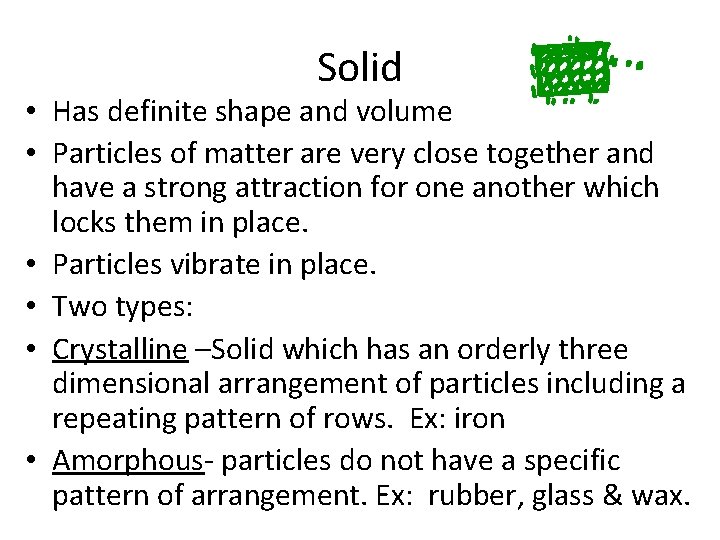
Solid • Has definite shape and volume • Particles of matter are very close together and have a strong attraction for one another which locks them in place. • Particles vibrate in place. • Two types: • Crystalline –Solid which has an orderly three dimensional arrangement of particles including a repeating pattern of rows. Ex: iron • Amorphous- particles do not have a specific pattern of arrangement. Ex: rubber, glass & wax.
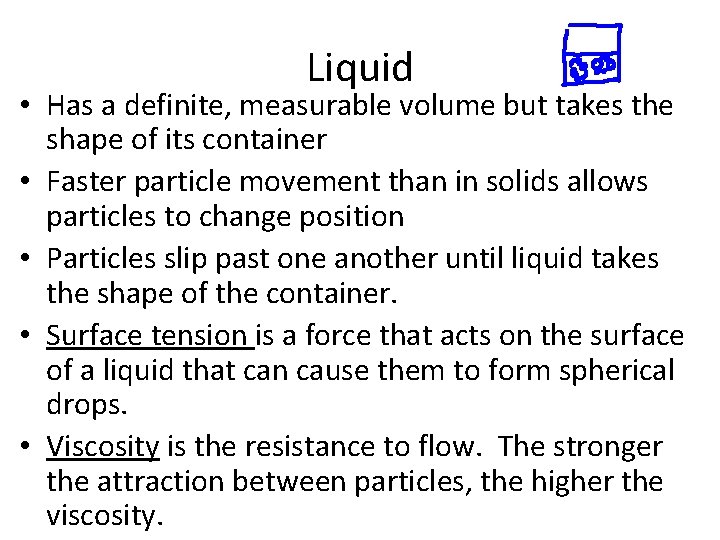
Liquid • Has a definite, measurable volume but takes the shape of its container • Faster particle movement than in solids allows particles to change position • Particles slip past one another until liquid takes the shape of the container. • Surface tension is a force that acts on the surface of a liquid that can cause them to form spherical drops. • Viscosity is the resistance to flow. The stronger the attraction between particles, the higher the viscosity.
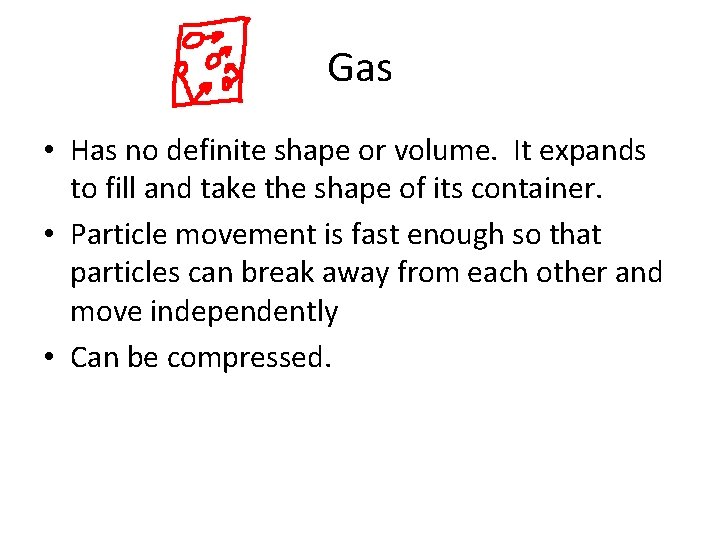
Gas • Has no definite shape or volume. It expands to fill and take the shape of its container. • Particle movement is fast enough so that particles can break away from each other and move independently • Can be compressed.