
Three classic HMM problems Decoding given a model
Three classic HMM problems Decoding: given a model and an output sequence, what is the most likely state sequence through the model that generated the output? A solution to this problem gives us a way to match up an observed sequence and the states in the model. In gene finding, the states correspond to sequence features such as start codons, stop codons, and splice sites 2. 1 S. Salzberg CMSC 828 N

Three classic HMM problems Learning: given a model and a set of observed sequences, how do we set the model’s parameters so that it has a high probability of generating those sequences? This is perhaps the most important, and most difficult problem. A solution to this problem allows us to determine all the probabilities in an HMMs by using an ensemble of training data 3. 2 S. Salzberg CMSC 828 N

Viterbi algorithm Where Vi(t) is the probability that the HMM is in state i after generating the sequence y 1, y 2, …, yt, following the most probable path in the HMM 3 S. Salzberg CMSC 828 N
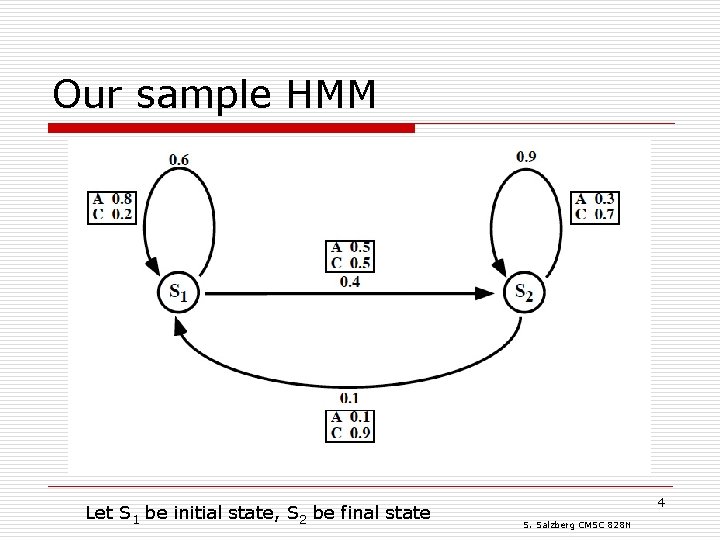
Our sample HMM Let S 1 be initial state, S 2 be final state 4 S. Salzberg CMSC 828 N
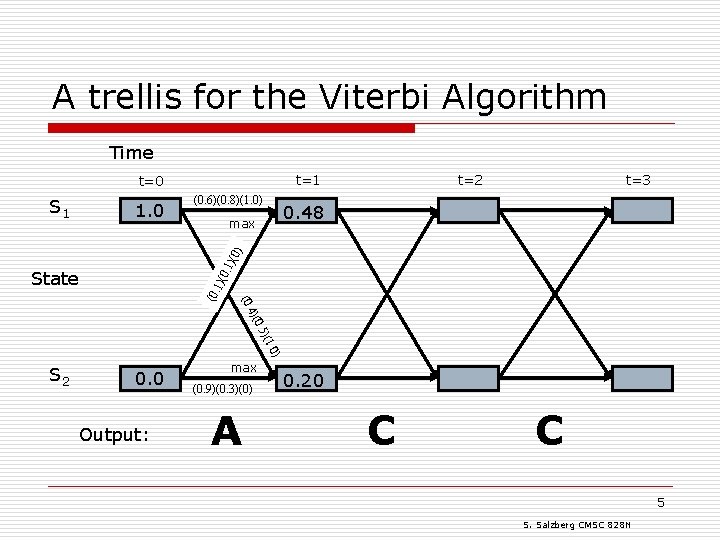
A trellis for the Viterbi Algorithm Time t=1 t=0 1. 0 (0. 6)(0. 8)(1. 0) t=3 0. 48 max 0. 1 )(0 ) S 1 t=2 . 0) )(1 0. 5 4)( (0. 1)( State S 2 0. 0 Output: max (0. 9)(0. 3)(0) A 0. 20 C C 5 S. Salzberg CMSC 828 N
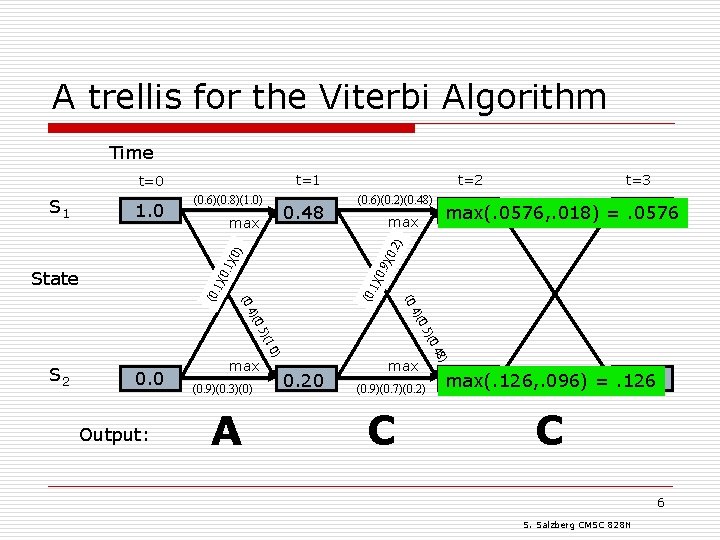
A trellis for the Viterbi Algorithm Time t=1 t=0 (0. 6)(0. 8)(1. 0) 0. 48 max (0. 6)(0. 2)(0. 48) )(0 0. 9 )(0 1)( 0. 1 (0. 4)( A 0. 20 (0. 9)(0. 7)(0. 2) C ) Output: (0. 9)(0. 3)(0) max . 48 0. 0 max . 0) )(1 )(0 0. 5 4)( S 2 . 0576 max(. 0576, . 018) =. 0576 max (0. 1)( State t=3 . 2) 1. 0 ) S 1 t=2 max(. 126, . 096). 126 =. 126 C 6 S. Salzberg CMSC 828 N
Learning in HMMs: the E-M algorithm o In order to learn the parameters in an “empty” HMM, we need: n n o The topology of the HMM Data - the more the better The learning algorithm is called “Estimate-Maximize” or E-M n n Also called the Forward-Backward algorithm Also called the Baum-Welch algorithm 7 S. Salzberg CMSC 828 N
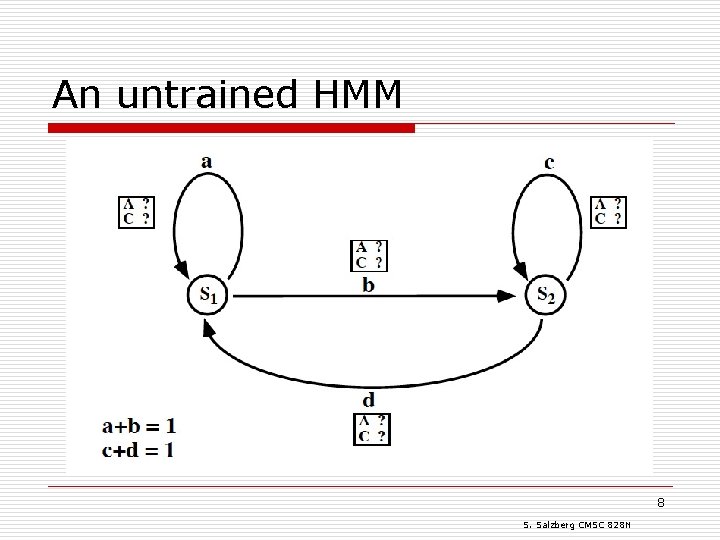
An untrained HMM 8 S. Salzberg CMSC 828 N
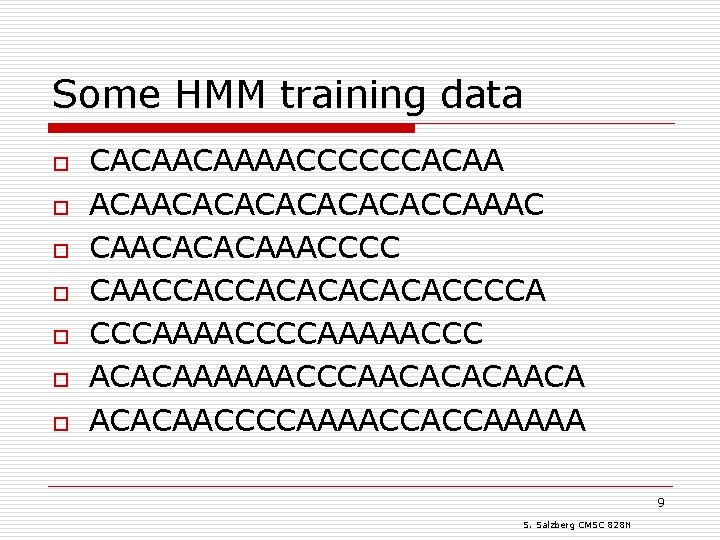
Some HMM training data o o o o CACAACAAAACCCCCCACAACACACACCAAAC CAACACACAAACCCC CAACCACCACACACCCCAAAACCCCAAAAACCC ACACAAAAAACCCAACACACAACA ACACAACCCCAAAACCACCAAAAA 9 S. Salzberg CMSC 828 N
Step 1: Guess all the probabilities o o We can start with random probabilities, the learning algorithm will adjust them If we can make good guesses, the results will generally be better 10 S. Salzberg CMSC 828 N
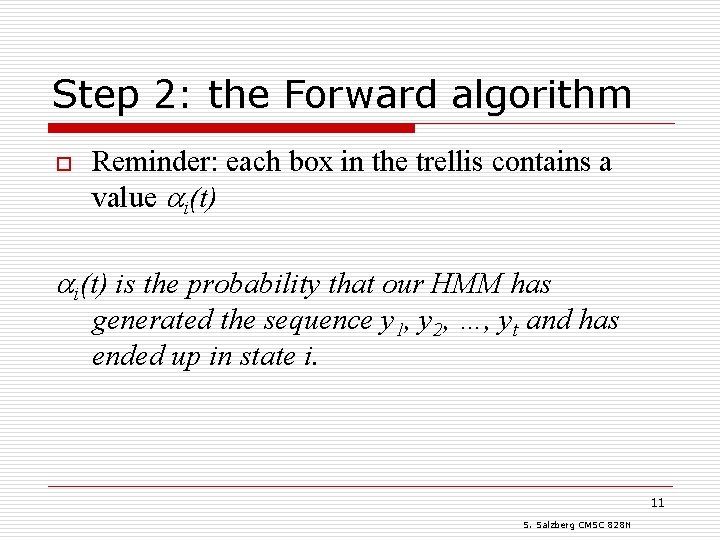
Step 2: the Forward algorithm o Reminder: each box in the trellis contains a value i(t) is the probability that our HMM has generated the sequence y 1, y 2, …, yt and has ended up in state i. 11 S. Salzberg CMSC 828 N
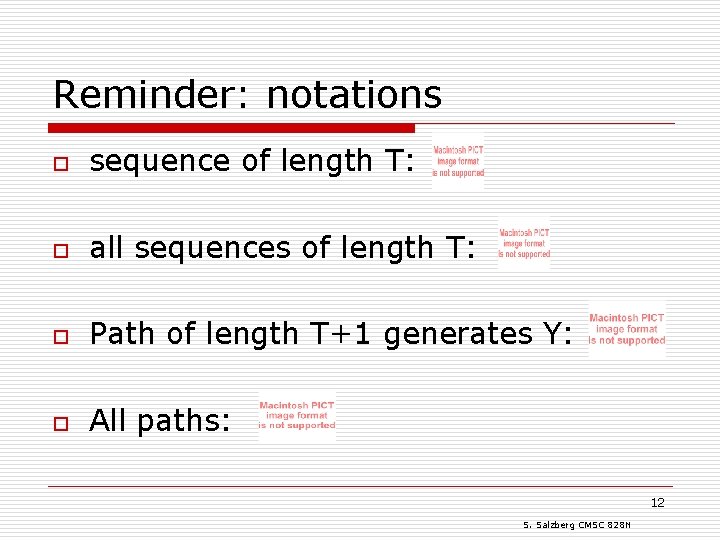
Reminder: notations o sequence of length T: o all sequences of length T: o Path of length T+1 generates Y: o All paths: 12 S. Salzberg CMSC 828 N
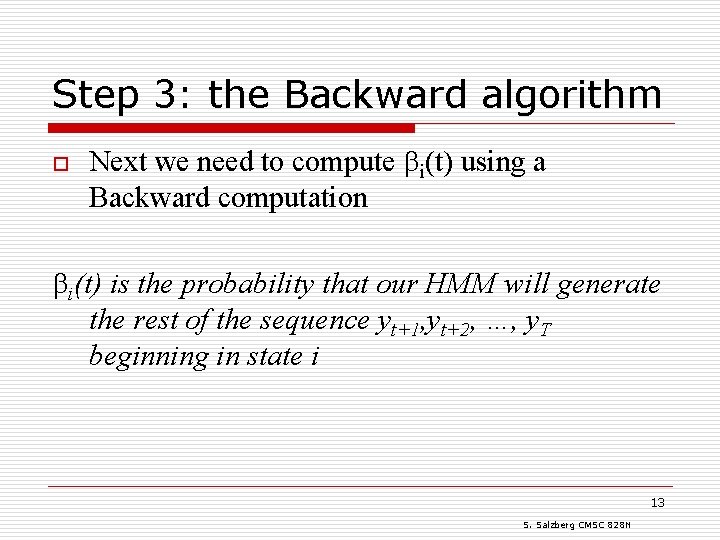
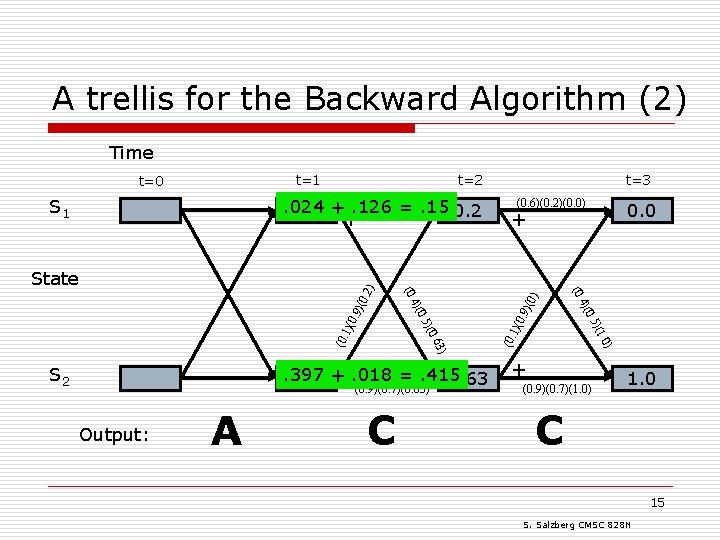
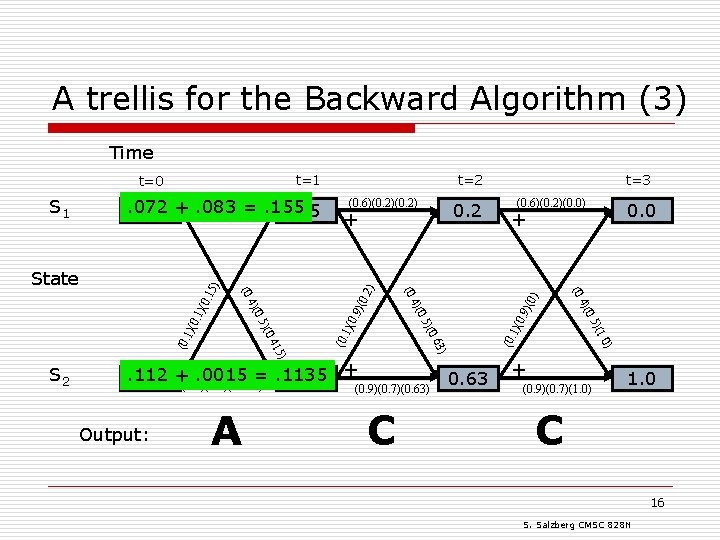
Step 3: the Backward algorithm o Next we need to compute i(t) using a Backward computation i(t) is the probability that our HMM will generate the rest of the sequence yt+1, yt+2, …, y. T beginning in state i 13 S. Salzberg CMSC 828 N
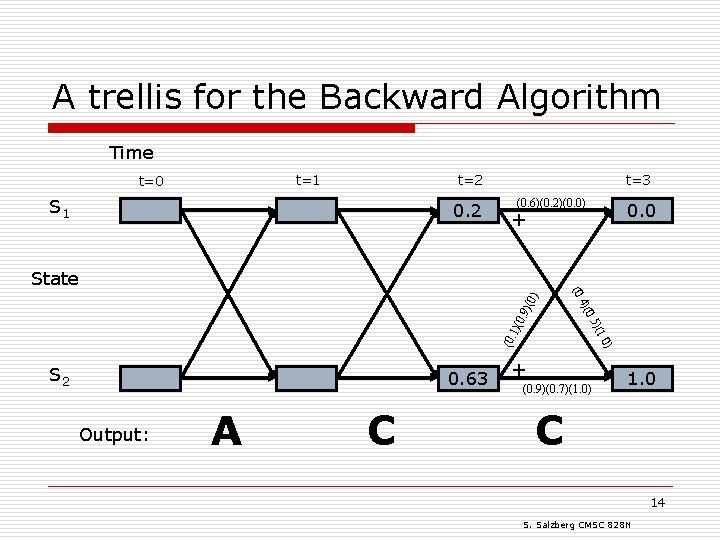
A trellis for the Backward Algorithm Time t=1 t=0 t=2 S 1 0. 2 t=3 (0. 6)(0. 2)(0. 0) 0. 0 + )(0 0. 9 Output: A C . 0) (0. )(1 1)( 0. 5 0. 63 4)( S 2 (0. ) State + (0. 9)(0. 7)(1. 0) 1. 0 C 14 S. Salzberg CMSC 828 N
A trellis for the Backward Algorithm (2) Time t=1 (0. 6)(0. 2). 024. 15 ++. 126 =. 15 0. 2 ) )(0 0. 9 . 0) ) . 63 )(1 )(0 0. 5 4)( 0. 5 1)( 0. 0 + (0. 4)( (0. 6)(0. 2)(0. 0) (0. . 2) State t=3 1)( S 1 t=2 (0. t=0 +. 397 =. 415 +. 018 0. 63 (0. 9)(0. 7)(0. 63) S 2 Output: A C + (0. 9)(0. 7)(1. 0) 1. 0 C 15 S. Salzberg CMSC 828 N
A trellis for the Backward Algorithm (3) Time t=1 ) )(0 0. 9 . 2) )(0 0. 9 1)( . 15 )(0 0. 1 1)( . 0) (0. )(1 ) 5) . 41 . 63 )(0 0. 5 4)( 0. 5 A 0. 0 + (0. 4)( +. 112. 0015 =. 1135. 415 0. 63. 114 +(0. 9)(0. 3)(0. 415) (0. 9)(0. 7)(0. 63) Output: (0. 6)(0. 2)(0. 0) (0. S 2 0. 2 + ) State (0. 6)(0. 2) t=3 1)( (0. 6)(0. 8)(0. 15). 072. 155 +. 083 =. 155 (0. S 1 t=2 (0. t=0 C + (0. 9)(0. 7)(1. 0) 1. 0 C 16 S. Salzberg CMSC 828 N
Step 4: Re-estimate the probabilities o o After running the Forward and Backward algorithms once, we can re-estimate all the probabilities in the HMM SF is the prob. that the HMM generated the entire sequence Nice property of E-M: the value of SF never decreases; it converges to a local maximum We can read off and values from Forward and Backward trellises 17 S. Salzberg CMSC 828 N

Compute new transition probabilities o is the probability of making transition i-j at time t, given the observed output n is dependent on data, plus it only applies for one time step; otherwise it is just like aij(t) 18 S. Salzberg CMSC 828 N
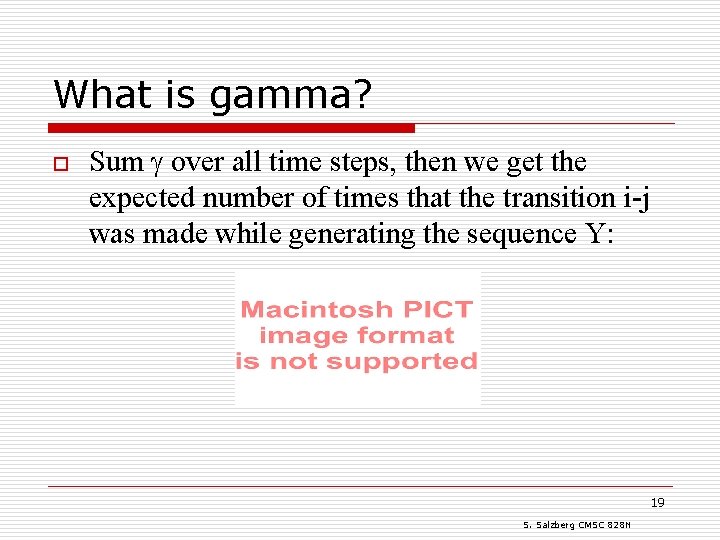
What is gamma? o Sum over all time steps, then we get the expected number of times that the transition i-j was made while generating the sequence Y: 19 S. Salzberg CMSC 828 N

How many times did we leave i? o Sum over all time steps and all states that can follow i, then we get the expected number of times that the transition i-x as made for any state x: 20 S. Salzberg CMSC 828 N

Recompute transition probability In other words, probability of going from state i to j is estimated by counting how often we took it for our data (C 1), and dividing that by how often we went from i to other states (C 2) 21 S. Salzberg CMSC 828 N
Recompute output probabilities o o Originally these were bij(k) values We need: n n expected number of times that we made the transition i-j and emitted the symbol k The expected number of times that we made the transition i-j 22 S. Salzberg CMSC 828 N

New estimate of bij(k) 23 S. Salzberg CMSC 828 N
Step 5: Go to step 2 o o Step 2 is Forward Algorithm Repeat entire process until the probabilities converge n o o Usually this is rapid, 10 -15 iterations “Estimate-Maximize” because the algorithm first estimates probabilities, then maximizes them based on the data “Forward-Backward” refers to the two computationally intensive steps in the algorithm 24 S. Salzberg CMSC 828 N
Computing requirements o o Trellis has N nodes per column, where N is the number of states Trellis has S columns, where S is the length of the sequence Between each pair of columns, we create E edges, one for each transition in the HMM Total trellis size is approximately S(N+E) 25 S. Salzberg CMSC 828 N
- Slides: 25