
Three Channels of Communication LO 5 Describe three
Three Channels of Communication (LO 5) § Describe three channels of communication and their affects. § Select and use the tools for decoding the messages accurately. § Describe how words model our reality and influence our behaviour. 12/27/2021 1
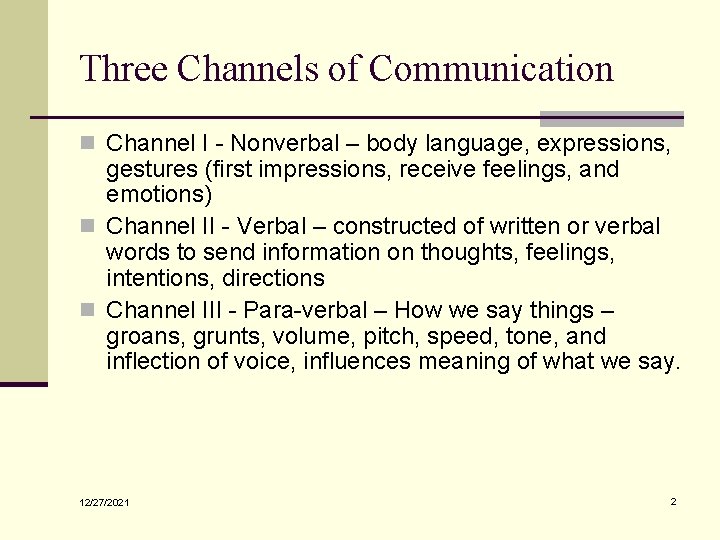
Three Channels of Communication n Channel I - Nonverbal – body language, expressions, gestures (first impressions, receive feelings, and emotions) n Channel II - Verbal – constructed of written or verbal words to send information on thoughts, feelings, intentions, directions n Channel III - Para-verbal – How we say things – groans, grunts, volume, pitch, speed, tone, and inflection of voice, influences meaning of what we say. 12/27/2021 2
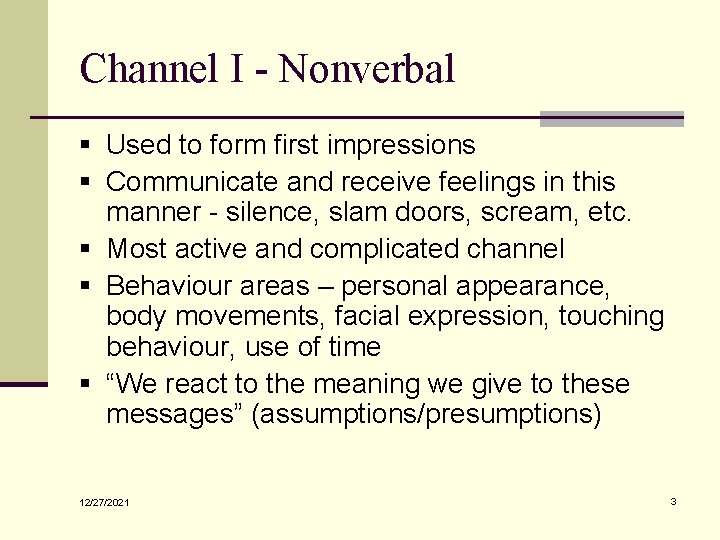
Channel I - Nonverbal § Used to form first impressions § Communicate and receive feelings in this manner - silence, slam doors, scream, etc. § Most active and complicated channel § Behaviour areas – personal appearance, body movements, facial expression, touching behaviour, use of time § “We react to the meaning we give to these messages” (assumptions/presumptions) 12/27/2021 3
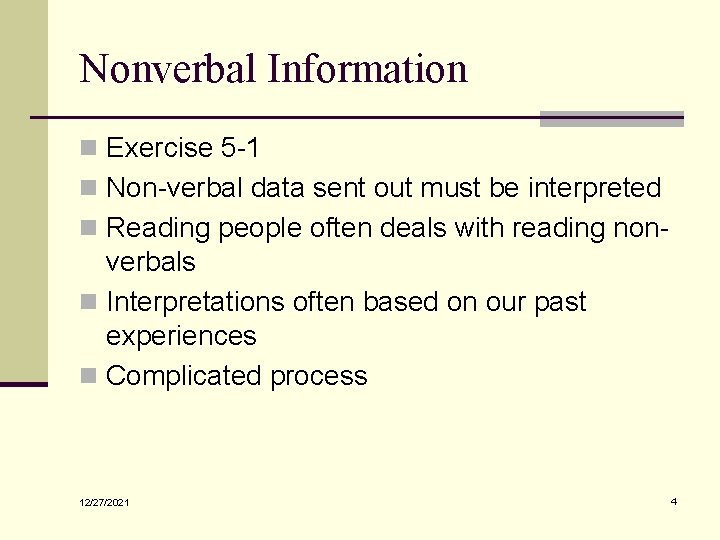
Nonverbal Information n Exercise 5 -1 n Non-verbal data sent out must be interpreted n Reading people often deals with reading non- verbals n Interpretations often based on our past experiences n Complicated process 12/27/2021 4
Communicating Feelings & Emotions (potential for conflict) n Expressing feelings and having them heard and understood forms the foundation for intimate relationships n Interpersonal studies indicate we send our feelings nonverbally as well n Interpreting feelings is challenging, especially when people try to hold or hide their feelings 12/27/2021 5
Meaning of Empathy & Empathizing n Meaning: Having feelings, expressing them, hearing them, and responding to them. n Empathizing – demonstrating that you heard the feeling accurately (high level of communication) i. e. , Saying “You seem angry” is an empathetic response when a nonverbal suggest that n When someone belies, we invariably believe the behavior n 12/27/2021 6
Channel II - The Verbal n Most specific form of communication n Meaning of words reside in the mind of the speaker and listener n Onomatopoeia – imitation of natural sounds, i. e. , Bow-wow n Other than “ono” the likeness of words and all others are gross abstractions n This abstraction is the root cause for misunderstanding and conflict 12/27/2021 7
Words as Abstract Concepts n Apple – you can touch, feel, taste, and see n Words create efficiency in communication n JUSTICE – a real abstraction n Ladder of Abstraction –Concrete Object § § § n 12/27/2021 The real apple Photograph of an apple Wax apple Still life painting of an apple The logo of the apple computer company The word apple Abstract Conceptualization 8
Channel III – The Para-Verbal n We add to or clarify our feelings, emotions, and intentions using the para-verbal channel i. e. , grunts, speed, inflection, tone n Writing; “Sure, I think George is a mature person” or “Sure, I………. , hissed Helen, with daggers in her eyes. n When attending to messages from the paraverbal, you help others convey their message more accurately 12/27/2021 9
Tuning into the Three Channels When Resolving Conflict n Conflict resolution requires that we stay tuned to listening to messages in all three channels n Serious conflicts - resolve in person n Mediator – listen to all three channels Help other people communicate effectively n Question to clarify n Describe to the other person what you feel n 12/27/2021 10
- Slides: 10